Why Manual Transfers Fail: Autopay, Bill Timing, and Idle Checking Cash
Manual transfers fail because bills, paychecks, and safe balances change faster than most cash plans update. See the 7 reasons and where automation fits.
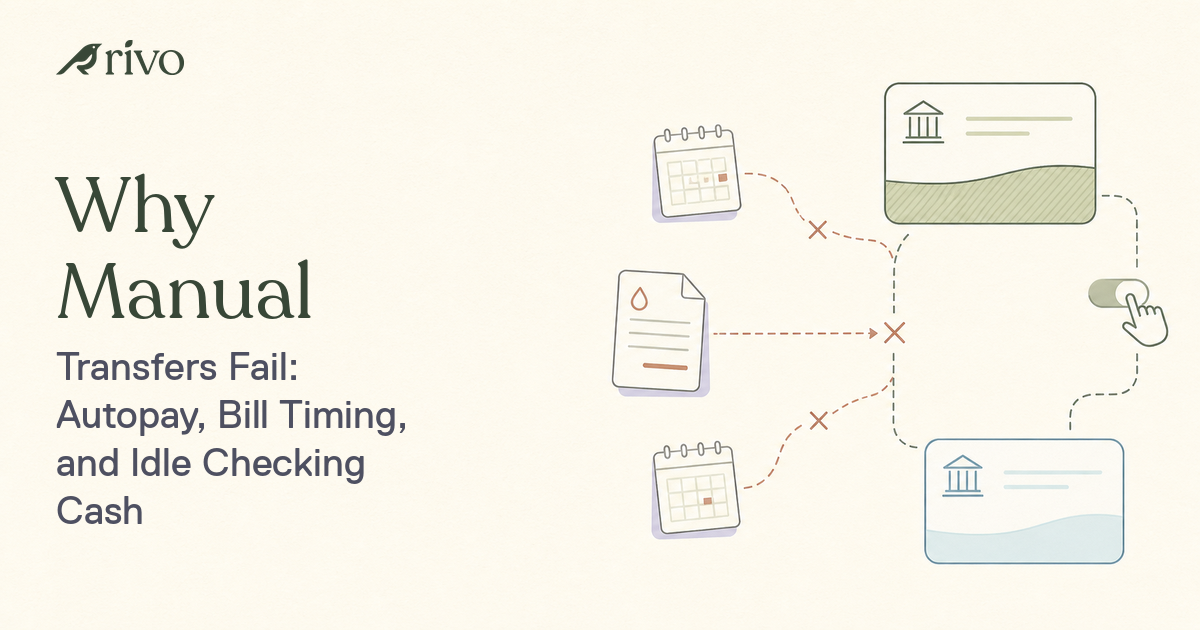
Manual transfers fail because household cash flow is not a one-time decision. Your rent, mortgage, credit cards, payroll timing, subscriptions, insurance, taxes, travel, and emergency spending keep changing. A transfer rule that looked obvious on the 1st can feel risky by the 12th.
That is why idle checking cash tends to survive even when the math looks obvious. The average national interest checking rate was 0.07% in June 2026, while the 4-week Treasury bill rate was 3.67% on July 16, 2026. The gap is visible, but the workflow is fragile.
Rivo exists for that workflow problem. It works with your existing bank account, lets you set a safe balance, identifies idle cash above that floor, moves eligible cash into short-duration U.S. Treasury Bills through Jiko Securities, and brings money back before bills are due. You do not need to switch banks, change direct deposit, or remember a recurring manual transfer.
*Movement of funds is not instant. Transfers to your linked account can take up to 3 business days to settle, and longer if a Treasury Bill must be sold first. Rivo plans around known bills. It does not guarantee same-day access or a specific arrival date.
TL;DR
- Manual transfers fail when the transfer decision depends on memory, calendar discipline, and confidence that every upcoming bill is covered.
- The problem is not only yield. It is timing. A $50,000 checking balance can look excessive on payday and necessary before rent, mortgage, credit cards, or taxes clear.
- The financial gap can be large. At a 0.07% interest checking rate, $50,000 earns about $35/year before taxes. At a 3.67% 4-week T-bill rate, the same $50,000 has a gross annualized reference value of about $1,835 before fees, taxes, balance changes, and timing effects.
- Manual systems break around 7 common failure modes: bill uncertainty, paycheck timing, irregular deposits, fear of overdrafts, stale buffers, transfer delay, and decision fatigue.
- Rivo is different from a reminder app. Rivo uses your safe balance and bill-aware refills to automate the idle layer while your existing checking account keeps handling everyday life.
- Rivo charges a 0.05% monthly management fee, approximately 0.60%/year before compounding, and available funds can be withdrawn through the app up to $15,000/day.
- Investments in T-bills are not FDIC-insured bank deposits. They are securities, carry standard fixed-income risks, and require the disclosures at the end of this article.
Quick Answer: Why Do Manual Transfers Fail?
Manual transfers fail because the task looks simple but the operating system is complex. Moving $10,000 from checking to a higher-earning option is easy. Knowing whether that same $10,000 is truly idle after this month's credit card bill, quarterly tax payment, school fee, insurance renewal, and paycheck delay is the hard part.
The mistake is treating cash movement like a monthly chore. In reality, it is a rolling cash-flow decision. The safe amount changes whenever your next 30-60 days change.
The result is usually not a dramatic mistake. It is a quiet default: more cash remains in checking than the household actually needs.
If you want to quantify that idle layer first, use the Checking Account Interest Calculator. If you need the definition before the workflow, read What Is Idle Cash?.
Why Manual Transfers Look Easy on Paper
Manual transfers look easy because the personal finance version is usually written as 3 clean steps:
- Keep enough cash in checking for bills.
- Move the rest to a higher-earning place.
- Transfer money back when you need it.
That advice is not wrong. It is incomplete. It assumes the user has a current bill calendar, a reliable safe-balance number, no transfer delay anxiety, and enough attention to repeat the process after every paycheck, bonus, refund, or spending spike.
The missing question is: what happens on the Tuesday night when you are tired, your checking account shows $31,000, and you cannot remember whether the annual insurance bill has already cleared?
This is why manual cash management often starts strong and fades. The first transfer feels good. The tenth transfer feels like another chore.
If your real question is whether moving money out of checking is worth the effort, read Is It Worth Moving Money Out of Checking?. This article focuses on why the effort often breaks.
The 7 Reasons Manual Transfers Fail
Manual transfers fail for 7 recurring reasons. Each one is small enough to ignore for a week, but strong enough to keep cash sitting in checking for years.
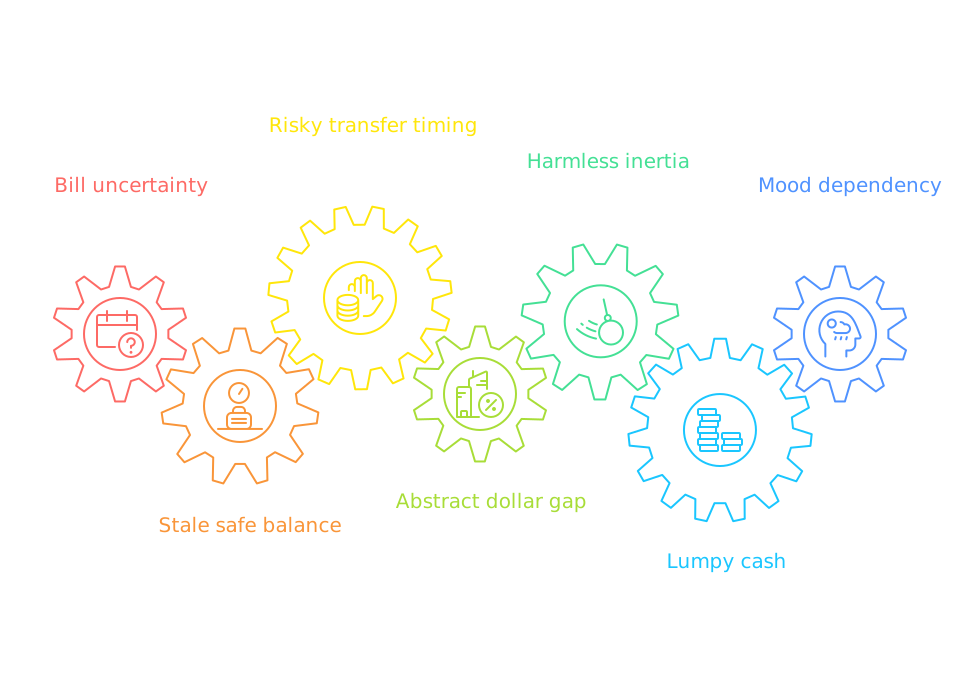
The important point: these are rational fears. A missed rent payment, mortgage payment, credit card payment, or tax withdrawal feels worse than a few weeks of low yield. So the cash stays put.
The fix is not to shame the user into more discipline. The fix is to separate bill money from idle money with a live safe-balance system. That is the same premise behind Can You Move Money Out of Checking Without Missing Bills?.
Failure Mode 1: Bill Uncertainty
Bill uncertainty is the biggest reason manual transfer systems decay. Most households do not have one neat monthly bill cycle. They have a pile of automatic payments with different posting dates, different amounts, and different failure consequences.
A household can have:
- Mortgage or rent on the 1st.
- Credit card autopay on the 12th.
- Utilities across 3 different dates.
- Insurance billed every 6 months.
- Property tax or estimated tax dates.
- Daycare, tuition, subscriptions, and memberships.
- Peer-to-peer payments, checks, and one-off transfers.
The checking balance is visible. The future obligations are harder to see. That mismatch creates the manual transfer freeze.
Rivo is built around this timing issue. You set a minimum checking threshold, and Rivo monitors cash flow before moving eligible idle cash. If upcoming activity looks uncertain, the system can behave more conservatively.
This does not mean every dollar should move. It means the decision should be based on actual bill timing, not memory.
Failure Mode 2: The Safe Balance Gets Stale
A safe balance is the amount you want to keep in checking before any cash can be treated as idle. It should include fixed bills, near-term variable spending, transfers, and a comfort buffer.
The problem is that many people set a safe balance once and never update it. A $7,500 floor from last year may be too low after a rent increase, too high after a loan payoff, or simply disconnected from the way the household now spends.
If you need a step-by-step formula, read How Much Money Should You Keep in Checking?. The short version is:
Safe balance = known bills + near-term variable spending + pending transfers + comfort buffer
Everything above that number is a candidate for review. It is not automatically idle, but it deserves a job.
Failure Mode 3: Transfer Timing Feels Risky
Manual transfer systems break when the user does not trust the return path. If money can move out quickly but not return before a bill clears, the rational move is to leave extra cash in checking.
This is especially true when households use different institutions: checking at one bank, savings at another bank, brokerage at a third platform, and TreasuryDirect for T-bills. Each extra account adds one more login, timing rule, and mental checkpoint.
This is where automation changes the decision. Rivo works on top of the existing bank relationship and plans around bill timing. It is not asking the user to become a cash manager every week.
For a deeper look at the DIY path, read Rivo vs TreasuryDirect. TreasuryDirect can work for disciplined users. The failure point is not access to T-bills. It is ongoing cash-flow management.
Failure Mode 4: The Dollar Gap Feels Abstract
People are more likely to fix a workflow when the cost is specific. "Your checking account pays very little" is easy to ignore. "$50,000 sitting at 0.07% earns about $35/year" is harder to ignore.
Here is the simple math using current public rates:
This table is not a promise of what any product will earn. It is a simple annualized comparison using a national interest checking rate and a 4-week T-bill reference rate. Real results depend on rate changes, fees, taxes, timing, maturity, liquidity decisions, and balance movement.
Rivo fee math also matters. Rivo charges a 0.05% monthly management fee, about 0.60%/year before compounding. On a full-year $50,000 average balance, a simple annualized fee estimate is about $300 before compounding effects. That is why the relevant question is not just "what is the highest rate?" It is "what net result can I actually maintain without manual work?"
If you want the fee-specific version of this math, read Rivo Fees Explained.
Failure Mode 5: Inertia Looks Harmless
Inertia is powerful because it does not feel like a decision. You are not choosing to earn less. You are choosing not to disturb a system that seems to be working.
That behavior is not rare. U.S. households and nonprofits held about $5.95 trillion in checkable deposits and currency at the end of Q1 2026. A Santander survey found that nearly 6 in 10 consumers, 58%, did not realize they could open a higher-rate savings account without leaving their primary bank. A research paper on depositor behavior estimated that depositor "sleepiness" accounted for 58% of the average bank's deposit franchise value.
Those numbers point to the same reality: cash stickiness is a system-level behavior, not a personal flaw.
Rivo targets the blur. The goal is not to move the cash you need for near-term obligations. The goal is to identify the cash above your safe balance and keep that idle layer working until it needs to return.
For the broader hidden-cost concept, read What Is the Inertia Tax?. For the return-gap version, read What Is Cash Drag?.
Failure Mode 6: Manual Systems Do Not Handle Lumpy Cash Well
Manual transfers become especially fragile after lumpy deposits. Bonuses, RSU vesting, tax refunds, reimbursements, business distributions, and home-sale proceeds can make checking look temporarily overfunded. But not every dollar is idle.
Some of that cash may already have a job:
- Taxes due later.
- Credit card payoff.
- Home repair.
- Tuition or child care.
- Upcoming travel.
- Estimated quarterly payments.
- Emergency fund replenishment.
- Investment contribution.
The mistake is either moving too much or moving nothing. Both outcomes are common because the cash is not labeled.
If this is your main scenario, read What Should You Do When a Bonus, RSU, or Tax Refund Lands in Checking?. That article focuses on lumpy deposits. This article focuses on why the manual movement habit fails after the first review.
Failure Mode 7: The System Depends on Mood
A manual transfer habit requires you to feel calm, informed, and available at the right time. That is not a durable operating model for household cash.
The worst time to make a cash movement decision is often the exact time people remember to make it: late at night, after a large bill posts, during a work crunch, or after seeing an unusually high checking balance.
The more a system depends on mood, the less reliable it becomes. This is why automation is valuable even for people who understand the math.
Rivo is not solving a knowledge problem only. It is solving a repetition problem. The app handles the recurring "is this money idle right now?" question using your linked account data, your chosen floor, and bill-aware timing.
Manual Transfers vs Automated Cash Management
Manual transfers can still work. Some people enjoy managing their own cash ladder, savings transfers, and T-bill purchases. The issue is fit.
.svg)
If you are the kind of person who updates a spreadsheet weekly, reconciles bills, understands transfer timing, and reviews yield options regularly, DIY can be fine. If you are the kind of person who knows the math but does not keep doing the work, automation fits the real behavior.
The decision is not "manual is bad and automation is good." The decision is whether the manual workflow survives your real calendar.
If you want the category-level comparison, read What Is Automated Cash Management?. If you want the no-bank-switch version, read Can You Earn More on Checking Cash Without Switching Banks?.
How to Know If Your Manual Transfer System Is Failing
Your manual transfer system is failing if you repeatedly know what you should do but cash still sits unassigned in checking.
Use this checklist:
Rivo works best for households with $5,000+ in checking, though there is no hard minimum. Smaller balances may not earn enough to justify the attention or fee.
That last point matters. Not every cash balance needs automation. If the idle layer is small, the best answer may be a simple safe-balance rule and a basic savings transfer.
A Manual Transfer System That Can Work
If you want to keep managing cash manually, make the system explicit. Do not rely on "I will know when there is too much."
Use a 6-part review:
- List every fixed payment due in the next 30 days.
- Add variable spending expected before the next paycheck.
- Add any pending card payoff, tax payment, rent, mortgage, tuition, or insurance amount.
- Add a comfort buffer you can explain in dollars.
- Subtract that total from your checking balance.
- Decide whether the excess is worth moving after taxes, fees, and timing.
That $15,000 is not automatically moveable. It is the amount that deserves a decision.
If you use a manual system, set a review day after your largest recurring bill clears. Set one rule for new large deposits. Set one rule for tax cash. Set one rule for emergency cash. Without those boundaries, the system eventually becomes a guess.
Where Rivo Fits
Rivo fits when your issue is not financial literacy but operational follow-through. You know idle checking cash is costing you, but you do not want to turn cash management into another weekly job.
Rivo workflow is built around 5 ideas:
Rivo is not a bank. It is a fintech layer that works with banking and brokerage partners. Banking services are provided by Jiko Bank, a division of Mid-Central National Bank. U.S. Treasury investments and investment advisory services are provided by Jiko Securities, Inc., a registered broker-dealer, member FINRA and SIPC.
If your objection is "I do not want to replace my bank," read Does Rivo Replace Your Bank?. If your objection is "I need to understand the mechanics," read How Does Rivo Autopilot Work?.
What Rivo Does Not Remove
Automation does not remove every cash-management trade-off. It changes the operating burden.
You still need to understand:
- T-bills are securities, not FDIC-insured bank deposits.
- SIPC protection is different from FDIC insurance.
- T-bill values can be affected if sold before maturity.
- Rates change.
- Fees reduce net yield.
- Taxes matter.
- You should set a safe balance that fits your actual bills and comfort level.
For the protection breakdown, read Are Treasury Bills Safe for Short-Term Cash?. For the tax angle, read Are Treasury Bills State Tax Exempt?.
When Manual Transfers Are Still Fine
Manual transfers are still fine when the workflow is small, the balance is low, or you actually enjoy managing cash.
You may not need Rivo if:
- Your extra checking cash is usually below a few thousand dollars.
- You already use a high-rate savings account consistently.
- You are comfortable buying and managing T-bills yourself.
- You do not use autopay heavily.
- Your cash flow is predictable and simple.
- You prefer full manual control over every movement.
The honest answer is that Rivo is not for every dollar and not for every person. It is for the idle layer that keeps surviving because the manual workflow is too easy to postpone.
What to Do This Week If Manual Transfers Keep Failing
Do not start by moving money. Start by naming the cash.
Use this 30-minute version:
- Open checking and list the current balance.
- Write down all bills and card payments due before the next paycheck.
- Add any irregular payment due in the next 60 days.
- Add a comfort buffer.
- Subtract the total from checking.
- Label the result "candidate idle cash."
- Decide whether that candidate amount is worth manual work or should be automated.
These are decision thresholds, not investment advice. Your exact answer depends on bills, risk tolerance, taxes, timing, and product fit.
If you want a direct comparison of places idle cash can go, read Treasury Bills vs Money Market Funds vs High-Yield Savings. If you want a Rivo-specific comparison, read Rivo vs High-Yield Savings vs Treasury Bills.
FAQ
Why do I keep forgetting to move money out of checking?
Because cash movement is a recurring decision with changing inputs. Your balance, bills, spending, and paycheck timing keep moving. If the system depends on memory, it will eventually fail during a busy week.
Is manual cash management bad?
No. Manual cash management can work when you have a clear safe balance, predictable bills, and a habit you actually maintain. It fails when the rule depends on confidence you do not have every month.
How much money makes manual transfers worth fixing?
Start reviewing the workflow once you regularly have $5,000+ in checking above your real safe balance. Rivo works best for households with $5,000+ in checking, though there is no hard minimum, because smaller balances may not create enough earnings to matter.
What is the main advantage of Rivo over reminders?
A reminder tells you to do the work. Rivo is designed to do the cash-management work around your existing bank account: identify idle cash above your floor, move eligible cash into short-duration T-bills through Jiko Securities, and bring cash back before bills are due.
Can I still keep a large checking buffer with Rivo?
Yes. You choose the safe balance. If you want a larger comfort buffer, set a larger floor. Rivo only evaluates cash above your selected minimum threshold for movement.
What if I need the money quickly?
You can withdraw available funds through the app up to $15,000/day. For true emergency needs, you can also pause automation or keep a higher safe balance in checking.
Related Rivo Reading
- To move cash without missing bills, read Can You Move Money Out of Checking Without Missing Bills?.
- If savings repeatedly has to refill checking after a transfer, read Why Do You Keep Transferring Money From Savings Back to Checking?.
- To define safe balance, read What Is a Safe Balance?.
- To choose a transfer rule that matches your real cash-flow pattern, read How Often Should You Move Money Out of Checking?.
- If transfer timing changes with client or commission income, read How Much Should You Keep in Checking With Irregular Income?.

This article is educational and is not financial, investment, tax, accounting, or legal advice.
Yield rate reflects the 4-week T-bill rate when held to maturity. Rate does not include fees. Rates are subject to change. Minimum balance of $100 required to earn the stated rate.
Rivo is a fintech company, not a bank. Banking services provided by Jiko Bank, a division of Mid-Central National Bank. Jiko Group, Inc. and its affiliates do not provide legal, tax, or accounting advice. You should consult your legal and/or tax advisors before making any financial decisions. This material is not intended as a recommendation, offer or solicitation for the purchase or sale of any security or investment strategy. See FINRA BrokerCheck, Jiko U.S. Treasuries Risk Disclosures and Jiko Securities Inc. Form CRS.
Investments in T-bills: Not FDIC Insured - No Bank Guarantee - May Lose Value. All U.S. treasury investments and investment advisory services provided by Jiko Securities, Inc., a registered broker-dealer, member FINRA and SIPC. Securities in your account are protected up to $500,000. For details, please see www.sipc.org.
Sources
- FDIC National Rates and Rate Caps: June 2026 national interest checking and savings rates.
- FRED 4-Week Treasury Bill Secondary Market Rate: 4-week T-bill reference rate used in illustrative math.
- FRED Checkable Deposits and Currency: household and nonprofit checkable deposits and currency level.
- Santander survey on higher-rate account misperceptions: consumer awareness data.
- Dynamic Competition for Sleepy Deposits: depositor sleepiness and deposit franchise value research.
- TreasuryDirect tax forms and withholding: Treasury marketable securities tax treatment.
- SIPC investor protection overview: SIPC protection limits.
- Rivo product details: Rivo fee, bank connection, safe balance, withdrawal, and control details.
- Jiko Agreements and Disclosures: Jiko Securities, Jiko Bank, SIPC, and T-bill risk disclosures.
.jpeg)
Ambrish Tyagi is the founder and CEO of Rivo. Previously led AI at Cruise and Amazon.
Follow on LinkedInGet Rivo Updates
Product news, money insights, and company updates.