Are Treasury Bills State Tax Exempt? How T-Bill Taxes Change Idle Checking Cash Math
T-bill interest is federally taxable but exempt from state and local income tax. See how that changes your idle checking cash math and after-tax yield.
.png)
Yes. Treasury bill interest is subject to federal income tax, but it is exempt from state and local income taxes, according to IRS Topic No. 403 and TreasuryDirect tax guidance. That tax treatment matters when you compare idle checking cash, bank interest, high-yield savings accounts, money market funds, direct T-bills, and automated cash management because the same pre-tax rate can produce a different after-tax result.
The practical question is not "Are T-bills taxed?" They are. The better question is: "After federal tax, state tax, local tax, product fees, bill timing, and transfer effort, which cash workflow actually fits my checking account?" That is where T-bills can be attractive for idle cash, and where Rivo is relevant for people who want Treasury bill exposure without manually buying, rolling, and refilling cash around bills.
TL;DR
- Treasury bill interest is federally taxable but exempt from state and local income taxes, which the IRS and TreasuryDirect both state directly.
- The state-tax benefit matters most when you live in a state or city with meaningful income tax, keep $10,000 to $200,000+ in taxable cash, and are comparing a bank cash product against Treasury bill income.
- The Rivo rates page listed a 3.65% annualized rate for Rivo Autopilot as of July 1, 2026, while the FRED 4-week T-bill series showed 3.61% on July 2, 2026.
- The same Rivo rates page lists national average interest checking at 0.07%, matching the FRED ICNDR series for June 2026.
- T-bills are not bank deposits. Bank deposit insurance, SIPC brokerage protection, and U.S. government backing are different protections with different limits and risks.
- Rivo does not replace your bank. It works on top of your existing checking account, lets you set a safe balance, and uses bill-aware automation to move idle cash into short-duration U.S. Treasury Bills through Jiko Securities.
What "State Tax Exempt" Actually Mean for Treasury Bills.
"State tax exempt" means the interest income from Treasury bills is generally not taxed by state or local income-tax systems. The income is still taxable federally, and you still need to report taxable interest as required by the IRS.
The IRS interest-income topic states that interest income from Treasury bills, notes, and bonds is subject to federal income tax but exempt from state and local income taxes. TreasuryDirect says the same for Treasury marketable securities and specifically includes bill "interest," which is the difference between what you pay and what you receive at maturity.
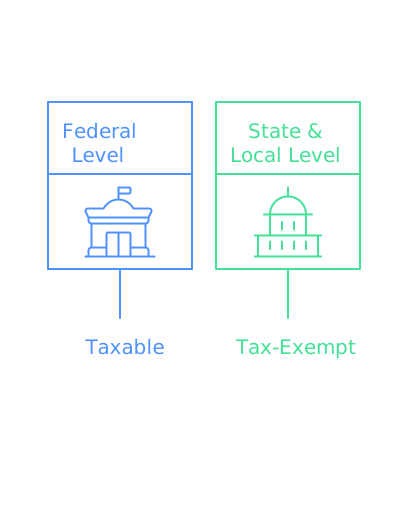
The simple tax split
The takeaway: T-bills are not tax-free. They are federally taxable. The edge is narrower and more specific: state and local income taxes generally do not apply to Treasury bill interest.
What "interest" means for a T-bill
Treasury bills do not pay periodic coupons the way many bonds do. TreasuryDirect explains that bills are sold at a discount or at par, and when the bill matures, you receive face value. For bills, the interest is the difference between what you paid and the face value you receive at maturity.
This distinction matters because the tax treatment follows the Treasury bill income, not the label on your app screen. Whether you bought directly through TreasuryDirect, through a brokerage, or through an automated cash management workflow, the tax question starts with what asset produced the income.
Why Does This Matter for Idle Checking Cash?
State-tax treatment matters because many households keep large taxable cash balances in checking for emotional and operational reasons. They want rent, mortgage, credit cards, utilities, tuition, and transfers covered, so they leave extra money in the account even when the extra amount is not needed for the next 30 to 90 days.
That extra amount is idle cash. Idle cash is the portion of checking above your bills, near-term spending, and safe balance. It can be useful as a cushion, but it can also sit at a very low rate for months.
The scale is not small. The FRED CDCABSHNO series shows U.S. households and nonprofit organizations held $5,948,854 million, or about $5.95 trillion, in checkable deposits and currency at the end of Q1 2026. The FRED ICNDR series shows the national interest-checking rate was 0.07% in June 2026.
Idle checking cash vs tax-aware cash
The tax benefit does not fix a bad cash plan. If you move too much out of checking and miss a bill, the state-tax benefit is irrelevant. That is why tax-aware cash management should start with a safe balance, not with a yield chart.
How Do Treasury Bills Compare With Checking, Savings, Money Market Funds, and Automated Cash Management?
Treasury bills are one cash option, not the only cash option. The right choice depends on 7 variables: pre-tax rate, taxes, fees, transfer timing, bill readiness, risk language, and how much manual work you will actually keep doing.
.svg)
Cash option comparison
The important distinction is that Rivo is not just "T-bills." It is an automated workflow around idle checking cash. The product connects to your existing bank account, monitors cash flow, keeps a user-set safe balance, moves idle cash into short-duration U.S. Treasury Bills through Jiko Securities, and refills checking before scheduled bills.
Where tax treatment is only 1 column
This is why the best article about T-bill tax treatment is not really a tax article. It is a cash workflow article.
How Do You Calculate the After-Tax Yield on Treasury Bills?
Use a simple formula before adding product-specific details.
For Treasury bill interest:
After-tax Treasury bill yield = pre-tax T-bill yield x (1 - federal tax rate)
For bank deposit interest:
After-tax bank yield = pre-tax bank yield x (1 - federal tax rate - state tax rate - local tax rate)
This is an educational formula, not tax advice. It ignores deductions, phaseouts, special state rules, account-level fees, timing, compounding, and whether a fee is or is not deductible for your situation.
Formula inputs
Same-rate illustration before product fees
This table isolates the tax effect only. It assumes the bank cash product and the T-bill each show the same 3.65% pre-tax rate, then applies a 24% federal tax rate and different illustrative state-tax rates.
The takeaway: the tax advantage grows with your state and local income-tax rate. At 0% state tax, there is no state-tax advantage. At 9% state tax, the difference on a 3.65% yield is roughly 0.329 percentage points before fees and other product differences.
Dollar version on $50,000 before product fees
This is why tax treatment matters most for higher balances and higher state-tax rates. A $10,000 balance at a 9% state tax rate changes the gross same-rate comparison by about $33 a year. A $100,000 balance changes it by about $329 a year.
What Changes in a High-Tax State
If you live in a state or city with meaningful income tax, Treasury bill interest can look stronger after tax than a bank product with the same headline rate. It does not automatically win. It simply gets a tax-treatment column that most bank deposit products do not get.
The mistake is comparing only the visible rate. A 4.00% taxable bank rate and a 3.65% Treasury bill yield do not answer the question by themselves. You need the after-tax rate, any product fee, the transfer workflow, the timing of bills, and whether you are comfortable with the asset and account structure.
What high-tax state households should check
For many households, the state-tax benefit is meaningful but not the main decision. The main decision is whether cash can leave checking without creating bill anxiety.
How Does the Rivo Rate Example Fit Into the Tax Math?
The Rivo rates page listed a 3.65% annualized rate for Rivo Autopilot as of July 1, 2026. The same page lists national average interest checking at 0.07% and estimates $730 in yearly earnings on a $20,000 balance for Rivo versus $14 for national average checking.
That example is useful, but it should not be the whole decision. The page also says the rate reflects the 4-week T-bill rate when held to maturity, does not include fees, is subject to change, and requires a $100 minimum balance to earn the stated rate.
Rivo numbers to validate before deciding
The right comparison is net of the pieces that apply to you. That means subtract product fees, apply your federal tax rate, apply state and local taxes where relevant, then ask whether the workflow is realistic.
What Does Rivo Actually Add Beyond T-Bill Tax Treatment?
Rivo adds automation around idle checking cash. That matters because Treasury bill tax treatment is useful only if the money is actually moved into T-bills and moved back before bills need it.
Manual T-bill buying can work well. Direct Treasury bills have a $100 minimum purchase and terms from 4 to 52 weeks, according to TreasuryDirect. But the manual workflow asks you to decide how much is idle, buy the bill, track maturity, reinvest or stop, and keep enough checking cash for bills.
Rivo Autopilot is built for a different user: someone who has extra checking cash, wants Treasury bill exposure, but does not want another recurring money chore.
Rivo vs DIY T-bills for state-tax-aware cash
The product fit is behavioral. If you already manage T-bills every month and keep checking perfectly funded, Rivo may not be necessary. If you keep extra money in checking because manual transfers are annoying or bill timing feels risky, automation can matter more than another rate comparison.
What Are the Main Limits of the T-Bill Tax Advantage?
The T-bill tax advantage is real, but it has boundaries. It should not be stretched into a claim that T-bills are tax-free, deposit products, or free of investment risk.
Tax and product boundaries
Rivo content should say this plainly: T-bill income is generally exempt from state and local income taxes, but it is not a tax-free product and it is not a bank deposit.
How Do FDIC, SIPC, and Treasury Backing Fit Into the Tax Question?
Tax treatment and protection type are separate issues. A product can have useful tax treatment and still not be a bank deposit. That matters because many people hear "cash" and assume all protections are identical.
The FDIC protects eligible deposits at FDIC-insured banks, including checking accounts, savings accounts, money market deposit accounts, and certificates of deposit. The same FDIC page says stocks and bonds are not covered deposit products.
The SIPC protects customer assets when a SIPC-member brokerage firm fails financially, up to $500,000 including a $250,000 cash limit. SIPC does not make a Treasury bill's market value stable, and it is not the same as deposit insurance.
Protection vocabulary
This distinction belongs in any article that combines T-bills, taxes, and checking cash. The goal is not to scare the reader. The goal is to keep the category clean.
What Tax Forms Should You Expect for T-Bill Income?
Expect tax reporting. The IRS says you must report taxable and tax-exempt interest on your federal income tax return even if you do not receive a Form 1099-INT or Form 1099-OID. TreasuryDirect explains that Treasury marketable securities generate Form 1099 information, and brokers can provide composite statements.
If you use Rivo, the Rivo FAQs explain that tax documents are accessible through the app and that the tax form lists Jiko Securities, Inc. as the payer because Rivo partners with Jiko to custody T-bill investments.
Tax-document workflow
This is a tax-prep detail, not a product feature. Do not use Rivo, TreasuryDirect, or a brokerage without understanding how tax documents will arrive and who is listed on them.
When Should Tax Treatment Not Drive the Decision?
Tax treatment should not drive the decision when your cash is not truly idle. If the money is needed for rent, mortgage, tuition, medical bills, taxes due soon, a card payment, or an unpredictable expense, the first job is coverage.
The hierarchy should be:
- Keep bill money covered.
- Set a safe balance.
- Identify the truly idle amount.
- Compare after-tax yield.
- Compare fees.
- Compare access time.
- Choose the workflow you will actually maintain.
Avoid tax-first cash decisions when...
T
his is where the Rivo safe balance is central. A tax-aware cash strategy that ignores safe balance is not a strategy. It is rate chasing with extra paperwork.
How Much Does the State-Tax Benefit Matter at Different Balances?
You can estimate the annual state-tax benefit with this formula:
State-tax benefit = taxable cash balance x Treasury bill yield x state/local tax rate
This isolates only the state/local exemption. It does not include federal tax, fees, compounding, timing, or differences between product rates.
State-tax benefit estimate at a 3.65% T-bill yield
The numbers become meaningful when the balance is meaningful. On $10,000, state-tax treatment may be a nice bonus. On $100,000, it can be a real line item. But even at $100,000, it is still only one line item. Product fees, risk, access, and automation remain part of the answer.
Quick mental math at 3 common balances
Those 3 rows are the fastest way to sanity-check the tax column before you spend 30 minutes comparing products.
How Should You Compare a High-Yield Savings Account and T-Bills After Tax?
Compare them with the same scenario, not with marketing screenshots.
Start with 8 inputs:
- balance
- pre-tax bank savings rate
- pre-tax T-bill yield
- federal marginal tax rate
- state marginal tax rate
- local income-tax rate
- product fee
- transfer and bill-timing workload
Same-scenario comparison template
This table prevents a common mistake: comparing a no-fee DIY workflow to an automation product without assigning any value to the work. If you are the kind of person who happily manages a T-bill ladder, automation may not be worth the fee. If you are the kind of person who has left $50,000 idle for 6 months because you were busy, automation has a different value.
Where Does Rivo Fit for People Who Care About Taxes?
Rivo fits when the tax-aware opportunity is real but the manual workflow is the blocker. The product is not trying to be the tax strategy. It is trying to make the idle-cash movement happen in the background while keeping checking usable.
The positioning is straightforward:
- Keep your existing bank.
- Set a safe balance.
- Let Rivo identify idle cash.
- Move idle cash into short-duration U.S. Treasury Bills through Jiko Securities.
- Bring money back before bills and transfers hit.
- Keep control through pause, stop, withdrawal, and disconnect settings.
*Movement of funds is not instant. Transfers can take up to 3 business days to settle. Rivo plans around known bills but does not guarantee same-day access or specific timing.
Rivo fit matrix
The tax benefit may open the door, but bill-aware automation is the reason to keep reading about Rivo.
The Best 15-Minute Tax-Aware Idle Cash Review?
You do not need a spreadsheet with 80 rows to make the first decision. You need a clean estimate that separates cash you need from cash you are parking by habit.
15-minute review
If the idle amount is under $1,000, the conclusion may be "do nothing." If the idle amount is $20,000, $50,000, or $100,000, the conclusion may be "this is worth a real workflow."
What Should You Do Next?
If you care about the state-tax treatment of Treasury bills, take 3 steps.
First, separate your safe balance from your idle cash. Use How Much Money Should You Keep in Checking? if you need a formula.
Second, compare your current checking rate against the current T-bill/Rivo rate and your own tax situation. Use Why Is My Checking Account Paying So Little Interest? if you want the bank-rate context.
Third, choose a workflow. If you want to buy and roll T-bills yourself, read Rivo vs TreasuryDirect. If you want the money movement handled around your bills, Rivo Autopilot is built for that use case.
Decision table
FAQ
Are Treasury bills completely tax-free?
No. Treasury bill interest is subject to federal income tax. The specific tax advantage is that Treasury bill interest is generally exempt from state and local income taxes, as explained by the IRS and TreasuryDirect.
Do I need to report Treasury bill interest if it is exempt from state tax?
Yes. The IRS says taxable and tax-exempt interest must be reported on your federal income tax return even if you do not receive Form 1099-INT or Form 1099-OID. The state/local exemption does not remove federal reporting.
Is Rivo a tax product?
No. Rivo is a cash management fintech, not a tax product. It uses short-duration U.S. Treasury Bills through Jiko Securities for idle cash, and Treasury bill interest is generally exempt from state and local income taxes. You should consult a tax advisor for your specific situation.
Does the state-tax benefit make Rivo the right choice for everyone?
No. Rivo is most relevant when you have meaningful idle cash, want to keep your existing bank, and value automation around bills. A disciplined DIY user may prefer TreasuryDirect or a brokerage. A user who wants only deposit-account framing may prefer a bank account.
Does SIPC protection mean Treasury bills are FDIC insured?
No. FDIC deposit insurance and SIPC brokerage protection are different. FDIC covers eligible bank deposits at FDIC-insured banks. SIPC protects customer assets when a SIPC-member brokerage firm fails financially and assets are missing, up to applicable limits.
What balance makes the state-tax benefit worth caring about?
There is no universal threshold. As a rule of thumb, the tax effect becomes easier to notice once you have $10,000 to $25,000+ in truly idle taxable cash, and it becomes more meaningful at $50,000 to $200,000+ in high-tax states. The workflow still has to fit your bill timing and risk comfort.
Related Rivo Reading
- To compare the main cash destinations, read Rivo vs High-Yield Savings vs Treasury Bills.
- To check T-bill protection language, read Are Treasury Bills Safe for Short-Term Cash.
- To compare T-bills with cash alternatives, read Treasury Bills vs Money Market Funds vs High-Yield Savings.
- To compare DIY T-bills with automation, read Rivo vs TreasuryDirect.
- To understand manual laddering, read What Is a Treasury Bill Ladder for Short-Term Cash.
- What Is Idle Cash?
- Can You Move Money Out of Checking Without Missing Bills?
- Are Treasury Bills Safe for Short-Term Cash?
- Rivo vs TreasuryDirect
- Does Rivo Replace Your Bank?

This article is educational and is not financial, investment, legal, accounting, or tax advice.
Yield rate reflects the 4-week T-bill rate when held to maturity. Rate does not include fees. Rates are subject to change. Minimum balance of $100 required to earn the stated rate.
Rivo is a fintech company, not a bank. Banking services provided by Jiko Bank, a division of Mid-Central National Bank. Jiko Group, Inc. and its affiliates do not provide legal, tax, or accounting advice. You should consult your legal and/or tax advisors before making any financial decisions. This material is not intended as a recommendation, offer or solicitation for the purchase or sale of any security or investment strategy. See FINRA BrokerCheck, Jiko U.S. Treasuries Risk Disclosures and Jiko Securities Inc. Form CRS.
Investments in T-bills: Not FDIC Insured - No Bank Guarantee - May Lose Value. All U.S. treasury investments and investment advisory services provided by Jiko Securities, Inc., a registered broker-dealer, member FINRA and SIPC. Securities in your account are protected up to $500,000. For details, please see www.sipc.org.
Sources
- Rivo rates, current listed rate, checking comparison, $20,000 example, and minimum balance: https://www.rivofi.com/big-bank-checking-account-rates
- Rivo FAQs, fee, tax-document, safe-balance, liquidity, and automation details: https://www.rivofi.com/faqs
- Rivo homepage, product workflow and tax note: https://www.rivofi.com/
- IRS Topic No. 403, interest received: https://www.irs.gov/taxtopics/tc403
- TreasuryDirect tax forms and withholding for marketable securities: https://treasurydirect.gov/marketable-securities/tax-forms-and-withholding/
- TreasuryDirect Treasury bills overview: https://www.treasurydirect.gov/marketable-securities/treasury-bills/
- FRED national interest checking rate: https://fred.stlouisfed.org/series/ICNDR
- FRED household checkable deposits and currency: https://fred.stlouisfed.org/series/CDCABSHNO
- FRED 4-week Treasury bill secondary market rate: https://fred.stlouisfed.org/series/DTB4WK
- FDIC deposit insurance overview: https://www.fdic.gov/resources/deposit-insurance
- SIPC investor protection overview: https://www.sipc.org/for-investors/what-sipc-protects
.jpeg)
Ambrish Tyagi is the founder and CEO of Rivo. Previously led AI at Cruise and Amazon.
Follow on LinkedInGet Rivo Updates
Product news, money insights, and company updates.