Can You Move Money Out of Checking Without Missing Bills? A Safe Balance and Autopay Guide
Move idle money out of checking without missing bills, breaking autopay, or risking overdrafts, using a safe balance, bill calendar, and automation.
.png)
Yes, you can move money out of checking without missing bills, but only if you separate required bill money from idle cash first. The right system keeps a safe balance in checking, tracks the next 30-45 days of bills, adds an autopay cushion, and moves only the extra layer into a higher-yield cash option.
The fear is rational. ACH debits can settle quickly, credit card autopay can hit before you notice, and rent or mortgage payments are not forgiving. That is why the safest approach is not "move everything." It is "protect the bill layer, then automate only the idle layer."
TL;DR
- Do not move money out of checking until you know your safe balance: next 30 days of bills + predictable spending + irregular bill reserve + comfort cushion.
- Idle cash is the amount above that safe balance. If you usually keep $25,000 in checking and need $11,500 for bills, spending, and cushion, the idle layer is about $13,500.
- The FDIC national average interest-checking rate was 0.07% in June 2026, while Rivo listed a 3.65% T-bill-based rate as of July 1, 2026, before fees and subject to change.
- Bill timing matters because Nacha estimates 80% of ACH payments settle in one banking day or less, and ACH debits typically settle the same day or next banking day.
- Rivo is built for this exact gap: it works with your existing bank, lets you set a minimum checking threshold, moves eligible idle cash into short-duration U.S. Treasury Bills through Jiko Securities, and plans money back before bills and transfers hit.
- Use manual transfers if you have 3-5 predictable bills and can review weekly. Use bill-aware automation if your checking account has 10+ recurring debits, irregular income, or a history of abandoning manual HYSA transfers.
Quick Answer: The Safe Way to Move Money Out of Checking
The safe way to move money out of checking is to move only the cash above your safe balance. Your safe balance is the money required for known bills, near-term card payments, routine spending, irregular expenses, and a small comfort cushion.
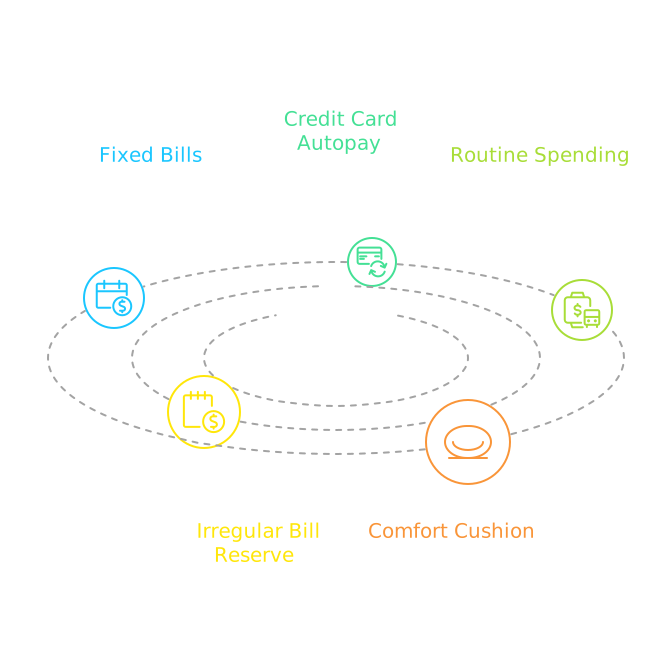
The 5-part safe balance formula
If your checking account has $30,000 and the safe balance is $12,500, the maximum idle layer is $17,500. That does not mean you must move all $17,500 on day one. It means the first $12,500 has a job, while the remaining dollars need a better rule.
The simplest rule
Keep money for the next bill cycle in checking. Move only the amount you would be comfortable not touching for 7-30 days, even though it remains available if you need to bring it back.
That rule is conservative, but it is the right starting point for households with autopay. If you are already unsure whether a $2,800 credit card payment or a $4,000 mortgage debit is about to hit, your first job is not chasing yield. Your first job is making checking legible.
Why Does Moving Money Out of Checking Feel Risky?
Moving money out of checking feels risky because checking is where money leaves your life. It is not just a storage account. It is the payment hub for rent, mortgage, payroll deposits, ACH debits, debit card spending, credit card autopay, peer transfers, subscriptions, and surprise charges.
.svg)
The problem is timing, not yield
Most people do not keep too much in checking because they love low rates. They keep too much because they do not trust their bill calendar.
The mistake is treating all cash above zero as movable. The better approach is to label every dollar by timing.
Why ACH timing changes the decision
ACH does not always feel slow from the consumer side. Nacha estimates that 80% of ACH payments settle in one banking day or less, and ACH debits usually settle the same day or the next banking day. That is good for payment efficiency, but it means a thin checking balance can become a problem quickly.
This is why your cash system needs a buffer. A transfer that is "available soon" may still be too late for a debit that clears today.
What Counts as Idle Cash After Bills and Autopay
Idle cash is money sitting in checking beyond what you need for bills, spending, and a safety buffer. It is not your rent money, mortgage money, near-term credit card payment, tax payment, or emergency reserve if you depend on that reserve for immediate liquidity.
Idle cash definition
Idle cash = current checking balance - safe balance - near-term known exceptions.
The $20,000 checking question usually starts here. A $20,000 balance is not automatically too much. It becomes too much when only $8,000-$12,000 has a near-term job and the rest sits for 60-90 days.
For the broader decision, read what to do with $20,000 sitting in checking.
Do not move these dollars first
- Money for rent, mortgage, or the next 30 days of housing payments.
- Credit card autopay money if the statement balance has already closed.
- Known tax payments, tuition payments, insurance premiums, or large medical bills.
- Emergency cash you need instantly, not within a transfer window.
- Cash you are emotionally not ready to move. A system you cancel in panic after 3 days is not a system.
This is also why "keep 1 month of expenses in checking" is too generic. A single person with $3,000 monthly spending and no debt has a different safe balance from a dual-income household with $9,000 in monthly card spend, two daycare drafts, and a mortgage.
The Cost of Low Checking Yield
Low checking yield costs more when the idle layer is large, stable, and ignored for months. The FDIC national average interest-checking rate was 0.07% in June 2026, and U.S. households and nonprofits held about $5.95 trillion in checkable deposits and currency at the end of Q1 2026. The opportunity is not that every dollar should move. The opportunity is that many households have a persistent surplus that never gets assigned.
Same household, different safe balance
The 3.65% column is an illustrative gross-yield scenario using the Rivo listed rate as of July 1, 2026. It does not include fees, taxes, changing rates, or early sale effects. It exists to show the size of the idle-cash problem, not to promise a result.
Why the fee math still matters
Rivo charges a 0.05% monthly management fee, equal to 0.6% per year, based on average daily balance. On $13,500, that is about $6.75 per month or $81 per year before compounding effects.
If you can manually manage Treasury bills perfectly, you may not want to pay for automation. If you keep meaning to move money and never do, the relevant comparison is not "manual strategy done perfectly." It is "what actually happened over the last 12 months."
For the cost-of-inaction framing, read what the inertia tax is.
Your Options Once Idle Cash Is Identified
Once you identify idle checking cash, the main options are: leave it in checking, move it to a high-yield savings account, buy Treasury bills manually, use a money market fund, or use automated cash management. The best option depends on bill timing, tax situation, manual effort, and how much cash you can comfortably move.
Option comparison for autopay households
Rivo is not a replacement for every cash option. It is most relevant when the problem is not knowledge. It is execution.
When the manual path works
Manual transfers can work if:
- You have fewer than 5 recurring debits.
- You review checking weekly.
- You have stable income dates.
- You do not mind logging into multiple accounts.
- You can leave a larger cushion without second-guessing yourself.
Manual transfers break when you need the system to remember for you. If you opened a high-yield savings account, moved money once, and then stopped for 6 months, you do not have a yield problem. You have an automation problem.
For a full comparison, read Rivo vs high-yield savings vs Treasury bills.
Building a Bill Calendar Before You Move Anything
Build a bill calendar by listing every outgoing payment, due date, expected amount, payment rail, and whether the amount is fixed or variable. The goal is not a perfect household budget. The goal is a reliable map of when checking must have cash available.
Bill calendar fields that matter
The calendar should include boring items. Utilities, insurance, childcare, memberships, and semiannual premiums are exactly the charges that turn a clean transfer plan into an overdraft risk.
The 30-45 day bill calendar
Once this calendar exists, your checking account stops being a mystery. You can see which dollars are spoken for and which dollars are merely sitting there.
The irregular bill problem
Most people underestimate irregular bills because they do not happen every paycheck. Property tax, car insurance, tuition deposits, medical bills, vacation balances, estimated taxes, and home repairs can all make a checking balance look idle when it is not.
Use this rule: if the bill is likely in the next 90 days and missing it would create stress, reserve for it before calculating idle cash.
Sizing the Autopay Cushion
The right autopay cushion depends on your bill volatility, income stability, and payment timing. A simple starting point is 10%-25% of the next 30 days of bills, plus a fixed-dollar floor such as $1,000-$2,500 for surprise debits.
Cushion sizing matrix
The goal is not to keep the smallest possible checking balance. The goal is to keep enough checking cash that the system feels boring.
Example: $25,000 in checking
This household should not move $25,000. It should treat $12,200 as protected and decide what to do with the $12,800 idle layer.
For a deeper formula, read how much money to keep in checking.
What Rivo Automates in This Workflow
Rivo automates the part most people fail to maintain manually: monitoring checking, identifying idle cash above a user-set threshold, moving idle balances into short-duration U.S. Treasury Bills, and moving money back before bills and transfers hit. It works with your existing bank, so you do not need to move direct deposit or rebuild bill pay.
*Movement of funds is not instant. Transfers to your linked account can take up to 3 business days to settle, and longer if a Treasury Bill must be sold first. Rivo plans around known bills. It does not guarantee same-day access or a specific arrival date.
Rivo workflow mapped to the safe balance problem
This is why Rivo is not just a yield wrapper. The valuable part is bill-aware movement. Yield matters, but the system only works if your checking account still does its job.
Current Rivo facts that matter for bill timing
Use Rivo if you want a system that does not require you to remember the sweep and refill cycle. Do not use Rivo for money you know you need today, money you cannot expose to fixed-income risk, or money you are not comfortable moving out of checking at all.
For the product-level overview, read what Rivo is.
The Risks When Idle Cash Moves Into Treasury Bills
Treasury bills are short-term U.S. government obligations, but they are not checking deposits. TreasuryDirect explains that Treasury bills are sold for terms ranging from 4 weeks to 52 weeks, have a $100 minimum purchase, and can be held to maturity or sold before maturity. That creates a different protection and risk profile from an FDIC-insured bank account.
Risk and protection table
The safe-balance rule solves the biggest practical risk. If rent is due tomorrow, it should not be in T-bills today. If the money has no near-term job, then the decision becomes yield, taxes, fees, and automation.
For a dedicated safety guide, read are Treasury bills safe for short-term cash.
When Should You Move Cash Manually vs Use Automation?
Use manual transfers when you have a simple bill pattern and the discipline to maintain it. Use automation when the real failure mode is forgetting, delaying, second-guessing, or abandoning the system after the first month.
Manual vs automated cash movement scorecard
The most honest test is historical. If your plan requires weekly action, did you actually do that for the last 12 weeks? If not, build a system around the person you are, not the person your spreadsheet assumes.
The 3-month behavior test
Automation is not about being unable to do math. It is about removing a recurring operational task from a busy household.
Your First 7 Days
The first 7 days should focus on classification, not maximum yield. You are building confidence that bills stay covered while idle cash stops sitting unnoticed.
Do not optimize during a chaotic week. If payroll is delayed, a card payment is in dispute, or a large bill is about to hit, wait until the dust settles. A conservative start is safer than an aggressive start that makes you reverse course.
First-month operating rule
Move less than the full idle amount in month 1. If your idle estimate is $18,000, start with $5,000-$10,000 or use an automation threshold that leaves more than your calculated safe balance. After one bill cycle passes cleanly, reduce the extra cushion if you want.
The best cash system is one you trust enough to keep running.
What If You Have Irregular Income, RSUs, or Bonuses?
Irregular income makes the safe balance more important, not less. RSU vests, annual bonuses, commission checks, and tax refunds can create a misleadingly high checking balance. Some of that money may be idle. Some of it may already belong to taxes, tuition, a down payment, or a future purchase.
Lump-sum sorting table
If the money has a job in the next 90 days, it is not idle. If it has no defined job and keeps sitting, it needs a rule.
High-tax-state note
Treasury bill interest is federally taxable but exempt from state and local income taxes, according to the IRS and TreasuryDirect. That can matter more for households in California, New York, New Jersey, and other high-tax states. It does not make T-bills the right answer for every dollar. It means after-tax yield belongs in the comparison.
For after-tax context, read Rivo vs MaxMyInterest.
When Not to Move Money Out of Checking
Do not move money out of checking when the cash is needed soon, when your bill calendar is unclear, or when moving it would create stress that causes you to abandon the system. A low-yield checking balance is inefficient. A missed rent payment, failed mortgage debit, or overdraft cycle is worse.
Avoid moving cash in these cases
The wrong move is not "leaving cash in checking." The wrong move is pretending that all cash should be optimized the same way.
Conservative household rule
If you are nervous, keep 2 safe balances in checking for the first month. For example, if your safe balance is $9,000 and checking holds $30,000, keep $18,000 and move only the remaining $12,000. This reduces first-month anxiety while still addressing the idle layer.
You can tighten the system later. You do not need to prove anything on day 1.
Final Framework: The Safe Sweep Decision
The safe sweep decision has 4 gates. If a dollar passes all 4, it may be a candidate for HYSA, Treasury bills, money market funds, or Rivo. If it fails any gate, keep it in checking for now.
The 4-gate safe sweep test
Rivo fits after the first 2 gates. It is not for bill money. It is for the cash above the safe balance that keeps staying idle because manual movement is easy to postpone.
Recommended path by household type
The point is not to drain checking. The point is to stop treating checking as the default home for every dollar.
FAQ
Can moving money out of checking cause an overdraft?
Yes, moving too much out of checking can cause an overdraft if a bill, ACH debit, card autopay, or debit card transaction clears before money returns. Prevent this by keeping a safe balance, using a bill calendar, adding a cushion, and moving only the idle layer.
How much money should I keep in checking before moving cash?
Start with next 30 days of bills, expected card autopay, routine spending, irregular bill reserves, and a 10%-25% cushion. If your total is $12,000 and checking has $30,000, the idle layer is about $18,000 before any extra exceptions.
Is Rivo a savings account?
No. Rivo is a fintech product that works with your existing bank account and uses short-duration U.S. Treasury Bills through Jiko Securities. T-bill holdings are not bank deposits and are not FDIC-insured.
How quickly can I withdraw from Rivo?
Available funds can be withdrawn through the app up to $15,000 per day. For bill planning, do not rely on same-day access for cash needed immediately. Keep near-term bills in checking.
Movement of funds is not instant. Transfers to your linked account can take up to 3 business days to settle, and longer if a Treasury Bill must be sold first. Rivo plans around known bills. It does not guarantee same-day access or a specific arrival date.
Are Treasury bills safe for money I may need soon?
Treasury bills are short-term U.S. government obligations, but they are still securities, not checking deposits. TreasuryDirect notes that bills can be held to maturity or sold before maturity. If the money is needed for a bill in the next few days, keep it in checking.
What is the best first step if I have too much in checking?
Do not transfer first. Calculate first. Build a 30-45 day bill calendar, set a safe balance, identify idle cash, and then choose between a manual HYSA transfer, DIY T-bills, a money market fund, or Rivo-style automated cash management.
Related Rivo Reading
- To size the checking floor, read How Much Money Should You Keep in Checking?.
- To define safe balance, read What Is a Safe Balance?.
- To classify emergency, sinking-fund, and operating cash before anything moves, read Sinking Fund vs Emergency Fund vs Safe Balance..
- To keep annual and quarterly obligations out of the idle-cash total, read Why Does Your Checking Account Look Full Until Annual Bills Arrive?.
- To compare one payment hub with a dedicated bills account before moving cash, read Should You Use a Separate Checking Account for Bills?. • To understand why manual transfers fail, read Why Manual Transfers Fail. • To understand overdraft controls, read Can Rivo Cause an Overdraft?. • To see the product workflow, read How Does Rivo Autopilot Work?.

This article is educational and is not financial, investment, tax, or legal advice. Talk to your advisor about your specific situation.
Yield rate references are as of the dates linked in the article. Rates are subject to change. Yield examples are illustrative, do not include all taxes or individual circumstances, and should not be read as a forward-looking return promise.
Rivo is a fintech company, not a bank. Banking services provided by Jiko Bank, a division of Mid-Central National Bank. Jiko Group, Inc. and its affiliates do not provide legal, tax, or accounting advice. You should consult your legal and/or tax advisors before making any financial decisions. This material is not intended as a recommendation, offer or solicitation for the purchase or sale of any security or investment strategy. See FINRA BrokerCheck, Jiko U.S. Treasuries Risk Disclosures and Jiko Securities Inc. Form CRS.
Investments in T-bills: Not FDIC Insured - No Bank Guarantee - May Lose Value. All U.S. treasury investments and investment advisory services provided by Jiko Securities, Inc., a registered broker-dealer, member FINRA and SIPC. Securities in your account are protected up to $500,000. For details, please see www.sipc.org.
External References
- Rivo homepage
- Rivo FAQs
- Rivo rate comparison page
- FRED: National Rate, Interest Checking
- FRED: Household checkable deposits and currency
- FRED: 4-week Treasury bill secondary market rate
- TreasuryDirect: Treasury Bills
- IRS Topic 403: Interest received
- SIPC: What SIPC protects
- FDIC: Deposit insurance
- Nacha: How ACH payments work

Get Rivo Updates
Product news, money insights, and company updates.