How Much Should You Keep in Checking With Irregular Income? A Safe Balance Formula for Freelancers and Commission Earners
Learn how much to keep in checking with irregular income, using a weekly cash-flow map, tax reserves, and a safe balance formula.
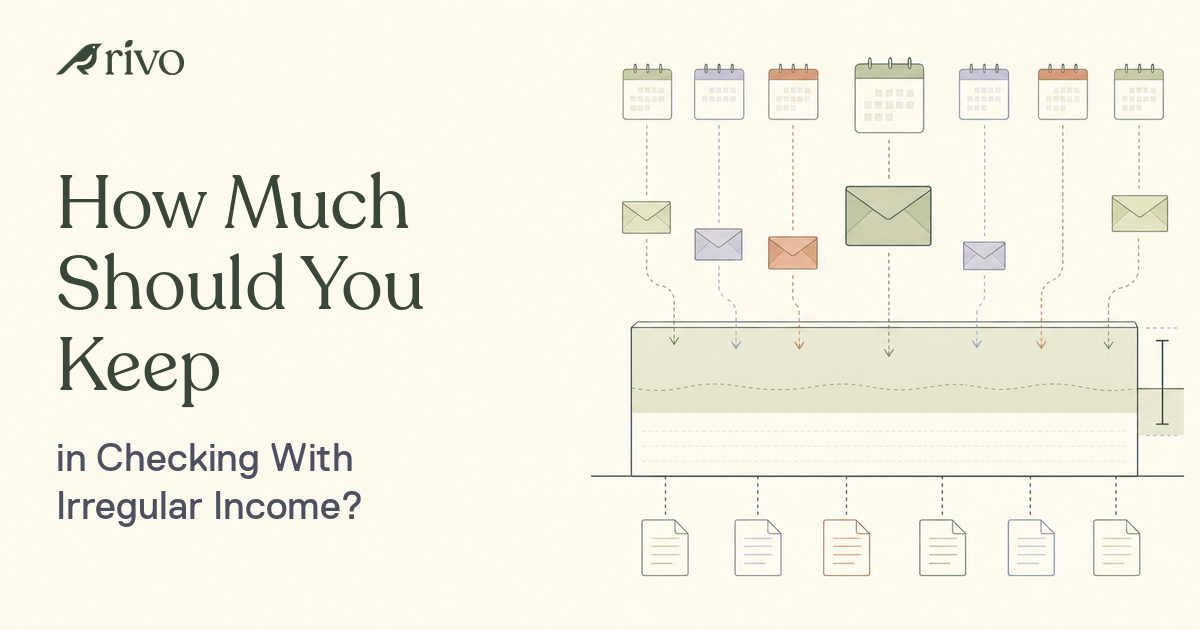
If your income changes from month to month, keep enough in checking to survive the lowest point in your next cash-flow cycle, not just enough to cover an average month. Map expected income and expenses week by week, find the largest projected shortfall before reliable income arrives, then add a timing cushion that reflects delayed invoices, changing commissions, and bill clusters.
The balance above that safe level is not automatically idle. Tax reserves, business expenses, annual insurance, tuition, and emergency savings still have jobs even when they sit untouched. Only recurring cash left after those obligations are funded should be evaluated as idle cash.
TL;DR
- Irregular income changes the checking question from "How much do I spend each month?" to "How low could checking fall before the next reliable deposit clears?"
- The Federal Reserve found that 30% of adults had income that varied at least occasionally in 2025. Among self-employed adults, 58% reported month-to-month income variation and 22% struggled to pay bills because income varied.
- Build a week-by-week cash-flow map using income you can reasonably expect to clear, every bill and autopay, known irregular expenses, and tax payments due during the planning window.
- Your irregular-income safe balance is the opening cash required to keep every projected weekly ending balance above zero, plus a personal timing cushion.
- Tax reserves, business operating cash, emergency savings, and money assigned to a known purchase are not idle cash. They may be stored outside checking, but they should not be swept into an unassigned surplus.
- Rivo can be relevant for recurring personal cash above the safe balance and assigned reserves. It works with your existing checking account, lets you set a minimum threshold, and becomes more conservative when income timing looks uncertain.
- Rivo uses short-duration U.S. Treasury Bills through Jiko Securities. It is not a bank account, charges a 0.05% monthly management fee, and limits withdrawals of available funds to $15,000 per day.
Quick Answer: What Is the Safe Balance for Irregular Income?
The safe balance is the amount your checking account needs at the start of a planning period so every expected bill can clear before the next reliable income arrives.
Use this process:
1. Build a week-by-week cash-flow map for a full income cycle. A 13-week view is a practical starting point for freelancers, consultants, and commission earners because it exposes monthly bills, quarterly obligations, and delayed deposits.
2. Count only income you have a reasonable basis to expect. Separate signed or earned receivables from hoped-for projects, sales, tips, or commissions.
3. Enter bills on the week they will leave checking, including credit-card autopay and irregular expenses.
4. Calculate the running balance from a zero starting point.
5. Find the lowest projected running balance.
6. Add enough opening cash to bring that low point to zero.
7. Add a timing cushion for late payments, spending variation, and transaction delays.
The formula is:
Irregular-income safe balance = cash required to offset the lowest projected weekly balance + timing cushion
.svg)
This is different from keeping a fixed multiple of monthly spending. The fixed multiple may be useful as a rough check, but the weekly map shows when the cash is actually needed.
Why Irregular Income Needs a Different Checking Rule
Irregular income creates a timing problem even when annual income is high.
An illustrative consultant can earn $180,000 in a year and still wait several weeks for a large invoice. A real estate agent can have a strong quarter followed by a quiet one. A salesperson may receive a base salary every two weeks but earn most variable compensation after a quarterly close. An online seller may have daily deposits but large inventory, advertising, and tax outflows.
Annual income hides those sequences.
The Federal Reserve explains that yearly income can mask month-to-month variability and that mismatches between income and expense timing can create financial challenges. In 2025, 11% of adults said they had struggled to pay bills during the prior year because income varied.
Average monthly income can create false confidence
Suppose an independent consultant earns an illustrative $144,000 during the year. The average is $12,000 per month, but the actual pattern may look like this:
These are illustrative inputs, not a recommended income or spending pattern. The lesson is that the highest balance after an invoice is not the same as idle cash.
The correct floor must bridge the low point between deposits.
Fixed-paycheck rules can fail
A household with predictable semimonthly pay can often size checking around the next bill cycle. A household with irregular income has to account for:
- Uncertain deposit dates
- Variable deposit amounts
- Client approval and payment delays
- Commission reversals or delayed closes
- Seasonal revenue gaps
- Quarterly estimated taxes
- Annual insurance, licensing, software, or professional fees
- Business costs that occur before customer payments
That does not mean all irregular-income households need a huge checking balance. It means the floor must come from the cash-flow sequence rather than a generic monthly average.
What Counts as Irregular Income?
Irregular income is income whose amount, timing, or both can change materially between payment periods.
It includes more than full-time self-employment.
The relevant test is operational:
Would a later or smaller deposit change whether upcoming bills can clear?
If yes, the income is variable enough to affect the safe balance.
Income can be variable even when it arrives often
Daily or weekly deposits can feel reliable because money keeps appearing. But frequency is not the same as predictability.
A gig worker may receive several deposits each week while fuel, vehicle maintenance, supplies, platform adjustments, and taxes remain unassigned. A small business owner may see daily customer payments but also have payroll, inventory, rent, and card settlements concentrated on specific dates.
Use net cash available to the household, not gross deposits, when sizing personal checking.
One variable earner can change a dual-income household
A stable paycheck can reduce the required floor, but it does not eliminate timing risk.
Start by asking which household obligations the stable income covers. If it covers the mortgage, utilities, insurance, groceries, and minimum debt payments, the variable income may be assigned to childcare, travel, investing, taxes, or larger goals. If it does not cover the core bills, checking must bridge the remaining gap.
The floor should reflect the role of each income stream, not just total household income.
Which Cash Is Not Idle When Income Varies?
Cash is not idle when it has a defined job, amount, or date.
That rule matters after a strong month. A freelancer may receive an illustrative $35,000 invoice payment and see checking jump to $48,000. The full increase is not available for optimization if part of it belongs to taxes, subcontractors, software renewals, household bills, or the next slow month.
Use a cash stack before calling anything surplus:
A reserve can sit still without being idle
A quarterly tax reserve may remain untouched for weeks. A seasonal business reserve may sit for months. A house repair fund may not move until a contractor is available.
The lack of transactions does not make the cash idle. Its assignment does.
This is why a balance chart alone cannot identify idle cash for a variable-income household. The chart needs labels.
Separate business and personal cash first
If you operate a business, do not use the household checking balance to absorb every business obligation without a written transfer rule.
At minimum, distinguish:
- Business revenue
- Business operating expenses
- Tax reserves
- Owner pay or distributions
- Personal checking
- Personal emergency reserves
The legal, tax, and accounting treatment depends on business structure and individual circumstances. Use a qualified professional for those decisions. For cash-flow planning, the practical point is simpler: a dollar cannot be called personal idle cash while it may still belong to the business or a tax obligation.
Building a Weekly Cash-Flow Map
A cash-flow map records when money is expected to enter and leave, then calculates the balance after each week.
The Consumer Financial Protection Bureau describes a cash-flow budget as a way to track the timing of income and expenses so enough money is available from week to week. Its worksheet carries each week's ending balance into the next week's opening balance.
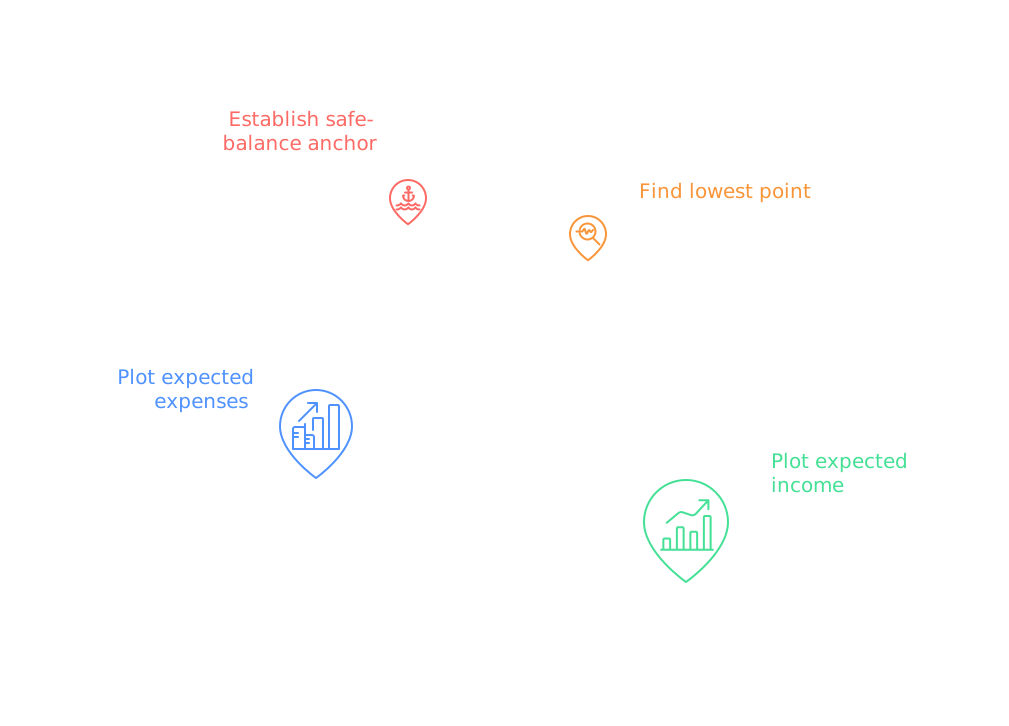
That sequence is exactly what irregular-income checking needs.
Step 1: Choose a window that contains a full weak period
Use a window long enough to include:
- At least one major bill cluster
- The realistic gap between variable deposits
- The next tax or annual obligation
- A weak sales, commission, or project period
A 13-week map is a useful operational starting point for many irregular-income households. A seasonal business may need a longer low-season map. A side-gig household whose salary covers all core bills may need less.
Step 2: Use conservative inflows
Create three labels:
This is not a claim that expected income will arrive. It is a planning discipline. The cash floor should not depend on revenue that is still speculative.
If payment timing is uncertain, run a second scenario with the deposit delayed. Use the lower projected balance when choosing the floor.
Step 3: Enter outflows on clearing dates
Include:
- Rent or mortgage
- Credit-card statement autopay
- Utilities and subscriptions
- Insurance
- Loan payments
- Childcare or tuition
- Groceries, transportation, and debit spending
- Personal transfers
- Taxes due during the period
- Annual or quarterly expenses
- Known large purchases
Do not spread an illustrative $6,000 annual insurance payment into a smooth $500 monthly average if the full payment will leave checking in one week. The cash-flow map needs the actual clearing pattern.
Step 4: Calculate the running balance
Use:
Weekly ending balance = weekly beginning balance + reliable inflows - expected outflows
Then carry that result into the next week.
Illustrative four-week map
The lowest projected point is an illustrative negative $6,500 in Week 2. An opening balance of $6,500 would bring that point to zero. The household would then add its own timing cushion rather than running checking to exactly zero.
The map does not recommend a cushion amount. It reveals the cash needed by the sequence.
Calculating the Safe Balance From the Map
Find the most negative cumulative balance, convert it to a positive opening requirement, then add a cushion.
If the lowest point is negative $14,000, the map needs $14,000 of opening cash to keep the modeled balance at zero or above. If the household adds an illustrative $4,000 timing cushion, the safe balance becomes $18,000.
Lowest projected cumulative balance = -$14,000
Opening cash needed = $14,000
Illustrative timing cushion = $4,000
Safe balance = $18,000
Those values are assumptions for demonstration. Your floor should come from your own cash-flow history and risk tolerance.
What belongs in the timing cushion?
The cushion covers uncertainty not already modeled:
- A client payment arriving later than the base-case date
- A commission being lower than forecast
- A credit-card statement being higher than expected
- A utility, insurance, medical, or repair bill increasing
- A bank holiday or transfer review affecting timing
- A work expense that must be paid before reimbursement
Do not use one universal percentage. A household with several stable clients and low fixed costs has a different timing risk from a household dependent on one large client or a single quarterly commission.
Use two scenarios instead of one inflated cushion
An oversized cushion can turn all available cash into checking cash forever. A better approach is to run:
1. A base case using conservative but expected deposits.
2. A delayed-income case that moves one or more deposits later.
Then compare the low points.
The safe balance should let you sleep through a plausible weak case. It does not need to fund every imaginable event. That broader role belongs to emergency planning and insurance, not only checking.
How the Formula Changes by Income Pattern
The formula stays the same, but the planning window and stress case change.
Freelancers and consultants
The key variables are invoice timing, customer concentration, and business expenses paid before collection.
Use the longest realistic payment delay from your recent history, not the fastest client. If one client represents a large share of income, run a scenario where that client's payment moves later. Do not count a proposal or verbal commitment as personal cash.
Commission earners
Separate base pay from variable compensation.
First determine which household bills the base pay can cover. Then map the remaining obligations against conservative commission timing. A pending deal is not available checking cash. A closed deal may still have approval, payroll, or clawback conditions.
After a strong commission deposit, treat the cash as funding future weak periods until the next cycle is secure. The remainder may become idle only after that runway is assigned.
Seasonal business owners
Monthly rules are weakest when an entire season carries the year.
Map the low season from its starting cash balance to the first conservative strong-season deposits. Include business fixed costs and the personal amount you expect to transfer to the household. The peak-season checking balance may look excessive while it is actually financing several future months.
Gig workers
Use net weekly cash after work-related costs.
Deposits from a platform are not the same as household income if fuel, supplies, equipment, insurance, or other costs still need to be paid. The IRS includes rides, deliveries, errands, online sales, rentals, and freelance services within common examples of gig work.
Track income and expenses together so the floor is not built from gross deposits.
Mixed-income households
Use stable income as the first layer of bill coverage.
If stable pay covers core monthly obligations, the variable-income floor may only need to protect taxes, irregular goals, and optional spending. If stable pay covers half of core obligations, the checking floor needs to bridge the other half during a weak period.
This approach can produce a smaller and more accurate floor than treating the whole household as fully variable.
How Should Taxes Affect the Checking Balance?
Tax money is assigned cash. It should be separated from the idle-cash calculation whether it remains in checking or in another clearly designated account.
The IRS states that independent contractors may need to pay estimated taxes. It lists estimated tax payment dates four times each year: April 15, June 15, September 15, and January 15, with next-business-day treatment when a date falls on a weekend or legal holiday.
Do not invent a universal tax percentage
The correct reserve can depend on:
- Business structure
- Net income after deductible expenses
- Other household income
- Federal bracket
- State and local rules
- Credits and prior-year payments
- Payroll withholding
- Safe-harbor rules and professional guidance
Use actual estimated-payment calculations, prior returns, tax software, or a qualified tax professional. Do not assume that a generic percentage fits every freelancer or commission earner.
Put tax payments into the weekly map
If an estimated payment is due during the planning period, enter it as an outflow in the due week.
If the tax reserve is held outside checking, do not count it as available checking cash. If the payment will be made from checking, make sure the reserve is transferred back early enough to clear.
The IRS also advises gig workers to keep records of income and expenses throughout the year. That recordkeeping improves both tax preparation and cash-flow planning.
A large invoice can create two different reserves
One part may need to cover the business costs required to deliver the work. Another part may need to cover taxes on net income. Only the owner-pay portion that remains after those obligations should enter the personal cash map.
This prevents a common error: treating gross business receipts as a personal checking windfall.
Where the Emergency Fund Fits
The safe balance and the emergency fund solve different problems.
The safe balance covers expected timing variation: normal bills, realistic income delays, known weak periods, and recurring spending. The emergency fund covers events outside the operating plan: a major income interruption, health expense, urgent repair, or other shock.
Some emergency cash can remain in checking if same-day access matters. The full reserve does not automatically need to sit in the operating account. The important rule is that it remains clearly assigned and accessible under the household's emergency plan.
For a deeper treatment, read Should You Keep Your Emergency Fund in Checking?
Avoid double counting
If the delayed-income scenario already funds an extra weak month, do not automatically add the same month again as a timing cushion and again as an emergency reserve.
Name each layer and its purpose. The goal is a conservative plan, not the largest possible checking number.
What Do Worked Examples Look Like?
The following examples show the method. Every amount is illustrative, not a recommendation.
Example 1: Independent consultant with delayed invoices
An independent consultant has $42,000 in personal checking. Over the next 13 weeks, conservative expected inflows and household outflows produce a lowest projected cumulative balance of negative $19,000. The consultant chooses an illustrative $5,000 timing cushion because one client has occasionally paid late.
Opening cash needed = $19,000
Illustrative timing cushion = $5,000
Safe balance = $24,000
Visible checking balance = $42,000
Potential personal surplus = $18,000
Before treating $18,000 as idle, the consultant confirms that business operating cash and estimated taxes are held separately. If either obligation is still mixed into personal checking, the candidate surplus is smaller.
Example 2: Sales employee with base pay and quarterly commission
A sales employee's base salary covers an illustrative $6,000 of the household's $9,000 monthly core outflows. The variable-income gap is therefore about $3,000 per month before irregular costs.
The 13-week map includes base pay, full credit-card autopay, and a weak commission case. Its low point requires $11,000 of opening cash. The household adds an illustrative $4,000 cushion.
Opening cash needed = $11,000
Illustrative timing cushion = $4,000
Safe balance = $15,000
A $30,000 commission deposit does not create $30,000 of idle cash. It first restores the $15,000 floor and funds taxes or goals assigned to the payment. Only the recurring remainder is a surplus candidate.
Example 3: Dual-income household with a freelance side business
Two stable paychecks cover mortgage, utilities, groceries, and insurance. Freelance income is assigned to quarterly taxes, travel, and longer-term savings.
Because stable pay covers the operating account, the personal checking floor may not need to expand after every freelance payment. The freelance deposit can be divided immediately among:
- Tax reserve
- Business expense reserve
- Planned household goal
- Unassigned personal surplus
This household's main risk is classification, not bill coverage.
Example 4: Seasonal business owner
A seasonal owner enters the low season with an illustrative $90,000 across business and personal cash. The business needs $48,000 for fixed operating obligations before the next conservative revenue period. The household needs $24,000 for expected personal outflows and a timing cushion.
The combined visible cash is not $90,000 of idle cash:
Illustrative total cash = $90,000
Business low-season reserve = $48,000
Personal safe balance = $24,000
Potential unassigned surplus = $18,000
The business and personal amounts should remain operationally separate. The example only shows why peak cash cannot be judged by the visible total.
Example summary
When Does Irregular-Income Cash Become Idle?
Cash becomes potentially idle when it remains above every assigned layer through more than one realistic income and bill cycle.
Use four tests:
1. Purpose test: Does the cash have a named business, tax, household, emergency, or purchase job?
2. Date test: Is it needed by a known date?
3. Stress test: Does the safe balance still hold if a meaningful deposit is later or smaller?
4. Persistence test: Does the same surplus remain after bills, taxes, and a weak period?
If the cash passes all four tests, it is more likely to be true idle cash.
A high balance after payment is not enough
The day after a client invoice, commission, or seasonal payout is the worst time to judge the surplus by sight. The balance is at its peak before the next run of expenses.
Wait until the cash is classified and the low point is modeled. Then decide.
Repeated surplus is stronger evidence
If checking remains an illustrative $20,000 above the safe balance after several bill cycles and the delayed-income scenario still works, the surplus is more credible than a one-day spike.
This is the irregular-income version of the general rule in How Much Money Should You Keep in Checking?: keep what protects the operating account, then evaluate the residual.
What to Do With the Surplus
Match the surplus to access needs, risk, protection structure, effort, and tax treatment.
The national interest checking rate was 0.07% in July 2026, but a national average does not tell you what your bank pays. Check your own account before comparing alternatives.
The U.S. Treasury issues bills with terms from 4 weeks to 52 weeks. Bills can be held to maturity or sold before maturity, and an early sale can produce a different result from holding to maturity.
This is not a ranking. An irregular-income household may prefer a larger amount in a simple deposit account because uncertainty is high. Another may use a Treasury workflow for a well-defined surplus. The destination comes after the floor.
How Can Rivo Fit Irregular Income?
Rivo can fit when irregular income repeatedly pushes checking above a conservative safe balance and the household does not want to manage each transfer manually.
The relevant product controls are:
1. Connect the existing checking account.
2. Set the minimum checking threshold.
3. Keep assigned bills and spending inside that floor.
4. Let cash-flow analysis evaluate the amount above the threshold.
5. Move eligible idle cash into short-duration U.S. Treasury Bills through Jiko Securities.
6. Plan refills before detected bills and scheduled payments.
7. Pause, modify, stop, or disconnect when the cash plan changes.
Rivo can adapt to fluctuating income patterns and changes in paycheck timing. When the pattern looks uncertain, the product can become more conservative, and the user can raise the checking threshold at any time. Those controls are described in the money movement and automation section.
The safe balance should come from your weak case
Do not set the threshold from the checking balance on a strong commission or invoice day.
Use the weekly map, delayed-income scenario, tax schedule, and known irregular expenses first. Then set the threshold at the amount you do not want automated.
For example, if the map produces an illustrative $22,000 safe balance and checking rises to $47,000 after an invoice, the candidate layer is $25,000. That layer can still shrink after taxes or business obligations are assigned.
Rivo should operate on the final unassigned personal surplus, not the raw deposit.
Current rate, fee, and access details
The current rate page lists a 3.65% gross annualized rate as of July 1, 2026, before fees and subject to change. The management fee is 0.05% per month, calculated on average daily balance. A minimum balance of $100 is required to earn the stated rate.
Available-funds withdrawals are limited to $15,000 per day. That limit matters for households that could need a large amount back quickly after a delayed commission, tax surprise, or business transfer.
Rivo is not a bank account or a high-yield savings account. The idle layer is invested in securities through Jiko Securities, so the protection and risk structure differs from an FDIC-insured deposit.
When Rivo Isn't the Right Fit
Rivo may not fit when the cash is not truly surplus, the safe balance is still unclear, or the household needs a different protection or access structure.
Keep the cash out of automation when
- A client or commission payment is already late and the account may need every available dollar.
- The tax reserve is not separated.
- Business and personal cash are still mixed.
- The household has not mapped credit-card autopay and other bill clusters.
- A large purchase, tuition payment, insurance premium, or home closing is near.
- The potential surplus is smaller than the household's normal weekly variation.
- Same-day access to more than the daily withdrawal limit may be required.
- The household wants the full balance held as an FDIC-insured bank deposit.
- The user is uncomfortable with the fixed-income risks of selling Treasury bills before maturity.
Manual can be enough
If you already maintain a cash-flow calendar, move only the true surplus, and refill checking before every bill, a manual process may be sufficient.
Automation matters when the process repeatedly fails because invoice dates, commission amounts, and bill timing change. It should solve an operating problem, not create a product obligation for cash that already has a job.
Start conservatively
Set a higher threshold first. Observe several real payment cycles. Lower the floor only when the weekly map and actual account history show that the extra amount is consistently unnecessary.
The product allows the user to increase the threshold, pause automation, and cancel planned movement after the 5 PM Pacific notification and before midnight.
How Often to Recalculate the Safe Balance
Recalculate when the pattern changes, not only on a fixed calendar.
Review after:
- A major client is gained or lost
- Payment terms change
- Base salary, quota, commission plan, or shift availability changes
- A partner starts or stops working
- Rent, mortgage, childcare, insurance, or debt payments change
- Quarterly or annual tax estimates change
- The business enters or leaves its strong season
- A large invoice, bonus, commission, or tax refund lands
- A major purchase becomes dated
A quarterly review is a practical default because it can align with taxes and income cycles, but the trigger matters more than the calendar.
Compare the model with actual low points
After each cycle, record:
- The projected lowest balance
- The actual lowest balance
- Which deposit or expense arrived differently
- Whether the timing cushion was used
- Whether the same surplus remained
If actual balances remain far above the threshold, the floor may be too conservative. If actual balances repeatedly approach it, the floor may be appropriate or too low.
Do not reduce the floor after one strong month
A strong invoice or commission month can temporarily hide a weak plan. Reduce the safe balance only after the cash-flow map still works under a realistic delayed-income or weak-income scenario.
A 7-Step Setup for Irregular-Income Checking
Use this sequence before moving any cash:
1. Separate business cash, tax reserves, household checking, and emergency savings.
2. Export recent checking and credit-card activity.
3. List expected income by the week it is likely to clear, using conservative dates.
4. List every household outflow by clearing week.
5. Run base, delayed-income, and weak-income scenarios.
6. Set the safe balance from the lowest plausible weekly balance plus a timing cushion.
7. Reclassify only the recurring remainder as potential idle cash.
Then choose whether the surplus should remain in checking, move manually, or use an automated cash-management workflow.
The order matters. Classification and downside planning come before yield.
Final Recommendation
With irregular income, do not set checking from average monthly spending or the account's peak balance. Build a weekly cash-flow map, use conservative income dates, include taxes and bill clusters, find the lowest projected point, and add a timing cushion.
Keep business obligations, taxes, emergency reserves, and dated goals outside the idle-cash calculation. If a meaningful personal surplus remains through multiple realistic income cycles, compare where it should sit and how much manual work the choice requires.
Rivo is most relevant when that surplus recurs, the household wants to keep its existing bank, and changing income makes manual transfers difficult to maintain. It is not a substitute for separating tax money, business cash, or the household's safe balance.
FAQ
How many months of expenses should a freelancer keep in checking?
There is no universal number. A weekly cash-flow map is more precise because it measures the longest realistic gap between income and bills. Keep enough opening cash to prevent the projected balance from falling below zero, then add a timing cushion. Emergency reserves and tax money should be calculated separately.
Should quarterly tax money stay in checking?
It can stay in checking or another clearly designated account, but it is not idle cash. If the payment will leave checking, schedule the reserve to return before the due date. Use actual estimates from tax records, software, or a qualified professional rather than a universal percentage.
What if a client payment is late?
Run a delayed-income scenario before setting the floor. Move the expected deposit to a later week, recalculate the lowest balance, and use that result to test the safe balance. If a late payment would consume the full surplus, the surplus is not ready for optimization.
Does commission income require a larger checking balance?
It can. The right amount depends on how much base pay covers, when commissions settle, how variable they are, and which bills must be paid before the next payout. Model a weak commission period rather than using average annual compensation.
Can Rivo work with irregular income?
Yes. Rivo can adapt as income patterns and paycheck timing change, while the user controls the minimum checking threshold. If conditions look uncertain, the product can become more conservative. Set the threshold from a weak-case cash-flow map, not from a strong deposit month.
Is money above my safe balance automatically idle cash?
No. First subtract business obligations, estimated taxes, emergency reserves, annual expenses, and cash assigned to known purchases. The recurring remainder after those jobs are funded is the potential idle layer.
Related Rivo Reading
- How Much Money Should You Keep in Checking?
- What Is a Safe Balance?
- Why Does Your Checking Account Look Full Until Annual Bills Arrive?
- To turn the irregular-income floor into a working transfer rule, read How to Automate Savings With Irregular Income?
- To keep estimated-tax cash from being mistaken for idle cash, read Why Does Your Checking Account Look High Before Taxes Are Due?

This article is educational and is not financial, investment, tax, accounting, or legal advice.
Yield rate reflects the 4-week T-bill rate when held to maturity. Rate does not include fees. Rates are subject to change. Minimum balance of $100 is required to earn the stated rate.
Rivo is a fintech company, not a bank. Banking services provided by Jiko Bank, a division of Mid-Central National Bank. Jiko Group, Inc. and its affiliates do not provide legal, tax, or accounting advice. You should consult your legal and/or tax advisors before making any financial decisions. This material is not intended as a recommendation, offer or solicitation for the purchase or sale of any security or investment strategy. See FINRA BrokerCheck, Jiko U.S. Treasuries Risk Disclosures and Jiko Securities Inc. Form CRS.
Investments in T-bills: Not FDIC Insured - No Bank Guarantee - May Lose Value. All U.S. treasury investments and investment advisory services provided by Jiko Securities, Inc., a registered broker-dealer, member FINRA and SIPC. Securities in your account are protected up to $500,000. For details, please see www.sipc.org.
Sources
- Federal Reserve: Report on the Economic Well-Being of U.S. Households in 2025, Income and Expenses
- Consumer Financial Protection Bureau: Creating a Cash Flow Budget
- Internal Revenue Service: Manage Taxes for Your Gig Work
- Federal Reserve Bank of St. Louis: National Rate for Interest Checking
- U.S. Treasury: Treasury Bills
- Rivo Rates
- Rivo Help Center

Shalu Yadav is Rivo's SEO/GEO Expert, bringing over 10 years of experience in making financial content discoverable across both classic search and generative AI platforms.
Follow on LinkedInGet Rivo Updates
Product news, money insights, and company updates.