What Should You Do When a Bonus, RSU, or Tax Refund Lands in Checking?
Got a bonus, RSU vest, or tax refund in checking? Use a safe balance, label taxes and bills, identify idle cash, and decide whether Rivo-style automation fits.
.png)
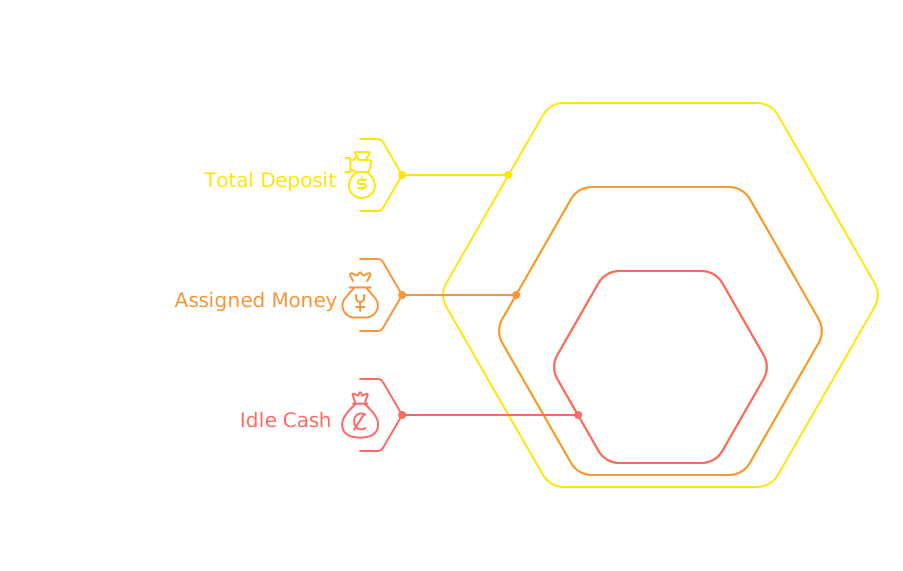
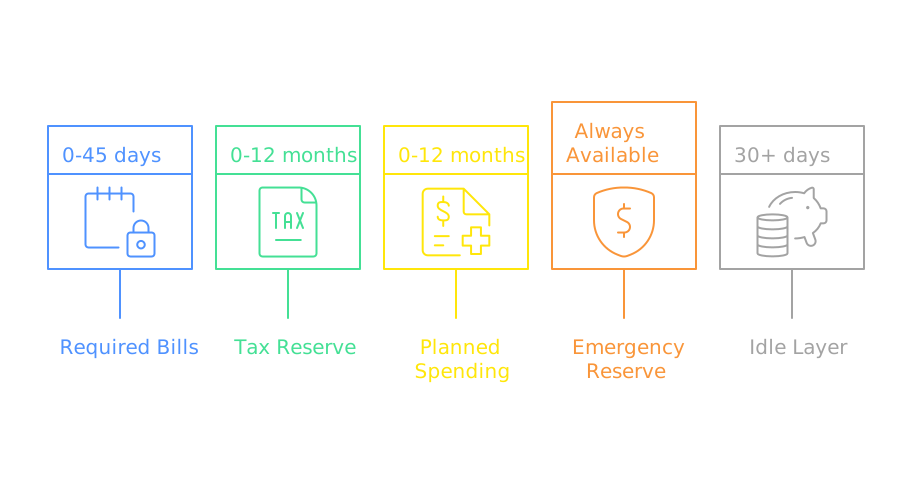
When a bonus, RSU vest, tax refund, commission check, severance payment, or other large deposit lands in checking, do not move the whole amount at once. First, label the cash by job: taxes, bills, near-term spending, debt, planned purchases, emergency reserves, and true idle cash.
The mistake is treating one large deposit as one decision. A 40,000 dollar balance may include a 9,000 dollar tax reserve, a 6,000 dollar credit-card payment, a 5,000 dollar vacation fund, and only 20,000 dollars that can safely be optimized. That is why the right workflow starts with a safe balance, not with the highest visible yield.
TL;DR
- A large checking deposit is not automatically idle cash. First separate required money from the dollars that can sit for 30, 60, or 90 days.
- The first rule is to protect the next 30-45 days of bills, autopay, rent, mortgage, credit cards, taxes, and known transfers before optimizing anything.
- Idle cash is the amount left after bills, near-term spending, tax reserves, emergency cash, and planned purchases are assigned.
- The national average interest checking rate was 0.07% in June 2026, according to FRED's ICNDR series, so a large balance can quietly under-earn if it stays in checking for months.
- Rivo fits when the same lumpy-cash problem repeats after paychecks, bonuses, RSUs, or refunds, and you want the idle layer moved into short-duration U.S. Treasury Bills while keeping your existing bank.
- Rivo listed a 3.65% gross annualized rate as of July 1, 2026, before fees and subject to change, on the Rivo rates page. The fee is 0.05% per month, based on the Rivo help center.
The First Thing to Do After a Bonus, RSU, or Tax Refund Hits Checking
The first thing to do is pause and assign the deposit before you optimize it. The cash may feel available because it is visible in checking, but some of it may already belong to taxes, debt, bills, a planned purchase, or a delayed transfer.
This is especially important for high-income households, tech employees, commission earners, and dual-income families. Their checking balances can jump by 10,000 dollars, 25,000 dollars, 50,000 dollars, or more after a single payroll event, but the visible balance is not the same as available idle cash.
The 5-bucket sort
The useful question is not "Where can I earn the highest rate?" The useful question is "Which dollars have no job for at least the next 30 days?"
Why a large deposit feels harder than normal cash flow
Large deposits create a false sense of simplicity. A 4,000 dollar paycheck gets absorbed by bills and spending quickly. A 40,000 dollar bonus sits there, looks safe, and avoids a decision.
That hesitation is rational. Moving money out of checking can create anxiety if rent, mortgage, credit-card autopay, tuition, insurance, or taxes are coming. The problem is that the hesitation can last for 3 months, 6 months, or 12 months.
What counts as a "large" checking deposit?
There is no universal cutoff. For one household, 5,000 dollars is a large deposit. For another, 50,000 dollars is normal after an annual bonus or RSU vest.
Use this practical rule: a deposit is "large" when it pushes checking above your normal 30-90 day balance range. If your checking account usually sits between 8,000 dollars and 16,000 dollars, a jump to 35,000 dollars deserves a written cash plan.
Why Do Bonuses and RSUs Sit in Checking for Too Long?
Bonuses, RSUs, tax refunds, and commission checks sit in checking because they are multi-decision deposits. They force you to make several decisions at once: how much to save, how much to invest, how much to reserve for taxes, how much to keep liquid, and how much to spend.
That is why lumpy cash often becomes idle cash. Not because the owner is careless. Because the decision has edge cases.
The decision stack
The bigger the deposit, the easier it is to rationalize doing nothing. You can tell yourself the cash is safe. That may be true for bill coverage, but it is not a complete cash-management plan.
Why checking becomes the default parking place
Checking is the path of least resistance. Direct deposit lands there. Credit cards pull from there. Mortgage, rent, utilities, and subscriptions pull from there. You can see the number every day.
The default is convenient, but convenience has a cost. U.S. households and nonprofit organizations held 5.948 trillion dollars in checkable deposits and currency at the end of Q1 2026, according to FRED's CDCABSHNO series. That number does not mean every dollar is idle, but it shows how much household liquidity sits close to checking.
The "I'll decide later" problem
"Later" is not a plan. It is a temporary placeholder that can become permanent.
If a 30,000 dollar bonus sits for 90 days at a checking rate near the June 2026 national average of 0.07%, based on FRED ICNDR, the cash is not working very hard. If part of that balance is truly needed in checking, keep it there. If part is idle, the decision should be explicit.
Calculate the Safe Balance Before Moving Any Money
Your safe balance is the minimum amount you want in checking before any optimization happens. It should cover bills, autopay, normal spending, known irregular expenses, and a comfort margin.
For lumpy deposits, the safe balance is more important than the yield choice. If the floor is wrong, even a good cash destination can create stress.
Safe balance formula
In this example, a 50,000 dollar post-bonus checking balance does not mean 50,000 dollars is available to move. It means 26,500 dollars may be the first candidate for optimization after the 23,500 dollar safe balance is protected.
Use 30-45 days for most households
A 30-day view works for simple cash flow. A 45-day view is safer when bills cluster, income timing changes, or credit-card autopay is large. A 90-day view can make sense for households with quarterly tax payments, variable income, tuition, insurance premiums, or upcoming purchases.
The point is not to keep the maximum possible amount in checking. The point is to keep enough money in checking that bills are boring.
Link this to your existing safe-balance rule
If you already have a written rule for checking, use it. If you do not, start with the full safe-balance formula in How Much Money Should You Keep in Checking?.
That article covers the recurring version of the same problem. This article covers the lumpy-deposit version.
How Much of a Bonus or RSU Is Actually Idle Cash?
The idle portion is the cash left after every required job has been assigned. If a 60,000 dollar RSU sale lands in checking, do not call it idle until taxes, bills, planned investments, spending, and emergency reserves are separated.
Idle cash is not "extra money" in the emotional sense. It is operationally unassigned cash that can sit outside checking without risking bills or planned payments.
Worked example: 60,000 dollar RSU sale
This is a workflow example, not tax advice. RSU withholding, capital gains, state taxes, and employer payroll treatment can vary. A tax professional should review the tax reserve if the amount is material.
Worked example: 12,000 dollar tax refund
The smaller the idle layer, the more effort matters. If the candidate idle layer is 2,500 dollars and you would need to open a new account, set reminders, and manage transfers, automation may matter more than a marginal yield difference.
Worked example: 80,000 dollar annual bonus
This is the exact moment where many households freeze. The account looks strong. Bills are covered. The household feels responsible. Then the idle layer sits for 6 months.
Options After You Find the Idle Layer
Once the idle layer is clear, compare options by job. Checking is for transactions. A high-yield savings account is a bank deposit option. Treasury bills are short-term U.S. government obligations. Money market funds are brokerage-based cash vehicles. Rivo is automated cash management on top of your existing checking account.
The right option depends on access, tax treatment, manual effort, bill timing, and whether the cash will stay idle.
Option comparison for lumpy deposits
This is not a ranking. It is a fit table. A person with a 3-week tuition payment should not optimize like a person with a recurring 25,000 dollar idle layer after every RSU vest.
Treasury bills in one sentence
Treasury bills are short-term debt obligations issued by the U.S. Treasury, with terms ranging from 4 weeks to 52 weeks, sold at a discount or at par, and paid at face value when they mature, based on TreasuryDirect's Treasury bill overview.
TreasuryDirect also notes a 100 dollar minimum purchase and 100 dollar increments for bills, plus federal tax due on interest and no state or local taxes on Treasury bill interest, on the same TreasuryDirect page.
Where Rivo fits in the option set
Rivo fits when the money starts in checking, the user wants to keep the current bank, and the hard part is not understanding yield. The hard part is remembering to move the right amount at the right time.
Rivo Autopilot lets users set a minimum checking threshold, connects through Plaid, analyzes cash flow, moves idle cash, and refills before bills. The product details are available in the Rivo help center and the broader explanation is in What Is Rivo?.
When Should You Leave the Cash in Checking?
Leave the cash in checking when it has a near-term job, when timing is unclear, or when moving it would create anxiety that outweighs the benefit. Optimization is not the goal if the deposit is already assigned.
Checking still matters. It is the operating account for bill payment, rent, mortgage, debit activity, credit-card autopay, payroll, and everyday cash flow.
Leave it in checking if any of these are true
- The money is needed in the next 7-30 days.
- A tax payment is due soon and the amount is not finalized.
- A credit-card autopay, rent, mortgage, insurance premium, or tuition payment is coming.
- You are between jobs, waiting on income, or managing severance.
- You are buying a home, car, or other large item and the closing date may change.
- You have not separated the deposit into tax, bill, savings, spending, and idle buckets.
- Moving the money would require you to monitor transfers manually every few days.
The biggest false signal: "I might need it"
"I might need it" is sometimes true. It is also sometimes a sign that the safe balance has not been calculated.
If you might need all 50,000 dollars, keep it liquid. If you might need 25,000 dollars, assign 25,000 dollars and evaluate the rest. The goal is not to push money out of checking. The goal is to stop treating assigned cash and idle cash as the same thing.
The checking account's job
A checking account should prevent overdrafts, failed payments, missed autopay, and household stress. It should not become a permanent parking lot for money that has no bill-related job.
For a deeper version of that decision, read Are You Keeping Too Much Money in Checking?.
When Is It Worth Moving the Idle Layer?
It is worth moving the idle layer when the expected benefit is larger than the effort, risk, and monitoring burden. The calculation changes with balance size, time horizon, checking yield, alternative yield, taxes, and automation.
The national average interest checking rate was 0.07% in June 2026, based on FRED ICNDR. Rivo listed a 3.65% gross annualized rate as of July 1, 2026, before fees and subject to change, on the Rivo rates page. The difference is enough to matter when the idle balance is large or persistent.
Simple annualized math before fees and taxes
This table uses the June 2026 national interest checking rate from FRED and the July 1, 2026 Rivo gross annualized rate from the Rivo rates page. It is illustrative math, not a promise of future results.
Monthly fee reality check
Rivo charges a 0.05% monthly management fee based on average daily balance, according to the Rivo help center. That is about 0.60% per year before compounding.
The fee matters most when balances are small or when the user would actually manage Treasury bills manually for free. The fee matters less when the real failure mode is inaction, missed transfers, abandoned savings workflows, or recurring idle cash after every large deposit.
90-day and 180-day idle-cash examples
The table below uses 0.07% checking from FRED ICNDR, 3.65% gross annualized yield from the Rivo rates page, and 0.05% monthly fee from the Rivo help center. It is rough scenario math, not a projection.
The point is not that every user should move every idle dollar. The point is that time matters. A 10,000 dollar idle layer for 14 days is a small operational issue. A 100,000 dollar idle layer for 365 days is a cash-management policy issue.
Quick threshold guide
Use this as a triage tool. The exact answer still depends on taxes, fees, transfer timing, bill timing, and whether the cash needs same-day access.
Timing checkpoints to use before you move cash
Use 1, 7, 14, 30, 60, and 90 as the decision checkpoints. Each number marks a different cash-flow question: cleared deposit, bill calendar, balance persistence, idle-cash classification, planned-use review, and automation readiness.
- Day 1: confirm the deposit cleared and no reversal, correction, or payroll adjustment is pending.
- Day 7: confirm the next 30 days of bills, autopay, transfers, rent, mortgage, or tuition.
- Day 14: check whether the balance is still above the safe balance after normal spending.
- Day 30: classify any remaining excess as recurring idle cash, temporary cash, or date-attached cash.
- Day 60: review whether the money still has no planned use.
- Day 90: decide whether the same rule should run automatically next time.
Time horizon test
If the idle layer appears once, a manual plan may be enough. If the idle layer appears every paycheck, quarter, bonus cycle, or tax season, the problem is no longer one deposit. It is a cash-management system problem.
What Should You Do With a Bonus If Taxes Are Unclear?
If taxes are unclear, do not optimize the uncertain tax portion. Keep it assigned until your withholding, estimated tax payment, state tax, local tax, and year-end plan are clear.
This is not about fear. It is about labeling. Tax money is not idle cash.
Tax reserve checklist
- Check the net deposit, not the headline bonus or grant value.
- Review whether federal withholding covered your likely tax bracket.
- Review state tax exposure if you live in a state with income tax.
- Separate RSU withholding from any later stock-sale gain or loss.
- Include estimated taxes if you have self-employment, commission, consulting, or other variable income.
- Keep the tax reserve separate from the idle layer until a tax professional or your own tax plan confirms the amount.
Why RSUs deserve extra caution
RSUs can create multiple cash events: vesting, withholding, sale, capital gain or loss, and a later tax filing. A simple "cash landed in checking" view may hide the tax complexity.
If the RSU cash will be used for taxes, it is assigned. If it will be reinvested soon, it is assigned. If it is left over after those decisions, that remainder may become idle cash.
Tax treatment of T-bill interest
TreasuryDirect lists federal tax due on Treasury bill interest and no state or local taxes on the Treasury bill overview. That is one reason short-duration Treasury bills can be relevant for cash held by people in high-tax states.
This is tax information, not tax advice. Rivo, Jiko Group, Inc., and affiliates do not provide legal, tax, or accounting advice. Consult a legal or tax advisor before making financial decisions.
How Can You Prevent the Same Deposit From Becoming Idle Again?
The fix is a written rule. Without a rule, every future bonus, RSU vest, refund, reimbursement, severance payment, or commission check becomes a fresh decision.
The rule does not need to be complex. It should tell you what stays in checking, what gets assigned, what can move, and what happens automatically.
A practical lumpy-cash rule
This turns a vague question into an operating policy.
Why manual rules often fail
Manual rules require follow-through. You need to check the balance, remember the bill calendar, move money, track transfers, reverse the move before bills, and repeat after every deposit.
That is exactly where many households fall off. They know the right idea, but the workflow is annoying enough that it does not happen consistently.
Where automation helps
Rivo is built for the recurring version of this problem. It works with an existing bank account, lets the user configure a minimum checking threshold, identifies idle cash above that floor, and moves money back before bills, based on the Rivo help center.
For a deeper product walkthrough, read How Much Should You Keep in Checking With Irregular Income?.
What If You Want to Keep Your Existing Bank?
You do not need to switch banks just because a large deposit landed in checking. The more precise question is whether your existing bank should remain the operating account while idle cash above the safe balance is managed elsewhere.
That distinction matters. Many people delay action because they think optimization means changing direct deposit, moving bill pay, opening multiple accounts, or rebuilding their financial life. Rivo is designed around a different premise: keep the bank, automate the idle layer.
Keep-bank workflow
This is why Does Rivo Replace Your Bank? matters as an internal next read. The answer is no. The product works on top of the existing bank relationship.
Why this matters after a bonus
After a bonus or RSU vest, most people are not looking for a new bank. They are trying to avoid wasting the idle layer while keeping bill payment simple.
That is the practical opening for Rivo. The product does not need to replace the checking account. It needs to identify the dollars that can leave checking temporarily and come back before they are needed.
Control still matters
Automation should not remove control. Rivo users can set minimum balances, customize thresholds, pause or stop automation, and withdraw available funds through the app up to 15,000 dollars per day, based on the Rivo help center.
If your main concern is liquidity and bill timing, that control layer is part of the decision.
The Best Plan for Different Types of Large Deposits
Different deposits need different rules. A tax refund, RSU vest, bonus, commission check, inheritance, or severance payment may all arrive in checking, but the right cash plan is not identical.
Use the deposit type to define the first constraint.
Deposit-by-deposit routing table
The key is not the label on the deposit. The key is whether the cash has a date attached.
Date-attached cash
Date-attached cash has a known use. Examples include a tax payment due in 60 days, a mortgage payment due on the first of the month, or a tuition payment due in August.
Date-attached cash should not be treated like long-term idle cash. It may still be held in a yield-bearing place depending on timing, but the decision is stricter because the date matters.
No-date cash
No-date cash is the portion that remains after known obligations are handled. That is the strongest candidate for automated cash management, Treasury bills, savings, or another short-term cash option.
If you are not sure whether the cash has a date, assume it does until you assign it.
How Does Rivo Fit After You Identify Idle Cash?
Rivo fits after the safe balance is set and the idle layer is clear. It is not the first step. The first step is classification.
Once classification is done, the decision becomes practical: do you want to manage the idle layer manually, or do you want software to handle recurring cash movement around bills?
Rivo fit matrix
Rivo works best for people with meaningful checking balances. The Rivo help center says the product works best for households with 5,000 dollars or more in checking, though there is no hard minimum and smaller balances may not earn enough to matter.
Rivo is not a bank deposit account
Rivo is a fintech company, not a bank. Banking services are provided by Jiko Bank, a division of Mid-Central National Bank. Securities and Treasury investments are provided by Jiko Securities, Inc., a registered broker-dealer and member FINRA/SIPC.
The distinction matters because short-duration T-bill holdings are different from checking or savings deposits. If you want a bank deposit product, use a bank deposit product. If you want an automated T-bill cash-management workflow on top of checking, evaluate Rivo.
What to read next if you are evaluating Rivo
Start with What Is Rivo?, then read Are Treasury Bills Safe for Short-Term Cash? and Rivo vs TreasuryDirect.
Those articles cover the product, the safety structure, and the DIY comparison.
What Mistakes Should You Avoid After a Large Deposit?
The biggest mistakes are moving too much, moving too little, ignoring taxes, and confusing a temporary balance spike with permanent idle cash.
The goal is not to maximize every dollar for every day. The goal is to create a cash workflow that protects bills and prevents long-term idle drag.
Mistake table
Mistake 1: Treating the deposit as one pile
A large deposit is usually several jobs in one pile. If you move the whole pile, you may accidentally move money needed for taxes, tuition, credit cards, or a home project.
Split first. Optimize second.
Mistake 2: Waiting for the perfect answer
Waiting for perfection can leave cash idle for months. You do not need to solve your entire financial life in 1 sitting. You need to identify which part is safe to move and which part is not.
Mistake 3: Comparing only yield
Yield is important, but it is not the whole decision. A 4-week T-bill, a high-yield savings account, a brokerage money market fund, and an automated cash-management product have different workflows, protections, tax treatment, fees, and failure modes.
For a broader comparison, read Treasury Bills vs Money Market Funds vs High-Yield Savings.
What Should a Simple 7-Day Plan Look Like After the Deposit Hits?
A 7-day plan prevents same-day overreaction while keeping the cash from disappearing into checking inertia. It gives you enough time to see pending payments, confirm the deposit, and assign the money.
Use this plan after a bonus, RSU sale, tax refund, severance payment, inheritance, home sale, or commission check.
Day-by-day plan
This is enough structure for most households. If the deposit is complex, slow down and get professional tax or financial advice before moving the uncertain portion.
The 24-hour rule
Do not make a large transfer within 24 hours just because the balance looks high. Let pending charges, payroll corrections, withholding questions, and bill timing settle first.
The 24-hour rule is not procrastination. It is classification time.
The 14-day idle trigger
If cash remains above the safe balance for 14 days after classification, it is more likely to be a real idle layer. That is when a manual transfer rule or Rivo-style automation becomes more relevant.
FAQ
Should I move my entire bonus out of checking?
Usually no. Move only the portion above your safe balance, tax reserves, known bills, and planned spending. A bonus can include multiple jobs, so the whole deposit should not be treated as idle cash.
How long should I wait before moving bonus money?
A practical default is 7 days for classification and 14 days for an idle-cash trigger. Shorten that if the cash has a clear job. Lengthen it if taxes, job changes, home purchases, or major bills are uncertain.
Are RSU proceeds idle cash?
Only after taxes, investment decisions, and near-term spending are assigned. RSU proceeds can look like cash, but tax withholding and reinvestment plans may change how much is actually idle.
Is a tax refund idle cash?
Not automatically. A tax refund can rebuild an emergency reserve, pay debt, fund planned expenses, or become idle cash. The leftover amount after assigned jobs is the candidate idle layer.
Can Rivo help with lumpy deposits?
Rivo can help when lumpy deposits create recurring idle checking cash above a user-set minimum balance. It is most relevant when you want to keep your bank, avoid manual transfers, and have idle cash moved back before bills.
Can I lose money if idle cash is moved into Treasury bills?
Treasury bills carry standard fixed-income risks. TreasuryDirect says bills can be held to maturity or sold before maturity, and Rivo uses short-duration U.S. Treasury Bills through Jiko Securities. If securities are sold before maturity, price changes can affect realized value.
Related Rivo Reading
- To separate the tax reserve inside a bonus, RSU, or other large deposit, read Why Does Your Checking Account Look High Before Taxes Are Due?.
- To size the checking floor, read How Much Money Should You Keep in Checking?.
- If large deposits are becoming a permanent checking cushion, read Why Do High Earners Keep So Much Money in Checking?.
- To distinguish a payroll-calendar deposit from a true windfall, read Is a Third Paycheck Really Extra Money?.
- To see the product workflow, read How Does Rivo Autopilot Work?. • For a deeper product walkthrough, read How Does Rivo Autopilot Work?. • To start from a specific checking balance, read What Should You Do With $20,000 Sitting in Your Checking Account?. • To decide whether moving money is worth it, read Is It Worth Moving Money Out of Checking?. • To calculate the dollar gap, read Checking Account Interest Calculator.

This article is educational and is not financial, investment, legal, accounting, or tax advice.
Yield rate reflects the 4-week T-bill rate when held to maturity. Rate does not include fees. Rates are subject to change. Minimum balance of $100 required to earn the stated rate.
Rivo is a fintech company, not a bank. Banking services provided by Jiko Bank, a division of Mid-Central National Bank. Jiko Group, Inc. and its affiliates do not provide legal, tax, or accounting advice. You should consult your legal and/or tax advisors before making any financial decisions. This material is not intended as a recommendation, offer or solicitation for the purchase or sale of any security or investment strategy. See FINRA BrokerCheck, Jiko U.S. Treasuries Risk Disclosures and Jiko Securities Inc. Form CRS.
Investments in T-bills: Not FDIC Insured - No Bank Guarantee - May Lose Value. All U.S. treasury investments and investment advisory services provided by Jiko Securities, Inc., a registered broker-dealer, member FINRA and SIPC. Securities in your account are protected up to $500,000. For details, please see www.sipc.org.
External References
- Rivo rates page: https://www.rivofi.com/big-bank-checking-account-rates
- Rivo help center: https://www.rivofi.com/faqs
- FRED national interest checking rate: https://fred.stlouisfed.org/series/ICNDR
- FRED household checkable deposits and currency: https://fred.stlouisfed.org/series/CDCABSHNO
- FRED 4-week Treasury Bill secondary market rate: https://fred.stlouisfed.org/series/DTB4WK
- TreasuryDirect Treasury bills: https://www.treasurydirect.gov/marketable-securities/treasury-bills/
- Jiko Treasury risk disclosure: https://jiko.io/docs/treasuries_risk_disclosure.pdf
- SIPC investor protection overview: https://www.sipc.org/for-investors/what-sipc-protects
.jpeg)
Ambrish Tyagi is the founder and CEO of Rivo. Previously led AI at Cruise and Amazon.
Follow on LinkedInGet Rivo Updates
Product news, money insights, and company updates.