What Is Cash Drag? How Idle Checking Cash Reduces Your Real Return
Learn what cash drag is, how to calculate it on checking cash, when it's acceptable, and how to reduce it without missing bills.
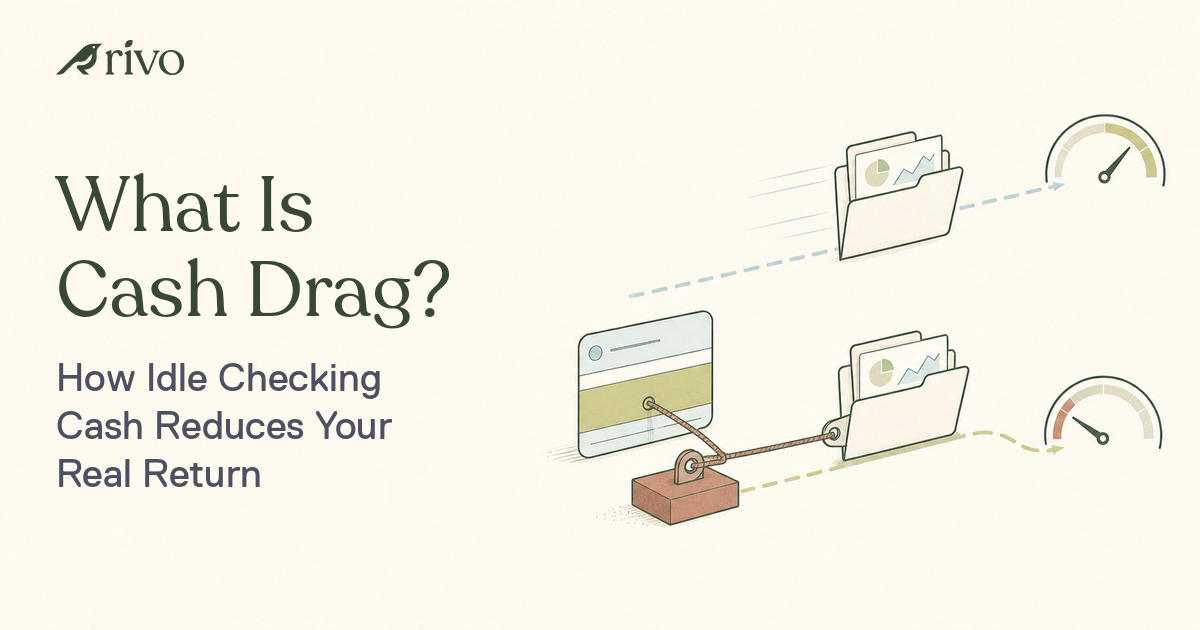
Cash drag is the return you give up when too much of your money sits in cash that earns little or nothing. In a checking account, cash drag starts when your balance rises above what you need for bills, spending, transfers, and a safe balance.
Some cash should stay in checking. Rent, mortgage payments, credit cards, utilities, payroll timing, taxes, and surprise expenses need liquid money. The problem is the extra layer: cash that feels safe because it is visible, but quietly earns far less than available short-term cash options.
TL;DR
- Cash drag is the gap between what your idle checking cash earns and what the same safe-to-access cash could have earned elsewhere.
- The national rate for interest checking was 0.07% in June 2026, while the 4-week Treasury Bill secondary market rate was 3.67% on July 16, 2026.
- U.S. households and nonprofits held about $5.95 trillion in checkable deposits and currency in Q1 2026, so even small rate gaps can become large at household scale.
- Cash drag is not always bad. The first layer of checking cash protects your bills. The drag starts when the same cash sits above your safe balance for weeks or months.
- A $25,000 idle checking balance earning 0.07% instead of 3.67% creates about $900 of annual gross return gap before fees and taxes, using an illustrative same-balance calculation.
- Rivo is built for the idle layer above your safe balance: keep your bank, set your minimum checking floor, and let idle cash move into short-duration U.S. Treasury Bills through Jiko Securities.
- Investments in T-bills are not FDIC-insured bank deposits. They are securities, carry standard fixed-income risks, and require the disclosures at the end of this article.
Quick Answer: What Is Cash Drag?
Cash drag is the performance loss caused by holding more cash than you need in a low-yield place. In investing, the term often describes a portfolio that earns less because part of it sits uninvested. In household cash management, it describes idle checking cash that could still be liquid but is not earning a meaningful return.
.svg)
The key word is "excess." The $3,000 you need for this month's rent is not cash drag. The $30,000 that has been sitting above your normal bill and spending needs for 4 months might be.
The table matters because cash drag is not a judgment about being "bad with money." It is a classification problem. You decide which dollars are operating cash, which dollars are emergency cash, and which dollars are idle cash.
If you have not defined those layers yet, start with What Is Idle Cash? and How Much Money Should You Keep in Checking?. Cash drag becomes easier to solve after the safe balance is clear.
What Counts as Cash Drag in a Checking Account?
Cash drag in checking is the extra return gap created by idle cash above your safe balance. It is not the full checking balance, because a checking account has a job: it keeps payments from failing.
A practical test is simple: if the money is needed in the next 7-30 days, it is probably operating cash. If it has sat there through multiple pay cycles without being needed, it may be idle cash.
The common mistake is treating the whole balance as one pile. That creates two bad decisions. You either keep too much because you fear missed bills, or move too much and create bill stress.
The better model is layered:
- First, protect payments.
- Second, define your safe balance.
- Third, measure the dollars above that safe balance.
- Fourth, decide whether those dollars deserve a better home.
Rivo uses this same logic. You set a safe balance, and only the cash above that minimum is considered for movement. That matters because the goal is not to maximize yield at any cost. The goal is to reduce avoidable drag without breaking bill reliability.
Why Does Cash Drag Matter More When Short-Term Rates Are High?
Cash drag gets larger when the gap between checking yields and short-term market yields widens. In June 2026, the national rate for interest checking was 0.07%. On July 16, 2026, the 4-week Treasury Bill secondary market rate was 3.67%.
Those two numbers are not identical products. Checking is a bank deposit account. Treasury Bills are U.S. government obligations. They have different insurance, tax, access, and risk profiles. But the gap is useful because it shows why idle cash has an opportunity cost.
This is why a checking strategy that worked in one year may quietly fail in another year. If your checking account pays 0.07% while short-term Treasury yields are several percentage points higher, the drag is not theoretical. It shows up as dollars you did not earn.
The household scale is large. FRED shows U.S. households and nonprofits held about $5.95 trillion in checkable deposits and currency at the end of Q1 2026. That series includes more than one person's checking account, but it shows how much money can sit in transaction-ready form.
How Do You Calculate Cash Drag on Checking Cash?
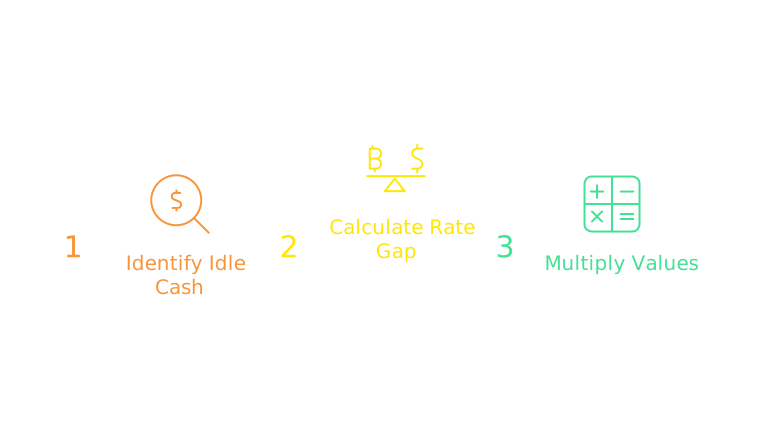
The simplest formula is:
Cash drag = idle cash x alternative annualized return - idle cash x checking rate
That is the gross version. A better version also subtracts fees, taxes, transfer delays, and any risk cost you care about.
Here is the same math using the June 2026 interest checking rate of 0.07% and an illustrative short-term Treasury reference of 3.67% on July 16, 2026. This is not a forecast. It is a same-scenario example using public rate data.
The math is not hard. The behavior is hard.
You have to know what is idle, move it, keep enough for bills, handle transfer timing, update the amount when spending changes, and remember to move money again after each bonus, RSU vest, tax refund, or large deposit. That is why cash drag often persists even for financially literate people.
If you want a direct worksheet, use the Checking Account Interest Calculator after you define your safe balance.
How Much Cash Drag Is Worth Caring About
Cash drag becomes worth solving when the dollar gap is larger than the effort, risk, and attention cost of fixing it.
For some people, $50 per year is not worth another account, app, or transfer rule. For others, $1,000 per year is enough to justify a system that runs in the background.
This is where Is It Worth Moving Money Out of Checking? becomes the next useful question. A move is worth it only if you can maintain access, avoid bill errors, and keep the process alive.
The break-even rule:
- If the balance is below $5,000 and changes constantly, simplicity may matter more than return.
- If the balance is $10,000-$25,000 and stays idle for months, the drag becomes visible.
- If the balance is $50,000 or more, even a conservative return gap can become four figures per year.
- If the cash belongs to an upcoming tax payment, house down payment, or tuition bill, treat the date and access need as more important than yield.
The point is not to move every dollar. The point is to stop letting the idle layer blur into the bill-payment layer.
When Cash Drag Is Acceptable
Cash drag is acceptable when it buys something valuable: certainty, bill safety, emotional comfort, or immediate access. A checking account is supposed to reduce payment failure risk. It is not supposed to be a performance engine.
The problem starts when you keep paying for safety you no longer need.
Cash drag is not a moral failure. It is a trade-off. You pay a return cost in exchange for access and simplicity.
But most people do not choose that trade-off consciously. The money lands in checking, bills keep clearing, nothing breaks, and the balance becomes invisible. That is how a temporary cushion turns into a permanent low-yield cash pile.
Why Do Smart People Still Let Cash Drag Build Up
Smart people tolerate cash drag because the friction is not intellectual. It is operational.
You can understand the math and still not want to move money. You may have irregular income, variable credit card bills, rent timing, childcare costs, quarterly taxes, reimbursements, or a spouse who uses the same account. Each edge case makes manual optimization feel risky.
Consumer behavior data supports the gap between knowing and acting. Santander reported that a Morning Consult survey of 2,206 U.S. adults found misperceptions kept many Americans from earning more on their money. A separate Dynata survey conducted in 2023 found that 82% of Americans were not using a high-yield savings account.
The lesson is not that people are careless. The lesson is that cash management has too many tiny decisions for a monthly to-do list.
Cash Drag vs the Inertia Tax
Cash drag is the mechanical return gap. The inertia tax is the behavioral cost of letting that gap continue.
They are connected, but not identical.
This distinction matters for content and for action.
If you ask, "How much return am I giving up?" you are measuring cash drag. If you ask, "Why have I not fixed this for 9 months?" you are dealing with inertia. If you ask, "Why does my bank not automatically pay me the market rate?" you are looking at bank spread and deposit economics.
Rivo is mostly aimed at the second and third problems. The product does not merely show a calculation. It creates a system for the idle layer so the calculation does not depend on your attention every month.
The Main Ways to Reduce Cash Drag
You can reduce cash drag manually, through a different account, through brokerage cash tools, through Treasury Bills, or through automation. The right answer depends on how much control you want, how much access you need, and how reliably you maintain the process.
High-yield savings can be a good fit if you want FDIC-insured deposits and do not mind moving money yourself. TreasuryDirect can work if you enjoy managing bills, auction dates, maturities, and transfers. Brokerage cash tools can work if you already manage cash inside a brokerage account.
Rivo is for a narrower behavioral problem: you want the idle layer to work, but you do not want to switch banks, rebuild bill pay, or manage a manual system. For a broader comparison, read Treasury Bills vs Money Market Funds vs High-Yield Savings and Rivo vs High-Yield Savings vs Treasury Bills.
Where Rivo Fits in a Cash Drag Plan
Rivo fits when the drag is recurring, the checking balance is meaningful, and the biggest blocker is behavior rather than knowledge.
You connect your existing checking account, set a safe balance, and Rivo monitors the cash above that floor. Idle cash can move into short-duration U.S. Treasury Bills through Jiko Securities, and money can move back before bills or transfers are due.
Rivo is not the right answer for every kind of cash.
Use it when:
- You have $5,000+ in checking often enough for the earnings to matter.
- You do not want to change direct deposit, bill pay, or your primary bank.
- You want idle cash above a safe balance handled automatically.
- You understand that T-bill holdings are securities, not FDIC-insured checking deposits.
- You prefer paying a fee for automation over maintaining a DIY transfer routine.
Avoid it when:
- You want only FDIC-insured bank deposits.
- You want to manage Treasury Bills yourself for no software fee.
- Your checking balance is usually below your safe balance.
- You need every dollar available for imminent bills.
- You are uncomfortable with securities, even short-duration government obligations.
For product mechanics, read How Does Rivo Autopilot Work?, Rivo Fees Explained, and Does Rivo Replace Your Bank?.
What Risks Matter When You Reduce Cash Drag
Reducing cash drag is not only about finding the highest number. You are changing where money sits, how quickly you can access it, and what kind of protection applies.
TreasuryDirect states that what you earn from Treasury marketable securities is subject to federal tax but exempt from state and local taxes. That tax treatment can matter for households in high-tax states, but it is not a reason to ignore risk, fees, or liquidity needs.
SIPC states that the limit of protection is $500,000, including a $250,000 cash limit. SIPC is different from FDIC insurance. It is not protection against market price changes.
Jiko disclosures for Treasury products state that T-bills are not FDIC insured, have no bank backing, and may lose value. Those words should stay visible in any cash-drag plan that uses T-bills.
The point is not to scare you away from earning more. The point is to avoid solving one problem by creating another one.
The 7-Day Cash Drag Audit
The fastest way to deal with cash drag is to audit one week of cash movement, not one year of financial history.
Here is a sample:
This is not financial advice. It is a measurement framework. Your actual safe balance may be higher or lower depending on bill timing, income volatility, family needs, and risk tolerance.
If you want to reduce cash drag without changing banks, read Can You Earn More on Checking Cash Without Switching Banks?.
What to Do Once You Find Cash Drag
Once you find the idle layer, choose the lowest-friction path you will actually maintain.
For lumpy deposits, read What Should You Do When a Bonus, RSU, or Tax Refund Lands in Checking?. Cash drag often spikes after large deposits because the cash feels temporary, then sits untouched for months.
For bill anxiety, read Can You Move Money Out of Checking Without Missing Bills?. Most cash-drag mistakes happen when people skip the safe-balance step.
The Mistakes That Make Cash Drag Worse
Cash drag gets worse when people compare rates without first defining the job of each dollar. A household with $40,000 in checking does not necessarily have $40,000 of idle cash. It may have $18,000 of bill money, $7,000 of normal spending, $5,000 for a known expense, and $10,000 of true surplus.
The goal is to avoid two opposite mistakes: leaving everything idle because moving money feels risky, or moving too much because the return gap looks large.
Mistake 1: using average balance instead of persistent surplus
Average balance can exaggerate or hide the problem. A checking account that briefly holds $50,000 after a home sale is different from a checking account that sits near $50,000 for 6 months. Cash drag is most useful when measured on the persistent surplus, not the peak balance.
Mistake 2: comparing only the largest public rate
The highest visible rate is not automatically the best fit. You still need to compare access, state tax treatment, fees, transfer timing, withdrawal rules, minimum balances, and whether the system is something you will maintain. A smaller net result that runs every month can beat a larger headline result you abandon after 2 transfers.
Mistake 3: moving money before mapping bills
The safe-balance step comes before the yield step. If a credit card autopay pulls $6,000 on the 18th, a rent payment pulls $4,000 on the 1st, and a tax payment is due in 3 weeks, those dollars have jobs. Moving them just to reduce drag can create a worse problem than low yield.
Mistake 4: ignoring lumpy deposits
Cash drag often begins after a bonus, RSU vest, tax refund, severance payment, house sale, or reimbursement. The deposit lands, you tell yourself you will decide later, and later becomes 90 days. A standing rule helps: if a large deposit is still there after 30 days, classify it.
Mistake 5: treating every cash product as interchangeable
Checking deposits, high-yield savings deposits, money market funds, Treasury Bills, and automated T-bill strategies do not use the same wrapper. FDIC insurance, SIPC protection, Treasury tax treatment, and fixed-income risk are different. Any cash-drag plan that hides those differences is too simplistic.
The better approach is boring but durable: keep payment cash where it belongs, put a label on idle cash, use the right product wrapper for your risk tolerance, and automate the part you are unlikely to maintain manually.
Final Recommendation
Cash drag is worth solving when a meaningful balance stays above your safe balance for long enough that the return gap beats the effort of fixing it. The first goal is not yield. The first goal is classification: bills, buffer, known expenses, comfort cushion, and idle cash.
After that, the choice is practical. If you enjoy manual systems, use a high-yield savings product, TreasuryDirect, or a brokerage cash tool and maintain the routine. If you already know you will not keep up with transfers, use automation.
Rivo exists for the household that wants to keep its bank, protect bill timing, and put idle checking cash above a safe balance to work in short-duration T-bills. That does not make checking bad. It just stops your safe balance from turning into a permanent low-yield parking lot.
FAQ
Is cash drag always bad?
No. Cash drag is acceptable when it buys liquidity, bill safety, or emotional comfort. It becomes a problem when cash above your safe balance sits for months without a job.
Is checking-account cash drag the same as investment cash drag?
No. Investment cash drag usually means part of a portfolio is sitting in cash instead of invested assets. Checking-account cash drag means extra transaction cash is earning little while reasonable short-term cash options may pay more.
How much checking cash should I keep before worrying about drag?
Start with bills due in the next 30 days, variable spending, known irregular expenses, and a comfort cushion. Anything above that safe balance may be idle cash, especially if it remains unused for multiple pay cycles.
Can I reduce cash drag without switching banks?
Yes. You can move money manually, use a brokerage or Treasury tool, or use Rivo to work on top of your existing checking account. Rivo is designed for people who do not want to change direct deposit, bill pay, or their primary bank setup.
Are Treasury Bills the same as checking deposits?
No. Treasury Bills are securities and direct U.S. government obligations. Checking deposits are bank deposits. The protections, tax treatment, liquidity mechanics, and risks are different.
Does Rivo remove all cash drag?
No. You should still keep a safe balance in checking. Rivo is meant to reduce avoidable drag on idle cash above that floor, not move every dollar out of checking.
Related Rivo Reading
- To understand low checking rates, read Why Is My Checking Account Paying So Little Interest?.
- To define idle cash, read What Is Idle Cash?.
- To distinguish cash drag from purchasing-power loss, read Does Money in Checking Lose Value to Inflation?.
- To understand the cost of inaction, read What Is the Inertia Tax?.
- To decide whether moving money is worth it, read Is It Worth Moving Money Out of Checking?.

This article is educational and is not financial, investment, tax, accounting, or legal advice.
Yield rate reflects the 4-week T-bill rate when held to maturity. Rate does not include fees. Rates are subject to change. Minimum balance of $100 required to earn the stated rate.
Rivo is a fintech company, not a bank. Banking services provided by Jiko Bank, a division of Mid-Central National Bank. Jiko Group, Inc. and its affiliates do not provide legal, tax, or accounting advice. You should consult your legal and/or tax advisors before making any financial decisions. This material is not intended as a recommendation, offer or solicitation for the purchase or sale of any security or investment strategy. See FINRA BrokerCheck, Jiko U.S. Treasuries Risk Disclosures and Jiko Securities Inc. Form CRS.
Investments in T-bills: Not FDIC Insured - No Bank Guarantee - May Lose Value. All U.S. treasury investments and investment advisory services provided by Jiko Securities, Inc., a registered broker-dealer, member FINRA and SIPC. Securities in your account are protected up to $500,000. For details, please see www.sipc.org.
Sources
- FRED: Households and nonprofit organizations checkable deposits and currency
- FRED: National rate for interest checking
- FRED: 4-week Treasury Bill secondary market rate
- FDIC: National rates and rate caps
- TreasuryDirect: Tax forms and withholding for Treasury marketable securities
- SIPC: What SIPC protects
- Jiko agreements and disclosures
- SSRN: The Cross Section of Bank Value
- New York Attorney General: Capital One settlement
- CFPB archived release: Capital One interest payments action
- CNBC report
- https://www.santanderus.com/news_press_article/misperceptions-preventing-americans-from-earning-more-on-their-money-ahead-of-holiday-season-santander-survey-finds/
.jpeg)
Ambrish Tyagi is the founder and CEO of Rivo. Previously led AI at Cruise and Amazon.
Follow on LinkedInGet Rivo Updates
Product news, money insights, and company updates.