How Does Rivo Autopilot Work? Setup, Safe Balance, Fees, and Withdrawals Explained
Learn how Rivo Autopilot works, from bank connection and safe balance setup to T-bill yield, fees, withdrawals, pausing, and bill-aware cash movement.
.png)
Rivo Autopilot works by connecting to your existing checking account, learning your cash flow, keeping a user-set safe balance in checking, moving eligible idle cash into short-duration U.S. Treasury Bills through Jiko Securities, and planning to move money back before bills or transfers hit.
The important point is that Rivo is not asking you to switch banks, move direct deposit, rebuild bill pay, or manually transfer money every week. It is designed to sit on top of your existing checking workflow and automate the part most households delay: deciding which dollars are idle and putting those dollars to work.
If you are still deciding what Rivo is, start with What Is Rivo?. If you already understand the category and want the product workflow, this guide walks through setup, safe balance, yield, fees, withdrawals, pausing, risks, and first-14-day expectations
TL;DR
- Rivo Autopilot connects to your existing bank through Plaid, so you can keep your bank, direct deposit, debit card, and bill pay setup.
- You set a minimum checking threshold, or safe balance. Rivo uses that floor, plus cash-flow analysis, to decide which dollars can leave checking and which dollars should stay available.
- Eligible idle cash is moved into short-duration U.S. Treasury Bills through Jiko Securities. Treasury Bills are investments, not FDIC-insured bank deposits.
- The current Rivo rate reference is 3.65%, reflecting the 4-week T-Bill rate as of July 1, 2026, before fees and taxes. Rates are subject to change.
- Rivo charges a flat 0.05% monthly management fee, or about 0.60% per year, based on the average daily Rivo balance.
- You can pause, modify, stop, or disconnect automation, and you can withdraw available funds through the app up to $15,000 per day.
Quick Answer: What Happens After You Turn On Rivo Autopilot?
After you turn on Rivo Autopilot, four things happen in sequence: Rivo connects to your existing checking account, studies your balance and money movement, keeps your safe balance protected, and moves only eligible idle cash into short-duration U.S. Treasury Bills.
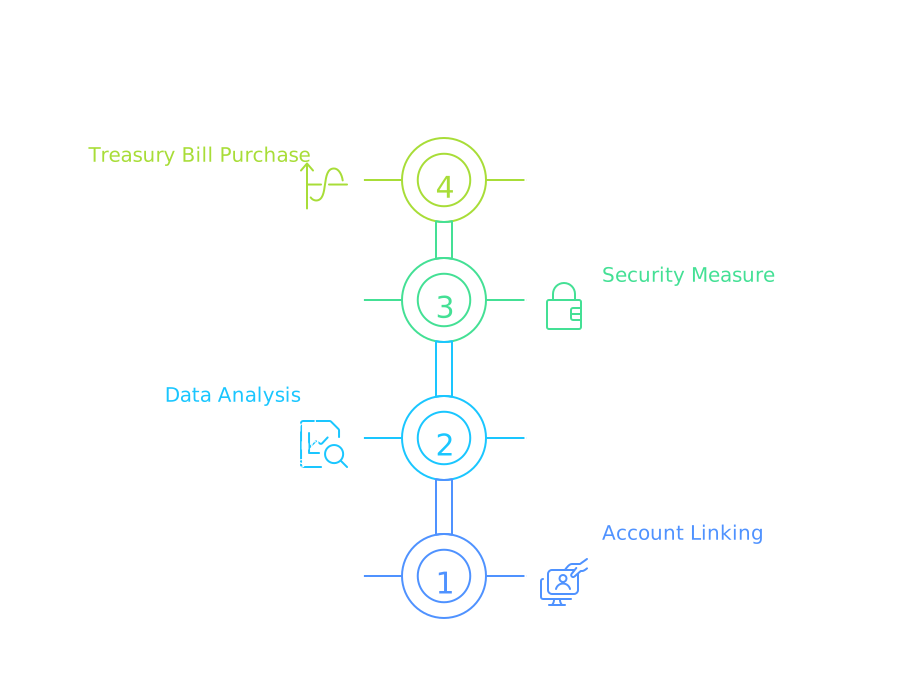
That creates a loop instead of a one-time transfer. Rivo is not trying to empty checking. It is trying to identify the cash that can safely work harder while the bill layer stays covered.
The product loop in 5 steps
The product loop is simple:
- Link checking.
- Set a safe balance.
- Let Rivo identify idle cash.
- Let eligible idle cash earn through 4-week T-bills.
- Let Rivo bring money back before bills, transfers, or spending patterns require it.
What Rivo does not change
Rivo does not require a new primary bank, a direct deposit move, a debit card migration, a bill-pay rebuild, or a new household budget. Your checking account remains the payment hub. Rivo handles the idle layer above the safe balance.
Why this is different from a manual transfer
A manual transfer is a snapshot decision. Rivo Autopilot is a recurring decision system. Manual transfers ask, "How much can I move today?" Rivo asks, "Which cash is idle, what bill timing is coming, and does the safe balance still make sense?"
Rivo Autopilot
Rivo Autopilot is the automated cash-management engine inside Rivo. It is built for households that keep extra money in checking because checking feels operationally safe, but that extra cash earns little or nothing while it sits there.
Rivo Autopilot identifies idle cash above a user-set safe balance, moves that cash into short-duration U.S. Treasury Bills through Jiko Securities, and moves money back before bills and transfers hit.
*Movement of funds is not instant. Transfers to and from your linked account can take up to 3 business days to settle. Rivo plans around known bills but does not guarantee same-day access or specific timing.
That makes the product less like a traditional savings account and more like a bill-aware automation layer for idle checking cash.
The category problem
Most household cash tools solve only part of the problem. Budgeting apps show where money went. Bank accounts store deposits. High-yield savings accounts can pay more, but they still require transfer discipline. TreasuryDirect lets you buy T-bills directly, but it is not built around household bill timing.
Rivo Autopilot is focused on the operational middle: the cash is probably not needed today, but the user does not want to misjudge bills and create an overdraft, late payment, or frantic transfer.
The ideal Rivo Autopilot user
Rivo Autopilot fits people who keep meaningful cash in checking, know some of it is idle, and do not want a recurring cash-management chore. A household with $8,000, $20,000, $50,000, or $100,000 moving through checking may have very different safe-balance needs, but the core question is the same: what amount should remain immediately available, and what amount is truly idle?
The wrong way to evaluate it
Do not evaluate Rivo Autopilot only as a headline yield. Yield matters, but the product is mainly an automation and timing system. The real comparison is between:
- cash staying idle in checking,
- manual transfers that may get forgotten,
- DIY T-bill management that requires attention,
- and automated bill-aware cash movement that runs in the background.
How Does Rivo Connect to Your Existing Bank?
Rivo connects to your existing bank account through Plaid. The product is designed so you can keep your current checking account, direct deposit, debit card, recurring bill payments, and existing bank relationship.
The setup path is intentionally short. You connect the account, confirm the account that should be used for Autopilot, set your minimum checking threshold, and let Rivo analyze cash flow before moving eligible idle cash.
Why one primary checking account matters
Rivo can connect multiple accounts, but Autopilot currently supports earnings for one primary checking account. That matters because bill-aware automation works best when the connected account is the real payment hub. If rent, mortgage, credit cards, utilities, tuition, transfers, and subscriptions all leave one account, Rivo has a clearer signal.
If household payments are spread across 3 or 4 banks, the first job is to choose the account where missed timing would hurt most. For many users, that is the account with mortgage or rent, credit card autopay, utilities, and payroll deposits.
What Rivo needs from the connection
Rivo needs to understand money movement, not just the balance. A $40,000 checking balance can be idle, fully spoken for, or somewhere in between. The difference depends on the next 7, 14, 30, and 45 days of activity.
The connected account gives Rivo the context to separate recurring bills from extra cash.
What does not need to change
You do not need to:
- switch banks,
- move direct deposit,
- cancel existing bill pay,
- open a new everyday checking account,
- rebuild your credit card autopay,
- stop using your debit card,
- or become a Treasury auction expert.
That is the behavioral unlock. Most people do not leave cash idle because they cannot do math. They leave cash idle because changing bank workflows is annoying and manual money movement is easy to postpone.
The Safe Balance, and How to Set It
The safe balance is the minimum amount you want to keep in checking before Rivo moves anything. It is the user's floor, not a Rivo guess. Rivo uses the safe balance as a guardrail for cash movement.
.svg)
The safe balance should cover known bills, near-term card payments, routine spending, irregular expenses, and a comfort cushion. The right number is different for a single renter with 5 bills and a busy family with 20 recurring debits.
If checking holds $35,000 and the safe balance is $13,000, the maximum idle layer is about $22,000. That does not mean every dollar above $13,000 has to move immediately. It means the first $13,000 has a job, while the rest needs a rule.
A conservative starting formula
Start with this formula:
safe balance = next 30 days of fixed bills + next credit card autopay + 14-30 days of variable spending + irregular bill reserve + comfort cushion.
This formula is intentionally conservative. It is easier to lower the safe balance after Rivo has observed the account than to recover from a floor that was too thin.
How to set the first safe balance
For the first 14 days, set the safe balance higher than your spreadsheet says. If your calculated floor is $11,800, start near $13,000 or $14,000. You can tune later.
Use a higher starting floor if:
- you have multiple credit card autopays,
- income timing varies,
- rent or mortgage clears early in the month,
- a quarterly tax payment is coming,
- a large insurance premium is due,
- you have travel coming up,
- or you are new to automated money movement.
When to raise the safe balance
Raise the safe balance before known cash-flow stress. Examples include a tax deadline, a home repair, a wedding trip, a tuition payment, a bonus delay, a payroll transition, or any month where spending is not normal.
Rivo is built to adapt, but the user-set floor is still the cleanest expression of comfort. If the number that lets you sleep is $18,000, set it at $18,000.
What Money Rivo Can Move, and What Stays Put
Rivo should move only the idle layer. The bill layer, spending layer, and comfort layer should stay in checking.
The easiest mistake is to look at a checking balance and treat every dollar above zero as available. That is not how household cash works. Some dollars are scheduled to leave. Some are likely to leave. Some are there because the user is worried about timing. Only the remaining layer is idle.
The 3 cash labels
Label checking cash in 3 layers:
- Required cash: bills and spending already spoken for.
- Safety cash: cushion for timing, comfort, and surprise expenses.
- Idle cash: money above those two layers.
Rivo Autopilot is built around the third layer.
Why the idle layer changes
The idle layer is not fixed. It grows after payroll, bonuses, RSU vests, tax refunds, or client payments. It shrinks before rent, mortgage, card autopay, tuition, tax deadlines, or travel. That is why a monthly manual transfer often misses the real cash-flow pattern.
Why some users should move slowly
If the account has irregular income, shared household spending, or unclear bill dates, start with a higher safe balance and let automation become more conservative. Rivo is useful because it is ongoing, not because the first sweep has to be aggressive.
How Cash Moves Into Treasury Bills
Rivo moves eligible idle cash into short-duration U.S. Treasury Bills through Jiko Securities. TreasuryDirect explains that Treasury Bills are sold with terms ranging from 4 weeks to 52 weeks and that they can be held to maturity or sold before maturity.
The current Rivo rate reference is tied to the 4-week T-Bill rate. The published Rivo comparison shows 3.65% as of July 1, 2026, before fees and taxes. The St. Louis Fed 4-week Treasury Bill series showed 3.57% on July 1, 2026, which is useful external context for short-term Treasury rate movement.
What yield means here
The Rivo rate is not a bank deposit rate. It is a Treasury-linked yield reference before fees and taxes. That is why the disclosures matter: rates can change, fees reduce returns, taxes can apply, and Treasury Bills are investment products.
Why 4-week bills are used
Short-duration bills are a natural fit for idle checking cash because the user's cash need can change quickly. A 4-week instrument is not the same as locking cash into a 1-year CD or buying a long-duration bond. It is still an investment, but the maturity is designed to stay close to household liquidity needs.
What happens to earnings
Earnings accumulate daily in the Rivo app. That is useful because idle-cash optimization is easier to understand when the user can see the difference between cash sitting in checking and cash working through the Treasury Bill position.
How Rivo Plans the Return Around Bills
Rivo brings money back by monitoring spending patterns, recurring obligations, safe-balance settings, and upcoming cash needs. The goal is not to maximize every last dollar of yield. The goal is to keep bills covered while the idle layer earns.
This is the part that separates Rivo from a simple sweep. Moving money out is easy. Moving the right amount back before bill timing creates stress is the harder workflow.
The difference between balance and cash flow
A checking balance is just a number. Cash flow is the schedule behind the number. A $25,000 balance one day after payday is different from a $25,000 balance one day before a mortgage payment, 2 card autopays, and a quarterly insurance debit.
Rivo Autopilot is designed around cash flow, not just balance.
Notification before movement
Rivo sends an email at 5PM Pacific before moving money, and the user has until midnight to manually cancel that movement. That notice window is important because it keeps automation from feeling invisible.
What to do around unusual months
Raise the safe balance or pause automation before unusual months. Examples include a home purchase, tax deadline, medical bill, major trip, school tuition cycle, or income transition. Rivo can adapt to spending changes, but user context is still valuable when a known non-recurring event is coming.
What Does Rivo Cost?
Rivo charges a flat 0.05% monthly management fee, calculated on the average daily Rivo balance. That is about 0.60% per year before considering compounding details. The fee is deducted automatically each month.
The fee should be evaluated against automation value, not just against a DIY spreadsheet. Some users can buy Treasury Bills manually for less explicit cost. Many households do not maintain that workflow consistently. The Rivo fee is for automation that keeps running.
Fee example on $20,000
At the current 3.65% gross annualized rate reference, $20,000 would produce about $730 before fees and taxes if the whole amount stayed invested for a year and the rate did not change. A 0.60% annualized fee is about $120 on $20,000. That leaves a rough pre-tax, post-fee estimate of about $610, before considering rate changes, timing, cash not fully invested, and tax situation.
That example is not a promise. It is a way to understand the fee mechanics.
Balance-by-balance illustration
The table below is illustrative math using the linked 3.65% gross annualized rate reference and the linked 0.05% monthly fee, or roughly 0.60% per year. It assumes the listed idle amount remains invested for 12 months, which real life may not match because rates, balances, and bill timing change.
Safe-balance sensitivity
The most important number is not the checking balance. It is the safe balance. A household with $50,000 in checking and a $15,000 floor has a very different idle layer than a household with the same $50,000 balance and a $30,000 floor.
Minimum balance for the stated rate
The stated Rivo rate requires a $100 minimum balance. Separately, Rivo works best when the user has enough idle checking cash for the automation to matter. Rivo materials describe $5,000+ in checking as the level where earnings may start to be meaningful.
How to know whether the fee makes sense
The fee makes more sense when:
- the idle balance is meaningful,
- manual transfers keep getting delayed,
- the bill calendar is complicated,
- the user values not changing banks,
- the user wants T-bill exposure without managing auctions,
- or after-tax Treasury Bill income matters in a high-tax state.
The fee makes less sense when:
- the checking surplus is small,
- the user already runs a disciplined Treasury Bill ladder,
- the user enjoys manual cash management,
- or same-day liquidity is required for nearly all cash.
How Do Withdrawals, Pausing, and Disconnecting Work?
Rivo Autopilot is built with user controls. You can withdraw available funds, pause automation, modify settings, stop Autopilot, cancel, or disconnect.
The most important control is the safe balance. The second most important control is the ability to pause when the month is unusual.
Withdrawal expectation
Rivo states that users can withdraw available funds through the app up to $15,000 per day. To request a withdrawal, users go to Transfer Funds and enter the amount.
Keep a same-day emergency layer in checking if you might need immediate cash. Treasury Bills are liquid, but a cash-management system is still not the same thing as cash already sitting in your checking account.
Movement of funds is not instant. Transfers to and from your linked account can take up to 3 business days to settle. Rivo plans around known bills but does not guarantee same-day access or specific timing.
When to pause
Pause before planned irregularity. A good rule: if you would tell a human money manager, "This month is weird," tell the automation too by raising the safe balance or pausing.
Good pause moments include:
- tax payments,
- home repairs,
- tuition,
- wedding or vacation travel,
- bonus timing changes,
- job transitions,
- moving expenses,
- medical bills,
- house closing costs,
- or any month where the normal bill pattern does not apply.
What cancellation means
If you cancel, active automations stop and funds are returned to the linked bank account according to the product flow. You retain access to account history. Rivo is the software layer, not the bank or custodian.
Risks and Protections
The main risk distinction is simple: Treasury Bills are not FDIC-insured bank deposits. They are securities held through a broker-dealer, so the protections that apply are not the ones that apply to a bank deposit. For the full FDIC, SIPC, and Treasury protection breakdown, read Are Treasury Bills Safe for Short-Term Cash?
Rivo is a fintech company, not a bank. Banking services are provided by Jiko Bank, a division of Mid-Central National Bank. U.S. Treasury investments and investment advisory services are provided by Jiko Securities, Inc., a registered broker-dealer, member FINRA and SIPC.
What SIPC does and does not mean
SIPC protection is about the custody function of the brokerage if securities or cash are missing when a member brokerage fails. SIPC does not protect you from market price movement, early-sale effects, or changes in interest rates.
That distinction should stay clear in every Rivo article. T-bills are among the most conservative fixed-income instruments, but they are still securities.
What FDIC does and does not mean
FDIC insurance applies to eligible deposits at FDIC-insured banks. The FDIC explains that deposit insurance protects money held in traditional deposit accounts like checking, savings, money market deposit accounts, and certificates of deposit. It also lists stocks and bonds among products not covered by FDIC insurance.
For Rivo, that means cash deposits through Jiko Bank and T-bill holdings through Jiko Securities should not be described as the same type of protection.
Tax treatment
The IRS states that interest income from Treasury bills, notes, and bonds is subject to federal income tax but exempt from state and local income taxes. TreasuryDirect also lists federal tax due and no state or local taxes for Treasury Bills.
This article is not tax advice. Your after-tax result depends on your income, state, local rules, filing status, and broader financial situation.
Who Rivo Autopilot Is Best For
Rivo Autopilot is best for people with meaningful idle checking cash, a busy payment life, and a desire to earn without switching banks or manually managing Treasury Bills.
The product is especially relevant for households that are financially responsible but operationally busy. The money is not idle because the user is careless. It is idle because the user is protecting bill timing and does not want to create a new weekly chore.
Best-fit example: busy high-earning household
A dual-income household keeps $45,000 in checking because payroll, mortgage, childcare, credit cards, and travel expenses all run through one account. The safe balance is $17,000. That leaves about $28,000 in potential idle cash. This household may benefit from Rivo because the cost of inaction is real and the bill calendar is too annoying to manage manually.
Best-fit example: RSU or bonus cash
A professional receives a $30,000 bonus and leaves it in checking "for now." Three months later, it is still there. Rivo Autopilot can put the idle portion to work while preserving the account's safe balance.
Best-fit example: abandoned manual transfers
Someone opened a high-yield savings account, moved money twice, then stopped. The problem was not awareness. The problem was maintenance. Rivo is built for users who need a system that continues after the first burst of motivation.
Who Should Not Use Rivo Yet?
Rivo is not for everyone. Some users should keep cash in checking, use a bank savings product, buy T-bills directly, or wait until their cash flow is simpler.
Do not use Rivo to stretch cash
Rivo is not for money you need to pay bills this week. It is for cash above the safe balance. If the safe balance calculation is tight, the right answer is not a smaller floor. The right answer is to keep cash liquid.
Do not use Rivo as a long-term investment plan
Rivo is not a retirement portfolio, brokerage allocation strategy, or equity replacement. It handles idle checking cash. Long-term investment money needs a separate plan.
Do not use Rivo if the product risk does not fit
Some people prefer FDIC-insured deposits only. That is a valid preference. Rivo uses T-bills through a brokerage structure, which means different protection, risk, and tax treatment.
What Should Your First 14 Days Look Like?
The first 14 days should be conservative. The goal is not to optimize every dollar immediately. The goal is to make sure the connected account, safe balance, and bill pattern are accurate.
First-week checklist
- Confirm the connected account is the payment hub.
- Confirm payroll deposits land in that account.
- List the next 30 days of rent, mortgage, utilities, subscriptions, and credit card autopays.
- Add any known irregular bills.
- Set the safe balance above the calculated floor.
- Watch the first email notice before money movement.
- Cancel or pause if the amount does not feel right.
First-month tuning
After the first month, tune the safe balance based on lived experience. If checking never got close to the floor, you may be able to lower it. If checking felt thin before a card payment, raise it. If spending spiked, keep a wider cushion.
What success should feel like
Success should feel uneventful. Bills clear. Checking stays comfortable. Idle cash earns in the background. You do not manually transfer money every few days. You do not wonder whether a credit card autopay will collide with a transfer.
Final Decision: Should You Turn On Rivo Autopilot?
Turn on Rivo Autopilot if your checking account regularly holds more than your safe balance, you want idle cash to earn through short-duration Treasury Bills, and you prefer automation over manual transfers.
Wait if you have not mapped your bills, your cash cushion is small, or you want FDIC-insured deposits only.
The simplest yes
Rivo makes sense when the sentence is: "I keep too much in checking, I know some of it is idle, I do not want to switch banks, and I want a system that moves money back before bills."
The simplest no
Rivo does not make sense when the sentence is: "I need every dollar immediately, I do not want securities exposure, or I already manage this perfectly myself."
The practical middle
Many users are in the middle. They should start with a high safe balance, observe for 14 days, and then decide whether the automation earns enough and feels controlled enough to keep.
FAQ
Does Rivo Autopilot replace my bank?
No. Rivo works with your existing checking account. You do not need to switch banks, move direct deposit, or rebuild bill pay.
Is Rivo Autopilot a savings account?
No. Rivo is not a savings account. Idle cash is invested in short-duration U.S. Treasury Bills through Jiko Securities. Treasury Bills are securities, not FDIC-insured bank deposits.
What rate does Rivo Autopilot currently show?
The current Rivo rate reference is 3.65%, reflecting the 4-week T-Bill rate as of July 1, 2026, before fees and taxes. Rates are subject to change.
How much does Rivo cost?
Rivo charges a flat 0.05% monthly management fee, or about 0.60% per year, based on the average daily Rivo balance.
Can I withdraw money from Rivo?
Yes. You can withdraw available funds through the app up to $15,000 per day.
Can I pause or stop Rivo Autopilot?
Yes. You can pause, modify, stop, cancel, or disconnect automation through the app settings.
Related Rivo Reading
- To start with the product overview, read What Is Rivo?.
- To understand available funds, T-bill sales, daily limits, and return-to-checking timing, read How Do Rivo Withdrawals Work?.
- To understand overdraft controls, read Can Rivo Cause an Overdraft?.
- To understand fees, read Rivo Fees Explained.
- To understand custody, account ownership, and access if the software company becomes unavailable, read What Happens to Your Money if Rivo Shuts Down?. • To define safe balance, read What Is a Safe Balance?. • To check whether your bank changes, read Does Rivo Replace Your Bank?.

This article is educational and is not financial, investment, legal, accounting, or tax advice.
Yield rate reflects the 4-week T-bill rate when held to maturity. Rate does not include fees. Rates are subject to change. Minimum balance of $100 required to earn the stated rate.
Rivo is a fintech company, not a bank. Banking services provided by Jiko Bank, a division of Mid-Central National Bank. Jiko Group, Inc. and its affiliates do not provide legal, tax, or accounting advice. You should consult your legal and/or tax advisors before making any financial decisions. This material is not intended as a recommendation, offer or solicitation for the purchase or sale of any security or investment strategy. See FINRA BrokerCheck, Jiko U.S. Treasuries Risk Disclosures and Jiko Securities Inc. Form CRS.
Investments in T-bills: Not FDIC Insured - No Bank Guarantee - May Lose Value. All U.S. treasury investments and investment advisory services provided by Jiko Securities, Inc., a registered broker-dealer, member FINRA and SIPC. Securities in your account are protected up to $500,000. For details, please see www.sipc.org.
External References
- Rivo homepage
- Rivo help center
- Rivo rate comparison
- FRED: 4-Week Treasury Bill Secondary Market Rate
- FRED: National Rate, Interest Checking
- TreasuryDirect: Treasury Bills
- IRS Topic No. 403: Interest Received
- SIPC: What SIPC Protects
- FDIC: Deposit Insurance

Shalu Yadav is Rivo's SEO/GEO Expert, bringing over 10 years of experience in making financial content discoverable across both classic search and generative AI platforms.
Follow on LinkedInGet Rivo Updates
Product news, money insights, and company updates.