Does Rivo Replace Your Bank? What Changes, What Stays, and How Money Moves
Does Rivo replace your bank? No. It works with your existing checking account, finds idle cash above your safe balance, and moves it into Treasury Bills.
.png)
No. Rivo does not replace your bank. Rivo works with your existing checking account, helps identify idle cash above the minimum balance you choose, and moves eligible cash into short-duration U.S. Treasury Bills through Jiko Securities while planning around bills and transfers.
That distinction matters. A bank switch asks you to move direct deposit, rebuild bill pay, update cards, test autopay, and retrain your daily money habits. Rivo is designed for a narrower job: keep your bank, protect a safe balance, and put idle checking cash to work in the background.
TL;DR
- Rivo is not a bank, neobank, savings account, robo-advisor, or budgeting app. Rivo is a fintech layer that works with an existing checking account and uses Jiko Bank and Jiko Securities for banking and brokerage infrastructure.
- Your bank relationship stays in place. Your direct deposit, debit card, bill pay, bank login, and primary checking workflow do not need to move.
- What changes is the idle-cash layer. Cash above your safe balance can be moved into short-duration U.S. Treasury Bills through Jiko Securities, then moved back when bills or transfers are approaching.
- Rivo charges a 0.05% monthly management fee, about 0.60% per year before compounding, based on average daily balance.
- The published Rivo rate table showed 3.65% for Rivo, 0.01% for major banks, and 0.07% for the national average on July 1, 2026. Rates change, and the stated Rivo rate is not net of fees.
- Protection depends on where the money is. FDIC deposit insurance covers eligible bank deposits up to $250,000 per depositor, per insured bank, per ownership category. SIPC protects customers of member brokerage firms up to $500,000, including a $250,000 limit for cash, but it does not protect against market-value changes.
Does Rivo Replace Your Bank?
Rivo does not replace your bank. It connects to your existing checking account, lets you set a minimum checking balance, and focuses on the dollars above that floor.
The practical test is simple: if a product asks you to move payroll, move bill pay, open a new everyday checking account, update autopay, and change how you spend, it is replacing your bank. Rivo does not ask for that. The homepage positioning is “Keep your bank. Earn on every dollar.”
The takeaway: Rivo is not trying to become your everyday bank. It is trying to make the cash above your everyday banking needs stop sitting idle.
What Actually Stays the Same After You Use Rivo?
The highest-friction parts of a bank switch stay untouched. That is the product point.
You keep the checking account where your paycheck arrives, where your rent or mortgage pulls from, where utilities are already authorized, and where your debit card may already be connected to apps. This matters because most bank-switching advice fails at the operational level, not the math level.
For many households, that is the real unlock. The issue is not that they cannot open another account. The issue is that managing another account becomes another recurring finance chore.
What Changes When Rivo Is Connected?
The change is the treatment of idle cash. Rivo watches the checking account, identifies cash above the safe balance, and moves eligible idle cash into short-duration U.S. Treasury Bills through Jiko Securities.
.svg)
Idle cash is money in checking that is not needed for near-term bills, normal spending, upcoming transfers, or a personal safety buffer. A $30,000 checking balance is not automatically idle. If $18,000 is needed for upcoming credit cards, mortgage, taxes, and a comfort floor, only the remaining $12,000 is the candidate layer.
This is different from a manual sweep. A manual sweep asks you to remember when to move money out and when to move money back. Rivo exists because the second step is where many people stop.
Why Is “Keep Your Bank” a Different Product Strategy?
“Keep your bank” is not just a tagline. It changes the adoption problem.
Most checking optimization advice assumes the user will build a new habit. Open another account. Move cash. Set reminders. Watch the calendar. Pull money back before credit card autopay. Repeat that every month. That workflow can work for a disciplined user, but it breaks for busy households with 10-30 recurring payments, irregular spending, quarterly taxes, RSU vesting, bonuses, reimbursements, or lumpy childcare costs.
Rivo makes a different bet: the best cash-management workflow is the one that avoids a daily behavior change.
The decision is not only about rate. It is about whether you want another financial workflow to maintain.
Where Does Money Go If Rivo Moves It Out of Checking?
Eligible idle cash moves into short-duration U.S. Treasury Bills through Jiko Securities. Treasury Bills are short-term U.S. government debt securities sold at a discount and paid at face value when they mature. TreasuryDirect lists regular T-bill maturities of 4, 6, 8, 13, 17, 26, and 52 weeks.
That destination is why Rivo is not a savings account. The cash is not simply moved from one bank deposit account to another bank deposit account. The idle layer is invested in T-bills through brokerage infrastructure, which creates a different protection, liquidity, tax, and risk profile.
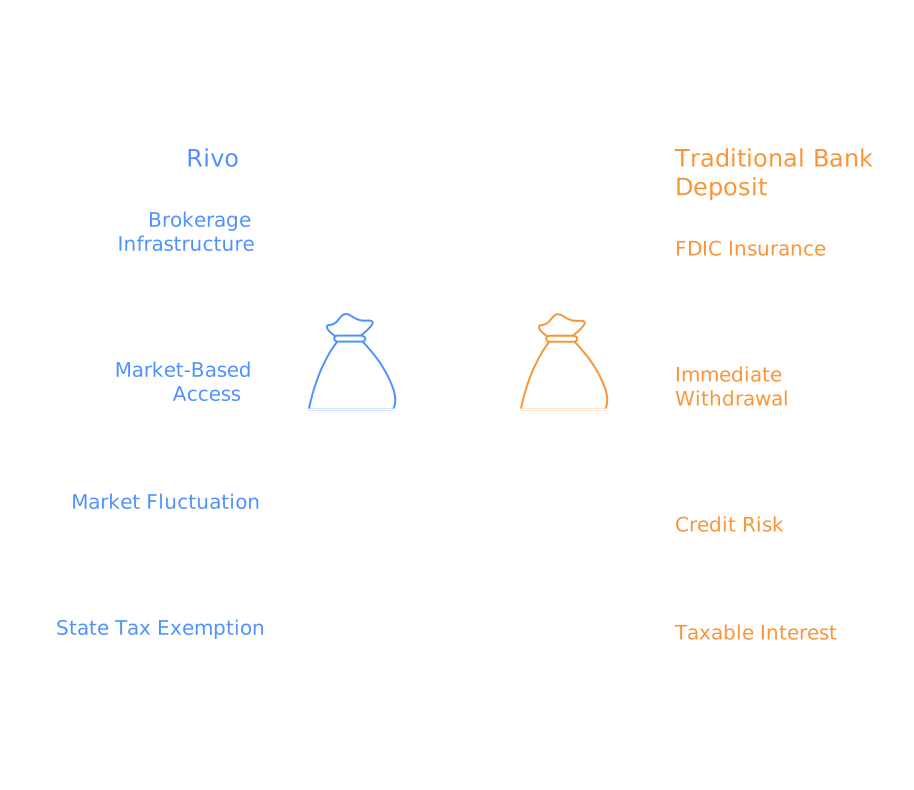
The key boundary: T-bills are not the same thing as bank deposits. That does not make them unsuitable, but it means the decision needs the right labels.
What Rivo Needs Access To
Rivo needs enough connection to understand the checking account cash flow and coordinate movement. Bank connectivity uses Plaid, with setup details available in the linked product help materials.
For a buyer, the access question is not just technical. It has 4 parts: what gets connected, what credentials are stored, what control the user keeps, and whether the product can be paused or disconnected.
That control model is central to the product. If you do not want any connected app to monitor cash flow or coordinate transfers, Rivo is not the right fit.
How Does Bill Timing Work If Your Checking Account Stays Put?
Bill timing is the hard part. Earning on idle cash is easy to describe, but bills create the operational risk.
Rivo is built around the idea that a checking account has a calendar. Paychecks arrive. Credit cards pull. Rent or mortgage hits. Utilities vary. Transfers move. The system has to leave enough money for these events and move money back before upcoming obligations.
This is why Rivo should be evaluated as cash management automation, not as a rate table alone. A high published rate is not useful if the workflow causes missed bills, manual cleanup, or constant monitoring.
What Happens When You Need Money Back?
Rivo is designed for liquid cash management, not long-term locked savings. Available funds can be withdrawn through the app up to $15,000 per day.
The phrase “available funds” matters. T-bills, settlement timing, weekends, bank transfer rails, and product policies can affect timing. That is normal for money movement products, but it means you should not treat any external cash-management tool as a substitute for cash you need in the next few hours.
The practical setup rule is conservative: set the safe balance high enough that you are comfortable even if a large bill, late paycheck, or unusual transfer appears.
Is Rivo a Bank, Broker, Savings Account, or App?
Rivo is a fintech company. Banking services are provided through Jiko Bank, a division of Mid-Central National Bank. U.S. Treasury investments and investment advisory services are provided by Jiko Securities, Inc., a registered broker-dealer, member FINRA and SIPC.
That means the right category label is not “bank replacement.” The right label is automated cash management for idle checking cash.
This is also the answer for readers comparing What Is Rivo? and How Does Rivo Autopilot Work?. The product is narrower than a bank and more active than a savings account.
What Protection Applies: FDIC, SIPC, and T-Bills?
The protection question must be split by asset type. A single acronym cannot describe every cash location.
FDIC deposit insurance applies to eligible deposits at FDIC-insured banks, within limits. The FDIC describes the standard coverage amount as $250,000 per depositor, per insured bank, per ownership category.
SIPC protection applies to customers of SIPC-member brokerage firms if customer securities or cash are missing from the account when a member firm fails. SIPC lists protection up to $500,000, including a $250,000 limit for cash. SIPC also explains that it does not protect against market-value declines.
That split is the cleanest way to think about safety. Are Treasury Bills Safe for Short-Term Cash? goes deeper into the FDIC, SIPC, and T-bill boundary.
The Cost of Bank-Replacement Question
The reason this question matters is that “I do not want to switch banks” often becomes “I will leave the cash where it is.” That can turn a product-fit objection into a recurring earnings gap.
The published Rivo rate table showed Rivo at 3.65%, major banks at 0.01%, and the national average at 0.07% on July 1, 2026. The FDIC national average rate for interest checking was 0.07% in July2026. Rates change, and the stated Rivo rate is not net of fees.
These are simple illustrative calculations, not a performance projection. They use the published rates above, exclude fees, exclude taxes, ignore compounding, and assume the full balance is idle for a full year. They compare Rivo with a low-rate checking account, not with the best deposit account you could open. Savings accounts marketed as high yield paid materially more than 0.07% over the same period, so run the same table against the account you would actually use.
What Does the Rivo Fee Mean in Plain Dollars?
Rivo charges a 0.05% monthly management fee, about 0.60% per year before compounding, based on average daily balance. Rates change, and the stated Rivo rate is not net of fees.
That fee should be evaluated as an automation cost. A DIY user can buy Treasury Bills directly or manage a brokerage cash workflow without paying Rivo. Rivo is for the user who wants the bill-aware money movement handled in the background.
The fee is worth comparing against your actual behavior. If you already manage T-bills, transfers, maturities, and bill timing reliably, you may not need Rivo. If you repeatedly leave cash in checking because the manual process is annoying, the fee may be the cost of solving the behavior gap.
For threshold math, read Is It Worth Moving Money Out of Checking?.
Who Should Use Rivo Without Replacing Their Bank?
Rivo is strongest when the user has recurring idle checking cash, meaningful bill complexity, and low appetite for manual cash management.
It is weaker when the user has tiny balances, needs every dollar immediately, wants only FDIC-insured bank deposits, or enjoys managing T-bills directly.
For the broader cash-floor question, read How Much Money Should You Keep in Checking? and What Is Idle Cash?
How Should You Decide Whether Rivo Fits Your Bank Setup?
Use a 5-question decision screen. If the answer is mostly yes, Rivo belongs in your shortlist. If the answer is mostly no, a bank deposit account, direct T-bill setup, or doing nothing may fit your current needs more cleanly.
The most honest sentence is this: Rivo is not for everyone who has a checking account. It is for people whose checking account is doing two jobs at once: paying bills and storing idle cash.
What Changes in the First 7 Days After You Connect Rivo?
The first 7 days should feel less like opening a new bank and more like adding an automation layer to an existing account. The biggest user action is choosing a safe balance that feels conservative enough for real bills.
Rivo is not useful if setup creates uncertainty. The right first-week workflow should answer 5 questions: which checking account is connected, what floor is protected, what cash is eligible, what bill timing is visible, and what controls are available if you want to pause.
Day 0: connect and set the floor
The starting point is not yield. It is the safe balance.
A user with $42,000 in checking might decide that $18,000 should stay untouched because the next 30 days include $4,500 mortgage, $2,800 credit card autopay, $900 utilities and insurance, $2,500 variable spending, $1,300 transfers, and a $6,000 comfort floor. In that setup, the candidate idle layer is not $42,000. It is closer to $24,000 before any additional conservatism.
Days 1-3: watch cash-flow assumptions
The first few days are about validating whether the floor is realistic. If income timing is irregular, billers pull on different days, or one card sometimes posts a larger statement, a higher safe balance can be the correct choice.
Days 4-7: evaluate the automation, not only the rate
By the end of week 1, the buyer should understand whether Rivo is reducing work. The product is solving for “I do not want to babysit transfers,” so the first-week test is workflow confidence.
The first-week standard should be conservative. If the setup feels too tight, raise the safe balance. Rivo is most useful when it quietly handles the idle layer, not when it makes you monitor checking more often.
How Do 3 Checking Setups Change the Bank-Replacement Answer?
The bank-replacement question changes by household pattern. A single person with $6,500 in checking, a dual-income household with $55,000 rotating through bills, and a high-income household after a $90,000 bonus do not have the same cash-management problem.
Scenario 1: $6,500 checking balance
This user may have $4,000 of near-term bills, $1,500 of variable spending, and a $1,000 comfort floor. There may be little or no idle layer after the safe balance. Rivo might still work, but the dollar value may be modest.
Scenario 2: $55,000 household checking balance
This user may keep $20,000 for bills and buffer, leaving $35,000 that frequently sits idle. The bank relationship matters because the household likely has 15-25 billers, 2 paychecks, multiple credit cards, and recurring transfers. Rivo is more relevant because it avoids rebuilding that setup.
Scenario 3: $90,000 post-bonus balance
This user may have a temporary cash spike after a bonus, RSU vest, tax refund, or home-sale reserve. The question is not “Should I switch banks?” The question is “Which dollars are idle, for how long, and how much do I need ready for near-term obligations?”
The decision is not whether Rivo can replace the bank in all 3 cases. It does not replace the bank in any of them. The decision is whether the idle layer is large enough and recurring enough to justify automation.
Final Recommendation: Treat Rivo as an Idle-Cash Layer, Not a Bank Replacement
Do not evaluate Rivo as if it is asking to become your bank. That is the wrong frame.
Evaluate it as an idle-cash layer that sits on top of your bank. Your current bank handles daily money movement, payroll, debit card life, and bill pay. Rivo focuses on the extra cash above your safe balance, the part that often earns little because moving it manually feels like one more chore.
That makes the decision more precise:
- If you want a new everyday bank, compare banks.
- If you want only bank deposits, compare savings accounts and cash management deposit programs.
- If you want to manage T-bills yourself, compare TreasuryDirect and brokerage workflows.
- If you want to keep your bank and automate idle cash around bills, compare Rivo.
For the full category view, read What Is Automated Cash Management?. For a side-by-side destination comparison, read Treasury Bills vs Money Market Funds vs High-Yield Savings and Rivo vs High-Yield Savings vs Treasury Bills.
FAQ
Do I have to move direct deposit to Rivo?
No. Rivo works with your existing checking account, so direct deposit does not need to move. That is the core difference between Rivo and a full bank switch.
Does Rivo open a new checking account for me?
No. Rivo is not a new primary checking account. The workflow connects to your existing bank account and uses Jiko infrastructure for banking and brokerage services connected to the T-bill workflow.
Can Rivo move money that I need for bills?
Rivo is designed around a user-selected safe balance and bill-aware refills. You should still set the safe balance conservatively. If a large upcoming payment makes you uncomfortable, keep a higher floor.
For a deeper bill-timing walkthrough, read Can You Move Money Out of Checking Without Missing Bills?.
Is Rivo FDIC insured?
Rivo is not a bank. Banking services are provided by Jiko Bank, a division of Mid-Central National Bank. Cash on deposit there may be eligible for FDIC insurance up to applicable limits, subject to FDIC rules, and FDIC insurance covers the failure of the insured depository institution only. T-bill holdings are securities, not deposits. They are Not FDIC Insured, carry No Bank Guarantee, and May Lose Value.
How is Rivo different from MaxMyInterest?
MaxMyInterest focuses on deposit optimization across banks. Rivo focuses on automated Treasury Bill cash management for idle checking cash while keeping the existing bank workflow in place. For the full comparison, read Rivo vs MaxMyInterest.
What if my checking balance is too high but I am not ready to connect Rivo?
Start by calculating your safe balance. List 30-60 days of fixed bills, add variable spending, add upcoming large payments, and add a comfort buffer. Then decide whether the remaining dollars are truly idle. For the problem-aware checklist, read Are You Keeping Too Much Money in Checking? and What Is the Inertia Tax?.
Related Rivo Reading
- To start with the product overview, read What Is Rivo?.
- To compare keeping your bank with using a brokerage cash hub, read Rivo vs Fidelity Cash Management Account.
- To understand available funds, T-bill sales, daily limits, and return-to-checking timing, read How Do Rivo Withdrawals Work?.
- To understand Plaid access, credential handling, and disconnect controls, read Is It Safe to Connect Your Bank Account to Rivo?.
- To understand custody, account ownership, and access if the software company becomes unavailable, read What Happens to Your Money if Rivo Shuts Down?. • For the broader cash-floor question, read How Much Money Should You Keep in Checking? and What Is Idle Cash?. • To see the product workflow, read How Does Rivo Autopilot Work?. • To understand overdraft controls, read Can Rivo Cause an Overdraft?. • To understand fees, read Rivo Fees Explained. • To earn more without switching banks, read Can You Earn More on Checking Cash Without Switching Banks?.

This article is educational and is not financial, investment, legal, accounting, or tax advice.
Yield rate reflects the 4-week T-bill rate when held to maturity. Rate does not include fees. Rates are subject to change. Minimum balance of $100 required to earn the stated rate.
Rivo is a fintech company, not a bank. Banking services provided by Jiko Bank, a division of Mid-Central National Bank. Jiko Group, Inc. and its affiliates do not provide legal, tax, or accounting advice. You should consult your legal and/or tax advisors before making any financial decisions. This material is not intended as a recommendation, offer or solicitation for the purchase or sale of any security or investment strategy. See FINRA BrokerCheck, Jiko U.S. Treasuries Risk Disclosures and Jiko Securities Inc. Form CRS.
Investments in T-bills: Not FDIC Insured - No Bank Guarantee - May Lose Value. All U.S. treasury investments and investment advisory services provided by Jiko Securities, Inc., a registered broker-dealer, member FINRA and SIPC. Securities in your account are protected up to $500,000. For details, please see www.sipc.org.
External References
- Rivo homepage: https://www.rivofi.com/
- Product help materials: https://www.rivofi.com/faqs
- Rivo published rate table: https://www.rivofi.com/big-bank-checking-account-rates
- TreasuryDirect Treasury Bills: https://www.treasurydirect.gov/marketable-securities/treasury-bills/
- FDIC deposit insurance overview: https://www.fdic.gov/resources/deposit-insurance/understanding-deposit-insurance/
- SIPC protection overview: https://www.sipc.org/for-investors/what-sipc-protects
- FRED interest checking national rate: https://fred.stlouisfed.org/series/ICNDR
.jpeg)
Ambrish Tyagi is the founder and CEO of Rivo. Previously led AI at Cruise and Amazon.
Follow on LinkedInGet Rivo Updates
Product news, money insights, and company updates.