Treasury Bills vs Money Market Funds vs High-Yield Savings: Where Should Idle Checking Cash Go?
Compare Treasury bills, money market funds, high-yield savings, and Rivo for idle cash: yield source, taxes, protection, liquidity, fees, and automation.
.png)
If idle cash is sitting above your bill money and safe balance, the right option depends on what you need most: bank simplicity, Treasury exposure, brokerage cash access, state-tax treatment, or automation. Treasury bills fit people who can manage purchases and maturities, money market funds fit people already using a brokerage, high-yield savings fits people who want an FDIC-insured deposit account, and Rivo fits people who want idle checking cash moved into short-duration Treasury bills automatically while keeping their existing bank.
The practical question is not "Which one has the highest headline rate today?" Rates move. The better question is: which option handles the exact job your checking account is failing at, without creating a bill-timing problem, tax surprise, protection mismatch, or manual-transfer habit you will abandon after 30-90 days?
If you want the product-level explanation first, read What Is Rivo? The Autopilot for Idle Checking Cash Explained. If your starting question is whether a specific balance is too large, start with What Should You Do With $20,000 Sitting in Your Checking Account?.
TL;DR
- Use a high-yield savings account if you want an FDIC-insured deposit account first. FDIC deposit insurance applies to checking, savings, money market deposit accounts, and CDs at FDIC-insured banks, with deposits automatically insured to at least $250,000 per insured bank.
- Use Treasury bills if you want direct short-term Treasury exposure and can manage the workflow. TreasuryDirect sells bills with maturities from 4 weeks to 52 weeks, a $100 minimum purchase, and federal tax due but no state or local tax on interest.
- Use a money market fund if you already keep cash inside a brokerage account. Money market funds are mutual funds that invest in short-term debt, cash, and cash equivalents, and their yields generally reflect short-term interest rates.
- Use Rivo if the real problem is not yield discovery but follow-through. Rivo works with your existing bank, lets you set a safe balance, charges 0.05% per month, and currently shows a 3.65% yield rate as of July 1, 2026 before fees.
- Protection is not identical across options. FDIC protects eligible bank deposits, SIPC protects eligible securities and cash if a SIPC-member broker-dealer fails up to $500,000, including a $250,000 cash limit, and SIPC does not protect market value changes.
- The safe-balance layer comes first. Before moving $1, $5,000, $25,000, or $100,000 anywhere, use How Much Money Should You Keep in Checking? to separate bill money from idle cash.
Quick Answer: Which Option Fits Idle Checking Cash?
Idle checking cash is money that sits above your near-term bills, spending needs, autopay timing, and comfort cushion. It is different from your rent money, credit card autopay money, emergency money, tax money, or cash assigned to a known upcoming purchase.
The best option is the one that solves the right problem without creating a larger one.
The decision is not permanent. A household can keep $6,000 in checking, $20,000 in a high-yield savings account, $25,000 in direct Treasury bills, and $30,000 under Rivo-style automation. The important move is to assign each dollar a job before comparing yield.
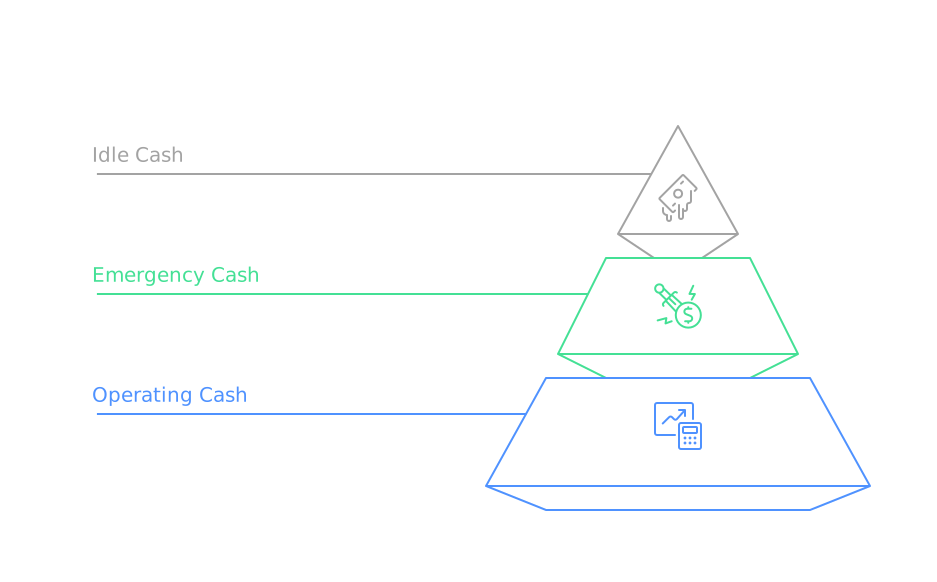
The 3-layer cash model
Use 3 layers before you choose an account or product:
- Layer 1: Checking operating cash. This covers rent or mortgage, credit cards, utilities, subscriptions, groceries, payroll timing, and the next 30 days of predictable withdrawals.
- Layer 2: Emergency and upcoming-expense cash. This covers 3-6 months of true emergency needs, tax bills, tuition, home repairs, travel, medical costs, or a planned purchase.
- Layer 3: Idle checking cash. This is the amount that keeps sitting above Layer 1 and Layer 2 because moving it feels inconvenient, risky, or easy to postpone.
The first decision rule
Do not compare Treasury bills, money market funds, high-yield savings, and Rivo against your full checking balance. Compare them only against the idle layer.
If $35,000 sits in checking and your safe balance is $11,000, the decision is about $24,000, not $35,000. If your safe balance is $30,000 because property tax, tuition, and contractor payments are coming up, the decision is only about $5,000.
Where Rivo belongs in that model
Rivo belongs in Layer 3. It is not trying to replace your checking account, your emergency plan, or your whole investment portfolio. It is built for the cash you keep meaning to move but do not want to manage manually.
That distinction matters because it keeps the recommendation narrow. Rivo should not be used for every dollar. It should be considered after the safe balance is set and the idle cash layer is clearly identified.
What Problem Are These Cash Options Solving?
These options are solving the same broad problem from different angles: cash that is safe enough to sit outside stocks, bonds, crypto, or long-term investments may still be earning very little if it stays in checking.
The national average interest checking rate was 0.07% in June 2026. At that rate, $25,000 earns about $17.50 per year before taxes. That is not a rounding error if the same $25,000 could have been assigned to a short-term cash option, but it is also not a reason to move cash blindly.
.svg)
Problem 1: Low checking yield
Checking accounts are designed for payments, not idle-cash optimization. They are excellent for debit card use, ACH pulls, rent, utilities, and credit-card autopay. They are weak when $10,000, $25,000, $50,000, or $100,000 sits there for months.
The scale is large. U.S. household checkable deposits reached about $5.95 trillion in Q1 2026, according to the FRED CDCABSHNO series. That does not mean every household has too much cash in checking, but it shows how large the checking layer is across the system.
Problem 2: Transfer anxiety
People do not leave money in checking only because they are uninformed. Many leave it there because missed bills feel worse than low yield. A $35 overdraft fee, a failed mortgage payment, or a late credit-card payment feels immediate. A low checking rate feels abstract.
That is why a pure "move your money" message fails. The real workflow is: define a safe balance, keep bill money covered, move only the idle layer, and decide whether you want to manage the transfers yourself.
Problem 3: Manual habits decay
Opening a high-yield savings account or buying a Treasury bill once is easy. Maintaining the workflow every month is harder.
Manual cash optimization requires at least 5 recurring decisions:
- How much can leave checking this week?
- Which bills are scheduled before the next paycheck?
- When will transfers settle?
- Should maturing Treasury bills be reinvested?
- Did a promotional bank rate, fund yield, or Treasury rate change enough to matter?
Rivo exists for the part many people stop doing. It connects to an existing bank through Plaid, lets the user set a minimum checking balance, identifies idle cash above that threshold, and moves money back before bills and transfers hit.
*Movement of funds is not instant. Transfers to your linked account can take up to 3 business days to settle, and longer if a Treasury Bill must be sold first. Rivo plans around known bills. It does not guarantee same-day access or a specific arrival date.
Problem 4: Protection labels are confusing
FDIC, SIPC, Treasury backing, money market funds, brokerage cash, and bank savings accounts are not interchangeable labels.
The takeaway: pick the protection model intentionally. A deposit account, a money market fund, a Treasury bill, and a Rivo-managed T-bill position can all be reasonable, but they do not carry the same wrapper.
The Mechanics of Treasury Bills for Short-Term Cash
Treasury bills are short-term U.S. Treasury securities. TreasuryDirect lists bills with maturities of 4, 6, 8, 13, 17, 26, and 52 weeks. They are sold at a discount or at par, and at maturity you receive face value.
For idle cash, the appeal is simple: a T-bill can be short duration, federally taxable, generally exempt from state and local income tax, and directly tied to U.S. Treasury debt rather than a bank deposit account.
Treasury bill mechanics
Treasury bills are often treated as a serious short-term cash option because their maturity schedule can be short. But the manual process still matters. A 4-week bill is only convenient if the user can track the bill, reinvest or redeem it, and keep enough cash available for bills.
The current-rate context
The 4-week Treasury bill secondary market rate was 3.57% on July 1, 2026. Rivo currently shows a 3.65% yield rate as of July 1, 2026 for its 4-week T-bill-based model before fees, with a $100 minimum to earn the stated rate. Those numbers should be treated as timestamped context, not a future promise. Treasury yields change as market conditions change.
When Treasury bills fit
Treasury bills fit if you can answer 5 questions cleanly:
- How much cash is truly idle after your safe balance?
- Which maturity schedule fits your bill calendar?
- Will you reinvest manually after maturity?
- What happens if a large unexpected bill arrives before maturity?
- Are you comparing after-tax outcomes, not only headline yield?
When Treasury bills are not the cleanest choice
Direct Treasury bills may be the wrong workflow if the cash has to move in and out of checking every few days, if you do not want to monitor maturities, or if you are likely to forget to reinvest.
The issue is not that Treasury bills are complicated for everyone. The issue is that idle checking cash is often idle because the owner is busy. A manual product does not solve a behavioral problem unless the user can keep running the process.
The Mechanics of Money Market Funds
Money market funds are mutual funds that invest in liquid, short-term debt securities, cash, and cash equivalents. Investor.gov explains that money market funds have relatively low risks compared with many other mutual funds, and that their yields generally reflect short-term interest rates.
They are common inside brokerage accounts because they can act like a cash parking place. But they are not the same thing as a money market deposit account at a bank.
Money market fund types
The category is not one product. Before using a money market fund for cash, identify the fund type, expense ratio, liquidity rules, holdings, settlement timing, and tax treatment.
Money market fund risk is different from bank deposit risk
Investor.gov is explicit that money invested in a money market fund is not protected by FDIC insurance like bank deposits, and that investors can lose some or all of the money invested in a fund. It also notes that many stable NAV money market funds seek to maintain a $1.00 share price, but there are circumstances where a fund can reprice below that level.
That does not make money market funds unsuitable. It means the product should be selected as a fund, not treated as a bank account.
Money market funds vs money market deposit accounts
The naming is confusing:
If you are comparing options for idle checking cash, do not collapse these 2 products into "money market." One is a fund. One is a bank deposit account.
When money market funds fit
Money market funds fit best when the cash already lives in a brokerage account, when the user understands fund-level risk, and when the transfer schedule is not tightly coupled to a checking-account bill calendar.
They may be less convenient when the idle cash originates in checking, when the user must move money back before specific bills, or when the user wants an FDIC-insured deposit account instead of a mutual fund.
The Mechanics of High-Yield Savings Accounts for Idle Checking Cash
A high-yield savings account is a bank deposit account designed for saving rather than daily payments. It can be a good home for emergency funds, near-term goals, or cash the user wants separated from checking.
The core advantage is not only yield. The core advantage is the bank deposit wrapper. FDIC deposit insurance protects money held at FDIC-insured banks in traditional deposit accounts like checking accounts, savings accounts, money market deposit accounts, and CDs, with automatic insurance to at least $250,000 at each insured bank.
High-yield savings strengths
High-yield savings friction
The weakness is workflow. A separate savings account still requires the user to decide when to transfer money out, when to move it back, and whether a changing rate justifies action.
If the account is at a different bank, direct deposits, bill pay, transfer timing, and login behavior can become the bottleneck. If the user opens the account but stops transferring after 2 months, the theoretical yield does not help the checking cash that remains idle.
Where high-yield savings beats automation
High-yield savings may be the better fit when the money is a true emergency fund, when the user wants deposit insurance above all else, when the user is uncomfortable with brokerage-based products, or when the user wants a simple account at a bank rather than Treasury securities.
Rivo is different. It is a fintech, not a bank, and it uses short-duration Treasury bills through Jiko Securities rather than an FDIC-insured savings account. That distinction is central to a fair comparison.
Where Rivo Fits
Rivo fits when the user's main problem is not choosing an option once. It fits when the user does not want to keep managing the option.
Rivo connects to an existing checking account, lets the user set a minimum checking threshold, identifies idle cash above that safe balance, moves the idle layer into short-duration U.S. Treasury bills through Jiko Securities, and brings money back before bills or transfers hit.
Rivo role by cash-management job
The automation layer is the product. The T-bill yield is important, but Rivo is not positioned as "just another place to park cash." It is positioned as a system that handles the recurring cash movement.
Rivo numbers to know
The fee math
The Rivo management fee is 0.05% per month. On $25,000, that is about $12.50 per month before compounding effects. On $50,000, it is about $25 per month. On $100,000, it is about $50 per month.
That fee only makes sense if the user values automation. Someone who already maintains a Treasury ladder, reviews bill timing every week, and enjoys managing cash can do much of the work manually. Someone who keeps $30,000 above their safe balance because they never get around to moving it is evaluating a different trade-off.
What Rivo should not be used for
Rivo should not be treated as an FDIC-insured savings account, a diversified investment portfolio, a robo-advisor, a budgeting app, or a replacement bank. It is a brokerage-based automated cash-management tool for idle checking cash.
That narrow positioning makes the comparison clearer. Rivo is for the idle layer above the safe balance. The safe balance itself should remain in checking.
Which Option Has the Cleanest Tax Treatment?
Tax treatment can change the cash decision, especially for people in high-tax states. Treasury bill interest is subject to federal income tax but exempt from state and local income taxes, according to IRS Topic 403. Bank-account interest is generally taxable interest. Money market fund tax treatment depends on fund type and holdings.
This is not tax advice. The point is to know which questions to ask before you compare yield.
Tax comparison table
Same-rate, different-tax outcome
Suppose 2 options both show a 3.65% annualized pre-tax rate. If one produces bank interest taxed federally, state, and locally, while the other produces Treasury bill interest exempt from state and local tax, the after-tax result can differ.
That does not automatically make the Treasury option right for everyone. It means the comparison should be after-tax, not headline-only.
Why this matters for Rivo
Rivo uses short-duration Treasury bills. That makes the Treasury bill tax treatment part of the decision. It also makes disclosures important: investment income on T-bills is taxed federally by the IRS, income from T-bills is not subject to state or local income taxes, and Jiko Group, Inc. and its affiliates do not provide legal, tax, or accounting advice.
If tax treatment is central to your decision, consult a legal or tax advisor before moving material cash.
Which Option Is Easiest to Use Without Missing Bills?
The easiest option is the one that matches your bill calendar. For many households, the friction is not opening a product. The friction is moving money without disrupting rent, mortgage, credit-card autopay, utilities, daycare, payroll timing, insurance, or irregular charges.
This is why Can You Move Money Out of Checking Without Missing Bills? is part of the same cluster. Yield is secondary if the transfer creates a bill-timing failure.
Bill-timing comparison
The manual transfer rule
Manual transfers can work if you follow a strict rule:
- Keep the next 30 days of bills in checking.
- Add all credit-card autopay and loan payments due before the next paycheck.
- Add an irregular-spend cushion.
- Keep upcoming known expenses out of the idle layer.
- Move only the amount above that floor.
- Recalculate after every large deposit, large bill, or income change.
Most people do not need a complex spreadsheet. They need a rule they will actually follow.
The Rivo rule
Rivo turns the manual transfer rule into an automated threshold. You set the safe balance. Rivo works above it.
That does not eliminate user responsibility. You still need to choose a conservative safe balance, increase it before unusual expenses, and understand that T-bill positions carry standard fixed-income risks. But it removes the recurring transfer habit from the user.
When bill timing should override yield
If a bill is due in 3 days, do not chase a marginal yield difference. If your income is irregular, set a higher safe balance. If you have a tax payment, tuition payment, home renovation draw, or business expense coming up, keep that cash separately assigned.
The right cash option is allowed to look boring. Missing a payment is not a sophisticated optimization.
Which Option Has the Right Protection Model?
Protection is where many cash comparisons become sloppy. A high-yield savings account, a Treasury bill, a money market fund, and a Rivo-managed T-bill position do not all use the same protection model.
The simplest way to compare them is to ask: "What is the asset, who holds it, and what problem does the protection cover?"
Protection model table
FDIC details
FDIC deposit insurance protects eligible deposits at FDIC-insured banks. FDIC lists checking accounts, savings accounts, money market deposit accounts, and CDs as covered deposit-account types, and notes that mutual funds, stocks, and bonds are not covered.
This makes FDIC the cleanest framework for someone who wants a bank deposit account. It does not make FDIC the right wrapper for every form of short-term cash.
SIPC details
SIPC protection applies if a SIPC-member brokerage firm fails and customer assets are missing. SIPC states that the protection limit is $500,000, including a $250,000 cash limit, and that SIPC does not protect against a decline in securities value.
That distinction matters for money market funds and Treasury securities held through a broker. SIPC is a custody protection, not an investment-performance promise.
Rivo disclosure boundary
Rivo is a fintech company, not a bank. Banking services are provided by Jiko Bank, a division of Mid-Central National Bank. All U.S. Treasury investments and investment advisory services are provided by Jiko Securities, Inc., a registered broker-dealer, member FINRA and SIPC.
The required investment disclosure is direct: Investments in T-bills: Not FDIC Insured. No Bank Guarantee. May Lose Value.
What Should You Choose for $10,000, $25,000, $50,000, or $100,000?
Balance size changes the decision because the cost of inaction, the value of automation, and the transfer-risk tolerance all change with the dollars involved.
A $2,000 idle layer may not justify a new workflow. A $50,000 idle layer can justify more process. A $100,000 idle layer deserves a deliberate cash policy.
Scenario routing
$10,000 example
If $10,000 sits in checking, the first question is whether $10,000 is actually too much. A household with $7,000 in monthly card autopay, $2,000 rent, and irregular paycheck timing may need most of it in checking.
If the safe balance is $5,000 and the idle layer is $5,000, Rivo may start to become relevant because the product works best for households with $5,000+ in checking. If the idle layer is only $1,000, simplicity may matter more than optimization.
$25,000 example
If $25,000 sits in checking and the safe balance is $10,000, then $15,000 is the decision layer.
At the 0.07% June 2026 national checking average, the full $25,000 earns about $17.50 per year. At a 3.65% annualized yield reference before fees, $15,000 of idle cash would produce about $547.50 before fees and taxes if the rate held for a full year. This is an illustrative calculation, not a future return claim.
$50,000 example
If $50,000 sits in checking and $20,000 is the safe balance, the idle layer is $30,000.
This is where the Rivo 0.05% monthly fee becomes a real but understandable trade-off. On $30,000, a 0.05% monthly fee is about $15 per month before compounding effects. The question is whether that automation is worth it compared with managing a HYSA transfer, money market fund, or direct Treasury workflow yourself.
$100,000 example
At $100,000, one product does not have to own the entire decision. You might keep $20,000 in checking, $30,000 in a high-yield savings account, $25,000 in direct Treasury bills, and $25,000 under automated Rivo management.
This is not overcomplication. It is cash segmentation. The mistake is treating all $100,000 as one undifferentiated balance.
When Should You Use Rivo Instead of Managing This Yourself?
Use Rivo when your problem is recurring follow-through, not financial literacy.
If you already understand Treasury bills, HYSA transfers, money market fund yields, and FDIC/SIPC distinctions, but your checking balance still sits too high for 60-90 days, the bottleneck is not knowledge. It is execution.
Rivo fit checklist
The strongest Rivo use case
The strongest use case is a busy household with a consistent checking surplus, complex autopay, and no desire to manage Treasury auctions or brokerage cash manually.
Example: a dual-income household keeps $45,000 in checking because mortgage, childcare, credit cards, insurance, and irregular expenses all pull from the same account. After using a safe-balance formula, they decide $18,000 should stay in checking. The remaining $27,000 is the idle layer.
That user can manually transfer to a high-yield savings account, buy Treasury bills directly, use a money market fund, or let Rivo manage the idle layer above the safe balance. The product fit depends on whether they value automation enough to pay the fee.
When Rivo is not the right answer
Rivo may not fit if:
- You want only FDIC-insured deposit products.
- You are uncomfortable with brokerage-based cash management.
- Your checking surplus is usually below $5,000.
- You already manage a T-bill ladder efficiently.
- You need all cash available for a large payment within days.
- You do not want any automated money movement.
That does not make Rivo weak. It makes the category boundary clearer.
What Does Same-Scenario Math Show?
Same-scenario math prevents the comparison from turning into a rate screenshot. Use the same idle balance, the same safe balance, the same rate date, and the same fee treatment before deciding.
The table below is illustrative. It uses the 0.07% June 2026 national interest checking rate, the 3.57% July 1, 2026 4-week Treasury bill secondary market rate, the 3.65% July 1, 2026 Rivo yield reference before fees, and the 0.05% monthly Rivo fee. It does not predict future rates, taxes, or user returns.
$25,000 checking balance example
The gross difference is clear, but the decision is still not only about the rate. The manual T-bill path has no Rivo automation fee, but it requires the user to maintain the process. The Rivo path has a fee, but it handles the recurring sweep and refill workflow.
$50,000 checking balance example
At $50,000, the idle layer can become financially meaningful. But if $32,000 is actually tax money due in 45 days, the recommendation changes. The same table should be rebuilt with your own bill calendar.
$100,000 checking balance example
The $100,000 example shows why the correct answer is often a split, not a single winner. Checking, high-yield savings, Treasury bills, money market funds, and Rivo can each be appropriate for a different cash job.
Cost-of-inaction snapshot
The simple post-fee Rivo column subtracts a 0.6% annual fee equivalent from the 3.65% July 1, 2026 reference, producing a 3.05% simplified estimate before taxes and before any compounding effect.
These are simple annualized illustrations using the cited rate references. They exclude taxes, transfer timing, changing rates, realized yield differences, early-sale effects, and product-specific terms.
The Four Options, Side by Side
The cleanest comparison uses the same criteria across all 4 options: yield source, effort, protection, tax treatment, liquidity, fees, and fit.
Side-by-side decision table
The table shows why the answer is conditional. High-yield savings wins on deposit simplicity. Treasury bills win for direct T-bill users. Money market funds win for brokerage-native cash parking. Rivo wins when the cash originates in checking and the user wants the movement automated around bills.
What headline yield misses
Headline yield misses 6 decision variables:
- State and local tax treatment.
- Whether cash is in a bank, brokerage, fund, or Treasury account.
- Transfer time back to checking.
- Whether the user must maintain a ladder or recurring transfer habit.
- Whether protection is FDIC, SIPC, Treasury issuer backing, or a mix.
- Whether the cash is emergency cash, bill cash, or truly idle cash.
Why this article overlaps but does not replace the Rivo comparison page
Rivo vs High-Yield Savings vs Treasury Bills compares 3 routes. This article adds money market funds and focuses on the broader decision architecture for idle checking cash.
If you are already down to Rivo vs HYSA vs T-bills, read that comparison next. If you are still deciding whether brokerage money market funds belong in the set, stay with this framework.
Final Decision Framework
The final decision is a 5-step sequence:
- Calculate your safe balance.
- Identify your idle layer.
- Choose your protection wrapper.
- Decide how much manual work you will actually maintain.
- Use the option that fits the job, not the option with the loudest rate.
Step 1: Calculate the safe balance
Use fixed bills, variable spending, autopay timing, and a comfort cushion. If you need a detailed formula, use How Much Money Should You Keep in Checking?.
Step 2: Identify idle cash
Idle cash is the money that remains above the safe balance for 30-90 days without a known job. If it has a job, it is not idle.
Step 3: Pick the protection wrapper
Choose FDIC if you want a bank deposit account. Choose direct Treasury exposure if you want T-bills and can manage them. Choose a money market fund if brokerage cash parking fits your workflow. Choose Rivo if you want the idle checking layer automated into short-duration T-bills through the product.
Step 4: Price the work
Manual work is not free if it does not happen. A no-fee manual T-bill ladder that you abandon after 60 days may underperform a paid automation layer that keeps running. A paid automation layer may be unnecessary if you already have a disciplined system.
Step 5: Make the cash map
The best cash setup is boring in the right places and automated where behavior breaks. Keep operating cash stable. Put only the idle layer to work. Then choose the tool that you will maintain.
FAQ
Are Treasury bills safer than high-yield savings accounts?
They are different. Treasury bills are U.S. Treasury securities, while high-yield savings accounts are bank deposit accounts. FDIC insurance applies to eligible bank deposits at FDIC-insured banks, while Treasury bills are not FDIC-insured deposit accounts.
Are money market funds the same as money market accounts?
No. A money market fund is a mutual fund that invests in short-term instruments. A money market deposit account is a bank deposit account. FDIC coverage can apply to eligible money market deposit accounts at FDIC-insured banks, but Investor.gov notes that money market funds are not FDIC-insured like bank accounts.
Does Rivo replace a high-yield savings account?
No. Rivo is not a bank and not a savings account. It is an automated cash-management product for idle checking cash that uses short-duration Treasury bills through Jiko Securities. A high-yield savings account may still be the right place for emergency funds or users who want only FDIC-insured deposits.
How much money should I keep in checking before using any of these options?
Keep enough for the next 30 days of bills, autopay, variable spending, and a comfort cushion. Then evaluate only the amount above that safe balance. For a full formula, read How Much Money Should You Keep in Checking?.
Is Rivo worth the 0.05% monthly fee?
It depends on whether automation solves a real behavior problem for you. If you already manage Treasury bills or transfers consistently, you may not need it. If $10,000, $25,000, $50,000, or more keeps sitting idle in checking because you do not want to manage the workflow, the fee is paying for bill-aware automation.
Can I split cash across several options?
Yes. Many households should split cash by job: checking for bills, FDIC-insured deposits for emergency funds, Treasury bills for direct short-term Treasury exposure, brokerage money market funds for brokerage cash, and Rivo for idle checking cash that should move automatically above a safe balance.
Related Rivo Reading
- To compare Rivo with the main options, read Rivo vs High-Yield Savings vs Treasury Bills.
- To check T-bill protection language, read Are Treasury Bills Safe for Short-Term Cash.
- To understand state tax treatment, read Are Treasury Bills State Tax Exempt.
- To compare DIY T-bills with automation, read Rivo vs TreasuryDirect.
- To understand automatic sweep mechanics, read What Is a Cash Sweep Account?. • <w:left w:space="0" w:sz="0" w:val="nil"/><w:bottom w:space="0" w:sz="0" w:val="nil"/><w:right w:space="0" w:sz="0" w:val="nil"/><w:between w:space="0" w:sz="0" w:val="nil"/></w:pBdr><w:shd w:fill="auto" w:val="clear"/><w:spacing w:after="80" w:before="0" w:line="276" w:lineRule="auto"/><w:ind w:left="360" w:right="0" w:hanging="360"/><w:jc w:val="left"/><w:rPr/></w:pPr><w:r w:rsidDel="00000000" w:rsidR="00000000" w:rsidRPr="00000000"><w:rPr><w:rFonts w:ascii="Arial" w:cs="Arial" w:eastAsia="Arial" w:hAnsi="Arial"/><w:b w:val="1"/><w:bCs w:val="1"/><w:i w:val="0"/><w:iCs w:val="0"/><w:smallCaps w:val="0"/><w:strike w:val="0"/><w:color w:val="000000"/><w:sz w:val="22"/><w:szCs w:val="22"/><w:u w:val="none"/><w:shd w:fill="auto" w:val="clear"/><w:vertAlign w:val="baseline"/><w:rtl w:val="0"/></w:rPr><w:t xml:space="preserve">The safe-balance layer comes first. Before moving $1, $5,000, $25,000, or $100,000 anywhere, use How Much Money Should You Keep in Checking? to separate bill money from idle cash. • To understand manual laddering, read What Is a Treasury Bill Ladder for Short-Term Cash.

This article is educational and is not financial, investment, legal, accounting, or tax advice.
Yield rate reflects the 4-week T-bill rate when held to maturity. Rate does not include fees. Rates are subject to change. Minimum balance of $100 required to earn the stated rate.
Rivo is a fintech company, not a bank. Banking services provided by Jiko Bank, a division of Mid-Central National Bank. Jiko Group, Inc. and its affiliates do not provide legal, tax, or accounting advice. You should consult your legal and/or tax advisors before making any financial decisions. This material is not intended as a recommendation, offer or solicitation for the purchase or sale of any security or investment strategy. See FINRA BrokerCheck, Jiko U.S. Treasuries Risk Disclosures and Jiko Securities Inc. Form CRS.
Investments in T-bills: Not FDIC Insured - No Bank Guarantee - May Lose Value. All U.S. treasury investments and investment advisory services provided by Jiko Securities, Inc., a registered broker-dealer, member FINRA and SIPC. Securities in your account are protected up to $500,000. For details, please see www.sipc.org.
External References
- Rivo homepage
- Rivo product FAQ
- Rivo checking account rates comparison
- TreasuryDirect: Treasury Bills
- IRS Topic 403: Interest Received
- FRED: National Rate, Interest Checking
- FRED: 4-Week Treasury Bill Secondary Market Rate
- FRED: Checkable Deposits and Currency
- FDIC: Deposit Insurance
- SIPC: What SIPC Protects
- Investor.gov: Money Market Funds
- Investor.gov: Money Market Funds Investor Bulletin
.jpeg)
Ambrish Tyagi is the founder and CEO of Rivo. Previously led AI at Cruise and Amazon.
Follow on LinkedInGet Rivo Updates
Product news, money insights, and company updates.