Rivo Fees Explained: 0.05% Monthly Fee, Net Yield Math, and When It Is Worth It
Learn what Rivo charges, how the 0.05% monthly management fee works, how it changes net yield, and when automated idle-cash management is worth the fee.
.png)
The Rivo management fee is a flat 0.05% per month, calculated on the average daily balance in your Rivo account. That is about 0.60% per year before compounding details, so the simple annual fee estimate is $60 on $10,000, $120 on $20,000, $300 on $50,000, and $600 on $100,000.
The right question is not only "What does Rivo cost?" The better question is: "After the fee, taxes, bill timing, transfer effort, and the safe balance I need in checking, does automation create enough value for my idle cash?" This guide shows the math.
If you are still deciding what Rivo is, start with What Is Rivo?. If you already understand the product and are evaluating whether the fee makes sense, this article is the fee and net-yield walkthrough.
TL;DR
- The Rivo fee is 0.05% per month, calculated on average daily balance. Simple annualized math is about 0.60% per year.
- At a $20,000 average Rivo balance, the simple fee estimate is about $10/month or $120/year. At $50,000, it is about $25/month or $300/year.
- The Rivo rates table listed a 3.65% gross annualized rate as of July 1, 2026, before fees and taxes. That rate is subject to change.
- The FRED national interest-checking rate was 0.07% in June 2026, while FRED 4-week Treasury bill data showed 3.61% on July 2, 2026.
- The fee usually matters less when you have $20,000 to $100,000+ in repeated idle checking cash and more when your idle layer is small, temporary, or easy to manage manually.
- Rivo is not a bank account. Idle cash is invested in short-duration U.S. Treasury Bills through Jiko Securities, so you need to understand fees, taxes, access, SIPC, FDIC, and fixed-income risk before using it.
Rivo Fee Quick Reference
The fee is simple. The decision is not. You still need to know how much cash is truly idle, how long it usually stays idle, whether you would actually maintain a manual Treasury bill workflow, and whether the bill-aware automation is worth paying for.
What Fee Does Rivo Charge?
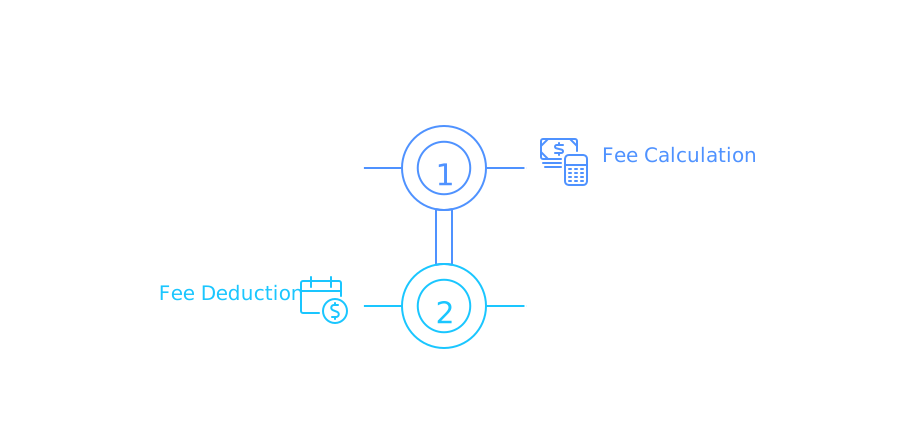
The Rivo fee is a 0.05% monthly management fee, calculated on the average daily balance of your Rivo account. The fee is deducted automatically each month.
For rough planning, multiply the average Rivo balance by 0.0005 to estimate the monthly fee. Multiply by 0.006 to estimate a simple annual fee before compounding details.
The fee formula
This is a management fee for automation, not a transfer fee, card fee, or bank-account maintenance fee. The fee should be judged against what the product does: identify idle cash, keep a user-set safe balance, move eligible idle cash into short-duration U.S. Treasury Bills through Jiko Securities, and plan around bills.
Why average daily balance matters
Average daily balance matters because your Rivo balance may change during the month. If $50,000 sits in Rivo for the whole month, the fee estimate is about $25. If only $20,000 sits in Rivo for half the month and the rest stays in checking for bills, the fee base is lower.
The average-balance detail is important because Rivo is built around cash movement, not static account parking. If bills are coming, money may move back. If your safe balance is high, less cash may be invested. If your cash flow changes, the average balance can change too.
What Are You Paying For?
You are paying for automated cash management, not only access to a Treasury yield. A disciplined person can buy Treasury bills directly or use a brokerage money market fund. The Rivo fee is for a workflow that keeps running around your checking account.
Rivo is designed for the person who keeps thinking "I should move this cash" and then leaves it alone because the manual workflow is annoying, risky, or easy to forget.
What the fee is meant to cover
The fee makes sense only if these jobs matter to you. If you already buy and roll T-bills, track every credit-card autopay, maintain a bill calendar, and never leave cash idle, the automation may be unnecessary. If you routinely leave $20,000, $50,000, or $100,000 in checking because the manual workflow keeps slipping, the fee deserves a closer look.
.svg)
The automation value test
Use this test before debating the fee:
- Do you know your true safe balance?
- Does your checking account often stay $10,000+ above that safe balance?
- Would the excess usually sit for 30 to 180 days?
- Have you delayed manual transfers because bills, rent, mortgage, or credit cards made the timing feel risky?
- Have you opened higher-yield cash options before but stopped moving money consistently?
- Do you want to keep your existing bank account as the bill hub?
If most answers are yes, the fee is less about access to yield and more about replacing a recurring household cash chore. If most answers are no, the fee may not solve a real problem yet.
How Does the Fee Change Gross Yield Into Net Yield?
The Rivo rates table listed a 3.65% gross annualized rate as of July 1, 2026, before fees and taxes. The fee is 0.05% monthly, or about 0.60% per year using simple annual math.
For rough pre-tax planning, subtract the simple annualized fee from the gross annualized rate. With a 3.65% gross rate and a 0.60% fee, the simplified pre-tax after-fee estimate is about 3.05% before taxes, timing, rate changes, and whether all cash stays invested for a full year.
Simple net-yield formula
This is not a performance promise. It is a fee lens. The actual result can differ because rates change, balances move, cash may not be invested every day, T-bills may be sold before maturity, and your tax situation matters.
Same-scenario pre-tax examples
The table below uses 3.65% as the gross annualized rate reference, 0.60% as the simple annualized fee, and 0.07% as the interest-checking benchmark. It assumes the listed amount remains invested for 12 months, which real household cash may not do.
The bigger the recurring idle layer, the more visible the net spread becomes. The smaller or more temporary the idle layer, the more the fee, taxes, transfer timing, and setup effort matter.
Why the $20,000 example matters
A $20,000 checking balance is not automatically a $20,000 Rivo balance. If your safe balance is $8,000, the potential idle layer is $12,000. If your safe balance is $15,000, the potential idle layer is $5,000. The fee should be evaluated on the cash that can actually leave checking, not the full number you see in your bank app.
For the full safe-balance workflow, read What Should You Do With $20,000 Sitting in Your Checking Account?.
When Is the Rivo Fee Worth It?
The Rivo fee is more likely to make sense when 4 conditions are true: the idle balance is meaningful, the cash repeats for multiple months, manual transfers have failed in real life, and bill timing creates enough anxiety that automation has value.
If you have $500 of idle cash for 10 days, the fee question probably does not matter. If you have $50,000 sitting above your safe balance for 6 months because you keep postponing the decision, the fee question matters a lot.
Fee fit matrix
The best Rivo fit is not "highest possible yield seeker." The best fit is a household with a real idle-cash layer and a real behavior problem. The fee pays for a system that keeps working after the first motivated weekend is over.
The behavioral cost of doing nothing
The FRED CDCABSHNO series showed about $5.95 trillion in U.S. household and nonprofit checkable deposits and currency at the end of Q1 2026. The FRED ICNDR series showed the national interest-checking rate at 0.07% in June 2026.
Those numbers matter because idle checking cash is not rare. Many households hold extra cash for responsible reasons: mortgages, rent, tuition, taxes, credit cards, travel, medical bills, childcare, and surprise spending. The fee question should be evaluated against the cash that is repeatedly idle after those obligations are protected.
The practical break-even question
Ask this before turning on any paid cash automation:
The break-even is not a single balance. It is a combination of balance size, time idle, rate spread, fee, tax treatment, risk comfort, and your ability to keep a manual workflow alive.
When Is the Fee Not Worth It?
The fee may not be worth it when the idle balance is too small, the cash is needed soon, you already maintain Treasury bills manually, or you want only FDIC-insured bank deposits.
Rivo is intentionally not the right answer for every cash problem. If the money is needed for a rent payment next week, it should stay in checking. If you are uncomfortable with Treasury bills as investment products, use bank deposits. If you are a disciplined DIY user, compare the fee against your own actual workflow.
Avoid or wait if...
The goal is not to pay a fee for a tiny optimization. The goal is to decide whether the fee solves a persistent idle-cash problem that you have not solved manually.
The small-balance problem
On a $2,000 balance, a 3.05% rough pre-tax after-fee estimate would be about $61/year before taxes and timing effects. That may be useful for some users, but it is not usually enough to justify much complexity.
This is why Rivo works best for households with $5,000+ in checking, even though there is no hard minimum. The smaller the balance, the more important it is that setup is easy and the idle layer is recurring.
The "I can do it myself" objection
You can buy Treasury bills yourself. TreasuryDirect shows T-bills are sold in terms from 4 weeks to 52 weeks, have a $100 minimum purchase, and can be held to maturity or sold before maturity. A brokerage can also provide Treasury access.
If you enjoy managing auctions, maturity dates, reinvestment, bill timing, and transfer timing, DIY may fit. Rivo is for the user who wants the idle-cash workflow handled in the background while the existing checking account stays in place.
How Does the Safe Balance Change the Fee Math?
Your safe balance changes everything. The fee should be applied to the cash that actually moves into Rivo, not the full checking balance you happen to see.
A safe balance is the minimum checking balance you want available before any optimization happens. It should cover known bills, near-term card payments, normal spending, irregular expenses, and a comfort margin.
Safe-balance examples
This is why Rivo should not be evaluated as "what happens to my whole bank balance?" The product is meant to work on the idle layer above your safe balance.
Why a high safe balance can be rational
A high safe balance is not a failure. It may be rational if you have a mortgage, kids, variable income, quarterly taxes, tuition, medical bills, contractor income, or large credit-card autopay. The mistake is not keeping a safe balance. The mistake is never separating the safe balance from the cash that keeps sitting above it.
For a deeper safe-balance framework, read What Is Idle Cash? and How Much Money Should You Keep in Checking?.
How Do Taxes Change the Fee Question?
Taxes can change the net result because Treasury bill income and bank deposit interest can be treated differently at the state and local level. IRS Topic No. 403 states that interest income from Treasury bills, notes, and bonds is subject to federal income tax but exempt from state and local income taxes. TreasuryDirect gives the same federal and state/local treatment for Treasury marketable securities and includes bill interest.
That does not mean T-bill income is tax-free. It means the state/local income-tax treatment can improve the after-tax comparison versus a bank product whose interest is usually taxed federally, state, and locally.
Tax-aware fee comparison
If you live in a state with no income tax, the state-tax angle may matter less. If you live in a high-tax state, the state/local exemption can become a bigger part of the decision. Either way, this is a tax question, not a marketing shortcut. Consult a tax advisor for your situation.
Simple after-tax thinking
Do not compare only headline rates. Compare:
- Gross rate.
- Product fee.
- Federal tax.
- State and local tax.
- Timing and liquidity.
- Risk and protection structure.
- Manual effort.
The Rivo fee is one line in that calculation. It is not the only line.
How Does the Rivo Fee Compare With DIY Treasury Bills?
DIY Treasury bills can be the right choice for people who want direct control and can maintain the workflow. Rivo can be the right choice for people who want the idle-cash decision and bill-aware movement handled automatically.
This is not a moral difference. It is an operating-model difference.
Rivo vs DIY fee frame
DIY can win on explicit software cost. Rivo can win on persistence, convenience, and bill-aware execution if the user would otherwise leave cash in checking. The relevant comparison is not "which option has the lowest stated fee?" It is "which option will I actually maintain for 12 months?"
What DIY still requires
DIY requires a recurring process:
- Decide which dollars are idle.
- Keep bill money in checking.
- Buy Treasury bills or choose a brokerage cash product.
- Track maturity or reinvestment.
- Keep enough money available for autopay.
- Adjust when income or spending changes.
- Sell or transfer if a cash need appears.
Some users are good at this. Those users may not need Rivo. Many households start strong and stop after a few months. Those households should price the fee against the cost of the workflow failing.
For the full DIY comparison, read Rivo vs TreasuryDirect.
How Do Liquidity and Access Affect the Fee Decision?
The fee is easier to judge when you know the access rules. Rivo is built around idle cash, not emergency cash needed today. The safe balance should keep near-term bill money in checking, while Rivo handles the idle layer above that floor.
Rivo users can withdraw available funds through the app up to $15,000 per day. Treasury bills are liquid, but selling before maturity can affect realized yield. That is why the fee should be evaluated with liquidity, not separately from it.
Movement of funds is not instant. Transfers can take up to 3 business days to settle. Rivo plans around known bills but does not guarantee same-day access or specific timing.
Fee and access table
The fee is not a reason to move urgent cash. If money is needed for a down payment, tuition bill, tax payment, payroll transition, or near-term rent, it should be protected first. Rivo is relevant after the safe balance and known near-term expenses are covered.
What Protection Details Should You Understand Before Paying the Fee?
A fee explainer should also cover protection language because the product is not a bank deposit account. Treasury Bills, FDIC deposit insurance, SIPC brokerage protection, and Rivo as a software layer are different concepts.
Rivo is a fintech company, not a bank. Banking services are provided by Jiko Bank, a division of Mid-Central National Bank. U.S. Treasury investments and investment advisory services are provided by Jiko Securities, Inc., a registered broker-dealer, member FINRA and SIPC.
Protection and risk boundaries
The fee only makes sense if you understand what you are buying. You are not buying a bank deposit product. You are using an automated cash-management product that moves eligible idle cash into short-duration U.S. Treasury Bills through regulated partners.
The required risk sentence
Investments in T-bills: Not FDIC Insured. No Bank Guarantee. May Lose Value.
That sentence is not fine print. It is the boundary that keeps the fee decision honest.
How Should You Calculate Whether the Fee Works for Your Balance?
Use a 5-step calculation. The output should be a yes, no, or wait decision. If the answer is "wait," that is still useful because it keeps bill money protected.
The 5-step fee calculator
Using the 3.65% gross rate reference, 0.60% simple annualized fee, and 0.07% checking benchmark, the rough pre-tax after-fee spread is about 2.98 percentage points. On a $21,000 idle layer, that is about $626 before taxes and timing effects.
That is not a promised result. It is a decision estimate.
Scenario table
The formula is intentionally conservative. A person with $25,000 in checking and a $10,000 safe balance should not evaluate Rivo on $25,000. The first $10,000 has a job. The $15,000 idle layer is the decision.
How Should You Decide?
Use Rivo if the fee solves a real operating problem: you keep meaningful idle cash in checking, manual transfers keep getting delayed, bills make timing stressful, and you want the cash-management workflow to run around your existing bank.
Wait or skip if the fee is solving a problem you do not have. Small balances, urgent cash, strong DIY discipline, and a need for bank-deposit-only products are all valid reasons not to use Rivo.
Final decision table
The cleanest decision is usually visible after 30 days of observation. If checking repeatedly stays above the safe balance, the idle layer is real. If the balance falls back down after bills, it was not idle.
A 15-minute pre-Rivo checklist
- Write down the next 30 days of known bills.
- Add your next credit-card autopay.
- Add a comfort margin.
- Subtract that safe balance from checking.
- Check whether the idle layer is at least $5,000 to $10,000.
- Compare the fee against the idle layer, not the full checking balance.
- Read the T-bill, tax, SIPC, FDIC, and liquidity disclosures.
- Start conservatively if you turn on automation.
The fee should feel boring after this exercise. If it still feels mysterious, do not turn on automation yet. Understand the safe balance first.
FAQ
How much does Rivo cost?
The Rivo management fee is 0.05% per month, calculated on the average daily balance in your Rivo account. Simple annualized math is about 0.60% per year before compounding details.
Is the Rivo fee charged on my whole checking balance?
No. The fee is based on the average daily balance in your Rivo account, not the entire checking balance at your bank. Your safe balance and near-term bill money should remain in checking.
What does 0.05% per month mean in dollars?
It means about $5/month on $10,000, $10/month on $20,000, $25/month on $50,000, and $50/month on $100,000. The actual fee depends on average daily balance.
Does the listed Rivo rate include fees?
No. The Rivo rates table states that the listed rate reflects the 4-week T-bill rate as of July 1, 2026 when held to maturity, does not include fees, is subject to change, and requires a $100 minimum balance to earn the stated rate.
Is Rivo worth it for $5,000?
Maybe, but only if the cash is truly idle and recurring. At $5,000, the simple fee estimate is about $2.50/month or $30/year. The earnings may not justify setup unless the idle cash repeats and automation is valuable to you.
Is Rivo worth it for $50,000?
It can be, if the $50,000 is above your safe balance and usually stays idle. At $50,000, the simple fee estimate is about $25/month or $300/year. The fee should be compared against the net yield difference, tax treatment, bill timing, and whether you would maintain the workflow manually.
Related Rivo Reading
- To see the product workflow, read How Does Rivo Autopilot Work?.
- To decide whether moving money is worth it, read Is It Worth Moving Money Out of Checking?.
- To calculate the dollar gap, read Checking Account Interest Calculator.
- To compare broader alternatives, read Rivo Alternatives.
- To compare DIY T-bills with automation, read Rivo vs TreasuryDirect. • Read How Much Money Should You Keep in Checking? • Read Are Treasury Bills Safe for Short-Term Cash?

This article is educational and is not financial, investment, legal, accounting, or tax advice.
Yield rate reflects the 4-week T-bill rate when held to maturity. Rate does not include fees. Rates are subject to change. Minimum balance of $100 required to earn the stated rate.
Rivo is a fintech company, not a bank. Banking services provided by Jiko Bank, a division of Mid-Central National Bank. Jiko Group, Inc. and its affiliates do not provide legal, tax, or accounting advice. You should consult your legal and/or tax advisors before making any financial decisions. This material is not intended as a recommendation, offer or solicitation for the purchase or sale of any security or investment strategy. See FINRA BrokerCheck, Jiko U.S. Treasuries Risk Disclosures and Jiko Securities Inc. Form CRS.
Investments in T-bills: Not FDIC Insured - No Bank Guarantee - May Lose Value. All U.S. treasury investments and investment advisory services provided by Jiko Securities, Inc., a registered broker-dealer, member FINRA and SIPC. Securities in your account are protected up to $500,000. For details, please see www.sipc.org.
Sources
- Rivo fee, setup, safe-balance, notification, liquidity, and control details: https://www.rivofi.com/faqs
- Rivo listed rate, checking comparison, $20,000 example, and minimum balance: https://www.rivofi.com/big-bank-checking-account-rates
- Rivo product workflow and partner disclosures: https://www.rivofi.com/
- Rivo privacy and data-sharing details: https://www.rivofi.com/privacy-policy
- FRED national interest checking rate: https://fred.stlouisfed.org/series/ICNDR
- FRED 4-week Treasury bill secondary market rate: https://fred.stlouisfed.org/series/DTB4WK
- FRED household checkable deposits and currency: https://fred.stlouisfed.org/series/CDCABSHNO
- TreasuryDirect Treasury bills overview: https://www.treasurydirect.gov/marketable-securities/treasury-bills/
- TreasuryDirect tax forms and withholding for marketable securities: https://treasurydirect.gov/marketable-securities/tax-forms-and-withholding/
- IRS Topic No. 403, interest received: https://www.irs.gov/taxtopics/tc403
- SIPC investor protection overview: https://www.sipc.org/for-investors/what-sipc-protects

Shalu Yadav is Rivo's SEO/GEO Expert, bringing over 10 years of experience in making financial content discoverable across both classic search and generative AI platforms.
Follow on LinkedInGet Rivo Updates
Product news, money insights, and company updates.