How Often Should You Move Money Out of Checking? Weekly, Monthly, Payday, or Balance-Triggered Rules
Compare weekly, monthly, payday, threshold, and bill-aware rules for moving excess checking cash without leaving bills exposed.
.png)
You should move money out of checking only when the balance is above the cash needed for upcoming bills, routine spending, known irregular expenses, and a protected checking floor. For stable pay and bills, a transfer after each payday or one monthly review may be enough. For variable cash flow, a balance-triggered or bill-aware rule is usually more reliable than a fixed calendar date.
The right cadence is therefore not simply weekly versus monthly. It is the combination of a trigger, an amount rule, a bill-coverage test, and a return plan. A frequent transfer with a weak cash forecast can create more risk than a slower transfer with a conservative floor.
For U.S. households, the operating details also depend on bank funds-availability terms, ACH business days, and the destination account or security used after cash leaves checking.
TL;DR
- Use a calendar rule only when income dates, bill dates, and spending are predictable enough for the same instruction to remain safe.
- A weekly transfer reacts faster than a monthly transfer, but it also creates more decisions, more account movement, and more chances to act on an incomplete balance.
- A payday rule works well when pay is reliable and the transfer happens only after the deposit is available and near-term bills are reserved.
- A fixed-dollar rule controls the amount but ignores whether this month is normal. A percentage rule adapts to income size but still ignores the bill calendar.
- A balance-triggered rule moves only the amount above a protected floor. It is stronger than a fixed amount when the surplus changes, but the floor must include pending and irregular obligations.
- A bill-aware rule combines a checking floor with expected inflows and outflows. It is the best fit when card autopay, variable bills, bonuses, commissions, or clustered expenses make the safe amount change.
- Start conservatively, observe complete cash-flow cycles, and increase automation only after the forecast explains the account's low points.
Quick Answer: Which Transfer Cadence Fits Your Cash Flow?
Choose the least complex rule that protects your checking account through its normal low point.
The default answer for many salaried households is: review after payday, move only cash above the protected floor, and recheck after the largest monthly autopay. That is different from transferring the same amount every Friday regardless of what is due.
The best rule is the one that survives an expensive month without forcing you to reverse transfers. If the rule repeatedly sends money out and brings it back, the cadence is too aggressive, the amount is too large, or the floor is incomplete.
What Does “How Often” Actually Control?
Transfer frequency is only one part of the workflow. A complete cash-movement rule has 5 decisions.
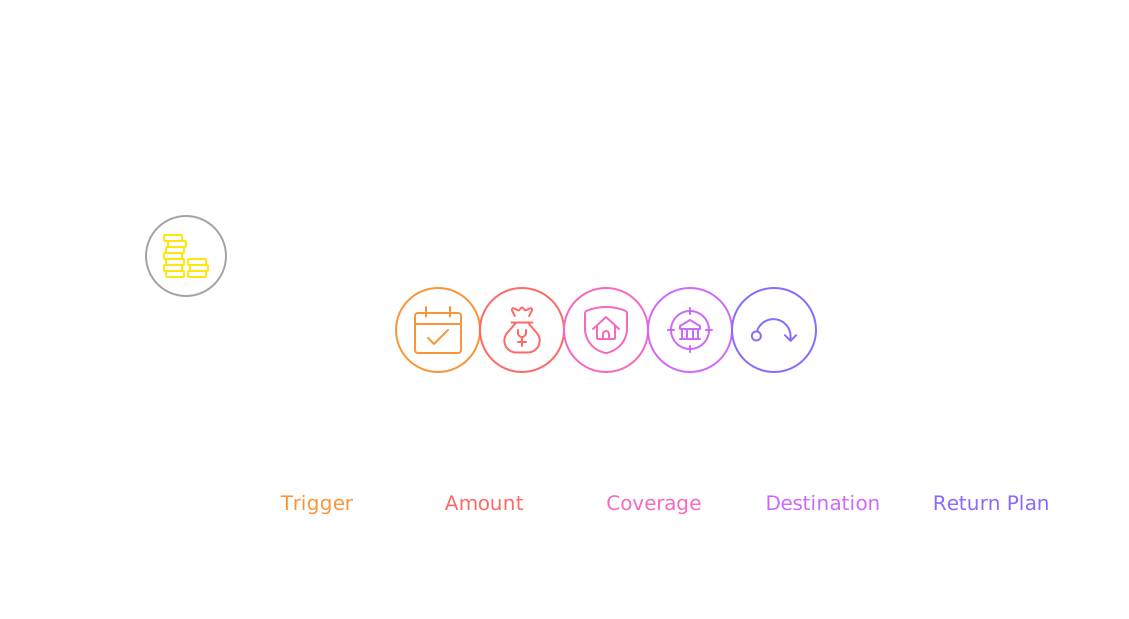
Which Transfer Cadence Fits Your Cash Flow?
.svg)
Frequency answers when. It does not answer whether the current balance is actually free.
This distinction matters because checking balances are not static. Payroll, card payments, rent, utilities, refunds, transfers, and pending transactions can produce a temporary peak that disappears before the next reliable deposit.
Calendar rule
A calendar rule acts because a date arrived. Examples include every Friday, the first of each month, or the day after payday.
Condition rule
A condition rule acts because account data meets a test. Examples include “move the amount above the checking floor” or “move only after the next bill cluster is funded.”
Hybrid rule
A hybrid rule reviews on a schedule but transfers only when a condition is satisfied. For example: “Review every Friday, but move cash only when the available balance exceeds the safe balance after pending bills.”
For most households, the hybrid is stronger than a pure calendar rule. It preserves a predictable review habit without assuming every week or month looks the same.
How Do Weekly, Monthly, Payday, and Balance Rules Compare?
The comparison should use the same decision fields: trigger, cash input, bill handling, irregular-income fit, manual effort, and failure mode.
The first table explains how each rule decides to act. The second shows whether that operating model fits changing cash flow.
No rule wins every column.
Fixed schedules win on simplicity. Threshold rules win on amount sensitivity. Bill-aware rules win on workflow coverage. Manual review wins on judgment when the month contains unusual information that no account pattern can reliably infer.
When Does a Weekly Transfer Rule Work?
A weekly rule works when small surpluses accumulate steadily and the weekly amount is materially below the account's normal margin of safety.
The CFPB explains that banks and credit unions may let customers schedule recurring transfers weekly or monthly. It also warns that the transfer should be coordinated with income, expenses, balance alerts, scheduled payments, and the bill calendar.
Weekly fixed-dollar rule
Weekly transfer =
a conservative recurring amount
that remains affordable in the most expensive normal week
The amount should not be based on the best week. It should be based on a week that includes normal variable spending and at least one meaningful debit.
Illustrative weekly example
The figures below are assumptions for demonstrating the rule. They are not a recommendation or reported customer data.
The illustrative household does not transfer the full $300. It begins at $150 because averages hide bill clusters and timing variance.
Weekly works when
- Income arrives weekly or the account receives several predictable deposits.
- The transfer is small relative to the safe balance.
- Major monthly bills are reserved separately.
- You can pause the rule during travel, leave, job changes, or unusual spending.
- The destination allows access on the timeline your bills require.
Weekly breaks when
- Most income arrives monthly but the transfer repeats every week.
- A mortgage, rent payment, tuition debit, or card statement creates one expensive week.
- The balance shown on Friday includes pending transactions that have not posted.
- The transfer runs before payroll is finally available.
- You stop noticing the total monthly amount because each transfer looks small.
A weekly schedule is a savings-habit tool. It is not automatically a cash-management system.
When a Monthly Transfer Is Enough
A monthly rule is enough when the surplus is stable, the bill calendar is visible, and one well-timed review captures the account's recurring excess.
Monthly does not have to mean the first day of the month. A better review date is often after the household's largest predictable bill cluster and after a reliable deposit has posted.
Illustrative monthly example
The figures below are a hypothetical cash-flow pattern.
Moving $14,500 near the start of the month would have treated assigned bill money as excess. Reviewing after the large debit cluster gives a more useful signal.
Monthly works when
- Income and bills follow a stable monthly pattern.
- The account's low point occurs in roughly the same part of the cycle.
- The household can identify irregular bills before the review.
- The surplus is large enough that one monthly movement is worthwhile.
- You prefer fewer transfers and a larger checking cushion.
Monthly breaks when
- A bonus or reimbursement arrives early and sits idle for most of the month.
- Bills vary materially from one cycle to the next.
- Multiple credit cards close and debit on different schedules.
- Pay is biweekly, creating months with an extra paycheck.
- The review date is before the account's true low point.
Monthly is not inherently safer than weekly. It is safer only when the review happens after the relevant obligations are visible.
Should You Move Money After Every Paycheck?
Moving money after payday is a useful default when pay is predictable and the account is reviewed after the deposit becomes available.
The payday rule aligns the transfer with an inflow instead of an arbitrary calendar date. The CFPB describes payday and fixed-day rules as “guaranteed” saving rules, meaning the trigger does not depend on spending behavior.
In the CFPB study of 127,243 savings goals, guaranteed rules such as payday or every-Friday saving averaged 5 transfers per month at $32.57 per transfer. The study describes an association within one app and time period, not a universal prescription for household cash management.
Payday fixed-dollar rule
Transfer after payday = fixed amount only after deposit availability and bills due before the next paycheck are reserved
This rule is easy to automate, but the amount should be tested against the smallest normal paycheck, not the largest one.
Payday percentage rule
Transfer after payday = eligible deposit x selected percentage subject to the protected checking floor
A percentage adapts to bonuses, commissions, or overtime. It can still fail if a larger deposit is already assigned to taxes, debt payoff, tuition, travel, or a known purchase.
Illustrative payday comparison
The figures below are hypothetical.
The percentage rule responds to deposit size. The fixed rule is easier to predict. Neither knows what the deposit is for.
Use payday as the review trigger, then apply a floor. That hybrid avoids treating every incoming dollar as equally available.
Is a Fixed-Dollar or Percentage Rule Better?
A fixed-dollar rule is better for a stable recurring surplus. A percentage rule is better for variable deposits. A threshold is better when the amount left in checking matters more than the size of the latest deposit.
Fixed-dollar decision rule
Use a fixed amount only if the amount remains affordable during the household's smallest normal deposit cycle.
Percentage decision rule
Use a percentage only on unassigned income. Do not apply it blindly to reimbursements, tax reserves, pass-through business cash, or money already committed to a purchase.
Threshold decision rule
Use a threshold when the goal is to preserve a specific checking floor:
Candidate amount to move =
available checking balance
- pending and scheduled outflows
- known irregular reserves
- protected checking floor
If the result is negative, move nothing. If it is positive, the result is a candidate amount, not an instruction to transfer every dollar.
For the full floor calculation, read What Is a Safe Balance?.
How Does a Balance-Triggered Rule Work?
A balance-triggered rule acts when checking exceeds a defined floor or target, rather than because a weekday or payday arrived.
This solves one limitation of fixed transfers: the moved amount changes with the actual surplus.
Static threshold
A static threshold uses one floor until the user changes it.
Example:
If available checking exceeds the protected floor,
review or move the amount above that floor.
The rule is easy to understand. Its weakness is that a floor can become stale after a rent increase, new mortgage, child-care change, insurance renewal, job transition, or shift in card spending.
Tiered threshold
A tiered rule moves only part of the surplus.
The figures below are illustrative.
The retained excess absorbs forecast error. A tiered rule can be useful during the first few cycles because it does not require perfect confidence immediately.
Dynamic threshold
A dynamic threshold changes with cash-flow conditions. It may increase before taxes, travel, tuition, insurance, or a large card payment and decrease after the obligation clears.
The dynamic version is closer to cash management than a recurring savings transfer. It treats the account floor as a live operating variable.
Threshold rule failure modes
A threshold is stronger than a date, but only if the inputs describe the real account.
Bill-Aware Cash Movement
Bill-aware cash movement is a rule that evaluates the checking floor, upcoming obligations, expected income, and transfer timing before deciding whether cash is idle.
It is different from a fixed savings transfer. A fixed transfer starts with “send this amount.” A bill-aware workflow starts with “what can safely leave right now?”
Bill-aware does not mean infallible. An unrecognized check, a new account, a cash payment, a disputed charge, a late payroll deposit, or a one-time obligation can sit outside the observed pattern.
The workflow still needs:
- a conservative user-set floor
- current linked-account data
- pending and expected debit awareness
- uncertainty handling
- a notification or review path
- a pause or cancel control
- a return plan
- periodic floor review
Bill-aware automation is most useful when the difficulty is not choosing one transfer date. The difficulty is that the safe amount changes.
How Much Should You Move Each Time?
Move less than the displayed surplus until the account has been observed through representative cycles.
Start with the safe-balance formula:
Protected checking requirement = fixed bills before next reliable income + expected credit-card payments + variable spending + known irregular expenses + transaction and comfort margin
Then calculate:
Candidate idle cash = available checking balance - protected checking requirement
Then apply a confidence factor:
Initial amount to move = candidate idle cash x conservative confidence factor
The confidence factor is a planning choice, not an evidence-based universal percentage. A lower factor leaves more room for unknowns during setup.
Illustrative amount calculation
All figures below are hypothetical.
The household leaves $5,350 of the candidate amount in checking during the first cycle. If the forecast is accurate and the post-bill low remains comfortably above the floor, the next movement can be reconsidered.
This is slower than transferring the full $10,700 immediately. It is also less likely to create a reversal that destroys trust in the workflow.
Which Cadence Fits Four Common Household Patterns?
The same rule should not be applied to every household. The cash pattern determines the cadence.
Scenario 1: Stable semimonthly salary and fixed bills
The figures are illustrative.
Best starting rule: review after each paycheck, but transfer only the balance above bills due before the next paycheck plus the floor.
Why it fits: the income trigger is stable, but the amount should change depending on whether the review occurs before housing or card autopay.
Avoid: transferring the same amount after both paychecks. The first and second half of the month do not carry the same obligations.
Scenario 2: Biweekly pay with an extra-paycheck month
The figures are illustrative.
Best starting rule: use a payday review with a target balance. Treat the additional paycheck as a classification event, not as automatically spendable or moveable.
Why it fits: a monthly transfer may miss the extra deposit, while a fixed transfer after every paycheck may move too much before a high-expense cycle.
Avoid: building recurring monthly spending around the occasional additional paycheck.
Scenario 3: Commission or freelance income
The figures are illustrative.
Best starting rule: classify every deposit, reserve taxes and near-term bills, then apply a threshold to the unassigned remainder.
Why it fits: a fixed weekly or monthly amount does not respond to a wide income range. A percentage alone is also incomplete because tax and business obligations may scale differently.
Avoid: treating the largest month as the new recurring baseline.
For a deeper version of this workflow, read How Much Should You Keep in Checking With Irregular Income?.
Scenario 4: Stable income with variable card autopay
The figures are illustrative.
Best starting rule: use the issued statements as reserved cash, then apply the threshold after the card-payment cluster.
Why it fits: the checking balance may look high while the card issuers already have a known claim on the cash.
Avoid: moving money based on the balance shown before card autopay.
For the full reserve method, read Why Does My Checking Account Drop After Credit Card Autopay?.
How Do Weekends, Holidays, and ACH Timing Change the Rule?
A transfer date is not the same as a settlement guarantee.
Nacha states that ACH payments can be processed on the same business day or scheduled one or two business days away. The ACH Network processes payments for 23.25 hours per business day and settles four times per day, while the Federal Reserve settlement service is currently closed on weekends and federal holidays.
That creates 4 practical controls.
Confirm availability, not just visibility
A deposit may appear in an interface before every institution treats it as finally available for the intended transfer. The CFPB cautions that a recent deposit may not be immediately available.
Do not schedule an outbound transfer merely because payroll is displayed as pending.
Add a business-day margin
If a bill is due immediately after a weekend or holiday, do not assume an outbound or return transfer will behave like a normal midweek transfer. Keep the needed cash directly available or complete the movement earlier under the relevant institution's terms.
Treat a card credit and checking debit as separate events
A card issuer may display a payment while the linked checking account still has not shown the final debit. Reserve the cash until both sides reconcile.
Know the destination's return path
An internal bank transfer, external ACH transfer, brokerage sale, and Treasury security liquidation can have different instructions, cutoff times, settlement, and availability rules. The correct cadence depends on the slowest required step.
Do not create a cadence that requires the payment system to be faster than the product terms.
What Risks Should Every Transfer Rule Control?
The main risk is not “transferring too often.” It is moving assigned cash or depending on a return that does not arrive before the obligation.
The CFPB explains that automatic payments can help avoid late payments, but a low account balance may produce overdraft or nonsufficient-funds fees. It recommends monitoring both balance and upcoming automatic payments.
Recalculate after material changes
Review the floor and cadence when any of these changes:
- pay frequency or employer
- housing payment
- child care or tuition
- credit-card use
- tax obligations
- insurance premiums
- health expenses
- leave or unemployment
- planned travel or renovation
- the account used for autopay
A rule that worked last quarter can be wrong after one structural change.
Do not optimize the final dollar
The purpose is not to keep checking at the smallest possible balance. The purpose is to separate bill-ready cash from genuinely idle cash without turning every debit into a liquidity event.
Manual Review vs Bill-Aware Automation
Manual review works when the account is simple and the owner reliably performs the review. Automation fits when timing complexity and follow-through are the binding constraints.
The CFPB savings-app study found that fixed guaranteed rules were associated with larger savings accumulation and a roughly 1.5 to 3.5 times larger increase in milestone attainment than the contingent rule categories studied. That result does not prove that one household cash-movement system is best. It does show why a clear recurring trigger can outperform vague intention.
The operational conclusion is narrower:
- If a fixed rule stays safe and actually runs, keep it.
- If the fixed rule repeatedly needs manual repair, improve the condition.
- If the condition requires a weekly spreadsheet that you do not maintain, consider bill-aware automation.
- If the month contains a major one-time event, use human judgment before any automation.
For the behavior-level failure modes, read Why Manual Transfers Fail.
Where Does Rivo Fit in the Cadence Decision?
Rivo fits when the correct amount changes too often for a fixed weekly, monthly, or payday instruction.
It works with your existing checking account, analyzes cash-flow patterns, uses a minimum threshold you set, identifies cash above the protected level, and plans refills before detected bills and transfers. The destination is short-duration U.S. Treasury Bills through Jiko Securities, not a savings account.
Rivo is not necessary when a simple recurring transfer already works. It is also not the right destination for cash you need immediately, cash you want held only as an FDIC-insured bank deposit, or money you are not comfortable investing in T-bills.
The product's differentiation is not “more transfers.” It is a different trigger: move cash when it is identified as idle, then plan its return around detected obligations.
That still requires a thoughtful minimum threshold. Automation should sit on top of a conservative cash policy, not replace one.
For the category explanation, read What Is Automated Cash Management?. For the automatic-sweep distinction, read Why Do You Keep Transferring Money From Savings Back to Checking?.
How Should You Set Up a Transfer Cadence?
Set up the rule in 7 steps.
Step 1: Map the account
List reliable income dates, fixed bills, variable bills, card autopay, pending transfers, irregular expenses, and any cash that already has a job.
Step 2: Find the low point
Review complete cash-flow cycles. Identify the lowest post-bill balance, not the highest post-payday balance.
Step 3: Set the protected floor
Include bills before the next reliable income, expected card payments, variable spending, irregular reserves, and a transaction and comfort margin.
Step 4: Choose the trigger
Use:
- weekly for frequent, stable surplus
- monthly for a stable monthly low point
- payday for reliable income-linked movement
- percentage for variable deposit size
- threshold for variable balance surplus
- bill-aware automation for variable obligations and timing
Step 5: Choose a conservative starting amount
Move only part of the candidate surplus until the forecast has been tested. The initial goal is an accurate operating rule, not maximum movement.
Step 6: Define pause conditions
Pause when income is late, a major charge is disputed, a bill amount is unknown, an account is changing, or the return path cannot meet the next obligation.
Step 7: Reconcile and revise
After each complete cycle, compare:
- forecast low
- actual low
- amount moved
- amount returned
- unplanned debits
- missed or delayed income
- distance above the floor
The rule is ready when it explains normal high and low points and has a clear exception path.
Final Takeaway
Convenience alone is a weak reason to pick weekly, monthly, or payday transfers. What tends to work is a trigger that matches how cash actually enters the account, an amount rule that preserves bill coverage, and a destination whose return timing and protection model fit the money's job. Test the workflow through a few representative cycles before trusting it.
A workable decision order looks like this:
- Calculate the protected checking requirement.
- Identify the account's normal low point.
- Choose payday or monthly review for stable cash flow.
- Add a balance condition if the surplus changes.
- Use bill-aware automation if fixed rules require repeated repair.
- Pause whenever an unusual obligation or income delay makes the forecast unreliable.
This is general information about cash-flow timing, not a recommendation.
The answer is rarely “move money every Friday” or “move money once a month.” The stronger answer is: review on a sensible cadence, but move only when the balance is genuinely above what checking must do next.
FAQ
Is it better to transfer money weekly or monthly?
Weekly is better when income or surplus appears frequently and the amount is small relative to the protected floor. Monthly is better when the account has one visible low point and a stable recurring surplus. Neither is safer without a bill-coverage test.
Should I transfer money on payday or the day after payday?
Transfer only after the deposit is available under your bank's terms and bills due before the next reliable deposit are reserved. The correct day depends on funds availability, scheduled debits, weekends, holidays, and the transfer method.
Can I move every dollar above a minimum checking balance?
Not automatically. Subtract pending transactions, card statements, variable spending, irregular expenses, and any assigned cash before treating the amount above the floor as idle.
How often should I change my automatic transfer?
Review it whenever income, housing, card use, child care, taxes, insurance, account structure, or other recurring obligations change. Also review it when the actual checking low repeatedly differs from the forecast.
Is a balance-triggered transfer safer than a fixed transfer?
It can be more responsive because the amount changes with the balance. It is only as safe as the threshold and data behind it. A stale floor or missing pending debit can still produce an over-transfer.
Does Rivo transfer money on a fixed weekly or monthly schedule?
Rivo is designed around connected cash-flow patterns, a user-set minimum checking threshold, identified idle cash, and planned refills before detected bills rather than a blind fixed-dollar calendar rule. Users can review movement notifications and pause, modify, or stop automation.
Related Rivo Reading
- Can You Move Money Out of Checking Without Missing Bills?
- What Is a Safe Balance?
- To combine deposit triggers with a protected floor, read How to Automate Savings With Irregular Income.l
- What Is Automated Cash Management?
- To calculate the low point before choosing a transfer date, read How to Forecast Your Checking Account Balance.

This article is educational and is not financial, investment, tax, accounting, or legal advice.
Yield rate reflects the 4-week T-bill rate when held to maturity. Rate does not include fees. Rates are subject to change. Minimum balance of $100 is required to earn the stated rate.
Rivo is a fintech company, not a bank. Banking services provided by Jiko Bank, a division of Mid-Central National Bank. Jiko Group, Inc. and its affiliates do not provide legal, tax, or accounting advice. You should consult your legal and/or tax advisors before making any financial decisions. This material is not intended as a recommendation, offer or solicitation for the purchase or sale of any security or investment strategy. See FINRA BrokerCheck, Jiko U.S. Treasuries Risk Disclosures and Jiko Securities Inc. Form CRS.
Investments in T-bills: Not FDIC Insured - No Bank Guarantee - May Lose Value. All U.S. treasury investments and investment advisory services provided by Jiko Securities, Inc., a registered broker-dealer, member FINRA and SIPC. Securities in your account are protected up to $500,000. For details, please see www.sipc.org.
Sources
- Consumer Financial Protection Bureau: Make Saving Automatic
- Consumer Financial Protection Bureau: Consumer Savings App Strategies and Savings Outcomes
- Consumer Financial Protection Bureau: How Automatic Payments From a Bank Account Work
- Consumer Financial Protection Bureau: What Is an Overdraft?
- Nacha: The ABCs of ACH
- Rivo Homepage
- Rivo Help Center

Shalu Yadav is Rivo's SEO/GEO Expert, bringing over 10 years of experience in making financial content discoverable across both classic search and generative AI platforms.
Follow on LinkedInGet Rivo Updates
Product news, money insights, and company updates.