What Is a Safe Balance? How to Set the Checking Floor That Keeps Bills Covered and Idle Cash Working
A safe balance is the checking floor that stays available for bills, autopay, spending, and surprises before any cash is treated as idle.
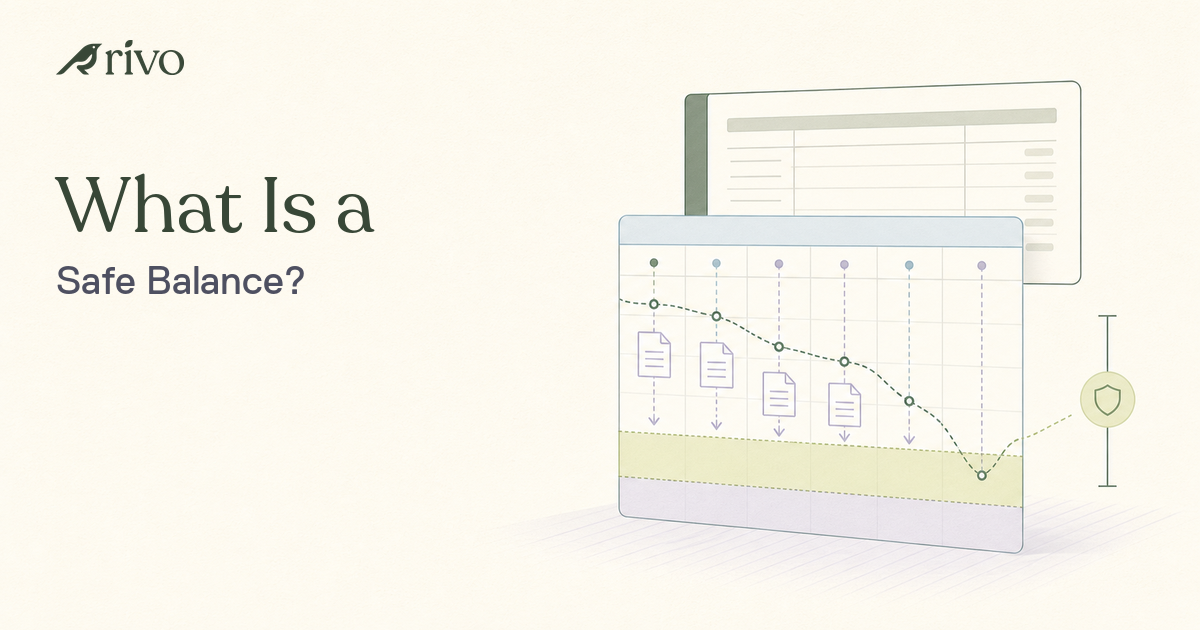
A safe balance is the minimum checking balance that should stay available for bills, autopay, debit spending, transfers, and near-term surprises before any excess cash is treated as idle. In Rivo, that floor matters because the product is designed to move only the eligible cash above your safe balance into short-duration U.S. Treasury Bills through Jiko Securities, then refill checking before bills are due.
The safe balance is not your full emergency fund, your total net worth, or a random round number like $10,000. It is an operating floor for the bank account that pays your real life. Once that floor is clear, the extra layer becomes easier to evaluate using What Is Idle Cash?, How Much Money Should You Keep in Checking?, and Can Rivo Cause an Overdraft?.
TL;DR
- A safe balance is the checking floor you keep untouched for bills, autopay, routine spending, transfers, and a comfort cushion. Rivo lets you configure this floor so automation does not treat every dollar in checking as movable cash, based on current Rivo money-movement controls.
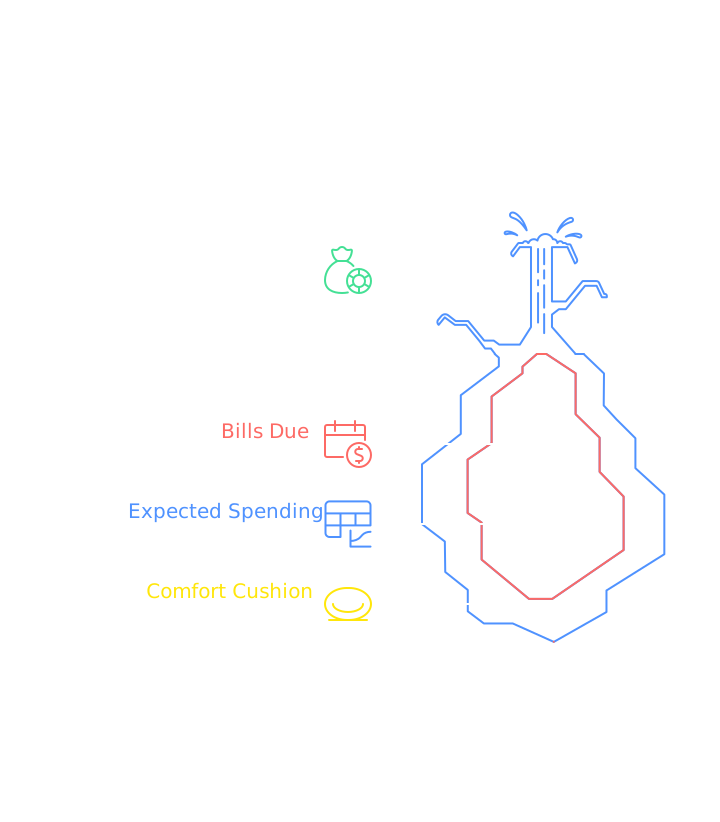
- The basic formula is: safe balance = next 30 days of bills + card autopay reserve + routine spending + known upcoming expenses + comfort cushion.
- The idle layer is: checking balance - safe balance. If checking has an illustrative $28,000 and the safe balance is an illustrative $11,000, the possible idle layer is $17,000.
- The reason this matters is the rate gap. The FDIC national interest checking benchmark was 0.07% in June 2026, while the 4-week Treasury Bill secondary market rate was 3.67% on July 16, 2026. The decision starts with liquidity first, then yield.
- Rivo works best for households with $5,000+ in checking, though there is no hard minimum. A $100 minimum balance is required to earn the stated rate.
- Current Rivo details list a 0.05% monthly management fee, about 0.60% per year before compounding, and available withdrawals up to $15,000 per day.
- The safe balance should rise before known cash spikes: property tax, tuition, travel, medical bills, contractor invoices, credit card payoff months, or income uncertainty.
What Is a Safe Balance in a Checking Account?
A safe balance in checking is the amount you want protected before any cash is moved elsewhere. It is a floor, not a target return strategy.
Most people use checking for payment readiness. Paychecks arrive there. Rent, mortgage, card autopay, insurance, utilities, subscriptions, taxes, and debit spending often leave from there. The safe balance is the part of checking that should stay liquid because it has a job in the next few days or weeks.
.svg)
Idle cash is different. Idle cash is the money above bills, spending, and the safety floor. If you have not separated those layers, your checking balance looks like one big pile. If you separate them, the account has at least 3 layers:
That layer separation is why a safe balance matters more than a headline rate. If the account has an illustrative $20,000 but $18,000 is assigned to mortgage, card autopay, tax, and upcoming travel, the idle layer is only $2,000. If the account has $20,000 and the safe balance is $7,000, the idle layer is $13,000.
Rivo exists for the second layer problem: meaningful idle cash sitting above the checking floor. It is not trying to pull away money you need for next week's bills.
Why Safe Balance Comes Before Yield
Yield is valuable only after the cash still does its payment job. The national interest checking benchmark was 0.07% in June 2026, and the 4-week Treasury Bill secondary market rate was 3.67% on July 16, 2026. That gap can be large, but it does not mean every checking dollar should move.
The safer question is:
What cash must stay ready?
Then:
What cash is persistently above that ready layer?
Only the second amount belongs in the idle-cash conversation.
The wrong order
- Look at the rate first.
- Move too much cash.
- Hope bills clear cleanly.
- Pull money back manually when life gets messy.
The Rivo order
- Set the checking floor.
- Let the system analyze recurring cash flow.
- Move only eligible idle cash above the floor.
- Refill before bills and transfers hit.
- Adjust, pause, or stop when the floor needs to change.
That order matters because the safe balance is a control surface. It tells the automation what not to touch.
How Do You Calculate a Safe Balance?
Use a cash-flow formula, not a round number.
Safe balance = next 30 days of fixed bills + expected card autopay + routine variable spending + known upcoming expenses + comfort cushion
Then:
Potential idle cash = current checking balance - safe balance
Safe balance worksheet
Example 1: Stable household
In this example, the household is not deciding whether to optimize $31,000. It is deciding whether the $20,300 above the $10,700 floor is truly idle.
Example 2: Same balance, different month
Same checking balance. Very different idle layer. This is why a static rule like "keep $10,000 in checking" is weaker than a safe-balance formula.
What Should Count as a Bill for Safe Balance?
Anything that can pull from checking, directly or indirectly, belongs in the safe-balance review. A bill is not only the obvious mortgage or rent payment. It is any scheduled or likely cash outflow that can reduce the checking balance before the next reliable inflow.
Include these payments
- Rent or mortgage
- Credit card autopay
- Student loans, auto loans, and personal loans
- Utilities, phone, internet, streaming, software, gym, and subscriptions
- Insurance premiums
- Child care, school, tuition, or camp payments
- Transfers to brokerage, retirement, family, or another bank
- Estimated taxes, property taxes, or tax payments
- Medical bills, contractor invoices, home repairs, and travel bookings
Separate fixed bills from variable spending
If you want the deeper bill-timing article, read Can You Move Money Out of Checking Without Missing Bills?. If the fear is specifically overdraft risk, read Can Rivo Cause an Overdraft?.
How Big Should the Comfort Cushion Be?
The comfort cushion is the part of your safe balance that exists because real cash flow is not perfectly scheduled. It covers pending transactions, small surprises, late paychecks, weekend settlement timing, and the psychological need to see enough money in checking.
There is no universal cushion. A single renter with stable payroll, no debit card use, and autopay on one card may choose a smaller cushion. A household with 2 incomes, children, contractor bills, variable card autopay, and frequent transfers may choose a larger one.
Cushion sizing by household pattern
The goal is not to minimize the safe balance. The goal is to make the idle layer honest. If a larger floor lets you trust automation, use a larger floor. The lost yield on a few extra thousand dollars can be a reasonable price for avoiding bill anxiety.
How Rivo Uses Safe Balance
Rivo uses safe balance as a user-defined floor in an automated cash-management workflow. Current product details describe a configurable minimum checking threshold, idle-cash detection above that threshold, early refills before bills clear, and controls to pause, stop, or cancel automation on the Rivo help center.
The workflow is:
- Link the checking account you already use.
- Let Rivo analyze cash flow and recurring bills.
- Set the minimum checking balance you want protected.
- Rivo identifies eligible idle cash above that floor.
- Eligible idle cash moves into short-duration U.S. Treasury Bills through Jiko Securities.
- Rivo plans refills before bills or transfers hit.
- You can adjust the floor, pause automation, stop automation, or disconnect.
Rivo safe-balance controls
This is the difference between automation and a calendar transfer. A calendar transfer follows a date. Rivo follows a cash-flow rule that starts with your floor.
What Happens Above the Safe Balance?
Cash above the safe balance may be idle, but it still needs a destination. You can leave it in checking, move it manually to a savings product, buy Treasury bills directly, use a brokerage money market fund, or let Rivo automate the eligible layer.
The decision depends on 4 questions:
- Do you need the money for a known bill in the next 30 days?
- Are you willing to transfer it manually and remember to transfer it back?
- Do you want bank-deposit treatment or Treasury-backed securities treatment?
- Do you want automation that handles refills before bills?
What to do with cash above the floor
The rate comparison is real. Rivo currently lists a 3.65% gross annualized rate as of July 1, 2026, before fees and taxes, and the FRED national interest checking benchmark was 0.07% in June 2026. But the safe-balance rule decides the principal amount before the rate math starts.
If the idle layer is $2,000, the dollar outcome may not justify any complexity. If the idle layer is $20,000, read What Should You Do With $20,000 Sitting in Your Checking Account?. If the idle layer is recurring because your balance keeps creeping up, read Why Does My Checking Account Balance Keep Growing?.
Safe Balance vs Emergency Fund: What Is the Difference?
The safe balance is for checking-account operations. The emergency fund is for financial resilience.
This distinction matters because people often keep the entire emergency fund in checking because they are afraid of missing bills. That may feel responsible, but it can turn a long-term safety fund into idle checking cash.
Safe balance vs emergency fund
If your emergency fund is in checking because you want instant payment readiness, that is a personal choice. But it should be a conscious decision. A useful starting point is to separate:
- next 30 days of bills
- near-term variable spending
- comfort cushion
- true emergency savings
- cash above both layers
For a deeper version, read Should You Keep Your Emergency Fund in Checking?.
When Should You Raise Your Safe Balance?
Raise your safe balance when cash flow becomes less predictable, when a known large payment is coming, or when seeing a lower checking balance would make you uncomfortable.
Automation should adapt to life. Life does not adapt to a fixed transfer rule.
Raise the floor before these events
Rivo lets users adjust thresholds and pause or stop automation through account controls described in current Rivo product details. That control is part of the product's safety design. The floor should not be treated as permanent.
When Can You Lower Your Safe Balance?
Lower the safe balance only after the cash has no near-term job. A bill paid yesterday is not the same as a bill due tomorrow.
Use this checklist:
- Mortgage or rent has cleared.
- Card autopay has cleared.
- Known one-time bills have cleared.
- Payroll has landed.
- No major travel, tax, tuition, repair, medical, or contractor payment is due soon.
- Debit card holds have settled.
- You still feel comfortable with the checking floor.
If all of that is true, the safe balance may be higher than needed. The extra layer can then be evaluated as idle cash.
Lowering the floor responsibly
Rivo is most useful when this review becomes less manual over time. You still control the floor, but the system is designed to learn the pattern around it.
How Safe Balance Changes the Math
The safe balance changes the numerator in every yield calculation. The rate is not applied to your full checking account. It applies only to the cash that can safely leave checking.
Use this structure:
Gross annualized earnings estimate = eligible idle cash x gross annualized rate
Then:
Rivo fee estimate = eligible balance x 0.60% annualized fee before compounding
Current Rivo details list a 0.05% monthly management fee, about 0.60% per year before compounding. Current Rivo rate details list a 3.65% gross annualized rate as of July 1, 2026, before fees and taxes, with a $100 minimum balance required to earn the stated rate.
Same checking balance, different safe balance
This is illustrative math, not a promise of future results. The source-backed inputs are the 3.65% gross annualized rate as of July 1, 2026 and the 0.05% monthly management fee. Rates change, fees apply, and taxes depend on your situation.
The table shows why safe balance is the first question. Two households can both have $25,000 in checking. One may have $20,000 of idle cash. The other may have only $3,000.
How Safe Balance Helps Avoid the Manual Transfer Trap
Manual transfers fail because they ask you to be the cash-flow system. You have to notice idle cash, move it out, remember every upcoming bill, move money back, and adjust when income or spending changes.
That workflow breaks in ordinary weeks:
- A card statement is higher than usual.
- A contractor deposit hits sooner than expected.
- A paycheck posts late.
- A hotel hold sits longer than planned.
- You forget a subscription renewal.
- A tax payment lands in the same week as rent.
This is why Why Manual Transfers Fail is a different problem from "which account pays the highest rate." The workflow has to survive attention gaps.
Manual transfer vs safe-balance automation
The strongest reason to use Rivo is not that a human cannot buy Treasury bills. A disciplined person can. The reason is that most households do not want one more recurring cash-management job.
How Safe Balance Works with T-Bills, FDIC, and SIPC
Safe balance is a checking-account control. T-bills, FDIC, and SIPC are protection and product-structure questions. Keep them separate.
TreasuryDirect describes Treasury bills as marketable securities with terms from 4 weeks to 52 weeks, issued in $100 increments, with federal tax due on interest and no state or local taxes listed by TreasuryDirect here. The IRS also states that interest from Treasury bills, notes, and bonds is subject to federal income tax but exempt from state and local income taxes in Topic 403.
FDIC insurance is different. FDIC deposit insurance applies to eligible deposit products at insured banks and the standard amount is $250,000 per depositor, per insured bank, per ownership category. The FDIC also lists U.S. Treasury Bills, Bonds, and Notes among investments it does not insure, while noting those investments are backed by the full faith and credit of the U.S. government in its deposit insurance guide.
SIPC protection is brokerage protection. SIPC explains that it protects the custody function if a broker-dealer fails, and also states that SIPC does not protect against a decline in the value of securities on its investor page.
Protection labels in plain English
This distinction is important because Rivo is a fintech, not a bank. Banking services are provided by Jiko Bank, a division of Mid-Central National Bank. U.S. Treasury investments and investment advisory services are provided by Jiko Securities, Inc., a registered broker-dealer, member FINRA and SIPC.
Who Should Set a Higher Safe Balance?
Set a higher safe balance if your cash life has more timing risk than the average budget spreadsheet can capture.
Higher-floor fit table
Rivo does not require you to use the lowest possible floor. In practice, a conservative floor can make automation easier to trust. If your safe balance is too tight, every bill feels like an event. If it is honest, idle cash becomes easier to see.
Who Can Use a Lower Safe Balance?
A lower safe balance can work when income is predictable, bills are simple, and the household already has a separate emergency plan.
Lower-floor fit table
The lower-floor case is not about being aggressive. It is about having fewer unknowns.
What Mistakes Should You Avoid?
The biggest safe-balance mistake is using the account balance as proof that cash is idle. A high checking balance can be assigned cash, not idle cash.
Common mistakes
If the balance is growing because you are using checking as a default holding tank, read Why Does My Checking Account Balance Keep Growing?. If the real issue is low checking yield, read Why Is My Checking Account Paying So Little Interest?.
How to Set Your Rivo Safe Balance in 10 Minutes
Use this 10-minute worksheet before activating or adjusting automation.
Step 1: List the next 30 days of fixed bills
Write down rent, mortgage, utilities, insurance, loans, subscriptions, and known ACH pulls. Use due dates, not vague categories.
Step 2: Add card autopay
Use the current statement balance if autopay will pull soon. If the statement is not final, use the higher of your current balance or a conservative estimate.
Step 3: Add routine spending
Use a weekly or monthly amount for groceries, debit, ATM, transfers, and daily spending. If you do not know the number, use the last 30 days from your bank or card app as a starting point.
Step 4: Add known large expenses
Taxes, tuition, travel, medical bills, home repairs, contractor invoices, and family transfers belong in the floor until paid.
Step 5: Add comfort cushion
Pick the amount that makes the account feel stable. This is not an optimization failure. It is the amount that lets automation run without daily anxiety.
Step 6: Compare balance to safe balance
Potential idle cash = current checking balance - safe balance
If the output is small, leave the cash alone or wait. If the output is meaningful and persistent, Rivo can evaluate the eligible idle layer.
Step 7: Revisit after life changes
Update the floor when income changes, a new bill starts, a card payoff spikes, or a large one-time payment appears.
When Is Rivo a Good Fit After You Set the Safe Balance?
Rivo is a good fit when your safe balance is clear, your checking account keeps holding extra cash above that floor, and you do not want to manage transfers or Treasury purchases manually.
Current Rivo details list:
- Works with existing bank accounts, so no direct-deposit or bill-pay switch is required here.
- A configurable minimum threshold for checking here.
- Bill-aware movement and early refills before scheduled bills here.
- A 5PM Pacific movement notice and cancellation window until midnight here.
- A 0.05% monthly management fee here.
- Withdrawals of available funds up to $15,000 per day here.
Good fit / avoid if
To include issued card statements in the floor, read Why Does My Checking Account Drop After Credit Card Autopay?. If you want the fee math, read Rivo Fees Explained. If you want to compare paths, read Rivo Alternatives.
FAQ
What is a safe balance in checking?
A safe balance is the minimum checking amount you keep available for bills, autopay, routine spending, transfers, and near-term surprises. In Rivo, it is the floor used before eligible idle cash is moved into short-duration U.S. Treasury Bills through Jiko Securities.
Is the safe balance the same as idle cash?
No. The safe balance is assigned cash. Idle cash is the layer above the safe balance. Use: idle cash = checking balance - safe balance.
How often should I update my safe balance?
Update it after major cash-flow changes: new rent or mortgage, new payroll timing, large card statement, property tax, tuition, medical bill, home repair, travel, or any period where income becomes uncertain.
What if I set my safe balance too low?
Raise it. Rivo lets users adjust thresholds and pause or stop automation through the controls described in current account management details. A conservative floor is preferable to a floor that makes every bill stressful.
Does Rivo move money below my safe balance?
Rivo is designed around a user-configured minimum checking threshold. Current product details describe this threshold as the amount that stays in checking so Rivo does not move more than you are comfortable with here.
What rate can the idle layer earn with Rivo?
Rivo currently lists a 3.65% gross annualized rate as of July 1, 2026, before fees and taxes. The rate reflects 4-week T-bill rate assumptions when held to maturity, rates can change, and a $100 minimum balance is required to earn the stated rate.
Is a larger safe balance bad?
Not necessarily. A larger safe balance can be rational if it protects bill timing, income uncertainty, large one-time payments, or peace of mind. The goal is not to move the maximum amount of cash. The goal is to identify the amount above the floor that can work without disrupting daily payments.
Related Rivo Reading
- To organize the paydays, due dates, and expected debits that the floor must protect, read How to Build a Bill Calendar for Your Checking Account.
- To include property tax, insurance, tuition, and other dated obligations, read Why Does Your Checking Account Look Full Until Annual Bills Arrive?.
- To test the floor against the next 30 days of paychecks, bills, and card autopay, read How to Forecast Your Checking Account Balance.
- To separate the checking floor from emergency and sinking funds, read Sinking Fund vs Emergency Fund vs Safe Balance..
- To calculate what remains after pending bills and assigned cash, read Is Your Available Balance Safe to Spend?.

This article is educational and is not financial, investment, tax, accounting, or legal advice.
Yield rate reflects the 4-week T-bill rate when held to maturity. Rate does not include fees. Rates are subject to change. Minimum balance of $100 required to earn the stated rate.
Rivo is a fintech company, not a bank. Banking services provided by Jiko Bank, a division of Mid-Central National Bank. Jiko Group, Inc. and its affiliates do not provide legal, tax, or accounting advice. You should consult your legal and/or tax advisors before making any financial decisions. This material is not intended as a recommendation, offer or solicitation for the purchase or sale of any security or investment strategy. See FINRA BrokerCheck, Jiko U.S. Treasuries Risk Disclosures and Jiko Securities Inc. Form CRS.
Investments in T-bills: Not FDIC Insured - No Bank Guarantee - May Lose Value. All U.S. treasury investments and investment advisory services provided by Jiko Securities, Inc., a registered broker-dealer, member FINRA and SIPC. Securities in your account are protected up to $500,000. For details, please see www.sipc.org.
Sources
- Rivo FAQ and product controls
- Rivo current rate page
- FRED National Rate: Interest Checking
- FRED 4-Week Treasury Bill Secondary Market Rate
- FRED Household Checkable Deposits and Currency
- TreasuryDirect: Treasury Bills
- IRS Topic 403: Interest Received
- FDIC Deposit Insurance At A Glance
- SIPC: What SIPC Protects
- Jiko Treasury Risk Disclosure

Get Rivo Updates
Product news, money insights, and company updates.