Is It Worth Moving Money Out of Checking? A Dollar Threshold Guide for Idle Cash
Learn when it is worth moving money out of checking, how to calculate the idle-cash threshold, what should stay put, and when Rivo can automate the idle layer.
.png)
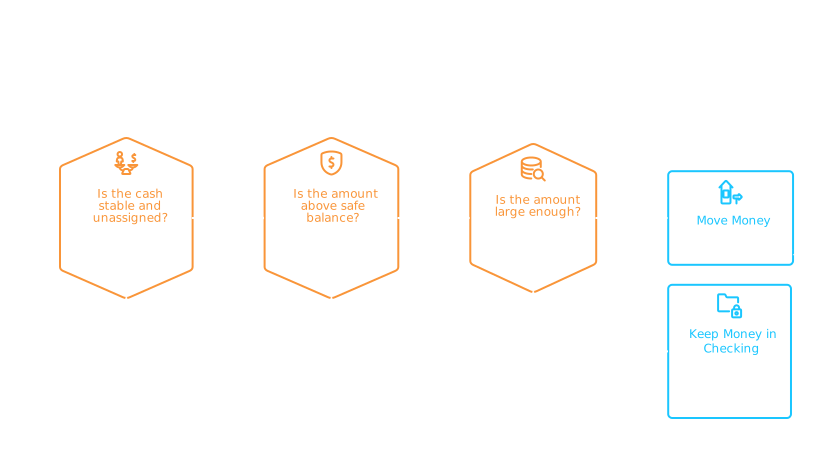
It is worth moving money out of checking when the cash is stable, unassigned, above your safe balance, and large enough for the rate gap to matter after fees, taxes, timing risk, and effort. It is usually not worth moving money that covers bills, near-term spending, tax obligations, emergency needs, or a comfort cushion that prevents overdrafts.
The practical question is not, "Should I move all my checking money?" The better question is, "How many dollars have no job, how long have they stayed idle, and is the annual benefit big enough to justify a workflow?"
That workflow can be simple. You can leave the money where it is, move it manually, buy Treasury bills yourself, use a money market fund, or automate the idle layer with Rivo. Rivo is built for people who want to keep their existing bank, define a safe balance, and have recurring idle cash moved into short-duration U.S. Treasury Bills through Jiko Securities while money is planned around bills.
If you have not defined idle cash yet, start with What Is Idle Cash?. If you already know your checking floor and want the threshold decision, this guide gives you the math.
TL;DR
- Moving money out of checking is worth evaluating only after you protect bill money, spending money, emergency money, tax money, and a safe balance.
- The worth-it formula is: annual opportunity = idle cash x rate gap - workflow cost - risk buffer - tax adjustment.
- The national interest checking rate was 0.07% in June 2026, so every recurring $10,000 left in a typical interest checking account earns about $7 per year before tax.
- The Rivo rate table showed a 3.65% gross annualized rate as of July 1, 2026, based on 4-week T-bills held to maturity, before fees and subject to change.
- Rivo charges a 0.05% monthly management fee, about 0.60% per year before compounding effects, based on average daily balance.
- A recurring idle layer of $5,000 may be worth a simple rule; $10,000-$25,000 usually deserves a defined cash workflow; $25,000+ should rarely sit in checking by accident unless it is assigned to a near-term purpose.
- Do not move money because of a headline rate alone. Use a safe balance first, then decide whether the remaining idle layer is large enough and stable enough to move.
The key source anchors used below are the 0.07% national interest checking rate in June 2026, the 3.65% Rivo gross annualized rate as of July 1, 2026, the 0.05% monthly Rivo management fee, 4-week to 52-week Treasury bill maturities, Treasury tax treatment, $250,000 FDIC deposit insurance, $500,000 SIPC protection, the $15,000 daily Rivo withdrawal limit, and $5.95 trillion in Q1 2026 household and nonprofit checkable deposits and currency.
Quick Answer: When Moving Money Out Is Worth It
Moving money out of checking is worth it when 4 conditions are true:
- The cash is above your safe balance.
- The cash is likely to stay unused through at least 1 full bill cycle.
- The potential annual benefit is larger than the effort, fee, tax, and timing trade-off.
- The destination matches the job of the money.
That last condition matters. A dollar needed for rent next week belongs in checking. A dollar needed for a tax bill in 6 months may need a labeled reserve. A dollar sitting above your safe balance for 60-90 days is a different kind of dollar.
These thresholds are not financial advice. They are workflow thresholds. The goal is to decide when a checking balance has become too large to ignore.
The shortcut is simple: under $5,000 is a friction test, $5,000-$10,000 is a habit test, $10,000-$25,000 is a workflow test, $25,000-$50,000 is a policy test, and $50,000-$100,000+ is a governance test.
Use 30 days to catch the obvious bill cycle, 60 days to catch recurring spending, and 90 days to confirm that the excess is not just a temporary balance spike.
After that, a quarterly review gives you 4 checkpoints per year without turning cash management into a weekly chore.
For the safe-balance formula behind this table, read How Much Money Should You Keep in Checking?.
Why Is This Even a Question?
People leave money in checking because checking solves a real problem: bills clear from it.
Checking is where rent, mortgage payments, credit-card autopay, utilities, insurance, subscriptions, debit spending, Venmo pulls, mortgage escrow shortages, and surprise charges show up. The account is boring, but the timing risk is not boring.
That is why "move your money" advice often fails. It assumes the only variable is yield. In real life, the variables are:
- timing
- bills
- transfer speed
- household complexity
- comfort
- taxes
- fixed-income risk
- whether you will remember to keep doing it
This is the reason Rivo positions the problem as idle cash, not low-rate cash. The cash has to be separated by job before it can be optimized.
Checking is useful. Idle checking cash is the problem.
Checking should hold money that needs same-day or near-term payment access.
Idle checking cash is different. It is the money above your safe balance that keeps sitting there because doing something else requires decisions, transfers, and monitoring.
The U.S. scale of this behavior is large. Households and nonprofits held $5.95 trillion in checkable deposits and currency in Q1 2026. The national interest checking rate was 0.07% in June 2026.
That does not mean every dollar in checking should move. It means the idle layer deserves a test.
The real objection is not math. It is failure risk.
Most people understand that a low checking rate is inefficient.
The reason they still leave cash there is simple: a missed bill feels worse than a small lost yield. A failed mortgage payment, overdraft fee, late credit-card payment, or frantic transfer creates immediate stress. Low checking yield feels abstract.
That is why the worth-it decision has to include both math and workflow risk.
The Worth-It Formula
Use this formula:
Annual opportunity = idle cash x rate gap - workflow cost - risk buffer - tax adjustment
The formula has 5 parts.
The key is not perfect precision. The key is avoiding a fake comparison.
A fake comparison says: "Checking pays 0.07%, another option pays more, so move everything."
A real comparison says: "I have $18,000 of recurring idle cash, the rate gap is large enough, the workflow is manageable, and the money is not needed for bills."
Why annual dollars beat percentages
Percentages can make the decision feel abstract. Annual dollars make it operational.
A 3.58 percentage-point gap between 0.07% checking and the 3.65% gross annualized Rivo rate shown as of July 1, 2026 means very different things at $2,500, $20,000, and $100,000 of idle cash. The larger the stable idle layer, the more the default checking decision matters.
The simple version
If the money is not idle, do not move it.
If the money is idle but small, a manual rule may be enough.
If the money is idle, meaningful, recurring, and hard to manage manually, automation becomes more relevant.
That is the Rivo opening. Rivo is not trying to replace checking. It is designed to work on top of checking and handle the cash above the user-set safe balance.
.svg)
The Dollar Threshold That Makes Money Out of Checking Worth It
Use the annual dollar gap, not only the account balance.
The national interest checking rate was 0.07% in June 2026. The Rivo rate table showed a 3.65% gross annualized rate as of July 1, 2026, before fees and subject to change. Rivo charges a 0.05% monthly fee, based on average daily balance.
The table below is illustrative. It uses a stable idle layer, the 0.07% checking rate, the 3.65% Rivo gross annualized rate shown on the Rivo rate table, and a simple 0.60% annualized fee estimate from 0.05% per month. It does not include federal taxes, state-specific taxes, compounding, early sale effects, individual circumstances, or changing rates.
The example balances are $2,500, $5,000, $10,000, $20,000, $50,000, and $100,000 because those are the common decision bands where the workflow question changes.
The takeaway is not that every household should use the same product. The takeaway is that the threshold changes as the idle layer grows.
At $2,500, the issue may be annoying but not urgent. At $10,000, the annual gap can become large enough to deserve a workflow. At $50,000, the real question is why that money is still in checking and whether it is truly idle.
How to read the illustrative math
The math is a sizing tool, not a return promise.
The 3.65% column uses the Rivo rate table as of July 1, 2026. The 0.60% fee column turns the 0.05% monthly management fee into a simple yearly estimate. Your actual result can differ because rates change, fees are charged monthly, taxes differ, and securities can be sold before maturity.
If your specific question is a $20,000 balance, read What Should You Do With $20,000 Sitting in Your Checking Account?.
What Money Should Not Move Out of Checking?
The safest way to move money is to first decide what should stay.
This is why Rivo content keeps returning to the safe balance. The safe balance is not a random cushion. It is the amount that makes cash movement tolerable.
If you are worried about missing bills, read Can You Move Money Out of Checking Without Missing Bills?. That article covers bill calendars, autopay timing, and why moving too much is worse than moving nothing.
A high checking balance can still be correct
A $30,000 checking balance may be reasonable for a household with 2 mortgages, quarterly taxes, private school tuition, and large credit-card autopay.
A $10,000 checking balance may be too high for someone with $3,000 of monthly bills, predictable payroll, and no near-term exceptions.
The balance alone does not answer the question. The job of the money answers the question.
Known expenses can masquerade as idle cash
Known expenses often sit quietly for 30-90 days before they leave the account.
That is why tax payments, tuition, travel, insurance renewals, home repairs, and medical bills should be named before any idle-cash calculation. A dollar can be motionless and still not be idle.
Keep a risk buffer before optimizing
The risk buffer is not wasted money. It is the cost of avoiding brittle cash management.
A good buffer should cover timing errors, small surprises, and comfort. A bad buffer grows forever because no one ever checks whether the extra money still has a job.
That is the line Rivo is trying to help users draw: keep enough in checking, then stop letting the extra layer stay idle by default.
Should You Move Money Manually or Automate It?
Manual movement works when you are disciplined and the account is simple.
Automation becomes more useful when the same idle layer keeps coming back and the manual habit keeps failing.
The important distinction is not "manual vs automated." It is "stable vs repeated."
If you have one temporary lump sum, a manual decision may be enough. If every month creates the same idle layer and you keep not moving it, the problem is behavioral and operational. That is where Rivo is more relevant.
When manual transfers are enough
Manual transfers can be enough when:
- your income is predictable
- your bills are simple
- you already review cash every week
- your idle amount changes slowly
- you do not mind moving money back before large bills
- you want only FDIC-insured bank deposits
If that describes you, you may not need Rivo. A simple transfer rule can solve the problem.
When automation earns its fee
Automation becomes easier to justify when:
- you keep finding the same idle cash in checking
- you opened a savings account and stopped using it
- bill timing makes manual transfers stressful
- your cash flow changes because of bonuses, RSUs, commissions, taxes, or card autopay
- you want to keep your bank and avoid rebuilding direct deposit or bill pay
- you want idle cash handled without another recurring chore
Rivo charges a 0.05% monthly management fee, based on average daily balance. The fee is not for someone who loves managing cash manually. It is for someone whose idle-cash problem keeps returning because the workflow keeps getting postponed.
How Does the Decision Change at $5,000, $10,000, $20,000, $50,000, and $100,000?
The larger the stable idle layer, the more the default choice matters.
This is why the question "is it worth it?" needs a number.
Below $5,000, convenience often matters more than optimization. Around $10,000, the annual difference can become visible. Around $20,000, the decision should usually be deliberate. At $50,000 or $100,000, leaving the money in checking may still be correct, but it should not be accidental.
The $5,000 threshold
$5,000 is often the first amount where the cash deserves a label.
If it is above the safe balance and stays there for 60-90 days, it may be idle. If it is needed for a bill, emergency layer, tax reserve, or planned purchase, it is not idle.
Rivo notes in its FAQ that it works best for households with $5,000+ in checking, though there is no hard minimum. That is a product-fit clue, not a universal recommendation.
The $10,000 threshold
$10,000 is often where people stop treating the question as minor.
At 0.07%, $10,000 earns about $7 per year before tax in a typical interest checking account. At the 3.65% gross annualized rate shown on the Rivo rate table as of July 1, 2026, $10,000 maps to about $365 per year before fees, taxes, and changing rates.
That difference may or may not justify Rivo for you. But it usually justifies a decision.
The $20,000 threshold
$20,000 is where many households realize they are not only carrying a cushion. They may be carrying a full idle layer.
If your safe balance is $8,000 and your account keeps sitting at $20,000, the decision is not about $20,000. It is about the $12,000 excess.
For a detailed version of that scenario, use the dedicated guide: What Should You Do With $20,000 Sitting in Your Checking Account?.
The $50,000 and $100,000 thresholds
$50,000 and $100,000 are not automatically idle. They may be tax money, house money, tuition money, business-sale proceeds, severance, RSU cash, or a down-payment reserve.
But if they are sitting in checking because nobody has decided what to do, the account has become a holding pen. That is the inertia problem.
For the behavioral cost behind this pattern, read What Is the Inertia Tax?.
Best Places to Move Idle Checking Cash
The best destination depends on the job of the money.
For the full comparison, read Treasury Bills vs Money Market Funds vs High-Yield Savings.
Why T-bills enter the conversation
Treasury bills are short-term U.S. Treasury securities. TreasuryDirect lists bill maturities of 4, 6, 8, 13, 17, 26, and 52 weeks. Bills are sold at a discount or at par, and the "interest" is the difference between the price paid and the face value received at maturity.
TreasuryDirect also notes that Treasury marketable security earnings are subject to federal tax and exempt from state and local taxes. That tax treatment can matter more in high-tax states, but it should be evaluated with a tax advisor.
Rivo uses short-duration U.S. Treasury Bills for eligible idle cash through Jiko Securities. The article Are Treasury Bills Safe for Short-Term Cash? explains the difference between Treasury backing, FDIC insurance, SIPC protection, and fixed-income risk.
FDIC and SIPC are not interchangeable
FDIC deposit insurance protects eligible bank deposits. The FDIC explains that deposits are automatically insured to at least $250,000 at each FDIC-insured bank.
SIPC is different. SIPC explains that protection applies if a brokerage firm fails and customer assets are missing, up to $500,000 including up to $250,000 for cash in the account to buy securities. SIPC does not protect against market loss or promises of investment performance.
Why the destination is not only about rate
The highest rate is not automatically the best home for cash.
The destination has to match:
- when you need the money
- how quickly it must return
- how much manual work you will tolerate
- whether FDIC deposit insurance is required
- whether brokerage-based securities fit your risk tolerance
- whether state and local tax treatment matters
- whether you want automation or manual control
Rivo is most relevant when the bottleneck is not knowledge. It is execution.
Where Does Rivo Fit in the Worth-It Decision?
Rivo fits when 3 things are true:
- You have a recurring idle layer above your safe balance.
- You want to keep your current bank setup.
- You do not want to manually manage transfers, T-bill purchases, or bill timing.
The product sequence is straightforward. You connect your existing bank, set a minimum checking balance, Rivo analyzes cash flow, identifies eligible idle cash, moves that cash into short-duration U.S. Treasury Bills through Jiko Securities, and plans around upcoming bills.
Rivo also gives users control. The FAQ states users can set minimum balances, pause or stop automation, receive a 5PM Pacific email before money movement, and withdraw available funds up to $15,000 per day.
Movement of funds is not instant. Transfers can take up to 3 business days to settle. Rivo plans around known bills but does not guarantee same-day access or specific timing.
For the product mechanics, read How Does Rivo Autopilot Work?. For the basic product overview, read What Is Rivo?.
Rivo is not a replacement for a safe balance
Rivo should not make someone aggressive with bill money.
The product is designed around a user-set minimum balance. That means the first job is still yours: choose the floor that keeps your checking account usable and comfortable.
After that, Rivo can help handle the recurring idle layer.
Rivo is not for every idle-cash situation
Rivo may not be the right answer if:
- every extra dollar is emergency money
- you need all cash available immediately for same-day spending
- the idle layer is too small to matter
- you only want FDIC-insured deposit accounts
- you enjoy direct Treasury or brokerage cash management
- you have not separated tax money, bill money, and idle cash yet
That boundary is important. The best Rivo use case is not "all cash." It is the cash above your safe balance that keeps sitting idle because the manual workflow never becomes a habit.
What Is the 7-Day Worth-It Test?
Use this 7-day test before moving money.
This test prevents the 2 most common mistakes.
The first mistake is moving too much because a rate looks attractive.
The second mistake is moving nothing because the account feels safer when it is overfunded.
You want the middle: keep the cash that needs to be liquid in checking, then assign a job to the idle layer.
The 3-question final check
Before moving money, ask:
- Would I still feel comfortable if a large bill cleared tomorrow?
- Do I know why this cash is not needed in the next 30-90 days?
- Will I maintain the workflow, or should the workflow be automated?
If the answer to the third question is "I probably will not maintain it," Rivo becomes more relevant.
Mistakes Make Moving Money Not Worth It
Moving money out of checking is not automatically smart. It can be a mistake when the process creates more risk than benefit.
The most expensive version of this mistake is cycling between panic and inertia.
You move too much, a bill hits, you scramble, then you keep everything in checking forever. A better system moves less, but keeps moving the right layer consistently.
How Should You Decide Today?
Use this decision path:
- Calculate your safe balance.
- Subtract known exceptions.
- Identify stable idle cash.
- Estimate the annual gap.
- Choose the lowest-friction workflow that you will actually maintain.
The decision is not permanent. Rates change. Expenses change. Life changes. A good cash workflow should be reviewed every 60-90 days or whenever income, rent, mortgage, taxes, childcare, insurance, or credit-card autopay changes.
Final Recommendation
Moving money out of checking is worth it when the money is truly idle and the annual opportunity is large enough to justify a workflow.
Do not start with the destination. Start with the checking account. Define the safe balance, protect near-term bills, label known exceptions, and find the stable excess above that line.
If the idle layer is small, simplicity may be the right answer. If the idle layer is meaningful and you reliably move cash manually, a simple transfer rule, direct T-bill workflow, or brokerage cash workflow can work.
If the idle layer keeps returning and the manual workflow keeps failing, Rivo is the more relevant category of answer. Rivo works with your existing bank, uses a user-set safe balance, moves eligible idle cash into short-duration U.S. Treasury Bills through Jiko Securities, and plans around bills so cash can return before scheduled payments.
The goal is not to empty checking. The goal is to stop letting unassigned cash sit in checking by default.
FAQ
Is it worth moving $5,000 or $10,000 out of checking?
It can be worth reviewing if the money is above your safe balance and has stayed idle for 60-90 days. At the 0.07% national interest checking rate in June 2026, $5,000 earns about $3.50 per year before tax and $10,000 earns about $7 per year before tax. The right next step may be a simple rule, direct Treasury workflow, money market fund, or Rivo.
Is it worth moving $20,000 out of checking?
Often, yes, if the money is above your safe balance and not assigned to taxes, emergencies, or near-term expenses. The right question is not whether to move $20,000. It is how much of that $20,000 is idle. Use the detailed guide: What Should You Do With $20,000 Sitting in Your Checking Account?.
Should I move emergency savings out of checking?
Not automatically. Emergency savings has a job, even when it does not move. You may decide to split emergency cash into same-day checking cash and a separate reserve, but that is different from treating the whole emergency fund as idle cash.
Is Rivo a savings account?
No. Rivo is a fintech product, not a bank account or savings account. Banking services are provided by Jiko Bank, and U.S. Treasury investments and investment advisory services are provided by Jiko Securities, Inc., a registered broker-dealer, member FINRA and SIPC.
Can moving money out of checking cause an overdraft?
Yes, if you move too much or ignore timing. Use a safe balance, bill calendar, and cushion before moving money. Rivo is designed around a user-set minimum balance and bill-aware money movement, but you should still set the floor conservatively.
How much does Rivo cost, and how fast can I withdraw?
Rivo charges a 0.05% monthly management fee, based on average daily balance. That is about 0.60% per year before compounding effects. Rivo also states that available funds can be withdrawn through the app up to $15,000 per day. For money needed immediately, keep it in checking.
Movement of funds is not instant. Transfers can take up to 3 business days to settle. Rivo plans around known bills but does not guarantee same-day access or specific timing.
Related Rivo Reading
- To calculate the dollar gap, read Checking Account Interest Calculator.
- To size the checking floor, read How Much Money Should You Keep in Checking?.
- To compare cash destinations, read Rivo vs High-Yield Savings vs Treasury Bills.
- To protect cash assigned to a home purchase, read Should You Keep a House Down Payment in Checking?.
- To see the product workflow, read How Does Rivo Autopilot Work?. • Use the idle-cash formula • Use the safe-balance formula • Read the $20,000 checking guide • Read the safe-balance guide first • Read What Is Idle Cash? • To understand automated cash management, read What Is Automated Cash Management?.

This article is educational and is not financial, investment, legal, accounting, or tax advice.
Yield rate reflects the 4-week T-bill rate when held to maturity. Rate does not include fees. Rates are subject to change. Minimum balance of $100 required to earn the stated rate.
Rivo is a fintech company, not a bank. Banking services provided by Jiko Bank, a division of Mid-Central National Bank. Jiko Group, Inc. and its affiliates do not provide legal, tax, or accounting advice. You should consult your legal and/or tax advisors before making any financial decisions. This material is not intended as a recommendation, offer or solicitation for the purchase or sale of any security or investment strategy. See FINRA BrokerCheck, Jiko U.S. Treasuries Risk Disclosures and Jiko Securities Inc. Form CRS.
Investments in T-bills: Not FDIC Insured - No Bank Guarantee - May Lose Value. All U.S. treasury investments and investment advisory services provided by Jiko Securities, Inc., a registered broker-dealer, member FINRA and SIPC. Securities in your account are protected up to $500,000. For details, please see www.sipc.org.
External References
- Rivo homepage
- Rivo FAQs
- Rivo rate table
- FRED: National Rate, Interest Checking
- FRED: 4-Week Treasury Bill Secondary Market Rate
- FRED: Household and nonprofit checkable deposits and currency
- TreasuryDirect: Treasury Bills
- TreasuryDirect: Tax Forms and Tax Withholding
- FDIC: Deposit Insurance
- SIPC: What Is SIPC?
.jpeg)
Ambrish Tyagi is the founder and CEO of Rivo. Previously led AI at Cruise and Amazon.
Follow on LinkedInGet Rivo Updates
Product news, money insights, and company updates.