What Is Automated Cash Management? A Bill-Aware Guide for Idle Checking Cash
Learn what automated cash management is, how it differs from manual transfers, what risks to check, and how Rivo handles idle checking cash.
.png)
Automated cash management is software that monitors your checking balance, separates bill money from idle cash, moves the idle layer into a higher-earning cash destination, and is designed to brings money back before scheduled payments need it. The goal is not to empty checking. The goal is to keep your bills covered while the dollars above your safe balance stop sitting unassigned.
Rivo is built for this exact category. It works with your existing bank, lets you set a minimum checking balance, identifies idle cash above that floor, moves eligible cash into short-duration U.S. Treasury Bills through Jiko Securities, and plans around bills so money can return before payments clear.
If you are still defining the problem, start with What Is Idle Cash?. If you already know you have recurring cash above your safe balance, this guide explains the solution category.
TL;DR
- Automated cash management is a system for moving the idle layer above your safe balance, not a reason to move rent, credit-card autopay, tax money, or emergency cash.
- The category exists because manual transfers break down when income timing, bill timing, credit-card autopay, variable spending, and changing rates all need attention.
- The national interest checking rate was 0.07% in June 2026, while U.S. households and nonprofits held $5.95 trillion in checkable deposits and currency in Q1 2026.
- Rivo works with your existing bank, uses a user-set checking floor, and returns money before bills or transfers hit.
- The current Rivo rate table, accessed July 6, 2026, listed a 3.65% Rivo return and 0.07% national average checking rate, before fees and subject to change.
- Rivo charges a 0.05% monthly management fee, which is about 0.60% per year before compounding effects, based on average daily balance.
- Automated cash management is useful when the annual benefit, tax treatment, workflow consistency, and bill protection are worth more than the fee, setup, and fixed-income risk.
The shortest definition is this: automated cash management turns a recurring cash decision into a rules-based workflow.
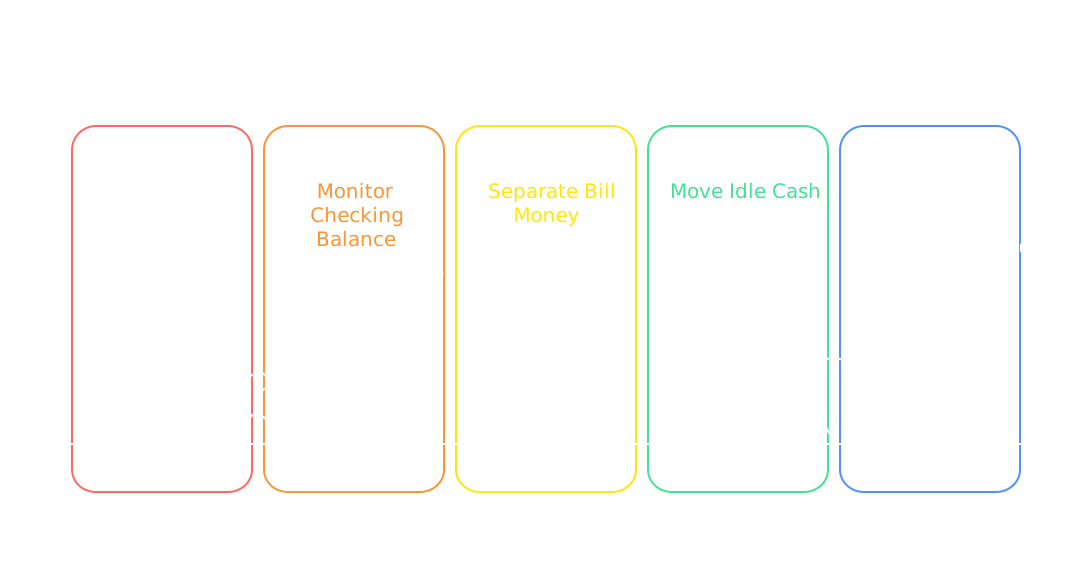
Automated Cash Management
Automated cash management is a bill-aware cash workflow that decides which dollars should stay in checking, which dollars are idle, where the idle layer should go, and when cash should return.
That sounds simple, but the workflow has 5 moving parts:
- balance monitoring
- bill and transfer prediction
- safe-balance control
- idle-cash movement
- refill timing
The important word is "management." A one-time transfer is not cash management. A reminder to move money every Friday is not cash management. A brokerage account that holds cash after you move it manually is not cash management by itself.
Automated cash management has to handle the full loop.
The full loop
The takeaway: cash management is not a rate table. It is a timing system.
The definition buyers should use
Automated cash management is software that applies a cash policy without requiring you to keep making the same transfer decision. It should know your checking floor, respect upcoming bills, move only the idle layer, and give you control to pause, adjust, withdraw, or disconnect.
That is why Rivo is positioned differently from a manual high-yield savings workflow. A savings account can be a useful destination. It does not automatically solve the recurring decision of what should leave checking, when it should return, and how much should stay for bills.
The 30-60-90 readiness test
Use a 30-60-90 day test before you automate. The goal is to separate a temporary balance spike from cash that keeps returning above your safe balance.
This test is deliberately conservative. A $10,000 balance spike after a bonus or home sale may not be idle on day 1. A $10,000 excess that survives 90 days, 3 payroll cycles, 3 rent or mortgage cycles, and 3 credit-card autopay cycles is different.
The same logic changes by balance size. A recurring $2,500 excess is a tracking problem, $5,000 is a habit problem, $10,000 is a workflow problem, $25,000 is a policy problem, and $50,000+ is a governance problem.
After setup, review the rule 4 times per year and whenever 1 major input changes: income, rent, mortgage, childcare, insurance, tax timing, or a recurring card autopay above $2,000. A good review takes 15 minutes: check the last 30 days, the next 30 days, and any 90-day exception above $1,000.
Why Does Automated Cash Management Exist
The category exists because cash is both simple and operationally messy.
Everyone understands that idle cash earning very little is inefficient. FRED showed the national interest checking rate at 0.07% in June 2026. At that rate, $25,000 of idle checking cash earns about $17.50 per year before tax.
But people still leave money in checking because checking solves a different problem: payments clear from it.
Why manual advice fails
Generic advice says, "move your extra cash." Real life asks 7 follow-up questions:
- Is the cash actually extra?
- What bills hit in the next 7 days?
- What credit-card statement is about to auto-pay?
- Is there a tax payment, tuition payment, insurance renewal, trip, repair, or transfer coming?
- How fast can money return?
- Will you remember to reverse the transfer?
- Will you still maintain the workflow in 3 months?
If the answer is unclear, checking becomes the default. That default is expensive at scale. Households and nonprofits held $5.95 trillion in checkable deposits and currency in Q1 2026.
The automation gap
This is where Rivo fits. Rivo is not trying to make checking unnecessary. It is designed to make the cash above checking's useful layer stop being forgotten.
How Automated Cash Management Works, Step by Step
The best way to understand the category is to follow 1 household through a month.
Assume a household keeps $42,000 in checking. It has $9,500 of fixed monthly bills, $5,500 of variable spending, a $3,000 comfort cushion, and a $4,000 insurance payment due in 45 days.
The first job is not to chase a rate. The first job is to protect the known obligations.
Step-by-step workflow
If that $20,000 stays stable for 30-90 days, it is not really bill money. It is idle cash.
The system can then decide whether to move part of that idle layer into the selected cash destination. Rivo uses short-duration U.S. Treasury Bills through Jiko Securities. TreasuryDirect describes Treasury bills as short-term securities with 4-week through 52-week maturities, and it states that interest is federally taxable with no state or local taxes.
What happens after cash moves?
Good automated cash management does not stop after the transfer. It keeps checking the pattern.
Rivo handles this through an app workflow where users can set a minimum threshold, pause or stop automation, and withdraw available funds through the app up to $15,000 per day.
For a deeper product-level walkthrough, read How Does Rivo Autopilot Work?.
How Is Automated Cash Management Different From Manual Transfers
Manual transfers work when the user is disciplined, the cash pattern is simple, and the dollar amount is large enough to justify attention. Automated cash management is for recurring complexity.
The difference is not only convenience. The difference is error handling.
Manual transfer workflow
Manual workflow:
- notice excess checking cash
- decide how much can leave
- transfer it to savings, brokerage cash, TreasuryDirect, or another destination
- watch bill dates
- remember to bring cash back
- repeat whenever income and spending change
This can work. Some people should do it manually, especially if they enjoy T-bill ladders, brokerage cash management, or spreadsheet-based household finance.
Automated workflow
Automated workflow:
- set a safe balance
- connect the checking account
- let the system identify recurring idle cash
- review notifications or app controls
- let the workflow move and return cash around bills
This is the Rivo argument: the fee is not for access to a magic rate. The fee is for the part that most people fail to maintain, which is the recurring sweep, refill, and monitoring process.
.svg)
Manual vs automated comparison
The best solution is the one you will keep using. If manual transfers are working, automation may not be necessary. If manual transfers keep failing, automation becomes the category to evaluate.
What Types of Cash Should Automated Cash Management Touch?
Not every dollar in checking should move.
The useful distinction is job-of-money. A dollar assigned to rent is not idle. A dollar assigned to tax payments is not idle. A dollar needed for a medical bill next week is not idle. A dollar sitting above all known obligations for 60-90 days is a different kind of dollar.
Cash layers
The safe-balance formula matters before the automation decision. If you have not calculated it, use How Much Money Should You Keep in Checking? before choosing a destination.
The 3 filters
Before cash moves, it should pass 3 filters:
- It is above the safe balance.
- It is not assigned to a known near-term obligation.
- It is stable enough that moving it will not create bill stress.
Rivo is built around that sequence. Users configure a minimum threshold, Rivo only moves money identified as idle, and Rivo plans around bills rather than treating the full checking balance as available.
Main Automated Cash Management Options
"Automated cash management" can mean different things depending on the destination, protection model, and level of bill awareness.
For households, the main options are:
- bank sweep or linked savings rules
- brokerage cash sweep
- money market fund workflow
- direct Treasury bill ladder
- cash management account
- Rivo-style automated checking cash optimization
Option comparison
There is no universal winner. The correct option depends on what problem you are solving.
If you need only FDIC-insured deposits, choose a deposit product. FDIC states deposit insurance covers deposits at insured banks and generally covers up to $250,000 per depositor, per ownership category, per insured bank.
If you want direct control over Treasury purchases and do not mind manual work, TreasuryDirect can make sense.
If you want idle checking cash handled without switching banks or managing auctions yourself, Rivo is the more relevant category.
For a broader destination comparison, read Treasury Bills vs Money Market Funds vs High-Yield Savings.
What Should You Check Before Using Automated Cash Management?
Automated cash management is a financial workflow, so the evaluation should be stricter than "does it show a good rate?"
The right checklist has 9 parts.
Evaluation checklist
The fee should be tested in dollars, not only percentages.
Fee math
At 0.05% per month, the simple annualized fee estimate is about 0.60% before compounding effects.
This does not mean Rivo is right or wrong for every balance. It means the decision should be made against actual idle cash, actual effort saved, actual tax situation, and actual bill risk.
If the fee feels too high for your balance, use a manual workflow. If the manual workflow is the reason your cash keeps sitting in checking, the fee may be paying for the part that needs to keep running.
What Role Do Treasury Bills Play in Automated Cash Management?
Treasury bills are 1 possible destination for idle cash. They are not the same as bank deposits, savings accounts, stocks, crypto, or long-term bond funds.
TreasuryDirect describes Treasury bills as short-term marketable securities. It lists regular maturities such as 4, 6, 8, 13, 17, 26, and 52 weeks, and notes that bills are auctioned on a regular schedule. It also states that interest is subject to federal tax but not state or local taxes.
Rivo uses short-duration U.S. Treasury Bills through Jiko Securities because the product is designed for idle checking cash, not long-term investment allocation.
Treasury bill decision points
The protection language matters. The FDIC states that U.S. Treasury bills are not covered deposit products. SIPC states that it protects customers when assets are missing from a financially troubled SIPC-member brokerage firm, with a $500,000 protection limit that includes a $250,000 cash limit, and that SIPC does not protect against market-value declines.
That is why every Rivo article that discusses T-bills should keep the boundary clear:
Investments in T-bills: Not FDIC Insured. No Bank Guarantee. May Lose Value.
For a deeper safety breakdown, read Are Treasury Bills Safe for Short-Term Cash?.
When Is Automated Cash Management Worth It?
Automated cash management is worth evaluating when you have recurring idle checking cash and the workflow saves more than it costs.
Use this formula:
Worth-it value = estimated cash benefit + tax-fit benefit + time saved - fees - risk adjustment - setup friction
This is not a precise financial planning formula. It is a decision filter.
Worth-it bands
These bands are not advice. They are workflow thresholds.
If you have $3,000 above your safe balance, simplicity may matter more than optimization. If you have $30,000 above your safe balance for 90 days, the question changes. At that point, you are no longer deciding whether cash management is interesting. You are deciding which workflow you trust.
Same-rate example table
The table below uses simple annual math for 7 illustrative idle-cash balances. It uses the 0.07% national interest checking rate for June 2026, the 3.65% Rivo return shown on the current rate table, and the 0.05% monthly Rivo fee, estimated as 0.60% per year before compounding effects.
This is not a forecast. It excludes federal taxes, state-specific tax effects, compounding, rate changes, early sale effects, and personal circumstances. The point is to show when automation starts to matter in annual dollars.
The table is also why automated cash management should not be evaluated only as a fee. At $5,000, a $30 simple annualized fee may or may not justify the workflow. At $50,000, a $300 simple annualized fee has to be compared against the dollar value of a workflow that keeps running, the tax profile, the effort saved, and the bill-timing controls.
For the threshold math, read Is It Worth Moving Money Out of Checking?.
A $20,000 example
The current Rivo rate table, accessed July 6, 2026, showed a 3.65% Rivo return and a 0.07% national average checking rate. At a $20,000 idle balance, that creates a large gross-rate gap before fees, taxes, changing rates, and individual circumstances.
The table also showed estimated yearly earnings of $730 on $20,000 with Rivo before the management fee, versus $14 at the national average checking rate. After the 0.05% monthly fee, about $120 a year on that balance, the estimate is closer to $610. Treat that as an estimate, not a promise. Rates change, fees matter, taxes matter, and T-bill investments carry standard fixed-income risk.
For the full $20,000 decision path, read What Should You Do With $20,000 Sitting in Your Checking Account?.
When Should You Avoid Automated Cash Management?
Avoid automated cash management when the money is not idle, when you need a deposit product, or when you cannot tolerate the product's risk and timing profile.
Avoid-if table
Automation should reduce stress. If it creates more stress, it is the wrong workflow.
Common mistake: moving before calculating
The most common mistake is moving money because the headline yield looks attractive.
The correct order is:
- Identify your recurring bills.
- Estimate variable spending.
- Add a comfort cushion.
- Exclude known exceptions.
- Calculate idle cash.
- Choose the workflow.
This prevents a bad loop: move too much, scramble before a bill, then leave everything in the checking account forever.
For bill timing, read Can You Move Money Out of Checking Without Missing Bills?.
How Does Rivo Fit the Automated Cash Management Category?
Rivo fits the category as automated, bill-aware cash management for people who want to keep their existing bank.
The product is designed around 4 decisions:
- How much should stay in the checking account?
- Which dollars are idle?
- How should idle dollars earn?
- When should money return before bills?
Rivo category fit
Rivo is not a bank. Banking services are provided by Jiko Bank, a division of Mid-Central National Bank. All U.S. Treasury investments and investment advisory services are provided by Jiko Securities, Inc., a registered broker-dealer, member FINRA and SIPC.
The category distinction matters. A bank account stores and moves deposits. A budgeting app tracks behavior. A brokerage account can hold cash-like instruments. Rivo is the automation layer that tries to keep the useful checking layer intact while making the idle layer work.
For the product overview, read What Is Rivo?.
The Questions to Ask Before Choosing a Cash Management Workflow
Use this buyer checklist before you choose any cash management workflow.
Buyer checklist
The best workflow is boring after setup. If it requires constant attention, it is still a manual system with a nicer interface.
Final routing
Final Recommendation
Automated cash management is worth understanding once you have recurring cash above your safe balance and you are tired of managing the same decision manually.
Do not use automation to move money you need for bills. Do not use it as a substitute for an emergency plan. Do not choose a T-bill workflow if you need only FDIC-insured deposits or cannot accept fixed-income risk.
Use automated cash management when the real problem is consistency. The money keeps sitting in checking. The manual transfer plan keeps getting delayed. The balance keeps growing above your safe balance because life is busy and the account still needs to cover bills.
That is the Rivo use case: keep your bank, set the floor, let the idle layer move into short-duration U.S. Treasury Bills through Jiko Securities, and keep bill money ready.
The goal is not a more complicated money life. The goal is a quieter one.
FAQ
Is automated cash management the same as a high-yield savings account?
No. A high-yield savings account is a deposit destination. Automated cash management is a workflow that decides how much checking cash can move, where it goes, and when it returns. Some workflows may use deposit accounts. Rivo uses short-duration U.S. Treasury Bills through Jiko Securities.
Does automated cash management replace checking?
No. Checking still handles bills, autopay, debit spending, ACH pulls, and near-term liquidity. Automated cash management should work on the cash above your safe balance, not replace the account where bills clear.
How much money do I need before automated cash management is worth it?
There is no universal number. Rivo works best for households with $5,000+ in checking, though there is no hard minimum. A practical starting point is to evaluate automation once you have recurring idle cash above your safe balance for 30-90 days.
Is Rivo a bank account?
No. Rivo is a fintech company, not a bank. Banking services are provided by Jiko Bank, and Treasury investments and investment advisory services are provided by Jiko Securities, Inc., member FINRA and SIPC.
Can automated cash management cause a missed bill?
It can if the workflow moves too much cash or ignores timing. That is why a safe balance, bill-aware refill logic, notifications, and user controls matter. Rivo is designed around a user-set checking floor and planned refills before bills or transfers hit.
What is the biggest risk of automated cash management?
The biggest risk is misunderstanding the product. FDIC deposit insurance, SIPC brokerage protection, U.S. Treasury obligations, rate changes, taxes, fees, liquidity, and early sale effects are different concepts. The workflow should make those boundaries clear before you use it.
Related Rivo Reading
- To see the Rivo product overview, read What Is Rivo?.
- To move cash without missing bills, read Can You Move Money Out of Checking Without Missing Bills?.
- To compare hard bill-account separation with a one-primary-checking automation layer, read Should You Use a Separate Checking Account for Bills?.
- To apply automated cash management to variable pay, read How to Automate Savings With Irregular Income.
- To understand automatic sweep mechanics, read What Is a Cash Sweep Account?. • What Is Idle Cash? • How Much Money Should You Keep in Checking? • Is It Worth Moving Money Out of Checking? • Treasury Bills vs Money Market Funds vs High-Yield Savings • How Does Rivo Autopilot Work? • To see the product workflow, read How Does Rivo Autopilot Work?. • To check whether your bank changes, read Does Rivo Replace Your Bank?. • To understand fees, read Rivo Fees Explained.

This article is educational and is not financial, investment, legal, accounting, or tax advice.
Yield rate reflects the 4-week T-bill rate when held to maturity. Rate does not include fees. Rates are subject to change. Minimum balance of $100 required to earn the stated rate.
Rivo is a fintech company, not a bank. Banking services provided by Jiko Bank, a division of Mid-Central National Bank. Jiko Group, Inc. and its affiliates do not provide legal, tax, or accounting advice. You should consult your legal and/or tax advisors before making any financial decisions. This material is not intended as a recommendation, offer or solicitation for the purchase or sale of any security or investment strategy. See FINRA BrokerCheck, Jiko U.S. Treasuries Risk Disclosures and Jiko Securities Inc. Form CRS.
Investments in T-bills: Not FDIC Insured - No Bank Guarantee - May Lose Value. All U.S. treasury investments and investment advisory services provided by Jiko Securities, Inc., a registered broker-dealer, member FINRA and SIPC. Securities in your account are protected up to $500,000. For details, please see www.sipc.org.
External References
- Rivo homepage
- Rivo FAQs
- Rivo rate table
- FRED: National Rate, Interest Checking
- FRED: 4-Week Treasury Bill Secondary Market Rate
- FRED: Household and nonprofit checkable deposits and currency
- TreasuryDirect: Treasury Bills
- FDIC: Understanding Deposit Insurance
- SIPC: What SIPC Protects
.jpeg)
Ambrish Tyagi is the founder and CEO of Rivo. Previously led AI at Cruise and Amazon.
Follow on LinkedInGet Rivo Updates
Product news, money insights, and company updates.