Can You Earn More on Checking Cash Without Switching Banks? Safe Balance, T-Bills, and Rivo Explained
Learn how to earn more on checking cash without switching banks, how to separate safe balance from idle cash, and where Rivo fits
Yes, you can earn more on checking cash without switching banks, but the answer is not to treat the whole checking balance as investable.
The right question is narrower: which dollars must stay in checking for bills, daily spending, same-day access, and emotional safety, and which dollars keep sitting above that safe balance after bills clear? That excess layer is the real opportunity.
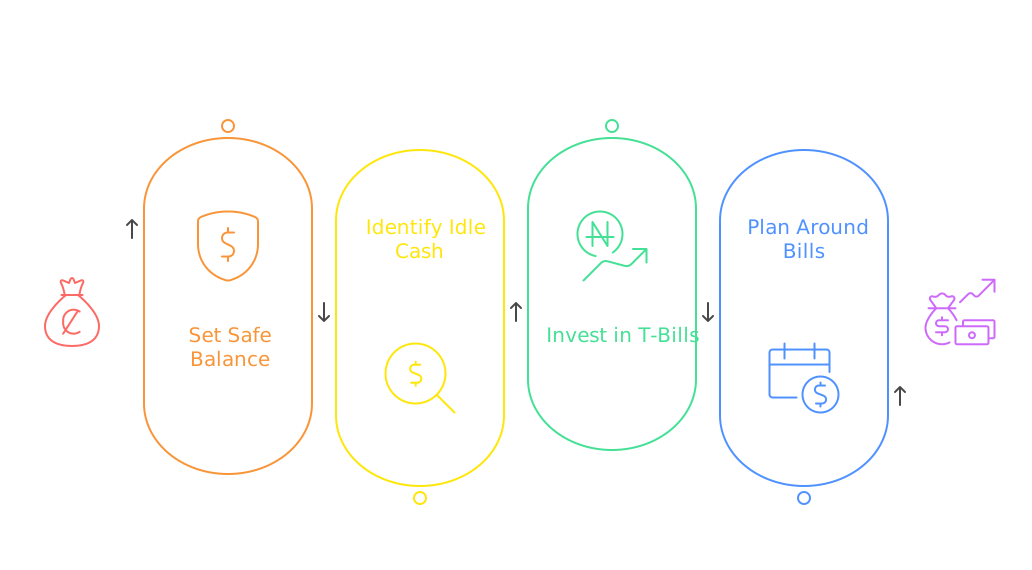
Rivo is built for that layer. It works with your existing checking account, lets you set a safe balance, identifies eligible idle cash, moves that idle cash into short-duration U.S. Treasury Bills through Jiko Securities, and plans around bills so money can come back before payments hit. You keep your bank, direct deposit, card autopay, and bill setup.
If you need the product overview first, read What Is Rivo?. If the bank-switching question is the blocker, read Does Rivo Replace Your Bank?. This guide focuses on the bigger workflow question: how do you earn more on checking cash without rebuilding your banking life?
TL;DR
- You can earn more on checking cash without switching banks if you separate bill money from idle cash and move only the stable excess above a safe balance.
- The national interest-checking rate was 0.07% in June 2026, while the Rivo rate table listed a 3.65% gross annualized rate as of July 1, 2026, before fees and taxes.
- The Rivo rate table estimated about $730 per year on $20,000, before fees and taxes, compared with about $14 per year at the national average checking rate.
- Rivo charges a 0.05% monthly management fee, about 0.60% per year before compounding, based on average daily Rivo balance.
- No-switch cash optimization still has trade-offs: T-bills are securities, rates change, fees matter, and money needed immediately should stay in checking.
- Rivo works best when you have a recurring idle layer, not a one-time high balance before a bill, tax payment, home repair, tuition bill, or credit-card autopay.
- The decision is not "Should I move all my checking cash?" The decision is "Can I keep my bank, protect a safe balance, and automate only the dollars that are truly idle?"
Quick Answer: How Can You Earn More on Checking Cash Without Switching Banks?
You can earn more on checking cash without switching banks by keeping your existing checking account for bill payment, then using a separate cash-management layer for the excess money above your safe balance.
.svg)
That layer can be manual or automated. Manual means you decide when to transfer money, where to put it, and when to bring it back. Automated means software watches the cash flow, respects a minimum balance, and moves eligible idle cash without forcing you to rebuild direct deposit or bill pay.
The difference is important. "Without switching banks" does not mean every dollar stays inside the checking account. It means your everyday bank remains the operating account while the idle layer gets a different job.
What Does "Without Switching Banks" Actually Mean?
"Without switching banks" means you do not move your main financial life. Your paycheck can still land where it lands. Your rent, mortgage, loan, card autopay, utilities, subscriptions, and debit-card spending can still run through the same checking account. Your bank app can remain the place where life happens.
The cash-management layer sits on top.
Rivo follows that model. The homepage flow is simple: connect your bank, tell Rivo how much you always want in the account, and let Rivo plan around bills while cash moves back before payments need it. The Rivo help center also notes that Rivo works with existing bank accounts and does not require you to switch banks, move direct deposit, or modify bill pay setup.
This matters because switching banks is not just a rate decision. It is a workflow migration. If you have multiple paychecks, several credit cards, rent or mortgage, insurance, utilities, school payments, and peer transfers, the operational cost of moving banks can be larger than the emotional benefit of a higher rate.
Rivo tries to avoid that migration cost. The product asks a smaller question: what part of the current checking balance can safely do more?
Why Checking Cash Usually Earn So Little
Checking accounts usually earn little because they are designed for payments, not optimization.
The account's primary job is to receive income, hold bill money, support card payments, and keep cash instantly available. That utility is valuable. The trade-off is that many checking balances earn very little while banks use deposits as part of their broader balance-sheet economics.
The public rate gap is visible. The national rate for interest checking was 0.07% in June 2026. The Rivo rate page compares a $20,000 balance at that national average with a gross annualized Rivo rate tied to short-term Treasury bills.
The point is not that checking is bad. Checking is necessary. The problem starts when checking becomes the default place for money that no longer needs same-day access.
If you want the deeper bank-rate explanation, read Why Is My Checking Account Paying So Little Interest?.
Which Dollars Can Leave Checking Without Creating Bill Risk?
Only the dollars above your safe balance should be considered for movement.
The safe balance is the amount that should remain in checking so bills, daily spending, autopay, irregular expenses, and comfort needs are covered. It is not a universal number. A single person with simple bills may need a smaller checking floor than a dual-income household with children, mortgage payments, multiple credit cards, insurance, property taxes, and lumpy reimbursements.
The stable excess is the only layer worth optimizing. Moving bill money is not optimization. It is risk transfer.
Use this conservative formula:
Potential idle cash = usual checking balance - safe balance - known near-term expenses
If your usual checking balance is $25,000, your safe balance is $12,000, and known near-term expenses are $3,000, the possible idle layer is $10,000. That $10,000 is the decision surface, not the full $25,000.
For a complete version of the safe-balance method, use How Much Money Should You Keep in Checking?.
Why High-Yield Savings Accounts Do Not Always Solve the No-Switch Problem
High-yield savings accounts can be useful. They are simple, familiar, and generally FDIC-insured when held at an FDIC-insured bank within applicable limits. They can be a strong fit for people who want deposit products and are willing to manage transfers.
The issue is not whether savings accounts are legitimate. The issue is whether they solve the behavior problem.
If your only problem is "my emergency fund needs a separate deposit account," a high-yield savings account may be enough. If your real problem is "checking cash keeps building because I do not want to mistime bills," then the missing capability is not just yield. The missing capability is bill-aware cash movement.
That is where Rivo is structurally different from a manual savings routine. Rivo keeps the bank relationship in place and focuses on the idle layer above your threshold. The product can become more conservative when spending spikes or timing looks uncertain, and users can adjust the buffer, pause, stop, or disconnect.
For a direct option comparison, read Rivo vs High-Yield Savings vs Treasury Bills.
How Does Rivo Let You Keep Your Bank and Still Put Idle Cash to Work?
Rivo uses a layered model: your bank remains the operating account, and Rivo manages eligible idle cash above the safe balance.
The product flow has a few core parts:
This is why the product is closer to automated cash management than to a new bank account. The job is not to replace your bank. The job is to make the dollars above your checking floor work harder while your normal bank setup keeps doing the payment work.
If you want the step-by-step product mechanics, read How Does Rivo Autopilot Work?.
What Is the Dollar Difference on $10,000, $20,000, or $50,000?
The dollar difference depends on the idle amount, gross rate, fee, taxes, and how long the money stays invested. Use the examples below as simple annual illustrations, not personal projections.
The source anchors are public: the national interest-checking rate was 0.07% in June 2026, and the Rivo rate table listed a 3.65% gross annualized rate as of July 1, 2026, before fees and taxes. The Rivo management fee is 0.05% monthly, about 0.60% annually before compounding.
The Rivo rate table estimates $730 per year on $20,000, before fees and taxes, because its own calculator uses the listed rate mechanics. The table above is a simplified illustration using the same gross rate as a straight annual calculation.
The takeaway is not that every household should move every balance. The takeaway is that the math becomes meaningful once the idle layer is large enough and stable enough.
If you want to estimate your own gap, use Checking Account Interest Calculator.
What Fees, Taxes, and Protection Details Change the Decision?
No-switch cash optimization is still a financial product decision. Fees, tax treatment, and protection language matter.
Rivo invests eligible idle cash in short-duration U.S. Treasury Bills through Jiko Securities. TreasuryDirect explains that Treasury bills are issued in terms from 4 weeks to 52 weeks. TreasuryDirect also notes that T-bill interest is subject to federal tax and not state or local tax.
The protection framework is different from an FDIC-insured deposit account. FDIC insurance covers eligible bank deposits up to $250,000 per depositor, per insured bank, per ownership category. SIPC protects customers of member brokerage firms up to $500,000, including a $250,000 cash limit, but SIPC does not protect against decline in the value of securities.
If fee math is your main objection, read Rivo Fees Explained. If protection language is your main objection, read Are Treasury Bills Safe for Short-Term Cash?.
How Should You Set a Safe Balance Before Automating Anything?
Set the safe balance before chasing yield. It is the amount that must stay in checking for the next 30 days of bills, card autopay, daily spending, known irregular expenses and a comfort cushion.
Start with the next bill cycle, not with the account's average balance. Average balances can hide timing risk. The lowest balance after bills clear is usually more useful than the balance on payday.
The safe balance can be intentionally conservative. If your first estimate is $9,000 and you would feel nervous below $12,000, start with $12,000. Optimization that creates anxiety usually gets abandoned.
Rivo lets users configure a minimum checking threshold. That makes the safe balance a product control, not just a spreadsheet number.
What Happens When Bills or Spending Patterns Change?
The no-switch approach only works if it respects changing cash flow.
Bills are not perfectly predictable. Credit-card balances move. Insurance renewals appear. Taxes are uneven. Paychecks can shift by a few days. Travel, healthcare, home repairs, family expenses, and tuition can create new cash needs. A cash workflow that ignores these changes will eventually break trust.
This is why "earning more" cannot be separated from "not missing bills." The better product is not simply the highest visible rate. The better product is the workflow you can keep running through real life.
For more on bill timing, read Can You Move Money Out of Checking Without Missing Bills?.
Who Should Use a No-Switch Cash Optimization System?
A no-switch system fits best when the cash problem is recurring, visible, and operational.
The best fit is not "anyone with money." It is someone whose checking account regularly holds meaningful cash above bills and buffers, and whose manual movement process is not surviving.
If you are unsure whether your cash is actually idle, read What Is Idle Cash?. If the balance keeps growing without a clear job, read Why Does My Checking Account Balance Keep Growing?.
When Should You Avoid Moving Checking Cash?
Avoid moving checking cash when the money has a near-term job, when the idle layer is too small, or when you need a protection framework that only FDIC-insured deposits provide.
This is not an argument against optimization. It is an argument for sizing the problem correctly. A good cash rule should reduce stress, not create a new monitoring habit.
What Is the Step-by-Step No-Switch Workflow?
Use this workflow before choosing Rivo, manual transfers, TreasuryDirect, a brokerage cash option, or a savings product.
If the idle layer is meaningful and recurring, Rivo can handle the ongoing workflow. If the idle layer is small or temporary, a one-time manual transfer or no action may be more sensible.
The important point is sequence. Do not start with the advertised rate. Start with the safe balance.
What Score Should You Use Before Choosing Manual Transfers or Automation?
Use a scorecard when the decision feels fuzzy. The purpose is not to turn household cash into a corporate finance model. The purpose is to separate "this sounds nice" from "this workflow will actually survive my bill life."
Score each line from 0 to 2. A 0 means the factor is weak, a 1 means it is mixed, and a 2 means it clearly points toward automation. The score is editorial, but the inputs should come from your actual checking history, bill calendar, and comfort level.
Total score
Example: Simple renter with low excess cash
If checking usually stays near $4,000 after bills, and the extra layer disappears every month, the score should stay low. The Rivo help center notes that Rivo works best for households with $5,000+ in checking, though there is no hard minimum. A small or unstable idle layer may not justify a new workflow.
Example: Dual-income household with recurring excess
If checking often stays $15,000 above bills after the mortgage, card autopay, utilities, insurance, and subscriptions clear, the score changes. The problem is not just rate. It is that manual movement has to happen every month, and the household may keep overbuffering because nobody wants to mistime a payment.
Example: DIY Treasury buyer
If you already buy Treasury bills, understand maturity dates, and enjoy managing transfers, the score may point away from Rivo even with a high idle balance. Rivo is most useful when automation is worth the 0.05% monthly fee. If you already maintain the process for free, the fee may not be worth it.
Example: Bank-switch avoider
If you keep a healthy checking balance because switching banks sounds like a project, the no-switch score should be higher. Rivo works with existing bank accounts, so the question becomes whether the idle layer is meaningful enough for automation, not whether you are ready to move your whole banking setup.
How Rivo Fits the No-Switch Decision
Rivo fits when the reader wants yield on eligible idle cash but does not want a new banking life.
The product is not a checking account replacement. It is not a budgeting app. It is not a robo-advisor. It is not a deposit savings account. It is a cash-management layer that works around an existing checking account and focuses on the idle layer.
Rivo is strongest when the failure is behavioral: you know cash should do more, but manual transfers, bill timing, and bank-switching friction keep the money stuck.
For a direct comparison against DIY Treasury bills, read Rivo vs TreasuryDirect. For a wider comparison, read Rivo Alternatives.
Final Takeaway: Keep the Bank, Move the Idle Layer
The practical goal is not to turn checking into an investment account. Checking should remain the place where bills get paid and life stays liquid.
The goal is to stop treating every dollar in checking as if it needs the same job. Bill money should stay available. Daily spending money should stay available. Emergency and comfort money should stay available. Stable excess above that safe balance can be evaluated differently.
Rivo is designed for that exact separation. Keep the bank. Protect a user-set safe balance. Move eligible idle cash into short-duration Treasury Bills through Jiko Securities. Plan around bills. Let the user pause, stop, or disconnect.
That is the no-switch cash-management decision in one sentence: keep the account that runs your life, and build a better system for the dollars above the floor.
FAQ
Can I earn interest on checking cash without changing banks?
You can earn more on cash connected to your checking workflow without changing banks, but the money may not remain inside the checking account itself. Rivo works with your existing bank and can move eligible idle cash above your safe balance into short-duration U.S. Treasury Bills through Jiko Securities.
Does Rivo require direct deposit or bill pay changes?
No. Rivo works with existing bank accounts and does not require you to move direct deposit or rebuild bill pay. The everyday checking account remains the operating account.
What checking balance is large enough for Rivo to matter?
The Rivo help center notes that Rivo works best for households with $5,000+ in checking, though there is no hard minimum. The better question is whether you have a recurring idle layer after bills, planned expenses, and the safe balance are covered.
Is Rivo the same as a high-yield savings account?
No. A high-yield savings account is a bank deposit product. Rivo uses a brokerage-based structure where eligible idle cash can be invested in short-duration U.S. Treasury Bills through Jiko Securities. That means the risk, tax, and protection framework is different.
What is the main risk of trying to earn more on checking cash?
The main risk is moving money that was not actually idle. If a large card payment, tax bill, rent payment, or emergency need is coming up, yield is secondary. Size your safe balance first, then evaluate only stable excess cash.
What should I compare before using Rivo?
Compare your true idle cash amount, the listed Rivo rate, the 0.05% monthly fee, T-bill tax treatment, FDIC/SIPC differences, withdrawal limits, bill timing, and whether automation is worth more to you than doing transfers manually.
Related Rivo Reading
- To check whether your bank changes, read Does Rivo Replace Your Bank?.
- To compare cash destinations, read Rivo vs High-Yield Savings vs Treasury Bills.
- To see the product workflow, read How Does Rivo Autopilot Work?.
- To understand fees, read Rivo Fees Explained.
- To compare keeping your bank with moving to an all-in-one digital bank, read Rivo vs SoFi Checking and Savings.

This article is educational and is not financial, investment, tax, accounting, or legal advice.
Yield rate reflects the 4-week T-bill rate when held to maturity. Rate does not include fees. Rates are subject to change. Minimum balance of $100 required to earn the stated rate.
Rivo is a fintech company, not a bank. Banking services provided by Jiko Bank, a division of Mid-Central National Bank. Jiko Group, Inc. and its affiliates do not provide legal, tax, or accounting advice. You should consult your legal and/or tax advisors before making any financial decisions. This material is not intended as a recommendation, offer or solicitation for the purchase or sale of any security or investment strategy. See FINRA BrokerCheck, Jiko U.S. Treasuries Risk Disclosures and Jiko Securities Inc. Form CRS.
Investments in T-bills: Not FDIC Insured - No Bank Guarantee - May Lose Value. All U.S. treasury investments and investment advisory services provided by Jiko Securities, Inc., a registered broker-dealer, member FINRA and SIPC. Securities in your account are protected up to $500,000. For details, please see www.sipc.org.
Sources
- Rivo homepage
- Rivo rates table
- Rivo help center
- FRED national rate for interest checking, ICNDR
- FRED 4-week Treasury bill secondary market rate, DTB4WK
- FRED household and nonprofit checkable deposits and currency, CDCABSHNO
- TreasuryDirect Treasury Bills
- FDIC Understanding Deposit Insurance
- SIPC What SIPC Protects

Shalu Yadav is Rivo's SEO/GEO Expert, bringing over 10 years of experience in making financial content discoverable across both classic search and generative AI platforms.
Follow on LinkedInGet Rivo Updates
Product news, money insights, and company updates.