Rivo Alternatives: TreasuryDirect, Money Market Funds, Cash Sweep Accounts, and Savings Products Compared
Compare Rivo alternatives on cost, taxes, protection, and effort: TreasuryDirect, money market funds, cash sweeps, savings products, and manual transfers.
The main Rivo alternatives are TreasuryDirect, brokerage money market funds, cash sweep accounts, savings marketplaces, Max, manual transfers, and doing nothing until your cash is truly idle. The right choice depends on the job you need done: direct Treasury Bill control, FDIC-insured deposits, brokerage cash access, rate shopping, or bill-aware automation on top of your existing checking account.
Rivo fits a narrower problem: you have idle cash above your safe checking balance, you do not want to switch banks, and the hard part is moving money out and back before bills. If you are still deciding whether the cash is idle at all, start with Checking Account Interest Calculator before comparing tools.
TL;DR
- TreasuryDirect is the clean DIY alternative. It lets individual investors buy Treasury Bills in `$100` minimums and `$100` increments, with no TreasuryDirect fee for opening an account or buying securities.
- Brokerage money market funds are useful inside an existing brokerage workflow. They can provide daily liquidity and short-term debt exposure, but Investor.gov explains that money market fund money is not FDIC-insured.
- Cash sweep accounts and savings marketplaces are deposit-first alternatives. Wealthfront, Betterment, Raisin, and similar products route cash to partner banks, where FDIC coverage depends on program terms, bank allocation, ownership category, and existing outside deposits.
- Max is the closest deposit-optimization comparison. Max helps allocate cash among FDIC-insured bank accounts and lists a `0.16%` annual fee with a `$20` quarterly minimum.
- Rivo is different because it starts with checking-account cash flow. It works with your existing bank, lets you set a safe balance, moves eligible idle cash into short-duration U.S. Treasury Bills through Jiko Securities, and plans around bills.
- The math can be material. FRED shows the national interest-checking rate at `0.07%` for June 2026, while the 4-week Treasury bill benchmark was `3.67%` on July 16, 2026. On $50,000 of idle cash, that rate gap is about $1,800 per year before fees and taxes.
Rivo Alternatives: Quick Comparison
The takeaway: do not compare Rivo alternatives as if they are all different wrappers around the same rate. The product architecture changes the decision. Rivo is a checking-adjacent automation tool. TreasuryDirect is a direct securities platform. Money market funds are mutual funds. Cash sweep products and marketplaces are deposit-routing products.
Rivo Alternatives Editorial Fit Scorecard
The table below is an editorial fit scorecard, not a customer rating, investment rating, product performance claim, or market ranking. A score of 1 means weak fit for that dimension. A score of 5 means strong fit for that dimension.
Scorecard method
The scorecard uses 6 buyer dimensions: bill-aware automation, DIY effort, deposit preference, Treasury fit, small-balance fit, and large-balance fit. It does not score investment return, customer satisfaction, safety, or future rates.
Scorecard caveat
The scores are useful for routing, not for ranking. A 5 in deposit-only fit does not make a product the best choice for someone who wants T-bill exposure. A 5 in Treasury fit does not make a product the best choice for someone who wants only bank deposits.
The Main Rivo Alternatives
The main Rivo alternatives fall into 6 practical categories: direct Treasury Bills, brokerage money market funds, cash sweep accounts, savings marketplaces, deposit optimization services, and manual cash movement.
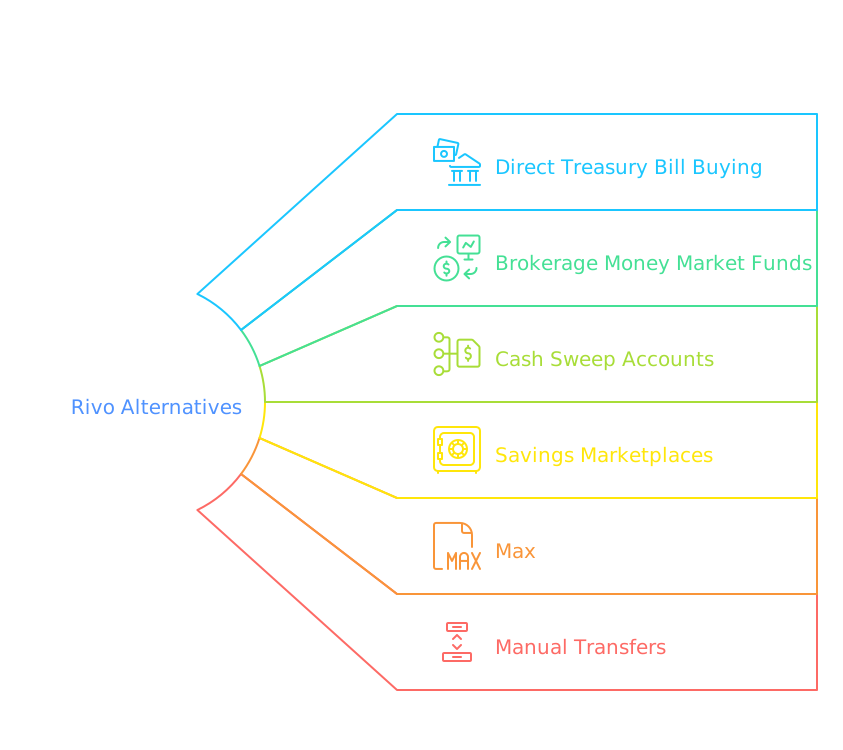
1. Direct Treasury Bill buying
TreasuryDirect is the purest alternative if your goal is simply to buy Treasury Bills. It is official, direct, and low direct cost. The trade-off is that it does not look at your checking account, estimate your safe balance, or move money back before rent, mortgage, credit cards, tuition, tax payments, or utilities.
2. Brokerage money market funds
Brokerage money market funds can be a practical alternative if your idle cash already lives near a brokerage account. FINRA explains that money market funds invest in short-term debt and are different from money market deposit accounts. The important boundary is that money market funds are investment products, not bank deposits.
3. Cash sweep accounts
Cash sweep products use a brokerage or fintech account to move uninvested cash into one or more partner banks. Wealthfront describes its Cash Account as using partner banks for FDIC coverage, and Betterment Cash Reserve similarly uses program banks subject to conditions. These products can be strong deposit-first choices when you want one interface and partner-bank routing.
4. Savings marketplaces
Savings marketplaces, such as Raisin, let users access savings products from many FDIC-member banks and NCUA-insured credit unions. Raisin notes that it is not a bank or credit union and that funds are held by partner institutions, subject to pass-through coverage rules and conditions.
5. Max
Max, formerly MaxMyInterest, is a direct comparison when your priority is FDIC-insured deposit optimization. Max describes a workflow where cash is spread across your own accounts at multiple banks, with monthly optimization and on-demand optimization options.
6. Manual transfers
Manual transfers can be the best alternative for disciplined users. If you already keep a spreadsheet, know your bill dates, maintain a T-bill ladder, rebalance savings accounts, and never forget transfers, software may add less value. If you stop after 30, 60, or 90 days, the cheap workflow becomes expensive because it stops working.
What Job Are You Hiring a Rivo Alternative to Do?
Start with the job, not the provider. A Rivo alternative can be excellent and still wrong if it solves the wrong cash problem.
This is the same decision path explained in Treasury Bills vs Money Market Funds vs High-Yield Savings. The categories overlap on "cash yield," but they do not overlap on workflow.
The clearest Rivo fit is a household with meaningful idle checking cash, not a household with every dollar assigned to immediate bills. If your checking balance is $30,000 but $20,000 is already reserved for the next 30 days of bills, the real comparison is on $10,000, not $30,000.
.svg)
Factor 1: cash location
If the cash starts in checking, bill timing matters more. If the cash starts in brokerage, fund liquidity matters more. If the cash starts in savings, bank coverage and transfer rules matter more.
Factor 2: protection preference
If you want FDIC or NCUA coverage, compare deposit products first. If you are comfortable with Treasury securities, compare TreasuryDirect, brokerage T-bills, and Rivo. If you are comparing money market funds, read the fund documents and understand that the product is a mutual fund.
Factor 3: automation need
If you need 0 recurring chores, manual transfers and direct T-bill ladders are weak fits. If you are comfortable with 1 monthly review, Max or a savings marketplace may fit. If you need checking refills around bills, Rivo is the more direct workflow.
Factor 4: fee tolerance
At $5,000, a 0.60% annualized fee is about $30 per year before compounding. At $50,000, it is about $300. At $100,000, it is about $600. The fee only makes sense if the automation is solving a real operational problem.
Factor 5: tax profile
The tax question is not identical for Treasury Bills, bank deposits, and money market funds. Treasury Bill interest is generally subject to federal tax and exempt from state and local income taxes. Bank deposit interest is generally taxable interest.
Factor 6: exit speed
If you need cash in 1 day, keep it in checking. If you can wait 1-3 business days, more alternatives open up. If you can hold for 4, 8, 13, 17, 26, or 52 weeks, direct Treasury Bills become easier to plan.
The Rivo Benchmark
Rivo is a fintech automation layer for idle checking cash. It works with an existing bank account, lets the user set a minimum checking floor, identifies cash above that safe balance, moves eligible cash into short-duration U.S. Treasury Bills through Jiko Securities, and moves money back before expected bills or transfers.
The benchmark is not just rate. The benchmark is this operating model:
If an alternative cannot be judged against these items, it may not be a real Rivo substitute. It may be a good cash product in a different category.
For a deeper walkthrough of the product itself, read What Is Rivo? and How Does Rivo Autopilot Work?.
When TreasuryDirect is the Best Rivo Alternative
TreasuryDirect is the best Rivo alternative when you want direct U.S. Treasury access and you are willing to manage the cash workflow yourself.
TreasuryDirect help materials state that Treasury Bills, Notes, Bonds, TIPS, and FRNs can be purchased in `$100` minimums and additional `$100` multiples. TreasuryDirect also states there are no fees charged when you open an account or buy securities.
That makes TreasuryDirect hard to beat for direct platform cost.
TreasuryDirect fit table
The simplest test is behavioral. If you will actually buy, track, mature, reinvest, and transfer cash on time for the next 12 months, TreasuryDirect can be a strong alternative. If you have been meaning to move cash for 6 months and still have not done it, the obstacle is not Treasury access. The obstacle is operational follow-through.
That is the full comparison in Rivo vs TreasuryDirect.
When Brokerage Money Market Funds are the Good Rivo Alternative
Brokerage money market funds are a good Rivo alternative when your idle cash already lives in, or naturally belongs near, a brokerage account.
FINRA describes money market funds as mutual funds that invest in short-term assets and are often used by investors for short-term cash. Investor.gov warns that money invested in a money market fund is not FDIC-insured like bank deposits and that investment loss is possible.
That does not make money market funds bad. It means they are different.
Money market fund decision table
Use a money market fund if you want brokerage cash parking and you are comfortable with fund disclosures, expense ratios, fund type, liquidity rules, and broker operations.
Use Rivo if the cash is still in checking because you are worried about bills. The problem is not "which short-term instrument exists?" The problem is "which dollars can safely leave checking and when do they need to come back?"
When Cash Sweep Accounts are the Good Rivo Alternative
Cash sweep accounts are good Rivo alternatives when you want a deposit-first experience with partner-bank routing and potentially expanded FDIC coverage.
Wealthfront states that its Cash Account can provide up to `$8 million` of FDIC insurance through partner banks for an individual account, subject to allocation and program terms. Betterment Cash Reserve lists eligible cash as FDIC-insured up to `$4 million` individual or `$8 million` joint at program banks, subject to conditions.
Those numbers are useful only if you understand the conditions. FDIC coverage is tied to insured banks, ownership categories, and existing balances you may already hold at the same bank.
Cash sweep comparison
Cash sweep accounts can be a strong alternative if the priority is deposit insurance and a familiar account experience. They are less direct if your main problem is that idle checking cash needs to move around bills without you doing the work.
When Are Savings Products or Savings Marketplaces are the Good Rivo Alternative
Savings products and marketplaces are good alternatives when you want a bank or credit union product and can tolerate a separate savings workflow.
Raisin states that it gives users access to products from 100+ FDIC-member banks and NCUA-insured credit unions through one login, while also noting that Raisin itself is not a bank or credit union. It also states that funds are held at partner institutions and that pass-through coverage has conditions.
That makes savings marketplaces useful for rate shoppers. It does not make them automatic bill managers.
Savings products can be right when you want bank deposits, not securities. They can be wrong when the friction is moving cash out of checking, remembering transfers, and keeping bills covered.
The important point is behavioral: opening a savings product is easy. Maintaining the right balance between checking and savings over 12 months is the part many households stop doing.
When Max is a Good Rivo Alternative?
Max is a good Rivo alternative when the main goal is FDIC-insured deposit optimization across multiple bank accounts.
Max describes its individual-investor product as spreading cash across your own accounts at multiple banks, keeping balances below FDIC insurance limits, and monitoring rates. Max lists a `0.16%` annual fee, calculated and collected quarterly, with a `$20` quarterly minimum.
That makes Max a serious comparison, but it is not the same product job.
Rivo vs Max routing
On pure platform fee, Max is cheaper: 0.16% per year compared with Rivo fee of about 0.60% per year before compounding. On workflow, the answer depends on the problem. Max is deposit allocation. Rivo is checking-adjacent idle-cash automation.
For the direct head-to-head, read Rivo vs MaxMyInterest.
When Manual Cash Management Is Enough
Manual cash management is enough when you have discipline, a simple bill calendar, a small number of accounts, and a stable cash pattern.
It can work very well. You can keep a checking floor, move extra cash into Treasury Bills, a money market fund, or a savings product, and refill checking before bills. You can avoid software fees. You can choose every product yourself.
The trade-off is maintenance.
The useful question is not whether manual management is possible. It is whether it will actually happen.
If your manual process already works, keep it. If the cash has stayed in checking for 3, 6, or 12 months because life got busy, an automated workflow may be worth paying for.
How Do Rivo Alternatives Compare on Taxes?
Taxes can change the after-tax answer, especially in states with high income taxes.
The IRS states that interest income from Treasury bills, notes, and bonds is subject to federal income tax but exempt from state and local income taxes. Bank deposit interest is generally taxable interest. Money market fund tax treatment depends on the fund type and holdings.
This is not tax advice. The practical buyer question is simpler: if two options show similar pre-tax rates, a Treasury Bill option may look different after state and local taxes. The difference matters more for larger balances and higher-tax states.
For a focused tax article, read Are Treasury Bills State Tax Exempt?.
How Do Rivo Alternatives Compare on FDIC, SIPC, and T-Bill Protection?
Protection language is where many cash comparisons become sloppy. FDIC, SIPC, Treasury backing, and investment risk are not the same thing.
FDIC deposit insurance protects eligible deposits at insured banks up to `$250,000` per depositor, per insured bank, per ownership category. SIPC states that protection is limited to `$500,000`, including a `$250,000` cash limit, and that SIPC does not protect against declines in securities value.
Rivo uses a broker-dealer and Treasury Bill structure for the earning component. Cash sweep products and savings marketplaces use bank or credit union deposits. Money market funds are mutual funds. TreasuryDirect is direct Treasury holding.
Those are not small differences. They decide what disclosures matter, what risks matter, and what questions you should ask before moving cash.
How Much Can the Difference Matter on $25,000, $50,000, or $100,000?
Use the same rate inputs when comparing options:
- Checking benchmark: `0.07%` national interest-checking rate for June 2026
- Treasury benchmark: `3.67%` 4-week Treasury bill rate on July 16, 2026
- Rivo fee estimate: `0.05%` monthly, roughly 0.60% per year before compounding
This table is illustrative. It assumes the whole idle balance stays exposed for 12 months, rates do not change, fees apply evenly, and taxes are excluded.
The decision implication is not "move all cash." It is "size the idle layer accurately." If only $10,000 of a $50,000 checking balance is idle, calculate on $10,000. If the full $50,000 sits above the safe balance for months, the opportunity cost is larger.
That sizing step is why How Much Money Should You Keep in Checking? and What Is Idle Cash? should come before picking a product.
Which Rivo Alternative Fits Each Buyer Type?
Use the table below as a shortlist. It is not a universal ranking because the right product changes with cash purpose, tax state, comfort with securities, deposit insurance preference, and behavior.
If your cash is operational, meaning it pays bills and survives unpredictable spending, Rivo deserves a closer look. If your cash is already separated from checking, a deposit product, money market fund, or direct Treasury workflow may be enough.
When Rivo Isn't the Right Choice
Do not choose Rivo if the problem is not idle checking cash.
Rivo can be a strong fit for checking-adjacent idle cash, but it is not supposed to solve every cash use case. The cleanest alternatives may win in these cases:
This is the fairest comparison. Rivo is not trying to replace TreasuryDirect for DIY users, Max for large deposit optimization, or money market funds inside brokerage accounts. Rivo is built for the household cash layer that keeps sitting in checking because moving it manually is the part that fails.
The Final Decision Framework
Use this 5-step framework before choosing any Rivo alternative.
Step 1. Separate safe balance from idle cash
Calculate:
Average checking balance - safe balance = idle cash
If the idle number is close to $0, stop. You do not need a Rivo alternative. You need checking liquidity.
Step 2. Choose the protection model first
If you want bank deposits, compare cash sweep accounts, direct savings products, savings marketplaces, and Max. If you are comfortable with U.S. Treasury securities or money market funds, compare TreasuryDirect, brokerage products, and Rivo.
Step 3. Compare workflow, not just rate
Ask who moves the cash, when it moves, who refills checking, and what happens when a bill timing changes.
Step 4. Calculate the same balance across options
Use the same idle balance, the same date, and the same tax assumption. Do not compare a promotional savings rate against a stale T-bill rate or a gross rate against an after-fee result.
Step 5. Pick the product you will still use in 90 days
A slightly lower-fee option that you abandon is not cheaper. A direct T-bill ladder that never gets updated is not optimized. A savings product that never receives the extra checking cash is not doing the job.
FAQ
What is the best Rivo alternative?
The best Rivo alternative depends on the cash job. TreasuryDirect is best for direct DIY T-bill buying. Money market funds are best inside brokerage workflows. Cash sweep accounts and savings marketplaces are best for deposit-first users. Max is best for FDIC-insured deposit optimization. Rivo fits when the main problem is idle checking cash and bill-aware automation.
Is TreasuryDirect cheaper than Rivo?
Yes, TreasuryDirect is usually cheaper on direct platform cost because TreasuryDirect states there are no fees to open an account or buy securities. Rivo charges `0.05%` monthly, about 0.60% per year before compounding, because it adds automation, safe-balance logic, checking-account monitoring, and bill-aware movement.
Are money market funds a substitute for Rivo?
Money market funds can be a substitute only if the cash already belongs in a brokerage workflow. They are not FDIC-insured bank deposits, and they do not monitor your checking safe balance or refill checking before bills. For brokerage cash, they can fit. For idle checking cash, they solve only part of the problem.
Is Max the closest Rivo alternative?
Max is one of the closest alternatives because it also addresses idle cash and automation. The difference is product structure: Max optimizes FDIC-insured bank deposits, while Rivo automates checking-adjacent idle cash into short-duration U.S. Treasury Bills through Jiko Securities.
Should I use a cash sweep account instead of Rivo?
Use a cash sweep account if your top priority is partner-bank deposit routing and FDIC coverage subject to program terms. Use Rivo if your top priority is keeping your current bank, setting a safe checking balance, and having eligible idle cash moved and refilled around bills.
What if I can manage T-bills myself?
If you can reliably manage T-bills yourself, TreasuryDirect or a brokerage can be a strong option. Rivo fee is most relevant when the manual workflow is the reason cash has stayed in checking for months.
Related Rivo Reading
- To compare Rivo with a goal-based, program-bank cash reserve, read Rivo vs Betterment Cash Reserve.
- To compare Rivo with a named high-yield savings account, read Rivo vs Ally Bank Savings.
- To compare Rivo with another brokerage cash account, read Rivo vs Vanguard Cash Plus Account.
- To compare Rivo with a brokerage-based cash hub, read Rivo vs Fidelity Cash Management Account.
- To compare Rivo with a separate cash account, read Rivo vs Wealthfront Cash Account.

This article is educational and is not financial, investment, tax, accounting, or legal advice.
Yield rate reflects the 4-week T-bill rate when held to maturity. Rate does not include fees. Rates are subject to change. Minimum balance of $100 required to earn the stated rate.
Rivo is a fintech company, not a bank. Banking services provided by Jiko Bank, a division of Mid-Central National Bank. Jiko Group, Inc. and its affiliates do not provide legal, tax, or accounting advice. You should consult your legal and/or tax advisors before making any financial decisions. This material is not intended as a recommendation, offer or solicitation for the purchase or sale of any security or investment strategy. See FINRA BrokerCheck, Jiko U.S. Treasuries Risk Disclosures and Jiko Securities Inc. Form CRS.
Investments in T-bills: Not FDIC Insured - No Bank Guarantee - May Lose Value. All U.S. treasury investments and investment advisory services provided by Jiko Securities, Inc., a registered broker-dealer, member FINRA and SIPC. Securities in your account are protected up to $500,000. For details, please see www.sipc.org.
Sources
- Rivo product overview
- Rivo product and fee details
- Rivo current rate details
- FRED National Rate: Interest Checking
- FRED 4-Week Treasury Bill Secondary Market Rate
- FRED Checkable Deposits and Currency
- TreasuryDirect marketable securities questions
- IRS Topic 403: Interest Received
- SIPC: What SIPC Protects
- FDIC Deposit Insurance Questions
- Investor.gov Money Market Funds Investor Bulletin
- FINRA: Taking a Look at Money Market Funds
- Wealthfront FDIC insurance for Cash Accounts
- Betterment Cash Reserve
- Raisin savings marketplace
- Max individual investors
.jpeg)
Ambrish Tyagi is the founder and CEO of Rivo. Previously led AI at Cruise and Amazon.
Follow on LinkedInGet Rivo Updates
Product news, money insights, and company updates.