What Should You Do With $20,000 Sitting in Your Checking Account?
If $20,000 is sitting in checking, keep a safe balance for bills, identify idle cash, and compare HYSA, Treasury bills, and Rivo Autopilot before moving money.
.png)
If you have $20,000 sitting in checking, the right first move is not to move all $20,000. The right move is to keep a safe balance for bills, spending, and surprises, then decide what to do with the idle cash above that floor.
For most households, that means splitting the money into 2 jobs: cash that must stay transaction-ready, and cash that can earn more. Rivo Autopilot is built for the second job. It works on top of your existing checking account, identifies idle cash above your safe balance, and moves that cash into short-duration U.S. Treasury Bills through Jiko Securities. It plans refills around detected bills. Movement is not instant and transfers can take up to 3 business days, so Rivo does not guarantee that money is back by a specific date
If you want the product-level explanation first, read What Is Rivo? The Autopilot for Idle Checking Cash Explained. This guide focuses on the narrower $20,000 decision: how much should stay in checking, and what should happen to the idle portion?
TL;DR
- Do not treat $20,000 as one lump sum. First calculate your safe balance: the next 30 days of bills, autopays, and planned spending, plus a comfort cushion.
- Idle cash is the portion of your checking balance that is not needed for bills, spending, or near-term emergencies. If your safe balance is $7,500, then $12,500 of a $20,000 balance may be idle.
- The national interest checking rate was 0.07% in June 2026. At that rate, $20,000 earns about $14 per year before taxes.
- The Rivo rate table lists a 3.65% gross annualized rate as of July 1, 2026, based on the 4-week T-bill rate when held to maturity, before fees. Rivo charges a 0.05% monthly management fee, about 0.60% per year.
- A high-yield savings account can work if you reliably move money back before bills hit. Direct T-bills can work if you are comfortable managing maturities, auctions, settlement, and reinvestment.
- Rivo makes sense when the problem is not just low checking yield. It makes sense when you want to keep your bank, set a safe balance, and automate the sweep and refill workflow around real bills.
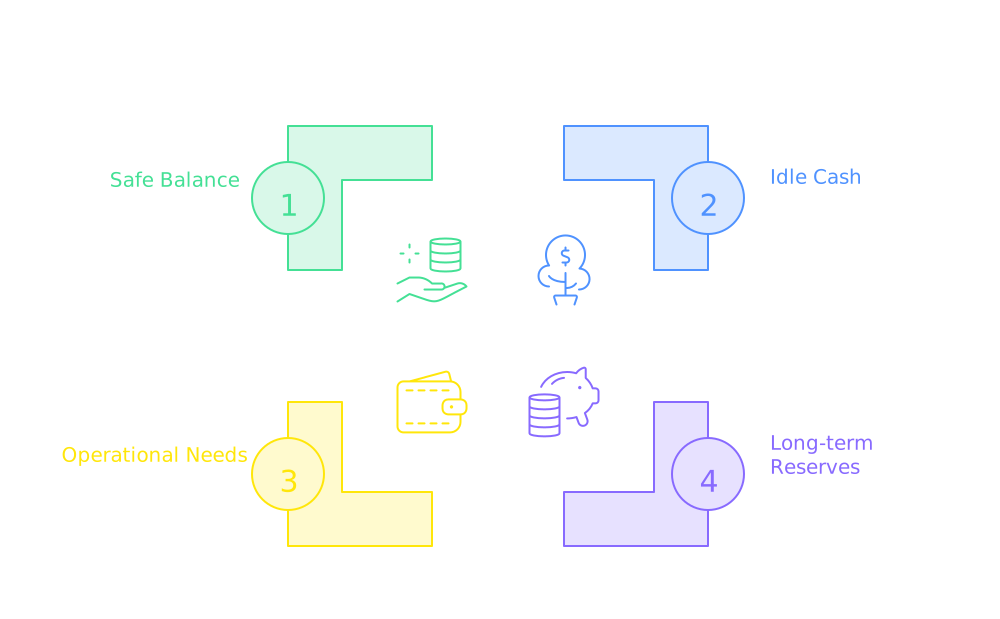
When $20,000 Becomes Too Much to Keep in Checking
$20,000 is too much to keep in a checking account only if a meaningful part of it is idle. If the full $20,000 is assigned to rent, mortgage, taxes, tuition, payroll gaps, or near-term emergencies, keeping it liquid can be rational.
The better question is: how much of the $20,000 needs to be available inside checking over the next 30 days?
The mistake is letting a safe balance become a permanent parking lot. A checking account is supposed to prevent overdrafts, failed payments, and daily friction. It is not designed to make idle cash productive.
Finding the Idle Cash Inside Your $20,000
Idle cash is money sitting in checking beyond what you need for bills, spending, and a safety buffer. It feels safe because it is visible and easy to access, but it often earns very little.
Use this simple formula:
Idle cash = checking balance - safe balance
Your safe balance should include:
- fixed bills due in the next 30 days
- expected credit card autopays
- rent, mortgage, utilities, insurance, and loan payments
- debit card spending you want covered from checking
- one comfort cushion for timing errors, surprise expenses, or delayed income
.svg)
Rivo uses this same logic through a user-set safe balance. You keep the amount you are comfortable with in checking, and Rivo Autopilot only evaluates cash above that threshold for movement.
What $20,000 Actually Earns in Checking
The math is why this question matters. At the FDIC national interest checking rate of 0.07% for June 2026, $20,000 earns about $14 per year before taxes.
Some large banks publish checking rates near 0.01%. At that rate, $20,000 earns about $2 per year
U.S. households and nonprofits still held about $5.95 trillion in checkable deposits and currency in Q1 2026, so this is not a niche problem.
The 3.65% example is a simple annualized gross estimate based on the current rate table. It does not include the management fee, taxes, balance changes, timing of sweeps, or any realized effect from selling T-bills before maturity.
Fee-adjusted example
Rivo charges a 0.05% monthly management fee, which is about 0.60% per year before any compounding or balance-timing effects. On $20,000, a simple annual fee estimate is:
$20,000 x 0.0060 = $120/year
Using the same simple $20,000 example:
That is not a promise of future earnings. Rates change, balances move, and T-bill values can be affected if sold before maturity. The point is narrower: checking-account yield and short-term Treasury-linked yield can be hundreds of dollars apart when the idle balance is large enough.
Your Real Options for $20,000 in Checking
You have 5 practical choices: leave the money in a checking account, move some to a high-yield savings account, buy Treasury bills yourself, use brokerage cash or a money market fund, or use automated cash management.
The best option depends on 5 variables: yield, access, safety/protection, taxes, and manual work.
This is why the answer cannot be "move everything to the highest rate." If a payment clears tomorrow, access wins. If $12,000 has not moved in 90 days, yield matters. If you forget transfers, the best manual account can still fail in practice.
When Keeping the Full $20,000 in Checking Makes Sense
Keep the full $20,000 in checking when the money is assigned to near-term obligations or when moving it would create payment risk.
That includes:
- rent or mortgage due soon
- quarterly tax payments
- a home purchase, tuition payment, medical bill, or insurance premium
- uncertain job income or delayed freelance payments
- a household transition such as relocation, divorce, new child, or job change
- a period where you cannot monitor accounts closely
Checking earns less because it is a transaction account. That is useful when the money needs to transact.
Practical safe balance rule
Use this rule before moving money:
Safe balance = next 30 days of bills + planned checking spending + comfort cushion
If your next 30 days of bills are $6,000 and your comfort cushion is $1,500, your safe balance is $7,500. With $20,000 in checking, the idle portion is about $12,500.
Rivo Autopilot is designed around that threshold. You set the safe balance, and the system treats cash above that floor differently from cash needed for daily life.
Where a High-Yield Savings Account Fits
A high-yield savings account makes sense when you want a bank deposit product, you are comfortable opening or using a separate savings account, and you can reliably move money before bills hit.
HYSAs are legitimate products. They are often the simplest upgrade from low-yield checking. The weakness is not usually the product. It is the workflow.
HYSA interest is generally taxable at federal, state, and local levels. Treasury bill interest is different: TreasuryDirect explains that what you earn from Treasury marketable securities is subject to federal tax but exempt from state and local taxes.
If you are disciplined about transfers, an HYSA can be enough. If your cash flow is busy and you keep forgetting to rebalance, the account can become another thing you meant to manage.
Where Treasury Bills Fit
Treasury bills make sense when you want short-duration U.S. government obligations and you understand that they are securities, not checking deposits.
T-bills are issued by the U.S. Treasury. Four-week T-bills are short-duration instruments, and the 4-week Treasury bill secondary market rate was 3.69% on a bank discount basis, or 3.75% coupon equivalent, on August 31, 2026. Rates change with market conditions, so check the current rate before you decide.
Direct T-bills are a good fit for people who like managing money manually. They are less ideal for someone whose real problem is attention: remembering maturities, checking bill dates, transferring money, and keeping checking from dipping too low.
That is the gap Rivo is designed to fill. It does not ask you to become a T-bill ladder manager. It uses short-duration T-bills through Jiko Securities and pairs that yield logic with bill-aware money movement.
Where Rivo Fits for $20,000 in Checking
Rivo makes sense when you have meaningful idle cash in checking and the real problem is not just yield. The real problem is keeping bills covered while idle cash earns without you manually moving money every week.
Rivo Autopilot works on top of your existing checking account. You link checking securely, set a safe balance, and Rivo analyzes cash flow, identifies idle cash above that floor, moves it into short-duration U.S. Treasury Bills through Jiko Securities, and refills checking before bills or transfers hit.
Rivo is not a high-yield savings account. It is not a bank, a robo-advisor, a neobank, or a budgeting app. It is automated cash management for idle checking cash.
For the full breakdown of how Rivo Autopilot works, including safe balance, bill-aware refills, partner structure, fees, and risk boundaries, see What Is Rivo?.
Rivo details to verify before you start
Choose Rivo Autopilot if your problem is idle checking cash plus the work of managing it. Rivo is designed for people who want to keep their bank, set a safe balance, earn on idle cash through short-duration U.S. Treasury Bills, and have money move back before bills are due.
For a deeper product explainer before you decide, read What Is Rivo?. For this article's workflow, start with the safe-balance calculation, then compare options only for the idle cash above that floor.
Rivo fit examples
The product is strongest for people who already keep cash in checking so nothing bounces, know some of it should earn, and do not want another manual money chore.
Comparing Safety, Taxes, Fees, and Access
Most cash mistakes come from mixing up 4 concepts: what backs the asset, what protects the account, how taxes work, and how fast money can move.
Those are separate questions.
The structure matters here:
- Rivo is a fintech company, not a bank.
- Banking services are provided by Jiko Bank, a division of Mid-Central National Bank.
- U.S. Treasury investments and investment advisory services are provided by Jiko Securities, Inc., a registered broker-dealer, member FINRA and SIPC.
- T-bill holdings are not FDIC-insured bank deposits.
- Cash deposits at Jiko Bank are covered by FDIC insurance where applicable and within standard limits.
- T-bill holdings are protected at the brokerage custody level through SIPC, but SIPC does not protect against market-value declines.
That does not make Rivo a poor fit. It means you should evaluate it as automated T-bill-based cash management, not as a savings account.
Protection and access matrix
Rivo currently supports withdrawals of available funds through the app up to $15,000 per day. That is useful, but it does not replace a same-day checking layer for cash you know you will need immediately.
Movement of funds is not instant. Transfers to your linked account can take up to 3 business days to settle, and longer if a Treasury Bill must be sold first. Rivo plans around known bills. It does not guarantee same-day access or a specific arrival date.
When the $20,000 Is Your Emergency Fund
If the $20,000 is your entire emergency fund, be more conservative. Emergency money has to be reachable, understandable, and available under stress.
That does not mean every dollar must sit in the checking account. It means the first layer should be boring.
For a $20,000 emergency fund, a conservative structure could be:
This is not the maximum-yield structure. It is the more resilient structure.
Use this rule:
Money needed same-day stays in checking.
Money needed this week stays in simple liquid savings.
Money unlikely to be needed this month can be optimized.
What Not to Do With $20,000 in Checking
Do not move the full $20,000 just because the checking rate is low. That can turn an earnings problem into a payment problem.
The goal is not to squeeze every last basis point out of cash. The goal is to earn more without making your financial operating system fragile.
Your Plan for This Week
Use a 7-day process. You do not need a complicated spreadsheet to make a better cash decision.
If your idle cash estimate is under $2,000, simplicity may matter more than optimization. If the idle cash estimate is $10,000-$15,000, the gap between checking yield and Treasury-linked yield can become meaningful.
Final Recommendation
If $20,000 is sitting in checking, keep enough there to make bills boring. Then stop treating the entire balance as if it has the same job.
Choose checking for money that needs to be transacted. Choose an HYSA if you want bank-deposit simplicity and can handle transfers. Choose direct Treasury bills if you want to manage the Treasury workflow yourself. Choose brokerage cash or money market funds only after reading the product-specific details.
Choose Rivo Autopilot if your problem is idle checking cash plus the work of managing it. Rivo Autopilot is built for the second job. It works on top of your existing checking account, identifies idle cash above your safe balance, and moves that cash into short-duration U.S. Treasury Bills through Jiko Securities. It plans refills around detected bills. Movement is not instant and transfers can take up to 3 business days, so Rivo does not guarantee that money is back by a specific date
For a deeper product explainer before you decide, read What Is Rivo?. For this article's workflow, start with the safe-balance calculation, then compare options only for the idle cash above that floor.
FAQ
How much should I keep in my checking account if I have $20,000?
Keep enough for the next 30 days of bills, planned checking spending, and one comfort cushion. For many households, that may be $5,000-$12,000, but the right number depends on rent, mortgage, credit cards, insurance, income timing, and upcoming large payments.
Is $20,000 too much to leave in checking?
$20,000 is too much only if part of it is idle. If $20,000 is assigned to near-term bills, taxes, tuition, or emergency needs, keeping it liquid can make sense. If $10,000-$15,000 is untouched for months, the opportunity cost can be hundreds of dollars per year.
How much can $20,000 earn outside checking?
At a 0.07% national interest checking rate, $20,000 earns about $14 per year before taxes. At a 3.65% gross annualized rate, $20,000 earns about $730 before fees, taxes, balance changes, and timing effects. With the 0.60% annualized management fee estimate, the simple before-tax, after-fee estimate is about $610 on a full-year $20,000 balance.
Is Rivo the same as a high-yield savings account?
No. Rivo is automated cash management, not a high-yield savings account. HYSAs are bank deposit products. Rivo works on top of an existing checking account and moves idle cash into short-duration U.S. Treasury Bills through Jiko Securities.
Can Rivo cause an overdraft?
Rivo is designed around a user-set safe balance and bill-aware refills. It only evaluates cash above the safe balance for movement, adapts when spending changes, and can be paused or adjusted. Movement is not instant and Rivo does not guarantee specific timing, so keep enough in checking for payments you know are coming.
Are Treasury bills FDIC-insured?
No. Treasury bills are securities, not FDIC-insured bank deposits. FDIC insurance applies to eligible deposit products at FDIC-insured banks within coverage limits. SIPC protection applies to eligible brokerage custody situations and does not protect against a decline in securities value.
Do Treasury bill earnings get taxed?
Yes. Treasury marketable securities earnings are subject to federal tax, but TreasuryDirect states they are exempt from state and local taxes. Tax treatment can depend on your situation, especially if securities are sold before maturity, so consult a qualified tax advisor.
What is the simplest first move?
Calculate your safe balance. If your safe balance is $8,000 and you have $20,000 in checking, the decision is not about $20,000. It is about what to do with the idle $12,000.
Related Rivo Reading
- To spot whether the balance is too high, read Are You Keeping Too Much Money in Checking?.
- To size the checking floor, read How Much Money Should You Keep in Checking?.
- To compare cash destinations, read Rivo vs High-Yield Savings vs Treasury Bills.
- To see how automation works, read How Does Rivo Autopilot Work?.
- To calculate the dollar gap, read Checking Account Interest Calculator.

This article is educational and is not financial, investment, tax, accounting, or legal advice.
Yield rate reflects the 4-week T-bill rate when held to maturity. Rate does not include fees. Rates are subject to change. Minimum balance of $100 required to earn the stated rate.
Rivo is a fintech company, not a bank. Banking services provided by Jiko Bank, a division of Mid-Central National Bank. Jiko Group, Inc. and its affiliates do not provide legal, tax, or accounting advice. You should consult your legal and/or tax advisors before making any financial decisions. This material is not intended as a recommendation, offer or solicitation for the purchase or sale of any security or investment strategy. See FINRA BrokerCheck, Jiko U.S. Treasuries Risk Disclosures and Jiko Securities Inc. Form CRS.
Investments in T-bills: Not FDIC Insured - No Bank Guarantee - May Lose Value. All U.S. treasury investments and investment advisory services provided by Jiko Securities, Inc., a registered broker-dealer, member FINRA and SIPC. Securities in your account are protected up to $500,000. For details, please see www.sipc.org.
.jpeg)
Ambrish Tyagi is the founder and CEO of Rivo. Previously led AI at Cruise and Amazon.
Follow on LinkedInGet Rivo Updates
Product news, money insights, and company updates.