Sinking Fund vs Emergency Fund vs Safe Balance: Which Cash Should Stay in Checking?
Compare a sinking fund, emergency fund, and checking safe balance, avoid double counting cash, and identify the recurring idle amount Rivo can manage.
.png)
A safe balance, emergency fund, and sinking fund are three different jobs for cash. Your safe balance keeps ordinary checking activity running, your emergency fund covers unplanned financial shocks, and each sinking fund accumulates money for a known future expense.
The same dollar should not count toward all three jobs. If $8,000 in checking is already reserved for property tax, it is not also available for credit-card autopay, an income-loss emergency, or idle-cash optimization.
The practical system is:
1. Protect the cash needed for the normal checking cycle.
2. Assign known future costs to sinking funds.
3. Maintain a separate emergency target for uncertain events.
4. Identify only the recurring amount left after all three layers.
That last layer may be idle cash. It can remain in checking, move manually to another suitable cash vehicle, or be managed through a bill-aware product such as Rivo. The right choice begins with classification, not yield.
TL;DR
- A safe balance is the operating floor that keeps checking above a chosen minimum while ordinary bills, card payments, transfers, and routine spending clear.
- An emergency fund is a reserve for unplanned expenses or financial shocks. The Consumer Financial Protection Bureau defines it as cash specifically set aside for unplanned expenses or financial emergencies.
- A sinking fund is money accumulated for a known future expense, such as property tax, insurance, tuition, vehicle registration, travel, or planned maintenance.
- One account can hold several cash jobs, but one dollar cannot fund several jobs at once. Use a purpose ledger even if you prefer fewer bank accounts.
- Calculate the safe balance from a chronological cash-flow forecast, calculate each sinking fund from its target and due date, and size emergency savings from the risks your household needs to absorb.
- The Federal Reserve reported that 55% of adults had emergency savings covering three months of expenses in 2025. That is a useful preparedness benchmark, not a universal prescription for every household.
- Rivo is relevant only for the stable, recurring remainder above the protected layers. It works with an existing bank account, uses a user-set minimum threshold, and is designed to plan cash movement around detected bills.
Quick Comparison: Safe Balance vs Emergency Fund vs Sinking Fund
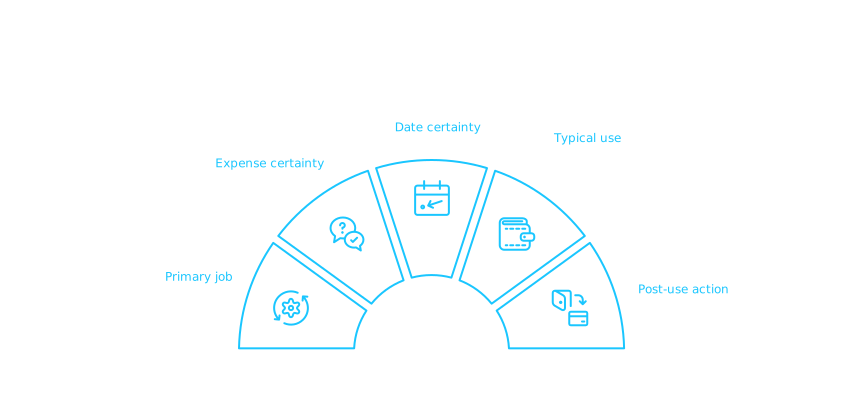
The fastest way to separate the three cash jobs is to compare purpose, predictability, timing, and replenishment.
The account name does not decide the cash job. A savings account can contain an emergency fund, several sinking funds, and a home goal. A checking account can contain the operating floor and the next property-tax payment. The labels in your ledger determine what the money is for.
What Is a Safe Balance?
A safe balance is the minimum checking amount you want protected while normal income, bills, card payments, and routine spending move through the account.
It is an operating rule, not a savings goal. The safe balance answers:
> How much must remain available in checking so the normal cash-flow sequence can clear without crossing my chosen floor?
The simple planning formula is:
safe balance = lowest projected checking point before the next reliable deposit + timing and spending cushion
Because a low point is chronological, a monthly total is not enough. The CFPB cash-flow budget carries each week's ending balance into the next week's starting balance. That sequence shows whether a mortgage, card payment, tuition debit, or delayed paycheck arrives first.
Safe balance includes operating cash
Include cash for:
- bills that will clear before the next reliable deposit
- issued credit-card statements scheduled for payment
- routine debit-card and account spending
- known transfers and checks
- pending transactions not yet reflected in the posted balance
- ordinary timing variation
- a household comfort cushion
The safe balance should be high enough to make the checking system reliable, but it should not absorb every future financial goal.
Safe balance changes with the cycle
An illustrative household might need a $9,000 floor in a normal month and a $15,000 temporary floor before tuition, property tax, or a large card payment. The higher amount is not necessarily a permanent checking requirement.
For the detailed floor calculation, read What Is a Safe Balance?.
What Is an Emergency Fund?
An emergency fund is cash reserved for events that are important, costly, and not scheduled as part of ordinary spending.
The CFPB definition includes unplanned expenses such as car repairs, home repairs, medical bills, or loss of income. The defining feature is uncertainty.
Emergency savings protects capacity
A true emergency fund protects the household's ability to keep functioning after a shock. It may replace income, pay a deductible, fund an urgent repair, or bridge the period before insurance reimbursement.
That job is different from checking operations:
Three months is a benchmark, not a command
The Federal Reserve's 2025 household survey tracked whether adults had rainy-day funds covering three months of expenses, and 55% answered yes. That measure is useful for comparing preparedness across households.
Your own target may differ because income stability, insurance, dependents, health needs, homeownership, access to credit, and risk tolerance differ. Do not convert a population benchmark into a personal recommendation without examining your situation.
For the account-location decision, read Should You Keep Your Emergency Fund in Checking?.
What Is a Sinking Fund?
A sinking fund is money accumulated gradually for a specific future expense whose purpose is already known.
The payment may be exact, estimated, or seasonal. What matters is that the obligation is reasonably foreseeable.
.svg)
Common sinking funds include:
The CFPB bill calendar recommends recording what each bill is for, the amount owed, and the due date. A sinking fund adds one more field: how much of the target has already been accumulated.
A known expense is not an emergency
An annual insurance renewal is irregular, but it is not unexpected. A roof replacement planned for next year is different from storm damage tonight.
Treating every irregular expense as an emergency creates two errors:
- the emergency fund is repeatedly depleted by predictable costs
- the checking balance appears safer than it is because sinking-fund cash looks unassigned
For the full annual-obligation workflow, read Why Does Your Checking Account Look Full Until Annual Bills Arrive?.
Why Households Double-Count Cash
Double counting happens when one displayed balance is used to support several promises.
An illustrative $30,000 checking balance can feel like:
- a $12,000 safe balance
- a $15,000 emergency reserve
- a $6,000 property-tax fund
- a $5,000 travel fund
Those labels total $38,000, which is $8,000 more than the actual cash. The account looks well funded only because the same dollars are being reused on paper.
The balance is a location, not a ledger
A bank balance answers where money is held. It does not reliably answer:
- which bill already owns the cash
- whether the emergency target is fully funded
- which sinking fund is behind schedule
- how much must remain liquid this week
- whether a recurring remainder is genuinely unassigned
The missing layer is a purpose ledger.
Four fields prevent most double counting
For every cash bucket, record:
The total assigned amount across every row cannot exceed the cash actually available across the listed accounts.
Calculating All Three Layers Without Double-Counting
Use a reconciliation formula that starts with real cash and subtracts each job once.
unassigned cash = total eligible cash - safe balance requirement - funded sinking funds - funded emergency reserve - other funded goals
This is a classification equation, not an investment recommendation. The result may still need a recurrence test before it becomes idle cash.
Step 1: Calculate the operating requirement
Build a chronological forecast through the next reliable income event or the next complete pay-and-bill cycle.
Record:
- opening available balance
- reliable deposits by availability date
- pending and scheduled debits
- issued credit-card statement payments
- routine variable spending
- transfers and checks
- the ending floor you want protected
Do not use only the monthly total. If a large bill clears before payroll, the account needs more opening cash than a monthly budget suggests.
Step 2: List every funded sinking obligation
For each known future expense, record:
remaining funding gap = target amount - amount already assigned
Then calculate:
contribution per funding period = remaining funding gap / funding periods remaining
All amounts in the example below are illustrative.
Only the "already funded" column is assigned cash today. Future contributions are planned cash flow, not current cash.
Step 3: Reconcile the emergency reserve
Define:
- target amount
- cash currently assigned to the target
- accounts included in the total
- assets deliberately excluded
- conditions that permit withdrawal
- rebuilding rule after use
If checking contains $4,000 designated for emergency access and savings contains $16,000 for the same emergency target, the funded emergency amount is $20,000, not $24,000 and not $36,000.
Step 4: Remove other goal cash
A home down payment, planned vehicle purchase, renovation, wedding, or education goal is not automatically a sinking fund or emergency fund. It is still assigned cash.
The key test is not the label. It is whether the amount has a defined purpose that would be disrupted if the money were repurposed.
Step 5: Test the remainder across time
A one-day remainder is not enough. Compare the unassigned amount across representative cycles that include:
- payday peaks
- mortgage or rent
- card autopay
- annual or quarterly obligations
- seasonal spending
- expected income variation
If the same amount remains after those cycles, it may be recurring idle cash. For the broader definition, read What Is Idle Cash?.
A Worked Household Reconciliation
The following figures are illustrative and do not represent a recommendation.
A dual-income household holds cash in two accounts:
The household then assigns each job:
The preliminary unassigned amount is:
$70,000 total cash - $55,000 assigned cash = $15,000 preliminary remainder
That $15,000 is not automatically movable. The household still checks:
- whether card spending after the latest statement close is reserved
- whether tuition or tax obligations are missing
- whether the $14,000 safe balance survives the lowest point
- whether a near-term purchase has not been labeled
- whether the remainder appears in more than one representative cycle
If the $15,000 survives those tests, it becomes a candidate for idle-cash management.
Why the account-level view can mislead
Looking only at checking would suggest $28,000 sits above the $14,000 floor. But $7,000 belongs to property tax and part of the emergency reserve is intentionally accessible there.
The checking-only surplus is therefore smaller than it looks. The household must reconcile purposes across both accounts before moving anything.
Where Each Cash Layer Should Be Held
Purpose comes before account choice. Then match the location to access time, certainty, protection, fees, tax treatment, and operational effort.
Checking is the operating location
Checking is useful for money that must pay bills directly or absorb ordinary spending. Its value is operational access, not necessarily return.
The safe balance should generally remain where the transactions occur. A sinking-fund payment due soon may also belong there.
Separate accounts can improve clarity
A separate savings account or labeled bank bucket can make sinking funds and emergency savings easier to distinguish. Eligible deposits at an insured bank are generally covered up to $250,000 per depositor, per insured bank, per ownership category.
Deposit insurance does not decide whether the account is operationally suitable. Transfer timing, withdrawal rules, fees, and bill-payment access still matter.
Treasury bills are securities
Treasury bills are short-term marketable securities, not bank deposits. TreasuryDirect explains their terms, auction process, and maturity mechanics.
If Treasury bills are used for an eligible cash layer, the buyer must understand maturity, early-sale risk, settlement, taxes, and how money returns to the payment account. SIPC protection has a $500,000 limit, including a $250,000 cash limit, and does not protect market value.
Hard-dated bill money and immediate emergency cash deserve conservative access planning.
Should the Buckets Be Separate Accounts?
Separate purposes do not require a separate bank account for every purpose. They require an auditable mapping between balances and jobs.
Choose among three operating models:
Use one account when the ledger is reliable
A consolidated account can work when:
- every bucket has a current funded amount
- the total reconciles to the real balance
- no one spends from the account without checking the ledger
- due dates and transfer milestones are visible
- another household decision-maker can understand the system
Use separation when the displayed balance creates mistakes
Physical separation can reduce accidental spending and make underfunded goals visible. It may also make reconciliation easier for couples or households with several large annual obligations.
The trade-off is operational dependency. Every additional account introduces transfer timing, login, statement, beneficiary, tax-document, and support considerations.
How Timing Should Change the Cash Location
Use a payment horizon rather than a single rule for all cash.
All timing ranges below are illustrative planning bands, not recommendations.
The horizon alone does not decide the vehicle. A household may prefer to keep more immediately accessible because of income uncertainty, medical needs, payment size, or discomfort with transfer mechanics.
Use the earliest plausible payment date
Insurance, tuition, taxes, and contractor payments can move from estimate to invoice quickly. Use the earliest plausible debit date, not the latest date that makes the plan work.
Keep the transfer path visible
If assigned cash is held outside checking, record:
- transfer initiation date
- expected availability date
- payment initiation date
- earliest plausible debit
- confirmation owner
- fallback source
The system is not complete until the cash is available where the bill will settle.
How Life Changes Alter the Three Cash Layers
The cash map should change when the household changes. A static target can become unsafe or unnecessarily large.
Reviewing the three layers together prevents one adjustment from being missed elsewhere.
For example, a higher insurance deductible may reduce the premium sinking fund but increase the amount the emergency plan must be able to absorb.
Manual Cash Buckets vs Automated Cash Management
Manual and automated systems solve different parts of the problem.
A manual system can classify cash, set goals, and move money according to explicit household rules. Automation can reduce recurring execution work after those rules are sound.
Automation does not eliminate classification. It should operate after the safe balance, dated obligations, emergency reserve, and goals are protected.
Manual works when the behavior is durable
A manual approach can be appropriate when:
- cash flow is simple
- balances are reviewed consistently
- transfer dates are reliable
- the household prefers direct control
- the incremental return does not justify a fee
Automation becomes relevant when the remainder recurs
Automation may be useful when:
- the checking balance repeatedly rebuilds
- the same idle layer remains after representative cycles
- manual transfers are postponed or reversed
- bills vary enough to require ongoing monitoring
- the household wants to keep its existing checking workflow
Where Rivo Fits
Rivo fits the recurring idle layer, not the entire cash stack.
The household should first identify:
- The safe balance
- Funded sinking obligations
- Funded emergency reserves
- Other short-term goals
- The amount that repeatedly remains unassigned
Rivo can then be evaluated for eligible cash in the fifth layer.
Rivo works with the existing bank
Current product information states that Rivo connects to an existing bank account without requiring a bank switch, direct-deposit change, or bill-pay change. That matters because the safe balance can remain in the existing checking workflow.
The threshold should represent protected cash
Rivo lets the user configure a minimum checking threshold. The threshold should reflect the operating floor and any assigned cash that must remain in checking during the relevant period.
If property tax or tuition will be debited soon, the protected amount may need to rise before that payment window.
Bill detection does not replace exception planning
Rivo is designed to detect upcoming bills and plan early refills. A first-time tuition payment, paper check, contractor invoice, estimated-tax payment, or changed insurance renewal may not behave like a stable recurring bill.
Treat unusual obligations as explicit exceptions. Review the threshold before the movement, not after the bill posts.
Product limits belong in the fit test
Rivo currently supports earnings for one primary checking account, charges a 0.05% monthly management fee based on average daily balance, and allows available withdrawals through the app up to $15,000 per day.
Those limits matter when a household uses several operating accounts, expects a large near-term payment, or can manage the same workflow manually at lower cost.
When Is Rivo Not the Right Layer?
Rivo should not be used to make an underfunded sinking fund, emergency reserve, or checking floor look like idle cash.
The product decision comes after the household cash architecture. A lower displayed checking balance is not a success if it makes bills, emergencies, or planned expenses harder to fund.
Common Classification Mistakes
Most cash-bucket errors are accounting errors in plain clothes.
Do not count credit-card limits as emergency savings
Credit can be a backup source, but it is not funded cash. Borrowing can add interest, fees, approval risk, and repayment pressure after the original shock.
Do not count the same deductible twice
If a home-insurance deductible is explicitly included inside the emergency target, do not also create a fully funded separate deductible bucket unless you intentionally want both reserves.
Do not call every unknown amount an emergency
An amount can be estimated and still be planned. Use a range and review date for uncertain sinking funds rather than moving the entire cost into the emergency category.
A 30-Day Setup for the Cash-Bucket System
Use one month to build and test the classification before changing the cash workflow.
Week 1: Inventory
- List every checking, savings, and eligible cash account.
- Record the current available balance.
- Identify the ordinary bills and card payments before the next reliable deposits.
- Review the prior full year for annual and seasonal costs.
- List emergency risks and existing insurance coverage.
Week 2: Assign
- Calculate the checking safe balance.
- Create one row for each sinking fund.
- Set the emergency target and funded amount.
- Add other short-term goals.
- Confirm that assigned totals do not exceed available cash.
Week 3: Stress-test
- Move one reliable deposit later in the forecast.
- Move one large debit earlier.
- Increase one estimated annual bill.
- Test an emergency that occurs during a heavy bill week.
- Confirm the payment and transfer paths still work.
Week 4: Operate
- Separate accounts or create a purpose ledger.
- Schedule only the contributions the cash flow can support.
- Set review dates and payment milestones.
- Observe the recurring unassigned remainder.
- Compare manual movement with bill-aware automation only after the remainder is stable.
The purpose of the month is not to maximize movement. It is to prove that every dollar has one job and that the checking system survives realistic timing.
Final Recommendation
Treat a safe balance, emergency fund, and sinking fund as three separate cash decisions.
The safe balance protects ordinary checking operations. Sinking funds prepare for known future expenses. The emergency fund protects against uncertain financial shocks. Short-term goals create additional assigned layers.
Reconcile all layers across every account. Do not let the same dollar cover a card payment, property-tax bill, emergency target, and idle-cash calculation at the same time.
Then observe the remainder across representative pay-and-bill cycles. If an amount repeatedly survives ordinary bills, sinking obligations, emergency reserves, short-term goals, and the protected checking floor, it may be idle cash.
Rivo can be evaluated for that recurring remainder when the household wants to keep its existing bank and use a configurable threshold with bill-aware cash movement. It is not a substitute for funding the first three layers.
The best cash system does not make every account balance small. It makes every dollar's job clear.
FAQ
Does money in checking count toward an emergency fund?
It can, but only the portion explicitly assigned to the emergency target. Cash needed for upcoming bills, card autopay, routine spending, sinking funds, or the safe balance cannot also count as emergency savings.
Is a sinking fund the same as a savings account?
No. A sinking fund is a purpose for money, while a savings account is one possible location. A sinking fund can be held in checking, savings, or another suitable cash vehicle if the access, protection, risk, fees, and payment timing fit the obligation.
Should annual bills come from the emergency fund?
Usually not when the bills are foreseeable. Property tax, insurance renewals, tuition, memberships, registration, and planned maintenance are better treated as sinking obligations. An emergency fund is for unplanned shocks.
Can the safe balance include part of the emergency fund?
Yes, if the ledger states exactly how much of the checking floor also serves as immediately accessible emergency cash. Do not count that amount twice when reconciling the total emergency reserve.
How many sinking funds should one household have?
Use as many purpose rows as needed to make material obligations visible, but not so many that the system becomes impossible to maintain. Related small annual renewals can be grouped if their combined target, due windows, and funded amount remain clear.
Can Rivo manage emergency-fund or sinking-fund cash?
Rivo is designed for eligible idle cash above a user-set checking threshold and around detected bills. Cash needed for a hard payment date or immediate emergency access should be classified and protected first. Review product access limits, fees, Treasury-bill risks, and unusual payment exceptions before deciding whether any assigned cash fits the workflow.
Related Rivo Reading
- What Is a Safe Balance?
- Should You Keep Your Emergency Fund in Checking?
- Why Does Your Checking Account Look Full Until Annual Bills Arrive?
- How to Manage Cash Flow in a Dual-Income Household
- To separate estimated-tax reserves from the emergency fund and safe balance, read Why Does Your Checking Account Look High Before Taxes Are Due?.

This article is educational and is not financial, investment, tax, accounting, or legal advice.
Rivo is a fintech company, not a bank. Banking services provided by Jiko Bank, a division of Mid-Central National Bank. Jiko Group, Inc. and its affiliates do not provide legal, tax, or accounting advice. You should consult your legal and/or tax advisors before making any financial decisions. This material is not intended as a recommendation, offer or solicitation for the purchase or sale of any security or investment strategy. See FINRA BrokerCheck, Jiko U.S. Treasuries Risk Disclosures and Jiko Securities Inc. Form CRS.
Investments in T-bills: Not FDIC Insured - No Bank Guarantee - May Lose Value. All U.S. treasury investments and investment advisory services provided by Jiko Securities, Inc., a registered broker-dealer, member FINRA and SIPC. Securities in your account are protected up to $500,000. For details, please see www.sipc.org.
Source references:
- Consumer Financial Protection Bureau Emergency Fund Guide
- Consumer Financial Protection Bureau Bill Calendar
- Consumer Financial Protection Bureau Cash-Flow Budget
- Federal Reserve Emergency Savings Data
- FDIC Deposit Insurance
- TreasuryDirect Treasury Bills
- Internal Revenue Service Interest Income
- SIPC Protection
- Rivo Homepage
- Rivo Help Center.

Get Rivo Updates
Product news, money insights, and company updates.