Why Does My Checking Account Drop After Credit Card Autopay? Statement Timing, False Surplus, and Safe Cash
Learn why credit card autopay causes a large checking-account drop, how statement timing creates false surplus, and how to reserve cash safely.
.png)
Your checking account drops after credit card autopay because the card delays when spending reaches checking. Purchases accumulate on the card throughout a billing cycle, but the linked checking account may not lose the cash until one statement payment is withdrawn weeks later.
The large debit can look sudden even when the spending was not. The real problem is that your card balance and checking balance run on different clocks. Until you reserve cash for the card payment, checking can display money that is present but already committed.
Treat every issued card statement as a pending claim on checking. Then reserve separately for purchases made after the statement closed, subtract other upcoming bills, and protect a minimum checking balance. Only the amount left after those commitments is potentially idle cash.
TL;DR
- Credit-card spending and checking-account movement happen on different dates. The purchase affects the card first and checking later.
- The checking balance shown before autopay can include cash already committed to an issued card statement. That creates a false surplus.
- Statement balance, current balance, minimum payment, and available credit are different figures. Use the exact autopay setting and issued statement when forecasting the next checking debit.
- A card reserve is cash mentally or operationally assigned to pay card charges, even while that cash still appears in checking.
- Track each card separately. Record its statement balance, scheduled payment date, payment source, new-cycle charges, and any known one-time purchases.
- Do not subtract the same card purchase twice. If it is already included in an issued statement, do not also count it as a separate future bill.
- A sharp balance drop is not automatically an affordability problem. It may be normal timing. Repeatedly lower post-payment balances can indicate rising spending or an inadequate checking floor. Rivo becomes relevant only after card obligations and that floor are accounted for.
Quick Answer: Why Does Credit Card Autopay Cause Such a Large Checking Drop?
Credit card autopay compresses many separate purchases into one checking-account withdrawal.
Suppose a household uses a card for groceries, travel, subscriptions, medical expenses, and everyday purchases. Those transactions increase the card balance as they post, but checking remains unchanged. When the statement balance is paid automatically, the linked checking account absorbs the accumulated spending in one debit.
The payment is therefore concentrated, not necessarily unexpected.
This timing gap explains why a checking account can appear overfunded immediately before autopay and tight immediately afterward.
The key diagnostic question is:
After every card payment, other bill, and protected cash need is included, does the checking account still maintain a recurring surplus?
If yes, part of the balance may be idle. If no, the pre-autopay high was assigned cash, not excess cash.
The Five Dates Behind One Credit Card Payment
A card purchase does not have one financially meaningful date. It has a sequence.
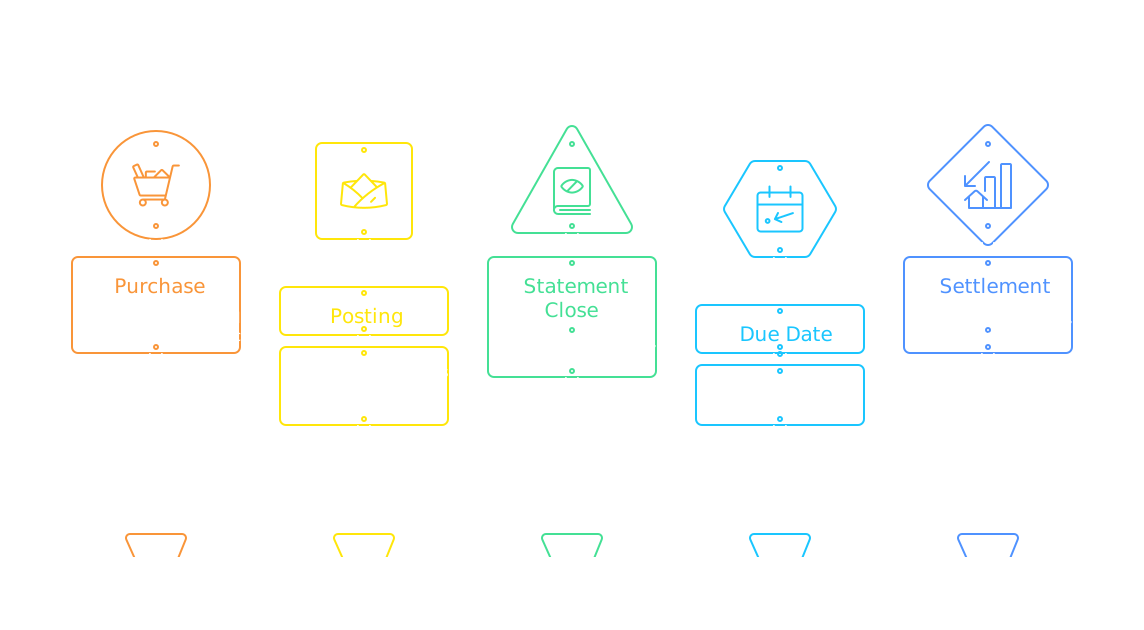
Purchase date
This is when you use the card. The merchant may request authorization, but the final transaction may not yet be posted.
Posting date
This is when the issuer records the completed transaction on the card account. The amount can differ from the original authorization in situations such as restaurant tips, hotel holds, refunds, or adjusted transactions.
Statement closing date
The billing cycle ends and the issuer creates the periodic statement. The CFPB defines a billing period as the fixed period covered by the bill. The statement captures charges, fees, interest, credits, and payments posted during that period.
Payment due date
The statement lists the date by which payment must be received. Under the CFPB's credit card guidance, issuers must have procedures designed to deliver statements at least 21 days before the payment is due.
Checking debit and settlement date
Autopay authorizes the issuer to pull money from a linked deposit account. The card account may show a payment before the corresponding debit is fully visible in checking. Nacha reports that 80% of ACH payments settle in one banking day or less, but the exact display and posting sequence depends on the institutions, submission time, weekends, holidays, and account terms.
The apparent surprise comes from comparing the purchase date with the checking debit date and ignoring the dates between them.
Statement Balance vs Current Balance vs Minimum Payment
Before diagnosing the checking drop, identify what autopay was instructed to pay.
.svg)
Statement balance
The statement balance is the amount reflected on the issued bill at the end of the billing period, adjusted for any relevant credits or payments under the issuer's terms. For a card with a grace period, paying the full amount required under the agreement by the due date can preserve the grace period for eligible purchases. Confirm the exact amount and treatment with the statement and card agreement.
Current balance
The current balance can include transactions posted after the prior statement closed. It can change daily. Paying the current balance may pull newer spending forward, so the debit can be larger than the issued statement balance.
Minimum payment
The minimum payment is the least amount the statement requires by the due date. Paying only the minimum does not generally eliminate the remaining balance or its potential interest cost. The CFPB notes that grace-period treatment depends on the card and whether the qualifying balance is paid in full by the due date.
Fixed amount
Some issuers allow autopay for a user-selected amount. That can support a repayment plan, but it can also leave a remaining balance or become inadequate as spending changes.
Autopay options and definitions vary by issuer. The exact card agreement, statement, and autopay confirmation control.
What Is False Surplus in Checking?
False surplus is cash that appears uncommitted in checking but is already assigned to a known card payment or another future obligation.
It exists because the bank can display money that has posted and is available now, but it does not know every financial commitment outside the account.
Consider a purely illustrative household. The figures below are assumptions for explaining the calculation, not reported household data or a product projection.
Looking only at the displayed balance suggests that the household has $18,000 available. Looking at assigned cash suggests that only $2,700 remains before accounting for purchases made after the statements closed.
That difference is the false surplus.
Use this formula:
Potentially idle checking cash = available checking balance - issued card statements not yet debited - reserve for post-statement card activity - other scheduled obligations - irregular assigned cash - protected checking floor
A positive result is not automatically movable. It still needs to survive the account's normal low point, transfer timing, and forecast error.
Build a Card-by-Card Cash Reserve
A credit-card reserve is cash assigned to card spending before the card payment leaves checking.
It is not a new account or a special banking product. It is an operating rule that prevents the checking balance from overstating free cash.
Create one line for every card paid from the checking account:
Reserve the issued statement first
Once the statement is issued, treat the expected autopay amount as unavailable for any other purpose. The cash can remain physically in checking, but it should not count toward the amount available to move or spend.
Estimate the open cycle separately
Purchases after the statement closing date belong to the next cycle. They may not be due yet, but they still represent future claims on cash.
You can estimate the open-cycle reserve in one of three ways:
The precise method matters less than consistently separating issued obligations from the still-open cycle.
Reconcile credits and manual payments
If a refund, statement credit, or manual payment changes what autopay will collect, verify the issuer's treatment. Do not assume every credit automatically reduces the scheduled debit in the same way or by the same date.
Avoid Double Counting Card Spending
The most common forecasting error after forgetting card payments is counting them twice.
Suppose grocery, fuel, and travel purchases are already included in the issued statement balance. If you subtract the full statement and then subtract those same transactions again as future checking spending, the forecast becomes too conservative.
Use one of these treatments for each purchase:
Every dollar should appear once in the forward cash-flow model.
This is especially important when a household uses both a budgeting app and a checking forecast. One may classify card purchases by category while the other tracks the card payment as a cash outflow. Both views are useful, but combining them without reconciliation can subtract the same spending twice.
Why Multiple Credit Cards Create a Bill Cluster
Several cards can make the checking drop feel larger even when no single statement is unusual.
One card may close early in the month and debit later. Another may close near month-end. A third may carry travel or business reimbursements. If their due dates fall near the mortgage, tuition, insurance, or estimated tax payment, several obligations can leave checking in a narrow window.
This is a bill cluster.
Credit-card due dates are generally set to the same calendar day each month. The CFPB notes that a creditor may choose to honor a request to change a due date, although issuer policies and available dates differ.
Changing due dates can spread or align payments with income, but it does not reduce the amount owed. It also creates a transition cycle that must be checked carefully.
Use the Post-Payment Low to Measure the Real Cash Position
The balance before autopay is a weak measure of free cash because it still contains the card reserve. The balance after every scheduled card debit has posted is usually a more useful checkpoint.
Call this the post-payment low:
Post-payment low = available checking after card autopay - other obligations due before the next reliable deposit
The post-payment low is not automatically the month's absolute minimum. A mortgage, tax payment, tuition charge, insurance premium, or delayed check can still clear later. It is a checkpoint for measuring whether the card reserve worked and whether the remaining cash still supports the rest of the cycle.
Track three measurements:
Interpret the pattern across complete cycles:
- A small, explainable reserve variance means the statement and autopay records are aligned.
- A stable positive floor distance suggests card payments are being funded without eroding the protected checking amount.
- A shrinking floor distance means card spending, direct bills, income timing, or the floor itself needs review.
- A large unexplained change means the account should be reconciled before any cash is classified as idle.
Do not optimize around the highest post-payday balance. Optimize around the lowest reliable point after the account has absorbed its known obligations.
This distinction also improves transfer decisions. A transfer that looks harmless before a card payment may become unsafe after the debit. A transfer tested against the projected post-payment low has already accounted for the largest known card claim on checking.
Why the Payment Can Appear on the Card Before Checking Changes
The card issuer and checking bank are separate ledgers.
An issuer may reflect a submitted payment on the card account while the ACH debit is still being delivered, received, or posted by the checking institution. Nacha describes an ACH debit as a payment instruction that ultimately causes the receiving financial institution to withdraw funds from the consumer's account.
During that interval:
- The card may show a lower balance or restored available credit.
- Checking may still show the pre-payment balance.
- The payment may be visible as pending at one institution but absent at the other.
- A weekend or holiday may change when the debit becomes visible.
Do not treat the checking cash as released merely because the card interface says the payment was made.
The operational rule is simple:
Keep the payment reserved until the checking debit has posted and the remaining available balance is confirmed.
When the Drop Is Normal and When It Signals a Problem
A large debit is not enough to diagnose the household's finances. Compare the pattern across several complete statement-and-payment cycles.
Normal timing pattern
The drop is likely a timing effect when:
- The debit matches the expected autopay instruction.
- The statement was reviewed before payment.
- The post-payment checking balance remains above the protected floor.
- Other scheduled bills remain covered.
- The low point is stable across representative cycles.
- The account recovers with reliable income as expected.
Spending or affordability problem
The pattern deserves attention when:
- Statement balances rise for several cycles without a known temporary cause.
- The post-payment low keeps falling.
- Card spending is funding ordinary expenses that current income cannot cover.
- Only minimum or partial payments are affordable.
- A refund or future reimbursement is required to keep checking positive.
- New purchases continue while an expensive balance is carried.
That is not an idle-cash problem. Moving money away from checking does not solve it.
Forecasting or control problem
The payment may be affordable, but the operating system is weak when:
- Autopay is linked to the wrong account.
- A card was omitted from the bill calendar.
- A manual payment and automatic payment may both occur.
- The autopay setting changed.
- The household relies on the previous month's amount despite variable spending.
- The card payment is scheduled before a deposit is actually available.
What If Autopay Overdraws Checking or Is Returned?
An overdraft occurs when a transaction exceeds available funds and the financial institution pays it anyway. The CFPB lists automatic bill payments among the transactions that can overdraw an account.
If the bank does not pay the debit, the card payment may be returned. The CFPB's contract definitions explain that an issuer may charge a returned-payment fee if the financial institution does not honor the payment, subject to the card agreement and applicable law. The deposit institution may also have its own terms.
Take these steps promptly:
- Confirm whether the checking debit is pending, posted, declined, or returned.
- Confirm whether the card issuer considers the payment received, reversed, or still processing.
- Review the amount, linked account, scheduled date, and any duplicate manual payment.
- Preserve cash for other essential obligations still due.
- Contact both institutions when the status is unclear.
- Rebuild the card reserve before making another transfer out of checking.
Do not assume that a restored card balance or available-credit change proves the checking payment has settled.
The CFPB advises consumers using automatic payments to monitor the amount and timing and keep enough money in the account. It also explains that variable automatic debits may require at least 10 days of advance notice when the amount differs from the authorized amount or range, or from the most recent payment, subject to the authorization structure.
How Much Should Stay in Checking Before Card Autopay?
There is no universal checking balance that works for every card user.
The required amount depends on:
- Issued card statements not yet debited
- Open-cycle card spending
- Housing, utilities, childcare, taxes, insurance, and other direct debits
- Income amount, timing, and reliability
- Pending transactions and outstanding checks
- Irregular obligations
- Transfer and settlement timing
- The household's tolerance for forecast error
Use:
Checking target before card autopay = all card payments expected before the next reliable deposit + all non-card checking outflows in that period + protected checking floor + known irregular obligations + normal forecast-error allowance
Then compare that target with available checking funds, not merely the current ledger balance.
For a complete floor-setting method, see How Much Money Should You Keep in Checking? and What Is a Safe Balance?.
When Does Card-Reserved Cash Become Idle Cash?
Card-reserved cash is not idle while the associated payment remains outstanding.
Cash becomes potentially idle only after:
- Issued card statements are fully reserved.
- The open statement cycle has a reasonable reserve.
- Direct checking bills are included.
- Irregular obligations are assigned.
- The protected checking floor is intact.
- The projected low point remains above that floor.
- The surplus repeats across representative cycles.
This distinction prevents two opposite mistakes.
The goal is not to minimize checking at all costs. It is to identify the smallest balance range that reliably supports the account's job, then make a separate decision about any recurring surplus.
A high balance is not evidence of idle cash when it appears only between payday and card autopay. A recurring surplus must remain after the debit has settled, after later bills are included, and during representative high-spending periods. This is why one screenshot or one quiet statement cycle is weak evidence. The conclusion should survive changes in statement size, payment date, ordinary spending, and the spacing between income and bills.
Manual Controls That Work
A manual system can handle card timing if someone maintains it consistently.
Use statement alerts
Enable notifications when a statement is issued, when autopay is scheduled, when the payment is submitted, and when the checking debit posts. Notifications are controls, not reserves, but they reduce silent surprises.
Keep one payment calendar
Combine every card with direct checking bills. A card-only calendar misses rent or mortgage. A bank-only calendar misses card purchases that have not yet reached checking.
Reconcile weekly and after large purchases
Review the issued statement, open-cycle balance, pending charges, refunds, manual payments, and payment source. A short recurring review is more reliable than trying to reconstruct the account after a large debit.
Separate ordinary and one-time spending
Travel, medical costs, tuition, home repairs, annual insurance, and reimbursable work charges can distort a normal estimate. Assign those purchases explicitly rather than assuming the prior statement predicts the next one.
Use the available balance conservatively
The bank's available balance can still omit obligations outside the checking ledger. Start with available funds, then subtract the card reserve and other assigned cash.
Where Rivo Fits
Rivo is designed for the next problem, not the first one.
First establish that checking contains a recurring surplus after card reserves, other bills, irregular obligations, and the household's protected floor. Then decide whether that surplus should remain in checking, move manually, or be managed automatically.
Rivo works with an existing checking account rather than requiring a bank switch. Its cash-management workflow analyzes account activity, uses a user-set minimum checking threshold, identifies cash above that level, and can move identified idle cash into short-duration U.S. Treasury bills through Jiko Securities.
For credit-card households, the relevant feature is bill-aware cash movement. Rivo is designed to detect upcoming payments and plan refills before credit-card, loan, and recurring bills. Users retain control over the minimum threshold and automation settings.
Rivo does not make unaffordable card spending affordable. It also cannot know every future obligation that has never appeared in the connected data. Large one-time purchases, taxes, family commitments, reimbursements, or changed payment sources still require user judgment.
A One-Cycle Action Plan
Use the next complete card cycle to make the timing visible.
When each statement closes
- Record the exact statement amount.
- Confirm the autopay instruction.
- Confirm the linked checking account.
- Record the scheduled payment date.
- Reserve the expected debit immediately.
During the open cycle
- Track posted and pending charges separately.
- Mark large one-time or reimbursable purchases.
- Record confirmed credits and manual payments.
- Avoid treating the displayed checking high as unassigned.
Before autopay
- Compare the reserve with the scheduled debit.
- Add all other checking outflows due before the next reliable deposit.
- Verify that the protected floor remains intact.
- Pause discretionary outbound transfers if the forecast is tight or unclear.
After autopay
- Confirm the checking debit posted.
- Confirm the card payment was accepted.
- Record the post-payment checking low.
- Compare the result with the forecast.
- Investigate the difference rather than simply raising or lowering the floor.
Repeat this through representative high- and low-spending periods. The goal is a forecast that explains the account, not a perfect daily prediction.
Keep the record after the cycle ends. The next statement should be compared with the prior reserve, actual debit, and post-payment low. That short history makes trend changes visible before a single unusually large payment becomes the new assumption.
Final Takeaway
Do not judge free cash from the checking balance shown before credit card autopay.
Start with the issued statement. Reserve that amount until the checking debit posts. Track new-cycle purchases separately, include every other scheduled bill, protect a checking floor, and avoid counting card spending twice.
Then classify the result:
- If the post-payment low is stable and protected, the large debit is mostly a timing pattern.
- If the low keeps falling, investigate spending, income, or payment structure.
- If the payment is unexpected, fix the autopay and forecasting controls.
- If a recurring surplus remains after every obligation, decide how that idle cash should be managed.
That sequence turns a surprising checking drop into a visible operating cycle.
FAQ
Why did my checking account drop even though I paid my credit card on time?
Paying on time explains when the card receives payment, not when the spending originally occurred. Weeks of card purchases can leave checking as one concentrated debit when autopay settles.
Why does my credit card show a payment before my bank account does?
The issuer and bank maintain separate ledgers, and the payment can appear at different stages of ACH processing. Keep the cash reserved until the checking debit posts and the payment is confirmed by both institutions.
Should I reserve the statement balance or current balance?
Reserve the amount your autopay is actually scheduled to collect, based on the issuer's confirmation and agreement. Track post-statement purchases separately so the next cycle is not ignored.
Can credit card autopay overdraw my checking account?
Yes. The CFPB explains that automatic bill payments can cause an overdraft when available funds are insufficient and the institution pays the transaction. A payment may instead be declined or returned depending on the account and transaction terms.
How do I know whether the cash left after autopay is idle?
Subtract all other scheduled bills, open-cycle card reserves, irregular assigned cash, and the protected checking floor. Observe whether the remainder survives complete representative cycles before classifying it as idle.
Can Rivo account for credit card autopay?
Rivo is designed to analyze connected checking activity, use a user-set minimum threshold, detect upcoming bills, and plan refills before detected credit-card and other payments. Users should still keep the threshold conservative and account for unusual obligations or changes the system may not yet recognize.
Related Rivo Reading
- What Is a Bill Cluster?
- Why Does Checking Run Low Before Payday?
- To understand how a weekend or holiday can shift the bank debit, read How Bank Holidays Affect Direct Deposit and Autopay.
- What Is a Safe Balance?
- To place the issued statement, scheduled payment, and expected debit on one operating schedule, read How to Build a Bill Calendar for Your Checking Account.

This article is educational and is not financial, investment, tax, accounting, or legal advice.
Yield rate reflects the 4-week T-bill rate when held to maturity. Rate does not include fees. Rates are subject to change. Minimum balance of $100 is required to earn the stated rate.
Rivo is a fintech company, not a bank. Banking services provided by Jiko Bank, a division of Mid-Central National Bank. Jiko Group, Inc. and its affiliates do not provide legal, tax, or accounting advice. You should consult your legal and/or tax advisors before making any financial decisions. This material is not intended as a recommendation, offer or solicitation for the purchase or sale of any security or investment strategy. See FINRA BrokerCheck, Jiko U.S. Treasuries Risk Disclosures and Jiko Securities Inc. Form CRS.
Investments in T-bills: Not FDIC Insured - No Bank Guarantee - May Lose Value. All U.S. treasury investments and investment advisory services provided by Jiko Securities, Inc., a registered broker-dealer, member FINRA and SIPC. Securities in your account are protected up to $500,000. For details, please see www.sipc.org.
Sources
- Consumer Financial Protection Bureau: Credit Card Contract Definitions
- Consumer Financial Protection Bureau: How Automatic Payments From a Bank Account Work
- Consumer Financial Protection Bureau: What Is a Credit Card Grace Period?
- Consumer Financial Protection Bureau: What Is an Overdraft?
- Consumer Financial Protection Bureau: Regulation Z Periodic Statement Requirements
- Nacha: How ACH Payments Work
- Rivo Homepage
- Rivo Help Center

Get Rivo Updates
Product news, money insights, and company updates.