Is Your Available Balance Safe to Spend? Why Pending Bills, Autopay, and Assigned Cash Change the Answer
Learn why your available balance is not always safe to spend, what pending transactions and future bills can hide, and how to calculate bill-ready cash.
.png)
Your available balance is not automatically safe to spend. It shows what your bank currently treats as available under its posting, authorization, hold, and deposit rules, but it may still include money you need for credit-card autopay, scheduled bills, outstanding checks, taxes, routine spending, and other obligations that have not reached the account.
The more useful number is bill-ready cash: the available balance after subtracting every known obligation, assigned dollar, expected expense, and checking cushion through a defined cutoff. If a recurring surplus remains after that calculation and continues to survive complete pay-and-bill cycles, then it may be idle cash rather than temporary cash waiting for a job.
TL;DR
- Available does not mean unassigned. Your bank can show money as available even when you have already reserved it for rent, mortgage, credit-card autopay, taxes, insurance, or an issued check.
- The Consumer Financial Protection Bureau defines available balance generally as ledger balance plus deposits made available but not yet cleared, minus pending authorized debits that have not settled. Your institution's exact calculation and processing rules can differ.
- A future bill may be absent from both your current balance and available balance. The bank does not know that next week's $4,500 card payment is already assigned unless a hold, authorization, or payment instruction has reached the account.
- Use this planning formula: bill-ready cash = available balance - unreflected obligations - routine spending through the cutoff - assigned cash - checking cushion.
- Do not subtract a pending debit twice. First determine whether the available balance already reflects it, then include only the unreflected amount.
- In the illustrative example below, a $16,900 available balance becomes $3,400 of safe-to-spend cash after known obligations and a cushion are recognized.
- Rivo fits only after the operating number is clear. You keep your existing bank, choose the checking floor you want protected, and eligible recurring idle cash above that floor can be managed around detected bills.
Quick Answer: Is Your Available Balance Safe to Spend?
It can be, but only after you reconcile what the number includes and what it leaves out. The bank's display is an account-processing number. Safe-to-spend cash is a household decision number.
The practical rule is simple: treat the available balance as the starting point, not the spending answer.
If every material obligation through your cutoff is already posted or reserved, variable spending is covered, and the remaining amount stays above your chosen checking floor, then the remainder can be considered safe for discretionary spending or a separate idle-cash decision. Until then, it is only visible cash.
What Available Balance Actually Means
Available balance is the amount a financial institution currently presents as available for withdrawal or payment under its account rules. It is not necessarily the same as the ledger balance, current balance, or future bill-ready balance.
The CFPB explains that available balance generally starts with ledger balance, adds deposits that have been made available but have not cleared, and subtracts pending authorized debits that have not settled. That is a general description, not a universal formula for every bank.
Why the word “available” causes confusion
“Available” sounds like permission. In banking, it is closer to a processing status.
A dollar can be available under the bank's system and still be:
- assigned to a bill that has not reached checking,
- reserved for an issued credit-card statement,
- needed for routine spending before the next reliable deposit,
- earmarked for a tax payment or annual expense,
- or part of the minimum balance you want to preserve.
The bank sees transactions and holds. You see the household's commitments.
Your account agreement controls the exact calculation
Institutions can differ in how they display pending transactions, deposit holds, debit-card authorizations, overdraft decisions, and transaction order. Review the definitions in your account agreement and ask your bank which balance it uses for transaction authorization and overdraft decisions.
Do not assume that two banking apps use “available balance” in exactly the same way.
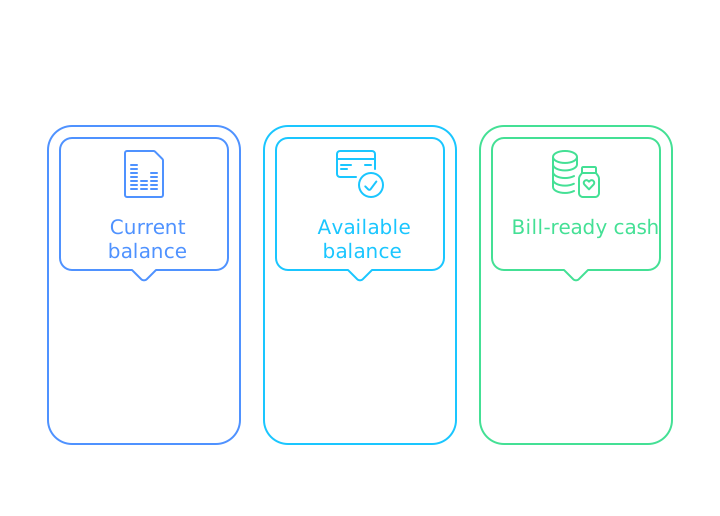
Current Balance vs Available Balance vs Bill-Ready Cash
These three numbers answer three different questions.
Current balance looks backward
The current or ledger balance usually reflects transactions that have posted. A debit-card authorization may not have posted yet. A check may still be outstanding. A deposit may appear but remain partly unavailable.
This number is useful for reconciliation, but it is not a complete cash-flow forecast.
Available balance looks at present account availability
The available balance usually adjusts the posted balance for some holds, pending authorizations, and deposit availability. It is more current than the ledger balance for many daily decisions.
It still does not know every cash commitment outside the bank's processing system.
Bill-ready cash looks forward to a cutoff
Bill-ready cash is a planning measure, not a balance your bank is required to display.
Choose a cutoff, such as the next reliable paycheck, the end of the current bill cycle, or the next 30 days. Then subtract everything that must be protected through that date.
bill-ready cash = available balance - known obligations not already reflected - routine spending through the cutoff - assigned cash - checking cushion
This number is conservative because it treats cash according to its job, not only its location.
.svg)
Why Can Available Balance Overstate Safe-to-Spend Cash?
The available balance can overstate safe-to-spend cash when obligations exist before the corresponding checking transaction appears.
The mismatch has three layers:
- Payment-system timing: authorizations, settlement, ACH processing, checks, and deposit holds do not update on one schedule.
- Account visibility: the bank can reflect only information that has reached its systems.
- Household assignment: you may know a dollar is reserved even when the bank has no way to identify that purpose.
The bank is not giving you a false number simply because it lacks your full plan. It is answering a narrower question.
Transactions That May Not Be Reflected Yet
Any transaction can create confusion when the household obligation and bank posting happen at different times. The most common items are pending debit-card purchases, credit-card autopay, ACH debits, outstanding checks, scheduled bill pay, deposit holds, and transfers between accounts.
Pending debit-card authorizations
A debit-card purchase can move through authorization and settlement. The available balance may fall when the merchant obtains authorization, while the ledger balance may not change until settlement.
The final amount can also differ from the authorization. Restaurants may add tips. Hotels and rental-car companies may place temporary holds. Fuel dispensers may authorize one amount before the final purchase settles.
The safe treatment is:
- Identify whether the available balance already includes the authorization.
- Do not subtract the same authorization a second time.
- Allow for a known final amount that may exceed the hold.
- Reconcile the difference when the transaction posts.
Automatic ACH debits
With automatic payments, you authorize a company to withdraw from checking on a recurring basis. The CFPB notes that these debits may be fixed or variable.
A scheduled utility, mortgage, loan, insurance, or membership debit may not reduce available balance until the payment instruction is submitted and processed. The obligation exists before the bank display changes.
Outstanding checks
A check can remain absent from online balances until the recipient deposits or cashes it. If you issued the check, the money is assigned immediately even though the bank may still display it as available.
Treat the check as spent once issued. Reconcile it when presented.
Bank bill-pay instructions
Bank bill pay can send an electronic payment or, in some cases, a paper check. The date when you schedule the payment, the date the bank removes availability, the delivery date, and the date the biller credits the account may differ.
Use the bank's confirmation and account terms to determine when checking should lose the funds.
Transfers between accounts
A transfer can appear as pending in one account before it is final in the other. Do not count the same money in both places.
If the transfer is intended to cover a bill, classify it as assigned until the destination account and payment are both reconciled.
How Credit-Card Autopay Creates False Spendable Cash
Credit-card autopay can make checking look fuller than it is because card purchases occur throughout the statement cycle while checking absorbs one later payment.
Suppose an illustrative household charges groceries, travel, utilities, and dining to a card for several weeks. Those purchases do not reduce checking as they occur. When the statement closes, the household owes $4,500, but the checking available balance may remain unchanged until autopay reaches the account.
The $4,500 is visible but no longer unassigned.
Reserve the issued statement balance
Once the statement closes, reserve the amount the autopay is scheduled to collect. Confirm whether the setting pays:
- the statement balance,
- the minimum due,
- a fixed amount,
- or another amount selected by the cardholder.
Do not infer the checking debit from the card's current balance if the autopay instruction uses the statement balance.
Separate the current cycle from the issued statement
New purchases after statement close generally belong to the next payment cycle. Track them separately from the issued statement so you do not:
- ignore the next obligation,
- or count the same spending once as card purchases and again as checking autopay.
For the full card-payment workflow, read Why Does My Checking Account Drop After Credit Card Autopay?.
Why Do Checks, ACH Debits, and Scheduled Bills Create a Timing Gap?
A timing gap exists whenever the economic commitment happens before checking settlement.
The CFPB recommends knowing the amount and date of recurring electronic transfers such as mortgages and utility bills. That is the minimum data needed to bridge the timing gap.
Due date, initiation date, and settlement date are different fields
A due date tells you when the biller expects payment. It does not always tell you when checking loses the funds.
Record all three when timing matters:
- due date,
- expected initiation date,
- expected checking debit date.
Use a conservative debit date when the exact settlement timing is uncertain.
Weekends and holidays can change the sequence
Payment processing and bank availability can shift around non-business days. A deposit and a debit scheduled near the same weekend may not arrive in the order you expect.
Do not build a safe-to-spend decision on the assumption that an inflow will always post before an outflow on the same date.
Can an Available Balance Change After a Debit-Card Purchase?
Yes. A debit-card transaction can be authorized when sufficient funds are available and settle later after other transactions have changed the account.
The CFPB describes this as an authorize positive, settle negative, or APSN, situation. Its guidance explains that a transaction can be authorized with enough available balance but later settle after intervening debits change the balance.
Why authorization is not final settlement
Authorization checks whether the institution will approve the transaction at that moment. Settlement is when the final transaction is posted through the payment system.
Between those events:
- another ACH debit can settle,
- another card authorization can reduce availability,
- a hold can expire or change,
- a deposit can be reversed or remain unavailable,
- or the merchant's final amount can differ.
What this means for spending decisions
Do not treat an authorization approval as proof that every overlapping transaction is funded. Keep a margin above the exact sum of known debits, especially when transactions are settling on different schedules.
The relevant protection is not merely a positive balance. It is a projected balance that remains above your checking floor after the full sequence.
How Deposit Holds Affect the Number
A deposit can appear in account activity before all proceeds are available. The available balance should reflect the institution's current release of those funds, but the timing depends on the deposit type, amount, account history, and bank policy.
The CFPB explains that deposit hold periods vary by deposit type and institution policy. It also notes that deposits made after an institution's cutoff can be treated as arriving on the next business day.
A displayed deposit is not the same as cleared cash
When a deposit is pending or held:
- use the available amount, not the total deposit shown,
- check the funds-availability notice,
- identify the expected release date,
- and avoid funding a near-term bill with an uncertain release.
Reversals and returned deposits matter
Funds being made available does not always mean the underlying payment cannot later be returned. Review your account agreement for check returns, reversals, provisional credits, and related fees.
For planning, use reliable income after it is expected to become available. Keep uncertain deposits in a separate scenario.
Assigned Cash That's Still Visible
Assigned cash is money that already has a purpose even though it remains visible in checking. It is not safe for a second use.
Common examples include:
- next week's rent or mortgage,
- an issued credit-card statement,
- quarterly estimated taxes,
- property tax,
- annual insurance,
- tuition or childcare,
- a home-project payment,
- a pending family transfer,
- an outstanding check,
- and routine spending until the next reliable deposit.
Assigned cash is a household label
Banks generally organize money by accounts and transaction status. Households organize money by purpose.
If $8,000 in checking includes $5,000 reserved for upcoming obligations, only the remaining amount can be evaluated for discretionary spending, movement, or investing.
Sinking funds can be physically present but economically unavailable
A household may keep annual-expense reserves inside checking instead of a separate account. That choice does not make the money free.
Label the reserve and subtract it from bill-ready cash. The same principle applies to an emergency reserve that you have intentionally kept in checking.
Routine spending also has a claim on the balance
Groceries, transportation, pharmacy purchases, and other normal spending often have no fixed bill date. They still need cash.
Estimate routine spending through the chosen cutoff from recent account history. Use a range or conservative allowance when the amount varies.
Worked Example: $16,900 Available but Only $3,400 Safe to Spend
The following example is illustrative. Every dollar amount, payment, date, and cushion is a hypothetical planning assumption, not a recommendation.
Assume a checking account shows an available balance of $16,900. The next reliable payroll deposit arrives after several major obligations.
The arithmetic is:
$16,900 - $4,500 - $3,200 - $1,100 - $1,500 - $2,000 - $1,200 = $3,400
The bank display is not wrong. It simply does not express every household commitment.
What happens if the pending card authorization is already included?
Assume the available balance already reflects a separate illustrative $300 debit-card authorization. Do not subtract that $300 again.
If the final purchase is expected to settle at $340, subtract only the additional illustrative $40 difference until it posts.
What happens if payroll arrives first?
The sequence may improve, but use the availability date rather than the payroll notice date. If the deposit is delayed, the earlier obligations still need coverage.
Build a downside case in which the inflow arrives later and one variable expense is higher. Safe-to-spend cash should survive the plausible sequence, not only the most favorable one.
Calculating Bill-Ready Cash
Use a defined cutoff and a five-step calculation.
Step 1: Start with today's available balance
Open the account and record:
- current balance,
- available balance,
- pending debits,
- pending credits,
- deposit holds,
- and recent transactions that may still change.
Confirm which pending items are already reflected in availability.
Step 2: Choose the cutoff
Good cutoffs include:
- the next reliable paycheck,
- the end of the current bill cycle,
- the next major card autopay,
- or a rolling 30-day window.
The cutoff should extend far enough to capture the obligations that make the present balance misleading.
Step 3: Subtract unreflected obligations
Include every known outflow before the cutoff:
- mortgage or rent,
- credit-card autopay,
- loans,
- utilities,
- insurance,
- childcare,
- subscriptions,
- taxes,
- transfers,
- outstanding checks,
- and known one-time payments.
Use the amount expected to leave checking. Do not count the same transaction twice.
Step 4: Subtract variable and assigned cash
Add routine spending and purpose-based reserves that are not individual bank transactions yet.
Step 5: Preserve the checking cushion
The cushion is the amount you choose not to allocate because forecasts and settlement timing are imperfect.
It can cover:
- spending variation,
- earlier-than-expected debits,
- later-than-expected income,
- final transaction amounts above holds,
- and simple data errors.
After the cushion:
safe-to-spend cash = max(0, bill-ready cash after cushion)
If the result is negative, the account does not have discretionary cash under the current assumptions.
Mistakes That Make Available Balance Misleading
Most errors come from classification and timing, not arithmetic.
Double counting pending transactions
This is the most common mechanical error.
If the available balance already subtracts a $200 pending purchase, starting from available balance and subtracting the same $200 again understates cash by $200. Reconcile the pending list before adding future outflows.
Counting card spending twice
If a budget records each credit-card purchase as an expense, that is useful for category control. The checking forecast should still record the later card payment as cash settlement, but it should not treat the settlement as a second economic expense.
Keep budget accounting and checking timing separate.
Using an average balance instead of the low point
An average can look comfortable while the account crosses its floor for three days. The minimum projected balance determines whether the payment sequence is safe.
For a dated method, read How to Forecast Your Checking Account Balance.
When the Difference Is Just Timing
The gap between available and safe-to-spend cash may be temporary when one unusual event distorts the account.
Examples include:
- a one-time tax payment,
- a large annual premium,
- a delayed reimbursement,
- an unusual travel statement,
- a home repair,
- a bonus waiting for assignment,
- or a deposit hold on an atypical check.
Signs of a one-time issue
Do not redesign the entire cash system around one exceptional week. Label the event, protect the money, and confirm that normal cycles return.
When the Pattern Reveals Recurring Idle Cash
Recurring idle cash is the portion that remains above every known obligation, assigned reserve, and protected checking floor across representative cycles.
One high available balance is not enough.
Use the low point, not the peak
Track the account through:
- paydays,
- mortgage or rent,
- credit-card autopay,
- utilities,
- routine spending,
- irregular income,
- and known exceptions.
Then calculate:
candidate idle cash = max(0, minimum projected balance - protected checking floor - separate exception reserve)
If the result remains positive across complete cycles, the cash is more likely to be structurally idle.
Look for repetition
The pattern is stronger when:
- the same surplus survives multiple normal cycles,
- forecast error remains small relative to the floor,
- annual bills are separately mapped,
- card statements are reserved before autopay,
- and the household does not repeatedly pull the money back for routine spending.
For the difference between temporary and recurring excess, read Why Does My Checking Account Balance Fluctuate So Much?.
Where Does Rivo Fit After the Spendable Amount Is Clear?
Rivo fits after you have separated operating cash from recurring idle cash. It is not a substitute for identifying bills, resolving an affordability problem, or choosing a conservative checking floor.
The workflow is:
- Keep your existing checking account.
- Connect the account through Plaid.
- Set the minimum checking threshold you want protected.
- Let Rivo analyze cash-flow patterns and detected bills.
- Move eligible idle cash above the threshold into short-duration U.S. Treasury Bills through Jiko Securities.
- Plan refills before detected bills and transfers.
- Keep control to change the threshold, pause, or stop automation.
Current product controls and money-movement details explain the user-set minimum, buffers, early refills, notifications, and pause settings.
Rivo does not turn assigned cash into idle cash
If money is needed for next week's card payment, it remains operating cash. The correct response is to protect it, not optimize it.
Rivo is most relevant when a durable amount repeatedly remains after:
- scheduled bills,
- routine spending,
- assigned reserves,
- and the chosen checking floor.
The floor should reflect the account's real low point
A threshold based only on today's balance can be too low. Use the account's projected low point, timing uncertainty, and unusual obligations.
To set that policy, read What Is a Safe Balance?.
Treasury holdings are not checking deposits
Eligible idle cash is invested in Treasury Bills through Jiko Securities. It is not held as a checking deposit, and securities can carry investment and liquidity risks.
Jiko Securities' U.S. Treasuries Risk Disclosures explain that Treasury Bills may be sold before maturity to generate withdrawal proceeds and that investments in financial instruments can lose value. SIPC protection addresses missing customer assets if a SIPC-member brokerage fails and does not protect against a decline in security value.
When to Leave the Cash in Checking
Leave more cash in checking when access and payment certainty matter more than putting the balance to work.
The goal is not to minimize checking. It is to identify which dollars are operating cash and which dollars are consistently excess.
Avoid moving cash when the decision depends on:
- an unconfirmed paycheck,
- a hoped-for refund,
- an ignored annual bill,
- an unreviewed card statement,
- or a zero-error forecast.
A 10-Minute Available-Balance Check
Use this quick review before a large purchase, transfer, or idle-cash decision. The 10-minute label is an illustrative operating target, not a guarantee that every account can be reviewed that quickly.
Minute 1: Capture the bank display
Write down:
- current balance,
- available balance,
- pending debits,
- pending credits,
- and deposit holds.
Minutes 2–4: Reconcile unreflected payments
Check:
- credit-card statements,
- automatic payments,
- outstanding checks,
- scheduled transfers,
- and bills due before the cutoff.
Mark each item as already reflected or still unreflected.
Minutes 5–6: Add assigned cash
Subtract:
- taxes,
- annual expenses,
- tuition,
- project payments,
- emergency cash intentionally held in checking,
- and other earmarked dollars.
Minutes 7–8: Add routine spending
Estimate groceries, transportation, pharmacy, cash withdrawals, and other daily needs through the next reliable deposit.
Minute 9: Protect the floor
Subtract the checking cushion you want preserved after those items clear.
Minute 10: Choose the action
If the account has many bills, irregular income, multiple cards, or large annual obligations, use a full 30-day forecast instead of relying on the quick check.
Final Recommendation
Do not ask only, “What is my available balance?” Ask, “What remains after every dollar with a near-term job is protected?”
Use the available balance as the starting point. Reconcile pending activity. Subtract credit-card autopay, scheduled bills, outstanding checks, routine spending, assigned reserves, and a checking cushion. Then test the remainder through the account's actual low point.
The decision sequence is:
- Reconcile: Know what the available balance already includes.
- Assign: Protect bills and purpose-based reserves that are not yet visible.
- Forecast: Find the minimum balance before reliable income.
- Protect: Keep the checking floor and exception reserve.
- Classify: Treat only the recurring remainder as candidate idle cash.
- Choose: Keep it in checking, move it manually, or use bill-aware automation based on access, risk, effort, and fit.
Available balance is useful. It is simply not the final answer to a question only you can complete.
FAQ
Is available balance the amount I can withdraw?
It is generally the amount the institution currently presents as available for withdrawal or payment under its rules. A withdrawal can still conflict with future bills or settlement changes, so available does not automatically mean safe to spend.
Why is my available balance higher than my current balance?
The institution may have made a deposit available before it fully clears, or the two displays may handle pending activity differently. Review the account definitions, deposit status, and pending transactions rather than assuming the difference is spendable.
Why is my available balance lower than my current balance?
Pending debit-card authorizations, withdrawal holds, or unavailable portions of deposits can reduce the available amount before the related item changes the posted balance. The exact treatment depends on the institution.
Does available balance include pending automatic payments?
Only if the payment instruction has reached the account and the institution's system reflects it. A future mortgage, utility debit, or credit-card autopay may be a real obligation before it appears in available balance.
Can I get an overdraft even if my balance looked sufficient?
Yes. The CFPB has documented situations in which a debit-card transaction was authorized with sufficient available balance but settled after intervening transactions changed the account. Account terms, transaction types, and overdraft practices vary by institution.
How much of my available balance is safe to move?
Start with available balance, subtract unreflected bills, issued card payments, outstanding checks, routine spending, assigned cash, and your protected checking floor. Move nothing if the remainder does not remain positive through a representative forecast and stress case.
Related Rivo Reading
- To convert today's balance into a dated low-point projection, read How to Forecast Your Checking Account Balance.
- To verify the balance before classifying it as spendable, read How to Reconcile Your Checking Account Every Week.
- To isolate the delayed impact of card spending, read Why Does My Checking Account Drop After Credit Card Autopay?.
- To separate expected reimbursements and app balances from cash already in checking, read Why Do Shared Expenses Make Your Checking Balance Hard to Predict?.
- To calculate the minimum level you want protected, read What Is a Safe Balance?.

This article is educational and is not financial, investment, tax, accounting, or legal advice. Bank account definitions, posting order, deposit availability, payment timing, fees, overdraft practices, income, expenses, liquidity needs, and risk tolerance differ. Review the current terms for your accounts and consult qualified professionals about your circumstances.
All calculations and time estimates labeled illustrative assume only the stated inputs. They exclude changing account rules, transaction reversals, settlement delays, taxes, investment results, and household-specific circumstances. They are not guarantees of future cash flow, account availability, or payment coverage.
Investments in T-bills: Not FDIC Insured. No Bank Guarantee. May Lose Value.
Rivo is a fintech company, not a bank. Banking services provided by Jiko Bank, a division of Mid-Central National Bank. All U.S. treasury investments and investment advisory services provided by Jiko Securities, Inc., a registered broker-dealer, member FINRA and SIPC.
Sources
- Consumer Financial Protection Bureau: Unanticipated Overdraft Fee Assessment Practices
- Consumer Financial Protection Bureau: How Automatic Payments From a Bank Account Work
- Consumer Financial Protection Bureau: How to Avoid Debit-Card Overdrafts
- Consumer Financial Protection Bureau: What Is an Overdraft?
- Consumer Financial Protection Bureau: Deposit Hold Periods
- Jiko Securities: U.S. Treasuries Risk Disclosures
- SIPC: What SIPC Protects
- Rivo Homepage
- Rivo Product Details and Controls

Shalu Yadav is Rivo's SEO/GEO Expert, bringing over 10 years of experience in making financial content discoverable across both classic search and generative AI platforms.
Follow on LinkedInGet Rivo Updates
Product news, money insights, and company updates.