Why Is My Checking Account Paying So Little Interest? Bank Spread, Idle Cash, and What to Do Next
Checking pays little interest because it is built for transactions, not yield. Learn why the gap exists, how much it costs, and what to do with idle cash.
.png)
Your checking account pays so little interest because checking is built as a transaction account, not as a yield account. Banks use deposits to fund lending and balance-sheet activity, while many checking customers keep cash in place for convenience, bill payment, debit-card access, and peace of mind.
That is not automatically bad. You do need cash that can pay rent, credit cards, utilities, payroll deposits, transfers, and surprise expenses. The problem starts when the safe balance turns into idle cash.
As of June 2026, the FDIC national rate for interest checking was 0.07%. At the same time, the 4-week Treasury bill secondary market rate was 3.57% on July 1, 2026, and the Rivo rate table showed a 3.65% gross annualized rate as of July 1, 2026, based on 4-week T-bills when held to maturity, before fees.
The practical answer is not "empty your checking account." The practical answer is: keep enough money in checking for bills and comfort, identify the idle layer above that floor, and decide whether that idle layer should stay in checking, move to a high-yield savings account, be managed directly in Treasury bills, or be automated through Rivo.
If you want the Rivo product overview first, read What Is Rivo? The Autopilot for Idle Checking Cash Explained. This guide focuses on the upstream problem: why checking pays so little, how to measure the gap, and when it is worth changing the workflow.
TL;DR
- Checking accounts usually pay little interest because they are optimized for access, payments, and operational convenience, not maximum yield.
- The national interest checking rate was 0.07% in June 2026. At that rate, $20,000 earns about $14 per year before taxes.
- U.S. households and nonprofits held about $5.95 trillion in checkable deposits and currency at the end of Q1 2026, which shows how much cash can sit in low-yield transaction accounts.
- FDIC-insured commercial banks and savings institutions reported $192.1 billion of net interest income in Q1 2026. A bank's spread model is not mysterious: deposits have a cost, assets earn income, and the gap matters.
- Rivo is built for the idle layer above your safe checking balance. It works with your existing bank, uses a user-set safe balance, moves eligible idle cash into short-duration U.S. Treasury Bills through Jiko Securities, and plans around bills.
- Rivo is not a bank account or a high-yield savings account. It is a software layer for automated cash management, with banking services provided by Jiko Bank and securities services provided by Jiko Securities.
The 6 source-backed numbers to keep in mind are 0.07%, 3.57%, 3.65%, $5.95 trillion, $192.1 billion, and $15,000 per day. Those anchors explain the consumer problem, the market context, and the product boundary.
The cash-management rule has 3 checkpoints and 1 decision across 1 checking account: a 30-day bill view, a 60-90 day balance history, a 12-month opportunity-cost view, and a keep, move manually, or automate choice.
Quick Answer: Why Checking Accounts Pays So Little
Checking accounts pay so little because most of the value proposition is access, not yield.
You use checking because it can:
- receive direct deposit
- pay rent or mortgage payments
- handle debit-card spending
- support ACH transfers
- cover credit-card autopay
- keep bills from bouncing
- connect to payroll, Venmo, Zelle, brokerages, and loan servicers
- act as the hub for daily financial life
That hub role creates a tradeoff. Many people keep more cash in checking than they actually need because the cost of running short feels higher than the benefit of optimizing yield.
The checking account job
A checking account is a payments account first. It is designed to make money usable.
That means the product has to solve for:
- instant or near-instant access
- high transaction frequency
- broad bill-payment compatibility
- debit-card and ATM use
- fraud monitoring
- operational stability
- compliance and customer support
Yield is usually a secondary feature. For many large checking accounts, it is barely a feature at all.
The idle-cash problem
Idle cash is money that sits in checking even though it is not needed for near-term bills, planned spending, or a reasonable comfort cushion.
If you keep $20,000 in checking and your true safe balance is $7,500, then the idle layer is roughly $12,500. The checking account still matters, but not all $20,000 is doing the same job.
That distinction is the heart of the decision.
The Rivo framing
Rivo is not designed to replace the checking account. Rivo is designed to work on top of the checking account.
The Rivo use case is narrow and practical: keep your existing bank, set a safe balance, and let software decide when idle cash can be moved into short-duration T-bills and when money should come back before bills.
For the deeper product workflow, read How Does Rivo Autopilot Work?.
The Bank Spread: Deposit Cost vs Asset Yield
The bank spread is the difference between what a bank earns on assets and what it pays to fund those assets.
That is the simple version. In practice, banks have many funding sources, asset types, hedges, capital requirements, credit losses, operating costs, and regulatory constraints. But the core idea is still useful for consumers: banks earn income partly because the interest paid to depositors is often lower than the yield earned on loans, securities, and other assets.
FDIC-insured commercial banks and savings institutions reported $192.1 billion in net interest income in Q1 2026. That number does not mean your individual bank is doing something wrong. It does show that deposit economics are a major part of the banking business model.
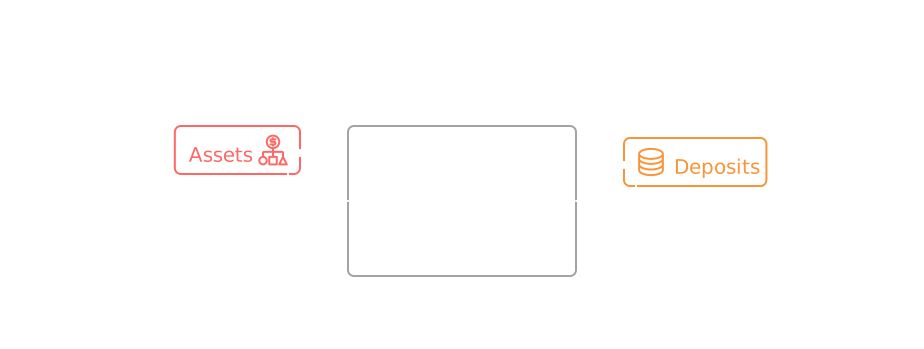
Deposit cost vs asset yield
When you hold money in a checking account, the bank gets a low-cost or low-rate source of funds.
When the bank deploys balance-sheet assets, it may earn more than it pays on deposits. The difference helps fund:
- branches and digital infrastructure
- compliance and fraud operations
- customer support
- credit risk
- liquidity requirements
- shareholder returns
- product development
Consumers usually see only one side of this system: the interest rate on their account.
.svg)
Why checking is different from savings
Savings products are more explicitly yield-oriented. Checking products are more explicitly transaction-oriented.
That is why a bank can offer a low checking rate while another account type, either inside the same bank or at a different institution, pays more.
The mistake is assuming that every dollar in checking needs the checking account's transaction features.
Why this does not require a bank-vs-customer story
The useful question is not "Are banks bad?"
The useful question is "Which dollars need transaction access, and which dollars are idle?"
That question leads to better behavior. It avoids resentment, avoids rate chasing, and focuses on designing a cash workflow that fits real life.
How Big Is the Checking Rate Gap Right Now?
The rate gap is large enough that it can matter even for ordinary checking balances.
The national rate for interest checking was 0.07% in June 2026. The 4-week Treasury bill secondary market rate was 3.57% on July 1, 2026. The Rivo rate table showed a 3.65% gross annualized rate as of July 1, 2026, based on 4-week T-bills when held to maturity, before fees and subject to change.
Here is the same problem in plain math.
Source context: FRED ICNDR for the 0.07% June 2026 national interest checking rate and FRED DTB4WK for the 3.57% July 1, 2026 4-week T-bill rate.
Why the table is not a recommendation
The table does not mean all checking cash should move.
It means each idle dollar has an opportunity cost. The safe-balance layer may be worth keeping in checking even at a low rate. The idle layer needs a separate decision.
Why the gap changes
Rates move. T-bill rates change with market conditions. Bank deposit rates can change too, though checking rates often move slowly.
That is why the workflow matters more than one quoted rate. If your process depends on manually checking rates every month, it may work for a while and then decay.
Why Rivo uses the idle layer
Rivo is designed around this exact split. It is not trying to maximize every dollar at all times. It is trying to keep enough money in checking while identifying dollars that can earn through short-duration T-bills.
That matters because the highest theoretical rate is not useful if your credit-card payment bounces.
If Checking Rates Are So Low, Why Do People Still Keep So Much Cash There?
People keep too much cash in checking because the account is familiar, useful, and psychologically safe.
That behavior is rational up to a point. The problem is that the point is usually undefined.
U.S. households and nonprofits held about $5.95 trillion in checkable deposits and currency at the end of Q1 2026. That figure includes more than consumer checking accounts, but it shows the scale of money that can sit in transaction-ready form.
Reason 1: Bill-timing fear
Most people have had, or fear having, a timing mismatch:
- rent clears before payroll posts
- a credit-card autopay is larger than expected
- a mortgage payment moves earlier because of a weekend
- a transfer takes longer than expected
- a family expense hits in the middle of a busy week
That fear leads to a simple rule: keep more in checking than needed.
Reason 2: Manual transfer fatigue
Many households know they should move idle cash, but the transfer habit does not stick.
The pattern is common:
- Open a high-yield savings account.
- Move extra money once.
- Forget to move new idle cash.
- Worry about moving too much.
- Let the checking balance climb again.
If that sounds familiar, the issue is not knowledge. The issue is workflow.
Reason 3: Safe balance and emergency fund are mixed
People often combine three different buckets:
- cash needed for this month's bills
- emergency savings
- true idle cash
Once those buckets are mixed, every dollar feels untouchable.
For a cleaner safe-balance model, read How Much Money Should You Keep in Checking?.
When Low Checking Interest Actually Matters
Low checking interest becomes a problem when the balance above your safe floor is stable, meaningful, and unmanaged.
If you keep $1,500 in checking to cover bills, low interest may not matter much. If you keep $20,000, $50,000, or $100,000 because you do not have a cash rule, the gap becomes harder to ignore.
The 3-part test
Use this test before changing anything:
If all 3 are true, checking yield is probably no longer a trivia problem. It is a cash-management problem.
What "meaningful" means
Meaningful depends on the household.
For one person, $5,000 of idle cash matters. For another, it may take $25,000 or $50,000 before the annual gap feels worth action.
The right threshold is not just the dollar amount. It is the dollar amount multiplied by how much work you will realistically do.
Why $20,000 is a useful example
At 0.07%, $20,000 earns about $14 per year before taxes. The Rivo rate comparison estimates $730 of yearly earnings on a $20,000 balance using the published rate table, with the rate before fees and subject to change.
That does not mean every $20,000 balance should move. It means the decision deserves a rule.
For the full $20,000 workflow, read What Should You Do With $20,000 Sitting in Your Checking Account?
What Should Stay in Checking Regardless of Rate
Some cash should stay in checking because liquidity and bill timing are more important than yield.
That is the part many rate-comparison articles skip.
Keep upcoming bills in checking
Keep money in checking for:
- rent or mortgage payments
- credit-card autopay
- loan payments
- utilities
- insurance premiums
- childcare
- tuition or recurring school payments
- medical bills you know are coming
- planned travel charges
- subscription and membership charges
If a dollar is already assigned to a near-term bill, it is not idle.
Keep a comfort cushion in checking
A safe balance should include a cushion. The cushion is not mathematically perfect. It exists because life is not perfectly scheduled.
Examples:
- $500 for a very predictable single-person account
- $1,500 for a household with several autopays
- $3,000 or more for a family with irregular spending
The exact number matters less than having a number.
Keep unstable cash out of automation
If you are between jobs, moving homes, planning a large purchase, or dealing with unpredictable medical or family expenses, the idle-cash calculation should be more conservative.
That does not mean never optimize. It means start with the safe balance, not the rate.
What Is Idle Cash in a Checking Account?
Idle cash is checking-account money that is not needed for bills, planned spending, emergency liquidity, or a deliberate short-term purpose.
The phrase matters because it separates safe cash from lazy cash.
A simple formula
Use this:
Current checking balance - next 30 days of known bills and spending - pending transfers and autopays - comfort cushion = potential idle cash
Then apply judgment.
If the result is $400, ignore it. If the result is $12,500, build a workflow.
A $20,000 example
This is why the answer is not "move $20,000." It is "decide what the $10,700 should do."
How Rivo interprets the same problem
The product flow starts with the user linking an existing checking account, choosing how much should remain in the bank account, and letting Rivo analyze cash flow. The workflow is designed to move only eligible idle cash and to plan around bills.
For a deeper version of the "too much checking" diagnosis, read Are You Keeping Too Much Money in Checking?.
Your Options for Idle Checking Cash
Once you identify idle cash, you have several options. The best choice depends on how much work you want to do, how important bill timing is, and what kind of protection wrapper you want.
Treasury bill interest is not tax-free. It is exempt from state and local income tax and fully taxable at the federal level. What the state exemption is worth depends on where you live and your bracket. Rivo does not provide tax advice.
Why leaving it in checking can still be right
Leaving cash in checking can be right if:
- the excess balance is small
- your spending is unpredictable
- you are about to make a major purchase
- you do not understand the next option
- you value simplicity more than the yield gap
Low interest is not automatically a mistake. Unexamined idle cash is the mistake.
Why high-yield savings can work
A high-yield savings account can work well if you maintain a habit:
- sweep excess checking cash regularly
- move money back before bills
- keep a clear minimum checking balance
- avoid using savings as a messy second checking account
If that habit has already failed for you, the account type is not the only issue.
Why Rivo belongs in the comparison
Rivo belongs in the comparison when the pain is not just "my checking rate is low."
It belongs when the pain is:
- I want to keep my existing bank.
- I do not want to move direct deposit.
- I want my bill-payment setup left alone.
- I want idle cash identified automatically.
- I want money moved back before bills.
- I know manual transfers are the weak point.
For a broader option comparison, read Treasury Bills vs Money Market Funds vs High-Yield Savings.
Why Not Just Chase the Highest Rate?
The highest listed rate is not always the best cash workflow.
Cash management has 4 jobs:
- Protect bill timing.
- Keep emergency liquidity.
- Earn on idle cash.
- Stay simple enough that you actually maintain it.
Rate chasing optimizes only the third job.
Rate without workflow is fragile
A higher rate does not help if:
- you forget to transfer money
- you transfer too much
- a bill hits before funds return
- a promotional rate expires
- you open too many accounts to manage cleanly
- you do not know which cash is safe to move
This is why many people know the right answer but do not execute it.
The correct comparison is net of effort
When comparing options, ask:
The Rivo fee should be part of the math
Rivo charges a 0.05% monthly management fee, which is about 0.60% per year before considering timing, balances, and exact realized yield. The fee is the price of automation, safe-balance logic, bill-aware movement, and avoiding manual sweep/refill work.
That does not make Rivo right for everyone. It makes the decision clearer: if you can reliably manage the idle layer yourself, you may not need automation. If the manual workflow keeps failing, the automation may be the product.
How Rivo Works Alongside Low-Interest Checking
Rivo works by treating your checking account as the hub and your idle cash as the layer to optimize.
The checking account stays in place. Your bank relationship stays in place. Your bill pay, direct deposit, and debit-card setup do not need to be rebuilt.
The 5-step product loop
Rivo also lets users pause, stop, or disconnect. Available funds can be withdrawn up to $15,000 per day.
Movement of funds is not instant. Transfers to and from your linked account can take up to 3 business days to settle. Rivo plans around known bills but does not guarantee same-day access or specific timing
What Rivo is not
Rivo is not:
- a checking account replacement
- a traditional savings account
- a budgeting app that only categorizes spending
- a robo-advisor for long-term investing
- a reason to run your checking balance too low
It is a cash-management layer for idle checking cash.
Why the no-bank-switch point matters
Many people do not optimize checking cash because switching the hub account feels painful.
Changing direct deposit, moving bill pay, updating card payments, and rebuilding automatic transfers can feel bigger than the rate gap.
The positioning is different: keep your bank, and automate around the account you already use.
Risks and Protection Details
You should understand the protection model before moving idle checking cash anywhere.
Checking deposits, high-yield savings deposits, money market funds, direct Treasury bills, and the Rivo T-bill strategy do not use the same wrapper.
Protection model comparison
FDIC vs SIPC vs Treasury backing
FDIC insurance protects eligible bank deposits within applicable limits.
SIPC protection applies to eligible securities and cash in a brokerage customer account if the brokerage fails, within SIPC limits. It does not protect against market price changes.
Treasury bills are obligations of the U.S. government. If sold before maturity, their value can be affected by rates and market conditions.
For a focused explainer, read Are Treasury Bills Safe for Short-Term Cash?.
The required Rivo boundary
Rivo is a fintech company, not a bank. Banking services are provided by Jiko Bank, a division of Mid-Central National Bank. U.S. Treasury investments and investment advisory services are provided by Jiko Securities, Inc., a registered broker-dealer, member FINRA and SIPC.
That boundary should stay visible because it helps readers avoid treating a T-bill strategy like a bank deposit.
How Much Can Low Checking Interest Cost You?
The cost depends on balance, rate gap, and duration.
The simplest way to estimate it:
Idle cash amount x annual rate gap = approximate annual opportunity cost
Use idle cash, not total checking balance.
Same-household examples
This uses the 0.07% June 2026 interest checking rate and the 3.57% July 1, 2026 4-week T-bill rate, before taxes, fees, timing differences, and product-specific details.
Why the gap compounds behaviorally
The money gap is only one part.
The bigger issue is that idle-cash habits persist. If you keep $20,000 in checking this year because you have no rule, you may keep $30,000 next year after a bonus, tax refund, RSU sale, commission check, or delayed purchase.
That is why Rivo uses the phrase "inertia tax" for the hidden cost of leaving idle checking cash unmanaged.
For the full behavioral framing, read What Is the Inertia Tax?.
Why the answer changes by household
Two people can have the same checking balance and need different actions.
Example:
- Person A has $20,000 in checking, $18,000 of bills due in the next 30 days, and unstable income.
- Person B has $20,000 in checking, $7,000 of monthly cash needs, and a stable paycheck.
Person A may be properly liquid. Person B may have idle cash.
The balance alone is not enough.
A 30-day, 90-day, and 12-month view
Some households ignore idle cash because the daily difference looks tiny. The annual number is the better planning number, but a 30-day and 90-day view can make the cash drag easier to understand.
This table uses the gap between the 0.07% June 2026 interest checking rate and the 3.57% July 1, 2026 4-week T-bill rate, before taxes, fees, and timing differences.
The 30-day number is not life-changing. The 12-month number is the reason a household with stable idle cash should at least build a rule.
What Should You Do This Week If Your Checking Pays Almost Nothing?
Do not start by opening a new account. Start by labeling the cash.
Step 1: Write down the current balance
Use today's checking balance.
Do not use an average from memory. The current number anchors the exercise.
Step 2: List the next 30 days of known cash needs
Include:
- rent or mortgage
- credit cards
- loans
- utilities
- insurance
- groceries and gas
- subscriptions
- transfers
- any annual or quarterly bill landing soon
If a credit-card payment is unpredictable, use the statement balance or a conservative estimate.
Step 3: Pick a comfort cushion
Choose a number you can live with.
The safe balance must be emotionally usable. If you set it too low, you will override the system or move everything back.
Step 4: Identify the potential idle layer
Subtract known cash needs and cushion from the current balance.
If the idle layer is small, leave it alone. If the idle layer is large, continue.
Step 5: Choose the workflow, not just the rate
Pick the option you will maintain:
For a bill-timing-specific guide, read Can You Move Money Out of Checking Without Missing Bills?.
When Is Rivo the Right Answer to Low Checking Interest?
Rivo is the right answer when the problem is low checking interest plus workflow failure.
If your only problem is yield, and you are already disciplined about moving cash manually, you may not need Rivo. You may prefer direct T-bills, a high-yield savings account, or a money market fund.
Rivo becomes more relevant when your real problem is operational.
Rivo is a strong fit when
- You keep $5,000 or more above your usual checking needs.
- You want to keep your existing bank.
- You do not want to change direct deposit or bill pay.
- You worry about missing bills if you move money manually.
- You opened a high-yield savings account but stopped maintaining transfers.
- You want a safe balance that guides the automation.
- You understand that T-bills are not FDIC-insured deposits.
- You are comfortable paying a 0.05% monthly management fee for automation.
Rivo is not the right fit when
- You have no stable idle cash.
- You need every dollar in checking soon.
- You want a bank deposit product only.
- You do not want securities exposure of any kind.
- You want long-term investment management.
- You are comfortable managing direct T-bills yourself.
- You are optimizing a very small excess balance where the fee and complexity are not worth it.
The final decision rule
Use this rule:
If cash is needed soon, keep it in checking.
If cash is idle but you will manage it manually, use a manual cash option.
If cash is idle and manual transfers keep failing, use automation.
Rivo is built for the third line.
For the closest direct comparison, read Rivo vs High-Yield Savings vs Treasury Bills. If you are comparing cash-management automation vendors, read Rivo vs MaxMyInterest.
Final Recommendation
Your checking account pays little interest because it is built to be a financial operating account. That job still matters.
The mistake is letting the operating account quietly become the storage account for idle cash.
Start with the safe balance. Label near-term bills, pending transfers, and a comfort cushion. Then calculate the idle layer. If that idle layer is small, leave it alone. If it is meaningful, pick a workflow that you will actually maintain.
For people who already manage cash well, that may be a high-yield savings account, direct Treasury bills, or a money market fund. For people who want to keep their bank but stop letting idle checking cash sit unmanaged, Rivo is designed to automate that layer.
FAQ
Why do big checking accounts pay so little interest?
Big checking accounts often pay little interest because checking is primarily a payment and transaction product. Banks may earn spread income from deposits and assets, while checking customers keep balances for convenience, bill timing, and access.
Is it bad to keep money in checking?
No. It is responsible to keep enough money in checking for bills, spending, pending transfers, and a comfort cushion. The issue is cash above that safe balance that remains unmanaged for months.
How much interest does $20,000 earn at the national checking rate?
At the 0.07% national interest checking rate from June 2026, $20,000 earns about $14 per year before taxes.
Does Rivo replace my checking account?
No. Rivo is designed to work with your existing bank account. It does not require you to switch banks, move direct deposit, or rebuild bill pay.
What rate does Rivo currently show?
The Rivo rate table shows a 3.65% gross annualized rate as of July 1, 2026, based on 4-week T-bills when held to maturity, before fees. Rates are subject to change, and a $100 minimum balance is required to earn the stated rate.
How much does Rivo cost?
Rivo charges a 0.05% monthly management fee, calculated on the average daily balance in the Rivo account.
Related Rivo Reading
- To understand how banks earn on checking balances, read How Do Banks Make Money on Checking Accounts?.
- To define idle cash, read What Is Idle Cash?.
- To calculate the dollar gap, read Checking Account Interest Calculator.
- To compare alternatives, read High-Yield Savings Account Alternatives for Idle Checking Cash.
- To see what a low checking rate means after inflation, read Does Money in Checking Lose Value to Inflation?. • For the full $20,000 workflow, read What Should You Do With $20,000 Sitting in Your Checking Account?. • To see the product overview, read What Is Rivo?.

This article is educational and is not financial, investment, legal, accounting, or tax advice.
Yield rate reflects the 4-week T-bill rate when held to maturity. Rate does not include fees. Rates are subject to change. Minimum balance of $100 required to earn the stated rate.
Rivo is a fintech company, not a bank. Banking services provided by Jiko Bank, a division of Mid-Central National Bank. Jiko Group, Inc. and its affiliates do not provide legal, tax, or accounting advice. You should consult your legal and/or tax advisors before making any financial decisions. This material is not intended as a recommendation, offer or solicitation for the purchase or sale of any security or investment strategy. See FINRA BrokerCheck, Jiko U.S. Treasuries Risk Disclosures and Jiko Securities Inc. Form CRS.
Investments in T-bills: Not FDIC Insured - No Bank Guarantee - May Lose Value. All U.S. treasury investments and investment advisory services provided by Jiko Securities, Inc., a registered broker-dealer, member FINRA and SIPC. Securities in your account are protected up to $500,000. For details, please see www.sipc.org.
External References
- Rivo homepage
- Rivo rate comparison
- Rivo product questions
- FRED: National Rate, Interest Checking
- FRED: 4-Week Treasury Bill Secondary Market Rate
- FRED: Checkable Deposits and Currency
- FRED: Bank Net Interest Income
- FDIC: Deposit Insurance
- SIPC: What SIPC Protects
- TreasuryDirect: Treasury Bills
- IRS Topic No. 403: Interest Received
.jpeg)
Ambrish Tyagi is the founder and CEO of Rivo. Previously led AI at Cruise and Amazon.
Follow on LinkedInGet Rivo Updates
Product news, money insights, and company updates.