Why Does Your Checking Account Look Full Until Annual Bills Arrive? The False Surplus Problem
Learn why annual and quarterly bills make checking look fuller than it is, how to identify assigned cash, and how to find a real recurring surplus.
.png)
Your checking account can look comfortably full for months and then lose thousands of dollars in one week.
Nothing necessarily went wrong. A property-tax payment, insurance premium, tuition bill, estimated-tax payment, professional renewal, or annual subscription may simply have reached its payment date.
The real problem started earlier. The balance looked unassigned because the obligation was not visible in the account. A monthly budget may have converted the cost into a smooth monthly amount, but checking still had to absorb the full debit at once.
That creates false surplus: cash that appears available or idle but is already committed to a known future expense.
The right response is not to keep every future dollar in checking forever. It is to separate three different decisions:
- How much must be accumulated for known annual and quarterly obligations?
- When must that assigned cash be available in checking?
- What amount still remains after those obligations and the normal checking floor are protected?
.svg)
Only the recurring remainder is a candidate for idle-cash optimization.
TL;DR
- Annual and quarterly bills create false surplus because the cash may sit untouched for months before leaving in one concentrated payment.
- A monthly budget and a checking cash-flow forecast do different jobs. The budget can divide an annual cost into monthly contributions, while the forecast must show the actual payment date and full debit.
- Property taxes, insurance, tuition, estimated taxes, memberships, seasonal travel, and planned maintenance are assigned cash when their purpose and timing are known.
- Use a full-year obligation map, then calculate a contribution schedule for each expense. Do not rely only on the last quiet month or the current checking balance.
- Keep the upcoming payment amount available before the due date, plus the normal checking floor and a timing cushion. The rest is not automatically idle until other assigned cash is also removed.
- Rivo is relevant only after a recurring surplus has been established. It works with an existing checking account, uses a user-set minimum threshold, and is designed to plan around detected bills.
- Large dated payments that must be available on a specific day deserve conservative treatment. Yield should not outrank bill coverage.
Quick Answer: Why Checking Looks Full Before Annual Bills Arrive
Checking looks full before annual bills because the account shows where cash is held, not every future job assigned to that cash.
A monthly insurance reserve can build quietly. A property-tax bill may not appear as a pending transaction until payment is initiated. Tuition can be known months in advance but invisible to the bank. Estimated-tax money can sit beside ordinary household cash even though it is not available for spending.
The resulting balance contains several layers:
The error is treating the displayed balance as if every layer were the last row.
Use this planning equation:
Potential recurring surplus = available checking cash - near-term bills and spending - checking cushion - annual and quarterly obligations - emergency and goal cash kept in the account
What Is False Surplus in a Checking Account?
False surplus is money that looks free because its future obligation is not reflected in the displayed balance.
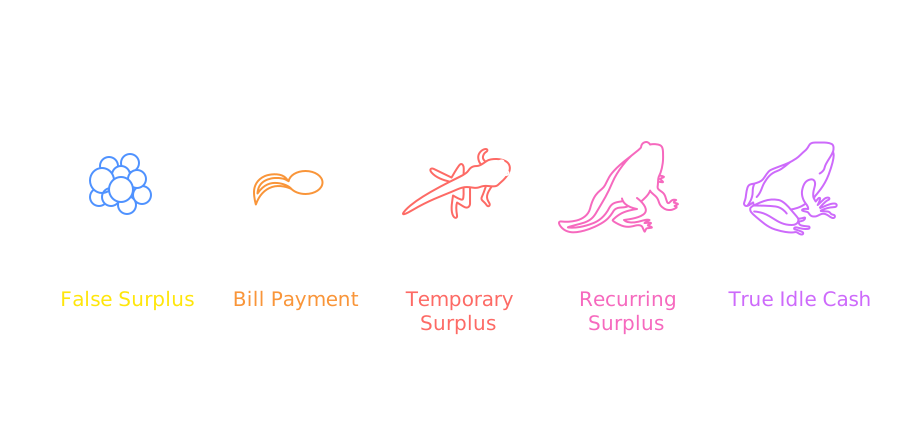
It differs from true idle cash.
False surplus has a nameable owner
You can usually finish the sentence:
> This money is for ________ and will probably be paid around ________.
If the answer is property tax in autumn, insurance at renewal, tuition before a semester, or estimated tax on a scheduled payment date, the money has a job.
True surplus survives the full map
True surplus is not whatever remains after this month's bills. It is the amount that remains after:
- the current pay-and-bill cycle
- known annual and quarterly obligations
- near-term planned purchases
- the checking cushion
- any emergency cash intentionally kept in checking
For a broader definition, read What Is Idle Cash?.
Why a Monthly Budget Can Hide an Annual-Bill Problem
A monthly budget converts income and expenses into a comparable period. That is useful for deciding whether the household can afford its spending over time.
The FDIC Money Smart spending plan explicitly includes conversions for income or expenses that do not occur monthly. An annual expense can be divided across the year to find a monthly planning amount.
But that monthly number is not the amount that leaves checking on the payment date.
Budget math smooths the cost
Suppose a household has an illustrative annual insurance premium of $4,800.
The budget can show:
$4,800 annual premium / 12 months = $400 monthly contribution
That tells the household how quickly to fund the obligation.
Cash-flow math preserves the debit
The checking forecast must still show:
Payment week: -$4,800
If the reserve is mixed into checking, the balance may look $4,800 higher than the household can safely spend immediately before payment.
If the reserve is held elsewhere, the forecast must show the transfer back to checking before the payment clears.
Both views are necessary
The CFPB bill calendar recommends tracking what each bill is for, the amount owed, and the due date. Its cash-flow budget adds the timing of income and expenses by week.
For annual obligations, extend that logic across the full year.
Expenses That Commonly Create False Surplus
The category is broader than "annual bills." Any known obligation with a long accumulation period and a concentrated payment can create the same illusion.
Predictable does not mean monthly
An expense can be fully predictable and still be irregular in the checking ledger.
That distinction matters because many households review only recent transactions. A lookback covering a quiet period will understate the amount assigned to future obligations.
Irregular does not mean unexpected
An unexpected emergency and an irregular bill are different.
Calling all irregular costs "emergencies" makes the checking floor hard to interpret. Known costs should be funded deliberately. Emergencies require a separate resilience decision.
The Three Clocks Behind Every Annual Bill
Annual-bill planning becomes clearer when each obligation is tracked on three clocks.
The accumulation clock starts before the invoice
Waiting for the bill to arrive can force the entire cost into one or two pay cycles. Start with the best supported estimate available, then update it when the final amount arrives.
The notice clock changes confidence
A projected insurance renewal is an estimate. The issued renewal notice is stronger evidence. A planned tuition amount may change after aid or enrollment adjustments. A tax reserve should be updated from current records or professional guidance.
Classify each amount:
- Estimated
- Confirmed
- Scheduled
- Paid
The settlement clock controls checking
The due date and the bank-debit date can differ. A payment initiated by ACH, card, check, wire, or bank bill pay can follow different processing timelines.
The safe rule is to have funds available before initiating the payment, then keep them protected until the debit has posted and the obligation is confirmed complete.
Build a Full-Year Obligation Map
A full-year map prevents a quiet month from becoming the baseline for the entire checking decision.
Use statements, tax records, renewal notices, school calendars, contracts, subscriptions, and household plans.
Start with the prior full year
Review a complete prior-year transaction history so seasonal and annual items appear. Then adjust for:
- price or coverage changes
- changed housing or vehicle arrangements
- new school, care, or medical commitments
- new professional requirements
- expected tax changes
- canceled or added subscriptions
- planned projects and travel
Historical cash flow is evidence, not a guarantee.
Add obligations that never touched checking
Some costs were paid by credit card and reached checking later through card autopay. Others may have been paid from another account.
The obligation map should follow the household expense, not only the merchant name in checking.
Do not double count escrowed costs
If property taxes or insurance are already funded through a mortgage escrow payment, do not also create a separate full reserve unless a known shortage, change, or direct-payment responsibility requires it.
Verify the actual payment responsibility from current loan and insurance records.
Calculate the Funding Rate Without Losing the Payment Date
The contribution schedule should reflect the amount still needed and the time remaining.
Use:
Contribution per funding period = (target amount - amount already funded) / remaining funding periods
All examples below are illustrative, not recommendations or predictions.
Use actual pay frequency when helpful
A household paid every two weeks may fund each obligation after every paycheck instead of once a month. A commission earner may use a base contribution plus an allocation from variable pay.
The formula changes frequency, not the target.
Separate funding progress from spendable cash
If an illustrative $6,000 property-tax reserve has reached $4,500, the $4,500 is not available merely because the payment is months away.
Show it as:
The $10,500 is still provisional. Emergency cash and other goals must also be classified before it becomes a recurring surplus.
Stress-Test the Payment Week
Accumulating the reserve is only half the job. The payment must clear without pushing checking below its protected floor.
Build a chronological payment-week forecast.
These figures are illustrative.
If the household's protected checking floor is an illustrative $7,500, the sequence falls below it before payroll. The annual reserve may be fully funded, but the payment timing still fails the comfort rule.
Possible responses include:
- transfer the assigned reserve into checking earlier
- increase the checking floor for the payment window
- reschedule an eligible payment after payroll
- preserve a larger timing cushion
- use a different funding account if the biller supports it
Test the earliest plausible debit
Do not assume every payment clears on the most convenient day. Use the earliest plausible debit date within the known window.
Test a higher confirmed amount
If the amount is still estimated, run a higher scenario. The goal is not to predict every surprise. It is to avoid building the plan on the lowest plausible bill.
Test a delayed deposit
Move an expected paycheck, reimbursement, or transfer later in the forecast. If one normal delay breaks the plan, the safe balance or payment timing is too aggressive.
For broader low-point analysis, read Why Does My Checking Account Balance Fluctuate So Much?.
Where Annual-Bill Cash Should Be Held
There is no universal account for every annual obligation. The decision depends on timing, certainty, access, protection, fees, taxes, and operational effort.
Checking is appropriate near the payment
Money due soon should be easy to use. A higher return is not useful if a transfer, sale, settlement, hold, or withdrawal rule interferes with the payment.
Separation can improve classification
A separate labeled bucket can stop property-tax or tuition money from being mistaken for spending cash. The benefit is operational clarity, not only rate.
Every transfer adds a dependency
If the reserve sits outside checking, the plan needs:
- a transfer date
- a responsible owner
- a buffer before the bill
- confirmation that the transfer completed
- confirmation that the bill posted
If that workflow is repeatedly missed, the apparent yield improvement may not justify the execution risk.
How Annual Bills Change the Safe Balance
A safe balance is the protected checking floor used for bills, autopay, routine spending, and timing variation.
Annual-bill cash can affect it in two ways.
Permanent-floor method
The household keeps a larger floor throughout the year.
Scheduled-floor method
The household keeps a normal floor, accumulates the annual reserve in a labeled location, and raises checking before the payment window.
Neither method is automatically better. The correct choice is the one the household can execute reliably.
To size the floor itself, read What Is a Safe Balance?.
A Practical Annual-Bill Classification Rule
Classify each dollar by purpose, date, and access need.
Assigned cash is not idle because it sits still
Movement does not determine purpose. Property-tax cash can remain untouched for months and still be fully assigned.
A due date is not enough
The amount, funding location, transfer path, and earliest plausible debit date matter too.
Recurrence is the final test
One strong month does not establish a recurring surplus. Observe representative cycles and known seasonal obligations.
How Rivo Fits After Annual-Bill Cash Is Protected
Rivo is an automated cash-management product for eligible idle cash in an existing checking workflow. It is not a replacement for annual-bill planning.
The order should be:
- Map recurring bills and spending.
- Add annual, quarterly, and other dated obligations.
- Protect the normal checking floor and timing cushion.
- Keep emergency and goal cash clearly assigned.
- Identify the amount that remains through representative cycles.
- Decide whether that recurring remainder should stay in checking, move manually, or use automation.
Rivo uses a user-set checking threshold
The minimum threshold is the amount the user does not want automated. Current account controls and product details explain how the threshold, movement notifications, withdrawals, and one-primary-checking-account workflow operate.
Annual-bill planning should inform that threshold. If a large obligation will be paid from checking soon, the protected amount may need to change before the payment window.
Rivo is designed around detected bills
Rivo analyzes linked checking activity and is designed to plan refills before detected bills. A system can only act on the information and patterns available to it.
An unusual tuition invoice, first-time tax payment, paper check, contractor payment, or changed renewal amount may need explicit user attention. Treat unusual dated payments as exceptions, not as ordinary pattern data.
Eligible idle cash uses short-duration Treasury bills
Eligible idle cash is invested through Jiko Securities in short-duration U.S. Treasury bills. Treasury bills are securities, not bank deposits. TreasuryDirect explains Treasury-bill maturities and the ability to hold a bill to maturity or sell before maturity.
If a payment has a hard near-term deadline, prioritize availability over potential return.
Fees and access limits belong in the decision
Rivo charges a 0.05% monthly management fee based on average daily balance. Available funds can be withdrawn through the app up to a $15,000 daily limit.
A planned payment larger than the current app limit, a same-day cash need, or an uncertain debit date deserves a separate plan. Do not assume every assigned dollar should pass through an optimization layer.
When Rivo Is and Is Not a Fit for This Problem
The false-surplus problem has two parts: classifying annual-bill cash and managing the true remainder. Rivo addresses the second part.
Rivo should not be used to make an unfunded annual bill look affordable. It should not convert assigned tax, tuition, property, insurance, emergency, or project money into "idle cash" by relabeling it.
Common Annual-Bill Mistakes
Most failures are classification or timing errors, not calculation errors.
Mistake 1: Calling the bill unexpected
If an expense occurs every year but is omitted from the plan, the surprise is operational, not necessarily financial.
Mistake 2: Using the average checking balance
An average blends months when the reserve is building with the payment month when the balance falls. It does not identify the minimum required balance during the payment sequence.
Mistake 3: Keeping the full reserve unlabeled
The money may be safe, but the account is hard to read. A purpose ledger, bank bucket, or separate account can make the same cash less likely to be spent twice.
Mistake 4: Treating all assigned cash the same
A tax payment due soon, an annual premium due later, and a planned project with flexible timing have different access needs.
Scenario 1: Property Tax in Main Checking
All figures in this scenario are illustrative.
A homeowner keeps an annual property-tax reserve in the main checking account.
The account appears to hold $38,000, but $29,000 is assigned.
The $9,000 remainder is not automatically recurring. The homeowner should compare it with prior low points, upcoming insurance, card autopay, and any other commitments.
Decision
Keep the property-tax reserve labeled and readily available before the payment window. Evaluate only the recurring amount that remains after the full map.
Scenario 2: Tuition Reserve Outside Checking
All figures in this scenario are illustrative.
A household accumulates $12,000 for tuition in a separate bank savings bucket. The tuition payment will be made from checking.
Decision
The reserve is easier to distinguish from ordinary spending, but the transfer is now a dependency. The household should not classify the separate reserve or its incoming transfer as surplus.
Scenario 3: Estimated Taxes and Irregular Income
All figures in this scenario are illustrative.
A consultant receives uneven client payments and keeps estimated-tax cash in personal checking.
The IRS divides the year into four estimated-tax payment periods with specific due dates. Those dates are not evenly spaced, so a generic monthly or quarterly assumption can distort cash timing.
Decision
Do not optimize the gross client deposit. Separate business obligations and tax cash first. For a deeper irregular-income model, read How Much Should You Keep in Checking With Irregular Income?.
Scenario 4: Annual Insurance Paid by Credit Card
All figures in this scenario are illustrative.
An annual insurance premium is charged to a credit card. Checking does not fall on the merchant-charge date. It falls when the card statement is paid.
Decision
Reserve the premium before renewal, then keep it assigned through the checking debit. Do not count the same amount twice if the issued card statement is already included in the bill-ready balance.
A Repeatable Annual-Bill Workflow
Use one process for every known irregular obligation.
Phase 1: Inventory
- Review a complete prior year of transactions.
- Add current obligations that did not exist last year.
- Include card-paid, escrowed, and externally paid items.
- Record amount, confidence, due window, payment method, and funding location.
Phase 2: Fund
- Calculate the remaining gap.
- Choose a contribution cadence.
- Assign contributions immediately after reliable income.
- Update estimates when new evidence arrives.
Phase 3: Prepare
- Confirm the final amount.
- Test the earliest plausible debit.
- Test the payment week against the checking floor.
- Move assigned cash into the payment account early enough.
Phase 4: Reconcile
- Confirm the payment posted.
- Compare actual and planned amounts.
- Release only genuine excess.
- Reset the next funding target.
Phase 5: Optimize the remainder
- Remove all other assigned cash.
- Compare the recurring low point with the protected floor.
- Decide whether simplicity, a manual transfer, or automation fits.
- Review fees, access, taxes, and protection before choosing a product.
How Often to Review the Annual-Bill Map
Use both a schedule and event triggers.
A full-year scan catches seasonality. A short cash-flow forecast protects the next payment sequence. Both are required.
Final Recommendation
When checking looks full until an annual bill arrives, do not judge the account from the displayed balance or a monthly average.
Build a full-year obligation map. Give every property-tax payment, insurance renewal, tuition bill, estimated-tax payment, professional renewal, planned project, and other known irregular expense an amount, confidence level, due window, funding location, and payment path.
Then preserve two views at once:
- the monthly contribution needed to fund the obligation
- the full debit that checking must absorb on the payment date
Protect the annual-bill reserve, the normal checking floor, and a timing cushion. Stress-test the payment week using a higher bill, an earlier debit, or a later deposit. Only the recurring remainder after every assigned layer is protected should be called potential idle cash.
Rivo can be relevant for that recurring remainder when the household wants to keep its existing bank and automate eligible idle cash around a conservative checking threshold. It is not a substitute for labeling annual-bill cash or preparing for a hard payment date.
The objective is not to keep checking as low as possible. It is to make the balance honest.
FAQ
Should annual bills stay in checking all year?
Not necessarily. They can remain in checking, a labeled bank savings bucket, a dedicated account, or another suitable cash location. The choice should reflect the payment date, transfer timing, protection, fees, risk, and household execution. Keep near-term payment cash simple and readily available.
Is money for property tax or tuition idle cash?
No, not when it is assigned to a known payment. It may sit untouched for months, but inactivity does not remove its purpose. Only the amount remaining after property tax, tuition, normal bills, the checking floor, and other assigned cash is protected can be tested as potential idle cash.
How do I budget for an annual expense?
Estimate the total amount, subtract what is already funded, divide the remaining gap across the funding periods left, and update the estimate when a final notice arrives. Keep the monthly contribution and the full payment date in separate views.
Why did an annual bill cause an overdraft if I budgeted for it?
The monthly budget may have included the cost without ensuring the full reserve was available in checking when the debit settled. Rebuild the payment week in chronological order, include the normal checking floor, and test earlier-debit and later-deposit cases. The CFPB explains the basic overdraft mechanism.
Can I invest money reserved for an annual bill?
That depends on the deadline, access needs, product rules, fees, taxes, and risk. Money needed on a hard near-term date should generally prioritize availability and principal clarity. Treasury bills are securities, not FDIC-insured deposits, and selling before maturity can involve market-value risk.
Can Rivo manage checking cash when annual bills change?
Rivo can use a user-set checking threshold and is designed to plan around detected bills. The user still needs to review the threshold and unusual obligations when a tax, tuition, insurance, property, or project payment changes. A first-time or unusually large payment should be treated as an explicit exception.
Related Rivo Reading
- To reconcile a positive monthly plan with irregular checking withdrawals, read Why Does My Budget Say I Have Money but My Checking Account Is Low?
- To identify another assigned-cash layer that can create false surplus, read Why Does Your Checking Account Look High Before Taxes Are Due?.
- What Is a Safe Balance?
- Sinking Fund vs Emergency Fund vs Safe Balance
- Why Is Family Cash Flow So Hard to Predict?

This article is educational and is not financial, investment, tax, accounting, or legal advice.
Yield rate reflects the 4-week T-bill rate when held to maturity. Rate does not include fees. Rates are subject to change. Minimum balance of $100 is required to earn the stated rate.
Rivo is a fintech company, not a bank. Banking services provided by Jiko Bank, a division of Mid-Central National Bank. Jiko Group, Inc. and its affiliates do not provide legal, tax, or accounting advice. You should consult your legal and/or tax advisors before making any financial decisions. This material is not intended as a recommendation, offer or solicitation for the purchase or sale of any security or investment strategy. See FINRA BrokerCheck, Jiko U.S. Treasuries Risk Disclosures and Jiko Securities Inc. Form CRS.
Investments in T-bills: Not FDIC Insured - No Bank Guarantee - May Lose Value. All U.S. treasury investments and investment advisory services provided by Jiko Securities, Inc., a registered broker-dealer, member FINRA and SIPC. Securities in your account are protected up to $500,000. For details, please see www.sipc.org.
Source references
- Consumer Financial Protection Bureau Bill Calendar
- Consumer Financial Protection Bureau Cash Flow Budget
- Consumer Financial Protection Bureau Overdraft Guide
- FDIC Money Smart Spending and Saving Plan
- Internal Revenue Service Estimated-Tax Payment Periods
- TreasuryDirect Treasury Bills
- Rivo Homepage
- Rivo Help Center.

Shalu Yadav is Rivo's SEO/GEO Expert, bringing over 10 years of experience in making financial content discoverable across both classic search and generative AI platforms.
Follow on LinkedInGet Rivo Updates
Product news, money insights, and company updates.