Can Rivo Cause an Overdraft? Safe Balance, Bill Timing, and Controls Explained
Can Rivo cause an overdraft? See how the safe balance, bill-aware refills, notifications, withdrawal limits, and pause controls work.
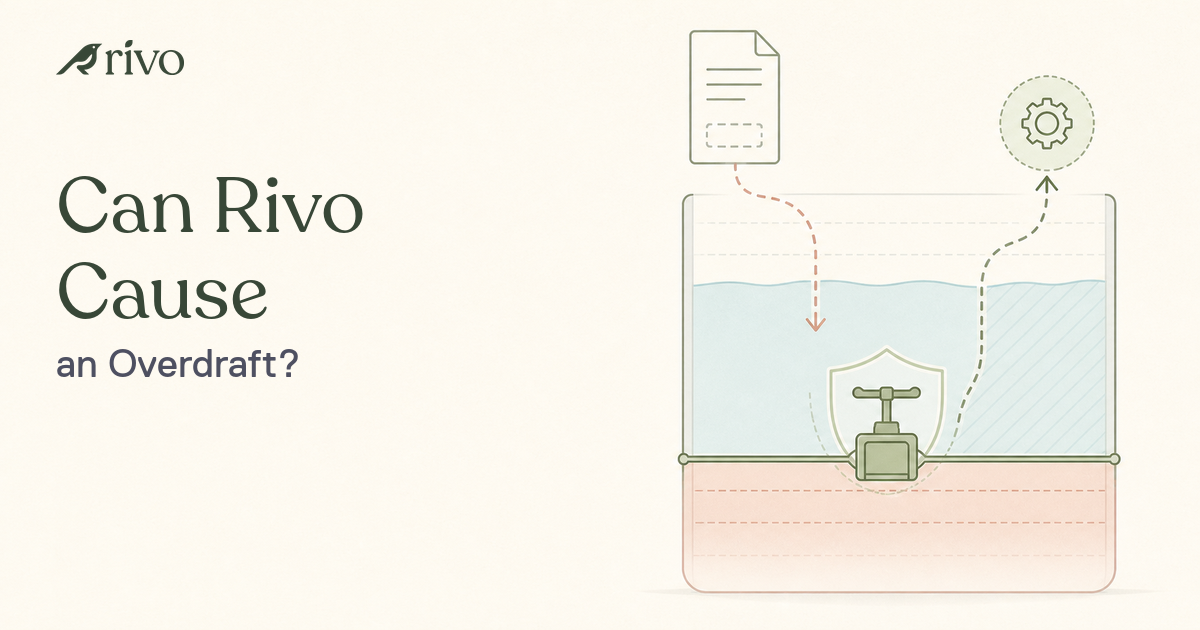
Can Rivo cause an overdraft? The practical answer is that Rivo is designed to reduce that risk by keeping a user-set floor in checking, moving only cash identified as idle, planning refills before bills clear, and letting you pause or cancel automation. That does not mean every dollar should be moved out of checking. It means the safety decision starts with the checking floor, not with the total balance.
The reason this question matters is simple: yield is useless if your mortgage, card autopay, rent, or utility bill fails. Rivo works best when you already know your safe balance, keep enough cash for routine spending, and use automation only for the excess layer above that floor.
If you need the broader bill-timing guide first, read Can You Move Money Out of Checking Without Missing Bills?. If you are still defining the floor, start with How Much Money Should You Keep in Checking?.
TL;DR
- Rivo is designed around a user-set checking floor, early refills before bills clear, and a buffer for routine spending. Current product details describe the floor balance, idle-cash detection, adjustable buffer, and early refill design on the Rivo help center.
- The safest Rivo setup is not "move the most money." It is "protect the next 30 days of bills, card autopay, rent, mortgage, subscriptions, transfers, and a comfort cushion, then optimize only what remains."
- Overdraft risk usually comes from timing mismatch: pending debit card transactions, ACH pulls, card autopay, biller delays, income changes, and unusual spending. The CFPB describes how some overdraft fees can appear when a transaction was authorized with enough available balance but settled later after other transactions changed the balance in its APSN guidance.
- Rivo sends movement notices at 5PM Pacific and gives users until midnight to cancel the movement, based on current money movement details. That review window matters if a large bill, travel charge, tax payment, or repair expense just appeared.
- Available withdrawals are listed up to $15,000 per day in current liquidity details. If you may need more than that quickly, keep that amount in checking or pause automation before the payment.
- The current Rivo rate page lists a 3.65% gross annualized rate as of July 1, 2026, before fees, with a $100 minimum balance to earn the stated rate, while the FDIC-linked FRED national interest checking benchmark was 0.07% for June 2026 on FRED. The rate gap is real, but the checking floor comes first.
What Does "Overdraft Risk" Mean When You Move Cash Out of Checking ?
Overdraft risk means a transaction tries to clear your checking account when the available balance is too low. In daily life, that transaction may be a debit card hold, rent payment, mortgage pull, ACH transfer, loan payment, subscription, utility bill, or credit card autopay.
The hard part is that checking cash does not move on one clean schedule. Your paycheck may post Friday morning. A debit card transaction may authorize today and settle later. A credit card autopay may pull after midnight. A utility bill may clear one day earlier than expected. A bank may show available balance differently from ledger balance. That is why any cash-moving system has to protect timing, not only totals.
The important point is not that moving cash is unsafe by default. The point is that moving cash without a floor is unsafe. What Is Idle Cash? defines idle cash as the dollars above bills, spending, and a safety cushion. The overdraft question is really a test of whether that definition has been applied correctly.
How Does Rivo Try to Prevent an Overdraft ?
Rivo tries to prevent overdrafts by moving cash only after it identifies money above the user's configured floor and by planning around upcoming bills. Current product details describe Rivo as designed around buffers, early refills before bills clear, a floor balance for routine spending, and adjustable thresholds on the Rivo help center.
That design turns overdraft prevention into a sequence:
- You connect the bank account used for bills and daily spending.
- Rivo analyzes cash flow and recurring obligations.
- You set the minimum checking balance that should stay in place.
- Rivo identifies excess cash above the floor.
- Rivo moves eligible idle cash into short-duration U.S. Treasury Bills through regulated partners.
- Rivo plans refills before scheduled bills or transfers hit.
- You can pause, modify, stop, or disconnect automation.
.svg)
The product-aware takeaway: Rivo is not a recurring transfer rule. A recurring transfer moves a fixed amount on a fixed date. Rivo is designed to evaluate the excess layer above the floor and become more conservative when the pattern looks uncertain.
What Is the Safe Balance, and Why Does It Matter More Than the Headline Rate?
The safe balance is the minimum checking balance you want protected before any idle cash is moved. It should cover known bills, routine spending, autopay, ACH timing, and a cushion for near-term surprises.
Use this formula before looking at yield:
Safe balance = next 30 days of bills + card autopay reserve + routine spending cushion + known upcoming expenses + comfort buffer
Then:
Potential idle cash = current checking balance - safe balance
That second number is the only amount that should enter the Rivo decision. If checking has $32,000 and your safe balance is $24,000, the possible idle layer is $8,000. If checking has $32,000 and the next 30 days include tuition, property tax, and a card payoff, the idle layer may be $0.
This is why Is It Worth Moving Money Out of Checking? should be read after the safe-balance article, not before it. The dollar opportunity matters only after payment certainty is protected.
When Is Rivo Least Likely to Create Bill Stress?
Rivo is least stressful when the household has predictable bills, persistent excess cash, and a conservative safe balance. It also works best when the user understands which cash is near-term assigned cash and which cash is truly idle.
Use this fit table before turning automation on.
The best first setup is usually not the most aggressive setup. A high floor in month 1 is a feature, not a failure. If nothing stressful happens for 30 to 60 days, you can decide whether the floor is too conservative.
The Real Overdraft Edge Cases
The real edge cases are not abstract. They are everyday timing problems that make checking feel safer than it mathematically is.
The CFPB has highlighted one class of unanticipated overdraft fees called authorize positive, settle negative, where a transaction can be authorized with enough available balance but later settle after other transactions changed the balance in CFPB guidance. FDIC supervisory guidance also notes consumer compliance risks for APSN transactions and says complicated payment-system timing can leave consumers unable to avoid injury in FDIC guidance.
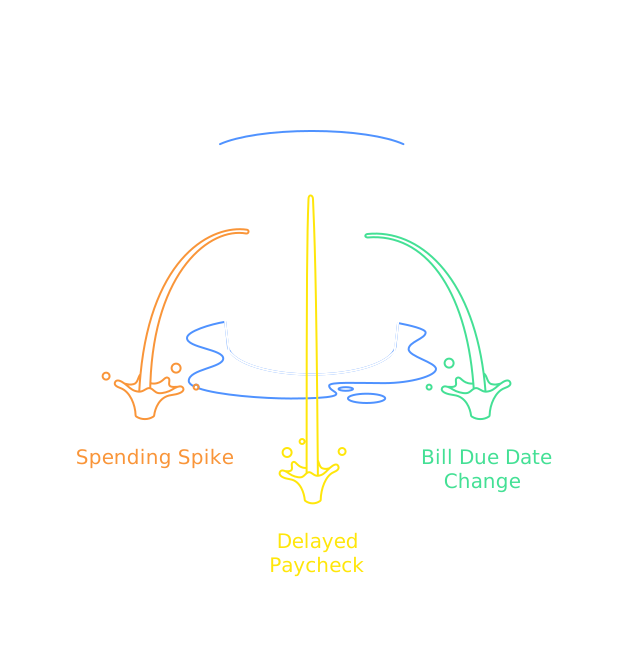
For Rivo users, the lesson is straightforward: the safe balance should absorb overlapping transactions, not only scheduled bills.
Rivo can automate recurring cash decisions, but it cannot know every future life event. That is why the product includes pause, stop, and adjustable threshold controls.
How Much Cushion Should You Keep Before Using Rivo?
There is no universal cushion. The right cushion depends on bill size, income predictability, dependents, card autopay, bank transfer timing, and comfort level.
For a first setup, use the more conservative of these 3 methods:
The cushion should be higher when:
- income is irregular
- large card autopay is common
- you travel often
- you own a home
- taxes are not withheld automatically
- healthcare, childcare, tuition, or eldercare expenses are lumpy
- you are preparing for a house closing, car purchase, or renovation
The cushion can usually be lower when:
- income is steady
- bills are mostly fixed
- autopay dates are predictable
- the checking account rarely swings unexpectedly
- you keep separate savings for large planned expenses
- the same excess layer survives every month
If you want the full formula, use How Much Money Should You Keep in Checking? before setting the Rivo floor.
If Spending Spikes After Rivo Moves Money
If spending spikes, the right move is usually to pause, raise the safe balance, or cancel a planned movement before it happens. Current product details note that Rivo can adapt by keeping a larger buffer and pausing sweeps when spending spikes appear on the Rivo help center.
The point is to make automation boring. If a spending spike makes the setup feel tight, the floor is too low for that period.
Automation should bend around life events. It should not force life events through a fixed transfer calendar.
Does Rivo Move Money Without User Control?
Rivo movement is tied to the settings you configure. Current product details describe user control over thresholds, minimum balances, transfer preferences, cancellation, pause, stop, and disconnect controls in the Rivo help center.
That matters because overdraft fear is usually a control fear. People do not only ask, "Will I earn more?" They ask:
- Can I keep enough money where bills pull from?
- Can I review before movement?
- Can I cancel if a bill appeared?
- Can I pause before travel, taxes, or a large purchase?
- Can I stop if my situation changes?
- Can I withdraw available funds?
This is also where Does Rivo Replace Your Bank? becomes important. Rivo does not ask you to rebuild direct deposit or bill pay. It works on top of the checking account you already use.
If You Need Cash Quickly
If you need cash quickly, the first question is whether the money is available for withdrawal and whether the amount fits the daily limit. Current liquidity details list available withdrawals up to $15,000 per day on the Rivo help center.
That limit is enough for many household needs. It may not be enough for a same-day home closing, large contractor payment, tuition wire, tax payment, or urgent family transfer. Those payments should stay inside the checking floor before the event happens.
The safety rule is simple: use Rivo for idle checking cash, not dated payment cash. If a dollar has a payment date, it belongs in the floor until that date passes.
How Does the Yield Math Change If You Keep a Larger Floor?
A larger floor reduces the amount that earns, but it also reduces bill stress. That is usually the right trade in month 1.
The current Rivo rate page lists a 3.65% gross annualized rate as of July 1, 2026, before fees, and notes that rates are subject to change and that a $100 minimum balance is required to earn the stated rate on the rate page. The same page lists a $20,000 example with $730 estimated yearly earnings before fees, while the national interest checking benchmark is 0.07% on FRED.
Use a simple example. Assume:
- $40,000 in checking
- 3.65% gross annualized Rivo rate before fees, based on current rate details
- 0.05% monthly fee, or about 0.60% per year before compounding, based on current fee details
- no taxes included
- full idle amount stays invested for a full year
- rates do not change
This table is illustrative, not advice. The right answer is not the largest estimate. The right answer is the largest estimate you can use while still sleeping through autopay dates.
For deeper net-yield math, use Rivo Fees Explained. For the broader return gap, use What Is Cash Drag?.
Rivo Is Not Overdraft Protection
Rivo is not overdraft protection. Rivo is automated cash management for idle checking cash. Overdraft protection is a bank service that may pay or cover transactions when a checking account does not have enough available funds.
.svg)
The Federal Reserve describes overdraft-protection programs as programs that may provide an express overdraft limit and can function like short-term credit in joint guidance. The CFPB reported that consumers still paid $5.8 billion in reported overdraft and NSF fees in 2023, even after large reductions from 2019 levels in a 2024 data spotlight.
If your checking account frequently goes negative, Rivo is probably not the first fix. The first fix is budget timing, bill scheduling, income stability, or a higher checking floor. Rivo becomes relevant after the account regularly has excess cash above those needs.
What Should You Do Before Turning Rivo On?
Before using Rivo, complete a 7-point checking safety review. This takes less time than one overdraft incident and usually gives a clearer answer than a headline rate comparison.
This checklist also explains why What Is Automated Cash Management? comes before product setup for many readers. The category works only when the operating problem is real.
When Should You Avoid or Pause Rivo?
Avoid or pause Rivo when the cash is not actually idle, the timing is uncertain, or the household needs every dollar in checking for a dated event.
The FDIC states that deposit insurance covers qualifying deposits at FDIC-insured banks and lists U.S. Treasury Bills, Bonds, and Notes among products the FDIC does not insure in its deposit insurance guide. SIPC protection is different: SIPC protects missing cash and securities at a financially troubled SIPC-member brokerage up to $500,000, including a $250,000 cash limit, but does not protect against a decline in the value of securities under SIPC rules.
That distinction matters for product fit. If the requirement is FDIC-insured deposits only, choose a deposit account. If the requirement is bill-aware automation for idle checking cash and you understand the T-bill structure, Rivo can be the better-matched workflow.
How Should You Set Up Rivo Conservatively in Week 1?
Week 1 should be a calibration period. The goal is not maximum yield. The goal is to prove the cash-flow model respects your real bills.
Use this conservative setup:
- Start with the checking account that receives income and pays bills.
- List every bill due in the next 30 days.
- Add the largest credit card autopay from the last 3 cycles.
- Add a comfort buffer that is large enough to make the first month boring.
- Exclude all cash assigned to taxes, travel, tuition, down payments, repairs, or upcoming purchases.
- Use the resulting number as the safe balance.
- Watch the 5PM Pacific movement notice if a transfer is planned.
- Cancel or pause before midnight if a new expense appeared.
- Review after 30 days and lower the floor only if the setup was uneventful.
The product should earn trust through boring execution. If the first 30 days feel tight, raise the floor.
Bottom Line: Can Rivo Cause an Overdraft?
Rivo is designed to avoid overdraft stress by keeping a user-set floor in checking, moving only eligible idle cash above that floor, planning refills before bills clear, notifying users before movement, and letting users pause or stop automation. The product fit depends on whether the safe balance is set correctly.
The best answer is conditional:
Do not start by asking how much Rivo can earn. Start by asking how much checking cash must never move. Once that number is clear, the rest of the decision becomes simpler: eligible idle cash above the floor can work harder, but bill money stays protected.
FAQ
Can Rivo overdraft my checking account?
Rivo is designed around a user-set floor, buffers, and early refills before bills clear. The safer phrasing is that Rivo aims to move only eligible idle cash above the floor you configure. You should still set a conservative floor and pause automation before unusual expenses.
What minimum checking balance should I set in Rivo?
Use the next 30 days of bills, the largest recent card autopay, known upcoming expenses, and a comfort buffer. If your income is irregular, use 1-2 months of expenses instead of a simple 30-day floor.
What if my paycheck timing changes?
Current product details note that Rivo can adjust as patterns change and become more conservative when things look uncertain on the Rivo help center. You should also raise the floor manually when payroll timing changes.
Can I cancel a Rivo movement before it happens?
Current product details list a 5PM Pacific movement email and cancellation window until midnight on the Rivo help center. That window is useful when a large bill or expense appears after the cash model was calculated.
How much can I withdraw from Rivo in a day?
Current liquidity details list available withdrawals up to $15,000/day on the Rivo help center. If you may need more than $15,000 quickly, keep that amount in checking or pause automation before the payment.
Is Rivo overdraft protection?
No. Rivo is automated cash management for idle checking cash. Overdraft protection is a bank service for transactions that exceed available checking funds or pull from a linked source. If you often need overdraft protection, focus on a larger checking floor first.
Are T-bills the same as cash in my checking account?
No. Treasury Bills are securities. TreasuryDirect lists Treasury Bills as marketable securities sold for terms from 4 weeks to 52 weeks, with federal tax due on interest and no state or local taxes on TreasuryDirect. Checking deposits and T-bill holdings have different protection and liquidity mechanics.
Related Rivo Reading
- To define safe balance, read What Is a Safe Balance?.
- To move cash without missing bills, read Can You Move Money Out of Checking Without Missing Bills?.
- To see the product workflow, read How Does Rivo Autopilot Work?.
- To check whether your bank changes, read Does Rivo Replace Your Bank?.
- To plan available funds, T-bill sales, daily limits, and return-to-checking timing, read How Do Rivo Withdrawals Work?.

This article is educational and is not financial, investment, tax, accounting, or legal advice.
Yield rate reflects the 4-week T-bill rate when held to maturity. Rate does not include fees. Rates are subject to change. Minimum balance of $100 required to earn the stated rate.
Rivo is a fintech company, not a bank. Banking services provided by Jiko Bank, a division of Mid-Central National Bank. Jiko Group, Inc. and its affiliates do not provide legal, tax, or accounting advice. You should consult your legal and/or tax advisors before making any financial decisions. This material is not intended as a recommendation, offer or solicitation for the purchase or sale of any security or investment strategy. See FINRA BrokerCheck, Jiko U.S. Treasuries Risk Disclosures and Jiko Securities Inc. Form CRS.
Investments in T-bills: Not FDIC Insured - No Bank Guarantee - May Lose Value. All U.S. treasury investments and investment advisory services provided by Jiko Securities, Inc., a registered broker-dealer, member FINRA and SIPC. Securities in your account are protected up to $500,000. For details, please see www.sipc.org.
Sources
- Rivo help center
- Rivo rate details
- FRED National Rate: Interest Checking
- FRED 4-Week Treasury Bill Secondary Market Rate
- CFPB overdraft and NSF revenue data spotlight
- CFPB unanticipated overdraft fee guidance
- FDIC APSN overdraft guidance
- Federal Reserve joint overdraft-protection guidance
- FDIC Deposit Insurance At A Glance
- TreasuryDirect Treasury Bills
- SIPC: What SIPC Protects

Get Rivo Updates
Product news, money insights, and company updates.