Should You Keep Your Emergency Fund in Checking? Safe Balance, Idle Cash, and Rivo Explained
Learn how much emergency cash belongs in checking, when excess becomes idle cash, and how to protect bill money while earning more on surplus funds.
You should keep enough emergency money in checking to handle same-day bills, urgent transfers, and payment timing surprises. You do not need to keep every emergency dollar in checking forever if part of the balance is not needed for bills, near-term spending, or first-day access.
The practical question is not "checking or not checking?" The practical question is how much cash must stay instantly available, how much belongs in an emergency reserve, and how much has quietly become idle cash. Rivo is built for that last layer: the cash above your safe balance that can work harder while your existing checking account still covers bills.
TL;DR
- An emergency fund is cash reserved for unplanned expenses or income disruption; the CFPB describes it as money set aside for unexpected expenses, while FINRA suggests 3-6 months of living expenses as a common target.
- Checking should hold first-day emergency cash, the next 30 days of bills, autopay timing, and your user-defined safe balance.
- The full emergency fund does not always need to sit in checking, especially if the balance stays above the same floor for 60-90 days.
- As of June 15, 2026, the FDIC national interest checking rate was 0.07%, while the 4-week Treasury bill rate was 3.67% on July 16, 2026. That gap can matter when emergency cash becomes large and persistent.
- Rivo works on top of your existing bank, preserves a safe balance you set, and moves eligible idle cash into short-duration U.S. Treasury Bills through Jiko Securities.
- This is not financial, tax, or investment advice. Emergency cash decisions should account for your job stability, dependents, bill timing, health needs, tax situation, and risk tolerance.
Emergency Fund in Checking: Quick Decision Table
Use this table before comparing rates. The first job is cash availability. Yield only matters after the emergency layer is defined.
The takeaway is simple: emergency cash is not one bucket. It is a stack. Checking is strongest for the first layer. Rivo becomes relevant only after the bill layer and first-day emergency layer are protected.
The Emergency Fund
An emergency fund is cash set aside for expenses you did not plan for, such as a job loss, medical bill, car repair, home repair, travel emergency, or temporary income disruption.
The emergency fund has a specific job
The job is not to maximize yield. The job is to prevent forced debt, missed bills, or panic selling. That is why emergency cash should be safer, more liquid, and less volatile than long-term investment money.
The CFPB frames an emergency fund as savings for unexpected expenses. FINRA describes 3-6 months of living expenses as a common reserve target. Those are useful anchors, but they still need to be translated into your household cash flow.
The mistake is treating the entire emergency fund like same-day checking money. A $30,000 reserve does not usually need the same liquidity profile for all $30,000.
Emergency fund is different from idle cash
Emergency cash has a known purpose even if the timing is unknown. Idle cash is money above your bills, near-term obligations, safe balance, and emergency reserve.
That distinction matters because idle cash can look like emergency cash when it is parked in checking. The balance feels safe, but part of it may no longer be doing a safety job.
If you need the definition first, read What Is Idle Cash?. If you need the checking floor first, read How Much Money Should You Keep in Checking?.
Keeping Your Emergency Fund in a Checking Account
You can keep the entire emergency fund in checking, but it is often inefficient once the balance becomes large, stable, and rarely used.
Checking is the operating account
Checking is designed for payments. It handles debit transactions, bill pay, ACH pulls, card autopay, transfers, rent, mortgage, and cash withdrawals. That makes checking valuable for the part of your emergency fund that may be needed immediately.
Checking is weaker as a long-term parking place. The FDIC national rate for interest checking was 0.07% as of June 15, 2026. If your emergency fund is $5,000, that may not matter much. If it is $50,000 and stays there for years, the rate gap becomes real money.
This is not an argument for moving emergency money into stocks or long-duration investments. It is an argument for matching each cash layer to the correct job.
A full checking emergency fund can hide idle cash
Suppose your household spends $8,000 per month and wants a 6-month reserve. That is a $48,000 target. Keeping all $48,000 in checking may feel clean, but it also means the last $20,000 or $30,000 may sit in a low-rate payment account even if it has not been touched for 12 months.
That is where the question changes. It is no longer "do I need an emergency fund?" You do. The question becomes "which part of this fund needs checking liquidity, and which part simply needs to stay cash-like?"
How Much Emergency Cash to Keep in Checking
A practical starting point is 1 bill cycle plus a first-day emergency cushion. For many households, that means the next 30 days of essential payments plus an additional comfort amount.
Start with the safe balance
The safe balance is the floor you do not want checking to fall below. It should include bills, planned spending, autopay timing, irregular expenses due soon, and a cushion that helps you sleep at night.
Use this formula:
Checking safe balance = next 30 days of bills + planned checking spending + autopay timing cushion + first-day emergency cushion
Then separate the emergency reserve:
Emergency reserve = target emergency fund - first-day emergency cash already included in checking
This table is illustrative. Your own floor may be higher if you are self-employed, have dependents, carry large card autopay balances, or have medical, childcare, mortgage, or tax timing risk.
Do not set the floor too tight
A safe balance should protect your behavior, not only your spreadsheet. If a $10,000 checking floor makes you nervous and a $15,000 floor makes you calm, the extra $5,000 may be worth leaving in checking.
Rivo is designed around user control. You set the safe balance, and eligible movement happens above that floor. That matters because the goal is not to squeeze every dollar out of checking. The goal is to automate only the part you can afford to let work in the background.
Separating Bill Money, Emergency Savings, and Idle Cash
Separate the balance by job. Most checking-account mistakes happen because all cash looks the same on one screen.
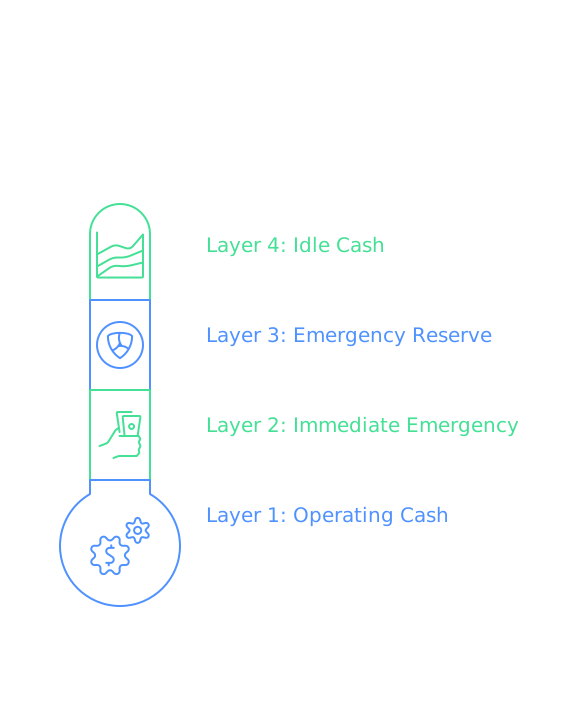
Use a 4-layer cash stack
The cleanest framework is:
- Operating cash
- First-day emergency cash
- Deeper emergency reserve
- Idle cash
This is why Can You Move Money Out of Checking Without Missing Bills? is a separate question from yield. Bill timing is an operating problem before it is a rate problem.
Watch the balance over 60-90 days
Emergency funds often get overbuilt because nobody wants to make a mistake. That is reasonable. But after 60-90 days, the data usually shows a pattern.
If the account never comes close to the floor, the excess is not protecting the next bill cycle. If the same $25,000 remains untouched after mortgage, card autopay, payroll gaps, and irregular expenses clear, that $25,000 deserves a different label.
It may still be emergency money. It may be idle cash. The answer depends on your reserve target and your access needs.
The Cost of Keeping Your Emergency Fund in Checking
The cost is the difference between what checking earns and what comparable cash options may earn. You should calculate it only for the amount above your safe balance and first-day emergency cash.
Use sourced rate inputs
This example uses 3 public inputs:
- Checking benchmark: 0.07% FDIC national interest checking rate as of June 15, 2026
- Treasury bill benchmark: 3.67% 4-week Treasury bill rate on July 16, 2026
- Rivo fee: 0.05% monthly management fee, about 0.60% per year before compounding
This table is arithmetic, not a recommendation. Rates change, taxes matter, and emergency cash has a job. The point is that a low-rate checking account can become expensive once the emergency reserve grows beyond the amount you truly need in the operating account.
The cost is not only yield
The opposite mistake is chasing yield without pricing friction. If moving money creates missed bills, overdrafts, delayed transfers, tax confusion, or anxiety, the headline yield is not the full answer.
That is why the decision should compare workflows:
If the answer is "I will forget," automation becomes part of the economics.
Where to Keep Emergency Cash Without Bill Risk
Emergency cash can live in more than one place. The right structure depends on access speed, transfer timing, product risk, tax treatment, and your willingness to manage the workflow.
Option fit depends on the layer
Rivo should not be framed as a replacement for the first-day emergency layer. It is more useful for recurring cash above the operating floor, especially when the alternative is forgetting manual transfers for months.
T-bills are not checking deposits
Treasury bills are securities. They are not bank deposits. That difference matters for emergency-fund decisions.
The IRS explains that Treasury bill, note, and bond interest is subject to federal income tax but exempt from state and local income taxes. The SIPC explains brokerage protection limits and what SIPC protects. The FDIC explains deposit insurance for bank deposits.
Those are different protections. A good emergency fund plan does not blur them.
When Emergency Cash Becomes Idle Cash
Emergency cash becomes idle when it sits above the amount needed for bills, urgent access, reserve targets, and known upcoming expenses.
Use 5 tests
This is the same idea as Is It Worth Moving Money Out of Checking?, but applied to emergency reserves. The threshold is not only mathematical. It is behavioral.
Over-saving in checking is still a workflow problem
Many households over-hold cash because they do not want to think about edge cases. That instinct is not irrational. It is what happens when a bank balance has to cover rent, mortgage, card autopay, daycare, repairs, income timing, and emotional comfort at the same time.
Rivo addresses the workflow layer. The user sets a safe balance, and the system evaluates only the cash above that floor. That is a different design from a recurring transfer rule that moves a fixed amount on a fixed date whether or not your spending changed.
Where Does Rivo Fit in an Emergency Fund Workflow?
Rivo fits after you protect the checking floor. It can help with the persistent surplus that stays above your safe balance after bills, first-day emergency cash, and known expenses are accounted for.
Rivo works on top of your existing bank
Rivo does not require a bank switch. The product connects to your existing account, preserves a safe balance you set, and moves eligible idle cash into short-duration U.S. Treasury Bills through Jiko Securities.
That matters for emergency-fund behavior. People often keep too much in checking because they do not want to change direct deposit, bill pay, debit usage, or card autopay. Rivo is designed to keep those habits intact while putting the excess layer to work.
Rivo is most relevant when you already know your floor, you have meaningful surplus cash, and the manual workflow is the reason the money keeps sitting in checking.
Rivo is not a bank account
Rivo is a fintech company, not a bank. Banking services are provided by Jiko Bank, a division of Mid-Central National Bank. Treasury investments and investment advisory services are provided through Jiko Securities, Inc., a registered broker-dealer, member FINRA and SIPC.
That structure is important for emergency funds. Cash deposits and Treasury securities have different mechanics, protections, taxes, and access paths.
For more detail, read Does Rivo Replace Your Bank?, How Does Rivo Autopilot Work?, and Are Treasury Bills Safe for Short-Term Cash?.
What Emergency Money Should Not Move?
Do not move cash if the cash has a near-term job, if you would panic during a transfer delay, or if you do not understand the product holding it.
Keep these layers out of automation
This is where conservative cash management is rational. The problem is not conservative cash. The problem is unclassified cash.
Avoid the all-or-nothing decision
You can keep $15,000 in checking, $25,000 in a separate emergency reserve, and use Rivo only for the cash above both layers. You can also keep more in checking during a job transition and reduce the floor after income stabilizes.
The useful decision is not "move or do not move." The useful decision is "which layer has which job?"
What Is a Practical Emergency Fund Setup?
A practical setup has 4 steps: define the safe balance, define the reserve target, separate first-day access from deeper reserve, and decide what happens to surplus.
Example household setup
Assume a household spends $8,000 per month on essential expenses and wants a 6-month emergency fund. The full target is $48,000, based on the FINRA 3-6 month emergency-fund rule of thumb.
This setup does not tell the household what to buy. It tells the household what each dollar is for.
If the $20,000 surplus keeps sitting in checking because manual transfers are tedious, that is where Rivo can be evaluated. If the household wants only bank deposits, Rivo may not be the right fit. If the household wants bill-aware automation on top of its existing bank, Rivo belongs in the comparison set.
The first 30 days matter most
Emergency funds fail when the first 30 days are underfunded. That is why the safe balance comes first. The deeper reserve can have a different access path if you understand settlement timing and product mechanics.
The order should be:
- Keep bills covered.
- Keep first-day emergency cash accessible.
- Build the deeper reserve.
- Compare the recurring surplus.
- Automate only the idle layer if the workflow fits.
How Taxes Affect Emergency Fund Yield
Taxes matter when comparing bank interest, Treasury bill interest, money market funds, and automated cash management.
Treasury bill income has different state and local treatment
The IRS states that Treasury bill, note, and bond interest is subject to federal income tax but exempt from state and local income taxes. That can matter in states with income tax.
Do not use tax treatment as the only deciding factor. Access, bill safety, product understanding, and household risk still come first.
Use after-tax math only after safety math
The sequence matters. First decide how much emergency cash needs immediate access. Then compare after-tax yield on the deeper reserve or idle layer.
If you reverse the order, the highest-yielding option may look attractive even when it is wrong for the money's job.
Emergency Fund Math by Household Type
Use household type only as a starting point. A renter with stable W-2 income, a dual-income family with childcare, and a self-employed household with uneven deposits can all need different checking floors even when their emergency-fund targets look similar.
Use 3-month and 6-month targets as ranges
The FINRA 3-6 month emergency-fund guideline is a range, not a command. The lower end may fit stable income and low fixed costs. The higher end may fit one-income households, self-employment, medical risk, dependents, or high fixed expenses.
This table is illustrative. It shows why "keep 6 months in checking" can be too blunt. A household with a $60,000 reserve target may need $20,000 in checking and still have $40,000 in a deeper reserve layer. Another household may need $35,000 in checking because income arrives irregularly and 2 large bills can clear inside the same week.
The cash stack should change after life changes
Do not set the emergency-fund structure once and ignore it for 5 years. Review the stack after a new mortgage, new child, job change, RSU vest, annual bonus, tax refund, relocation, medical event, or major insurance change.
This is where automation can help only after the inputs are right. If the safe balance is stale, any transfer workflow is solving the wrong problem. If the safe balance is current and surplus persists for 60-90 days, the decision shifts back to idle-cash management.
Determining Whether Rivo Is Right for You
Rivo is a fit when the emergency fund is already built, checking has a clear safe balance, and the recurring surplus is large enough that manual inaction has a cost.
Strong-fit signals
- You keep $10,000, $25,000, $50,000, or more above your checking floor.
- Your bills are on autopay and you want them to stay boring.
- You do not want to switch banks.
- You tried manual transfers and stopped.
- You want exposure to short-duration U.S. Treasury Bills without managing auctions yourself.
- You understand that T-bills are securities, not FDIC-insured deposits.
- You want the option to pause, stop, or disconnect.
Weak-fit signals
- Your emergency fund is not built yet.
- Your checking balance is often close to zero.
- You need every emergency dollar same day.
- You want only FDIC-insured bank deposits.
- You do not want securities exposure, even short-duration Treasury exposure.
- Your surplus cash is too small for the fee and effort to matter.
The most honest version is this: Rivo is not trying to replace the emergency fund. It helps identify and automate the cash that no longer needs to behave like emergency cash.
Emergency Fund Checklist Before You Move Any Cash
Run this checklist before moving money out of checking, whether you use Rivo, a savings product, TreasuryDirect, a brokerage account, or anything else.
If you cannot pass the first 4 checks, keep the setup simple. If you can pass all 8 checks, the emergency-fund question has become an idle-cash workflow question.
FAQ
Is it bad to keep an emergency fund in checking?
No. Keeping emergency cash in checking can be reasonable, especially for first-day access and bills. It becomes inefficient when the balance is much larger than your safe balance and stays there for 60-90 days or longer.
How much emergency fund should be in checking?
A practical starting point is the next 30 days of bills plus first-day emergency cash. FINRA uses 3-6 months of living expenses as a common total emergency-fund target, but not all 3-6 months must necessarily stay in checking.
Should emergency savings earn yield?
Emergency savings can earn yield if the product still fits the job: liquidity, safety, access timing, tax treatment, and user understanding. A 0.07% checking benchmark makes the cost visible, but yield should not override bill safety.
Can Rivo hold my whole emergency fund?
Rivo may fit the excess layer above your safe balance, but it should not be treated as a blanket replacement for all emergency cash. Rivo uses short-duration U.S. Treasury Bills through Jiko Securities, and T-bills are securities, not bank deposits.
What if I need cash quickly?
Keep first-day emergency cash in checking or another immediately accessible place. For available funds, Rivo account details list a $15,000/day withdrawal limit, but you should understand timing, settlement, and your own access needs before relying on any workflow.
Are Treasury bills safe for emergency money?
Treasury bills are direct U.S. government obligations, but they still have product mechanics and standard fixed-income risks. Read Are Treasury Bills Safe for Short-Term Cash? before using T-bills for any emergency-reserve layer.
Related Rivo Reading
- To size the checking floor, read How Much Money Should You Keep in Checking?.
- To define safe balance, read What Is a Safe Balance?.
- If income changes from month to month, read How Much Should You Keep in Checking With Irregular Income?.
- To decide whether moving money is worth it, read Is It Worth Moving Money Out of Checking?.
- To separate planned expenses, true emergencies, and the checking floor, read Sinking Fund vs Emergency Fund vs Safe Balance..

This article is educational and is not financial, investment, tax, accounting, or legal advice.
Yield rate reflects the 4-week T-bill rate when held to maturity. Rate does not include fees. Rates are subject to change. Minimum balance of $100 required to earn the stated rate.
Rivo is a fintech company, not a bank. Banking services provided by Jiko Bank, a division of Mid-Central National Bank. Jiko Group, Inc. and its affiliates do not provide legal, tax, or accounting advice. You should consult your legal and/or tax advisors before making any financial decisions. This material is not intended as a recommendation, offer or solicitation for the purchase or sale of any security or investment strategy. See FINRA BrokerCheck, Jiko U.S. Treasuries Risk Disclosures and Jiko Securities Inc. Form CRS.
Investments in T-bills: Not FDIC Insured - No Bank Guarantee - May Lose Value. All U.S. treasury investments and investment advisory services provided by Jiko Securities, Inc., a registered broker-dealer, member FINRA and SIPC. Securities in your account are protected up to $500,000. For details, please see www.sipc.org.
The checking and savings columns are FDIC-insured bank deposits, subject to limits. The Treasury bill column is a security. It is not FDIC insured, carries no bank guarantee, and its value can change if it is sold before maturity.
Sources
- CFPB, An Essential Guide to Building an Emergency Fund.
- FINRA, Building an Emergency Fund.
- FDIC, National Rates and Rate Caps, June 15, 2026.
- FRED, 4-Week Treasury Bill Secondary Market Rate, Discount Basis, July 16, 2026 observation.
- IRS, Topic No. 403, Interest Received.
- SIPC, What SIPC Protects.
- FDIC, Deposit Insurance FAQs.
- Rivo, Homepage, rate details, and account details.
- Savings product

Get Rivo Updates
Product news, money insights, and company updates.