Why Does My Checking Account Balance Keep Growing? Cash Creep, Safe Balance, and Rivo Explained
Why checking balances keep creeping up, how to separate bill money from idle cash, and when automation can help with the excess layer.
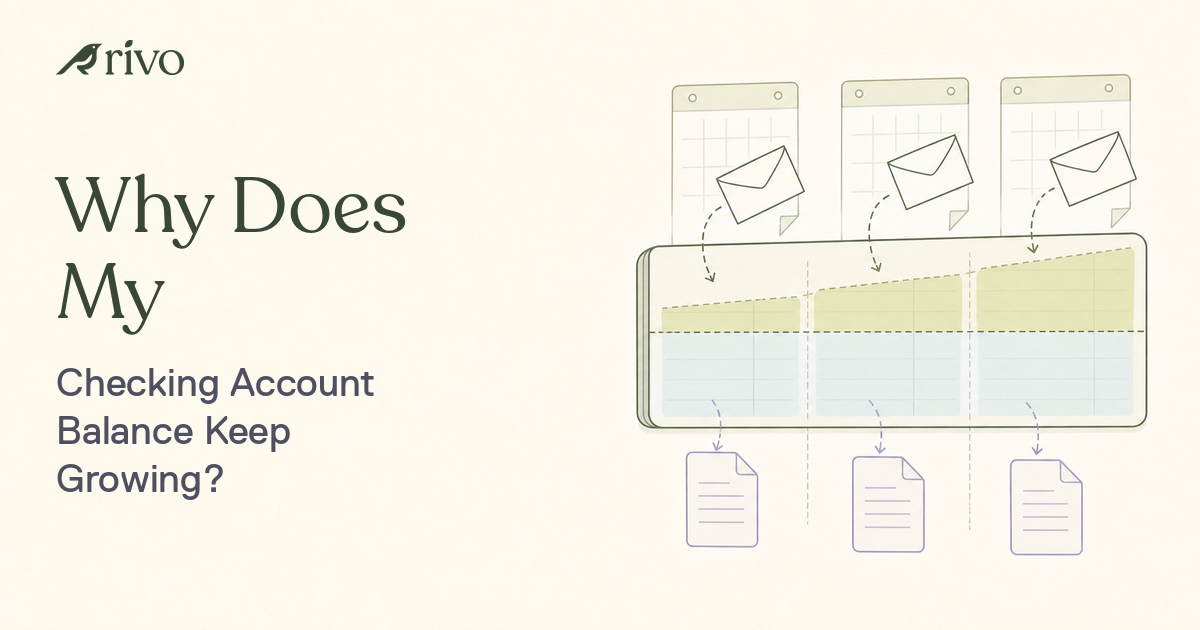
Your checking account balance usually keeps growing for one of 4 reasons: your income is larger than your monthly spending, you are holding a bigger bill buffer than you actually use, a bonus or refund landed and never moved, or you have not defined the line between safe cash and idle cash.
The problem is not that a growing checking balance is bad. The problem is that checking slowly becomes the default parking place for money that no longer needs checking liquidity. Once that happens, a balance that started as caution can turn into cash creep: extra money sitting above bills, autopay timing, near-term spending, and emergency needs.
Rivo is built for that excess layer. You keep your existing bank, set the checking floor you want protected, and eligible idle cash above that floor can move into short-duration U.S. Treasury Bills through Jiko Securities while bill-aware automation keeps checking funded.
TL;DR
- A growing checking balance is useful if it covers the next 30 days of bills, card autopay, rent, mortgage, planned spending, and a comfort cushion.
- The balance becomes cash creep when the same extra dollars stay above your safe balance for 30, 60, or 90 days without a job.
- As of June 2026, the national interest checking benchmark was 0.07%, while the 4-week Treasury bill rate was 3.67% on July 16, 2026. The gap can matter once your extra checking balance is $10,000, $25,000, or $50,000.
- Current Rivo rate details list 3.65% on idle cash as of July 1, 2026, before fees, with a $100 minimum balance required to earn the stated rate and the rate moves with the 4-week Treasury bill
- Rivo charges a 0.05% monthly management fee, or about 0.60% per year before compounding, and available funds have a $15,000/day withdrawal limit.
- This is not financial, tax, or investment advice. The right checking balance depends on your bills, income stability, dependents, upcoming expenses, emergency fund, tax situation, and risk tolerance.
Checking Balance Creep: Quick Diagnosis Table
Use this table before optimizing anything. A large checking balance is not automatically wasteful. It becomes wasteful only after the safety job is already covered.
.svg)
The key word is persistent. A checking balance that is high for 1 week after payroll is different from a checking balance that stays $20,000 above your safe balance for 6 months.
What a Growing Checking Balance Actually Means
A checking balance keeps growing when inflows arrive faster than outflows and the extra money has no automatic destination.
.svg)
It usually starts as responsible behavior
Most people do not overfund checking because they are careless. They do it because checking is the account that protects rent, mortgage, credit card autopay, utilities, daycare, insurance, subscriptions, tax payments, and ACH transfers.
That makes checking feel like the safest place to leave everything. Every paycheck lands there. Every bill pulls from it. Every surprise can be handled from it. The problem appears only when the account becomes a storage closet for money that is no longer needed for payment timing.
When those layers are mixed together, the balance can grow without triggering action. You see "$38,000 in checking" but cannot tell whether it is safety, timing, emergency money, or inertia.
Cash creep is a measurement problem first
Cash creep is not just "too much money." It is money without a job that keeps surviving every bill cycle.
If you have not named your bill layer, your emergency layer, and your planned-expense layer, you cannot know whether the remaining dollars are idle. That is why the first fix is not moving money. The first fix is classification.
For the basic definition, read What Is Idle Cash?. For the checking floor formula, read How Much Money Should You Keep in Checking?.
Why Checking Balance Cash Creep Happens
Checking balance creep happens because the account is doing too many jobs at once: bill payment, emergency reserve, mental safety buffer, tax parking lot, bonus holding area, and default destination for all direct deposits.
The 7 common causes
The biggest leak is not one dramatic mistake. It is 12 small non-decisions per year. A $2,000 monthly surplus becomes $24,000 in 12 months if nothing routes it elsewhere.
The account balance hides the actual floor
Most households know the current balance. Fewer know the lowest safe balance.
That matters because a $40,000 checking balance can have very different meanings:
The same headline balance can be cautious, neutral, or inefficient. The right answer depends on the floor.
Separating Safe Cash From Idle Cash
Separate safe cash from idle cash by assigning checking into 4 layers: bills, buffer, emergency cash, and excess.
.svg)
Use the 4-layer checking stack
This is the core move. Do not compare yields until the first 3 layers are protected.
The CFPB emergency fund guide frames emergency savings as money set aside for unexpected expenses, and it emphasizes cash-flow timing. That timing point matters: emergency money should be available when needed, but not every dollar needs to sit in the same payment account.
Use a 30-60-90 day persistence test
The persistence test is simple:
- Write down your safe balance.
- Look at the lowest checking balance over the last 30 days.
- Repeat at 60 days and 90 days.
- Treat only the repeated excess as candidate idle cash
If your safe balance is $18,000 and your 90-day low is $25,000, the first candidate idle layer is not $22,000. It is closer to $7,000. That is the conservative method.
The formula
Use this version when you want a practical number:
Candidate idle cash = 90-day low balance - safe balance - known upcoming expenses
Example:
The candidate idle cash is not automatically money to move. It is money worth reviewing.
When Checking balance Creep Becomes Expensive
Checking balance creep becomes expensive when the extra cash is large enough, stable enough, and low-yield enough that the lost earnings matter more than the convenience of doing nothing.
The benchmark gap is wide
As of June 2026, the national rate for interest checking was 0.07%. On July 16, 2026, the 4-week Treasury bill secondary market rate was 3.67%. Current Rivo rate details list 3.65% as of July 1, 2026, before fees.
Those are not the same product. Checking deposits, Treasury bills, brokerage protection, taxes, fees, liquidity, and risk are different. The comparison is useful only after your cash layer is truly excess.
This table is illustrative. Rates change, fees matter, taxes matter, and investment mechanics matter. The point is not that every dollar should move. The point is that a persistent excess balance has a measurable opportunity cost.
Fees change the net math
Rivo charges a 0.05% monthly management fee, or about 0.60% per year before compounding. That means you should think in net terms, not headline terms.
This is a simplified illustration, not a projection. It does not account for rate changes, compounding, early liquidation effects, taxes, or your personal circumstances.
Taxes can change the after-tax answer
Interest from U.S. Treasury bills is subject to federal income tax and exempt from state and local income taxes according to IRS Topic No. 403. That can matter more in states with higher income tax rates.
Bank account interest is generally taxable interest. Treasury bill interest has a different state and local tax treatment. The correct after-tax comparison depends on your federal bracket, state, local tax rules, and whether any sale creates a different tax outcome.
Setting a Safe Balance for a Growing Checking Account
A safe balance is the minimum checking floor you want protected before any cash is considered excess.
A safe balance is not a vibe
The safest version of "I want enough in checking" is a number. It should include the next 30 days of bills, planned spending, autopay timing, a first-day emergency cushion, and any known upcoming expense.
Safe balance = 30-day bills + planned spending + timing cushion + first-day emergency cushion + known near-term expenses
Your safe balance can be high and still be rational. The mistake is leaving it undefined.
A safe balance should change when your life changes
Review the number after major events:
- Income changes.
- Rent or mortgage changes.
- A child, dependent, or caregiving obligation changes.
- A large tax payment is coming.
- Insurance, tuition, travel, or home repair expenses are scheduled.
- You switch payroll timing.
- You add or remove credit card autopay.
- You move from 2 incomes to 1 income.
If your safe balance was $18,000 last year and your bill structure changed, the old number may be too high or too low.
What Should You Do With Extra Cash Above Your Safe Balance?
Once the excess layer is identified, compare options by 6 criteria: access timing, yield, tax treatment, protection type, manual work, and bill readiness.
The real options
If you want the broad comparison, read Rivo Alternatives. If you want the T-bill safety layer first, read Are Treasury Bills Safe for Short-Term Cash?.
Manual transfers work until they become a recurring chore
Manual transfers are fine when you have 1 account, 2 predictable bills, and a monthly routine. They break when cash flow gets more dynamic: card autopay varies, income timing shifts, RSUs vest, taxes come due, travel hits, or a large purchase temporarily changes the safe balance.
That is why cash creep returns. The issue is not knowledge. Most people know extra checking cash could earn more elsewhere. The issue is that the transfer decision keeps coming back.
Where Rivo Fits When Checking Cash Keeps Growing
Rivo fits when your checking account has a persistent excess layer above the safe balance you want protected.
The workflow
The fit is narrow by design: money above your safe balance, not every dollar in checking.
Current product details to know
These details matter because this is not a bank deposit product. Rivo is a fintech layer. Banking services are provided by Jiko Bank, and U.S. Treasury investments and investment advisory services are provided by Jiko Securities, Inc., a registered broker-dealer, member FINRA and SIPC.
Which Growing-Balance Scenario Are You In?
The right move depends on why the balance is growing.
Scenario matrix
The same tool can be a fit in 1 scenario and a bad fit in another. If your cash is about to leave checking for taxes, tuition, escrow, a down payment, or a renovation, it may not be idle.
The hardest case is "I might need it"
"I might need it" is valid. But it needs a number.
Convert uncertainty into categories:
Once the concern has a label and number, the leftover cash is easier to see.
How Much Cash Creep Is Worth Fixing
Cash creep is worth fixing when the possible benefit is larger than the friction, risk, fee, and attention required.
A practical threshold table
This table uses the June 2026 interest checking benchmark and the July 1, 2026 Rivo rate detail for a simple before-fee illustration. It is not a return estimate.
If you want a more direct worksheet, use the Checking Account Interest Calculator.
The threshold is personal
For some households, $100 per year is not worth changing a workflow. For others, $1,000 per year is too much to ignore. The right threshold depends on:
- How stable the excess is.
- How much time manual transfers take.
- Whether the cash has a near-term job.
- Whether the product risk is acceptable.
- Whether the fee still leaves enough net benefit.
- Whether the household understands FDIC, SIPC, and Treasury bill mechanics.
The right question is not "what is the highest rate?" The right question is "what is the highest-utility workflow for this cash layer?"
When to Leave the Extra Cash Alone
Leave the extra cash alone when the money is not truly idle, the timing risk is high, or the complexity is not worth it.
Avoid moving it if any of these are true
For emergency-fund specific decisions, read Should You Keep Your Emergency Fund in Checking?. For bank-replacement concerns, read Does Rivo Replace Your Bank?.
Safety is not one thing
FDIC insurance, SIPC protection, U.S. Treasury obligations, liquidity, settlement timing, rate variability, and user control are different safety dimensions.
The FDIC deposit insurance limit is $250,000 per depositor, per insured bank, per ownership category. SIPC protection has a $500,000 limit, including a $250,000 cash limit, and SIPC does not protect against a decline in the value of securities. Those protections are not interchangeable.
Building a Cash-Creep Policy in 20 Minutes
You do not need a perfect spreadsheet. You need a rule that survives normal life.
The 20-minute workflow
Use this rule after the worksheet:
If persistent excess is below $5,000, review monthly.
If persistent excess is $5,000-$10,000, create a transfer or automation rule.
If persistent excess is above $10,000 for 90 days, choose a deliberate cash workflow.
Those thresholds are illustrative, not advice. They are useful because they force the balance to become a decision instead of background noise.
What to Track After You Fix Checking Balance Creep
Track 5 numbers after you fix checking balance creep: safe balance, 30-day low, planned-expense reserve, excess cash, and earnings net of fees.
The post-fix dashboard
The mistake after the first cleanup is treating the work as done forever. Checking is dynamic. Your account can look clean in July and become messy again by October if a bonus, tax refund, reimbursement, travel refund, insurance payout, or RSU vest lands without a rule.
This is also where Rivo can reduce manual review. If you set the safe balance too low, automation can feel stressful. If you set it too high, too much money stays in checking. A good safe balance is conservative enough to protect bills and specific enough to expose recurring excess.
A monthly review can be 5 minutes
You do not need to review every transaction. You need to confirm whether the rule is still true.
Use this 5-minute review:
- Did any new bill, loan, rent, mortgage, card autopay, insurance premium, tuition payment, or tax payment appear?
- Did income timing change?
- Did a one-time deposit land?
- Did the checking balance fall near the safe balance?
- Did any available idle cash need same-day access?
- Did the earnings justify the workflow after fees and taxes?
If the answers are boring, keep the rule. If 2 or more answers changed, reset the safe balance.
The "do nothing" benchmark should stay visible
Every cash workflow competes against doing nothing. Doing nothing has 3 advantages: it is easy, familiar, and usually liquid. Its weakness is that the extra balance may earn very little.
The "best" workflow is the one you will actually maintain. A theoretically optimal setup that you abandon after 2 months often loses to a simpler rule that works all year.
What Are Good Cash-Creep Rules by Household Type?
The safest rule is the one that matches your income pattern, bill volatility, and planned expenses.
Use different rules for different cash lives
The rule should not punish caution. If you need $25,000 in checking to feel stable because your household bills are high and lumpy, that can be valid. The cash-creep question starts above that number.
The Rivo fit test in 6 questions
Rivo is more likely to fit if most answers are yes:
- Do you already keep more than $5,000 in checking?
- Does the same excess layer survive at least 60-90 days?
- Do you want to keep your existing bank and bill setup?
- Do you want a user-set checking floor?
- Do you understand that T-bills are securities, not bank deposits?
- Does the potential net benefit justify the 0.05% monthly fee?
Rivo is less likely to fit if the excess is small, income is volatile, major expenses are imminent, or you specifically need every dollar in FDIC-insured deposits. In those cases, the best next move may be a clearer safe balance, a dedicated savings account, or no change at all.
The Bottom Line on a Growing Checking Balance That Keeps Growing
A growing checking balance is a signal, not a verdict. It tells you your cash system is producing extra money, but it does not tell you whether that money is still safety cash.
The practical answer
Use this order:
- Protect the next 30 days of bills.
- Add a timing cushion.
- Add first-day emergency cash.
- Label known upcoming expenses.
- Measure the 30, 60, and 90-day low balance.
- Treat only persistent excess as candidate idle cash.
- Compare doing nothing, manual transfers, savings products, Treasury bills, and automation.
That order keeps the article's central point intact: checking is for payment certainty. Idle cash is the leftover layer after payment certainty is already protected.
Rivo enters the decision only after that line is clear. If the excess layer is real, persistent, and large enough to matter, Rivo can help keep your existing bank while eligible idle cash works in short-duration U.S. Treasury Bills through Jiko Securities. If the excess layer is not real, the right answer is to keep the cash where it is.
FAQ
Is it bad if my checking account balance keeps growing?
No. A growing checking balance can mean you are saving well. It becomes a problem only when the same extra money stays above bills, buffer, emergency cash, and planned expenses for 30-90 days.
How much is too much to keep in checking?
"Too much" is the amount above your safe balance and known cash needs. For one household that may be $5,000. For another it may be $50,000. Start with your 30-day bills, planned spending, timing cushion, and first-day emergency cash.
Should I move extra checking cash every month?
Monthly transfers work if your income and bills are predictable. They break when card autopay, taxes, bonuses, RSUs, travel, repairs, or irregular income change the floor. Automation becomes useful when the decision repeats and the excess layer is stable.
Can Rivo help if I am afraid of missing bills?
Rivo is designed around a user-set checking floor and bill-aware movement. It works with your existing bank, and funds can move back before bills and transfers hit. You should still set a conservative safe balance and understand product mechanics before using any automation.
*Movement of funds is not instant. Transfers to your linked account can take up to 3 business days to settle, and longer if a Treasury Bill must be sold first. Rivo plans around known bills. It does not guarantee same-day access or a specific arrival date.
What happens if rates change?
Checking rates, Treasury bill rates, and Rivo rates can all change. The 4-week Treasury bill rate is a market benchmark, and current Rivo rate details note that rates are subject to change.
Is cash in Treasury bills the same as cash in a bank account?
No. T-bills are securities. FDIC insurance applies to eligible bank deposits, while SIPC protection applies to missing cash and securities if a SIPC-member brokerage firm fails financially. Read Are Treasury Bills Safe for Short-Term Cash? before using T-bills for short-term cash.
Related Rivo Reading
- To define idle cash, read What Is Idle Cash?.
- To spot whether the balance is too high, read Are You Keeping Too Much Money in Checking?.
- If higher income is making the balance grow, read Why Do High Earners Keep So Much Money in Checking?.
- To size the checking floor, read How Much Money Should You Keep in Checking?.
- To separate a normal cash-flow cycle from recurring surplus, read Why Does My Checking Account Balance Fluctuate So Much?

This article is educational and is not financial, investment, tax, accounting, or legal advice.
Yield rate reflects the 4-week T-bill rate when held to maturity. Rate does not include fees. Rates are subject to change. Minimum balance of $100 required to earn the stated rate.
Rivo is a fintech company, not a bank. Banking services provided by Jiko Bank, a division of Mid-Central National Bank. Jiko Group, Inc. and its affiliates do not provide legal, tax, or accounting advice. You should consult your legal and/or tax advisors before making any financial decisions. This material is not intended as a recommendation, offer or solicitation for the purchase or sale of any security or investment strategy. See FINRA BrokerCheck, Jiko U.S. Treasuries Risk Disclosures and Jiko Securities Inc. Form CRS.
Investments in T-bills: Not FDIC Insured - No Bank Guarantee - May Lose Value. All U.S. treasury investments and investment advisory services provided by Jiko Securities, Inc., a registered broker-dealer, member FINRA and SIPC. Securities in your account are protected up to $500,000. For details, please see www.sipc.org.
Sources
- Rivo, Homepage, rate details, and account details.
- FRED, National Rate: Interest Checking, June 2026 observation.
- FRED, 4-Week Treasury Bill Secondary Market Rate, Discount Basis, July 16, 2026 observation.
- CFPB, An Essential Guide to Building an Emergency Fund.
- IRS, Topic No. 403, Interest Received.
- SIPC, What SIPC Protects.
- FDIC, Deposit Insurance FAQs.

Get Rivo Updates
Product news, money insights, and company updates.