High-Yield Savings Account Alternatives for Idle Checking Cash: HYSAs, T-Bills, Money Market Funds, and Rivo
Compare high-yield savings alternatives for idle checking cash: money market funds, Treasury bills, brokerage cash, and Rivo automation
If your checking account keeps holding more cash than your bills actually require, a high-yield savings account is not the only alternative. You can leave cash in checking, move money manually to savings, use a brokerage money market fund, buy Treasury bills directly, use a cash management account, or automate the idle layer with Rivo.
The right answer depends on the job of the cash. Checking is built for payment readiness. High-yield savings is built for bank-deposit simplicity. Treasury bills are securities backed by the U.S. government. Money market funds are mutual funds. Rivo is automated cash management that works with your existing checking account, lets you set a safe balance, moves eligible idle cash into short-duration U.S. Treasury Bills through Jiko Securities, and brings cash back before bills are due.
*Movement of funds is not instant. Transfers to your linked account can take up to 3 business days to settle, and longer if a Treasury Bill must be sold first. Rivo plans around known bills. It does not guarantee same-day access or a specific arrival date.
The return gap can be meaningful. The national interest checking rate was 0.07% in June 2026, while the 4-week Treasury Bill secondary market rate was 3.67% on July 16, 2026. Rivo currently lists a 3.65% gross annualized rate as of July 1, 2026, before fees and taxes, with a $100 minimum balance required to earn the stated rate.
If you need the basic cash-layer definition first, read What Is Idle Cash?. If you already know your balance is too high and want the no-bank-switch path, read Can You Earn More on Checking Cash Without Switching Banks?. If you want the direct three-way comparison, read Rivo vs High-Yield Savings vs Treasury Bills.
TL;DR
- A high-yield savings account is a good fit when you want a bank deposit product, FDIC deposit insurance subject to standard limits, and you are willing to manage transfers.
- The main alternatives are brokerage money market funds, cash management accounts, direct Treasury bills, Treasury-backed automation, and keeping a larger checking buffer when payment readiness matters more than yield.
- The FDIC national average rate for interest checking rate was 0.07% in June 2026. At that rate, $25,000 earns about $18/year before taxes.
- Rivo lists a 3.65% gross annualized rate as of July 1, 2026, before fees and taxes. The product charges a 0.05% monthly management fee, about 0.60%/year before compounding.
- TreasuryDirect lists Treasury bills with maturities from 4 weeks to 52 weeks and a $100 minimum purchase. Direct T-bills work best if you will manage auctions, maturities, and reinvestment yourself.
- Protection labels matter. FDIC deposit insurance covers eligible bank deposits up to $250,000 per depositor, per insured bank, per ownership category. SIPC protects eligible securities and related cash at member brokerage firms up to $500,000, including a $250,000 cash limit, but it does not protect against market-value changes.
- Rivo is most relevant when your real problem is not finding a higher rate. It is keeping bills covered while the excess checking balance works in the background.
Quick Answer: What Is the Best High-Yield Savings Account Alternative for Idle Checking Cash?
The best alternative is the one that matches the cash job. If the cash must pay a bill in the next few days, checking is still the best tool. If the cash is emergency savings and you want a bank deposit product, a high-yield savings account can be enough. If the cash is persistent surplus above your safe balance, Treasury bills, money market funds, cash management accounts, or Rivo-style automation deserve a closer look.
The cash job test
The mistake is comparing every option against your full checking balance. The comparison should start after your safe balance is set.
.svg)
Use this formula:
Idle checking cash = checking balance - safe balance
If you have $42,000 in checking and your real safe balance is $14,000, the decision is about the $28,000 idle layer. If your safe balance is $38,000 because a property tax bill, tuition payment, or renovation invoice is due soon, the decision is only about $4,000.
That is why Rivo starts with a user-set safe balance. The product is not trying to move every dollar out of checking. It is built to identify money above the floor, move eligible idle cash into short-duration T-bills, and refill checking before bills and transfers hit.
Why People Look for High-Yield Savings Account Alternatives
People usually look for high-yield savings account alternatives after 1 of 4 things happens: the checking balance keeps growing, savings transfers become annoying, a bank rate changes, or a bill near-miss makes the user uncomfortable moving cash manually.
The issue is rarely ignorance. Most people know idle cash should earn something. The hard part is turning that knowledge into a workflow that survives paychecks, rent, mortgage payments, credit cards, taxes, travel, and irregular expenses.
The national data explains why this search intent matters. U.S. households and nonprofit organizations held about $5.95 trillion in checkable deposits and currency at the end of Q1 2026. Not every dollar in that number is idle, but it shows how large the transaction-cash layer is across households.
At the same time, the national interest checking rate was 0.07% in June 2026. A $50,000 checking balance earning 0.07% produces about $35/year before taxes. That is why a household with a persistent $20,000, $50,000, or $100,000 surplus eventually starts comparing alternatives.
If your specific issue is a balance that quietly keeps climbing, read Why Does My Checking Account Balance Keep Growing?. If your issue is the opportunity cost, read What Is Cash Drag?.
The 6 Alternatives to Compare Before Moving Cash
High-yield savings is only 1 option. A serious comparison needs 6 choices because each solves a different part of the checking-cash problem.
The table should not push every user to the same answer. If you need same-day payment cash, keep it in checking. If you want deposit insurance for a specific bucket, use a bank deposit product. If you already manage a brokerage account daily, a money market fund may fit. If you want to buy T-bills directly and manage maturities, direct Treasury bills can work. If the repeated cash movement is the failure point, Rivo is the relevant alternative.
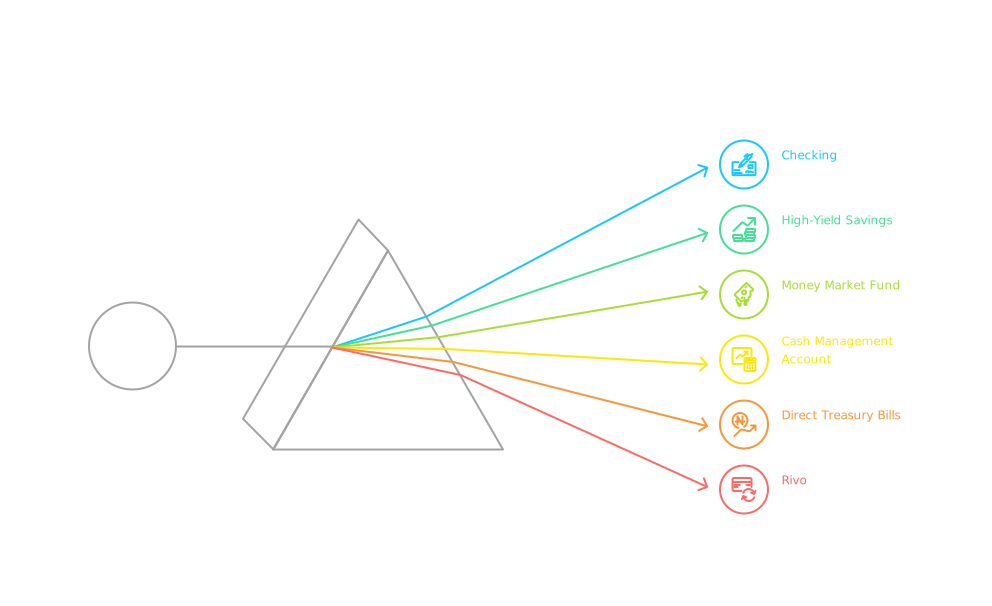
The practical decision is a 3-part filter:
- Cash job: What bills, payments, or emergency needs does this cash support?
- Wrapper: Do you need a bank deposit, a security, a mutual fund, or an automated cash-management layer?
- Workflow: Will you maintain the process after the first 30-90 days?
Rivo wins only the workflow case it was built for: idle checking cash that should work without requiring you to switch banks or manage repeated transfers.
Option 1: Keep More Cash in Checking When Payment Readiness Matters Most
Keeping cash in checking is not always wrong. Checking is the right home for money that needs to transact, clear, or stay immediately available for bills. The error is letting the checking account become a permanent warehouse for cash above the real safety floor.
The safe-balance exercise comes before yield math. If you move too much cash and then worry about a bill, you will usually undo the plan. You will transfer money back, raise the checking buffer, and ignore the system until the next rate article makes the issue visible again.
For a structured floor, use How Much Money Should You Keep in Checking?. A useful safe balance usually includes fixed bills, variable spending, pending transfers, a timing cushion, and any known large expenses.
Rivo uses the same principle. The user configures a minimum checking threshold, and Rivo only evaluates cash above that floor. That matters because the product is not trying to optimize at the expense of payment reliability. It is trying to separate bill money from idle money.
Option 2: Use a High-Yield Savings Account If You Want Deposit Simplicity
A high-yield savings account is often the simplest alternative to idle checking cash. It is familiar, usually easy to open, and can be a good fit for emergency savings or planned purchases where a bank deposit product is the priority.
The FDIC standard insurance amount is $250,000 per depositor, per FDIC-insured bank, per ownership category. That protection applies to eligible deposits at insured banks, subject to ownership-category rules and limits. It does not mean every product with a cash-like label has the same treatment.
The trade-off is not the account itself. The trade-off is maintenance.
You still need to decide how much to move, when to move it, and when to bring it back. If your checking balance changes around rent, mortgage, credit cards, payroll timing, RSUs, contractor payments, or tax payments, manual transfers can become the whole job.
This is where Rivo differs from a savings account. A savings account is a place to store cash. Rivo is a system for checking-cash automation. It works with your existing bank, monitors cash flow, uses your safe balance, and plans around bills.
Option 3: Use a Money Market Fund If Your Cash Already Lives in a Brokerage
Money market funds can be a useful alternative when cash already sits inside a brokerage account. Investor.gov describes money market funds as mutual funds that invest in short-term debt securities, cash, and cash equivalents, with dividends that generally reflect short-term interest rates.
That can make them attractive for brokerage users. But a money market fund is not the same as a savings account or a money market deposit account.
Investor.gov is explicit that money invested in a money market fund is not protected by FDIC insurance like bank deposits. SIPC may protect eligible money market mutual fund positions as securities in a brokerage-firm failure scenario, but SIPC does not protect against a decline in security value.
Money market funds can fit disciplined brokerage users. They are less clean for cash that must cover near-term household bills from checking. A brokerage money market fund may have attractive characteristics, but it does not automatically solve the "bring money back before credit card autopay" problem.
If you want the broader comparison, read Treasury Bills vs Money Market Funds vs High-Yield Savings.
Option 4: Use a Cash Management Account If You Want a Cash Hub
Cash management accounts can work for people who want a brokerage-style cash hub. Depending on the provider, the account may route cash into partner banks, use sweep programs, include debit or bill-pay features, or sit next to investing accounts.
The category is broad, so the details matter more than the label.
A cash management account is often a better fit for someone willing to change their cash hub. Rivo is built for a different user: someone who wants to keep the existing checking account, keep direct deposits and bill pay where they are, and automate only the idle layer above the safe balance.
This distinction is important because "move your whole cash life" and "make your current checking setup work harder" are different decisions.
If you want the no-switch framing, read Does Rivo Replace Your Bank?.
Option 5: Buy Treasury Bills Directly If You Want the DIY Route
Treasury bills are short-term U.S. Treasury securities. TreasuryDirect lists bill terms from 4 weeks to 52 weeks, with bills sold at a discount or at par and paid at face value when they mature. TreasuryDirect also lists a $100 minimum purchase in $100 increments.
Direct T-bills are a strong alternative for users who want control and will maintain the workflow.
TreasuryDirect lists federal tax due on interest and no state or local taxes for bills (Treasury bills at a glance). The IRS also explains that Treasury bill, note, and bond interest is federally taxable and exempt from state and local income taxes (IRS Topic No. 403).
The trade-off is workflow. A 4-week T-bill can be suitable for short-term cash, but it is not the same as checking. You still need to know when bills clear, whether cash should be reinvested, and what happens if you need money before maturity.
If the DIY route fits, use it. If the reason cash is idle is that manual money movement keeps failing, read Why Manual Transfers Fail before assuming direct T-bills will solve the behavior problem.
Option 6: Use Rivo If You Want Idle Checking Cash Automated Around Bills
Rivo is the alternative for people who want to keep their bank but stop letting surplus checking cash sit idle. It connects to an existing checking account, lets the user set a safe balance, identifies eligible idle cash above that threshold, moves that cash into short-duration U.S. Treasury Bills through Jiko Securities, and brings money back before bills and transfers are due.
*Movement of funds is not instant. Transfers to your linked account can take up to 3 business days to settle, and longer if a Treasury Bill must be sold first. Rivo plans around known bills. It does not guarantee same-day access or a specific arrival date.
The workflow difference is the product.
This does not make Rivo the right answer for every cash dollar. It makes Rivo relevant when your core failure mode is repeated attention.
Rivo charges a 0.05% monthly management fee, roughly 0.60%/year before compounding. Rivo supports available-funds withdrawals through the app up to $15,000/day. Rivo also notes that it works best for households with $5,000+ in checking, though there is no hard minimum.
The fee is easiest to understand as an automation fee. If you can buy T-bills yourself, maintain the ladder, keep bills covered, and update the plan every time cash flow changes, DIY may be cheaper. If you start manual transfers and then stop, the cheaper tool may not be the cheaper outcome.
For product mechanics, read How Does Rivo Autopilot Work?. For fee detail, read Rivo Fees Explained.
Same-Balance Math: Checking, Rivo, and T-Bill References
Use same-balance math before you compare alternatives. Otherwise, it is easy to compare a savings rate on $10,000 with a Treasury rate on $50,000 and reach the wrong conclusion.
The table below uses simple annualized math. It is not a projection. It does not include taxes, rate changes, compounding, balance changes, transfer timing, settlement timing, or early-sale effects.
Assumptions:
- Checking reference: 0.07% national interest checking rate in June 2026.
- Treasury reference: 3.67% 4-week T-bill secondary market rate on July 16, 2026.
- Rivo published reference: 3.65% gross annualized rate as of July 1, 2026, before fees and taxes.
- Rivo fee reference: 0.05% monthly management fee, about 0.60%/year before compounding.
This table is deliberately conservative in structure. It separates gross yield from fees because the published rate does not include fees. It also avoids treating a current rate as a fixed future outcome.
The important output is the order of magnitude. At $5,000 of idle cash, the decision may be more about simplicity than dollars. At $25,000 or $50,000 of persistent idle cash, the cost of doing nothing becomes easier to see.
If you want to run your own version, use the Checking Account Interest Calculator.
Protection and Tax Treatment Are Not the Same Across Alternatives
Do not compare cash options by rate alone. The wrapper matters.
FDIC insurance and SIPC protection answer different questions. FDIC protects eligible bank deposits up to standard limits at insured banks. SIPC protects eligible securities and related cash when assets are missing after a SIPC-member broker-dealer fails, subject to limits. SIPC also explains that it does not protect against a decline in security value (SIPC protection details).
T-bills add a third label. They are U.S. Treasury obligations, not FDIC-insured bank deposits. TreasuryDirect explains that bills can be held until maturity or sold before maturity, and lists federal tax due but no state or local taxes (Treasury bills).
Rivo is a fintech company, not a bank. Banking services are provided by Jiko Bank, a division of Mid-Central National Bank. U.S. Treasury investments and investment advisory services are provided by Jiko Securities, Inc., a registered broker-dealer and member FINRA/SIPC.
When High-Yield Savings Is Still the Right Answer
High-yield savings still wins when deposit simplicity matters more than automation or Treasury exposure.
Use a high-yield savings account when:
- You want eligible bank deposits and FDIC insurance subject to limits.
- You are separating emergency savings from checking.
- Your bills are predictable and transfers are easy.
- You are comfortable maintaining a second account.
- You do not want securities, brokerage disclosures, or T-bill mechanics.
- You only need to move cash a few times per year.
This is not a downgrade of high-yield savings accounts. It is a boundary. A high-yield savings account solves storage and rate improvement. It does not necessarily solve the bill-aware movement problem.
If your checking balance is stable, your bills are easy, and you are comfortable with the manual transfer habit, a savings account may be enough.
When Rivo Is the More Relevant Alternative
Rivo becomes more relevant when the issue is recurring idle cash inside checking, not one-time savings storage.
Use Rivo when:
- You want to keep your existing bank.
- You do not want to move direct deposit or rebuild bill pay.
- You have a persistent surplus above your safe balance.
- Manual transfers have failed before.
- You want cash moved back before bills and transfers are due.
- You want exposure to short-duration Treasury bills without managing auctions yourself.
- You want pause, stop, and disconnect controls.
Rivo should not be framed as a replacement for every cash tool. It is not a stock portfolio, not a budgeting app, not a neobank, and not a savings account. It is a focused product for the idle checking cash problem.
That focus is useful. A household can still keep bill money in checking, emergency savings in a deposit product, long-term investments in a brokerage or retirement account, and idle checking surplus under Rivo automation.
Decision Matrix: Which Alternative Should You Choose?
Use this matrix after you know your safe balance.
The matrix is intentionally conditional. A strong article about cash should not tell every reader to do the same thing. Cash has jobs. Product fit follows the job.
The cleanest Rivo use case is persistent idle checking cash. The weakest Rivo use case is cash that should stay fully in checking or cash that the user already manages well through direct Treasury bills.
A 30-Minute Checklist Before Choosing an Alternative
Do this before opening a new account, buying a bill, or activating automation.
- Pull your last 90 days of checking balances.
- List every fixed bill due before the next paycheck.
- Add variable spending, pending transfers, and known one-time expenses.
- Set a safe balance that protects the next 30 days.
- Calculate the amount above that safe balance.
- Check whether that excess stayed above the floor for 60-90 days.
- Compare current checking rate, savings rate, Treasury reference rate, and product fee.
- Decide whether you need a bank deposit product or are comfortable with securities.
- Decide whether you will manage transfers manually.
- If manual work is the blocker, choose an automation path instead of another reminder.
For many households, this review changes the question from "which account has the highest rate?" to "which dollars are idle, and who or what will keep the workflow running?"
That is the right question.
FAQ
What is the best high-yield savings account alternative for idle checking cash?
The best alternative depends on the cash job. Use checking for bills, high-yield savings for simple bank-deposit savings, money market funds for brokerage cash, direct Treasury bills for DIY Treasury exposure, and Rivo when the problem is idle checking cash plus repeated manual transfers.
Is Rivo a high-yield savings account?
No. Rivo is not a savings account and not a bank. Rivo is automated cash management that works with your existing bank account and uses short-duration U.S. Treasury Bills through Jiko Securities for eligible idle cash.
How much idle checking cash makes alternatives worth comparing?
There is no universal cutoff. The product works best for households with $5,000+ in checking, while smaller balances may not earn enough to matter. The stronger test is whether cash above your safe balance stays there for 60-90 days.
Are Treasury bills safer than high-yield savings accounts?
They are different products. High-yield savings accounts are bank deposits with FDIC insurance if eligible and within limits. Treasury bills are U.S. Treasury securities, not FDIC-insured bank deposits. SIPC protection can apply to eligible brokerage custody situations, but it is not the same as FDIC insurance and does not protect against market-value changes.
Does Rivo charge a fee?
Yes. Rivo charges a 0.05% monthly management fee, about 0.60%/year before compounding, based on average daily balance. The published rate on the rates page is before fees and taxes.
Can I withdraw from Rivo when I need cash?
Rivo supports available-funds withdrawals through the app up to $15,000/day. For bills or known large same-day needs, set the safe balance high enough so required cash stays in checking.
Do Treasury bills have state and local income tax?
TreasuryDirect lists federal tax due and no state or local taxes for Treasury bills (Treasury bills at a glance). The IRS also states Treasury bill, note, and bond interest is subject to federal income tax and exempt from state and local income taxes (IRS Topic No. 403). This is not tax advice.
Related Rivo Reading
- To compare Rivo with savings and T-bills, read Rivo vs High-Yield Savings vs Treasury Bills.
- To compare Rivo with a goal-based, program-bank cash reserve, read Rivo vs Betterment Cash Reserve.
- To compare broader alternatives, read Rivo Alternatives.
- To compare Rivo with a separate cash account, read Rivo vs Wealthfront Cash Account.
- To compare Rivo directly with a named savings account, read Rivo vs Ally Bank Savings.

This article is educational and is not financial, investment, tax, accounting, or legal advice.
Yield rate reflects the 4-week T-bill rate when held to maturity. Rate does not include fees. Rates are subject to change. Minimum balance of $100 required to earn the stated rate.
Rivo is a fintech company, not a bank. Banking services provided by Jiko Bank, a division of Mid-Central National Bank. Jiko Group, Inc. and its affiliates do not provide legal, tax, or accounting advice. You should consult your legal and/or tax advisors before making any financial decisions. This material is not intended as a recommendation, offer or solicitation for the purchase or sale of any security or investment strategy. See FINRA BrokerCheck, Jiko U.S. Treasuries Risk Disclosures and Jiko Securities Inc. Form CRS.
Investments in T-bills: Not FDIC Insured - No Bank Guarantee - May Lose Value. All U.S. treasury investments and investment advisory services provided by Jiko Securities, Inc., a registered broker-dealer, member FINRA and SIPC. Securities in your account are protected up to $500,000. For details, please see www.sipc.org.
Sources
- Rates and disclosures: current published Rivo rate, rate basis, checking comparison, $100 minimum, and fee/disclosure links.
- Product details: fee, safe balance, money movement, available-funds withdrawal, account access, and user control details.
- FRED National Rate: Interest Checking: June 2026 national interest checking rate.
- FRED 4-Week Treasury Bill Secondary Market Rate: 4-week T-bill reference rate used in illustrative math.
- FRED Checkable Deposits and Currency: household and nonprofit checkable deposits and currency level.
- FDIC deposit insurance overview: deposit insurance limit and ownership-category rule.
- IRS Topic No. 403: Treasury bill, note, and bond interest tax treatment.
- SIPC investor protection overview: SIPC protection scope for brokerage securities and related cash.
- TreasuryDirect Treasury Bills: T-bill terms, purchase minimum, maturity mechanics, and tax notes.
- Investor.gov Money Market Fund definition: money market fund category description.
- Investor.gov money market fund bulletin: money market fund FDIC and risk distinction.

Get Rivo Updates
Product news, money insights, and company updates.