Rivo vs Wealthfront Cash Account: Automated Idle Checking Cash vs a Separate Cash Account
Rivo vs Wealthfront Cash Account: compare bank switching, fees, rates, protection, taxes, liquidity, and bill handling.
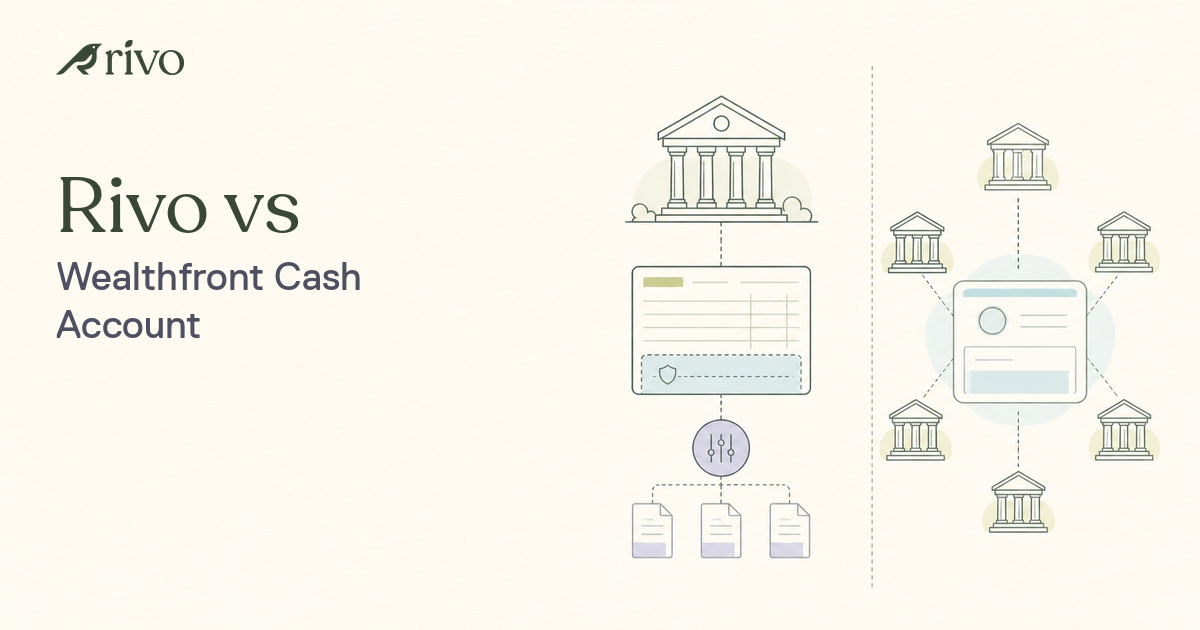
Rivo and the Wealthfront Cash Account can both help cash earn more, but they solve different problems.
The Wealthfront Cash Account is a separate brokerage cash account with checking and savings features. Available cash is swept to program banks, where it earns a variable rate and may qualify for FDIC insurance subject to program terms. You can use the account for direct deposit, bills, debit-card spending, checks, and savings goals.
Rivo works on top of your existing checking account. You keep your bank, set a safe balance, and let Rivo identify cash above that floor. Eligible idle cash moves into short-duration U.S. Treasury Bills through Jiko Securities, and Rivo plans refills before expected bills.
The short answer is simple:
- Choose the Wealthfront Cash Account when you want a new place to hold, spend, and organize cash in one account.
- Choose Rivo when your current checking account works, but too much cash stays there because moving it manually around bills is the problem.
This is not a rate-only decision. The account structure, money-movement workflow, protection model, taxes, and amount of attention required are different.
TL;DR
- The Wealthfront Cash Account is a separate cash hub. It combines checking and savings features and sweeps available cash to program banks. The current page lists a 3.30% base APY, zero account fees, and FDIC insurance eligibility of up to $8 million for an individual account, subject to program conditions.
- Rivo is a checking-adjacent automation layer. It works with your existing bank, uses a user-set safe balance, and moves eligible idle cash into short-duration U.S. Treasury Bills through Jiko Securities.
- The current Rivo rate is variable. The rate page lists a 3.65% gross annualized rate as of July 1, 2026. The rate reflects the four-week T-bill rate when held to maturity, excludes fees, and can change.
- Rivo charges a management fee. The fee is 0.05% per month, or about 0.60% per year before compounding. The Wealthfront Cash Account lists no account fee, although some debit-card transactions can have fees.
- The protection labels are not interchangeable. Eligible Wealthfront deposits at program banks can receive FDIC pass-through coverage subject to conditions. Rivo T-bill holdings are securities, not FDIC-insured bank deposits. SIPC can protect eligible assets if a member brokerage fails, but SIPC does not protect against changes in security value.
- Taxes can change the net comparison. Wealthfront Cash Account interest is generally bank-deposit interest. T-bill investment income is federally taxable but not subject to state or local income taxes. Consult a tax advisor for your situation.
- Choose based on the job. Wealthfront can replace or supplement a cash account. Rivo keeps the existing checking account in place and automates the idle layer above a chosen floor.
Rivo vs Wealthfront Cash Account in One Minute
The table shows why a headline-rate comparison is incomplete. One product changes where you hold and transact with cash. The other leaves your daily bank setup in place and manages the excess around it.

What Problem Does Each Product Solve?
The clearest way to compare Rivo and the Wealthfront Cash Account is to ask what caused the cash problem in the first place.
Wealthfront solves the cash-account problem
The Wealthfront Cash Account is relevant when you want a single account for a paycheck, bills, debit-card spending, savings categories, and interest. Individual and Joint Cash Accounts include checking features such as direct deposit, account and routing numbers, bill pay, and debit-card access.
That makes Wealthfront a practical option for someone who is willing to make it a primary or secondary cash hub.
The operating model is:
1. Open a Wealthfront Cash Account.
2. Deposit or transfer cash into the account.
3. Use account features for spending, bills, or savings.
4. Available cash is swept to program banks.
5. Program banks pay a variable rate on eligible deposits.
This can reduce the need to maintain a low-interest checking account plus a separate savings account. It can also put spending cash and savings cash under one interface.
Rivo solves the idle-checking-cash workflow problem
Rivo starts from a different constraint: you already have a checking account you want to keep.
Your paycheck lands there. Bills clear there. Autopay is already configured. The account works, but the balance regularly grows above what bills and spending require. You know some of the money is idle, yet manual transfers create another task and another chance to mistime a payment.
The operating model is:
1. Connect an existing checking account through Plaid.
2. Set a minimum checking threshold, or safe balance.
3. Rivo analyzes cash flow and identifies eligible cash above that floor.
4. Eligible idle cash moves into short-duration U.S. Treasury Bills through Jiko Securities.
5. Rivo plans to refill checking before expected bills and transfers.
6. You can adjust the floor, pause automation, stop, or disconnect.
Rivo is not trying to become your new checking account. It is trying to make the surplus above your checking floor productive without requiring a bank switch.
.svg)
Is Rivo a Cash Account Like Wealthfront?
No. Rivo is not a cash account, savings account, or bank.
Rivo is an automated cash-management service. It connects to an existing checking account and uses short-duration U.S. Treasury Bills through Jiko Securities for eligible idle cash. The user still relies on the existing bank account for normal checking activity.
The Wealthfront Cash Account is offered by Wealthfront Brokerage and combines checking and savings features. Wealthfront sweeps available cash to program banks, where it may receive FDIC pass-through insurance if program conditions are met.
That structural difference should be the first filter. If you want another account, compare cash-account features. If you do not want another account, compare how well an automation layer works with the account you already use.
Do You Have to Switch Banks?
Rivo does not require you to switch banks. The product works with existing bank accounts and is designed to leave direct deposit and bill pay in place.
The Wealthfront Cash Account does not force you to close another bank account, but using its full checking workflow means opening and funding a separate account. If you want Wealthfront to become the center of your cash life, you may also move direct deposit, bills, payment apps, and spending activity.
.svg)
This distinction matters because there are two kinds of switching:
- Provider switching: closing an old bank and moving everything.
- Workflow switching: keeping the old bank open but moving paychecks, bills, and daily cash activity to a new account.
Wealthfront can work without a full provider switch, but it still introduces a new cash destination. Rivo is designed for users who want the existing destination to remain unchanged.
Use this test:
How Do Rates and Fees Compare?
As of the dates published on each provider page:
- The Rivo rate page lists a 3.65% gross annualized rate as of July 1, 2026. It reflects the four-week T-bill rate when held to maturity, excludes fees, and is subject to change.
- The Wealthfront Cash Account page lists a 3.30% base APY provided by program banks. It is variable and subject to change.
- The Rivo fee is 0.05% per month, based on average daily balance. That is about 0.60% per year before compounding.
- The Wealthfront Cash Account lists no account fee, although debit-card use can create certain ATM, teller, international, or cash-deposit fees.
Do not subtract one headline rate from the other and stop. The published measures are not identical:
- Wealthfront publishes an APY for deposits at program banks. APY includes the effect of compounding.
- Rivo publishes a gross annualized T-bill-linked rate before the management fee.
- Rates can change on different dates and for different reasons.
- Rivo money may move in and out around bills, so the full balance may not stay invested for a full year.
- Taxes can affect bank interest and T-bill income differently.
Same-balance illustration
Assume an illustrative $20,000 balance remains eligible for a full year and both published rates stay unchanged. This is simple decision math, not a forecast.
At these dated rates, the Wealthfront base APY produces a higher before-tax amount than the simple Rivo after-fee estimate. In a state with income tax, the after-tax result may narrow or reverse because qualifying T-bill income is not subject to state or local income taxes. Your result depends on tax rates, balance changes, rate changes, timing, and whether T-bills are held to maturity.
The decision should therefore be:
Net cash outcome = earnings - fees - taxes - workflow failures
The last term matters. A no-account-fee product does not help idle checking cash if you never move the money into it. A paid automation product does not make sense if you already manage transfers reliably and do not need its workflow.
How Are FDIC and SIPC Protection Different?
Wealthfront and Rivo use different financial structures, so the protection language must stay separate.
Wealthfront Cash Account protection
Wealthfront sweeps available cash to participating program banks. Eligible deposits may receive FDIC pass-through insurance, subject to program conditions, ownership rules, allocation, and any deposits you already hold at the same banks.
Wealthfront lists FDIC insurance eligibility of up to $8 million for an Individual Cash Account and up to $16 million for a Joint Cash Account. Those figures depend on the number of available program banks and the satisfaction of coverage conditions. Customers are responsible for monitoring total deposits held at each program bank.
FDIC insurance protects eligible deposits if an insured bank fails. It does not protect a brokerage firm, and it does not apply before cash reaches a program bank under every circumstance.
Rivo protection
Rivo places eligible idle cash into U.S. Treasury Bills through Jiko Securities. T-bills are securities, not FDIC-insured bank deposits.
SIPC can protect eligible securities and cash held for securities transactions if a member brokerage fails. The current SIPC limit is up to $500,000, including a $250,000 limit for cash. SIPC does not protect against a decline in the value of a security or the result of selling a T-bill before maturity.
Protection is not a single score. Decide whether you want a bank-deposit structure or a Treasury-security structure, then evaluate the rules that apply to that structure.
How Tax Treatment Affects the Comparison
Tax treatment can matter when the before-tax rates are close.
Interest paid through Wealthfront program banks is generally taxable bank interest. Depending on your situation, federal, state, and local income taxes may apply.
Investment income on Treasury Bills is subject to federal income tax. TreasuryDirect states that it is not subject to state or local income taxes.
That can make Rivo more relevant for users in states with income tax, but it does not automatically decide the comparison. The Rivo management fee still reduces the gross result, and each household has a different tax profile.
Use this sequence:
1. Compare the same balance.
2. Use current, dated rates from both providers.
3. Subtract applicable product fees.
4. Estimate federal, state, and local taxes for each product structure.
5. Include the operational value of automation only if you need it.
This article is educational content, not tax advice. Consult a qualified tax advisor before making a decision based on tax treatment.
Which Product Handles Bills More Directly?
Both products can support bill management, but they do it differently.
The Wealthfront Cash Account can pay bills directly when checking features are enabled. You can use account and routing numbers, direct deposit, payment apps, a debit card, and check features. The cash stays inside the Wealthfront account until you spend or transfer it.
Rivo leaves bill payment at your current bank. It monitors the linked checking workflow, respects a user-set floor, and plans refills before expected bills or transfers. The cash-management loop sits around the checking account rather than replacing its payment functions.
If you are comfortable changing the account that pays bills, Wealthfront gives you a direct cash-account workflow. If changing bill pay is the friction you are trying to avoid, Rivo addresses that exact constraint.
Which Product Gives Faster Access to Cash?
The answer depends on where you need the cash.
Wealthfront advertises free instant withdrawals to eligible external accounts, including supported transfers through real-time payment networks. Other external withdrawals generally follow provider timing, and recent deposits can take longer.
Rivo allows withdrawals of available funds through the app up to $15,000 per day. Rivo also plans refills before expected bills. If T-bills must be sold before maturity, the realized result can differ from the held-to-maturity rate and liquidity timing still matters.
Neither statement means every dollar should leave checking. Cash needed for an immediate debit transaction, same-day bill, tax payment, closing, tuition payment, or other known large expense should remain where it can transact on time.
For larger cash needs, ask:
- Is the amount already available, or is it tied to a recent deposit?
- Does an external account qualify for instant transfer?
- Is a T-bill sale required?
- Is there a daily withdrawal limit?
- Does the bill need same-day funds or can it be planned in advance?
Rivo is strongest for predictable cash flow that can be planned around a floor. Wealthfront is strongest when the cash already sits in the Cash Account and its payment or transfer features match the need.
When Wealthfront Cash Account Is the Right Fit
The Wealthfront Cash Account is the more direct fit when you want a separate account that combines spending, saving, and variable interest.
Choose Wealthfront first when:
- You want eligible deposits swept to program banks.
- FDIC pass-through insurance eligibility is central to the decision.
- You want checking features, savings categories, and interest in one account.
- You are comfortable opening and funding a new cash account.
- You may move direct deposit or bill pay to the new account.
- You want no account management fee.
- You already use Wealthfront investing products and prefer one interface.
- You reliably direct new excess cash into the Cash Account.
Example: the new cash-hub household
A household keeps $18,000 between checking and savings, wants a debit card and bill pay in the same interface, and is willing to redirect paychecks. The main decision is where to hold and transact with cash.
The Wealthfront Cash Account fits because the household is willing to make the account part of daily banking. Rivo would add less value if there is no need to preserve the existing checking workflow.
When Rivo Is the Right Fit
Rivo is the more direct fit when the existing checking account is staying, but persistent surplus cash is not being managed.
Choose Rivo first when:
- You want to keep the current bank.
- You do not want to move direct deposit or bill pay.
- Your checking balance repeatedly stays above what bills require.
- Manual savings transfers or T-bill purchases have not become a durable habit.
- You want to choose a checking floor and automate only cash above it.
- You are comfortable holding short-duration U.S. Treasury Bills through a brokerage relationship.
- Bill-aware refills matter more than opening another cash account.
- The potential idle balance is large enough for the workflow to justify the fee.
Example: the existing-bank household
A household keeps an illustrative $40,000 in checking because mortgage, credit cards, insurance, and irregular expenses all clear from that account. After reviewing bills and adding a cushion, the household sets an illustrative $17,000 safe balance.
$40,000 checking balance - $17,000 safe balance = $23,000 potential idle cash
The household has opened savings accounts before but stopped making transfers. It does not want to change direct deposit or update every bill.
Rivo fits the workflow because the goal is not to create a new cash hub. The goal is to leave the current hub alone while automating the idle layer above the chosen floor.
When Should You Avoid Rivo?
Do not choose Rivo when the money is not truly idle or when the automation fee does not solve a real problem.
Rivo may be a weak fit when:
- Nearly all checking cash is needed for bills or near-term spending.
- You want only FDIC-insured bank deposits.
- You are uncomfortable holding Treasury securities.
- You can manage direct T-bill purchases and checking transfers consistently.
- You need access above the $15,000 daily available-funds withdrawal limit without planning.
- Your checking balance is usually below the $5,000 level where the product is described as working best.
- You prefer a new primary cash account with direct spending features.
- You do not want to pay the 0.05% monthly management fee.
Rivo is not a universal replacement for checking, savings, or a brokerage. It is a specific solution for persistent idle checking cash and the repeated work of moving it safely.
When Should You Avoid the Wealthfront Cash Account?
The Wealthfront Cash Account may be a weak fit when the main obstacle is opening, funding, and maintaining another account.
Consider another path when:
- You do not want a separate cash account.
- You want every bill to continue clearing from the same existing checking account.
- You know you will not move excess checking cash into Wealthfront consistently.
- You want direct short-duration Treasury Bill exposure rather than program-bank deposits.
- You need a system that identifies cash above an external checking floor and plans refills around that account.
- Your deposits at program banks may overlap with money already held at those banks, reducing available FDIC coverage.
- The specific checking features you need are unavailable for your account type.
Wealthfront can be a strong cash account. It does not solve the behavior problem if the money remains in the old checking account because the transfer never happens.
Decision Matrix: Rivo or Wealthfront Cash Account?
The final question is not "Which product has the highest rate today?"
It is:
Do I want a new cash account, or do I want my existing checking account automated?
That answer usually resolves the comparison faster than another rate table.
Final Recommendation
Choose the Wealthfront Cash Account when you want a separate account that can receive deposits, pay bills, support spending, organize savings, and route eligible cash to program banks.
Choose Rivo when your existing checking account already works and the unresolved problem is the idle balance above what bills require. Rivo lets you set a safe balance, keep the bank setup in place, and automate eligible cash movement into short-duration U.S. Treasury Bills through Jiko Securities.
The Wealthfront Cash Account is a destination for cash. Rivo is a control layer for cash already sitting in checking.
Before choosing either product, calculate the true idle amount:
Potential idle cash = checking balance - safe balance
If the result is close to zero, keep the cash available for bills. If the result stays meaningfully positive for months, decide whether you want to move the cash into a new account or automate it around the one you already use.
FAQ
Is Rivo the same as the Wealthfront Cash Account?
No. The Wealthfront Cash Account is a separate brokerage cash account that sweeps available cash to program banks and includes checking and savings features. Rivo connects to an existing checking account and uses short-duration U.S. Treasury Bills through Jiko Securities for eligible idle cash above a user-set floor.
Does Rivo require a bank switch?
No. Rivo works with existing bank accounts and does not require users to move direct deposit or bill pay.
Is the Wealthfront Cash Account a bank account?
The Cash Account is offered by Wealthfront Brokerage, not a bank. Wealthfront sweeps available cash to participating program banks, where eligible deposits may receive FDIC pass-through insurance subject to conditions.
Which has a higher current rate?
The Rivo rate page lists a 3.65% gross annualized rate as of July 1, 2026, before fees and taxes. The Wealthfront Cash Account page lists a 3.30% base APY. Those conditional rates can exceed the Rivo rate for a qualifying customer. The measures are different, all of these rates can change, and the Rivo fee must be included before comparing net outcomes.
Which charges less?
The Wealthfront Cash Account lists no account fee, although some debit-card transactions can have fees. Rivo charges 0.05% per month, based on average daily balance.
Which is FDIC-insured?
Eligible Wealthfront deposits swept to program banks may receive FDIC pass-through insurance subject to program conditions. Rivo T-bill holdings are securities and are not FDIC-insured bank deposits.
Which is easier for bills?
Wealthfront can pay bills directly from eligible Individual or Joint Cash Accounts. Rivo is designed to leave bills at the existing bank and plan refills to linked checking before expected payments.
Can you use both Rivo and Wealthfront?
Potentially, but the roles should be clear. Wealthfront could hold a separate savings or spending bucket, while Rivo could manage eligible surplus above a floor in a supported primary checking account. More accounts can also add complexity, so use both only when each has a distinct job.
What is the biggest difference between Rivo and Wealthfront?
Wealthfront asks where you want to hold and use cash. Rivo asks how much cash must remain in your current checking account and what should happen to the excess.
Related Rivo Reading
- To compare the broader provider landscape, read Rivo Alternatives.
- To compare Rivo with a goal-based, program-bank cash reserve, read Rivo vs Betterment Cash Reserve.
- To compare another brokerage-based cash hub, read Rivo vs Fidelity Cash Management Account.
- To compare a brokerage cash account with bill-aware automation, read Rivo vs Vanguard Cash Plus Account.
- To compare a paid brokerage cash program with Rivo, read Rivo vs Robinhood Gold Cash Sweep.

This article is educational and is not financial, investment, tax, accounting, or legal advice.
Yield rate reflects the 4-week T-bill rate when held to maturity. Rate does not include fees. Rates are subject to change. Minimum balance of $100 required to earn the stated rate.
Rivo is a fintech company, not a bank. Banking services provided by Jiko Bank, a division of Mid-Central National Bank. Jiko Group, Inc. and its affiliates do not provide legal, tax, or accounting advice. You should consult your legal and/or tax advisors before making any financial decisions. This material is not intended as a recommendation, offer or solicitation for the purchase or sale of any security or investment strategy. See FINRA BrokerCheck, Jiko U.S. Treasuries Risk Disclosures and Jiko Securities Inc. Form CRS.
Investments in T-bills: Not FDIC Insured - No Bank Guarantee - May Lose Value. All U.S. treasury investments and investment advisory services provided by Jiko Securities, Inc., a registered broker-dealer, member FINRA and SIPC. Securities in your account are protected up to $500,000. For details, please see www.sipc.org.
Wealthfront Cash Account rates, features, program banks, promotions, and FDIC insurance eligibility can change. Review current Wealthfront disclosures and program-bank information before opening or funding an account.
Sources
- Rivo product overview
- Rivo product, fee, money-movement, and access details
- Rivo current rate details
- Wealthfront Cash Account
- Wealthfront Cash Account overview
- Wealthfront Cash Account fees
- Wealthfront checking features
- TreasuryDirect Treasury Bills
- TreasuryDirect tax forms and withholding
- SIPC: What SIPC Protects
.jpeg)
Ambrish Tyagi is the founder and CEO of Rivo. Previously led AI at Cruise and Amazon.
Follow on LinkedInGet Rivo Updates
Product news, money insights, and company updates.