Rivo vs Ally Bank Savings: Bill-Aware T-Bill Automation or a Separate High-Yield Savings Account?
Compare Rivo vs Ally Bank Savings on rates, fees, automation, buckets, transfer timing, FDIC and SIPC protection, taxes, liquidity, and buyer fit.
.png)
Rivo and Ally Bank Savings can both help cash earn more than it may earn in a low-interest checking account, but they automate different jobs.
Ally gives you a separate FDIC-insured savings account. You can move money into it, divide the balance among savings buckets, schedule recurring transfers, use Round Ups with an Ally Spending Account, or let Surprise Savings make small transfers from a linked checking account.
Rivo keeps your existing checking account at the center. You set the minimum balance that should remain protected, and Rivo manages eligible cash above that floor through short-duration U.S. Treasury Bills held at Jiko Securities. The automation is designed to account for cash-flow patterns and bring money back before expected bills.
*Movement of funds is not instant. Transfers to your linked account can take up to 3 business days to settle, and longer if a Treasury Bill must be sold first. Rivo plans around known bills. It does not guarantee same-day access or a specific arrival date..
The practical choice is:
- Choose Ally Bank Savings if you want a no-maintenance-fee, FDIC-insured savings account with named buckets and user-configured saving tools.
- Choose Rivo if your current bank works, but a variable surplus repeatedly stays in checking because deciding how much to transfer and when to bring it back is the recurring problem.
This is not a universal winner-takes-all comparison. Ally can be the better place for an emergency fund or named savings goals. Rivo can be the better operating layer for cash that changes after paydays, card payments, rent, taxes, and other bills.
For the broader category decision, read Rivo vs High-Yield Savings vs Treasury Bills. For the product mechanics, read What Is Rivo?.
TL;DR
- Ally is the stronger fit for deposit-first savers. Its Savings Account is an FDIC-insured bank deposit with $0 monthly maintenance fees and a $0 minimum opening deposit.
- Rivo is the stronger fit for variable checking surplus. It works with an existing checking account, protects a user-set minimum balance, and manages eligible cash around expected bills.
- Current headline rates are close after the Rivo fee. Ally Bank Savings Account listed a 3.00% variable APY as of September 2, 2026. Rivo listed a 3.64% gross annualized rate as of August 3, 2026, before its 0.05% monthly management fee.
- Ally has richer goal organization. Its Savings Account supports up to 30 savings buckets plus recurring transfers, Round Ups, and Surprise Savings.
- The two automation systems are not equivalent. Ally Surprise Savings moves up to $25 on Mondays, Wednesdays, and Fridays, subject to checking-history and balance rules. Rivo is designed to evaluate eligible cash above a checking floor and plan refills before expected bills.
- Protection and taxes can change a close comparison. Ally Savings is an FDIC-insured deposit account. Rivo uses Treasury securities held through Jiko Securities, a SIPC member. Bank interest is generally taxable income, while Treasury-bill interest is federally taxable but exempt from state and local income taxes, according to IRS Topic 403.
- Start with the cash job. Assigned emergency savings, a house fund, and next month's bills should not be treated as the same pool as recurring idle checking cash.
Rivo vs Ally Bank Savings in One Minute
The fastest way to choose is to ask where the money belongs before it earns anything. If it is savings cash, Ally is the natural starting point. If it is a recurring excess inside checking that remains after bills and a cushion, Rivo addresses the more specific workflow.
.svg)
The Core Difference Between Rivo and Ally Bank Savings
The core difference is a destination account versus a checking-aware management layer.
Ally creates a savings destination
Ally Bank Savings is a destination. You open the account, fund it, organize the balance, and decide how cash should move in or out. Ally adds tools that reduce some of the manual work, but the savings account remains a separate bank account with its own transfer and withdrawal rules.
Rivo manages the checking-surplus layer
Rivo is an overlay. You keep the transaction account where paychecks land and bills clear. The protected minimum remains in checking, while eligible cash above that floor can be managed through Treasury Bills.
Ally is more complete as a savings product. Rivo is more specialized as a checking-surplus workflow.
What Is Ally Bank Savings?
Ally Bank Savings is an online savings account offered by Ally Bank, Member FDIC. Its current product page lists a variable APY, daily compounding, no monthly maintenance fee, no minimum opening deposit, savings buckets, boosters, and round-the-clock customer support.
The account is useful for:
- emergency savings
- home, travel, tuition, or tax goals
- cash that should remain in an FDIC-insured deposit
- people who prefer a separate savings account
- savers who want named buckets without opening multiple accounts
- households that will use scheduled transfers or Ally's saving boosters
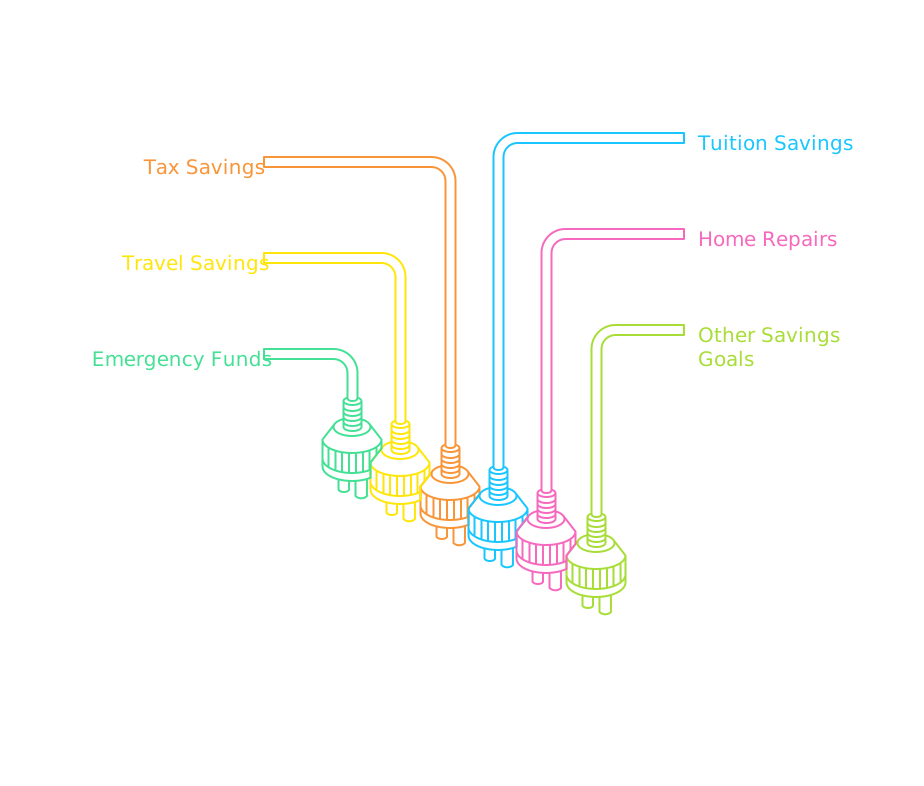
Ally's strongest feature is organization
The Savings Account supports up to 30 buckets. Each bucket is an allocation inside the same account, not a separate deposit account. Interest still accrues on the total account balance.
These tools make Ally more than a rate-only account. A household can see which dollars are assigned to which goal without maintaining several separate savings accounts.
What Is Rivo?
Rivo is automated cash management for money that repeatedly remains above the operating needs of an existing checking account.
The workflow is:
1. Keep the existing checking account, direct deposit, bill pay, and debit-card setup.
2. Connect checking through Plaid.
3. Set the minimum checking balance that should remain protected.
4. Let Rivo analyze balances and cash-flow patterns.
5. Move eligible cash above the protected floor into short-duration U.S. Treasury Bills through Jiko Securities.
6. Plan money back before expected bills and transfers.
7. Adjust the floor, pause, stop, or disconnect when circumstances change.
The current product supports earnings automation for one primary checking account. A user can connect multiple accounts, but only one primary checking account is currently used for the automated earnings workflow.
Rivo is not a savings account, high-yield savings account, bank replacement, or goal-bucket app. Its job is narrower: determine which part of a checking balance may be eligible to work and manage that layer around the checking account's obligations.
.svg)
Ally Surprise Savings vs. Rivo Autopilot
Ally Surprise Savings is the closest feature-level comparison, but the movement scope is materially different.
Ally analyzes a linked checking account and moves small amounts into Ally Savings. Current help-center terms state that Surprise Savings:
- moves up to $25 per transfer
- runs on Mondays, Wednesdays, and Fridays, excluding bank holidays
- does not start a transfer if linked checking is below $1,000
- requires at least 180 days of transaction history for an external checking account
- requires at least 90 days of transaction history for an Ally Spending Account
- sends an alert after a transfer
- requires the user to move money back manually after the transfer completes
Rivo uses a user-set checking floor rather than the same fixed transfer cap. Its current terms describe a system that evaluates cash above the protected amount, becomes more conservative when patterns look uncertain, and plans refills before expected bills.
Ally Surprise Savings is intentionally conservative and incremental. Rivo is designed for a larger and more variable idle-cash layer. That makes Rivo more relevant when the recurring surplus is measured in thousands rather than a series of small saving transfers.
Do You Have to Switch Banks?
Neither option requires closing your current checking account.
Ally Bank Savings can be opened alongside an existing bank. You then link accounts and move cash through ACH, wire, direct deposit, or other supported methods. Adding an Ally Spending Account is optional.
Rivo is explicitly designed around keeping the existing checking account. The transaction hub stays where it is, and only the eligible layer above the protected floor enters the Rivo workflow.
The difference is not whether you can keep your bank. The difference is whether you want to create a separate savings destination and manage the boundary between accounts.
Current Rates Compared
As of the dates shown on each provider's current pages:
- Ally Bank Savings Account listed a 3.00% variable APY as of September 2, 2026.
- Rivo listed a 3.64% gross annualized rate as of August 3, 2026, reflecting the four-week T-bill rate when held to maturity and before fees
- Rivo charges a 0.05% monthly management fee, calculated on average daily balance.
The current rate spread is not the decision
The dated numbers make the pre-tax rate comparison nearly even after a simplified Rivo fee subtraction. Rivo does not win this decision through a dramatic headline-rate gap. It wins only when its workflow, Treasury structure, and tax treatment are more valuable to the buyer than Ally's deposit structure, no-maintenance-fee model, and savings tools.
Rates can change after publication. Confirm both current pages on the day you decide.
How Do Fees and Account Costs Compare?
Ally lists no monthly maintenance fee, no minimum opening deposit, no overdraft item fee, and no fee for standard or expedited ACH transfers on its current Savings Account page. It lists a $20 outgoing domestic wire fee.
Rivo charges for automated cash management.
A $0 account can still leave work with the user
Ally is cheaper on stated recurring product cost. The Rivo fee pays for a different service: checking analysis, a protected floor, eligible Treasury movement, and planned refills.
The right fee question is not "which line is lower?" It is "does the paid automation solve the reason the cash remained idle?"
What Each Option Produces on the Same Illustrative Balance
The following calculations use the dated published rates, assume those rates remain unchanged for a full year, ignore compounding differences, and hold the full balance in the earning position. They are illustrative, not forecasts.
For Rivo, the simplified calculation subtracts a 0.60% annual fee equivalent from the 3.65% gross annualized rate as on july 1, 2026The actual fee uses average daily balance, and actual results can change with T-bill rates, movement timing, early sales, and taxes.
Illustrative $20,000 earning balance
Illustrative $50,000 earning balance
The difference is only $10 in the first illustration and $25 in the second. A rate change of a few basis points could reverse the order. That is why workflow, taxes, protection, and access should drive the decision.
How Taxes Affect the Comparison
For a U.S. taxpayer, bank-account interest and Treasury-bill interest are generally federally taxable. The state and local treatment differs.
IRS Topic 403 identifies bank-account interest as taxable interest and states that interest on Treasury bills, notes, and bonds is subject to federal income tax but exempt from state and local income taxes.
Illustrative tax sensitivity
Assume a household has a 24% federal marginal rate and an 8% state marginal rate. Ignore deductions, credits, compounding, timing, and any special treatment. On an illustrative $50,000 balance:
This is a simplified sensitivity test, not tax advice. It shows why a close pre-tax comparison can favor Treasury income for some residents of states with income tax. A resident of a state without individual income tax would not receive that same state-tax difference.
Is Ally FDIC-Insured, and Is Rivo SIPC-Protected?
Yes, but those statements describe different systems.
FDIC protects eligible deposits
The FDIC standard coverage limit is $250,000 per depositor, per insured bank, per ownership category. Eligible deposits in Ally Bank Savings fall under that deposit-insurance framework.
SIPC addresses brokerage custody failure
Rivo's earning asset is a security, not a bank deposit. Jiko's current Treasury risk disclosure states that Jiko Securities is a SIPC member and that SIPC protection covers eligible customer securities up to $500,000, including up to $250,000 for cash claims.
Do not collapse these labels into "both are insured." Ally is the clearer choice if the requirement is an FDIC-insured deposit. Rivo requires comfort with Treasury securities, brokerage custody, and the possibility that a sale before maturity can affect realized value.
Liquidity and Transfer Timing Compared
Ally Savings is liquid, but moving cash to an external bank uses payment rails and account rules.
Ally access depends on the transfer rail
Ally's current transfer guide lists:
- instant transfers between Ally Bank accounts
- one business day for eligible next-day external transfers
- three business days for standard external transfers
- possible extra time on weekends and bank holidays
- 10 limited withdrawals or transfers per Savings statement cycle
Rivo access depends on the protected floor and available funds
Rivo keeps the protected floor in the existing checking account. Current product terms allow withdrawals of available funds up to $15,000 per day, while early T-bill liquidation can create costs or change realized yield.
Liquidity is not only "can I withdraw?" It is "which account has the money, what rail moves it, what cutoff applies, and what happens if the need arrives earlier than expected?"
Buckets vs. a Safe Balance
Savings buckets and a safe balance solve opposite allocation problems.
Buckets assign savings
A bucket answers: "What is this savings money for?"
A safe balance protects checking
A safe balance answers: "How much must remain in checking before anything is considered eligible to move?"
You may need both concepts. Assigned savings should be kept out of the idle-cash calculation. The safe balance should include near-term checking needs, not long-term goals already stored in a savings bucket.
Which Option Is Better for an Emergency Fund?
Ally Bank Savings is usually the more direct fit when the emergency fund must remain an FDIC-insured deposit, stay visibly separated from checking, and use named goal organization.
Rivo is not an emergency-fund account. Some households may choose Treasury securities for part of a larger reserve, but money that must be available without notice should not depend on a T-bill sale, a brokerage withdrawal, or a daily app limit.
The clean architecture is often three layers: checking for transactions, Ally Savings for assigned reserves, and only then a separate decision about recurring idle checking cash.
For the full reserve decision, read Should You Keep Your Emergency Fund in Checking?.
Which Option Is Better for Variable Checking Surplus?
Rivo is usually the more direct fit when the surplus changes every month and manual transfers are the reason cash stays in checking.
Consider an illustrative household:
- checking starts the month at $42,000
- ordinary bills and spending require $18,000
- a conservative checking cushion is $7,000
- a $5,000 annual-insurance payment is due next month
- the remaining $12,000 may be eligible idle cash
A fixed $500 recurring transfer would move too little. Moving the full visible difference would move too much because the annual bill is assigned. The useful workflow is to protect the floor and known obligations, then evaluate what remains.
Rivo's differentiation is not that Ally lacks automation. Ally has useful automation. Rivo's difference is that the automation starts from a protected checking floor and a larger variable surplus rather than a user-selected saving rule or small Surprise Savings transfer.
Who Should Choose Ally Bank Savings?
Choose Ally when the cash is savings first.
Strong Ally fit
- You want an FDIC-insured deposit account.
- You want no monthly maintenance fee.
- You want up to 30 named savings buckets.
- You prefer a bank account over Treasury securities.
- You will use recurring transfers, Round Ups, or Surprise Savings.
- You can plan around external transfer timing and the statement-cycle withdrawal limit.
- You want an emergency fund or goal balance visibly separated from checking.
Ally is not a weak alternative. It is a strong savings account for buyers who will consistently move the right amount into it and keep assigned savings separate from daily spending.
Who Should Choose Rivo?
Choose Rivo when the cash is checking surplus first.
Strong Rivo fit
- Your existing checking account already handles paychecks and bills reliably.
- The balance repeatedly remains above bills, spending, and a conservative cushion.
- The surplus changes after bonuses, card payments, taxes, or irregular expenses.
- Manual transfers to savings or direct Treasury Bills have not stayed consistent.
- You are comfortable with a brokerage-held Treasury structure.
- You value planned refills enough to pay the management fee.
- Treasury income's state and local tax treatment matters in your situation.
Rivo is not for every dollar. It is for the cash that repeatedly survives the checking cycle above a realistic floor.
When to Choose Neither
Choose neither when the money is not idle, the economics are too small, or the current system already works.
A vendor-aware comparison should preserve the option to wait. Assigned cash should not be moved merely because a current rate looks attractive.
Can You Use Ally Bank Savings and Rivo Together?
Yes, if each system has one distinct job.
One reasonable structure is:
1. Existing checking handles paychecks, bills, cards, and immediate spending.
2. Ally Savings holds the emergency fund and named goals.
3. Rivo evaluates only the recurring cash above the checking floor.
Avoid overlapping automations. An Ally recurring transfer, Ally Surprise Savings, and Rivo should not all assume the same checking dollars are available. Choose one owner for each movement rule, then test the full setup across at least one complete bill cycle.
Rivo or Ally: Buyer-Fit Decision Matrix
Ally wins the deposit, fee, and goal-organization rows. Rivo wins the variable-surplus and bill-aware rows. That is the correct comparison frame.
How to Choose Between Rivo and Ally
Use a six-step decision process.
Step 1: Label every dollar
Separate checking bills, a timing cushion, emergency savings, named goals, taxes, and long-term investments. Only compare the unassigned recurring surplus.
Step 2: Choose the required wrapper
If the money must be a bank deposit, Ally fits the requirement. If short-duration Treasury securities are acceptable, Rivo can remain in the comparison.
Step 3: Decide whether the amount is fixed or variable
Use Ally recurring transfers for a predictable amount. Use Rivo when the amount above the checking floor changes after each cash-flow cycle.
Step 4: Normalize rates and fees
Compare Ally's current APY with Rivo's current gross annualized rate minus the current management fee. Use the same balance and same date.
Step 5: Test access and protection
Map the earliest plausible withdrawal date, transfer rail, daily or statement-cycle limit, FDIC coverage, SIPC scope, and early-sale risk.
Step 6: Run a complete bill cycle
Test paydays, housing, card autopay, utilities, insurance, taxes, and an irregular expense. Keep the floor conservative until actual low-balance behavior is visible.
Final Recommendation
Choose Ally Bank Savings if you want a separate FDIC-insured savings account with no monthly maintenance fee, named buckets, daily compounding, and several user-configured saving tools. It is the clearer answer for an emergency fund, assigned goals, and deposit-first savers.
Choose Rivo if you want to keep the checking account that already runs your household and automate the cash that repeatedly remains above bills and a conservative floor. It is the clearer answer when the surplus changes, manual transfers are the reason the cash remains idle, and a Treasury-based structure fits your risk and tax preferences.
Do not choose Rivo because its dated gross rate is 0.65 percentage points above Ally's dated APY. After the current Rivo fee, the simplified pre-tax difference is about 0.05 percentage points. Do not choose Ally only because its recurring fee is $0. A free account that never receives the recurring surplus does not solve the workflow.
Choose the cash job first. Then compare the current rate, fee, tax treatment, protection, transfer timing, and automation that you will still use after several complete bill cycles.
Pre-Decision Validation Checklist
Repeat this checklist whenever rates, product terms, or your cash-flow pattern changes. A correct comparison is dated.
FAQ
Is Rivo the same as an Ally high-yield savings account?
No. Ally Bank Savings is an FDIC-insured deposit account. Rivo is an automated cash-management service that works with an existing checking account and uses short-duration U.S. Treasury Bills through Jiko Securities for eligible idle cash.
Which currently pays more, Rivo or Ally Bank Savings?
The current pages list 3.64% gross annualized for Rivo as of August 3, 2026 and 3.00% APY for Ally Bank Savings as of September 2, 2026. Rivo charges a 0.05% monthly fee, making the simplified pre-tax comparison close. Rates can change.
Does Ally automate idle cash like Rivo?
Ally offers Surprise Savings, recurring transfers, and Round Ups, but the mechanics differ. Surprise Savings currently moves up to $25 on three weekdays under account-history and balance rules. Rivo is designed around a user-set checking floor, a larger eligible surplus, and planned refills before expected bills.
Is Rivo FDIC-insured like Ally?
No. Ally Savings deposits are eligible for FDIC insurance under applicable limits. Rivo's Treasury-bill holdings are securities, not FDIC-insured deposits. They are held through Jiko Securities, a SIPC member, and SIPC does not protect against market loss.
Is Ally better for an emergency fund?
Ally is usually the more direct fit when the emergency fund must be an FDIC-insured deposit with a named bucket. Keep any amount needed immediately in checking, because external transfers can take time.
Can I use Ally for savings goals and Rivo for checking surplus?
Yes, if the jobs do not overlap. Ally can hold assigned goals and emergency savings, while Rivo evaluates only the recurring cash above the checking floor. Disable duplicate transfer rules that could act on the same dollars.
Related Rivo Reading
- To compare the main cash destinations, read Rivo vs High-Yield Savings vs Treasury Bills.
- To compare Rivo with FDIC-insured deposit optimization, read Rivo vs MaxMyInterest.
- To compare the broader vendor and DIY landscape, read Rivo Alternatives.
- To evaluate other alternatives to a separate savings account, read High-Yield Savings Account Alternatives for Idle Checking Cash.
- To compare a brokerage cash account with bill-aware automation, read Rivo vs Vanguard Cash Plus Account.

This article is educational and is not financial, investment, tax, accounting, or legal advice.
Yield rate reflects the 4-week T-bill rate when held to maturity. Rate does not include fees. Rates are subject to change. Minimum balance of $100 is required to earn the stated rate.
Rivo is a fintech company, not a bank. Banking services provided by Jiko Bank, a division of Mid-Central National Bank. Jiko Group, Inc. and its affiliates do not provide legal, tax, or accounting advice. You should consult your legal and/or tax advisors before making any financial decisions. This material is not intended as a recommendation, offer or solicitation for the purchase or sale of any security or investment strategy. See FINRA BrokerCheck, Jiko U.S. Treasuries Risk Disclosures and Jiko Securities Inc. Form CRS.
Investments in T-bills: Not FDIC Insured - No Bank Guarantee - May Lose Value. All U.S. treasury investments and investment advisory services provided by Jiko Securities, Inc., a registered broker-dealer, member FINRA and SIPC. Securities in your account are protected up to $500,000. For details, please see www.sipc.org.
Investment income on T-bills is taxed federally by the Internal Revenue Service. Income earned from T-bills is not subject to state tax and is not subject to local income taxes. Jiko Group, Inc. and its affiliates do not provide legal, tax, or accounting advice. You should consult your legal and/or tax advisors before making any financial decisions.
Ally Bank Savings rates, features, limits, and fees cited in this article reflect publicly available terms checked on July 28, 2026 and can change. Ally Bank is a Member FDIC. Rivo is not affiliated with or endorsed by Ally Financial Inc. or Ally Bank.
Sources
- Rivo homepage
- Rivo product details
- Rivo current rate page
- Ally Bank Savings Account
- Ally Bank savings rates
- Ally Savings and Money Market help
- Ally ACH transfer timing
- Ally transfer help
- FDIC deposit insurance FAQs
- SIPC investor protection overview
- TreasuryDirect Treasury Bills
- IRS Topic 403: Interest Received
- Jiko U.S. Treasuries Risk Disclosure
- https://www.ally.com/help/bank/savings-money-market

Shalu Yadav is Rivo's SEO/GEO Expert, bringing over 10 years of experience in making financial content discoverable across both classic search and generative AI platforms.
Follow on LinkedInGet Rivo Updates
Product news, money insights, and company updates.