Rivo vs Betterment Cash Reserve: Existing-Bank Automation or an FDIC Cash Account?
Compare Rivo vs Betterment Cash Reserve on bank switching, rates, fees, automation, FDIC and SIPC protection, taxes, and access before you choose.
.png)
Rivo and Betterment Cash Reserve can both help cash earn more than it may earn in a conventional checking account. They do not solve the same cash-management problem.
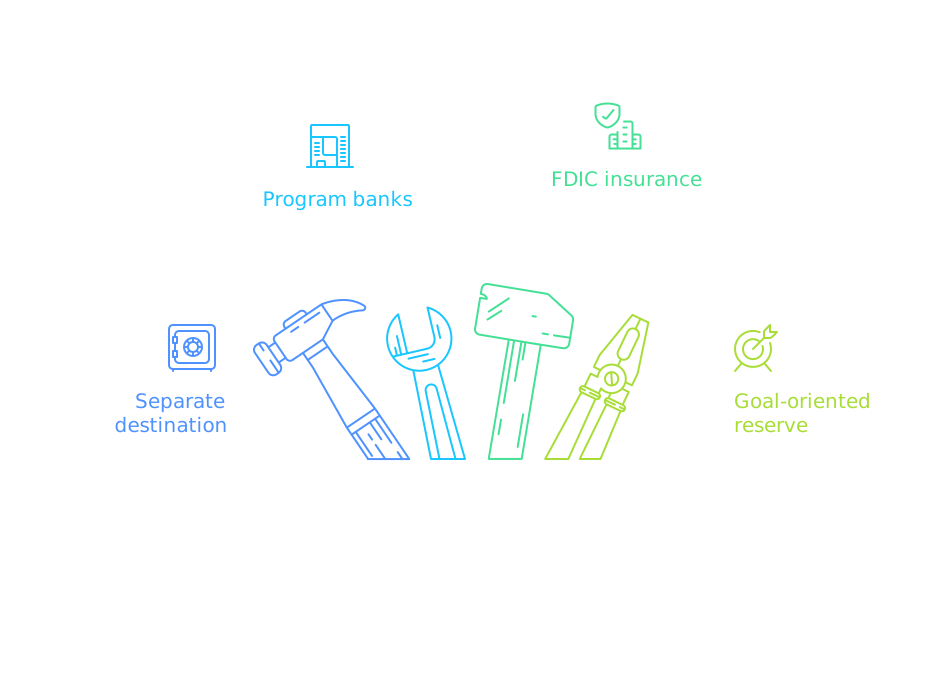
Betterment Cash Reserve is a separate cash destination. You transfer money into a Betterment cash goal, where eligible cash is deposited at program banks and can receive FDIC insurance subject to program terms. It works well when you want a defined reserve for an emergency fund, near-term goal, or cash you have already decided to move out of checking.
Rivo works on top of the checking account you already use. You set a minimum balance, Rivo identifies eligible cash above that floor, and the surplus is managed in short-duration U.S. Treasury Bills through Jiko Securities. Rivo also plans refills around expected bills.
The practical choice is:
- Choose Betterment Cash Reserve if you want a separate, goal-oriented cash reserve, prefer a program-bank deposit structure, and are comfortable deciding how much to transfer.
- Choose Rivo if your existing checking workflow works, but the amount of truly idle cash changes after bills and makes manual transfers difficult to maintain.
This is not simply a comparison between two published yields. It is a choice between a destination account for cash you allocate and an automation layer for cash that remains above a checking floor.
For the product overview, read What Is Rivo?. For a wider view of deposit, brokerage, and Treasury choices, read Rivo Alternatives.
TL;DR
- Betterment Cash Reserve is stronger when you want a separate cash goal. It supports named cash goals, recurring deposits, unlimited withdrawals, and program-bank FDIC insurance subject to conditions.
- Rivo is stronger when the transfer decision is the problem. You keep your existing checking account, choose a minimum balance, and let Rivo manage eligible surplus around expected cash needs.
- The current headline rates are close, but they are not stated on the same basis. Betterment's current terms list a 3.25% variable APY. Rivo lists a 3.65% gross annualized T-bill-linked rate as of July 1, 2026, before its management fee and taxes.
- Betterment currently has a temporary new-customer offer. Eligible new clients can receive a 0.75 percentage-point APY boost on up to $1,000,000 through January 15, 2027, with conditions and a variable underlying rate.
- The fee models differ. Betterment LLC and Betterment Securities list no fee on a Cash Reserve balance. Rivo charges 0.05% per month on the average daily balance.
- The protection labels are not interchangeable. Betterment routes eligible cash to FDIC-insured program banks. Rivo's T-bills are bought in your name and held in custody by Jiko Securities, a SIPC member. SIPC does not protect against a decline in a security's market value.
- The deciding question is operational. Do you already know what amount belongs in a separate reserve, or do you need a system that continually determines what remains available above your checking floor?
Rivo vs Betterment Cash Reserve in One Minute
The shortest useful summary is this: Betterment Cash Reserve helps you hold money after you decide it belongs in reserve. Rivo helps determine and manage the amount that can leave checking without forcing you to rebuild the banking workflow.
What Is the Core Difference Between Rivo and Betterment Cash Reserve?
The core difference is allocation versus orchestration.
Betterment Cash Reserve begins with an allocation decision. You decide that a specific amount belongs in an emergency fund, home-repair fund, tax reserve, travel fund, or other cash goal. You then transfer that amount from a connected funding account.
Rivo begins with an operating constraint. You decide how much must remain in checking. The system then evaluates eligible cash above that floor, monitors expected activity, and manages movement around the bills and transfers that continue to clear from checking.
.svg)
Allocation works when the amount is already known
If you have decided that a fixed emergency reserve should remain separate from spending, a cash goal is intuitive. The destination makes the purpose visible, and the transfer creates behavioral distance from daily checking.
Examples include:
- a home down payment expected in the next year
- a quarterly tax reserve
- a known tuition payment
- a fixed emergency-fund target
- a travel fund with a defined budget
Orchestration works when the amount keeps changing
Many households cannot identify one stable transfer amount because checking supports rent or mortgage payments, several credit-card autopays, insurance premiums, payroll changes, travel, and irregular annual expenses. The balance looks high after income arrives and less comfortable after obligations clear.
For that household, the problem is not opening another cash account. The problem is repeatedly answering, "How much is actually idle today?"
Rivo is designed around that question. For the underlying cash-flow problem, read Why Does My Checking Account Balance Fluctuate So Much?.
Betterment Cash Reserve
Betterment Cash Reserve is a cash-management product offered by Betterment LLC. It requires a Betterment Securities brokerage account, and Betterment is not a bank. Client cash in the program is deposited into participating program banks, where eligible balances can receive FDIC insurance subject to program rules.
The Betterment Cash Reserve overview lists:
- a variable APY
- FDIC insurance on eligible cash at program banks, subject to conditions
- access generally within 1 to 2 business days
- unlimited withdrawals
- no minimum balance requirement
- no fee on the Cash Reserve balance
Betterment also lets users create multiple cash goals. That makes Cash Reserve useful as a visible destination for separate near-term purposes.
Cash Reserve is separate from Betterment Checking
Cash Reserve is not the same product as Betterment Checking. It does not itself provide the routing and account-number workflow of a conventional checking account. Betterment's support page states that Cash Reserve does not currently accept direct deposit.
That distinction matters. A Cash Reserve withdrawal generally returns money to a connected funding account before the money can be used for a bill, card purchase, or cash withdrawal from the external bank.
Program-bank coverage depends on the whole ownership picture
Betterment currently describes eligible Cash Reserve balances as potentially FDIC-insured up to $4 million for an individual account or $8 million for a joint account, subject to program conditions.
That aggregate headline is not a new FDIC limit at a single bank. The standard insurance limit is applied by depositor, insured bank, and ownership category. Betterment can allocate deposits across program banks. Existing deposits you already hold directly or indirectly at the same bank can reduce available coverage.
The correct review is:
- identify the ownership category
- check the current program-bank list
- identify banks you may exclude
- account for deposits already held at each program bank
- review what protection applies while cash is in transit
The Betterment Cash Reserve disclosure notes that funds in transit to or from program banks are generally not FDIC-insured but are covered by SIPC.
What Is Rivo?
Rivo is automated cash management for money that repeatedly remains above the operating needs of an existing checking account.
The workflow is:
1. Keep the current checking account, direct deposit, debit card, and bill setup.
2. Connect the checking account through Plaid.
3. Choose a minimum checking balance.
4. Let Rivo analyze balances, income, spending patterns, and expected obligations.
5. Move eligible idle cash into short-duration U.S. Treasury Bills through Jiko Securities.
6. Plan refills before expected bills and transfers.
7. Pause, change the floor, request funds, or disconnect when circumstances change.
Rivo currently supports earnings automation for one primary checking account. Product-fit guidance indicates it works best for households that usually keep at least $5,000 in checking, while the current rate page lists a $100 minimum balance to earn the stated rate.
.svg)
Rivo is not a savings goal
Rivo does not ask you to create a separate "home repair" or "vacation" bucket before cash can be managed. Its main organizing rule is the checking floor.
That floor should reflect:
- upcoming bills
- routine card spending
- irregular obligations
- a comfort buffer
- the time needed to restore funds
Rivo is not a replacement checking account
Rivo does not replace your current bill pay, debit card, checks, or direct deposit. Those remain with the existing bank. The narrower job is to manage the eligible layer above the floor.
For the account-structure distinction, read Does Rivo Replace Your Bank?.
Do You Have to Change Your Checking Workflow?
Neither option requires you to close your current bank account. The amount of workflow change is still different.
Betterment Cash Reserve adds a destination outside the current checking account. You connect a funding source, choose an amount, transfer it, and later request a withdrawal when the money is needed. Betterment says an individual, joint, or trust cash goal can have up to four connected funding accounts over a 90-day period, with restrictions on multiple auto-deposits into one goal.
Rivo adds a management layer to the checking account's existing cash flow. Direct deposit and bills stay in place. The primary setup decision is the minimum balance and the controls governing movement.
Betterment adds intentional separation
Separation can be a feature. Money labeled "emergency fund" may be less likely to be spent casually. A goal can also make progress easier to see.
Rivo preserves transactional continuity
Continuity can also be a feature. Households with many existing billers, cards, checks, and transfers may not want a second reserve workflow for the portion of checking that changes every week.
The best account model depends on whether separation improves behavior or creates another manual cash-management task.
How Do Current Rates and Promotions Compare?
The current published figures are close enough that product structure should remain part of the decision.
Do not compare a temporary offer with a permanent assumption
The Betterment boost is useful for eligible new clients, but it has an end date. Its base rate can also change during the promotional period. A full-year illustration that assumes today's boosted rate lasts for a full year would overstate the known offer period.
The clean comparison uses:
- Betterment's current base APY for a stable annual illustration
- the temporary boost as a separate, dated benefit
- Rivo's current gross annualized T-bill-linked rate
- Rivo's fee as a separate cost
- tax treatment as a separate household-specific factor
Rates can change on both sides
Betterment's APY is variable. Rivo's return changes with prevailing short-duration Treasury rates and may also differ when a security is sold before maturity.
Neither current figure should be treated as a guaranteed future return. The decision should still work if the relative rate ordering changes.
How Do Fees Compare?
Betterment has the simpler balance-fee story. Betterment LLC and Betterment Securities do not charge a fee on the Cash Reserve balance. Program banks compensate Betterment LLC.
Rivo charges 0.05% each month, calculated on average daily balance. A simple annualized approximation is 0.60%, before considering monthly balance changes or compounding.
Illustration assumptions: The Rivo column assumes the same average balance for all 12 months and calculates 0.05% × 12. Actual fees depend on average daily balance. The table excludes taxes, rate changes, money movement, and any costs imposed by an external bank.
A fee comparison is not a value comparison
The fee tells you the direct cost, not whether the workflow produces a better result for a specific household.
Betterment may be the better value when:
- you already know the reserve amount
- you are willing to make or schedule the transfer
- you prefer the deposit structure
- you want goal labels
- you do not need bill-aware checking refills
Rivo may be the better value when:
- the idle amount changes frequently
- manual transfers repeatedly stop
- checking remains intentionally high to avoid shortfalls
- moving billers or direct deposit is undesirable
- the automation keeps more eligible cash working for more days
The fee is worth evaluating against the behavior it changes, not only against the same balance held perfectly in both products.
What Could the Same Balance Earn?
The following illustrations compare the current base figures without using Betterment's temporary new-client boost.
Illustration assumptions: Rivo uses the 3.65% gross annualized rate published for July 1, 2026 and a simple 0.60% annual fee approximation based on the 0.05% monthly fee. Betterment uses the 3.25% variable APY in terms updated June 17, 2026. The table assumes the full balance remains in the earning destination for 1 year. It excludes taxes, changing rates, transfer timing, cash retained in checking, early sales, and compounding differences. It is educational, not a forecast.
Betterment leads this simplified before-tax base-rate example
Under these fixed inputs, Betterment's base APY produces about $20 more on $10,000, $40 more on $20,000, $100 more on $50,000, and $200 more on $100,000 before tax.
That result is useful, but incomplete. It assumes both products receive exactly the same full balance for exactly the same period. In practice, a user may transfer less to a separate reserve because the safe amount is uncertain. Rivo may leave more cash in checking because the floor is conservative. Actual average balances matter as much as the displayed rate.
The promotional boost is a separate benefit
An eligible new Betterment client could currently receive a total rate equal to the variable base APY plus the 0.75-point boost through the stated end date. That can be a meaningful short-term advantage.
It should not be annualized beyond the known offer period, and it should not determine a long-term workflow choice by itself.
Rate changes can reverse the before-tax result
This sensitivity table holds Betterment at an illustrative 3.25% APY and applies the same simple 0.60% annual Rivo fee approximation used above. It shows why a small current lead should not be treated as permanent.
Illustration assumptions: The rates are hypothetical except for the row using the current 3.65% Rivo gross rate and the 3.25% Betterment base APY. The table assumes a constant $50,000 balance for 1 year, subtracts a simple 0.60% Rivo fee approximation, and excludes taxes, compounding, transfer timing, early sales, and promotions.
How Do Taxes Affect the Comparison?
Interest from Treasury marketable securities is subject to federal income tax but generally exempt from state and local income taxes. The TreasuryDirect tax guidance explains this treatment.
Interest from program-bank deposits is generally subject to federal, state, and local income tax where applicable.
An illustrative state-tax break-even point
Using only the current base inputs, Rivo's simplified return after its annualized fee approximation is 3.05%. Betterment's base rate is 3.25%.
If Betterment deposit interest faces a combined state and local marginal tax rate of roughly 6.15%, then 3.25% × (1 - 6.15%) is approximately 3.05%.
This is an illustrative comparison, not tax advice. It excludes federal taxes because both forms of income are generally federally taxable, and it assumes the entire Rivo balance remains invested at the stated gross rate. Household tax brackets, deductions, residency, security sales, and rate changes can alter the result.
Illustration assumptions: The table applies only a hypothetical state and local marginal tax rate to Betterment's 3.25% base APY and assumes Treasury-bill interest receives the usual state and local exemption. It does not calculate federal tax, deductions, capital gains or losses, changing rates, or individual filing circumstances.
Tax treatment can narrow or reverse a small rate gap
For a resident of a jurisdiction with no individual state income tax, the Treasury exemption may provide little or no state-tax advantage. For a resident of a higher-tax jurisdiction, it can matter more.
The correct after-tax comparison uses:
1. the expected average earning balance
2. the current gross return or APY
3. direct fees
4. federal tax treatment
5. state and local tax treatment
6. the effect of any sale before maturity
For a broader asset comparison, read Rivo vs High-Yield Savings Accounts vs Treasury Bills.
Where Does the Money Sit, and What Protection Applies?
The products use different legal and protection structures.
Betterment Cash Reserve uses a cash sweep program. Client cash is moved to participating program banks. Eligible balances can receive FDIC insurance when they arrive at those banks, subject to the depositor's ownership category, total deposits at each bank, bank allocation, and other program conditions.
Rivo uses short-duration U.S. Treasury Bills held through Jiko Securities. T-bills are securities issued by the U.S. Treasury. They are not bank deposits and are not FDIC-insured.
What FDIC insurance does
FDIC insurance protects eligible deposits if an insured bank fails, up to applicable limits. It does not mean every dollar displayed by a nonbank financial app is automatically insured at every moment.
For Betterment, coverage depends on whether cash has reached a program bank and how the deposit is allocated. The $4 million and $8 million figures depend on using multiple banks and satisfying program conditions.
What SIPC protection does
SIPC helps restore eligible customer cash and securities when a member brokerage fails and customer assets are missing. The SIPC investor guide states that it does not protect against a decline in the value of securities.
This matters because a T-bill sold before maturity can realize a different price from the amount expected at maturity. The Jiko Treasuries risk disclosure describes risks including interest-rate, liquidity, market, and early-sale considerations.
Government backing and insurance answer different questions
A Treasury bill is a direct obligation of the U.S. government. FDIC insurance is a statutory protection for eligible bank deposits. SIPC is a customer-asset protection framework for brokerage failure.
These are not interchangeable safety badges. A buyer should identify:
- the legal asset
- the institution holding it
- the failure scenario covered
- the applicable limits
- what happens during transfer
- what happens if money is needed before the planned date
How Quickly Can You Access Cash?
Neither earning destination should be treated as the same thing as instantly spendable checking.
Betterment states that Cash Reserve withdrawals generally reach a connected funding account in 1 to 2 business days. Requests before 1 PM ET generally arrive in 1 business day, while later requests generally arrive in 2. A withdrawal soon after a deposit may be held for up to 5 business days.
Rivo plans refills ahead of detected obligations. Users can also request available funds through the app, subject to a $15,000 daily available-funds withdrawal limit. If a T-bill must be sold before maturity, the realized yield can differ and sale-related costs or price movement may apply.
Liquidity is not the same as instant availability
An asset can be liquid because it can usually be converted to cash, while still requiring processing, settlement, and transfer time before the checking account can spend it.
Keep a true operating buffer in checking
The checking floor should cover obligations that cannot wait for a transfer. That includes same-day card charges, unexpected autopays, cash withdrawals, and billing surprises.
For a framework that separates operating cash from reserves, read Sinking Fund vs Emergency Fund vs Safe Balance.
How Does the Automation Differ?
Betterment automates contributions to a destination. Rivo automates management around a boundary.
Betterment supports cash goals and auto-deposits from a connected funding source. That works when the user can define a fixed amount or schedule.
Rivo uses the checking floor and cash-flow context to identify eligible surplus. The amount can change as income, bills, and spending change.
Betterment is rule-based saving
A recurring deposit is effective when income and goals are stable. It creates a predictable contribution habit and visible goal progress.
Rivo is balance-aware cash management
Balance-aware management is useful when the surplus is not stable. The system should avoid moving the same amount after a high-expense month that it moved after a low-expense month.
Both still require user judgment
No automation knows every future obligation. Users should review:
- annual renewals
- tax payments
- medical expenses
- travel
- large card balances
- home or vehicle repairs
- income changes
- one-time transfers
Automation reduces recurring work. It does not eliminate the need to define constraints.
Which Is Better for an Emergency Fund?
Betterment Cash Reserve is usually the more intuitive fit for a separate emergency reserve. The money can be labeled, isolated from daily checking, and held as eligible program-bank deposits.
Rivo is usually the more natural fit for a dynamic operating surplus that sits above a safe checking balance.
Betterment gives the reserve a visible boundary
If the goal is "6 months of essential expenses," a separate goal can make the balance easy to measure. It also reduces the chance that normal spending absorbs the reserve.
Rivo gives checking a visible floor
Some households keep an emergency cushion inside checking because many obligations already clear there. Rivo lets that household define what should remain and manage only the eligible amount above it.
A layered approach can be more resilient
A household might keep:
1. immediate operating cash in checking
2. a separate fixed emergency reserve in Betterment Cash Reserve
3. variable surplus above the checking floor under Rivo management
That structure uses each product for a different job. It should be checked for complexity, transfer timing, fees, and duplicate reserves.
Who Should Choose Betterment Cash Reserve?
Betterment Cash Reserve is the stronger default when the buyer values a separate cash destination more than adaptive checking management.
Choose Betterment for an FDIC deposit preference
If the buyer specifically wants eligible program-bank deposits rather than Treasury securities, Betterment aligns more directly with that preference.
Choose Betterment for named cash goals
Cash goals can help organize:
- an emergency fund
- a down payment
- a tax reserve
- a vehicle purchase
- a planned move
- a near-term home project
Choose Betterment when the transfer amount is predictable
If the rule is "move $500 on every payday," recurring deposits can be sufficient. There may be no need to pay for a system that evaluates a changing checking surplus.
Choose Betterment when no balance fee matters most
Betterment's current fee disclosure states that Betterment LLC and Betterment Securities charge $0 on the Cash Reserve balance. That is a clear advantage when comparing identical balances that the user will maintain equally well.
Choose Betterment when the current promotion fits
Eligible new clients may benefit from the 0.75-point temporary boost. Read the eligibility rules, settlement timing, balance cap, and end date before relying on it.
Who Should Choose Rivo?
Rivo is the stronger default when the buyer's main problem is not finding a cash account. It is deciding how much can safely leave checking as the month changes.
Choose Rivo when you want to keep your bank
The current checking account remains the transaction hub. Direct deposit, bill pay, debit cards, and established account history stay in place.
Choose Rivo when idle cash is variable
The surplus after bills may be $8,000 one month and $23,000 another. A fixed transfer rule may be too conservative after a light month and too aggressive before annual bills.
Choose Rivo when manual transfers repeatedly fail
Manual optimization often stops because users must:
- inspect checking
- remember upcoming bills
- estimate the buffer
- initiate a transfer
- remember when to move money back
- repeat the decision after each cash-flow change
For the behavioral pattern, read Why Manual Transfers Between Checking and Savings Fail.
Choose Rivo when state-tax treatment matters
Treasury-bill interest is generally exempt from state and local income taxes. That can improve the after-tax comparison in higher-tax jurisdictions, although individual tax circumstances vary.
Choose Rivo when bill-aware refills matter
The defining product value is not only the earning asset. It is the connection between a checking floor, eligible surplus, expected obligations, and planned refills.
When Should You Choose Neither?
Neither product is the right place for every dollar.
Choose ordinary checking for immediate obligations
Cash needed today, tomorrow, or for unpredictable same-day charges should remain in a transaction account with immediate access.
Choose direct T-bill ownership for hands-on control
An experienced user may prefer buying Treasury bills directly through TreasuryDirect or a brokerage. That can reduce or eliminate an automation fee, but the user must handle purchases, maturity timing, reinvestment, and cash movement.
Choose a conventional savings account for simplicity
A direct high-yield savings account may be enough when the balance is stable, transfers are occasional, and the user prefers a straightforward bank relationship.
Choose a money market fund for brokerage convenience
A money market fund can fit cash already inside a brokerage ecosystem. It has a different yield, fee, liquidity, tax, and protection structure from both products.
Choose professional advice for a complex cash plan
Large near-term obligations, concentrated assets, business cash, trust structures, tax uncertainty, or material liquidity constraints may require individualized financial, legal, or tax advice.
Can You Use Rivo and Betterment Cash Reserve Together?
Yes, if each product has a separate job and the added complexity is justified.
Avoid counting the same reserve twice
If the checking floor already includes a large emergency cushion, do not assume the Betterment emergency goal is an additional layer unless that is intentional. Duplicate buffers can recreate cash drag.
Avoid circular transfers
The operating design should be clear:
- which account receives income
- which account pays bills
- what amount must remain immediately available
- which product holds the fixed reserve
- which product manages variable surplus
- how emergency money returns to checking
Compare the combined cost
Betterment does not charge a balance fee for Cash Reserve under its current disclosure, while Rivo charges its monthly management fee. External banks can also impose transfer, wire, or account fees. Evaluate the whole workflow, not one line item.
Rivo vs Betterment Cash Reserve Decision Matrix
A Five-Step Choice Framework
Step 1: Define the cash job
Write one sentence:
- "This is a fixed emergency reserve."
- "This is a known purchase fund."
- "This is variable surplus above checking needs."
- "This is money required for bills this month."
The job should determine the account before the current rate does.
Step 2: Define the access deadline
Use a real deadline:
- same day
- next business day
- within 2 business days
- within 5 business days
- on a known future date
Cash with a same-day deadline belongs in checking.
Step 3: Compare the maintainable return
Use:
1. the current base rate
2. temporary promotions
3. direct fees
4. expected average balance
5. tax treatment
6. days the cash will actually remain in the earning destination
Do not compare the maximum advertised promotional rate with a net base return on the other side.
Step 4: Review protection and limits
For Betterment, review program banks, ownership categories, existing deposits, transit treatment, and current program terms.
For Rivo, review the Jiko brokerage arrangement, SIPC scope, T-bill risk, early-sale effects, and the $15,000 daily available-funds withdrawal limit.
Step 5: Run one full cash-flow cycle
Before relying on either workflow for a large balance:
- observe one full income and bill cycle
- verify transfer timing
- test a small withdrawal
- confirm the checking floor
- add known annual obligations
- review alerts and controls
- reassess after income or expenses change
Final Recommendation
Choose Betterment Cash Reserve when you have already decided what amount belongs in a separate reserve. It is a strong fit for emergency funds and near-term cash goals when you prefer eligible program-bank deposits, want named goals, and value a current $0 balance fee. The temporary new-client boost can add value, but it should be treated as a dated offer rather than the foundation of the decision.
Choose Rivo when the amount available to move is the unresolved problem. It is designed for households that want to keep their existing checking account, define a protected minimum, and automate eligible surplus around changing bills. The tradeoff is a 0.05% monthly management fee, a securities-based structure, and the need to understand early-sale and brokerage protections.
The strongest question is not "Which product shows the higher rate today?"
It is:
Do you need a separate place for cash you have already allocated, or a system that continually manages what remains above your checking floor?
That answer usually determines the better fit before a small rate difference does.
FAQ
Is Rivo better than Betterment Cash Reserve?
Rivo is better suited to variable idle cash that remains above a user-set checking floor. Betterment Cash Reserve is better suited to a defined reserve or savings goal that the user is ready to fund. Neither is universally better.
Is Betterment Cash Reserve a bank account?
Cash Reserve is offered by Betterment LLC and requires a Betterment Securities brokerage account. Betterment is not a bank. Eligible cash is deposited at participating program banks and can receive FDIC insurance subject to conditions. Cash Reserve does not have its own routing number for direct deposit.
Is Rivo FDIC-insured?
Rivo's T-bill holdings are securities, not FDIC-insured bank deposits. They are held through Jiko Securities, a SIPC member. SIPC protection addresses missing customer cash or securities in a member brokerage failure, subject to limits and rules; it does not protect against market losses.
Which option currently has the higher rate?
Betterment's current terms list a 3.25% variable base APY, plus a temporary 0.75-point boost for eligible new clients through January 15, 2027. Rivo lists a 3.65% gross annualized T-bill-linked rate as of July 1, 2026, before fees and taxes. The better net result depends on eligibility, fees, taxes, average balance, transfer timing, and future rate changes.
Which is better for an emergency fund?
Betterment Cash Reserve is usually the clearer fit for a fixed, separate emergency fund because it supports cash goals and eligible program-bank deposits. Rivo can fit the variable cash above a protected checking buffer. Same-day emergency money should remain in checking.
Can I use both products?
Yes. One possible structure is a fixed emergency reserve in Betterment Cash Reserve and variable checking surplus under Rivo management. Use separate rules for each layer, avoid counting the same reserve twice, and account for transfer timing and Rivo's fee.
Related Rivo Reading
- To compare Rivo with a separate brokerage cash account that includes checking features, read Rivo vs Wealthfront Cash Account.
- To compare a second program-bank brokerage cash product, read Rivo vs Vanguard Cash Plus Account.
- To compare Rivo with a brokerage-based transaction hub, read Rivo vs Fidelity Cash Management Account.
- To review direct banks, cash sweeps, money market funds, and Treasury options, read Rivo Alternatives.
- To compare deposit and non-deposit destinations for idle cash, read High-Yield Savings Account Alternatives for Idle Checking Cash.

This article is for educational purposes only and is not individualized investment, tax, or legal advice. Rates, APYs, fees, offers, product features, limits, program banks, and tax rules can change. Confirm current terms with each provider and consult qualified professionals about your circumstances.
Rivo is a financial technology company, not a bank. Banking services are provided by Jiko Bank, a division of Mid-Central National Bank. Securities are offered by Jiko Securities, Inc., a registered broker-dealer and member of FINRA and SIPC. Investments in Treasury bills are not FDIC-insured, are not bank-guaranteed, and may lose value if sold before maturity. SIPC protection does not protect against market losses.
The 3.65% Rivo rate cited in this article reflects the 4-week Treasury-bill rate as of July 1, 2026 when held to maturity. It is before Rivo fees and taxes, is subject to change, and requires a $100 minimum balance to earn the stated rate.
Betterment Cash Reserve is offered by Betterment LLC and requires a Betterment Securities brokerage account. Betterment is not a bank. Eligible cash is deposited at program banks, where FDIC insurance is subject to ownership, allocation, transit, other-deposit, and program conditions. Betterment is not affiliated with or endorsed by Rivo. References to Betterment are for comparative educational purposes.
Illustrative calculations assume constant rates and balances unless stated otherwise. They do not predict actual earnings. Actual results depend on rates, fees, taxes, balance changes, product eligibility, money movement, settlement, and whether Treasury securities are held to maturity.
Sources
- Rivo homepage
- Rivo FAQs
- Rivo rate page
- Betterment Cash Reserve
- Betterment Cash Reserve overview
- Betterment Cash Reserve fees
- Betterment Cash Reserve withdrawal timing
- Betterment Cash Reserve account and routing details
- Betterment Cash Reserve funding options
- Betterment new-client Cash Reserve boost terms
- U.S. Treasury: Treasury Bills
- U.S. Treasury: Tax Forms and Withholding
- FDIC: Deposit Insurance
- SIPC: What SIPC Protects
- Jiko Treasuries Risk Disclosure

Shalu Yadav is Rivo's SEO/GEO Expert, bringing over 10 years of experience in making financial content discoverable across both classic search and generative AI platforms.
Follow on LinkedInGet Rivo Updates
Product news, money insights, and company updates.