What Happens to Idle Cash When Interest Rates Change? Checking, T-Bills, and Rivo Explained
Interest rate changes can widen or shrink the gap on idle checking cash. Learn how rate moves affect checking, T-bills, and where automation fits.
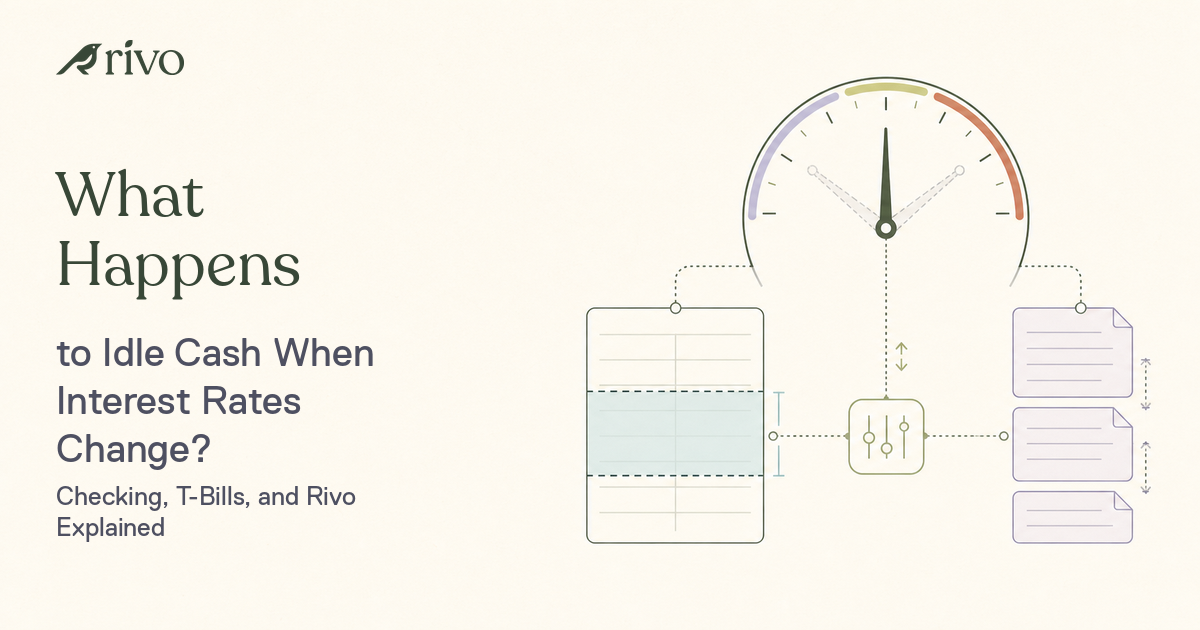
When interest rates change, idle checking cash does not automatically fix itself. Your bank may keep paying very little, short-term Treasury Bill yields may move quickly, and the real question becomes which dollars must stay liquid for bills versus which dollars are simply sitting above your safe balance.
That matters because the gap can be large. The FDIC national average rate for interest checking rate was 0.07% in June 2026, while the 4-week Treasury Bill secondary market rate was 3.67% on July 16, 2026. If $50,000 sits idle for a year, that is about $35/year at 0.07% versus about $1,835/year at a 3.67% annualized reference rate before fees, taxes, rate changes, balance changes, and timing effects.
Rivo exists for the rate-change problem plus the bill-timing problem. It works with your existing bank account, lets you set a safe balance, identifies idle cash above that floor, moves eligible cash into short-duration U.S. Treasury Bills through Jiko Securities, and brings money back before bills are due. You do not need to switch banks, chase promotional rates, or remember a transfer every time the Fed changes direction.
*Movement of funds is not instant. Transfers to your linked account can take up to 3 business days to settle, and longer if a Treasury Bill must be sold first. Rivo plans around known bills. It does not guarantee same-day access or a specific arrival date.
TL;DR
- Idle cash is the money sitting above what you need for bills, spending, pending transfers, and a safe balance. Interest-rate changes affect that idle layer first.
- Checking rates often move slowly for consumers. The national interest checking rate was 0.07% in June 2026, even while the 4-week T-bill rate was 3.67% on July 16, 2026.
- If short-term rates rise, the cost of ignoring idle checking cash can grow. If rates fall, the gap may shrink, but the need for a safe-balance system does not disappear.
- A $50,000 idle balance has a gross annualized reference gap of about $1,800 when comparing 0.07% checking with 3.67% 4-week T-bills, before fees, taxes, timing, and rate movement.
- Manual rate chasing breaks because bills, paychecks, card payments, tax payments, and transfer timing do not move on the same calendar as rate announcements.
- Rivo is built to manage the idle layer around your existing checking account. It uses a safe balance, bill-aware refills, short-duration T-bills, and user controls such as pause, stop, disconnect, and available-funds withdrawals up to $15,000/day.
- Investments in T-bills are not FDIC-insured bank deposits. They are securities, carry standard fixed-income risks, and require the disclosures at the end of this article.
Quick Answer: What Happens to Idle Cash When Rates Change?
When rates change, idle checking cash goes through 3 separate effects: the yield gap changes, the after-tax comparison changes, and the manual workload changes. The cash does not become more or less idle just because the Fed moves rates. It becomes more or less expensive to ignore.
The first mistake is watching only the headline rate. A bank deposit rate, a 4-week T-bill rate, a savings product rate, and a money market fund yield are different products with different protections, taxes, liquidity mechanics, and operational effort.
The useful question is not "what is the highest rate today?" The useful question is "how much cash is truly idle, what return gap exists today, what risk and tax treatment apply, and can I maintain the process without missing bills?"
If you need the basic definition first, read What Is Idle Cash?. If you already know you have idle cash and want the return-gap version, read What Is Cash Drag?.
Why Rate Changes Create a Checking-Cash Problem
Rate changes create a checking-cash problem because checking accounts are built for payments, not yield optimization. Your checking account has to support rent, mortgage, credit cards, utilities, subscriptions, payroll timing, taxes, and unexpected charges. That payment job is real.
The problem begins when the payment account quietly becomes the storage account. That is how a $12,000 safe balance becomes a $37,000 average checking balance without anyone making an active decision.
The last row is where rate changes matter most. If $25,000 sits above your safe balance for 4 months, that is not the same as keeping $25,000 ready for a bill next week.
This is why Rivo starts with the safe balance. The safe balance is the floor you want left in checking before cash can be considered idle. It is not a magic number. It is a rule that says which dollars have a near-term job and which dollars deserve review.
If your safe balance is unclear, start with How Much Money Should You Keep in Checking?. Rate math is unreliable until the floor is clear.
The Rate Gap: 0.07% Checking Versus 3.67% 4-Week T-Bills
The rate gap is the simplest way to see why idle cash deserves attention. In June 2026, FRED showed the national rate for interest checking at 0.07%. On July 16, 2026, FRED showed the 4-week Treasury Bill secondary market rate at 3.67%.
Those are not the same product. Checking is a bank deposit account. T-bills are securities backed by the U.S. government and have different tax treatment, protection structure, and liquidation risk. The comparison is still useful because it sizes the opportunity cost of leaving persistent surplus in checking.
This is not a promise about future earnings. It is a same-balance, annualized reference calculation using public rates as of specific dates. Real outcomes depend on rate changes, fees, taxes, timing, product mechanics, withdrawal needs, and how long the cash stays invested.
The table also explains why people feel fine doing nothing when rates are low, then suddenly feel behind when rates are higher. The same $50,000 balance looks harmless at a tiny rate gap and expensive at a multi-percentage-point gap.
If you want the calculator version of this math, use the Checking Account Interest Calculator.
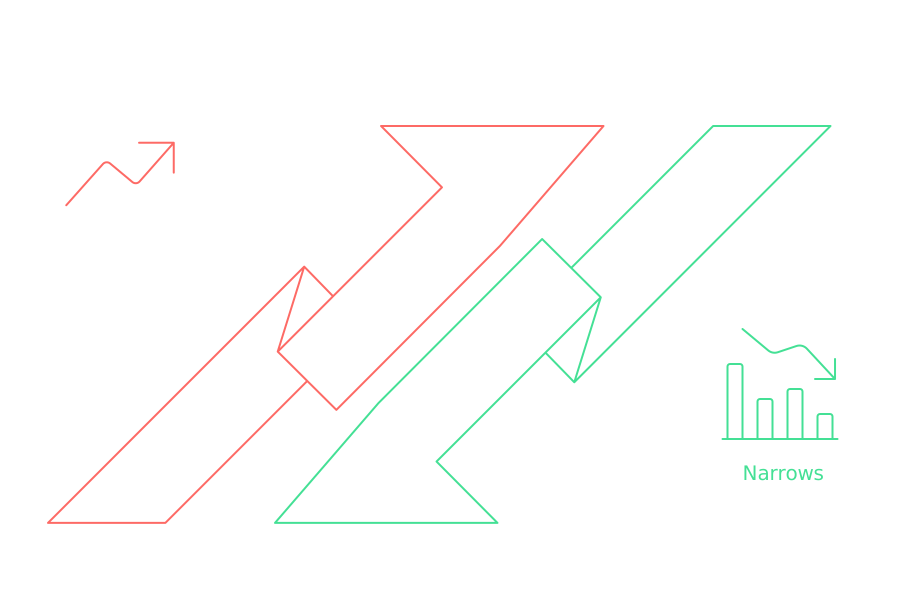
What If Rates Rise?
When short-term rates rise, idle cash can become more expensive to ignore. The checking balance may look unchanged, but the gap between low-rate checking and short-duration alternatives can widen.
Rising rates do not mean every dollar should leave checking. They mean the persistent surplus deserves a faster review. A household that leaves $10,000 idle may be making a small mistake. A household that leaves $100,000 idle through multiple pay cycles may be creating a recurring gap.
The trap in a rising-rate environment is urgency without a system. People see a higher headline rate, move too much money, then transfer it back when bills feel tight. After 2 or 3 cycles, the workflow gets abandoned.
Rivo is designed around that failure mode. You set the checking floor, and the system evaluates the cash above that floor. The point is not to predict every rate move. The point is to keep the idle layer working while bill money stays protected.
What If Rates Fall?
When short-term rates fall, the gross opportunity cost of idle checking cash can shrink. That does not automatically mean idle cash should sit in checking forever.
Falling rates change the math, not the operating problem. You still need a clear safe balance, a way to avoid missed bills, and a process for handling cash that accumulates after paydays, bonuses, refunds, or stock compensation.
Here is a simple illustrative stress test:
Even if short-term rates fall, the checking-account question remains: how much cash needs to sit in the payment account, and how much is persistent surplus?
That is why rate-aware cash management should not be a one-time reaction to a Fed meeting. It should be a repeatable rule.
Why Manual Rate Chasing Breaks
Manual rate chasing breaks because the rate environment changes faster than most people update their cash plan. A rate article, Fed meeting, or bank email may motivate one transfer. It rarely creates a durable household cash system.
The operational problem is that rates and bills live on different clocks:
- Rates can change daily.
- Bank promotions can expire.
- Paychecks arrive on payroll cycles.
- Credit card autopay depends on statement timing.
- Rent, mortgage, taxes, and insurance follow separate schedules.
- Transfers can be affected by weekends, holidays, settlement, and bank timing.
This is the same behavioral loop behind Why Manual Transfers Fail. The issue is not intelligence. It is maintenance.
Rivo charges a 0.05% monthly management fee, approximately 0.60%/year before compounding. That fee is not for a secret rate. It is for a system that keeps running: safe balance, bill-aware refills, eligible idle cash movement, notifications, and user controls.
.svg)
Why Checking Rates Can Lag Market Rates
Checking rates can lag market rates because banks do not have to reprice every deposit account equally or instantly. Some consumers watch rates closely. Many do not. That difference creates a large deposit business.
FRED shows U.S. households and nonprofits held about $5.95 trillion in checkable deposits and currency at the end of Q1 2026. That number does not mean every dollar is idle. It does show how much household cash can sit in transaction-ready form.
This is why "just switch banks" is weak advice for many households. The more practical question is whether the existing bank can stay in place while the idle layer works harder.
Rivo takes that approach. It does not ask you to replace the bank account that pays bills. It works on top of your existing checking account and evaluates the excess above your selected safe balance.
If this is your main objection, read Can You Earn More on Checking Cash Without Switching Banks?.
How T-Bills React to Rate Changes
T-bills are short-term U.S. government obligations. Short-duration T-bill yields tend to reflect current short-term rate conditions more directly than many consumer checking rates, though the exact yield changes with market demand, auctions, and Federal Reserve policy expectations.
Rivo uses short-duration U.S. Treasury Bills through Jiko Securities. The short duration matters because the purpose is not long-term investing. The purpose is to put idle cash to work while preserving a path back to checking when bills need to clear.
The tax point matters. The IRS states that interest income from Treasury bills, notes, and bonds is subject to federal income tax but exempt from state and local income taxes (IRS Topic No. 403). That does not make T-bills the right choice for every household, but it changes the after-tax comparison in high-tax states.
The protection point also matters. SIPC explains that it protects securities and cash at member brokerage firms in defined circumstances, including Treasury securities as securities (SIPC investor protection overview). SIPC is not the same as FDIC insurance on bank deposits.
If the safety question is your main concern, read Are Treasury Bills Safe for Short-Term Cash?.
How to Decide Whether a Rate Change Matters for You
A rate change matters when it changes your annual dollar gap enough to justify action. A 0.25 percentage point move may be irrelevant for $1,000 of idle cash. It may be meaningful for $100,000 of idle cash that sits for months.
Use 4 inputs:
- Your current checking balance.
- Your safe balance.
- The amount above that safe balance.
- The current gap between your checking rate and your realistic short-term cash option.
This table uses simple annualized gross math and does not include taxes, fees, timing, or risk. It is meant to answer one question: is the gap worth reviewing?
For many people, the answer changes around $5,000 to $25,000 of persistent surplus. Below that range, simplicity can be worth more than optimization. Above that range, the repeated gap becomes harder to ignore.
Rivo works best for households with meaningful idle cash in checking. The product details note that smaller balances may not earn enough to matter, while the Rivo workflow can be more relevant once a household regularly has $5,000+ in checking.
A 30-Minute Rate-Change Cash Review
Do this before moving money. A rate review without a safe-balance review can create bill stress.
- Write down your current checking balance.
- List every bill, card payment, tax payment, transfer, and known expense due before the next paycheck.
- Add any large known expense due in the next 60 days.
- Add a comfort amount for normal spending variance.
- Subtract that number from checking.
- Treat the result as candidate idle cash, not automatically movable cash.
- Compare the candidate amount against the current rate gap.
- Decide whether manual transfers, a simple rule, or automation fits.
The key is repeatability. A cash plan that works only on the day you create it will fail the next time bills, income, or rates change.
If your main fear is missing autopay, read Can You Move Money Out of Checking Without Missing Bills?. That is the operational test any rate strategy has to pass.
Where Rivo Fits When Rates Move
Rivo fits when the problem is not simply "I need a higher rate." The problem is "I keep cash in checking because I need bills covered, but a persistent surplus keeps building and I do not want to manage transfers manually."
That is a different job from a rate table. It combines rate awareness, liquidity management, bill timing, and user control.
Rivo is not the right fit for every household. If your checking balance rarely rises above your safe balance, the earnings may not matter. If you enjoy direct T-bill management and never miss a review, DIY can work. If you want FDIC-insured deposits specifically, a bank savings product may fit your risk preference.
Rivo fits the household that knows money is sitting idle but wants the existing bank account, direct deposit, and bill setup to stay unchanged.
For product mechanics, read How Does Rivo Autopilot Work?. For fee math, read Rivo Fees Explained.
Rate Changes by Cash Type
Not all cash should react the same way to a rate move. The worst response is to treat emergency money, bill money, tax money, and surplus money as one balance.
This split prevents a common mistake: optimizing money that should stay boring. Your bill money should be boring. Your safe balance should protect life. The idle layer is the part that deserves rate-sensitive management.
If your cash came from a bonus, RSU vest, refund, or reimbursement, read What Should You Do When a Bonus, RSU, or Tax Refund Lands in Checking?.
Rate Changes and High-Tax States
After-tax yield can matter when rates change. Treasury bill interest is taxed federally and generally exempt from state and local income taxes, according to the IRS. That state and local tax treatment can make T-bills more attractive for taxable cash in states with higher income tax rates.
Do not over-read that sentence. It is not tax advice, and state-specific outcomes depend on your situation. It is simply a reason to compare after-tax yield, not only headline yield.
This is one reason a rate change can be misleading. A deposit product with a higher headline rate may not produce the same after-tax result as a Treasury-backed approach, especially for households in high-tax states. The only defensible comparison is after fees, after taxes, after access needs, and under the same cash-balance assumptions.
For the dedicated tax article, read Are Treasury Bills State Tax Exempt?.
Rate Changes and Safety
Rate changes should not make you ignore safety. A higher yield does not erase product differences.
Checking deposits, savings products, money market funds, brokerage cash, and Treasury Bills can all play legitimate roles. The right choice depends on the job of the cash.
Rivo is a fintech company, not a bank. Banking services are provided by Jiko Bank, and U.S. Treasury investments and investment advisory services are provided by Jiko Securities, a registered broker-dealer and member FINRA/SIPC. The important point is that T-bill holdings are securities, not FDIC-insured bank deposits.
SIPC protection and FDIC insurance are not interchangeable. SIPC protection applies in defined brokerage-firm failure situations, while FDIC insurance applies to insured bank deposits. This distinction should be clear before any rate-based decision.
What to Do Now
If rates changed and you are wondering whether your checking cash should move, do not start with a product. Start with the cash job.
Use this order:
- Define your safe balance.
- Identify cash above that floor.
- Size the rate gap with current public rates.
- Compare gross return, fees, taxes, liquidity, and product protection.
- Choose manual management only if you will maintain it.
- Choose automation if the repeated review is the part that keeps failing.
Rivo is most relevant when you want the idle layer to work without turning cash management into a recurring chore. It keeps your existing bank, uses your safe balance, moves eligible idle cash into short-duration T-bills through Jiko Securities, and returns money before bills are due.
FAQ
Do interest-rate changes affect all checking cash?
No. Rate changes matter most for cash above your safe balance. Money needed for rent, mortgage, credit card autopay, utilities, taxes, and near-term spending should be judged first by access and timing, not yield.
Should I move money every time the Fed changes rates?
Usually no. Fed moves can change the rate environment, but your cash plan should be based on your safe balance, idle cash amount, taxes, fees, product risk, and transfer timing. A repeatable rule is more useful than reacting to every announcement.
What rate should I use to estimate idle-cash cost?
Use your actual checking rate if you know it. If you need a public baseline, FRED showed national interest checking at 0.07% in June 2026. For a short-term Treasury reference, FRED showed the 4-week T-bill rate at 3.67% on July 16, 2026.
Does Rivo earn the same amount when rates change?
No fixed yield should be assumed. Rivo yield tracks short-term Treasury conditions and rates are subject to change. Fees, taxes, maturity, timing, and balance movement all affect the result.
Is Rivo a bank account?
No. Rivo is a fintech company, not a bank. It works with your existing bank account and uses U.S. Treasury Bills through Jiko Securities for eligible idle cash. Banking services are provided by Jiko Bank.
Is T-bill income taxed differently from savings interest?
Treasury bill interest is subject to federal income tax and generally exempt from state and local income taxes, according to the IRS. This is not tax advice. Your actual tax result depends on your situation.
Related Rivo Reading
- To understand low checking rates, read Why Is My Checking Account Paying So Little Interest?.
- To compare cash destinations, read Rivo vs High-Yield Savings vs Treasury Bills.
- To compare T-bills with cash alternatives, read Treasury Bills vs Money Market Funds vs High-Yield Savings.
- To understand fees, read Rivo Fees Explained.
- To calculate the dollar gap, read Checking Account Interest Calculator.

This article is educational and is not financial, investment, tax, accounting, or legal advice.
Yield rate reflects the 4-week T-bill rate when held to maturity. Rate does not include fees. Rates are subject to change. Minimum balance of $100 required to earn the stated rate.
Rivo is a fintech company, not a bank. Banking services provided by Jiko Bank, a division of Mid-Central National Bank. Jiko Group, Inc. and its affiliates do not provide legal, tax, or accounting advice. You should consult your legal and/or tax advisors before making any financial decisions. This material is not intended as a recommendation, offer or solicitation for the purchase or sale of any security or investment strategy. See FINRA BrokerCheck, Jiko U.S. Treasuries Risk Disclosures and Jiko Securities Inc. Form CRS.
Investments in T-bills: Not FDIC Insured - No Bank Guarantee - May Lose Value. All U.S. treasury investments and investment advisory services provided by Jiko Securities, Inc., a registered broker-dealer, member FINRA and SIPC. Securities in your account are protected up to $500,000. For details, please see www.sipc.org.
Sources
- FRED National Rate: Interest Checking: June 2026 national interest checking rate.
- FRED 4-Week Treasury Bill Secondary Market Rate: 4-week T-bill reference rate used in illustrative math.
- Federal Reserve H.15 Selected Interest Rates: daily short-term rate context.
- FRED Checkable Deposits and Currency: household and nonprofit checkable deposits and currency level.
- IRS Topic No. 403: Treasury bill, note, and bond interest tax treatment.
- SIPC investor protection overview: SIPC protection scope for brokerage securities and related cash.
- Rivo product details: Rivo fee, safe balance, money movement, withdrawal, and control details.
- Rivo homepage disclosures: Rivo bank, brokerage, T-bill, and tax disclosures.
.jpeg)
Ambrish Tyagi is the founder and CEO of Rivo. Previously led AI at Cruise and Amazon.
Follow on LinkedInGet Rivo Updates
Product news, money insights, and company updates.