Why Does Checking Run Low Before Payday? Cash-Flow Timing, Bill Clusters, and Safe Balance Explained
Why checking runs low before payday even when income covers expenses, and how to build a weekly cash-flow map and safe balance.
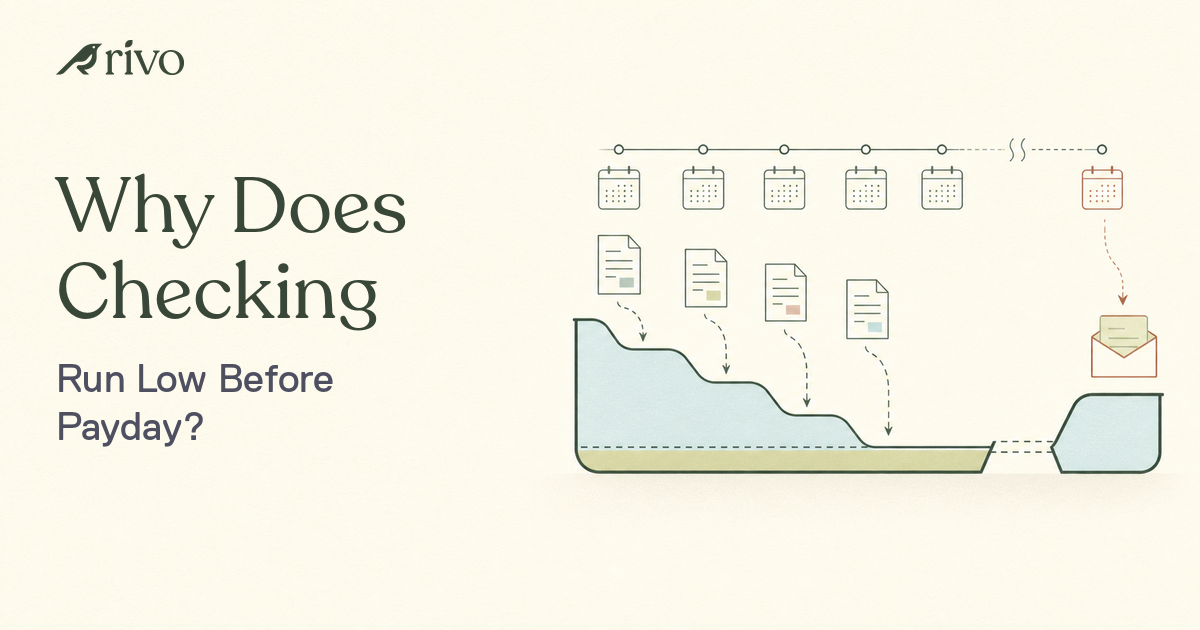
Checking can run low before payday even when your household earns more than it spends because monthly totals hide timing. A paycheck may arrive after the mortgage, credit-card autopay, childcare, insurance, and other drafts have already cleared.
That creates a cash-flow timing mismatch. The household may be financially healthy over the full month but still need a larger checking floor during one difficult week.
The right response is not automatically to cut spending, move every bill, or keep the entire account permanently overfunded. Map income and outflows by clearing date, find the lowest projected balance before the next reliable deposit, and add a cushion for variable charges and transaction timing. Only the recurring amount above that safe balance is a candidate for idle cash.
TL;DR
- A monthly budget answers whether income exceeds expenses. A cash-flow map answers whether enough money is available on the day each payment leaves checking.
- The Consumer Financial Protection Bureau defines cash flow as the timing of money coming in and going out. When the timing is off, checking can run short at the end of a week or month even if the broader budget works.
- Build the map by week or by day. Include paycheck clearing dates, mortgage or rent, full-statement credit-card autopay, childcare, utilities, insurance, transfers, and known one-time payments.
- Your timing floor is the opening cash needed to keep the lowest projected balance at zero. Your safe balance is that floor plus a cushion for ordinary spending variation, pending transactions, and payment timing.
- Do not treat every balance above today's bills as idle. Card statements, tax reserves, annual expenses, emergency cash, and dated purchases may already have jobs.
- Rivo can be relevant when a recurring surplus remains after the timing floor and assigned cash are protected. It works with an existing checking account, lets the user set a minimum threshold, and plans refills before detected bills.
Quick Answer: Why Does Checking Run Low Before Payday?
Checking runs low before payday when outflows are concentrated earlier than inflows.
The simplest example is a household paid in the middle and at the end of the month while most large bills clear early in the month. Monthly income can still exceed monthly expenses, but checking needs enough opening cash to bridge the first bill cluster.
Use this formula:
Cash-flow timing floor = cash required to offset the lowest projected running balance
Safe balance = cash-flow timing floor + ordinary spending cushion + transaction timing cushion
The formula starts from a calendar, not a percentage of income. A household with predictable paychecks but concentrated bills may need a larger timing floor than a household with the same income and expenses spread evenly across the month.
The decision comes in this order: protect the low point, label assigned cash, then evaluate the recurring remainder.
What Is a Personal Cash-Flow Timing Mismatch?
A personal cash-flow timing mismatch occurs when income and expenses are adequate in total but arrive in the wrong sequence for the checking account.
The CFPB cash-flow budget tracks income and expenses week by week. Each week's ending balance becomes the next week's starting balance. That sequence exposes a problem a monthly budget can miss.
Cash flow is different from profitability
A household can have a monthly surplus and a weekly cash shortage at the same time.
Consider an illustrative household with $14,000 of monthly take-home income and $13,000 of monthly outflows. The household finishes the month with an illustrative $1,000 surplus. But the timing can still produce a negative running balance:
These are illustrative assumptions, not a recommended income or spending pattern.
The monthly budget is positive. The lowest cumulative point is negative $6,500. That means the household needs at least an illustrative $6,500 of opening cash before adding a cushion.
The low point matters more than the average
An average checking balance can look comfortable because the high balance after payday offsets the low balance after a bill cluster.
Suppose the account moves between an illustrative $24,000 after payday and $8,000 after mortgage and card autopay. The average may be around $16,000, but the operational question is whether $8,000 is the correct low point or an unnecessarily large floor.
The high point does not identify idle cash by itself. The low point shows how much of the balance the payment system actually uses.
A mismatch can happen with stable income
Irregular income can deepen a timing problem, but it is not required.
A household with two predictable salaries can still have:
- Both paychecks landing after the largest bill week
- Several credit cards drafting on nearby dates
- Childcare and housing clearing together
- Annual or semiannual insurance charges
- A mortgage payment at the start of the month
- Recurring transfers scheduled before payroll clears
Income variability can deepen the same problem. The Federal Reserve found that 30% of adults had income that varied at least occasionally in 2025, while 11% said income variation had made it difficult to pay bills. A fixed-pay household still needs a timing map, but a variable-income household also needs delayed-income and weak-income scenarios.
If income amount and timing also change, use the separate guide on how much to keep in checking with irregular income. This article focuses on the sequencing problem that can exist even when pay is reliable.
How Can Monthly Income Cover Expenses While One Week Goes Negative?
Monthly totals ignore order.
If $14,000 enters checking and $13,000 leaves during the same month, a normal budget reports a $1,000 surplus. It does not show whether $6,500 left before the first $7,000 paycheck arrived.
Use a running balance, not a monthly subtraction
The correct calculation is chronological:
1. Start with the cash available at the beginning of the planning window.
2. Add income on the date it is expected to clear.
3. Subtract each payment on the date it is expected to leave.
4. Calculate the balance after every material transaction or weekly group.
5. Identify the lowest projected point.
The monthly surplus answers a long-run affordability question. The lowest projected point answers the checking-account question.
No single bank balance replaces the calendar. The safest usable number combines posted account data with bills and spending that have not cleared yet.
A positive month can still produce overdraft risk
Automatic payments can reduce late-payment risk, but they can create account-balance risk if the checking account is too low when the debit arrives.
The CFPB advises consumers to watch both their balance and upcoming automatic payments. If there is not enough money when a payment is due, the bank and the biller may both charge fees.
The practical lesson is not to avoid autopay. It is to fund the clearing date, not merely the month.
Which Bills Usually Create a Checking Account Cluster?
A bill cluster is a group of large or recurring outflows that clear within a short part of the pay cycle.
.svg)
The cluster is more important than the number of bills. Several small subscriptions may matter less than one mortgage payment and one full-statement card debit.
Credit cards compress spending into one withdrawal
When daily purchases go on a card, checking does not fall each time you buy groceries, book travel, or pay a medical bill. The checking impact arrives later as one statement payment.
That can make checking look overfunded between the purchase date and the autopay date.
If an illustrative household spends $7,800 on a card during a travel month, its checking account may remain unchanged for weeks. The $7,800 is not idle merely because the card issuer has not debited it yet.
Annual expenses can hide outside the normal month
Property tax, insurance, tuition, memberships, professional fees, and planned repairs may appear only a few times each year.
A checking floor built from one quiet month can fail when one of those charges enters the same week as normal bills. Keep a separate calendar of dated irregular expenses and include them in the relevant cycle.
Transfers are bills too
A recurring transfer to savings, a brokerage, a family member, or another bank is still an outflow from checking.
The transfer may be optional in a budget sense, but it is operationally real once scheduled. Include it in the map or move it to a date after the bill cluster.
How Your Pay Schedule Changes the Timing Gap
The amount of the paycheck matters, but the cadence determines which bills it can fund before the next deposit.
Map the actual clearing date
The payroll date printed on a pay statement may not match the moment funds are usable in every account. Likewise, a bill's due date may not match the exact day the debit appears.
Use observed bank history where possible. Record the dates deposits became available and the dates major debits posted during several completed cycles.
Dual-income does not automatically mean a smaller floor
Two incomes help only if their timing and purpose reduce the gap.
One household may use one salary for housing and childcare and the other for cards, taxes, and savings. Another may pool both salaries while every large bill clears before either next paycheck.
The correct floor depends on the combined sequence, not the number of earners.
Changes to payroll require a new map
Recalculate after:
- A new job changes pay cadence
- A partner begins or stops working
- Payroll moves because of a holiday
- A bonus or commission replaces part of fixed pay
- Direct deposit moves to a different account
- Benefit deductions materially change net pay
Do not assume the old safe balance still works after the deposit schedule changes.
How Credit-Card Autopay Distorts the Checking Balance
Credit-card autopay creates a delay between spending and the checking withdrawal.
The card balance grows as purchases post. Checking may remain high until the selected payment date. That visible checking balance includes cash already committed to the card payment.
Statement balance and current balance are different
The statement balance covers charges, credits, fees, and payments recorded during the completed billing period. The current balance can include newer activity after that period.
For full-statement autopay, use the issued statement amount once available. Before the statement issues, use a conservative estimate from current activity and known purchases.
This table describes cash-flow treatment, not a recommendation for how much debt to repay. Payment choice depends on the card agreement and the household's financial situation.
Variable automatic debits require attention
Automatic debits can be fixed or variable. The CFPB notes that a company generally must provide notice at least 10 days before a scheduled payment when the amount differs from the authorized amount or range, or from the most recent payment.
That notice can help with planning, but the checking map should still use the actual scheduled amount as soon as it is known.
The card due date may be changeable
If several card payments cluster before payday, ask whether the issuer permits a due-date change. Do not change every date at once without checking how the transition cycle will work.
The goal is a smoother sequence, not a calendar that is harder to monitor.
Why Does an Average Checking Balance Give the Wrong Answer?
An average blends together money you have before bills and money you have after bills.
That makes it useful for describing account size but weak for setting the operating floor.
Peak, average, and trough answer different questions
All amounts are illustrative.
The $17,000 candidate still needs a job test. Taxes, a home repair, tuition, or an emergency reserve may explain part of it.
Averages are especially weak after large deposits
A bonus, reimbursement, tax refund, or asset sale can raise the average balance for a month without changing the household's normal operating needs.
Classify one-time deposits separately. The guide on what to do when a bonus, RSU, or tax refund lands in checking explains how to assign those dollars before evaluating yield.
Historical lows need context
The lowest posted balance is useful, but it can be misleading if:
- A bill was paid from another account
- A card payment was delayed
- A one-time deposit arrived early
- A large annual expense has not happened yet
- The household temporarily reduced spending
- A refund or reimbursement distorted the cycle
Use history to test the forecast, not to replace it.
Building a Paycheck-to-Paycheck Cash-Flow Map
Build the map from the bank account outward.
The CFPB recommends tracking income, resources, and expenses for at least one month before building a cash-flow budget. For a household with annual or seasonal charges, use enough history to capture those exceptions too.
.svg)
Step 1: Export transaction history
Collect:
- Checking deposits and withdrawals
- Credit-card statements
- Mortgage or rent schedule
- Utility and insurance history
- Childcare, tuition, and loan schedules
- Transfers to savings, brokerage, or other accounts
- Known one-time payments
Use actual clearing history for recurring payments. A due date alone may not reveal when checking normally changes.
Step 2: Separate fixed, variable, and dated outflows
Step 3: Place reliable inflows
Use the date income is expected to be available, not merely earned.
For stable salary, the deposit schedule may be predictable. For bonuses, commissions, reimbursements, and invoices, use conservative dates or exclude the amount from the base case until it is reliable.
Step 4: Calculate the running balance
Group the map daily when several large transactions occur close together. Weekly grouping is sufficient when dates are stable and no material cluster is hidden inside the week.
Step 5: Stress the map
Run at least these illustrative scenarios:
The safe balance should work in a plausible weak case, not only in the smoothest month.
Calculating the Lowest-Balance Floor
Calculate cumulative net cash flow from a zero opening balance.
The most negative point shows how much opening cash is required to prevent the projected balance from falling below zero.
Worked example
Assume the following illustrative transaction sequence:
The lowest projected point is negative $10,200. The illustrative timing floor is therefore $10,200 before adding a cushion.
If the household adds an illustrative $2,800 cushion based on recent spending and timing variation, the safe balance becomes $13,000.
Illustrative timing floor: $10,200 + illustrative timing and spending cushion: $2,800 = illustrative safe balance: $13,000
The $13,000 is not an industry benchmark. It is the output of this household's assumptions.
Do not double-count card spending
If groceries and travel were purchased on Card A, do not subtract those purchases as checking outflows and then subtract the full card statement again.
For the checking map, record the checking debit. Maintain a separate spending view if you also want category-level budgeting.
Do not count unsettled income as cash
A paycheck scheduled for tomorrow may be reliable. A commission expected after a deal closes is less certain. A client invoice may be earned but still delayed.
The floor should not depend on money that may arrive after the bill cluster.
How Much Timing Cushion to Add
Add a cushion based on observed variation and known uncertainty, not a universal percentage.
There is no single correct cushion for every household. A fixed-pay household with stable bills may need less than a household with variable card spending, reimbursements, travel, or one variable income stream.
Build the cushion from components
All methods in the table are planning examples, not universal recommendations.
Use a confidence range
Instead of pretending the safe balance is exact, calculate:
- Base floor
- Conservative floor
- Temporary floor for the next unusual cycle
An illustrative household may have a $10,200 base timing floor, a $13,000 normal safe balance, and an $18,000 temporary floor during a travel or tuition month.
The temporary increase should come back down after the dated expense clears.
Keep emergencies separate
A timing cushion covers ordinary forecast error. It is not the same as an emergency fund for job loss, medical events, or major repairs.
The guide on whether to keep an emergency fund in checking explains how to separate same-day operating cash from a broader emergency reserve.
Changing Bill Due Dates to Match Payday
Changing due dates can reduce a recurring timing mismatch, but only when the biller allows it and the new schedule actually improves the full calendar.
The CFPB found that suggesting a bill due-date change to align with income flow could help some consumers manage cash flow. Start by understanding the current income and bill schedule.
Change the largest constraint first
Moving a $40 subscription does little if a $5,000 card payment creates the low point. Test the new date in the map before requesting the change.
All dollar amounts are illustrative.
Confirm the transition cycle
A date change can affect the first billing period, the next statement, or the number of days between payments. Ask the biller what amount and date will apply during the transition.
Keep extra cash in checking until the first revised cycle clears as expected.
A larger floor may be simpler
If the current schedule is easy to understand and the required floor is affordable, keeping a stable checking cushion may be better than changing many due dates.
The objective is reliable payment coverage. Yield optimization comes after that.
Which Cash Is Assigned, and Which Cash May Be Idle?
Cash is assigned when it has a known job, amount, or date.
Cash may be idle when it repeatedly survives full pay and bill cycles after assigned layers are protected.
Today's balance is not the idle-cash number
Use:
Potential idle cash = current checking balance - safe balance - issued but uncleared card payments - tax and sinking-fund reserves kept in checking - other dated commitments
If the result is negative, the account is not overfunded for the current cycle.
If the result is positive once, wait. If a similar amount remains through several normal and high-spending cycles, it is a stronger idle-cash candidate.
A high balance can be correct
An illustrative $60,000 checking balance may be appropriate before a $25,000 tax payment, a $12,000 tuition bill, and a $10,000 card payment.
The same $60,000 may be overfunded if the safe balance is $18,000, no major payments are pending, and the account has not fallen below $45,000 for several completed cycles.
Classification matters more than the headline balance.
What to Do With Cash Between Paydays
First protect the amount needed before the next reliable inflow. Then choose a location and workflow for the remaining layers.
This is not a ranking. Different cash jobs can use different locations.
Manual movement can work
A manual process can be enough when:
- The timing map is stable
- The surplus is easy to identify
- Transfers are reviewed before every bill cluster
- The household consistently moves cash back on time
- Product fees would outweigh the value of automation
The problem appears when manual transfers use a fixed date or round number that ignores the account's projected low point. The article on why manual transfers fail covers that workflow in detail.
Direct Treasury bills require a separate decision
The U.S. Treasury offers bills with terms from 4 weeks through 52 weeks. Investors can hold them to maturity or sell before maturity, but an early sale can produce a different result.
Cash needed for the immediate bill cluster should not depend on selling an investment at the last moment.
Moving nothing is a valid temporary choice
If the safe balance is unclear, keep the cash simple while you observe another cycle.
An extra month of data is often more useful than a premature transfer based on an average balance.
Where Does Rivo Fit in a Cash-Flow Timing Plan?
Rivo can fit when the household has a recurring amount above the safe balance and the main difficulty is keeping manual movement aligned with changing bills.
The workflow is:
1. Connect the existing checking account.
2. Set a minimum checking threshold.
3. Keep the timing floor and assigned cash inside that protected amount.
4. Let cash-flow analysis evaluate the amount above the threshold.
5. Move eligible idle cash into short-duration U.S. Treasury Bills through Jiko Securities.
6. Plan refills before detected bills and scheduled payments.
7. Pause, modify, stop, or disconnect when the household's plan changes.
Rivo does not replace the cash-flow map. The user still needs to identify unusual obligations, choose a conservative floor, and avoid classifying known tax, tuition, home, or emergency cash as idle.
Bill timing is the relevant product capability
Rivo is designed around buffers and early refills. The user can set a minimum checking threshold, and the product plans ahead of scheduled bills.
If paycheck timing changes or the pattern looks uncertain, the product can become more conservative. The user can increase the buffer at any time.
This is different from a static monthly transfer because the product decision is tied to cash-flow conditions rather than one recurring calendar date.
Current rate, fee, and access details
The current rate page lists a 3.65% gross annualized rate as of July 1, 2026, before fees and subject to change. The management fee is 0.05% per month, calculated on average daily balance. A $100 minimum balance is required to earn the stated rate. The rate reflects the 4-week Treasury bill rate when held to maturity and moves with that market.
Available-funds withdrawals are limited to $15,000 per day. Rivo also sends a 5 PM Pacific movement notice with a cancellation window until midnight.
Those details matter when the next bill cluster is large. A household that may need more than the daily limit on short notice should keep that amount outside the automated layer.
The idle layer is not a bank deposit
Rivo is a fintech, not a bank account or high-yield savings account. Eligible idle cash is invested in securities through Jiko Securities.
That means Treasury risk, brokerage protection, access timing, fees, and the user's need for liquidity all belong in the decision.
When Rivo Isn't the Right Response to a Payday Gap
Rivo is not the right response when the account is genuinely short, the budget is structurally negative, or the safe balance has not been established.
Keep cash out of automation when
- Monthly outflows exceed reliable income
- The household is using debt to cover routine bills
- A major payment is already due
- The timing map depends on an uncertain deposit
- The card statement is unusually large and not yet funded
- Tax, tuition, home, medical, or emergency cash is mixed with the apparent surplus
- Same-day access to more than the daily withdrawal limit may be needed
- The household wants the full balance held as an FDIC-insured bank deposit
- The user is uncomfortable with fixed-income risk or brokerage structure
Automation can manage a genuine surplus. It cannot create surplus where none exists.
Fix the operating problem first
If the mismatch is caused by one bill cluster, a due-date change or higher checking floor may solve it.
If monthly expenses exceed income, the required response is broader budgeting, income, debt, or professional guidance. That is outside the scope of cash optimization.
Start with a higher threshold
When the map is new, use a conservative threshold and observe real cycles.
Lower the floor only after actual low points stay comfortably above it and all assigned cash is separately identified.
How Often Should You Review the Cash-Flow Timing Floor?
Review after every material change to income, bill amount, or clearing date.
At minimum, compare forecast and actual results after each completed cycle while building the model.
Compare projected and actual low points
Record:
- Projected lowest balance
- Actual lowest posted balance
- Largest timing difference
- Largest amount difference
- Whether the cushion was used
- Recurring amount left above the safe balance
If the model consistently overstates the low point, the floor may be too high. If checking repeatedly approaches or crosses the floor, the model or cushion needs revision.
Do not optimize from one smooth month
A quiet card cycle can create a false surplus. Test the floor against a recent high-card month and the next known annual expense before reducing it.
A 30-Day Setup for Paycheck and Bill Timing
Use one complete cycle to turn the checking balance into an operating model.
All day ranges are an illustrative implementation sequence. Use the cadence that matches your pay and bill cycle.
Then choose whether to:
- Keep the surplus in checking for another observation period
- Use a separate deposit account
- Move cash manually
- Buy Treasury bills directly
- Use an automated cash-management workflow such as Rivo
The destination is the last decision, not the first.
Final Recommendation
If checking runs low before payday, do not judge the account from monthly income, monthly spending, or its post-payday peak.
Map the sequence. Put every reliable deposit and material outflow on its expected clearing date. Find the lowest projected running balance, add a cushion based on real variation, and use that result as the safe balance.
Keep issued card statements, taxes, emergency reserves, annual bills, and dated purchases out of the idle-cash calculation. Only recurring unassigned cash above those layers should be compared across checking, savings, Treasury products, or automation.
Rivo is most relevant when the household already has a genuine recurring surplus, wants to keep its existing bank, and finds it difficult to coordinate manual movements around changing bill clusters. It is not a fix for a negative budget or an unknown checking floor.
FAQ
Why is my checking account low before payday if I make enough money?
Income can exceed expenses over the month while bills clear before the next paycheck. Build a chronological cash-flow map and find the lowest running balance. The opening cash required to offset that low point is the timing floor.
How much should I keep in checking between paychecks?
Keep enough to cover every scheduled outflow before the next reliable deposit, plus a cushion for ordinary spending and timing variation. The broader guide on how much money to keep in checking provides the complete safe-balance framework.
Should I move credit-card due dates closer to payday?
It may help when several large payments cluster before income arrives. Test the proposed date in the full calendar, ask the issuer how the transition cycle works, and keep extra cash until the first revised payment clears.
Is money waiting for credit-card autopay idle cash?
No. Once the statement or expected payment amount is known, that money is assigned to the upcoming checking debit. It should be subtracted before calculating potential idle cash.
Can Rivo help if paycheck timing changes?
Rivo can adjust as patterns change, become more conservative when timing looks uncertain, and let the user increase the checking buffer. Set the threshold from a conservative cash-flow map and keep unusual upcoming payments outside the idle layer.
What if I need to move cash out of checking without missing bills?
Protect the safe balance first, move only recurring cash above assigned obligations, and plan the return before the next low point. The guide on moving money out of checking without missing bills compares the timing controls.
Related Rivo Reading
- What Is a Safe Balance?
- What Is a Bill Cluster?
- To account for long weekends that shift payroll and debits, read How Bank Holidays Affect Direct Deposit and Autopay.
- Why Do Biweekly Paychecks Make Monthly Bills Hard to Time?
- Why Does My Checking Account Drop After Credit Card Autopay?

This article is educational and is not financial, investment, tax, accounting, or legal advice.
Yield rate reflects the 4-week T-bill rate when held to maturity. Rate does not include fees. Rates are subject to change. Minimum balance of $100 is required to earn the stated rate.
Rivo is a fintech company, not a bank. Banking services provided by Jiko Bank, a division of Mid-Central National Bank. Jiko Group, Inc. and its affiliates do not provide legal, tax, or accounting advice. You should consult your legal and/or tax advisors before making any financial decisions. This material is not intended as a recommendation, offer or solicitation for the purchase or sale of any security or investment strategy. See FINRA BrokerCheck, Jiko U.S. Treasuries Risk Disclosures and Jiko Securities Inc. Form CRS.
Investments in T-bills: Not FDIC Insured - No Bank Guarantee - May Lose Value. All U.S. treasury investments and investment advisory services provided by Jiko Securities, Inc., a registered broker-dealer, member FINRA and SIPC. Securities in your account are protected up to $500,000. For details, please see www.sipc.org.
Sources
- Consumer Financial Protection Bureau: Creating a Cash Flow Budget
- Consumer Financial Protection Bureau: Consumer Insights on Paying Bills
- Consumer Financial Protection Bureau: Automatic Payments From a Bank Account
- Consumer Financial Protection Bureau: Credit Card Contract Definitions
- Consumer Financial Protection Bureau: Guide to Building an Emergency Fund
- Federal Reserve: Report on the Economic Well-Being of U.S. Households in 2025
- U.S. Treasury: Treasury Bills
- Rivo Rates
- Rivo Help Center

Shalu Yadav is Rivo's SEO/GEO Expert, bringing over 10 years of experience in making financial content discoverable across both classic search and generative AI platforms.
Follow on LinkedInGet Rivo Updates
Product news, money insights, and company updates.