What Is a Bill Cluster? Why Rent, Mortgage, Autopay, and Card Payments Hit Checking at Once
Learn what a bill cluster is, why several payments can drain checking at once, how to measure the cluster, and how to protect the account before it hits.
.png)
A bill cluster is a group of payments that leaves your checking account within a short period and behaves like one large cash-flow event. Rent or mortgage, credit-card autopay, utilities, insurance, childcare, loans, taxes, and transfers may be separate obligations, but their combined effect can make checking fall sharply in a few days.
The term is a practical cash-flow label, not a standardized bank, accounting, or legal classification. It helps name a common household problem: monthly income may cover monthly expenses, yet the account can still feel tight because too many outflows concentrate before the next reliable deposit.
The right first response is not to cancel every automatic payment or keep an arbitrary amount in checking forever. Map the cluster, identify which dates actually move cash, measure the lowest projected balance, and protect enough checking cash to survive the full window.
Only after that work should you decide whether the cluster needs to be reshaped, whether the checking floor needs to rise, or whether a recurring amount above the protected floor is truly idle.
TL;DR
- A bill cluster is a practical term for several payments that hit checking close enough together to act like one concentrated outflow.
- A cluster can exist even when total monthly income exceeds total monthly expenses. The problem can be timing rather than overspending.
- Track each bill's purpose, amount, due date, scheduled payment date, expected checking debit date, and posted date. Those dates can answer different questions.
- Measure the cluster window, total cluster amount, balance before the cluster, lowest balance after it, and the date the account recovers.
- Credit-card autopay can enlarge a cluster because weeks of card purchases reach checking as one statement payment.
- Weekends and federal holidays can shift payment processing because ACH payments do not currently settle on weekends and federal holidays.
- Rivo becomes relevant only after the cluster is mapped and a conservative checking threshold is set. It works with your existing bank and plans cash movement around detected bills.
Quick Answer: What Is a Bill Cluster?
A bill cluster is a concentrated group of checking-account outflows.
The payments do not have to share a biller, payment method, or exact due date. They belong to the same cluster when they draw from the same checking balance during a window short enough that the household must fund them together.
The defining feature is concentration, not category.
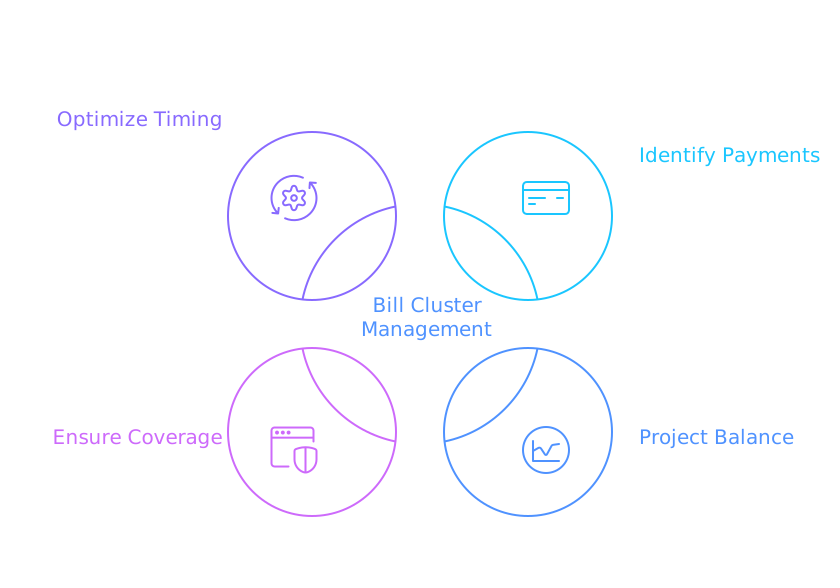
A bill cluster is not the same as total monthly spending
Monthly spending asks how much leaves over the whole month. A bill cluster asks how much leaves before the account has time to recover.
Two households can spend the same amount in a month and face different checking risk. One may spread payments across several paychecks. The other may have housing, cards, childcare, and utilities clear within the same short window.
A bill cluster is not automatically a financial emergency
A fully funded cluster can be normal. The account rises when income arrives, falls when obligations clear, and remains above a protected floor.
The cluster becomes a problem when:
- it is not visible before it begins,
- the expected debit dates are wrong,
- one large payment varies materially,
- income arrives after the low point,
- assigned cash is mistaken for free cash,
- or the account does not contain enough money to cover the full sequence.
The goal is to distinguish a predictable concentration from a genuine cash shortfall.
Why Do Independent Bills Behave Like One Liquidity Event?
Independent bills behave like one liquidity event because they compete for the same balance at nearly the same time.
The landlord does not coordinate with the card issuer. The utility company does not coordinate with childcare. The loan servicer does not coordinate with payroll. Yet every debit may reach one checking account before the next dependable inflow.
The account experiences the sequence, not the organizational chart behind it.
The balance cannot reuse the same dollar
A dollar assigned to rent cannot also cover card autopay. A dollar assigned to a card statement cannot also protect a utility debit.
Looking at each bill separately can therefore understate the cash requirement. The household must fund the cumulative effect.
Consecutive debits can matter more than the largest debit
The largest payment often gets the most attention, but the deepest balance drop may come after several smaller payments accumulate.
An illustrative mortgage debit might be manageable by itself. The same debit followed by an illustrative card payment, childcare charge, insurance premium, and transfer can push checking below the intended floor.
Recovery timing changes the risk
The same cluster can be easy or difficult depending on when income becomes available.
If a reliable deposit arrives before the cluster's deepest point, it can fund later payments. If the deposit arrives after the deepest point, the opening checking balance must carry the entire sequence.
That is why the cluster should be measured against a chronological cash-flow map, not a monthly total.
How Common Is the Underlying Timing Problem?
Bill concentration is not measured as a standardized national category, so there is no credible universal statistic for how many households have a "bill cluster." The underlying cash-flow pressures are well documented.
- The CFPB notes that consumers typically receive about seven to ten regular bills each month, often on different days and in amounts that can change.
- In the Federal Reserve's latest household survey, 30% of adults reported income that varied at least occasionally during 2025.
- The same report found that 11% of adults struggled to pay bills because their income varied.
- The Federal Reserve also reported that 16% of adults did not pay all bills in full in the prior month.
- When missed bills and difficulty paying were considered together, 28% of adults struggled with bills in the prior month.
These figures do not prove that bill clustering caused every hardship. They show why timing, concentration, and income reliability deserve separate attention from a monthly budget total.
What Types of Bill Clusters Exist?
Use the following taxonomy as a planning framework. These are practical labels for diagnosing the pattern, not official bank categories.
Date cluster
A date cluster is the clearest version. Several obligations are scheduled around the beginning, middle, or end of the month.
Housing may clear first, followed by card autopay, utilities, childcare, a loan, and an account transfer. Each bill can be predictable while the combined cash requirement remains easy to underestimate.
Amount cluster
An amount cluster occurs when familiar bills become unusually large in the same cycle.
Seasonal utilities, travel-heavy card statements, annual insurance, tuition, taxes, home repairs, and medical payments can enlarge an otherwise manageable window.
.svg)
Processing cluster
A processing cluster appears when payment rails and bank posting behavior make transactions reach checking closer together than their labels suggest.
The scheduled date, effective date, settlement date, and posted date may not all match. A weekend or federal holiday can also change when an ACH entry settles.
Income-gap cluster
An income-gap cluster occurs when the household has enough income over the month but not enough available before the cluster's low point.
This is common when a large group of bills uses calendar dates while pay arrives weekly, every other week, twice monthly, monthly, or irregularly.
Mixed cluster
Most real clusters are mixed. A fixed housing date may combine with a variable card payment, a holiday shift, and a delayed commission deposit.
The mixed cluster is why a single rule such as "keep one paycheck in checking" can fail. The cash requirement depends on the sequence and the weak case, not one round number.
Which Dates Matter Inside a Bill Cluster
One bill can have several relevant dates. Treating them as interchangeable is a common source of forecast error.
Due date and debit date are not always identical
The due date is a biller's deadline. The checking debit date is the cash-management event.
A payment can be initiated before the due date, processed on the due date, or posted later depending on the payment method and institution. Use observed account history and the biller's terms to estimate when checking needs the cash.
Card statements add another clock
A credit card has a statement cycle, a statement date, a due date, an autopay setting, and a checking debit.
The CFPB explains that a card due date generally falls on the same calendar day each month, but the statement amount can change with purchases, credits, interest, and payment choices.
Posted history improves the next forecast
After the cluster clears, compare the expected debit date with the actual posted date. The difference becomes evidence for the next cycle.
The objective is not perfect prediction. It is a conservative range that keeps the account above its floor when transactions move slightly.
Why Can a Monthly Budget Hide a Bill Cluster?
A monthly budget compresses time. It can show that income exceeds expenses while hiding the day the balance reaches its lowest point.
The CFPB's cash-flow tool carries each week's ending balance into the next week's starting balance because the sequence of income and expenses changes whether cash is available when needed.
Monthly totals ignore order
Consider two illustrative sequences with the same income and bills:
The monthly arithmetic is identical. The opening-balance requirement is not.
Average balance can hide the low point
An account can have a high average balance because it sits full after payday and then falls sharply during a cluster.
The average does not reveal whether the account approached zero, crossed a comfort threshold, or required a transfer during the concentrated window.
Category budgets do not always show the checking debit
Credit-card purchases may appear in categories throughout the month, while checking sees one card payment later.
For the checking forecast, map the checking debit. For spending analysis, retain the purchase categories. Do not subtract both from checking.
How Credit-Card Autopay Enlarges a Bill Cluster
Credit-card autopay can turn many prior purchases into one large checking debit.
Groceries, travel, subscriptions, healthcare, dining, and household purchases may occur across several weeks. Checking may remain high during that period because the purchases happened on the card. When the statement payment clears, the delayed effect arrives at once.
The statement payment is assigned cash
Once the statement amount and payment setting are known, that cash is no longer free for another purpose.
It may still appear in checking, but its job is already defined.
Full-statement autopay is variable
Housing or loan payments may be stable. A full-statement card payment can change materially from one cycle to the next.
Use the issued statement for the current obligation. Use current-cycle activity only as a planning input for the next statement, and avoid counting the same purchase twice.
Several cards can create a secondary cluster
Households with multiple cards may have several statement payments within the same window. Even when each card has a manageable balance, the combined checking debit can be large.
If one card creates the problem, the dedicated guide explains why checking drops after credit-card autopay. This article focuses on the broader group of bills surrounding that payment.
How Weekends and Holidays Affect the Cluster
Weekends and federal holidays can change when payment activity settles or posts.
Nacha states that the ACH Network currently processes on banking days and does not settle on weekends and federal holidays. It also notes that consumer bill payments due over a weekend or holiday are collected on the next banking day.
That can create several effects:
- a debit expected during the weekend may settle on the next banking day,
- multiple entries may appear closer together,
- a paycheck and a bill may change order,
- the posted date may differ from the bill label,
- and a cluster can cross from one calendar month into another.
Do not assume every institution or biller displays the sequence in the same way. Use the specific terms and actual account history.
For a deeper explanation, read How Do Bank Holidays Affect Direct Deposit and Autopay?.
How Pay Schedules Change a Bill Cluster
The same bill cluster behaves differently under different income schedules.
Stable income does not remove timing risk
A household can have stable salaries and still face a concentrated bill window. Predictable income makes the map easier, but it does not spread the bills automatically.
Irregular income increases the evidence requirement
The Federal Reserve reported that 58% of self-employed adults had month-to-month income variation in 2025, and 22% struggled to pay bills because income varied.
For irregular income, exclude uncertain deposits from the base case. Add them only when the timing and amount are dependable enough for the specific cluster.
Dual income can still create one low point
Two incomes help only when they become available before the account needs them.
If one paycheck arrives after housing and card autopay, the earlier balance still has to cover those bills. Map each deposit separately rather than treating combined monthly income as one amount.
How Do You Measure a Bill Cluster?
Measure the cluster as a short cash-flow sequence.
Use these planning fields:
Use this planning formula:
Projected balance after each event equals:
- prior projected balance
- plus reliable inflows that become available
- minus expected checking outflows
The lowest result is the cluster's projected low point.
Do not use only the cluster total
The total is useful, but the sequence can matter. A deposit inside the window may fund later bills. A bill that clears earlier than expected may increase the opening requirement.
Use a range for variable amounts
For utilities, card payments, and other variable obligations, calculate a base case and a conservative case.
The range should come from actual statements, invoices, and account history rather than a universal percentage.
Protect assigned cash outside the window
A tax payment due later may not belong to the immediate cluster, but it still belongs in the household's cash plan.
Do not label money idle merely because it survives this one group of bills.
Worked Example: A Beginning-of-Month Bill Cluster
The following example is entirely illustrative. Every amount, date, payment, and balance is a hypothetical planning assumption, not a recommendation or claim about a typical household.
Assume checking begins the illustrative cluster with $18,700.
Under these assumptions:
- the illustrative cluster window runs from Day 2 through Day 6,
- the illustrative cluster amount is $12,400,
- the illustrative pre-cluster balance is $18,700,
- the illustrative post-cluster low is $6,300,
- and the illustrative recovery date is Day 8.
If the household wants an illustrative protected checking floor of $5,000 after the planned sequence, the base case leaves $1,300 above that floor before the paycheck.
That $1,300 is not automatically idle. The household still needs to account for routine spending, outstanding checks, later bills, taxes, and any assigned reserves.
Stress the example
Now assume the illustrative card payment is $900 higher and the paycheck arrives after the weekend.
The projected low falls by $900 and lasts longer. If routine spending also occurs before recovery, the original floor may be too low.
The stress case shows why a cluster should be funded from a conservative sequence rather than the smoothest recent month.
When a Bill Cluster Is Normal
A bill cluster can be normal when it is visible, fully funded, and compatible with the household's preferred checking floor.
Normal does not mean the balance stays flat. It means the balance follows an understood cycle without missed payments, emergency transfers, or accidental use of assigned cash.
A normal cluster may still be inconvenient. Convenience is a reason to consider due-date changes or automation, but it is different from financial insufficiency.
When a Bill Cluster Is a Warning
A bill cluster is a warning when the pattern is not fully funded, depends on uncertain income, or repeatedly consumes cash assigned elsewhere.
Timing warning
The household has enough income overall, but bills reach checking before reliable deposits.
Possible responses include changing eligible due dates, splitting an allowable payment, adjusting paycheck allocation, or holding a larger floor.
Amount warning
The cluster is normally affordable, but one or more variable payments are rising.
Review the issued card statement, utilities, insurance, childcare, and other changing obligations. A timing fix will not solve a permanently larger expense.
Forecast warning
The expected dates or amounts repeatedly miss the actual account activity.
Use posted history to revise the map. Add a conservative range until the pattern becomes reliable.
Structural warning
Reliable income does not cover recurring expenses and required debt payments over the full cycle.
Automation cannot create surplus. A structural shortfall requires a broader response involving spending, income, debt, benefits, biller assistance, or qualified professional guidance.
What Mistakes Make a Bill Cluster Harder to See?
Most cluster mistakes are classification or timing errors.
Do not confuse notification with settlement
A biller email, bank alert, pending label, and posted transaction can represent different stages.
Use the stage that changes available checking cash for the forecast, then reconcile it after posting.
Do not let one missed item invalidate the entire method
The first map will be imperfect. Record the error, update the expected date or amount, and keep a larger floor while the model learns.
Cash-flow planning improves through reconciliation, not through pretending every date is certain.
How to Reduce or Reshape a Bill Cluster
Start with the largest constraint. A small subscription change will not materially improve a cluster dominated by housing and card payments.
Ask whether an eligible due date can change
The CFPB found that changing some bill due dates to align with income flow may help consumers manage cash flow.
Before requesting a change:
- test the proposed date in the full map,
- ask how the transition cycle works,
- confirm the first revised amount and payment date,
- and keep extra cash until the new pattern clears correctly.
Not every biller offers the same flexibility.
Spread only the payments that can safely move
If several card payments or utilities cluster together, moving one may reduce the low point.
Do not create a new problem by pushing a payment into a later cluster or beyond its timely-payment requirements.
Use a separate bills account when separation adds clarity
A dedicated checking account for recurring bills can make the cluster easier to see. It can also create another account to fund and reconcile.
The structure works best when the transfer into the bills account is based on the actual bill schedule and includes variable obligations.
Allocate each paycheck before spending expands
Assign part of each reliable deposit to the next cluster. This can be done inside one account with labels or in separate accounts.
The purpose is to prevent the post-payday balance from looking fully available when the cash already funds later obligations.
Keep a conservative floor while testing changes
Do not lower the floor on the same day you change due dates, payment methods, or account structure.
Observe the revised sequence, compare projected and actual lows, and reduce excess only after the new pattern proves stable.
How Much to Keep in Checking Before a Cluster
Keep enough to cover the lowest projected point plus a cushion for ordinary uncertainty and any assigned cash intentionally held in checking.
Use:
Protected checking requirement equals:
- opening cash needed to survive the projected low point
- plus an evidence-based timing and spending cushion
- plus assigned reserves intentionally kept in checking
There is no universal dollar amount or percentage.
The correct floor depends on:
- cluster amount,
- reliable inflow timing,
- card-statement variability,
- ordinary checking spending,
- processing uncertainty,
- outstanding checks,
- income reliability,
- upcoming irregular payments,
- and personal tolerance for a low balance.
If the account repeatedly approaches the floor, raise it or improve the map. If the balance remains materially above the floor through representative cycles, the excess deserves a separate decision.
When Does Cash Above the Cluster Requirement Become Idle?
Cash above one cluster is not automatically idle.
It becomes a stronger idle-cash candidate when it remains after:
- the immediate cluster is funded,
- routine spending is projected,
- issued card statements are covered,
- taxes and annual bills are assigned,
- emergency and purchase reserves are separated, and the protected floor survives representative cycles.
Use:
Potential idle cash equals:
- current checking balance
- minus the protected checking requirement
- minus known obligations outside the immediate cluster
- minus assigned reserves
If the result appears only after a light month, wait. If a similar remainder survives normal and weak cycles, the classification becomes more credible.
Where Rivo Fits Once the Cluster Is Mapped
Rivo fits after the household has established a real operating floor and a recurring amount above it.
Rivo works with your existing checking account. You set the minimum balance you want protected, and cash-flow analysis evaluates eligible idle cash above that threshold. As detected bills and transfers approach, Rivo plans refills so checking is funded before the expected need.
The relevant workflow is:
Eligible idle cash is invested in short-duration U.S. Treasury Bills through Jiko Securities. Rivo is a fintech company, not a bank, and the T-bill layer is a securities product rather than an FDIC-insured bank deposit.
Rivo does not make an underfunded cluster affordable. It addresses the operational problem that can remain after the cluster is fully funded: recurring surplus stays in checking because manual movement and return timing are hard to maintain.
When Automation Should Stay Paused
Keep automation paused or use a higher threshold when:
- the bill map is incomplete,
- a major card statement has not been issued,
- income timing is uncertain,
- a tax, tuition, home, medical, or legal payment is approaching,
- the household is changing due dates or payment methods,
- the next cluster is unusually large,
- same-day access is required,
- or the account is structurally short.
The conservative order is:
- protect payment coverage,
- observe the cluster,
- reconcile the result,
- then optimize only the recurring unassigned amount.
A Thirty-Day Bill-Cluster Review
The following sequence is an illustrative implementation plan, not a required timeline.
For the complete implementation, use How to Build a Bill Calendar for Your Checking Account.
Final Recommendation
If several payments hit checking at once, name the event before trying to optimize it.
Build the cluster from actual checking debits. Separate the due date from the expected debit date. Add housing, card payments, utilities, insurance, childcare, loans, taxes, transfers, and routine spending in chronological order. Include only reliable inflows. Find the lowest projected balance and protect a cushion based on real variation.
Then classify the result:
- A visible, funded, repeatable cluster is an operating pattern.
- A funded but inconvenient cluster may benefit from selective due-date changes or account separation.
- A cluster that depends on uncertain income needs a larger floor and more conservative assumptions.
- A cluster that exceeds reliable cash requires a broader financial response.
- A recurring amount that survives the cluster, assigned reserves, and representative weak cases may be idle.
Rivo is relevant to that final category. It can automate eligible cash above a user-set checking threshold while planning around detected bills, without requiring a bank switch. The cluster still has to be understood first.
FAQ
Is "bill cluster" an official banking term?
No. In this article, bill cluster is a practical cash-flow term for several payments that reach the same checking account within a short window. It is not a standardized bank, accounting, or legal classification.
Why do my bills all come out at the beginning of the month?
Many recurring obligations use fixed calendar dates, while pay schedules use a different cadence. Housing, card autopay, utilities, insurance, childcare, loans, and transfers can therefore concentrate before the next deposit. Map expected checking debit dates rather than relying only on due dates.
Should I change all my bill due dates?
No. Test the largest constraints first, confirm that the biller permits a change, understand the transition cycle, and make sure the new date does not create another cluster. Keep extra cash until the revised payment clears as expected.
Is credit-card autopay part of the bill cluster?
Yes, when it reaches checking inside the same concentrated window. Because it represents prior card spending, the debit may be larger than individual purchases visible during the month.
How much should I keep in checking for a bill cluster?
Keep enough to survive the projected low point, ordinary variation, and assigned reserves held in checking. There is no universal percentage, so use actual statements, deposits, and posted history.
Can Rivo help manage cash around a bill cluster?
After the cluster is mapped, Rivo can evaluate eligible cash above a user-set checking floor and plan refills around detected bills. It cannot solve a structural shortfall or identify every unusual obligation.
Related Rivo Reading

This article is educational and is not financial, investment, tax, accounting, or legal advice.
Yield rate reflects the 4-week T-bill rate when held to maturity. Rate does not include fees. Rates are subject to change. Minimum balance of $100 is required to earn the stated rate.
Rivo is a fintech company, not a bank. Banking services provided by Jiko Bank, a division of Mid-Central National Bank. Jiko Group, Inc. and its affiliates do not provide legal, tax, or accounting advice. You should consult your legal and/or tax advisors before making any financial decisions. This material is not intended as a recommendation, offer or solicitation for the purchase or sale of any security or investment strategy. See FINRA BrokerCheck, Jiko U.S. Treasuries Risk Disclosures and Jiko Securities Inc. Form CRS.
Investments in T-bills: Not FDIC Insured - No Bank Guarantee - May Lose Value. All U.S. treasury investments and investment advisory services provided by Jiko Securities, Inc., a registered broker-dealer, member FINRA and SIPC. Securities in your account are protected up to $500,000. For details, please see www.sipc.org.
External References
- Rivo FAQ
- Rivo rate comparison page
- FDIC: Understanding Deposit Insurance
- SIPC: What SIPC Protects
- TreasuryDirect: Treasury Bills
- TreasuryDirect: Tax Forms and Withholding
- TreasuryDirect FAQ
- FINRA BrokerCheck: Jiko Securities
- Jiko U.S. Treasuries Risk Disclosure
- Jiko Securities Form CRF

Get Rivo Updates
Product news, money insights, and company updates.