Why Do Biweekly Paychecks Make Monthly Bills Hard to Time? A Checking Cash-Flow Guide
Learn why biweekly paychecks drift against fixed monthly bills, how to map each paycheck to a bill cluster, and how to protect checking between paydays
.png)
Biweekly paychecks can make monthly bills hard to time because income arrives every other week while rent, mortgage, credit-card autopay, utilities, and other bills usually follow fixed calendar dates. The payday moves through the month. The bill date often does not.
That creates a paycheck-to-bill mismatch: the number of days between a deposit and a major bill cluster changes from one cycle to the next. One month, a paycheck may arrive just before rent. In another, the same rent payment may need to be carried for most of the two-week pay cycle.
This is a cash-flow timing problem, not automatic evidence of overspending. A household can earn enough over the year and still feel short before a particular bill window because annual income, monthly bills, and checking liquidity use different clocks.
The practical answer is to stop forcing a biweekly income pattern into a static monthly budget. Map actual pay dates, assign bills to the deposits that must fund them, calculate the lowest projected checking balance, and protect enough cash for the weak part of the cycle.
TL;DR
- Biweekly pay means 26 payroll periods in a standard year, while semimonthly pay means 24. They are not the same schedule.
- Most calendar months contain two biweekly paydays, while two months usually contain a third. Which months have three depends on the actual payday sequence.
- A third paycheck is not automatically extra money. It may need to fund bills that arrive before the following paycheck.
- Fixed monthly bill dates drift relative to a 14-day paycheck cadence, so the same bill can sit close to payday in one cycle and far from it in another.
- Build the forecast from actual deposit and debit dates. The CFPB defines cash flow as the timing of money coming in and going out.
- Measure the pre-bill balance, projected low point, days until the next reliable paycheck, and post-bill recovery date.
- With Rivo, you set a minimum checking threshold and keep control of automation. Rivo plans around detected bills and aims to move funds back before expected payments. Movement is not instant and specific timing is not guaranteed.
.svg)
Quick Answer: Why Do Biweekly Paychecks and Monthly Bills Fall Out of Sync?
A biweekly paycheck repeats every 14 days. A monthly bill repeats by calendar date.
Those patterns do not divide into each other evenly. A 14-day cycle advances through the calendar, while a bill due on the first, fifteenth, or last day of the month stays anchored to that date. The gap between income and the bill therefore expands and contracts.
The mismatch becomes visible when housing, card autopay, childcare, insurance, loans, or transfers clear before the next dependable deposit.
Biweekly vs. Twice-Monthly Pay
No. Biweekly pay and twice-monthly, or semimonthly, pay are different.
IRS withholding tables annualize biweekly pay using 26 pay periods per year and semimonthly pay using 24 pay periods per year. A biweekly employee is paid every other week, while a semimonthly employee is paid twice each month. These schedules are not the same in months with three biweekly paychecks.
The distinction matters because a plan built for the first and fifteenth will not accurately describe deposits that arrive every other Friday.
The weekday may be stable while the date moves
Someone paid every other Friday can rely on the weekday pattern under ordinary conditions, but the calendar date changes from month to month. Fixed bills do not follow that movement.
Semimonthly pay has its own timing risk
Fixed pay dates can be easier to place on a bill calendar, but that does not guarantee even cash flow. Housing, card payments, and other obligations may still concentrate in one half of the month.
The purpose of the distinction is accurate mapping, not declaring one pay schedule universally better.
Why Most Months Have Two Biweekly Paychecks
Biweekly payroll has 26 pay periods in a standard year. That produces two paychecks in most calendar months and a third paycheck in two months under the typical sequence.
The specific three-paycheck months depend on the first payday of the year, the regular payday weekday, employer processing, and any calendar adjustment. Do not rely on a generic online calendar. Use the employer's payroll schedule or the dates in actual direct-deposit history.
Two-paycheck months are the operating baseline
If essential bills require two ordinary paychecks, the household should be able to fund them without assuming a third paycheck will arrive in the same month.
Three-paycheck months are cadence events
A third paycheck exists because the 14-day cadence passes through the calendar month three times. It is not a bonus created by lower expenses.
Some of that deposit may be available for goals. Some may already be needed for the next rent payment, card statement, annual bill, or long gap before another deposit.
The dedicated guide explains how to decide whether a third paycheck is really extra money.
Why the Same Rent Payment Feels Different Each Month
The rent or mortgage amount may stay constant, but its distance from payday changes.
When a paycheck arrives shortly before housing clears, the deposit appears to fund the bill directly. When housing clears late in a pay cycle, the household must preserve cash from the prior deposit for more days.
The bill does not become larger
The checking requirement changes because the account must carry the money longer and absorb more intervening spending.
Groceries, transport, card payments, utilities, subscriptions, and family costs can reduce the balance between payday and housing. A monthly budget may include all of those expenses correctly while failing to show their order.
The available balance can create a false sense of surplus
Cash assigned to a bill still appears in the bank balance until the debit occurs. If that assigned cash is spent, transferred, or invested before the bill clears, the account can look healthy and then fall abruptly.
The problem is not that checking showed the wrong balance. The problem is that the displayed balance did not show which dollars already had a job.
What Is a Paycheck-to-Bill Gap?
The paycheck-to-bill gap is the number of days between the deposit expected to fund a bill or bill cluster and the date checking is expected to lose that money.
The gap is a planning metric, not a bank-defined term.
A short gap is not always safer. Several large payments may clear immediately after payday. A long gap is not always dangerous. The household may maintain enough assigned cash and a stable floor.
The useful question is: What is the lowest projected balance across the complete gap?
How a Monthly Budget Hides the Mismatch
A monthly budget adds income and expenses within a calendar period. Checking experiences a dated sequence.
The CFPB recommends a bill calendar that records what each bill is for, the amount owed, and the due date. Its cash-flow guidance also focuses on when income and expenses occur.
Monthly arithmetic can be correct while the account runs low
Suppose income for the month exceeds total expenses. That tells you the month has a positive net result.
It does not tell you whether rent, a card payment, and childcare clear before the second paycheck. It also does not tell you whether a deposit included in the month's total arrives before or after the lowest point.
Calendar boundaries can misclassify assigned cash
A paycheck received near the end of one month may fund bills at the beginning of the next. Treating it as surplus in the first month and treating the bills as a separate problem in the second breaks the actual cash-flow connection.
Average balances hide the weak day
Checking may sit high after payday and low after a bill cluster. An average blends those states together.
For bill safety, the lowest projected balance matters more than the average.
How Far Ahead Should a Biweekly Cash-Flow Forecast Extend?
Extend the forecast beyond the current calendar month until the account passes the next major bill cluster and reaches the following reliable recovery point.
Stopping on the last day of the month can make assigned cash look uncommitted. A late-month paycheck may appear after most of that month's expenses have cleared, yet it may be the only dependable income available before early-next-month housing, card autopay, childcare, or insurance.
Cross month-end without resetting the balance
Carry the projected ending balance directly into the next day. Do not label the late-month remainder as savings, spending money, or idle cash until the next cluster has been included.
This is especially important when the next biweekly deposit falls after the first major bills of the new month.
Continue through the next weak point
The forecast has gone far enough for the immediate decision when it shows:
- the deposit being evaluated,
- all known debits that depend on it,
- ordinary spending between those events,
- the next major cluster,
- the lowest projected balance,
- and the reliable inflow that begins recovery.
If a large variable bill has not been issued, use a conservative range or extend the forecast until the amount becomes known.
Match the horizon to the decision
A bill-payment decision may require only the sequence through the next recovery date. Classifying cash as recurring idle cash requires broader evidence. The apparent surplus should survive more than one representative cycle, including a cycle in which the paycheck lands in a less favorable position.
A future tax payment, annual premium, tuition payment, home project, travel cost, or other known obligation can require an even longer view. The forecast should extend far enough to keep that assigned reserve out of the idle layer.
The rule is simple: stop only after the cash being evaluated has passed every known job that could claim it before the next dependable recovery.
Illustrative Example: How the Pay-Date Drift Changes Checking
The dates and dollar amounts in this section are illustrative only. They do not describe a Rivo customer, expected result, or universal household.
Assume an illustrative household:
- receives an illustrative $3,400 net paycheck every other Friday,
- has an illustrative $2,600 housing payment on the first,
- pays an illustrative $1,700 card statement on the fifth,
- has an illustrative $650 childcare debit on the seventh,
- expects an illustrative $500 of ordinary spending before the next paycheck,
- and wants an illustrative $2,000 protected checking floor.
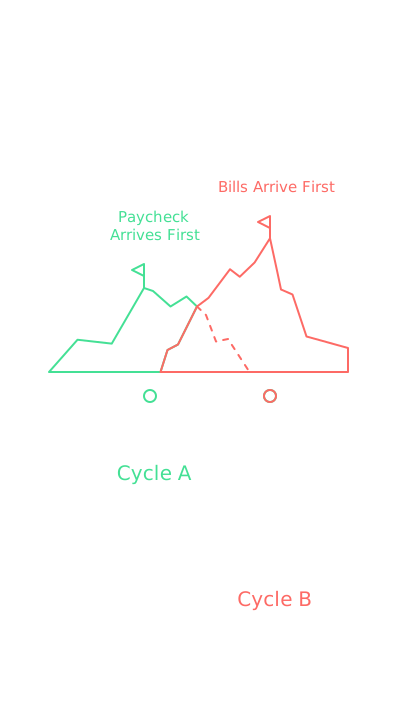
Illustrative Cycle A: Payday Arrives Just Before the Cluster
The illustrative low point is $2,350, which remains $350 above the illustrative protected floor.
Illustrative Cycle B: The Cluster Arrives Late in the Pay Cycle
The illustrative low point is $400, which is $1,600 below the illustrative protected floor even though the same paycheck and bills exist across the broader cycle.
What changed?
The bill amounts did not change. Their position relative to payday changed.
Cycle A receives income before the cluster. Cycle B requires the opening checking balance to carry the cluster until income arrives afterward.
This is why "two paychecks cover the month" is not a complete funding rule.
Why Can Dividing Monthly Bills by Two Fail?
Dividing monthly bills by two can be a useful allocation shortcut, but it can fail as a checking forecast.
Half the expense is not half the debit
A landlord or mortgage servicer usually does not withdraw half from each paycheck. Checking loses the full payment on the scheduled debit date.
If the household sets aside half conceptually but leaves the remainder available for spending, the full debit can still cause a shortfall.
The two pay cycles may not carry equal obligations
One cycle may contain housing and card autopay. The next may contain utilities and smaller subscriptions. Equal allocations can hide unequal timing.
The third paycheck complicates the shortcut
In a three-paycheck month, dividing monthly bills by two can make the third deposit look entirely unassigned. But part of it may fund the next month's early bills.
Use allocation to assign responsibility. Use a dated running balance to test liquidity.
How Do Bill Clusters Make the Mismatch Worse?
A bill cluster is a group of payments close enough together to behave like one checking-account cash-flow event.
The full explainer covers why rent, mortgage, autopay, and card payments can hit checking at once. In a biweekly pay cycle, the key question is whether the next paycheck lands before or after the deepest point in that cluster.
The same cluster can move among these positions as payday drifts through the calendar.
Which Paycheck Should Fund Each Bill?
Assign each bill to the latest reliable paycheck that arrives early enough for the money to remain available before the expected debit.
Do not assign based only on the calendar month label.
Start with actual pay dates
List upcoming net-deposit dates from payroll records or observed account history. Use the amount expected to become available, not gross salary.
Add expected checking debit dates
For each bill, capture:
- bill or transfer name,
- expected amount or conservative range,
- due date,
- scheduled payment date,
- expected checking debit date,
- and actual posted date after it clears.
The due date protects against lateness. The expected debit date protects checking liquidity. They can be different.
Work backward from the debit
Choose the reliable deposit that must reserve the money. If no deposit arrives before the debit, the obligation belongs to the opening checking balance or an earlier paycheck.
Preserve the assignment across month-end
A late-month paycheck may belong to early-next-month housing and card payments. Keep that assignment visible even though the calendar page changes.
How Do You Calculate the Opening Cash Needed Before a Bill Cluster?
Use a dated running-balance forecast.
Projected balance after event = prior projected balance + reliable inflows - expected outflows
Then identify the lowest projected balance before the account receives enough reliable income to recover.
A practical opening-cash requirement is:
Required opening cash = outflows before the next reliable deposit + protected checking floor - reliable inflows before the low point
If the calculation produces a negative amount, use zero for this narrow requirement. That does not mean every other cash need is funded.
Use ranges for variable bills
Card statements, utilities, travel, taxes, repairs, and family costs may change. Use the issued amount when known. Before it is known, use a conservative estimate or range based on current obligations and relevant history.
Exclude uncertain income
Do not fund a fixed bill with an expected commission, reimbursement, client payment, or bonus unless its timing is dependable enough for the decision.
For uncertain income, run the forecast twice:
- a base case that excludes the uncertain deposit,
- and an upside case that includes it after it becomes available.
The protected floor should survive the base case.
What Four Metrics Reveal the Timing Risk?
Track four metrics for each important bill window.
One additional metric can improve the diagnosis:
Floor gap = projected low point - protected checking floor
A negative floor gap means the current sequence does not protect the intended minimum. It does not identify the remedy by itself. The household may need more opening cash, a different bill date, a different payment setting, lower spending, or a more conservative automation setting.
When a Payday or Bill Falls Near a Holiday
Weekends and federal holidays can alter settlement and posting timing.
Nacha explains that the ACH Network processes on banking days and does not settle on weekends or federal holidays. Employer policy, biller instructions, payment method, and bank posting behavior still determine the exact customer-facing result.
Do not assume a paycheck will always appear early because a regular payday falls on a holiday. Do not assume every bill will wait until the same displayed date.
Use a conservative forecast when:
- a paycheck date falls near a non-banking day,
- a large bill is scheduled around the same period,
- the employer has changed payroll timing before,
- or the bank's pending and posted dates have differed materially.
The dedicated guide explains how bank holidays can affect direct deposit and autopay.
How Two Income Schedules Change the Plan
A dual-income household may have two biweekly schedules, a biweekly and semimonthly combination, or one regular paycheck plus variable income.
More deposits can smooth cash flow, but only if their timing and reliability are mapped correctly.
Staggered paydays can reduce the gap
When dependable deposits alternate, the account may receive income more frequently. That can shorten the period that opening cash must carry.
Overlapping paydays can preserve the cluster
If both deposits arrive near the same part of the month, the account may still face a long gap before the next inflow.
One income should not automatically backstop the other
A commission, freelance payment, equity event, reimbursement, or bonus may not be reliable enough to fund fixed obligations before it arrives.
Assign each deposit a confidence level. Use only high-confidence income in the base case.
What Should You Do About the Mismatch?
Use a sequence of bounded fixes. Do not begin by moving every bill or keeping all cash in checking indefinitely.
Step 1: Map the next several paydays
Use actual employer dates and deposit history. Include known holiday adjustments only when supported by employer policy or observed behavior.
Step 2: Build a bill calendar
The CFPB's bill-calendar process begins by gathering monthly bills and recording each bill's purpose, amount, and due date.
Extend that record with the scheduled payment date and expected checking debit date.
Step 3: Assign each bill to a reliable paycheck
Work backward from the expected debit. Mark cash as assigned once the funding deposit arrives.
Step 4: Calculate the running balance
Place deposits, bills, card payments, transfers, and ordinary spending in chronological order. Carry the ending balance forward.
Step 5: Test the weak cycle
Do not set the checking floor from the easiest month. Test a cycle in which a major cluster lands late in the biweekly pay period, variable bills run high, and uncertain income arrives late.
Step 6: Review after transactions post
Compare expected and actual debit dates. Update the next forecast instead of treating the first calendar as permanent.
For the complete implementation workflow, use How to Build a Bill Calendar for Your Checking Account.
Should You Change Bill Due Dates?
Sometimes. A selective due-date change can reduce concentration or align a bill more closely with dependable income.
The CFPB notes that people may be able to work with creditors, landlords, utilities, or card companies to adjust some bill due dates.
Before requesting a change, confirm:
- whether the biller permits it,
- when the change becomes effective,
- whether the transition creates a longer or shorter first cycle,
- whether the payment amount changes,
- whether autopay must be reauthorized,
- and which checking debit date will result.
Do not move every bill to payday automatically. That can create a larger cluster immediately after the deposit.
The objective is a safer sequence, not a tidy-looking calendar.
Would a Separate Bills Account Solve the Problem?
A separate bills account can make assignments clearer, but it does not remove the underlying timing requirement.
The account still needs enough cash before each debit. The household still needs to decide how much of each paycheck to transfer and when.
When it can help
- bill money is frequently mistaken for spending money,
- many fixed obligations draw from one account,
- both household earners need a shared operating view,
- or a clear boundary improves consistency.
When it can add complexity
- transfers create another timing dependency,
- variable card payments make fixed allocations inaccurate,
- bills draw from several accounts,
- or the household stops monitoring the source account.
Use a separate account as an operating tool, not as a substitute for a cash-flow forecast.
How Much Should Stay in Checking?
Keep enough in checking to cover the weak sequence, not an arbitrary multiple of expenses.
A practical minimum should reflect:
- known bills before the next reliable deposit,
- ordinary spending during the same period,
- variable-payment ranges,
- expected processing uncertainty,
- and a comfort buffer for unplanned activity.
The guide to why checking runs low before payday explains how to identify the recurring low point and build a timing floor.
The result should be reviewed when pay schedules, housing, childcare, card behavior, income reliability, or major recurring bills change.
Cash above that protected requirement is only potentially idle. It is not idle if it is assigned to next month's bills, taxes, a known purchase, an emergency reserve, or another near-term obligation.
Where Does Rivo Fit?
Rivo fits after the paycheck cadence, bill sequence, and protected checking threshold are understood.
With Rivo, you connect an existing checking account and set the minimum amount you want to keep available. Rivo analyzes the balance and spending pattern, identifies cash above the protected threshold, and plans around detected bills and transfers.
As expected payments approach, Rivo moves money back into checking. If income timing becomes uncertain, the automation can operate more conservatively, and you can adjust the threshold, pause automation, move money manually, or disconnect.
That is different from forcing every month into a fixed sweep amount. A biweekly-pay household may have more genuinely idle cash after one deposit and less after another because the next bill cluster is not always in the same position.
What Rivo does not replace
Rivo does not replace:
- accurate bill information,
- a realistic minimum checking threshold,
- emergency savings,
- debt strategy,
- employer payroll confirmation,
- or judgment about unusual upcoming expenses.
It is an automated cash-management layer for cash that is genuinely above the household's protected operating need.
When Should Automation Stay Paused or Conservative?
Keep automation paused or use a higher checking threshold when the near-term sequence is not reliable enough to classify cash as idle.
Examples include:
- a new job or changed payroll provider,
- an uncertain first paycheck,
- variable commission or freelance income,
- a large card statement that is not final,
- a new rent, mortgage, tuition, tax, or insurance payment,
- a changed autopay instruction,
- a holiday period with unclear timing,
- account aggregation delays,
- or an upcoming expense that is not visible in recurring history.
Resume or lower the threshold only when the weak-case forecast remains above the intended floor.
What Mistakes Make Biweekly Cash Flow Harder?
Mistake 1: Treating biweekly as twice monthly
The schedules have different annual frequencies and different calendar behavior.
Mistake 2: Calling the third paycheck free money
Check what the deposit must fund before the next reliable payday, including bills across month-end.
Mistake 3: Dividing every monthly bill by two and stopping
Allocation does not prove the full debit can clear on its actual date.
Mistake 4: Using the bill due date as the checking debit date
Track both. Add scheduled, expected debit, and posted dates when they differ.
Mistake 5: Counting card purchases and card autopay against checking
For checking cash flow, record the card payment. For spending analysis, keep the underlying categories. Do not subtract both from checking.
Mistake 6: Funding fixed bills with uncertain income
Exclude the deposit from the base case until its timing is dependable.
Mistake 7: Setting the floor from a favorable cycle
Use the late-paycheck, high-bill, uncertain-timing case.
Mistake 8: Assuming last month's dates will repeat exactly
Update the calendar with actual future pay dates and observed payment history.
Final Recommendation
Treat biweekly pay and monthly bills as two separate clocks.
Start with actual deposit dates. Add expected checking debit dates. Assign every major bill to the latest reliable paycheck that arrives before it. Carry the running balance across month-end and identify the lowest point before recovery.
Then set a checking threshold that survives the weak cycle, not just the average month.
If cash remains consistently above that protected requirement after upcoming obligations and irregular expenses are included, it may be genuinely idle. That is the point at which automated cash management can help without confusing assigned bill money with available surplus.
FAQ
Why are biweekly paychecks difficult to budget with monthly bills?
Biweekly paychecks repeat every 14 days, while monthly bills usually follow fixed calendar dates. The payday therefore moves relative to rent, mortgage, card autopay, and other obligations. The household must plan from the actual sequence instead of assuming each month has the same two paydays.
How many paychecks do you receive when paid biweekly?
The IRS uses 26 annual payroll periods for biweekly pay. Most calendar months therefore contain two paydays, while two months usually contain a third under the typical sequence.
Is biweekly pay the same as being paid twice a month?
No. The IRS distinguishes 26 biweekly pay periods from 24 semimonthly pay periods. Biweekly pay usually repeats on a weekday every other week. Semimonthly pay usually uses two defined dates or employer-adjusted dates each month.
Is a third paycheck extra money?
Not automatically. First subtract bills, ordinary spending, assigned reserves, and obligations due before the following reliable paycheck. The remainder, if any, may be available for savings, debt reduction, investing, or other goals.
Should I move all bills to the day after payday?
Usually not. Moving every bill can create one larger cluster. Consider selective changes only after mapping the existing sequence and confirming the biller's transition rules. CFPB guidance notes that some bill due dates may be adjustable.
Can Rivo work with biweekly or changing paycheck timing?
Yes. Rivo works with your existing checking account, plans around detected bills, and lets you set the minimum balance that remains available. When income timing becomes uncertain, use a more conservative threshold or pause automation until the cash-flow sequence is reliable.
Related Rivo Reading
1. Should You Change Your Bill Due Dates to Match Payday?
2. Is a Third Paycheck Really Extra Money?
3. Why Does a Five-Week Month Make Your Checking Account Run Low?
4. How to Build a Bill Calendar for Your Checking Account
5. What Is a Bill Cluster? Why Rent, Mortgage, Autopay, and Card Payments Hit Checking at Once

This article is educational and is not financial, investment, tax, accounting, or legal advice.
Rivo is a fintech company, not a bank. Banking services provided by Jiko Bank, a division of Mid-Central National Bank. Jiko Group, Inc. and its affiliates do not provide legal, tax, or accounting advice. You should consult your legal and/or tax advisors before making any financial decisions. This material is not intended as a recommendation, offer or solicitation for the purchase or sale of any security or investment strategy. See FINRA BrokerCheck, Jiko U.S. Treasuries Risk Disclosures and Jiko Securities Inc. Form CRS.
Investments in T-bills: Not FDIC Insured - No Bank Guarantee - May Lose Value. All U.S. treasury investments and investment advisory services provided by Jiko Securities, Inc., a registered broker-dealer, member FINRA and SIPC. Securities in your account are protected up to $500,000. For details, please see www.sipc.org.

Get Rivo Updates
Product news, money insights, and company updates.