Why Does My Checking Account Balance Fluctuate So Much? Paydays, Autopay, and False Idle Cash
Learn why checking balances rise and fall, how pending transactions and card autopay distort the number, and how to find recurring idle cash.
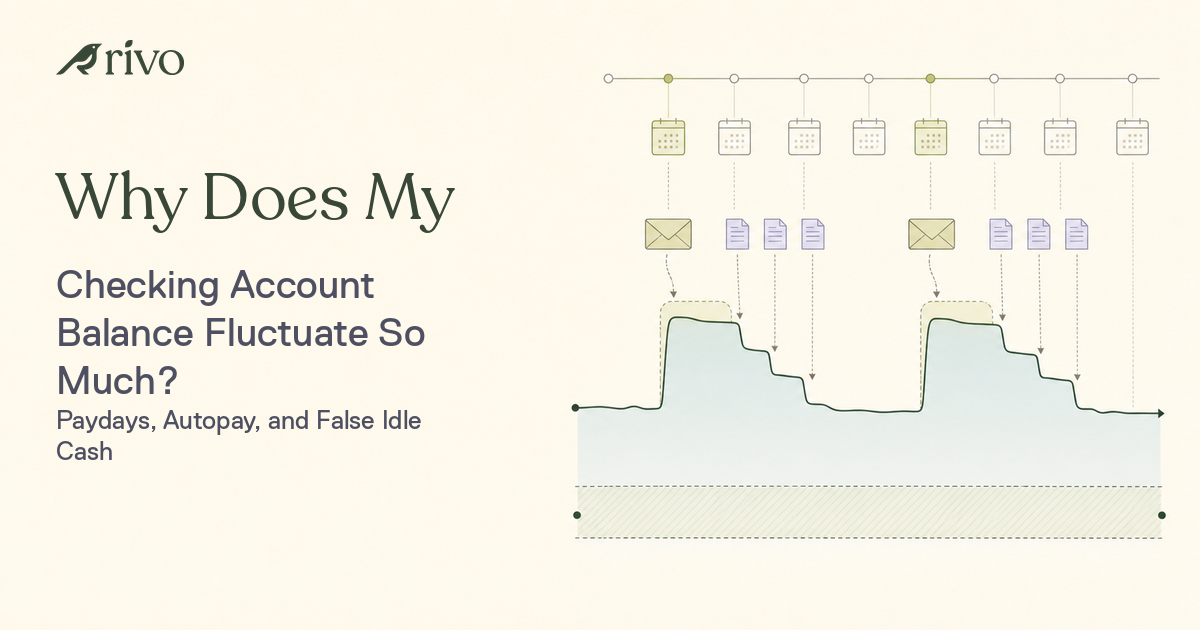
Your checking account balance can fluctuate by thousands of dollars without anything being wrong. Paychecks arrive in large deposits, everyday purchases may accumulate on credit cards, and mortgage, rent, card autopay, childcare, taxes, or insurance can leave checking in a few concentrated withdrawals.
The confusing part is that every balance can tell a different story. The post-payday high can look like excess cash. The pre-payday low can feel like overspending. The monthly average can appear healthy while hiding one difficult bill week. The available balance can include money already committed to a card statement that has not been debited yet.
The useful question is not simply, "Why did my balance change?" It is:
Does the pattern show normal cash-flow timing, spending that needs attention, or cash that repeatedly remains idle after every bill is covered?
Answer that by mapping the account through at least three representative pay-and-bill cycles. Track the low point, not just the peak or average. Subtract pending payments, issued card statements, taxes, annual expenses, and other assigned cash. Then decide whether the recurring remainder should stay in checking, move elsewhere manually, or be managed automatically.
TL;DR
- A fluctuating checking balance is often normal. Income arrives in chunks, while bills and spending leave on different dates.
- The post-payday balance is not the same as spendable cash. It may include money reserved for rent or mortgage, credit-card autopay, taxes, transfers, and bills that have not posted.
- Current balance, available balance, and bill-ready balance answer different questions. Your bank may show what has posted and what is available now, but it cannot know every obligation you have assigned outside the account.
- Credit cards create a delayed checking impact. Purchases happen throughout one statement cycle, but checking may fall only when the statement payment is debited weeks later.
- A monthly average can hide the account's real low point. Use a chronological balance timeline and find the lowest projected balance before the next reliable deposit.
- Diagnose three cycles. A falling low point may signal spending growth or a new bill. A stable low point may show normal timing. A low point that remains well above your protected floor may reveal recurring idle cash.
- Rivo can be relevant after that surplus is established. It works with an existing checking account, uses a user-set minimum threshold, and plans refills before detected bills.
Quick Answer: Why Does Your Checking Account Balance Fluctuate?
Your checking account balance fluctuates because deposits and withdrawals do not occur at a smooth daily rate.
A salary may enter twice a month. A mortgage may leave once. Credit-card purchases may not affect checking until one large autopay clears. Utilities vary. Annual bills appear outside the normal monthly pattern. Pending card transactions, deposit holds, bank processing, refunds, and transfers can also change the amount shown as available.
.svg)
Most balance movement fits one of three categories:
Do not classify the pattern from a single balance. One post-payday screenshot cannot show how much is free, and one low-balance day cannot prove the budget is broken.
Use this sequence:
- Reconcile the balance shown by the bank.
- Add every reliable deposit by expected availability date.
- Subtract every known bill by expected clearing date.
- Include variable daily spending and full-statement card payments.
- Find the lowest projected balance.
- Add a cushion for normal forecast error.
- Observe whether cash remains above that level across at least three cycles.
The result separates a temporary peak from a persistent surplus.
What Makes a Checking Balance Rise and Fall?
Checking is an operating account. It receives income, funds payments, and absorbs timing differences. Movement is part of its job.
The size of the movement depends on how much of the household's financial life passes through the account and how concentrated the dates are.
Paychecks create visible peaks
When one or two large deposits arrive, checking jumps immediately. That peak can create a sense of extra capacity even though much of the money has a job later in the cycle.
Suppose an illustrative $7,500 paycheck enters an account that already holds $12,000. The displayed balance becomes $19,500. If $4,200 of housing, a $5,300 card statement, $2,400 of childcare, and normal spending will leave before the next full cycle ends, the $19,500 peak is not a $19,500 spending allowance.
Bills create cliffs
Large bills leave in discrete amounts. Several bills clearing close together can produce a sharp drop even when their total was expected.
A cliff is not automatically a problem. It becomes a problem when:
- The post-bill balance falls below the household's protected floor
- A bill was omitted from the forecast
- The amount is materially higher than expected
- The decline becomes deeper across repeated cycles
- The next reliable deposit arrives too late to cover remaining payments
Everyday spending creates slopes
Groceries, fuel, dining, transportation, and debit-card purchases usually create a gradual decline. The slope matters because it can reveal behavior that a monthly total hides.
If checking drops faster each cycle even though fixed bills have not changed, review:
- Debit-card and cash withdrawals
- Peer-to-peer payments
- New subscriptions
- Duplicate charges
- Higher utility or insurance payments
- Credit-card payments that reflect prior spending
- Transfers that were classified as savings but are repeatedly reversed
The objective is not to eliminate fluctuation. It is to explain it.
Current Balance vs Available Balance vs Bill-Ready Balance
A bank balance is a snapshot of account processing. It is not a complete forecast of your household obligations.
.svg)
The exact labels and posting rules vary by institution, but three concepts are useful:
The CFPB describes available balance calculations as generally starting with the ledger balance, adding available uncleared deposits, and subtracting pending authorized debits that have not settled. The exact calculation is governed by the institution's account agreement and processing practices.
That means a pending debit-card authorization may reduce the available balance before it posts to the current balance. A deposit can appear in account activity while part of it remains unavailable. A card statement scheduled for next week may appear in neither number.
Use this formula as a planning layer:
Bill-ready balance = available balance - pending obligations not already reflected - issued credit-card statements - scheduled bills before the next reliable deposit - assigned tax, sinking-fund, and near-term purchase cash
The bill-ready balance is your own decision tool, not a bank-provided legal balance.
Why the bank cannot show your true spendable amount
Your bank knows the transactions it has received. It may not know:
- A credit-card statement due in twelve days
- A property-tax payment you plan to initiate
- A check that has not been deposited by the recipient
- A tuition invoice due next month
- A contractor payment awaiting completion
- A family transfer you have committed to make
- The amount you want to preserve as an emergency reserve
Calling all available cash "spendable" ignores those obligations.
Why balance alerts still help
Alerts can reveal when the account crosses a threshold, a large debit posts, or a deposit becomes available. They are useful controls, but the threshold should come from the cash-flow map.
An alert set at an arbitrary round number can be too low during a heavy bill week and too high during a quiet cycle. Review the threshold after material changes to income, housing, childcare, debt payments, or card use.
Why Credit-Card Autopay Creates False Idle Cash
Credit cards separate the purchase date from the checking-account payment date.
You can buy groceries, flights, furniture, or medical services throughout a statement cycle without reducing checking. The card issuer records the purchases. Checking still displays the cash. When the statement payment clears, those weeks of spending may leave as one large debit.
This delay produces false idle cash.
The card balance and checking balance move on different clocks
There are at least four dates to distinguish:
1. Purchase date
2. Card transaction posting date
3. Statement closing date
4. Autopay or payment clearing date
If you pay the full statement balance, the checking effect may occur several weeks after the original purchase.
The safe calculation is:
Potential idle cash before card autopay = checking cash - issued statement balance - known post-statement purchases you intend to reserve - other scheduled obligations - protected checking floor
Do not subtract the same card spending twice. If daily card purchases are already included in a future statement estimate, do not also treat them as immediate checking outflows in the timeline.
Variable autopay is a known but changing bill
The CFPB explains that recurring bank debits may be fixed or may vary within an authorized range. For variable automatic payments outside the authorized amount or range, or different from the most recent payment, the company generally must provide advance notice under the applicable rule.
The practical control is to use the actual issued statement as soon as it is available. Do not forecast a travel-heavy or medical-expense month from the prior month's smaller payment.
Statement close can produce a temporary blind spot
Immediately after one statement closes, the next statement has begun accumulating charges but does not yet have a final amount. The issued statement is assigned cash. The new cycle is an estimate.
Use:
- The exact issued statement balance for the next autopay
- Current posted card activity for the new cycle
- A representative high-month estimate when upcoming travel or large purchases are known
- A separate assigned-cash entry for one-time purchases
This keeps a large checking balance from being mistaken for a large uncommitted balance.
Why the Monthly Average Can Hide the Real Low Point
An average balance compresses every peak and trough into one number.
That may be useful for fee calculations or historical reporting. It is weak for deciding how much money can leave checking safely.
Consider an account that moves through the following illustrative points:
These numbers are illustrative and are not a recommended balance or spending pattern.
The visible peak is $19,500. The listed-point average is about $13,600. The low point is $9,100.
If the household protects a $6,000 checking floor and has $2,000 assigned to a near-term annual payment not included in the table, the provisional recurring surplus at the low point is only:
$9,100 cycle low -$6,000 protected floor -$2,000 assigned irregular cash = $1,100 provisional surplus
Calculating from the $19,500 peak would overstate the amount by including the next round of bills. Calculating from the approximate $13,600 average would still ignore the account's deepest drawdown.
The low point is not perfect. One cycle can be unusually quiet or unusually expensive. That is why the decision should use at least three representative cycles and include known exceptions.
Build a 30-Day Checking Balance Timeline
A timeline makes the account explainable. You can build it in a spreadsheet, calendar, budgeting tool, or ledger.
Start with the current available balance. Then add and subtract cash in chronological order.
Step 1: Start with available funds
Use the bank's available balance, not an assumption based on a recent deposit. Review deposit holds, debit authorizations, and recent transactions.
The CFPB notes that deposited funds may not always be available immediately. Availability depends on the type of deposit, timing, account history, and applicable rules.
Step 2: Add reliable income by availability date
Include salary, pension, benefit, or other reliable deposits when the funds are expected to be usable.
For variable income, build at least two cases:
- Base case using conservative expected income
- Delayed or weak-income case using a later date or lower amount
The Federal Reserve reported that 30% of adults had income that varied at least occasionally in 2025, and 11% said income variation had made paying bills difficult. If either amount or timing changes, the low point needs more than one scenario.
Step 3: Subtract fixed bills
Enter housing, loans, childcare, insurance, utilities, subscriptions, and automatic transfers by expected clearing date.
Use actual bills where available. A recurring bill can keep the same date while changing in amount.
Step 4: Add full-statement card payments
Use each issued statement balance and payment date. For a statement that has not closed, estimate from current posted card transactions plus known upcoming purchases.
Step 5: Estimate variable checking spending
Use representative debit-card spending, cash withdrawals, peer-to-peer transfers, and other direct checking activity.
Do not hide the amount in one monthly total. Spread it across the dates or weeks when it is likely to occur so the running balance remains meaningful.
Step 6: Add irregular obligations
Include:
- Quarterly estimated taxes
- Annual or semiannual insurance
- Property tax
- Tuition
- Travel
- Planned home or vehicle work
- Professional dues
- Gifts and seasonal spending
- Medical payments
If the money is already reserved, mark it as assigned. Assigned cash is not idle cash.
Step 7: Find the lowest projected balance
The lowest point before a reliable replenishment is the operational constraint.
If the projection falls below zero, the account needs more opening cash, earlier income, later payments, lower outflows, or a combination. If the projection remains positive but below the comfort threshold, increase the floor or adjust the calendar.
Diagnose Three Cycles, Not One Day
One cycle can mislead. Three completed cycles begin to reveal whether the shape is stable.
Record for each cycle:
- Opening balance
- Highest balance
- Lowest available balance
- Date of the low point
- Largest deposit
- Largest debit
- Total checking outflows
- Credit-card statement payments
- Assigned irregular cash
- Unexplained transaction difference
Then compare the pattern.
Use a representative low, not the single worst event
The lowest balance ever recorded may reflect a rare purchase that is unlikely to recur. The highest recent low may come from an unusually quiet month.
Use judgment:
- Keep known recurring annual events in the model
- Separate true emergencies from normal operating cash
- Stress test a recent high-spending cycle
- Do not optimize from a holiday, travel, or bonus month alone
- Recalculate after a major life or income change
Reconcile unexplained differences
Your projected and actual balances will differ. The difference is useful data.
If the model expected $10,000 and the account shows $8,900, find the $1,100 difference before lowering the floor or moving more money. It may be an omitted debit, a larger card payment, a delayed deposit, a hold, or a forecasting error.
A floor built on unreconciled data is not conservative. It is incomplete.
Is It a Timing Problem, a Spending Problem, or an Idle-Cash Problem?
The same fluctuating line can produce three different decisions.
Timing problem
You probably have a timing problem when:
- Monthly income is sufficient, but one bill cluster creates a difficult low point
- The low occurs on roughly the same date each cycle
- A later paycheck restores the account
- Moving a due date or increasing opening cash would resolve the gap
- Total spending remains within the household plan
The first action is a cash-flow calendar. The separate guide on why checking runs low before payday goes deeper into bill clusters and paycheck sequencing.
Spending or affordability problem
You may have a spending or affordability problem when:
- Each low point is lower than the last
- The account does not recover after normal income
- Card statements grow without a known one-time cause
- Transfers from savings repeatedly cover ordinary bills
- Total outflows exceed reliable income
- Minimum payments or overdrafts become recurring
Automation cannot create a surplus that does not exist. Reconcile spending, income, debt obligations, and recurring charges before moving operating cash elsewhere.
Idle-cash problem
You may have recurring idle cash when:
- The account's low point remains well above the protected floor
- The surplus survives high-spending and irregular-bill cycles
- Taxes, emergency reserves, annual expenses, and dated purchases are already assigned
- The money has remained unassigned across several completed cycles
- Manual transfers are repeatedly delayed or reversed because the timing is hard to manage
Use this calculation:
Recurring idle-cash estimate =
conservative cycle low
- protected checking floor
- assigned near-term cash held in checking
If the result is negative, there is no demonstrated idle cash. If it is positive once, observe another cycle. If it remains positive across representative cycles, compare destinations and operating methods.
How Much Should Stay in Checking When the Balance Swings?
There is no universal dollar amount or fixed number of months that works for every checking account.
The amount should protect the account through its deepest normal drawdown while preserving a cushion for forecast error.
Use four layers:
Then preserve a separate emergency-reserve decision. Some households keep emergency cash in checking for immediate access. Others separate it to make operating cash easier to read. Either approach requires the money to be labeled so it is not mistaken for idle.
The detailed guide on how much money to keep in checking provides the full floor-sizing framework.
Use observed error to size the cushion
Instead of choosing a cushion only because it feels comfortable, measure how wrong the forecast has been.
For three cycles, record:
Forecast error =
actual low balance
- projected low balance
If the model repeatedly overestimates the low balance by an illustrative $800 to $1,200, investigate the missing events and use a larger cushion until the forecast improves.
Recalculate after material changes
Update the floor after:
- A change in pay frequency or employer
- A move or housing-payment change
- New childcare or tuition
- A major credit-card spending change
- A loan beginning or ending
- A new tax schedule
- A change in how many accounts fund the household
- A recurring transfer or subscription change
A floor is a working control, not a permanent personal-finance rule.
How Pending Transactions and ACH Timing Change the Picture
Transactions can move through authorization, settlement, posting, and funds-availability stages. The displayed balance can change during that process.
For ACH payments, Nacha reports that approximately 80% of ACH network volume settles in one banking day or less, with ACH debits settling either the same banking day or the next banking day. Settlement speed does not mean every consumer-facing balance display or funds transfer is identical. Banks, billers, weekends, cutoffs, and account terms still matter.
Pending debit-card transactions can change
A merchant may authorize one amount and settle another. Restaurants, hotels, fuel stations, and car-rental companies can create temporary authorization patterns that differ from the final posted charge.
Do not add a pending amount twice if the bank's available balance already subtracts it. Reconcile the transaction when it posts.
Checks can remain invisible until presented
A written check may reduce your personal ledger immediately while the bank balance remains unchanged until the recipient deposits it.
Treat an outstanding check as spent. Keeping it in the idle-cash calculation risks moving the same money elsewhere.
Deposits can appear before full availability
Review when funds become available, especially for checks, unusually large deposits, or accounts subject to a hold. A visible deposit should not fund a bill until the usable amount and date are confirmed.
Automatic payments can trigger overdraft
The CFPB explains that an overdraft can occur when a transaction exceeds the available balance and the institution pays it anyway. Automatic payments, checks, and other transactions can also be returned when funds are insufficient, depending on the account and transaction.
The operating control is straightforward: fund the clearing window, not just the stated due date.
How Pay Frequency Changes the Balance Pattern
The same monthly income can produce different checking shapes depending on cadence.
Biweekly is not the same as twice monthly
Biweekly pay produces more annual pay periods than twice-monthly pay. The important operational point is that biweekly deposit dates move relative to fixed due dates, while semimonthly dates are usually more stable.
A due-date arrangement that works in one biweekly month may create a tighter gap in another.
Two incomes can smooth or concentrate the cycle
If two paychecks arrive on different weeks, they may reduce the deepest drawdown. If both arrive together and major bills follow, the account can show a large peak and a long decline.
Build one household timeline even when income comes from separate sources. Then mark which obligations must be funded from which account.
Early direct deposit does not replace a cushion
Some accounts may make payroll available before the employer's stated pay date under their own terms. Do not assume early availability will always occur when sizing the minimum operational balance. Use the date you can conservatively rely on.
When Balance Fluctuation Is Normal
Fluctuation is usually normal when the movement is explainable, repeatable, and funded.
Healthy signs include:
- Paycheck peaks occur when expected
- Major declines match known bills or card statements
- The account remains above its protected floor
- The low point recovers after reliable income
- Differences between projected and actual balances are small and reconciled
- Annual or irregular charges have assigned funding
- There is no recurring reliance on overdraft or emergency transfers
Normal does not mean optimal. An account can be safe and still hold more idle cash than necessary. Safety and efficiency are separate decisions.
When the Pattern Needs Attention
Investigate promptly when the movement is unexplained or the floor is eroding.
Warning signs include:
- Transactions you do not recognize
- Duplicate or incorrect debits
- A deposit that is missing or held longer than expected
- A card payment that does not match the issued statement or chosen autopay setting
- New recurring charges
- The balance failing to recover after income
- A lower low point for several consecutive cycles
- Returned payments, overdrafts, or repeated emergency transfers
- A scheduled withdrawal that exceeds the institution or product's access limits
For unrecognized activity, use the bank or card issuer's dispute and security process. For a recurring affordability gap, review income, spending, and debt obligations before trying to optimize yield.
When Fluctuation Reveals Too Much Cash in Checking
A large peak does not prove that checking holds too much cash. A persistently elevated low point is stronger evidence.
Suppose the household protects an illustrative $8,000 floor. Across three representative cycles, the lowest balances are $16,400, $15,700, and $16,100. The household also keeps $2,500 in checking for a known insurance payment.
Using the lowest observed cycle:
$15,700 conservative low -$8,000 protected floor -$2,500 assigned insurance cash = $5,200 recurring idle-cash estimate
These figures are illustrative. The $5,200 is a candidate for review, not proof that the full amount should immediately leave checking.
Before acting, ask:
- Did the three cycles include a representative card statement?
- Is any tax, emergency, tuition, or purchase cash missing?
- Are upcoming bills materially different?
- Could income be delayed?
- How quickly can the chosen destination return funds?
- Are transfer, settlement, withdrawal, tax, fee, or investment risks understood?
The broader guide on why a checking balance keeps growing addresses persistent accumulation. This article focuses on deciding what the repeated ups and downs actually mean.
Manual Transfers vs Bill-Aware Automation
Once recurring idle cash is established, there are two operating questions:
1. Where should the cash go?
2. Who will coordinate movement around the checking low point?
The destination could be a deposit account, a money market fund, Treasury bills, or another product that fits the household's liquidity, risk, tax, and account needs. The operating method could be manual, fixed-rule, or bill-aware.
Manual movement can work well for a stable household that reviews cash on a set schedule. Fixed transfers can work when income and bills are highly predictable. Automation becomes more relevant when the surplus is recurring but the amount and timing vary enough to make manual coordination unreliable.
The detailed guide on moving money out of checking without missing bills compares the controls needed before moving cash.
How Rivo Fits a Fluctuating Checking Balance
Rivo is an automated cash-management option for a household that has already established a genuine surplus above its checking needs.
It works with an existing checking account. The user sets a minimum checking threshold. Rivo analyzes cash-flow patterns, identifies cash above the threshold that appears idle, and moves that cash into short-duration U.S. Treasury bills through Jiko Securities. As detected bills and transfers approach, it plans to move money back to checking.
That design addresses the operational problem in a fluctuating account: the amount available to move can change from one cycle to the next.
Important controls and limits include:
- The user can configure the minimum checking threshold and adjust how much Rivo is allowed to move.
- Rivo sends an email at 5 p.m. Pacific before moving money, with a cancellation window until midnight.
- Users can pause, modify, or stop the automation.
- Available withdrawals initiated in the app are currently subject to a $15,000 daily limit.
- Rivo charges a 0.05% monthly management fee based on the average daily Rivo balance.
- The published yield was 3.65% as of July 1, 2026, before the management fee and individual taxes, assuming the underlying 4-week T-bills are held to maturity.
Rivo does not fix a negative household budget, identify every obligation known only to the user, or remove the need to set a conservative floor. It also does not replace the linked bank. The decision should begin with the cash-flow model, not the published yield.
Use Rivo only after comparing:
- The recurring amount likely to remain idle
- The household's required checking floor
- Near-term access needs
- The daily withdrawal limit
- The management fee
- T-bill risks, including the effect of selling before maturity
- SIPC protection for securities versus FDIC insurance for eligible bank deposits
- The alternative of managing transfers directly
A Three-Cycle Action Plan
Use the next three complete pay-and-bill cycles to turn the fluctuating balance into a decision.
Cycle 1: Explain every movement
- Export checking and card activity.
- Record current and available balances.
- Add paycheck availability dates.
- Add bills by expected clearing date.
- Add issued card statements.
- Mark pending transactions and outstanding checks.
- Label tax, emergency, and irregular-expense cash.
- Compare projected and actual daily or weekly lows.
Cycle 2: Test the model
- Update variable spending assumptions.
- Use the new card statement amount.
- Include known annual or irregular bills.
- Measure the forecast error at the low point.
- Increase the cushion if the actual balance falls below projection.
- Investigate any unexplained difference.
Cycle 3: Make the operating decision
- Choose the conservative low across representative cycles.
- Subtract the protected floor.
- Subtract assigned near-term cash.
- Treat only the positive remainder as a candidate surplus.
- Compare manual movement, a fixed rule, and bill-aware automation.
- Start conservatively and review the next cycle after any change.
Do not force a yield decision when the diagnosis is still uncertain. A correct floor is worth more than an aggressive transfer based on a temporary peak.
Final Recommendation
When your checking balance fluctuates, stop judging it from the highest number, the lowest number, or the monthly average alone.
Build a chronological view. Reconcile current and available balances. Subtract issued card statements, scheduled bills, pending obligations, outstanding checks, taxes, annual expenses, and other assigned cash. Find the lowest projected point before reliable income and compare it with the actual low across at least three representative cycles.
Then classify the pattern:
- Stable, explainable movement is normal cash-flow timing.
- Falling lows or unexplained declines require a spending, income, or transaction review.
- A low point that repeatedly remains above the protected floor and assigned cash may reveal recurring idle cash.
Only the third pattern creates an optimization decision. At that point, compare where the cash should be held and whether manual transfers, fixed rules, or bill-aware automation fit the household's timing and control needs.
Rivo can be one option for recurring surplus cash when the user wants to keep an existing bank and automate movement around detected bills. It should sit on top of a conservative checking floor, not replace one.
FAQ
Why does my checking account balance change even when I did not buy anything today?
A pending transaction may have been authorized or settled, a prior purchase may have posted, an automatic payment may have cleared, a deposit hold may have changed, or a check may have been presented. Compare current and available balances, then review pending and recently posted transactions.
Is my available balance the amount I can safely spend?
Not necessarily. Available balance generally reflects the institution's view of posted activity, holds, and relevant pending transactions. It may not include a future credit-card autopay, outstanding check, tax payment, or other obligation known only to you. Subtract those items to estimate a bill-ready balance.
Why is my checking balance highest right after payday?
Income arrives as one large deposit while bills leave later on separate dates. The post-payday peak includes money assigned to future payments, so it should not be treated as surplus until the rest of the cycle is mapped.
Why does credit-card autopay make my checking balance drop so much?
Card purchases accumulate outside checking during the statement cycle. When the full statement is paid, many days of spending affect checking in one debit. Reserve the issued statement balance as soon as it becomes available.
How many months should I track before deciding cash is idle?
Track at least three representative pay-and-bill cycles, then include any known quarterly, annual, or irregular obligations. A single quiet month or post-payday high is not enough to establish a recurring surplus.
Can Rivo manage cash if my checking balance changes throughout the month?
Rivo is designed to analyze changing cash-flow patterns, use a user-set minimum checking threshold, move identified idle cash into short-duration U.S. Treasury bills through Jiko Securities, and plan refills before detected bills. Keep the threshold conservative and account separately for unusual obligations the system may not know.
Related Rivo Reading
- To separate visible cash from money already assigned to bills, read Is Your Available Balance Safe to Spend?.
- Why Does My Checking Account Drop After Credit Card Autopay?
- To convert those balance changes into a dated 30-day projection, read How to Forecast Your Checking Account Balance.
- What Is a Safe Balance?
- What Is a Bill Cluster?

This article is educational and is not financial, investment, tax, accounting, or legal advice.
Yield rate reflects the 4-week T-bill rate when held to maturity. Rate does not include fees. Rates are subject to change. Minimum balance of $100 is required to earn the stated rate.
Rivo is a fintech company, not a bank. Banking services provided by Jiko Bank, a division of Mid-Central National Bank. Jiko Group, Inc. and its affiliates do not provide legal, tax, or accounting advice. You should consult your legal and/or tax advisors before making any financial decisions. This material is not intended as a recommendation, offer or solicitation for the purchase or sale of any security or investment strategy. See FINRA BrokerCheck, Jiko U.S. Treasuries Risk Disclosures and Jiko Securities Inc. Form CRS.
Investments in T-bills: Not FDIC Insured - No Bank Guarantee - May Lose Value. All U.S. treasury investments and investment advisory services provided by Jiko Securities, Inc., a registered broker-dealer, member FINRA and SIPC. Securities in your account are protected up to $500,000. For details, please see www.sipc.org.
Sources
- Consumer Financial Protection Bureau: Guidance Compendium
- Consumer Financial Protection Bureau: Automatic Payments From a Bank Account
- Consumer Financial Protection Bureau: Funds Availability After a Deposit
- Consumer Financial Protection Bureau: What Is an Overdraft?
- Nacha: ACH Payments Settle in One Business Day or Less
- Federal Reserve: Economic Well-Being of U.S. Households in 2025
- Rivo Homepage
- Rivo Help Center
- Rivo Rates

Get Rivo Updates
Product news, money insights, and company updates.