Rivo vs Fidelity Cash Management Account: Keep Your Bank or Use a Brokerage Cash Hub?
Rivo vs Fidelity Cash Management Account: compare automation, rates, fees, protection, taxes, bills, and liquidity.
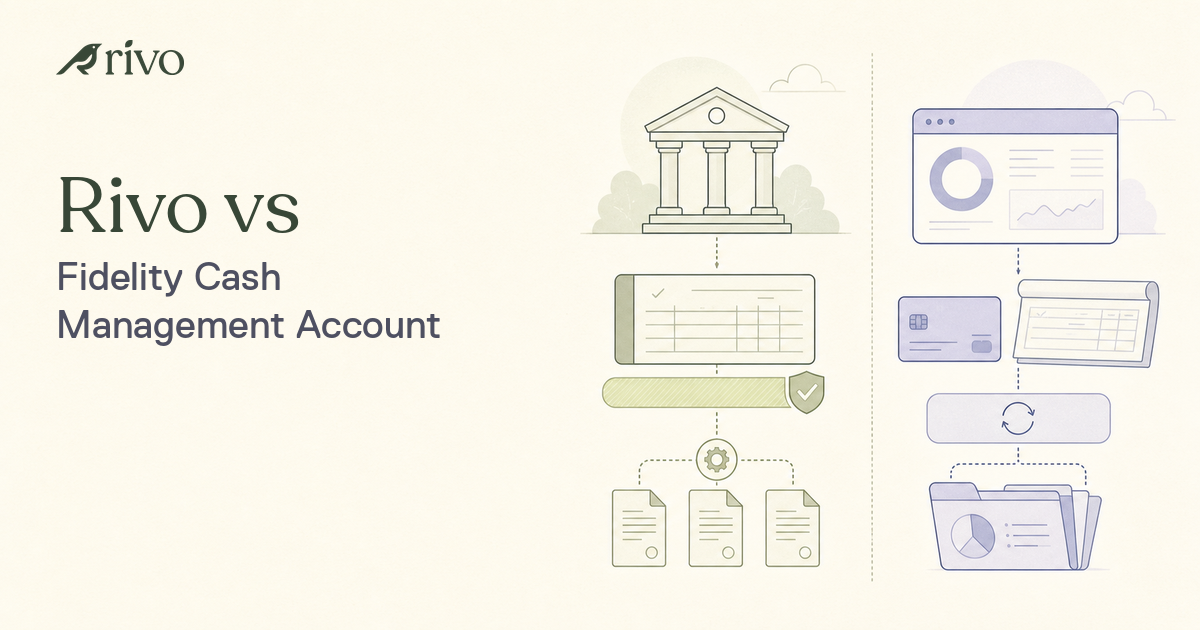
Rivo and the Fidelity Cash Management Account can both make cash more productive, but they solve different cash-management problems.
The Fidelity Cash Management Account is a brokerage account designed for spending, saving, and investing. It can receive direct deposit, pay bills, support checkwriting, provide debit-card access, and automatically hold uninvested cash in either the Fidelity Government Money Market Fund, known as SPAXX, or an FDIC-Insured Deposit Sweep Program.
Rivo does not try to become your everyday transaction account. It works with the checking account you already use, lets you set a minimum balance, and moves eligible idle cash into short-duration U.S. Treasury Bills through Jiko Securities. It then plans refills before expected bills and transfers.
The practical choice is:
- Choose Fidelity when you want a brokerage-based cash hub with spending features and a choice between a money market fund and program-bank deposits.
- Choose Rivo when your current checking setup works, but cash repeatedly sits above the amount needed for bills because manual transfers are difficult to maintain.
This is not simply a Rivo rate versus Fidelity rate comparison. You are deciding where daily cash activity should happen, what the earning asset should be, which protection framework you prefer, and whether the idle-cash workflow should be scheduled by you or managed around your existing checking balance.
TL;DR
- Fidelity is the stronger fit for a new cash hub. The Fidelity Cash Management Account is a brokerage account with direct deposit, Bill Pay, checkwriting, debit-card access, mobile check deposit, and transfers between Fidelity and external bank accounts.
- Rivo is the stronger fit for keeping an existing checking workflow. You leave direct deposit and bill pay at your current bank, set a safe balance, and let Rivo manage eligible cash above that floor.
- Fidelity gives you a core-position choice. SPAXX is a government money market mutual fund. Fidelity displayed a 3.31% seven-day yield as of August 21, 2026. Yields change daily. Fidelity does not publish a current FDIC sweep rate on its public Cash Management Account pages, so we do not state one.
- Rivo uses short-duration Treasury Bills. The current rate page lists a 3.65% gross annualized rate as of July 1, 2026, before Rivo fees and taxes. The rate reflects the four-week T-bill rate when held to maturity and is subject to change.
- The fee structures are different. Fidelity lists no account fee or minimum to open. Rivo charges 0.05% per month, based on average daily balance. SPAXX fund expenses are already reflected in its reported seven-day yield, so do not subtract the expense ratio from that yield a second time.
- Protection depends on the asset, not the app name. Fidelity program-bank deposits may receive FDIC pass-through insurance subject to program conditions. SPAXX and Rivo T-bill holdings are securities, not FDIC-insured deposits. SIPC protects eligible assets if a member brokerage fails, but does not protect market value.
- The deciding question is operational. Do you want to move your cash life into a Fidelity account, or keep your existing bank and automate only the recurring idle layer?
Rivo vs Fidelity Cash Management Account in One Minute
The fastest way to choose is to start with the account model. Fidelity gives cash a new operating home. Rivo leaves the operating home alone and manages the excess around it.
What Is the Fidelity Cash Management Account?
The Fidelity Cash Management Account, or Fidelity CMA, is a brokerage account with cash-management features. It is not a bank account.
Fidelity positions the CMA as an alternative to traditional banking for customers who want spending and saving tools alongside a brokerage relationship. Its cash-management features include:
- direct deposit
- mobile check deposit
- online Bill Pay
- checkwriting
- debit-card and ATM access
- transfers between Fidelity and external bank accounts
- a core position that handles uninvested cash
The core position is the key earning mechanism. When you open the account, you can select:
- SPAXX: the Fidelity Government Money Market Fund, a mutual fund invested in short-term government securities and related instruments.
- FDIC-Insured Deposit Sweep Program: cash is automatically allocated to participating program banks, subject to availability, limits, and program terms.
The Fidelity CMA can therefore do two jobs at once. It can be a transaction account for incoming and outgoing cash, and it can automatically place uninvested cash into the selected core position.
That is useful when you are willing to make Fidelity the center of the workflow. Your paycheck can arrive there, bills can leave from there, and unused cash can remain in the selected core without a separate savings transfer.
What Is Rivo?
Rivo is an automated cash-management service for cash that repeatedly accumulates in an existing checking account.
You connect a checking account, set the amount you want to keep available, and let Rivo identify eligible cash above that threshold. The extra cash moves into short-duration U.S. Treasury Bills through Jiko Securities. As expected bills and transfers approach, Rivo plans to move money back into checking.
The workflow is:
1. Keep your current bank and checking account.
2. Connect the account securely through Plaid.
3. Set a minimum checking balance, often called a safe balance.
4. Let Rivo analyze income, spending, balances, and expected bills.
5. Move eligible idle cash into short-duration T-bills through Jiko Securities.
6. Refill checking before expected payments.
7. Adjust the threshold, pause, stop, or disconnect when needed.
.svg)
Rivo currently supports earnings automation for one primary checking account. It works best for households with $5,000 or more in checking, although that is guidance rather than a hard account-opening minimum. The rate page lists a $100 minimum to earn the stated rate.
Rivo is not a checking account, savings account, money market fund, or diversified investment portfolio. Its job is narrower: manage the persistent cash layer above what your existing checking account needs.
For a full category explanation, read What Is Automated Cash Management?.
The Main Difference: A New Cash Hub vs an Existing-Bank Automation Layer
Fidelity and Rivo can appear similar because both combine cash access with an earning mechanism. The workflow is fundamentally different.
Fidelity consolidates the cash workflow
With Fidelity, the CMA can receive income, hold cash, pay bills, support checks, and provide debit-card access. The account itself becomes the place where cash lives and moves.
That can eliminate a checking-to-savings transfer loop. Cash does not need to leave the CMA to enter SPAXX or the FDIC sweep because the core position is built into the account.
The trade-off is migration. To receive the full operational benefit, you may need to:
- redirect direct deposit
- update billers and autopay
- change payment-app connections
- order or activate a debit card
- move recurring cash reserves
- learn Fidelity’s brokerage settlement and availability rules
You do not have to close your bank account. However, a second account does not simplify cash unless you give it a defined role.
Rivo preserves the cash workflow
With Rivo, the checking account remains the center. Direct deposit, card payments, rent, mortgage, utilities, and everyday spending continue to use the bank setup you already have.
The work shifts from account migration to threshold design. You decide how much must remain in checking. Rivo then manages eligible surplus above that amount.
That is relevant when the account is not the problem. The problem is that the balance fluctuates around bills, so you keep too much in checking to avoid mistiming a transfer.
The distinction is:
Fidelity CMA: move the cash workflow into a brokerage account
Rivo: keep the cash workflow at the bank and automate the recurring surplus
If you are unsure whether an automation layer changes your bank relationship, read Does Rivo Replace Your Bank?.
.svg)
Where Does Your Money Actually Sit?
The product interface does not determine the financial protection. The underlying asset and custodian do.
Rivo uses individual Treasury securities
Treasury Bills are short-term obligations issued by the U.S. Treasury. TreasuryDirect lists bill terms from four to 52 weeks. Rivo uses short-duration bills through Jiko Securities rather than placing earning cash in a bank-deposit sweep or mutual fund.
The maturity structure matters. A T-bill has a defined maturity value, but selling before maturity can produce a different realized result because market prices and interest rates change.
Fidelity SPAXX uses a pooled mutual fund
SPAXX is a government money market mutual fund. Fidelity states that it normally invests at least 99.5% of total assets in cash, U.S. government securities, or fully collateralized repurchase agreements.
SPAXX seeks to preserve a stable $1.00 share price, but it is an investment, not an insured deposit. The fund provides daily liquidity, and Fidelity automatically uses the core position to settle eligible debits in the account.
Fidelity’s FDIC sweep uses program-bank deposits
With the FDIC sweep, Fidelity allocates uninvested cash across one or more program banks. Fidelity’s current materials state that eligible customers may receive up to $4 million of FDIC insurance, assuming sufficient program-bank capacity and compliance with coverage rules.
That headline limit is not automatic in every circumstance. FDIC coverage is generally aggregated by bank, depositor, and ownership category. Deposits you hold directly at the same program bank can reduce available coverage, so Fidelity instructs customers to monitor their balances by bank.
How Do Current Rates and Fees Compare?
The comparison has three rate paths, not two:
1. Rivo’s T-bill-linked gross annualized rate.
2. Fidelity SPAXX’s seven-day yield.
3. Fidelity’s FDIC sweep APY.
These measures are not identical.
The dates differ, and all three rates are variable. A fair comparison should use the most recent values on the day you decide.
Why SPAXX’s expense ratio should not be subtracted twice
SPAXX reports a 0.42% gross expense ratio. That does not mean you should subtract another 0.42 percentage points from the published seven-day yield.
Fidelity defines a money market fund’s seven-day yield as annualized income over the prior seven days, net of fund expenses and including applicable waivers or reimbursements. Fund operating costs reduce the yield before it is reported.
The clean comparison is therefore:
Rivo estimate = published gross annualized rate - Rivo management fee
SPAXX estimate = published seven-day yield
FDIC sweep estimate = published APY
Taxes, balance changes, timing, and product-specific cash availability still need separate treatment.
What Would Each Option Produce on an Illustrative $20,000?
Assume an illustrative $20,000 remains fully eligible for an entire year and the linked rates do not change. This is comparison math, not a prediction of returns.
At these dated rates and assumptions, SPAXX produces the highest before-tax illustration. Rivo is next after its simple management-fee estimate. The Fidelity FDIC sweep produces the lowest illustration but uses a bank-deposit structure rather than a money market fund or individual T-bills.
That result does not establish a permanent ranking. It changes when:
- rates move
- the Rivo balance moves back to checking for bills
- SPAXX’s seven-day yield changes
- the Fidelity sweep rate changes
- T-bills are sold before maturity
- state tax treatment changes the net result
- manual cash remains outside the selected earning option
The last point is the operational difference. Fidelity can produce the modeled amount only on cash actually held in the CMA core position. Rivo can produce the modeled amount only on eligible cash actually moved into T-bills. A theoretically stronger rate does not help cash that never reaches it.
For a broader same-scenario comparison across bank deposits and Treasury Bills, read Rivo vs High-Yield Savings vs Treasury Bills.
Which Product Automates Idle Cash More Completely?
Both products automate something, but they automate different objects.
Fidelity automates the core position
Once cash is inside the Fidelity CMA, the selected core position handles uninvested cash automatically.
- SPAXX purchases and redemptions support eligible cash activity.
- The FDIC sweep allocates cash to program banks and withdraws it as account debits settle.
- You can configure recurring transfers between eligible Fidelity and external accounts.
- You can set up direct deposit so incoming cash lands in the CMA.
This is strong in-account automation. The user still decides how much cash belongs in Fidelity and, when external checking remains active, how much to transfer between institutions.
Fidelity’s public CMA materials describe direct deposit, automatic transfers, and built-in cash handling. They do not describe a service that continuously analyzes an outside checking account, preserves a user-defined floor there, and refills that external account before expected bills.
Rivo automates the checking-to-earning loop
Rivo focuses on the boundary between an existing checking account and the earning asset.
- You set a minimum checking balance.
- Rivo analyzes cash flow and identifies eligible surplus.
- It plans movements into short-duration T-bills.
- It plans refills before expected bills and transfers.
- It can become more conservative as spending patterns change.
The distinction is not “automatic” versus “manual.” It is:
Choose Fidelity when you want the cash account to handle the transactions. Choose Rivo when you want the bank account to keep handling transactions while the surplus moves around it.
Which Product Is Easier for Bills and Everyday Spending?
Fidelity is more direct when you want the product itself to handle spending.
The CMA includes Bill Pay, checkwriting, mobile deposit, and a debit card. Fidelity also advertises unlimited global ATM reimbursement for eligible withdrawals under current program terms.
That can reduce the need for a separate bank checking account. It is particularly useful for someone who already uses Fidelity for investments and wants cash, spending, and portfolio visibility under one login.
Rivo takes the opposite approach. It does not replace the existing debit card, checks, or bank Bill Pay. It is designed so:
- the paycheck still arrives at the bank
- autopay still pulls from the bank
- ordinary purchases still use the bank’s card
- Rivo manages eligible cash above the chosen floor
Rivo is easier when changing bill instructions creates more work than it removes. Fidelity is easier when consolidating cash activity into a new account is the goal.
Use this practical test:
How Do FDIC and SIPC Protection Differ?
FDIC insurance and SIPC protection solve different failure events. Neither is a universal guarantee against every loss.
Fidelity with the FDIC sweep
When the FDIC sweep is selected, eligible cash is deposited at participating program banks. Fidelity automatically allocates cash across banks and currently describes potential FDIC coverage of up to $4 million, subject to:
- available program-bank capacity
- FDIC ownership-category rules
- deposits already held at the same banks
- correct account titling and pass-through requirements
- the program’s overflow rules
Fidelity’s disclosure states that excess cash or cash that cannot be accepted by program banks may enter a Money Market Overflow. Overflow money is not an FDIC-insured deposit.
Fidelity with SPAXX
SPAXX is a security held in a brokerage account. It is not FDIC-insured.
SIPC may protect eligible securities and cash when a member brokerage fails and customer property is missing. The standard limit is up to $500,000, including a $250,000 limit for cash. SPAXX shares are securities rather than cash for the cash sublimit analysis.
SIPC does not:
- guarantee a $1.00 net asset value
- reimburse an investment loss
- lock in a yield
- protect against market-price changes
Rivo T-bills through Jiko Securities
Rivo’s earning assets are Treasury Bills held through Jiko Securities, a FINRA and SIPC member. T-bills are direct obligations of the U.S. government, but they are securities rather than FDIC-insured bank deposits.
The same SIPC boundary applies: brokerage-custody protection is not protection against the market value of a security. If a T-bill is sold before maturity, the proceeds and realized return may differ from the hold-to-maturity result.
Do not choose based on the largest insurance number alone. Choose the asset structure first, then verify exactly which protection applies at each stage.
How Does Cash Access Compare?
Fidelity provides more direct transaction methods inside the product. Rivo preserves direct access through the linked bank while adding a separate investment-and-refill process.
Fidelity access
Depending on account status and transaction availability, the Fidelity CMA supports:
- debit-card purchases
- ATM withdrawals
- online Bill Pay
- checks
- electronic funds transfers
- bank wires
- transfers between eligible Fidelity accounts
- mobile check deposit
SPAXX is used as a core position, so eligible account debits can be settled by redeeming fund shares. Fidelity’s FDIC program also sweeps deposits back as needed to satisfy account transactions.
The user still needs to understand collection periods, settled cash, transaction limits, holds, and brokerage-specific availability. “Accessible” does not mean every deposit is immediately withdrawable after every funding method.
Rivo access
The everyday checking balance remains directly available through the bank. Rivo plans to return money before expected bills, and users can request withdrawals of available funds through the app up to $15,000 per day.
That daily limit matters for large, unplanned payments. A household expecting a home closing, tax payment, tuition bill, or other large withdrawal should move money early rather than rely on same-day access from an invested balance.
Rivo also sends a movement notice at 5 PM Pacific with cancellation available until midnight. That control helps users review a planned movement, but it does not eliminate the need for an adequate checking floor.
How Do Taxes Affect Rivo vs Fidelity?
The tax comparison depends on which Fidelity core position you choose.
Rivo Treasury income
Investment income from Treasury Bills is subject to federal income tax. TreasuryDirect states that it is not subject to state or local income taxes.
That can improve the after-tax result for residents of states with income tax. The exact benefit depends on marginal rates, holding period, early-sale treatment, and the household’s tax situation.
Fidelity FDIC sweep interest
Interest from program-bank deposits is generally taxable interest. The IRS explains that bank-account interest is taxable income. State and local treatment depends on jurisdiction.
Fidelity SPAXX distributions
Money market funds generally pay dividends rather than bank interest. The IRS states that money market fund amounts are generally reported as dividends.
SPAXX invests in government securities and repurchase agreements, so state-tax treatment can depend on the fund’s annual income composition and the rules of the taxpayer’s state. Do not assume that all SPAXX income receives the same state-tax treatment as interest from directly held Treasury Bills.
This article is educational and not tax advice. Review the current tax documents and consult a qualified tax advisor before choosing based on after-tax yield.
Which Option Requires Less Ongoing Work?
The answer depends on whether setup work or recurring work is your actual problem.
Fidelity can reduce recurring work after migration
Once direct deposit and bills are inside the CMA, the core position can keep uninvested cash productive without a manual savings transfer. The user may still need to:
- monitor the selected core position
- compare SPAXX and FDIC sweep rates
- review program-bank allocations
- maintain external-account connections
- manage brokerage settlement and holds
- decide whether excess cash should move into longer-term investments
This is a strong workflow for users already comfortable with Fidelity and brokerage accounts.
Rivo can reduce recurring work without migration
Rivo does not require users to rebuild their payment stack. The user’s main responsibilities are:
- set a realistic checking floor
- review planned cash movements
- increase the floor before unusual expenses
- keep linked-account information current
- monitor large or unpredictable payments
- pause automation when cash flow becomes uncertain
This is a strong workflow for users whose friction is not opening an account. It is remembering transfers and timing them around bills.
When Should You Choose Fidelity Cash Management Account?
Fidelity is the stronger first option to evaluate when most of the following are true:
- You already use Fidelity and want cash plus investments under one platform.
- You want direct deposit, debit-card access, checks, Bill Pay, and mobile deposit.
- You are comfortable using a brokerage account for everyday cash.
- You want to choose between a government money market fund and an FDIC deposit sweep.
- You prefer no CMA account fee.
- You are willing to move or rebuild part of your cash workflow.
- You understand the distinction between SPAXX, program-bank deposits, FDIC insurance, and SIPC protection.
- You can keep most relevant cash inside the CMA instead of leaving a large balance at an outside bank.
Fidelity is particularly compelling when account consolidation is the desired outcome. Its strength is not only yield. It can place transaction features and the earning core in the same account.
When Should You Choose Rivo?
Rivo is the stronger first option to evaluate when most of the following are true:
- Your current bank, card, direct deposit, and Bill Pay setup already work.
- You do not want to update recurring payments.
- Your checking balance repeatedly rises above what bills require.
- You leave excess cash in checking because transfer timing feels risky.
- You have tried manual savings or brokerage transfers and stopped.
- You want a user-set minimum checking threshold.
- You want the idle layer placed in short-duration U.S. Treasury Bills.
- State and local tax treatment of direct Treasury income matters to you.
- You value bill-aware refills enough to justify a 0.05% monthly management fee.
Rivo’s fee pays for the workflow, not merely access to Treasury yield. If you can manage a Fidelity CMA, brokerage money market fund, or direct T-bill ladder consistently without leaving cash behind in checking, you may not need that automation.
For a wider provider and DIY comparison, read Rivo Alternatives.
When Should You Choose Neither?
Neither option is automatically appropriate for every dollar.
Avoid moving the cash when:
- it is assigned to a payment arriving within days
- the amount above your safe balance is negligible
- your income or bill timing is temporarily unstable
- you cannot tolerate a delay in accessing invested cash
- you do not understand the selected asset or protection framework
- opening another account would create more fragmentation
- a high-yield savings account already solves the problem with an acceptable workflow
- you need a diversified long-term portfolio rather than short-term cash management
The first calculation is not expected yield. It is:
Recurring idle cash = checking balance
- upcoming bills
- ordinary spending
- transaction cushion
- assigned cash
If the result is not consistently positive, the money is not recurring idle cash. Keep payment readiness ahead of yield.
Can You Use Rivo and Fidelity Together?
Potentially, but only if each product has a distinct job.
One workable structure is:
- Keep the existing bank as the primary checking account.
- Use Rivo for eligible recurring cash above the bank’s safe balance.
- Use Fidelity CMA for brokerage-adjacent spending, investment transfers, or a separate cash goal.
Another structure is:
- Make Fidelity CMA the primary cash hub.
- Use SPAXX or the FDIC sweep as the core.
- Do not add Rivo unless you still maintain a supported external checking account with persistent idle surplus.
Using both becomes inefficient when:
- the same dollars move through multiple layers
- you cannot tell which account pays which bill
- cash is duplicated as a cushion in several accounts
- transfer holds create avoidable timing risk
- account monitoring takes more time than the yield is worth
More automation does not always mean less complexity. Assign one role to each account and remove any layer that does not solve a separate problem.
.svg)
A Same-Scenario Decision Matrix
Use the table below to route the decision by household workflow rather than by brand familiarity.
The decision is conditional. Fidelity wins the cash-hub use case. Rivo wins the keep-your-bank, automate-the-surplus use case. A disciplined DIY user can reasonably choose neither.
How to Choose Between Rivo and Fidelity in Five Steps
Step 1: Choose the daily transaction account
Decide whether your current bank or Fidelity CMA should receive income and pay ordinary bills. Do not compare yields until this is clear.
Choose Fidelity as the transaction hub when you want its debit card, checks, Bill Pay, ATM access, and brokerage integration. Keep your bank as the transaction hub when its branches, cash deposits, customer service, payment connections, or existing workflow remain important.
Step 2: Calculate the safe balance
List:
- fixed bills
- card autopay
- variable spending
- annual or quarterly expenses
- pending transactions
- a transaction cushion
- a comfort buffer
Use the lowest projected checking balance, not the post-payday high, to set the floor. For a full framework, read What Is a Safe Balance for a Checking Account?.
Step 3: Choose the earning asset
Select among:
- Fidelity program-bank deposits
- SPAXX money market fund shares
- short-duration T-bills through Rivo
- another savings, money market, or Treasury option
Compare the legal form, rate measure, protection, tax treatment, liquidity, and early-sale risk. Do not treat “cash” as one asset category.
Step 4: Normalize rates and costs
Use the same balance and the same period.
Before-tax benefit = earnings
- direct account or management fees
- any transaction costs
Then estimate taxes and include the value of work you would actually avoid.
Step 5: Stress-test the workflow
Ask:
- What happens if a paycheck arrives late?
- What happens if a card bill is larger than expected?
- What happens if you need more than Rivo’s $15,000 daily available-funds withdrawal limit?
- What happens if a Fidelity deposit is still subject to a collection period?
- What happens if SPAXX or a T-bill position must be sold?
- What happens if you stop reviewing the system for a month?
The right product is the one that still works in the household’s difficult week, not only in the annual yield illustration.
Final Recommendation
Choose Fidelity Cash Management Account when you want a brokerage-based cash hub that can receive income, pay bills, support spending, and automatically place uninvested cash in either SPAXX or an FDIC deposit sweep.
Choose Rivo when you want to keep your existing checking account and automate the cash that repeatedly accumulates above a safe balance. The product’s value is the checking-to-T-bill workflow: identify eligible surplus, preserve a user-defined floor, and plan refills before expected bills.
Fidelity asks, “Should this account become the home for your cash?”
Rivo asks, “How much does your current checking account need, and what should happen to the recurring excess?”
Start with that distinction. Then compare the current linked rates, direct fees, underlying assets, protection rules, tax treatment, and access limits for the same balance.
FAQ
Is Fidelity Cash Management Account a bank account?
No. Fidelity describes the CMA as a brokerage account that supports spending, saving, and investing. If you choose the FDIC sweep, eligible cash is deposited at participating program banks and may receive pass-through insurance subject to program conditions.
Does Fidelity CMA automatically invest idle cash?
Fidelity automatically holds uninvested CMA cash in the selected core position: SPAXX or the FDIC-Insured Deposit Sweep Program. That automation applies to cash already inside the Fidelity account. It is not the same as analyzing a separate checking account and moving only the amount above a user-defined bill-ready floor.
Which currently has the higher rate, Rivo or Fidelity?
On the dates shown, Rivo’s published gross annualized rate was higher than SPAXX’s seven-day yield. Rivo listed a 3.64% gross annualized rate as of August 3, 2026, before management fees and taxes. SPAXX listed a 3.31% seven-day yield as of August 21, 2026. These are different yield measures and both can change. Because Rivo’s figure is stated before fees and taxes, it should not be treated as a net-return comparison. Fidelity does not publish a current rate for the FDIC-Insured Deposit Sweep Program on its public Cash Management Account pages, so we do not state one. Check the rate inside your account or ask Fidelity before comparing.
Is SPAXX FDIC-insured?
No. SPAXX is a government money market mutual fund, not a bank deposit. It may receive SIPC protection as an eligible brokerage security, but SIPC does not protect against investment losses or guarantee the fund’s share price.
Can Fidelity CMA replace checking?
It can perform many checking-like functions, including direct deposit, Bill Pay, checkwriting, debit-card use, and mobile deposit. Whether it should replace your bank depends on branch access, cash deposits, transaction holds, payment connections, service needs, and comfort using a brokerage account for daily cash.
Can Rivo and Fidelity be used together?
Yes, when their roles do not overlap. Fidelity can serve a separate brokerage cash or spending goal while Rivo manages eligible recurring surplus above a floor in a supported primary checking account. Using both is unnecessary when one account already solves the full workflow.
Related Rivo Reading
- To compare another brokerage cash account, read Rivo vs Wealthfront Cash Account.
- To compare broader provider and DIY options, read Rivo Alternatives.
- To compare another brokerage cash account, read Rivo vs Vanguard Cash Plus Account.
- To compare Rivo with a goal-based, program-bank cash reserve, read Rivo vs Betterment Cash Reserve.
- To compare another brokerage-centered cash program, read Rivo vs Robinhood Gold Cash Sweep.

This article is educational and is not financial, investment, tax, accounting, or legal advice.
Yield rate reflects the 4-week T-bill rate when held to maturity. Rate does not include fees. Rates are subject to change. Minimum balance of $100 required to earn the stated rate.
Rivo is a fintech company, not a bank. Banking services provided by Jiko Bank, a division of Mid-Central National Bank. Jiko Group, Inc. and its affiliates do not provide legal, tax, or accounting advice. You should consult your legal and/or tax advisors before making any financial decisions. This material is not intended as a recommendation, offer or solicitation for the purchase or sale of any security or investment strategy. See FINRA BrokerCheck, Jiko U.S. Treasuries Risk Disclosures and Jiko Securities Inc. Form CRS.
Investments in T-bills: Not FDIC Insured - No Bank Guarantee - May Lose Value. All U.S. treasury investments and investment advisory services provided by Jiko Securities, Inc., a registered broker-dealer, member FINRA and SIPC. Securities in your account are protected up to $500,000. For details, please see www.sipc.org.
Sources
- Rivo product overview
- Rivo product, fee, safe-balance, notice, and access details
- Rivo current rate details
- Fidelity Cash Management Account overview
- Fidelity Cash Management Account current cash options
- Fidelity CMA core-position and protection FAQs
- Fidelity CMA FDIC sweep rates
- Fidelity SPAXX fund details, yield, and expenses
- Fidelity FDIC-Insured Deposit Sweep Program disclosure
- Fidelity account-protection details
- Fidelity money market fund overview
- TreasuryDirect Treasury Bills
- TreasuryDirect tax forms and withholding
- IRS Publication 550: Investment Income and Expenses
- SIPC: What SIPC Protects

Get Rivo Updates
Product news, money insights, and company updates.