Rivo vs SoFi Checking and Savings: Keep Your Bank or Build a New Cash Hub?
Compare Rivo vs SoFi Checking and Savings on bank switching, rates, fees, automation, FDIC and SIPC protection, taxes, bills, and idle-cash fit.
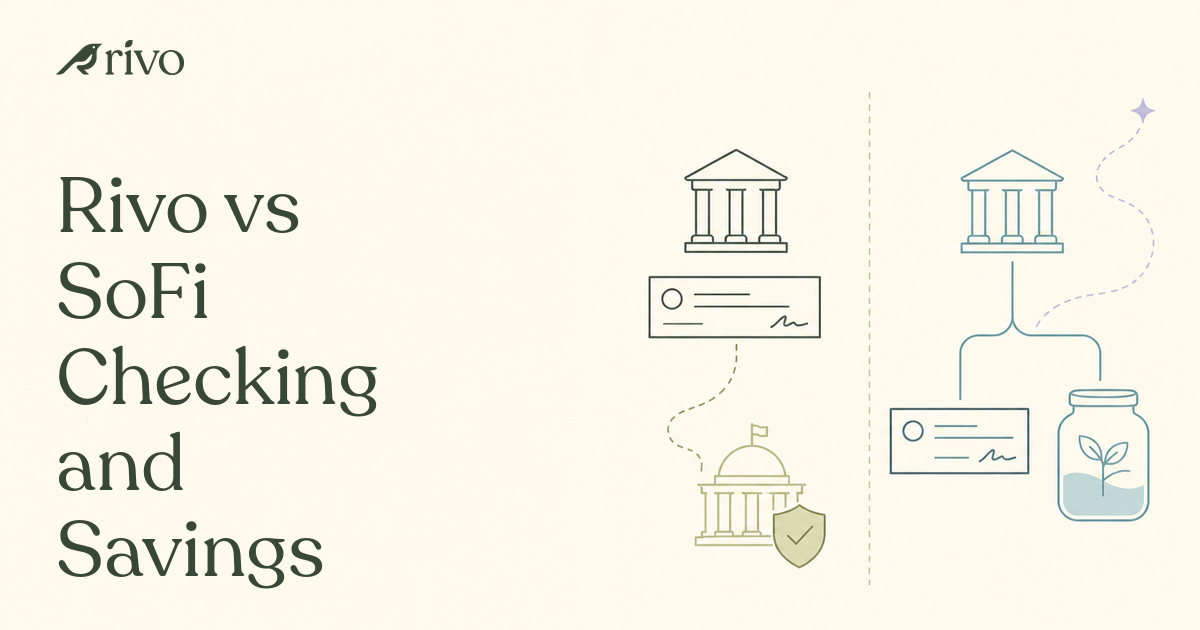
Rivo and SoFi Checking and Savings can both help cash earn more, but they solve different cash-management problems.
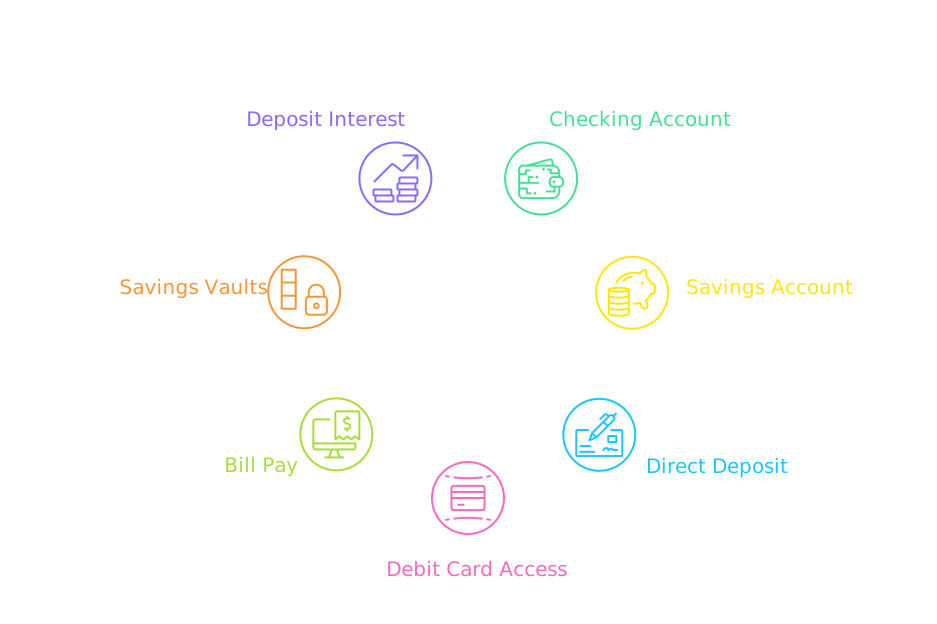
SoFi Checking and Savings gives your money a new banking home. SoFi Bank provides checking, savings, direct deposit, debit-card access, bill pay, savings Vaults, and deposit interest inside one account relationship.
Rivo leaves your current banking home in place. You keep the checking account, direct deposit, debit card, and bill setup you already use. Rivo lets you set a minimum checking balance, identifies eligible cash above that floor, moves the idle layer into short-duration U.S. Treasury Bills through Jiko Securities, and plans refills before expected bills.
The practical choice is:
- Choose SoFi if you want an all-in-one digital bank and are willing to move or rebuild your daily cash workflow.
- Choose Rivo if your current bank works, but surplus cash repeatedly sits in checking because manual transfers do not stay aligned with bills.
This is not only a rate comparison. It is a decision about where daily banking should happen, what the earning asset should be, how much setup you will accept, and whether automation should follow fixed rules or respond to the cash flow in an existing checking account.
For the product overview, read What Is Rivo?. If the bank-switch question is already your main concern, read Does Rivo Replace Your Bank?.
TL;DR
- SoFi is the stronger fit when you want a new primary cash hub. SoFi Checking and Savings includes checking, savings, direct deposit, bill pay, a debit card, Vaults, and automatic savings features.
- Rivo is the stronger fit when you want to keep your current bank. Rivo works on top of an existing checking account and manages eligible idle cash above a user-set floor.
- The current rate comparison depends on SoFi eligibility. As of May 28, 2026, SoFi listed a 0.50% APY for checking, a 0.80% standard savings APY, and a 3.10% savings APY for members with eligible direct deposit or at least $5,000 in qualifying deposits during each rolling 31-day period.
- SoFi Savings offers a variable APY that can change. SoFi Plus is a $10 monthly membership. Eligible direct deposit or qualifying deposits may provide access to certain SoFi banking benefits, but they should not be described as a blanket waiver of the SoFi Plus membership fee. Check SoFi’s current rate sheet and account terms before comparing rates or fees.
- Rivo uses a different asset and fee model. Rivo’s rate page lists a 3.64% gross annualized rate, reflecting the 4-week Treasury bill rate as of August 3, 2026, before fees and taxes. Rivo charges a 0.05% monthly management fee based on average daily Rivo balance. SoFi rates and eligibility terms can change. Before publishing this comparison, refresh the current SoFi rate sheet on the same date you confirm the Rivo rate, then update all comparison-table inputs and earnings calculations using those dated figures.
- The protection labels are not interchangeable. SoFi Checking and Savings deposits are held in an FDIC-insured bank structure. Rivo's T-bill holdings are securities, not FDIC-insured deposits, and are held through Jiko Securities, a SIPC member.
- The deciding question is operational. Do you want to move your cash life into SoFi, or keep your current bank and automate only the cash that remains above your checking floor?
Rivo vs SoFi Checking and Savings in One Minute
The fastest way to choose is to start with the account model. SoFi asks whether you want a new banking hub. Rivo asks whether you want the excess above your current checking floor managed without rebuilding that hub.
The Core Difference Between Rivo and SoFi
The core difference is replacement versus overlay.
SoFi Checking and Savings is a bank-account system. It can receive your paycheck, hold savings, support debit transactions, pay bills, and organize goals through Vaults. You decide how much money belongs in checking, savings, or a Vault and configure the movement rules.
.svg)
Rivo is an automated cash-management layer. It connects to the checking account you already use, lets you define the protected minimum, evaluates cash above that floor, and manages eligible surplus around expected bills.
Neither model is universally better. SoFi can simplify a fragmented banking setup. Rivo can reduce disruption when the existing setup is already reliable.
What Is SoFi Checking and Savings?
SoFi Checking and Savings is a combined digital banking product offered by SoFi Bank, N.A., Member FDIC. Opening a SoFi Savings account also opens a SoFi Checking account, according to the SoFi savings-account disclosure.
The product can handle:
- direct deposit
- checking and savings balances
- debit-card purchases
- online bill pay
- external transfers
- savings Vaults
- paycheck-based AutoSave
- recurring transfers
- debit-card Roundups
- optional SoFi Plus membership benefits
SoFi is more than a savings rate
SoFi's strongest case is not a single APY. It is the combination of transaction features and deposit-account tools.
SoFi Vaults let users organize savings into as many as 20 goal buckets without opening separate deposit accounts. SoFi Autopilot can send a fixed amount or percentage of an eligible paycheck to a Vault, schedule recurring transfers, or direct Roundups from settled debit-card purchases.
That makes SoFi useful when the buyer wants to rebuild checking, savings, and goals inside one provider.
SoFi's savings rate has multiple paths
The SoFi Bank Rate Sheet dated May 28, 2026 lists several savings outcomes:
These are variable rates, not permanent promises. The correct comparison uses the rate the household can maintain after promotional and eligibility conditions, not the largest number on a marketing page.
What Is Rivo?
Rivo is automated cash management for money that repeatedly remains above the operating needs of an existing checking account.
The workflow is:
- Keep the current bank, direct deposit, debit card, and bill pay.
- Connect the checking account through Plaid.
- Set a minimum checking balance.
- Let Rivo analyze balances, income, spending, and expected bills.
- Move eligible idle cash into short-duration U.S. Treasury Bills through Jiko Securities.
- Plan refills before expected bills and transfers.
- Adjust the floor, pause, stop, or disconnect when circumstances change.
.svg)
Rivo currently supports earnings automation for one primary checking account. It works best for households with $5,000 or more in checking, although that is product-fit guidance rather than a hard opening minimum. The rate page lists a $100 minimum balance to earn the stated rate.
Rivo is not a checking account, savings account, or all-in-one banking replacement. Its job is narrower: preserve the checking floor and manage the eligible idle layer.
For the broader workflow, read Can You Earn More on Checking Cash Without Switching Banks?.
Do You Have to Switch Banks?
You do not have to close another bank account to open SoFi, but SoFi provides the most operational value when you actively use its bank accounts. Direct deposit, higher-rate eligibility, AutoSave, early paycheck access, overdraft coverage, bill pay, and debit-card Roundups all become more relevant when SoFi is inside the daily cash flow.
Rivo is designed around the opposite constraint: the current bank relationship should stay.
When switching effort is worth it
Switching can be rational when the current bank is expensive, lacks needed features, or creates a fragmented cash system. SoFi can consolidate checking, savings, goals, and digital banking features under one relationship.
When switching effort is the blocker
Switching is less attractive when direct deposit, billers, card autopay, checks, transfers, and household habits already work. In that case, the unused surplus is the problem, not the bank account itself.
Rivo fits the second situation. It avoids forcing a banking migration to solve an idle-cash workflow.
Do SoFi Autopilot and Rivo Autopilot Automate the Same Job?
No. The shared word "Autopilot" hides two different control systems.
SoFi Autopilot executes rules the user configures. It can split part of a paycheck into savings or Vaults, schedule recurring transfers, and use Roundups to move the difference from debit-card purchases.
Rivo Autopilot starts from the balance and the checking-account floor. It evaluates the cash above that floor, watches cash-flow patterns and expected bills, and manages eligible movement into and out of short-duration T-bills.
SoFi Autopilot is strong when the rule is "save this amount every payday." Rivo Autopilot is designed for the different rule "keep enough in checking, then manage what is actually left."
Current Rates Compared
The current rate comparison has more than two numbers because SoFi has qualification tiers and Rivo has a management fee.
What the table does not prove
It does not prove Rivo always earns more. Under the dated inputs, the eligible-deposit SoFi savings rate is close to Rivo's simplified rate after its management fee. The SoFi Plus tier can be higher on its eligible balance, and a new-member promotion can temporarily be higher.
It also does not prove SoFi always earns more. A household may leave a large balance in SoFi Checking at 0.50% rather than moving it to Savings. A household may not maintain qualifying deposit activity. Rivo's Treasury-bill income also has different state and local tax treatment.
The useful comparison is the rate you can maintain on the cash that will actually reach the earning destination.
How Do Fees Compare?
SoFi Checking and Savings lists no monthly maintenance, minimum-balance, overdraft, inactive-account, or return-item fee on its May 18, 2026 fee sheet. Certain transactions still have charges.
Rivo charges for the cash-management service.
What the Rivo fee buys
The Rivo fee is not payment for opening a TreasuryDirect account or for the Treasury security itself. It pays for the automation layer: checking-account analysis, a user-set floor, eligible sweeps, bill-aware planning, and ongoing management.
What SoFi's no-maintenance-fee structure requires
SoFi's base bank accounts do not charge a monthly maintenance fee, but the household still has to choose where cash sits. Higher SoFi savings rates may require deposit activity or a paid SoFi Plus membership. Some faster transfer and wire methods carry transaction fees.
Compare total operating cost, not only the line labeled "monthly fee."
What Each Option Produces on the Same Balance
The following examples normalize the dated published rates. They are illustrative, before tax, and assume the stated rate remains unchanged for a full year. Actual earnings vary with rates, average balances, qualification status, timing, compounding, T-bill purchases and sales, and product terms.
For Rivo, the simplified estimate subtracts 0.60 percentage points from the 3.65% gross annualized rate because the management fee is 0.05% per month. The actual fee is calculated from average daily balance.
Illustrative $20,000 earning balance
At this balance, the dated Rivo and eligible-deposit SoFi savings inputs produce nearly the same simplified pre-tax dollars. SoFi Plus produces more under the assumptions, but the result includes a paid membership and assumes the full balance remains within the 4.50% tier for the year.
Illustrative $50,000 earning balance
The $50,000 illustration shows why tier rules matter. SoFi Plus does not apply 4.50% to the full balance under the cited terms. Rivo does not have that tier in its published rate table, but its management fee scales with average daily balance.
Do not choose between these products from this table alone. SoFi may offer more gross dollars under some conditions. Rivo may remove more manual work and may receive more favorable state and local income-tax treatment on Treasury-bill income. Those are different sources of value.
Where Your Money Sits and What Protection Applies
Protection follows the account and asset structure, not the app logo.
SoFi deposit protection
SoFi Checking and Savings is offered by SoFi Bank, N.A., Member FDIC. Standard FDIC coverage is generally $250,000 per depositor, per insured bank, per ownership category. SoFi also offers an optional insured deposit program that can provide up to $3 million of aggregate FDIC insurance through participating banks, subject to program terms, ownership categories, and deposits held at the same participating banks through other relationships.
Rivo brokerage protection
Rivo is a fintech, not a bank. Eligible idle cash is invested in Treasury Bills through Jiko Securities, a registered broker-dealer and SIPC member. SIPC protects eligible customer assets when a member brokerage fails and assets are missing, subject to a $500,000 limit including a $250,000 cash limit. SIPC does not protect against market-value changes.
Protection labels answer different failures
FDIC and SIPC solve different failure events. Neither label eliminates the need to understand liquidity, rates, fees, taxes, and product terms.
How Does Tax Treatment Affect Rivo vs SoFi?
SoFi Checking and Savings interest is bank-deposit interest. It is generally subject to federal, state, and local income taxes.
Rivo's earning asset is a Treasury bill. The U.S. Treasury states that income from Treasury marketable securities is subject to federal income tax but exempt from state and local income taxes.
Illustrative state-tax sensitivity
Assume a household has a 9% marginal state income-tax rate. Every illustrative $1,000 of bank interest could create $90 of state income tax before considering deductions, local rules, or other tax details. Treasury-bill income is generally exempt from that state tax.
That does not make Rivo automatically better. SoFi may have a higher gross rate, especially under SoFi Plus or a promotional tier. The tax difference is one column in the comparison, not the whole decision.
This article is not tax advice. Use actual federal, state, and local rules and consult a qualified tax professional.
Which Product Suits Bills and Everyday Spending
SoFi is the more complete direct banking product. Rivo deliberately does not replace the transaction account.
Choose SoFi when daily banking itself needs improvement. Choose Rivo when daily banking works and only the recurring surplus needs a better operating system.
Which Product Requires Less Ongoing Work
The answer depends on which work you are trying to eliminate.
SoFi reduces fragmentation after the user commits to the SoFi account. Checking, savings, Vaults, recurring transfers, and bill activity can live together. The ongoing work is maintaining goals, rate eligibility, and transfer rules.
Rivo reduces the work of repeatedly deciding how much can leave checking and when it should return. The ongoing work is maintaining the floor and flagging unusual periods when cash should stay protected.
The key distinction is fixed-rule automation versus variable-surplus automation.
Cash Access Compared
SoFi deposit balances are bank deposits that can support transactions and transfers under SoFi's account limits. Internal transfers between SoFi Checking, Savings, and Vaults are described as immediate in SoFi's Vault transfer guidance.
Rivo leaves the protected checking balance at the existing bank. Money invested in Treasury Bills is not the same as checking cash. Rivo plans ahead for detected bills, and users can request available-funds withdrawals through the app up to $15,000 per day. Selling a T-bill before maturity can affect the realized result.
Liquidity is not a yes-or-no feature. It is a timing promise. Match the cash destination to the earliest plausible use date.
Who Should Choose SoFi Checking and Savings?
Choose SoFi when the bank account itself is part of the problem.
Strong SoFi fit
- You want checking and savings from the same digital bank.
- You are willing to move direct deposit or maintain qualifying deposits.
- You want debit-card access, bill pay, Vaults, Roundups, and paycheck AutoSave.
- You prefer FDIC-insured deposits to a brokerage-based Treasury structure.
- You want no monthly maintenance fee for the base checking and savings accounts.
- You will use enough SoFi Plus benefits to justify the paid membership.
SoFi is not merely a high-yield account. It is a credible replacement for a daily bank relationship when the buyer wants that replacement.
Who Should Choose Rivo?
Choose Rivo when the existing bank is not the problem.
Strong Rivo fit
- Your direct deposit, bills, debit card, and bank relationship already work.
- The checking balance repeatedly stays above the amount needed for bills and a cushion.
- The surplus changes from month to month.
- Manual transfers to savings or Treasury Bills are inconsistent.
- You value bill-aware cash movement enough to pay a management fee.
- Treasury-bill income and its state and local tax treatment fit your situation.
Rivo is not for every dollar. It is for the cash that repeatedly survives the checking cycle above a conservative floor.
When Should You Choose Neither?
Choose neither when the money is not actually idle, the balance is too small to justify complexity, or the current setup already solves the job.
The correct answer can be "do nothing yet." A product comparison should not turn uncertain bill money into an earning-balance experiment.
Using SoFi and Rivo Together
Potentially, but using both should solve two separate jobs.
One reasonable structure could use SoFi as the household's primary checking account and Rivo for eligible surplus above a protected floor, but only if the SoFi account is supported, the connection works as expected, and the household understands both systems' movement rules. Do not assume compatibility without checking the current product support.
Another structure could use an existing bank plus Rivo while keeping a separate SoFi Savings account for named goals. In that case:
- SoFi Vaults hold assigned savings.
- The existing checking account handles transactions.
- Rivo evaluates only cash above the checking floor.
- Each dollar has one owner and one movement rule.
Avoid overlapping automations. A SoFi recurring transfer and a Rivo sweep should not both treat the same dollars as available. Duplicate rules can create avoidable movement, confused balances, and weaker cash forecasts.
Rivo or SoFi: Buyer-Fit Decision Matrix
The matrix is intentionally conditional. SoFi wins several product and rate rows. Rivo wins the no-switch and variable-idle-cash workflow rows. Choose the system that removes the actual source of friction.
How to Choose Between Rivo and SoFi
Use a five-step decision process.
Step 1: Define the cash job
Separate transaction cash, near-term reserves, named savings goals, and stable idle cash. Do not compare rates on money needed for imminent bills.
Step 2: Decide whether the bank should change
If the bank lacks core features or charges unwanted fees, evaluate SoFi as a replacement. If the bank works, evaluate Rivo as an overlay.
Step 3: Use the maintainable rate
For SoFi, identify whether you will maintain eligible direct deposit, qualifying deposits, a promotion, or SoFi Plus. For Rivo, subtract the management fee from the current Treasury-linked gross rate.
Step 4: Compare structure and tax
Choose between insured bank deposits and Treasury securities with a clear understanding of FDIC, SIPC, early-sale risk, and applicable taxes.
Step 5: Run one complete cash-flow cycle
Test the setup through payroll, rent or mortgage, card autopay, utilities, and irregular spending. Keep the old workflow available until the new one is proven.
How to Decide
This is general information, not a recommendation to buy or sell any security.
If you want a new digital bank relationship with direct deposit, checking, savings, bill pay, a debit card, Vaults and user-configured savings automation, SoFi Checking and Savings is the closer fit. Its base accounts list no monthly maintenance fee, and its current savings rate can be competitive when you satisfy the applicable deposit or membership conditions.
If you want to keep the bank account that already runs your household and fix only the idle-cash layer Rivo is the closer fit. Rivo is built around a user-set checking floor, variable cash-flow analysis, Treasury-bill exposure through Jiko Securities, and planned refills before bills.
Do not choose Rivo because a gross rate looks larger than SoFi's standard tier. Do not choose SoFi because a temporary or paid tier shows the highest headline APY. First choose the account model. Then compare the rate you can maintain after fees, taxes, eligibility rules, and real cash behavior.
The best answer is the one your household will keep using through complete bill cycles without exposing assigned cash or creating a new manual routine.
FAQ
Is Rivo the same as SoFi Checking and Savings?
No. SoFi Checking and Savings is a bank-account product offered by SoFi Bank. Rivo is a fintech cash-management layer that works with an existing checking account and invests eligible idle cash in short-duration Treasury Bills through Jiko Securities.
Does Rivo require me to move direct deposit?
No. Direct deposit can stay at the existing bank. SoFi can also be used without moving every banking activity, but some rates and features depend on eligible direct deposit or qualifying deposit activity.
Which currently pays more, Rivo or SoFi?
It depends on the SoFi tier and the Rivo fee. Under the dated published inputs, SoFi ranges from 0.80% standard Savings APY to 4.50% APY on an eligible SoFi Plus tier, while Rivo lists a 3.65% gross annualized rate before its 0.05% monthly management fee. Rates and terms can change.
Is Rivo FDIC-insured like SoFi?
No. Rivo's T-bill holdings are securities, not FDIC-insured bank deposits. They are held through Jiko Securities, a SIPC member. SoFi Checking and Savings deposits are held in an FDIC-insured bank structure, subject to coverage limits and program terms.
Does SoFi automate idle cash the same way as Rivo?
No. SoFi Autopilot executes user-configured paycheck splits, recurring transfers, and Roundups. Rivo analyzes cash above a checking floor and plans movement based on eligible surplus and expected bills.
Can I use SoFi Savings for goals and Rivo for checking surplus?
Potentially. Give each system a distinct cash job, verify current account support, and avoid overlapping transfer rules. Assigned goal cash should not also be treated as idle checking cash.
Related Rivo Reading
- To compare Rivo with a goal-based, program-bank cash reserve, read Rivo vs Betterment Cash Reserve.
- To see exactly what stays at your current bank, read Does Rivo Replace Your Bank?.
- To compare the broader provider and DIY landscape, read Rivo Alternatives.
- To compare Rivo with a separate brokerage cash account, read Rivo vs Wealthfront Cash Account.
- To compare Rivo with a standalone online savings account, read Rivo vs Ally Bank Savings.

This article is educational and is not financial, investment, tax, accounting, or legal advice.
Yield rate reflects the 4-week T-bill rate when held to maturity. Rate does not include fees. Rates are subject to change. Minimum balance of $100 is required to earn the stated rate.
Rivo is a fintech company, not a bank. Banking services provided by Jiko Bank, a division of Mid-Central National Bank. Jiko Group, Inc. and its affiliates do not provide legal, tax, or accounting advice. You should consult your legal and/or tax advisors before making any financial decisions. This material is not intended as a recommendation, offer or solicitation for the purchase or sale of any security or investment strategy. See FINRA BrokerCheck, Jiko U.S. Treasuries Risk Disclosures and Jiko Securities Inc. Form CRS.
Investments in T-bills: Not FDIC Insured - No Bank Guarantee - May Lose Value. All U.S. treasury investments and investment advisory services provided by Jiko Securities, Inc., a registered broker-dealer, member FINRA and SIPC. Securities in your account are protected up to $500,000. For details, please see www.sipc.org.
SoFi rates, promotions, membership benefits, deposit requirements, and fees cited in this article reflect publicly available terms dated May 2026 and can change. SoFi Checking and Savings is offered through SoFi Bank, N.A., Member FDIC. Rivo is not affiliated with or endorsed by SoFi.
Sources
- Rivo homepage
- Rivo FAQs
- Rivo rate comparison page
- SoFi Checking and Savings
- SoFi Bank Rate Sheet
- SoFi Bank Fee Sheet
- SoFi Plus
- SoFi Automatic Savings and Vaults
- SoFi Insured Deposit Program
- Protection and tax references: FDIC deposit insurance, SIPC protection, and TreasuryDirect tax guidance.

Shalu Yadav is Rivo's SEO/GEO Expert, bringing over 10 years of experience in making financial content discoverable across both classic search and generative AI platforms.
Follow on LinkedInGet Rivo Updates
Product news, money insights, and company updates.