How Do Banks Make Money on Checking Accounts? Deposit Spread, Net Interest Income, and Idle Cash
Learn how banks make money on checking accounts, how deposit spread works, and why low checking rates create idle cash above your safe balance.
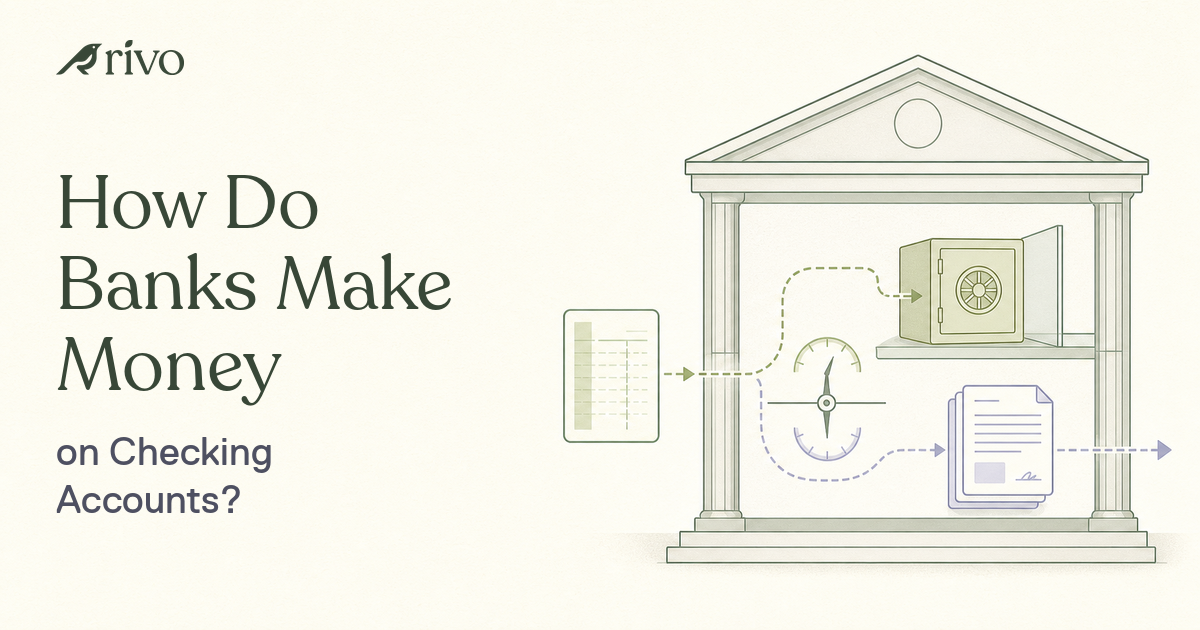
Banks make money on checking accounts because deposits are low-cost funding. Your checking balance is a liability for the bank, but the bank can use its overall funding base to support loans, securities, reserves, card programs, and other financial activity while paying many checking customers a very low rate.
.svg)
The point is not that checking accounts are bad. The point is that checking is built for payments, not for optimizing the cash that sits above your safe balance. Once your bills, autopay, spending, and comfort floor are covered, the extra layer becomes idle cash, and that is the layer Rivo is built to help automate.
TL;DR
- Banks earn a deposit spread when the yield on interest-earning assets is higher than what they pay on deposits. The Federal Reserve defines net interest income as interest income minus interest expense in its net interest margin explanation.
- The national rate for interest checking was 0.07% in June 2026. At that rate, $20,000 earns about $14 per year before taxes.
- U.S. households and nonprofits held about $5.95 trillion in checkable deposits and currency in Q1 2026. Even small spreads matter when the base is measured in trillions.
- FDIC-insured U.S. commercial banks and savings institutions reported $192.1 billion of net interest income in Q1 2026. That number is system-wide bank income, not a consumer checking-account payout.
- Rivo does not ask you to stop using your bank. It works with your existing checking account, lets you set a safe balance, and can move eligible idle cash into short-duration U.S. Treasury Bills through Jiko Securities.
- The right decision is not "move all checking cash." The right decision is "protect the checking floor, identify the idle layer, and choose a workflow for that layer."
How Do Banks Make Money on Checking Accounts?
Banks make money from checking accounts in 4 main ways: deposit spread, account fees, payment economics, and cross-selling. Deposit spread is usually the most important concept for people with large checking balances because it explains why cash can be useful to a bank even when the account looks boring to you.
Checking account economics at a glance
The important piece for idle cash is deposit spread. A bank does not need every checking customer to pay a monthly fee for the relationship to be valuable. A stable deposit base can help fund the bank and support profitable lending and securities activity.
What Is Deposit Spread?
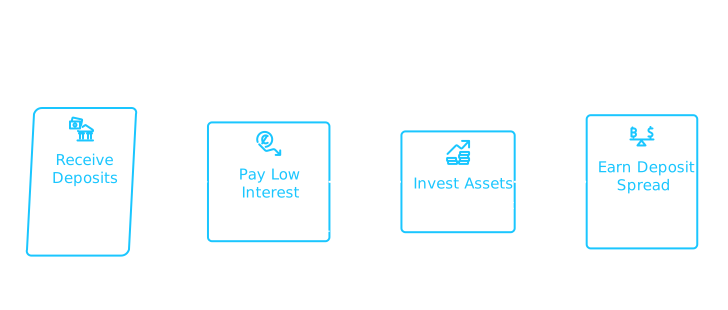
Deposit spread is the gap between what a financial institution earns on interest-earning assets and what it pays on customer deposits. In banking language, the broader metric is net interest income: interest income minus interest expense.
The Federal Reserve describes net interest income as the difference between interest income and interest expense in its explanation of net interest margins. Richmond Fed research explains net interest margin as the spread between what banks receive on interest-earning assets and what they pay on interest-paying liabilities, divided by interest-earning assets in a bank-margin explainer.
Simple deposit spread example
This table is not saying your checking account should match the T-bill rate. Checking accounts provide payments, debit access, bill pay, FDIC deposit insurance when eligible, fraud workflows, customer support, and instant usability. The table simply shows why a large idle checking layer has a cost.
Why Do Checking Accounts Usually Pay So Little?
Checking accounts pay little because they are designed for transactions first. The bank is providing rails for direct deposit, rent, mortgage, debit card use, ACH pulls, wires, subscriptions, and cash access. The customer often values reliability more than rate.
That makes checking sticky. A savings account is easier to shop. A brokerage account is easier to compare on yield. A primary checking account is tied to payroll, bills, cards, peer payments, merchant drafts, and household routines.
Why checking stays sticky
This is why the Rivo category exists. The product does not need your bank to be bad. It only needs the idle layer above your checking floor to have a better job.
How Big Is the Checking Cash Problem?
The checking-cash problem is large because the deposit base is large. U.S. households and nonprofits held $5,948,854 million in checkable deposits and currency in Q1 2026, which is about $5.95 trillion.
At the same time, the national rate for interest checking was 0.07% in June 2026. Those 2 facts create the demand-creation problem: many households keep a large amount in checking because checking feels safe and convenient, even when a meaningful layer may be idle.
Why a small rate gap becomes a large dollar problem
The 0.07% in June 2026 checking figure is from the FRED ICNDR series. The 3.65% gross annualized figure matches the Rivo published rate as of July 1, 2026 on the Rivo rates page. The Rivo rate excludes fees, rates change, and the $100 minimum balance requirement applies.
This is not a recommendation to move all cash. It is a diagnostic. If the dollars above your safe balance are meaningful, the annual gap becomes worth measuring.
What Is Net Interest Income and Why Should Depositors Care?
Net interest income is the difference between interest income and interest expense. In plain English, it is the money banks make from earning interest on assets while paying interest on funding sources such as deposits and other liabilities.
FDIC-insured U.S. commercial banks and savings institutions reported $192.1 billion of net interest income in Q1 2026. That is not a scandal. It is the core banking model.
The consumer question is narrower: how much of your checking balance needs the bank's payment infrastructure, and how much is just parked there because moving it takes work?
Bank view vs household view
The mistake is treating the whole balance as one category. Checking cash has multiple jobs. Bill cash and idle cash should not be managed the same way.
Are Banks Doing Something Wrong by Paying Low Checking Rates?
Low checking rates are not automatically wrongdoing. Banks provide services and assume costs: fraud monitoring, debit cards, branches, mobile apps, customer service, payment networks, compliance, FDIC assessments, liquidity management, and capital requirements.
The issue is not "banks are bad." The issue is that a primary checking account is a poor place to leave every extra dollar once the safety floor is already covered.
Fair framing for low checking rates
This framing matters because it leads to a better decision. If your bank works well for payroll and payments, keep it. If your extra cash is idle, give that extra layer a rule.
How Much Does Low Checking Yield Cost on $20,000?
At a 0.07% national interest checking rate in June 2026, $20,000 earns about $14 per year before taxes. At a 3.65% gross annualized rate, $20,000 produces about $730 before fees, taxes, timing effects, balance changes, and product risk.
The Rivo rates page shows an estimated $730 yearly earnings figure on a $20,000 balance, based on its published rate methodology as of July 1, 2026. The same page notes that the rate reflects 4-week T-bills when held to maturity, excludes fees, is subject to change, and requires a $100 minimum balance.
.svg)
$20,000 checking example
This example is intentionally conservative because it evaluates only the $12,000 idle layer, not the full $20,000. If the whole balance is needed for bills, the opportunity gap is irrelevant. If only part of it is needed, the excess deserves a plan.
What Is the Inertia Cost of a Checking Account?
The inertia cost is the money you give up when extra checking cash sits in a low-yield account because moving it feels annoying, risky, or not worth the attention. It is not an official tax. It is a behavioral cost.
Academic research calls a related idea "sleepy deposits." A Harvard Business School paper on dynamic competition for sleepy deposits estimated that depositor sleepiness accounts for 58% of the average bank's deposit franchise value. The exact estimate is academic model output, but the practical point is simple: customer inattention has value in banking.
Why people keep paying the inertia cost
For a full problem guide, read What Is the Inertia Tax?. For the narrower calculation, use the Checking Account Interest Calculator.
When Is Checking Still the Right Place for Cash?
Checking is the right place for money that needs immediate transaction access. Rent, mortgage, card autopay, utilities, payroll gaps, debit spending, same-day transfers, tuition, property taxes, medical payments, and near-term repairs should not be sacrificed for yield.
The correct process starts with your safe balance. A safe balance is the minimum checking floor that should stay available for bills, autopay, spending, and surprises before any idle cash decision starts.
Cash that should usually stay in checking
If this list consumes your whole balance, do not optimize yet. If it leaves a stable excess layer, continue.
When Does Checking Cash Become Idle Cash?
Checking cash becomes idle when it stays above your safe balance after near-term bills, known expenses, and your comfort floor are covered. The key is persistence. A one-day spike is not idle. A recurring layer that survives multiple bill cycles may be idle.
Idle cash test
If you are unsure, start with What Is a Safe Balance? and How Much Money Should You Keep in Checking?. Those articles define the floor before this article defines the bank economics.
How Does Rivo Change the Checking Account Decision?
Rivo changes the decision by separating the bank relationship from the idle-cash job. Your existing checking account can keep doing what it is good at: receiving payroll, paying bills, handling daily spending, and staying familiar.
The eligible idle layer above your safe balance can be managed differently. Rivo connects through Plaid, lets you set a minimum checking threshold, identifies eligible idle cash, moves it into short-duration U.S. Treasury Bills through Jiko Securities, and plans around bills so money can come back before payments hit.
Bank account vs Rivo layer
This is why Does Rivo Replace Your Bank? is a separate product-aware question. The answer is no. The better framing is: keep the bank for payments, automate the excess layer if the excess is meaningful.
What Fees, Protection Details, and Limits Matter?
The economics do not stop at headline yield. You need fees, protection type, liquidity, taxes, and product structure before deciding.
Rivo charges a flat 0.05% monthly management fee based on average daily balance, according to Rivo fee details. That is about 0.60% per year before compounding effects. Available funds can be withdrawn through the app up to $15,000 per day. The Rivo rates page states that the $100 minimum balance is required to earn the stated rate.
Decision-critical product details
SIPC protection is not the same as FDIC deposit insurance. SIPC explains that its limit is $500,000, including a $250,000 cash limit, and that SIPC does not protect against a decline in security value. Jiko risk disclosures explain that T-bills may be sold before maturity when funds are withdrawn and that an investment in any financial instrument involves risk in the U.S. Treasuries risk disclosure.
How Do T-Bills Change the Tax Math?
Treasury Bill interest is generally exempt from state and local income tax, while still being federally taxable. The legal basis is that obligations of the U.S. Government are exempt from state or local taxation under 31 U.S.C. 3124, with stated exceptions.
This matters most in high-tax states because a lower gross Treasury yield can sometimes compete well after state and local taxes. But tax treatment is personal. Do not turn a general tax feature into a personal recommendation.
Simplified after-tax framing
Investment income on T-bills is taxed federally by the Internal Revenue Service. Income earned from T-bills is not subject to state tax and is not subject to local income taxes. Jiko Group, Inc. and its affiliates do not provide legal, tax, or accounting advice. You should consult your legal and/or tax advisors before making any financial decisions.
Should You Move Cash Out of Checking After Learning How Banks Make Money?
Not automatically. Understanding bank economics should make you more precise, not more reactive.
The first decision is your safe balance. The second decision is whether the amount above that floor is meaningful. The third decision is whether you want to manage the idle layer manually or use automation.
Decision matrix
If the problem is simply "I do not know how much to keep in checking," start with the safe balance article. If the problem is "I know I have idle cash, but I keep leaving it there," automated cash management becomes the next concept.
What Are the Main Mistakes People Make?
The biggest mistake is thinking the bank-rate gap means every dollar should move. It does not. The second mistake is thinking safety means every dollar must stay in checking forever. It does not.
Common mistakes
For bonus and tax-refund situations, use What Should You Do When a Bonus, RSU, or Tax Refund Lands in Checking?. Large deposits can create temporary idle cash, but only after taxes, bills, and planned uses are separated.
How Should You Audit Your Checking Account in 15 Minutes?
You do not need a full budget to see whether the bank economics matter. You need 4 numbers: current balance, lowest balance in the last 60-90 days, bills due in the next 30 days, and your comfort cushion.
The goal is to separate "cash that is doing payment work" from "cash that is sitting because no rule exists." Once those 2 buckets are separate, the bank-rate gap becomes actionable instead of abstract.
The 15-minute checking audit
Example audit
At the 0.07% national interest checking rate, $22,000 earns about $15.40 per year before taxes. At the 3.65% gross annualized Rivo rate, the same $22,000 would produce about $803 before fees, taxes, timing, and balance changes. A 0.60% approximate annual fee impact on $22,000 is about $132, using the 0.05% monthly fee as the source.
The exact output will change with rates, cash flow, taxes, and product usage. The decision point does not change: $22,000 of persistent idle cash deserves a different workflow than $22,000 needed for a tax payment in 6 days.
How Should You Compare Rivo With Doing Nothing?
Doing nothing is a real option. It is simple, familiar, and can be correct when your balance is small, your spending is volatile, or the extra yield is not worth the mental load.
The comparison becomes clearer when you use the same balance and the same constraints. Do not compare your whole $42,000 checking account against a rate table if $20,000 is your safe balance. Compare only the $22,000 idle layer.
Same-scenario comparison
This table is illustrative, not personal advice. It shows why "how banks make money on checking" leads to a practical question: is the idle layer large enough that doing nothing is now an active choice?
Who Should Not Act on the Bank Spread Yet?
Some people should read this article and still keep cash where it is. The goal is a better decision, not automatic movement.
Avoid acting yet if
Rivo is most relevant when the problem is persistent idle cash, not temporary cash. If the extra balance is only there for 3 days before a bill, leave it alone. If it survives 3 full bill cycles, evaluate it.
What Should You Do Next?
Use this order:
- List the next 30 days of bills, card autopay, rent, mortgage, subscriptions, transfers, and known large expenses.
- Add a comfort cushion that you will actually trust.
- Calculate your safe balance.
- Review 60-90 days of balance history to see whether cash stays above that floor.
- Estimate the idle layer.
- Compare checking, savings, money market funds, DIY T-bills, and Rivo-style automation on net yield, taxes, access, risk, and effort.
Before you act, make the checklist concrete:
- Confirm the next 30 days of bills before moving any cash.
- Check whether the balance stayed above your floor for 60-90 days.
- Separate at least 1 known large expense, such as taxes, travel, tuition, or a home repair.
- Treat less than $1,000 of idle cash as a low-priority optimization.
- Recheck $5,000-$10,000 of repeated idle cash because the dollar gap can start to matter.
- Use the 0.07% national checking rate as the low-yield baseline when you need a simple benchmark.
- Use the 3.65% gross Rivo rate only with the fee, tax, timing, and risk disclosures attached.
- Remember the 0.05% monthly Rivo fee before comparing gross yield numbers.
- Plan around the $15,000 daily withdrawal limit if you may need a large transfer.
- Wait 1-2 more bill cycles if income is irregular, a move is coming, or your lowest balance is unclear.
The 3-number decision rule
Use 3 numbers before choosing a product: your safe balance, your persistent idle cash, and the annual gap. If the idle layer is $2,000, the 0.07% checking rate creates only $1.40 of annual checking interest, while a 3.65% gross yield creates $73 before fees and taxes. If the idle layer is $25,000, the same comparison is $17.50 versus $912.50 before fees and taxes.
That is why the decision changes by balance size. A $2,000 idle layer may not justify any new workflow. A $25,000 idle layer that survives 3 bill cycles deserves a more deliberate rule.
If manual transfers have failed before, the answer may not be another spreadsheet. The answer may be a workflow that keeps your existing bank while automating the idle layer around bills.
FAQ
How do banks make money from checking accounts?
Banks can make money from checking accounts through deposit spread, account fees, payment economics, and cross-selling. Deposit spread matters most for idle cash because checking deposits can be a low-cost funding source while the bank earns income from loans, securities, reserves, and other assets.
Is it bad to keep money in checking?
No. Checking is the right place for bill money, daily spending, upcoming autopay, and a comfort floor. The problem begins when a recurring layer stays above your safe balance for 60-90 days and earns very little.
How much does $20,000 earn in checking?
At the 0.07% national interest checking rate, $20,000 earns about $14 per year before taxes. If only $12,000 of that balance is idle after your safe balance, the checking interest on the idle layer is about $8.40 per year.
Why do banks not raise checking rates when Treasury yields rise?
Primary checking accounts are sticky. People keep them for payroll, bills, autopay, debit cards, and trust. Banks do compete for deposits, but a core checking relationship is not as easy to shop as a simple rate product.
Does Rivo replace my bank?
No. Rivo works with your existing checking account. Your bank can still handle direct deposit, bill pay, cards, and daily spending, while Rivo can manage eligible idle cash above the safe balance.
Is Rivo a bank account?
No. Rivo is a fintech company, not a bank. Banking services are provided by Jiko Bank, a division of Mid-Central National Bank. U.S. Treasury investments and investment advisory services are provided by Jiko Securities, Inc., a registered broker-dealer, member FINRA and SIPC.
Related Rivo Reading
- To understand low checking rates, read Why Is My Checking Account Paying So Little Interest?.
- To calculate the dollar gap, read Checking Account Interest Calculator.
- To define idle cash, read What Is Idle Cash?.
- To quantify cash drag, read What Is Cash Drag?.
- To see the product overview, read What Is Rivo?.

This article is educational and is not financial, investment, tax, accounting, or legal advice.
Yield rate reflects the 4-week T-bill rate when held to maturity. Rate does not include fees. Rates are subject to change. Minimum balance of $100 required to earn the stated rate.
Rivo is a fintech company, not a bank. Banking services provided by Jiko Bank, a division of Mid-Central National Bank. Jiko Group, Inc. and its affiliates do not provide legal, tax, or accounting advice. You should consult your legal and/or tax advisors before making any financial decisions. This material is not intended as a recommendation, offer or solicitation for the purchase or sale of any security or investment strategy. See FINRA BrokerCheck, Jiko U.S. Treasuries Risk Disclosures and Jiko Securities Inc. Form CRS.
Investments in T-bills: Not FDIC Insured - No Bank Guarantee - May Lose Value. All U.S. treasury investments and investment advisory services provided by Jiko Securities, Inc., a registered broker-dealer, member FINRA and SIPC. Securities in your account are protected up to $500,000. For details, please see www.sipc.org.

Get Rivo Updates
Product news, money insights, and company updates.