What Is a Treasury Bill Ladder for Short-Term Cash? Setup, Risks, Taxes, and Rivo Automation
A Treasury bill ladder staggers T-bill maturities so cash becomes available on a schedule. Learn how it works, where it breaks, and where automation fits.
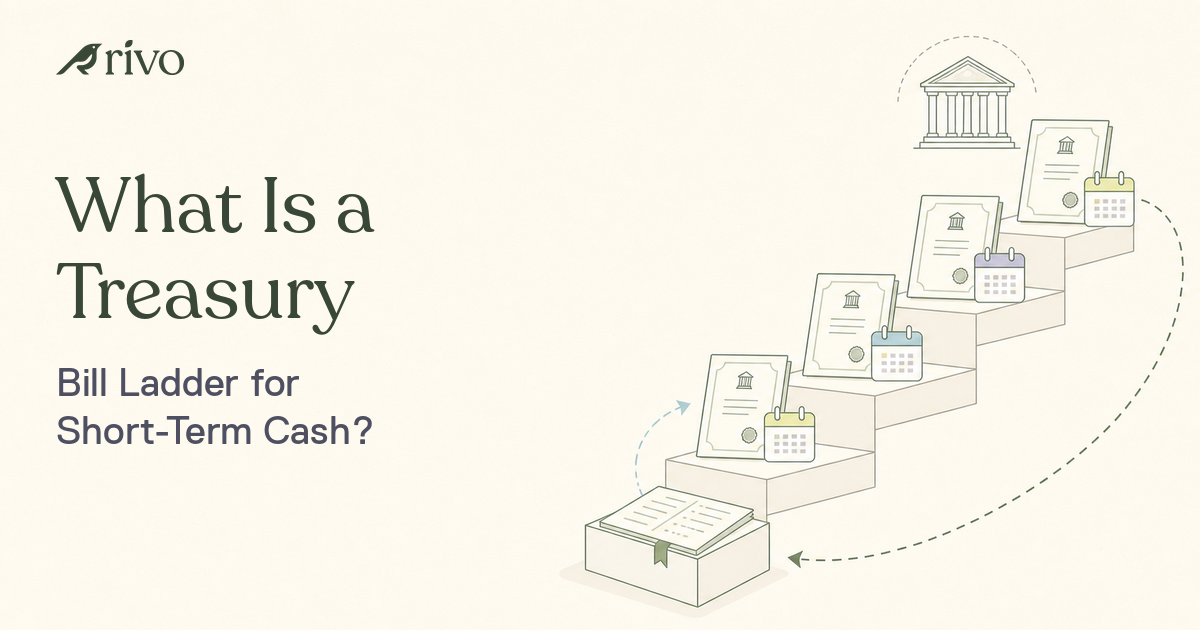
A Treasury bill ladder is a cash strategy where you buy short-term U.S. Treasury Bills with different maturity dates, so part of your money matures on a repeating schedule. Instead of putting $20,000 into 1 bill that matures all at once, you might buy 4 separate 4-week bills across 4 weeks, so roughly 1 quarter of the ladder matures each week after the setup period.
The appeal is simple: T-bills can offer market-linked short-term yield, TreasuryDirect lists no state or local taxes on bill interest, and the Federal Reserve reported the 4-week Treasury bill secondary market rate at 3.67% on July 16, 2026. The problem is also simple: a ladder is not just a yield choice. It is a calendar, liquidity, tax, maturity, reinvestment, and bill-payment workflow.
That workflow is where many checking-account savers get stuck. If the cash is truly idle, a ladder can make sense. If the cash is needed for mortgage, rent, credit card autopay, tuition, taxes, insurance, or irregular income gaps, the ladder needs a safe checking floor first. If the manual workflow is the blocker, Rivo exists for that gap: keep your bank, set the safe balance, and let idle cash move into short-duration U.S. Treasury Bills through Jiko Securities while money is planned back before bills are due.
If you are still deciding what portion of checking is idle, start with What Is a Safe Balance?. This guide starts after that: what a T-bill ladder is, how it works, and when automation may be the cleaner system.
TL;DR
- A Treasury bill ladder staggers T-bill maturity dates so a slice of cash matures every week, month, or quarter instead of locking the full amount into 1 maturity date.
- TreasuryDirect lists bills at 4, 6, 8, 13, 17, and 26 weeks on a weekly auction schedule, with 52-week bills every 4 weeks and no regular schedule for cash management bills here.
- A simple $20,000 example at the July 16, 2026 4-week T-bill rate of 3.67% produces about $734/year before taxes, fees, timing, and price effects, if the full balance stays exposed for a full year.
- The national interest checking benchmark was 0.07% for June 2026, which means $20,000 in interest checking earns about $14/year before taxes at that benchmark.
- The manual ladder breaks when you forget auctions, misjudge bills, need early cash, miss a reinvestment window, or treat emergency cash as idle cash.
- Rivo is not a manual TreasuryDirect ladder. Rivo is an automated cash management layer that works with your existing bank, uses a user-set safe balance, moves eligible idle cash into short-duration T-bills through Jiko Securities, and plans refills before bills.
What Is a Treasury Bill Ladder?
A Treasury bill ladder is a set of U.S. Treasury Bills that mature at staggered dates. The ladder is meant to combine 2 goals: earn on short-term cash and keep predictable access to part of the money.
Treasury Bills are short-term debt obligations issued by the U.S. Treasury. TreasuryDirect lists bills as short-term securities that mature in 4, 6, 8, 13, 17, 26, or 52 weeks, and it notes that bill interest is federally taxable but not subject to state or local taxes here.
The word "ladder" matters because the maturities are the product. A single 13-week bill is a holding. A ladder is a sequence.
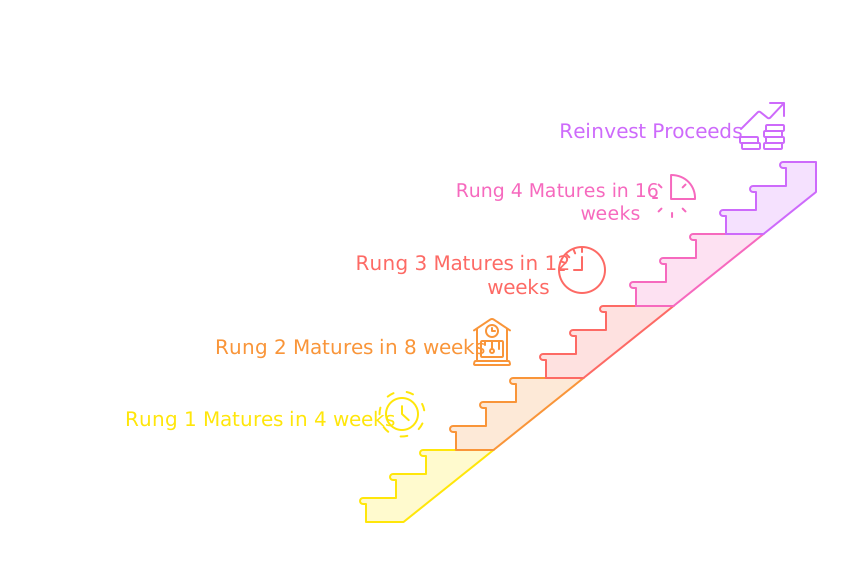
Treasury bill ladder in 1 sentence
A T-bill ladder is a short-term cash system where different rungs mature at different dates, giving you recurring chances to take cash back or reinvest.
The simplest ladder example
Assume you have $20,000 above your safe balance. You split it into 4 rungs:
After the setup period, 1 rung matures roughly each week. You can spend that cash, hold it in checking, or reinvest it into a new 4-week bill.
What the ladder is trying to solve
The ladder is trying to avoid 2 bad extremes. The first extreme is leaving all idle cash in a checking account that may earn almost nothing. The second extreme is putting all cash into one maturity date and discovering that bills need the money earlier.
The ladder says: not all cash needs the same date.
Why Do People Use T-Bill Ladders for Short-Term Cash?
People use T-bill ladders because the cash is too important for long-term market risk but too idle to sit at a near-zero checking rate. That creates a narrow use case: short-term, high-quality, rate-sensitive cash with known or manageable timing needs.
In July 2026, the rate gap is visible. The FDIC national interest checking benchmark on FRED was 0.07% for June 2026. The 4-week Treasury Bill secondary market rate on FRED was 3.67% on July 16, 2026. That gap does not mean every dollar should move. It means the idle layer deserves a real decision.
The 3 cash jobs
The ladder belongs in the third row most often. It can sometimes belong in the second row. It usually does not belong in the first row.
Why checking cash creates the ladder question
Checking is built for payment reliability. It is not built to maximize yield. If $20,000 sits in checking at 0.07%, the annual earnings are about $14 before taxes. If the same $20,000 is exposed to a 3.67% short-term T-bill benchmark for a full year, the simple gross estimate is about $734 before taxes, timing effects, and any product fees.
That is a $720 gross gap in a simple same-balance example.
Why the answer is not "move everything"
The gap is real, but so is payment timing. A mortgage that fails, a credit card autopay that pulls early, or a quarterly tax payment that arrives during the wrong ladder week can turn yield optimization into operational stress.
The right question is not "Can a T-bill ladder earn more than checking?" The right question is "Which cash can survive the ladder calendar?"
How Does a Treasury Bill Ladder Work Step by Step?
A Treasury bill ladder has 6 operating steps: decide the cash amount, choose the rung structure, buy the bills, track maturity dates, decide whether to reinvest, and hold enough cash outside the ladder for bills.
This is why the ladder is a workflow, not only an investment idea.
Step 1: Set the safe checking balance first
Before buying a bill, calculate the checking floor:
safe balance = next 30 days of bills + card autopay reserve + routine spending + known upcoming expenses + comfort cushion
Then calculate:
possible ladder cash = current checking balance - safe balance
If your checking balance is $30,000 and your safe balance is $12,000, the possible ladder cash is $18,000. If the safe balance is $27,000, the possible ladder cash is only $3,000.
Step 2: Pick a ladder interval
The interval is how often a rung matures.
TreasuryDirect lists weekly auctions for 4, 6, 8, 13, 17, and 26-week bills, and every 4 weeks for 52-week bills here.
Step 3: Buy the first rungs
A 4-week weekly ladder can be built over 4 weeks. You buy a bill each week for 4 weeks. After the first bill matures, you can reinvest into another 4-week bill and keep the pattern running.
If you want a 13-week weekly ladder, the full system takes longer to establish because 13 rungs are required for a weekly maturity rhythm. Many households do not need that complexity.
Step 4: Track maturity dates
The maturity date is the date that determines your liquidity. If the cash is needed before that date, you may need to sell early through a broker or keep more cash outside the ladder.
TreasuryDirect says that if no reinvestment instruction exists, principal is deposited into the designated bank account on the maturity date here.
Step 5: Decide whether to reinvest
TreasuryDirect allows reinvestment instructions when buying the original security or up to 4 business days before maturity here. That is convenient, but it still requires an intentional setup and a calendar-aware decision.
Reinvestment is where many cash ladders quietly become stale. The bill matures, the cash returns, and the user forgets to restart the system. Or the reinvestment runs even though a large payment is now coming.
Step 6: Keep the bill calendar separate from the bill-pay calendar
The T-bill calendar answers when Treasury cash matures. The bill-pay calendar answers when money must be in checking. The household needs both.
Rivo product mechanics are designed around that second calendar. Rivo lets users set a minimum checking threshold, plans ahead of scheduled bills, and describes refills before bills and transfers hit in current product details here.
What Does a $20,000 Treasury Bill Ladder Look Like?
A $20,000 T-bill ladder usually starts with a split, not a lump sum. The exact split depends on the safe balance, but a 4-rung structure is easiest to understand.
Assume the $20,000 is already above your safe checking balance. If the $20,000 includes rent, tax money, or card autopay, calculate the safe balance again before using this example.
Example A: 4-rung weekly 4-week ladder
This structure creates weekly decision points after setup. That is useful if you want liquidity. It is annoying if you do not want another recurring financial chore.
Example B: 4-rung 13-week ladder
A 13-week ladder may offer a cleaner cadence if you do not need weekly access. It can also be too slow for checking-account cash if your spending pattern changes.
Simple earnings math
Use a simple gross annual estimate first:
gross annual estimate = ladder balance x annualized rate
At a 3.67% 4-week T-bill benchmark:
This table is illustrative. Real T-bill pricing uses discount mechanics, rates move, maturity dates matter, taxes matter, and selling before maturity can change realized results.
What Are the Main Benefits of a Treasury Bill Ladder?
The main benefit is structured access to short-term Treasury exposure. A ladder gives you more timing control than a single bill, and more yield potential than a low-rate checking account when cash is truly idle.
.svg)
Benefit 1: Staggered maturity dates
The ladder creates recurring liquidity. If 1 rung matures every week or month, you have a planned cash decision point instead of waiting for the full balance to mature.
Benefit 2: Treasury-backed short-term debt
Treasury Bills are issued by the U.S. Treasury. Jiko Securities risk disclosures describe U.S. T-bills as short-term debt instruments issued by the U.S. government and backed by its full faith and credit here.
That does not remove every risk. It does define the issuer and instrument type.
Benefit 3: State and local tax treatment
TreasuryDirect lists federal tax due on bill interest and no state or local taxes here. For households in high-tax states, that can matter when comparing T-bills with bank deposit interest.
This article is not tax advice. The operational point is that tax treatment should be part of the comparison, not a footnote after the decision.
Benefit 4: Lower reinvestment shock than 1 maturity
If all cash matures on 1 date, the full amount faces the rate available at the next reinvestment date. A ladder spreads those dates. That can reduce the feeling of one large all-or-nothing decision.
Benefit 5: A useful test of idle cash discipline
If you can run a T-bill ladder for 90 days without missing bills, forgetting reinvestments, or needing early sales, you may have a stable manual cash routine. If the workflow keeps breaking, the issue is not financial knowledge. The issue is operational load.
What Can Go Wrong With a T-Bill Ladder?
A T-bill ladder can go wrong when the calendar and the cash-flow reality do not match. The failure mode is rarely "Treasury Bills are confusing." The failure mode is usually "the money was not as idle as it looked."
Risk 1: You need cash before maturity
If cash is needed before a bill matures, you may need to sell before maturity or keep a larger cash buffer. Early sale pricing can affect realized yield. Rivo product details make the same risk boundary clear for short-duration Treasuries: selling early can affect realized yield here.
Risk 2: You confuse SIPC and FDIC
T-bills are securities, not FDIC-insured bank deposits. SIPC says it does not protect against the decline in value of securities here. FDIC insurance and SIPC protection solve different problems.
If you need only FDIC-insured deposit products, a T-bill ladder may not match your preference.
Risk 3: You reinvest when bills are coming
Automatic reinvestment can be helpful. It can also be wrong if a tuition bill, property tax payment, insurance renewal, or card payoff is coming soon.
The 4 business day reinvestment window noted by TreasuryDirect means the ladder still needs calendar attention here.
Risk 4: You ladder the emergency fund without an access plan
Emergency cash has a different job from idle cash. Some emergency funds can sit in a liquid savings product, T-bill ladder, or brokerage cash setup. Some should stay closer. The question is not the label. The question is access timing.
If a $7,500 car repair, family emergency, medical bill, or job gap would force an early sale, the ladder is too tight.
Risk 5: You stop maintaining the system
Manual systems decay. The first month feels clean because setup is fresh. Month 4 is different. Bills change, income shifts, card statements spike, and the reinvestment email lands while you are busy.
This is the opening for automation. Rivo charges a 0.05% monthly management fee, about 0.60% per year before compounding, for the operational layer: checking floor, cash-flow monitoring, idle-cash movement, and bill-aware refills.
Treasury Bill Ladder vs Rivo: What Is the Difference?
A Treasury bill ladder is a do-it-yourself cash strategy. Rivo is an automated cash management product that uses short-duration U.S. Treasury Bills through Jiko Securities while working with your existing bank account.
.svg)
The difference is not "T-bills versus no T-bills." Both can involve T-bills. The difference is who manages the timing system.
Same instrument family, different workflow
The manual ladder wins when you want direct control and will actually maintain the system. Rivo fits when the problem is not knowledge, but consistency.
Why "keep your bank" matters
Many cash strategies fail because they ask you to rebuild your money life. New bank. New transfer routine. New direct deposit. New bill-pay setup. New calendar.
Rivo removes that friction by working with existing bank accounts. That is not a small feature. It is the behavioral reason the product exists.
Why bill-aware refill matters
A T-bill ladder can mature on schedule and still fail the household if the maturity date does not match bill timing. Rivo is designed around the bill calendar: minimum threshold, upcoming bills, cash-flow changes, and planned refills.
That is different from simply saying "buy short-term Treasuries."
When Should You Build a T-Bill Ladder Yourself?
Build a T-bill ladder yourself when you have stable idle cash, enjoy managing cash calendars, understand T-bill mechanics, and want full control over purchase and reinvestment decisions.
DIY is not inferior. It is just operationally demanding.
DIY fit table
The 90-day self-test
Before building a full ladder, run a 90-day test:
- Track every bill due in the next 30 days.
- Mark all credit card autopay dates.
- Identify any tax, tuition, travel, insurance, home repair, or contractor payment.
- Keep a safe balance that covers those obligations.
- Simulate weekly ladder decisions without buying the full amount.
- If the calendar feels annoying in week 3, do not build a 13-rung ladder.
- If the cash stays untouched for 90 days, the idle layer may be real.
The 90-day test is useful because it separates "I have cash today" from "this cash has no job."
When DIY is too much
DIY becomes too much when the ladder requires more attention than the money is worth. A $2,000 idle balance may not justify weekly calendar work. A $50,000 recurring idle balance might. A $20,000 balance sits in the middle: the math can matter, but only if the cash is actually idle and the workflow survives.
If the workflow is the blocker, read Rivo vs TreasuryDirect before deciding.
When Does Rivo Fit a Manual Ladder Problem?
Rivo fits when you want the T-bill-linked cash outcome without running the T-bill ladder yourself. The product is built for households that keep meaningful idle cash in checking because manual transfer systems do not survive real life.
Use Rivo when the issue is 4-part: idle cash, current bank preference, bill timing, and low desire for manual maintenance.
Rivo fit table
The cost of automation
Rivo charges a flat monthly management fee of 5 basis points, or 0.05%, based on average daily balance here. Simple annualized, that is about 0.60% before compounding effects.
On $20,000, that is about $120/year. If the simple gross T-bill-linked estimate is about $730/year at 3.65%, the rough pre-tax, after-fee estimate is about $610/year before balance timing, tax, and realized-yield effects.
That fee is not for access to an impossible instrument. T-bills are available directly. The fee is for automation around checking, safe balance, cash movement, and bill-aware refills.
What Rivo does not replace
Rivo does not replace your checking account, emergency planning, tax judgment, or need to understand T-bill risk. Rivo is not a bank. Banking services are provided by Jiko Bank, and securities are offered through Jiko Securities.
If you want only FDIC-insured deposit accounts, do not treat a T-bill product as the same thing.
How Should Taxes Change the Ladder Decision?
Taxes should change the ladder decision because a T-bill ladder and a bank deposit product can produce different after-tax results even when the headline yield looks similar. TreasuryDirect notes that Treasury bill interest is subject to federal income tax but not state or local income taxes here.
That does not make a T-bill ladder the right answer for every household. It means the comparison should use after-tax cash, not only the rate visible on the product page.
Simple after-tax comparison framework
The tax comparison is most important in states with meaningful state income tax. A person in California, New York, New Jersey, or another higher-tax state may care more about T-bill tax treatment than a person in a no-income-tax state.
Example: why after-tax yield can differ from headline yield
Assume a $20,000 idle-cash balance. Also assume a 3.67% T-bill benchmark and a 3.67% deposit product rate, just to isolate tax treatment.
This table is not tax advice. It is the reason a serious cash comparison should not stop at the headline rate.
Why Rivo still needs fee math
Rivo uses T-bills, but it also charges a management fee. The fee is 0.05% per month, which is about 0.60% per year before compounding. That means the right comparison is not "T-bill rate versus checking rate." It is:
estimated net outcome = gross T-bill-linked yield - Rivo fee - federal tax impact + state/local tax difference where relevant
If you are comparing Rivo with a manual T-bill ladder, the manual ladder may have no Rivo fee. If you are comparing Rivo with doing nothing in checking, the automation fee may still be worthwhile because the manual alternative is not actually happening.
What Is the Best Ladder Setup for Idle Checking Cash?
The best ladder setup for idle checking cash is usually short, simple, and conservative. For many households, a 4-week or 8-week structure is easier to maintain than a long ladder with many rungs.
Checking cash is different from portfolio cash. It is connected to autopay, card balances, direct deposit timing, Venmo transfers, insurance renewals, quarterly taxes, travel, school payments, and irregular household spending. The ladder should respect that reality.
Ladder setup by cash confidence
The higher the confidence, the more manual structure can work. The lower the confidence, the more the safe balance and bill calendar matter.
A conservative first ladder
For a first manual ladder, start smaller than the maximum possible amount. If you think $20,000 is idle, test $5,000 or $10,000 first. If you think 13 weeks is fine, test 4 weeks first.
The goal is to validate behavior before optimizing yield. If the cash never needs to come back early, you can expand. If bills feel tight, stop.
A Rivo-first setup
A Rivo-first setup starts from the checking floor instead of the ladder rungs:
- Link the existing checking account.
- Set a safe balance that covers near-term obligations.
- Let only cash above that threshold become eligible.
- Review the bill calendar and refill behavior.
- Pause, adjust, or disconnect if the safe balance needs to change.
This is a different operating model. You are not choosing auctions. You are choosing the boundary between working cash and idle cash.
How Do Treasury Bill Ladders Compare With Other Cash Options?
Treasury bill ladders are one cash option among several. The right answer depends on what you value most: payment reliability, manual control, yield, tax treatment, insurance type, or automation.
Cash option comparison
The choice is not only yield. It is the system you will actually maintain.
The hidden decision: who owns the calendar?
Every cash option has a calendar owner:
- Checking account: the bank and your autopay setup own the payment calendar.
- Manual T-bill ladder: you own the maturity, reinvestment, and bill calendar.
- TreasuryDirect: you own auction and maturity decisions.
- Brokerage cash: you own the brokerage and bank-transfer workflow.
- Rivo: you set the safe balance, and automation handles eligible idle-cash movement and planned refills.
If you want manual control, own the calendar. If you want idle cash handled around bills, use an automation layer built for that job.
What Should You Do Before You Build a T-Bill Ladder?
Before building a T-bill ladder, separate working cash from idle cash. A ladder built on the wrong cash layer is fragile from day 1.
Use this pre-ladder checklist before buying anything.
Pre-ladder checklist
If 2 or more rows fail, the ladder is not ready. Keep the money in checking, use a simpler cash product, or automate the workflow.
The 5-question Rivo screen
Rivo may fit if you answer "yes" to at least 3 of these 5 questions:
- Do you often keep $5,000+ in checking after bills and regular spending?
- Do you want to keep your current bank?
- Do you dislike manual transfers, Treasury auctions, or ladder maintenance?
- Do you want money planned back before bills rather than moved only when you remember?
- Are you comfortable with short-duration T-bill exposure and the required disclosures?
If you answer "no" to question 5, do not force the fit. A deposit-only cash setup may be cleaner for your preferences.
A Bottom Line: A T-Bill Ladder Only Works for Cash That Can Survive the Calendar
A Treasury bill ladder only works for cash that can survive the calendar. Use a Treasury bill ladder only for cash that can survive the calendar. That means the money is above your safe checking balance, not needed for near-term bills, not your only emergency access, and not likely to be pulled before maturity.
A manual ladder is a strong choice when you want control and will maintain it. It is weak when the balance looks idle only because you have not mapped the next 30-90 days of bills.
Rivo fits the middle case: you have meaningful idle checking cash, you want T-bill-linked yield, but you do not want to manage the ladder, reinvestment schedule, safe balance, and refill calendar yourself. The product works with your existing bank, moves only eligible idle cash above your threshold, and charges a 0.05% monthly management fee for the automation layer here.
The decision should be boring:
The best cash system is the one that protects bill payment first, then earns on the layer that is actually idle.
Related Rivo Reading
- To compare DIY T-bills with automation, read Rivo vs TreasuryDirect.
- To compare T-bills with cash alternatives, read Treasury Bills vs Money Market Funds vs High-Yield Savings.
- To understand state tax treatment, read Are Treasury Bills State Tax Exempt.
- To check T-bill protection language, read Are Treasury Bills Safe for Short-Term Cash.
- To understand fees, read Rivo Fees Explained.

This article is educational and is not financial, investment, tax, accounting, or legal advice.
Yield rate reflects the 4-week T-bill rate as of 1 July 2026, when held to maturity. Rate does not include fees. Rates are subject to change. Minimum balance of $100 required to earn the stated rate.
Rivo is a fintech company, not a bank. Banking services provided by Jiko Bank, a division of Mid-Central National Bank. Jiko Group, Inc. and its affiliates do not provide legal, tax, or accounting advice. You should consult your legal and/or tax advisors before making any financial decisions. This material is not intended as a recommendation, offer or solicitation for the purchase or sale of any security or investment strategy. See FINRA BrokerCheck, Jiko U.S. Treasuries Risk Disclosures and Jiko Securities Inc. Form CRS.
Investments in T-bills: Not FDIC Insured - No Bank Guarantee - May Lose Value. All U.S. treasury investments and investment advisory services provided by Jiko Securities, Inc., a registered broker-dealer, member FINRA and SIPC. Securities in your account are protected up to $500,000. For details, please see www.sipc.org.
.jpeg)
Ambrish Tyagi is the founder and CEO of Rivo. Previously led AI at Cruise and Amazon.
Follow on LinkedInGet Rivo Updates
Product news, money insights, and company updates.