How to Automate Savings With Irregular Income: A Floor-and-Surplus System for Freelancers, Commission Earners, and Variable-Pay Households
Learn how to automate savings with irregular income using a protected checking floor, deposit rules, surplus sweeps,pause conditions, bill-aware cash management
.png)
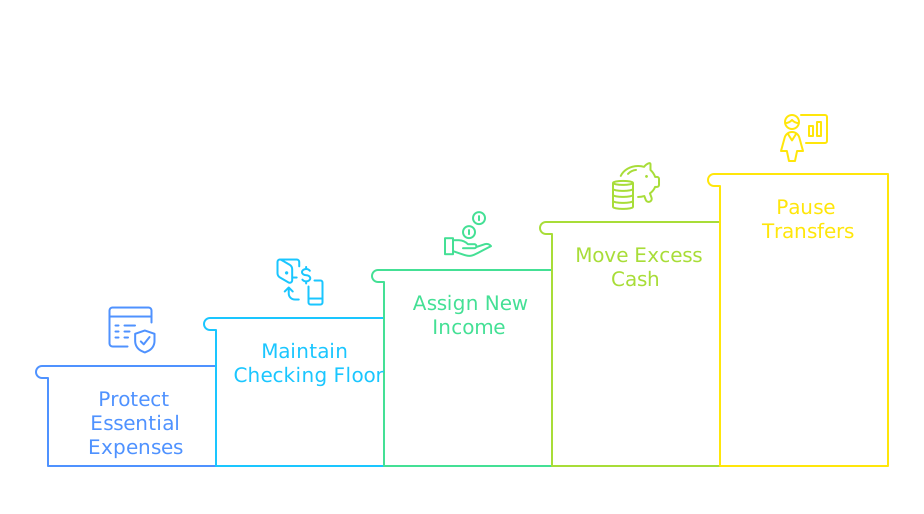
You can automate savings with irregular income, but the rule should respond to cash flow instead of assuming every month looks the same. Protect bills, taxes, routine spending, and a checking floor first; then move only the amount that remains above those needs.
The most useful setup is a floor-and-surplus system:
- a protected layer that stays available for the household's next obligations,
- a deposit rule that assigns newly received income,
- a surplus rule that moves only verified excess cash,
- and pause conditions that stop movement when the forecast becomes uncertain.
This is different from scheduling the same transfer after every payday. A fixed transfer can be too aggressive after a weak deposit and too conservative after a strong one. The automation should change when income, bills, credit-card payments, or timing changes.
TL;DR
- Income variability is common enough to require a different automation rule. The Federal Reserve reported that 30% of adults had income that varied at least occasionally in 2025.
- A fixed recurring transfer is simple, but it can create a shortfall when a deposit arrives late or a bill is larger than expected. The Consumer Financial Protection Bureau advises monitoring income, expenses, account balances, and scheduled payments when setting recurring transfers.
- Use a protected checking floor based on the account's projected low point, assigned reserves, and ordinary timing error.
- Separate cash into operating money, assigned reserves, and verified surplus before applying a saving rule.
- Compare five methods: direct-deposit split, fixed transfer, percentage-of-deposit rule, floor-based surplus sweep, and bill-aware automation.
- Do not automate tax money, business operating cash, an emergency reserve, or a known annual bill into a destination that cannot meet its access requirement.
- Rivo can fit after the floor is established. It works with an existing checking account, uses a user-set minimum threshold, analyzes cash flow, and plans movement around detected bills.
Quick Answer: What Is the Best Way to Automate Savings With Irregular Income?
The best method is usually a hybrid rule that combines assignment with verification.
When income arrives:
1. Separate taxes and business obligations when applicable.
2. Fund bills and routine spending through the next protected point.
3. Restore the checking floor.
4. Direct a conservative amount toward savings goals.
5. Move any additional verified surplus only after the account's low point remains protected.
The exact destination depends on the goal. Immediate-use cash may belong in checking or an insured deposit account. Longer-horizon savings may use another account or investment strategy that matches the household's liquidity and risk needs. Rivo is relevant only to the eligible idle-cash layer, not every dollar labeled savings.
The table is a routing tool, not a ranking. The best method is the one that protects the household's real payment sequence while reducing the amount of manual work it will actually maintain.
Why Does Irregular Income Need a Different Savings Rule?
Irregular income changes the amount, timing, or reliability of cash entering the household. The bills may remain fixed even while deposits change.
The Federal Reserve reported that 11% of adults struggled to pay bills because their income varied in 2025. Among self-employed adults, 58% reported month-to-month income variability.
Automation is still useful. The trigger and amount simply need to follow confirmed cash rather than an idealized monthly average.
A strong month is not a new baseline
A large commission, client payment, bonus, or seasonal surge can make checking look permanently overfunded. If the next deposit is smaller or later, the same automatic transfer may remove cash needed to bridge the weak period.
Use a strong month to fund the system's missing layers:
- taxes,
- upcoming bills,
- annual obligations,
- the checking floor,
- emergency or income-smoothing reserves,
- and only then goal savings or idle-cash movement.
The problem is not saving after a strong month. It is committing the strong-month amount as the recurring rule.
Average income can hide the weak sequence
An average compresses high and low deposits into one number. Checking operates on dates.
A household can have adequate annual income and still face a cash shortage when:
- a client pays late,
- a commission posts after the mortgage,
- two card statements clear before the next deposit,
- seasonal work slows,
- or business and personal obligations overlap.
The CFPB cash-flow budget organizes income and expenses by when they occur. That timing view is the correct base for savings automation.
The automation rule must distinguish variability from insufficiency
Variable income means the amount or timing changes. Insufficient income means reliable cash cannot support recurring obligations over time.
Automation cannot repair a negative household budget. If essential spending repeatedly exceeds dependable income, the first task is resolving the shortfall. Saving automation becomes relevant when the household has a positive but uneven margin.
What Automated Saving Means When Income Varies
Automated saving is a rule that moves or assigns cash without requiring a fresh decision each time. With irregular income, that rule should have inputs, conditions, and a stop state.
The workflow needs more than "move money every Friday."
An automatic transfer is only one part of this system. The quality of the automation depends on the quality of the boundary around it.
Assignment can be automatic even when movement is not
A household may automatically label part of each deposit for taxes or a savings goal while keeping the cash in checking until the next review. This still reduces decision friction.
The system can progress through levels:
- automatic assignment with manual movement,
- automatic movement of a small base amount,
- conditional movement above a floor,
- or bill-aware movement after cash-flow analysis.
Start at the lowest level that reduces work without creating a liquidity problem.
Saving and investing are separate decisions
The rule can identify money available for a goal. It does not determine the correct destination.
Compare:
- access time,
- account protection,
- market or fixed-income risk,
- fees,
- tax treatment,
- transfer limits,
- and the goal's horizon.
Cash needed soon should not be placed into a product merely because it offers a higher expected return.
Why Can a Fixed Automatic Transfer Fail?
A fixed automatic transfer assumes that the same amount is affordable on the same date. That can work when the account has a stable minimum income and a wide checking margin.
It becomes fragile when the transfer date and amount ignore the current cash-flow sequence.
The date can be wrong
A transfer scheduled by calendar may run:
- before a delayed deposit becomes available,
- before a variable card payment clears,
- during a holiday-shifted payment window,
- before a client pays,
- or during a seasonal slowdown.
The CFPB warns that a recurring transfer can contribute to overdraft fees when checking lacks enough money. Confirm availability and upcoming payments before increasing the rule.
The amount can be wrong
A fixed amount may be:
- too large after a weak deposit,
- too small after a strong deposit,
- unrelated to the current bill cluster,
- or based on an old checking floor.
The solution is not necessarily a percentage. A percentage scales with income but can still move too much when the account is below its required floor.
The destination can be wrong
Moving money to another account can create a return-path problem. If checking needs a refill, the household must know:
- how to initiate the return,
- when funds become available,
- whether a security must be sold,
- whether a transfer limit applies,
- and what happens on nonbusiness days.
The transfer is safe only when both directions fit the bill schedule.
The rule can become stale
Income and bills change after:
- a new client,
- a compensation change,
- parental leave,
- a move,
- a new mortgage or lease,
- childcare changes,
- a new card,
- or a business expense shift.
An old automation can continue executing perfectly while solving the wrong problem.
Saving Methods That Work With Variable Income
The methods differ by trigger, amount logic, and how much future cash flow they consider.
Split direct deposit
An employer may allow payroll to be divided among accounts. The CFPB identifies split direct deposit as one way to automate saving.
This works well when:
- a stable salary covers essential obligations,
- the split amount is conservative,
- and variable commissions or outside income receive a separate rule.
It is less useful when income arrives from several clients, platforms, or accounts that do not support an automatic split.
Fixed recurring transfer
The same amount moves weekly, monthly, or after a regular payday.
Use it when:
- the lowest dependable income can support the transfer,
- the bill schedule is stable,
- checking has a measured floor,
- and the household reviews the rule after material changes.
Avoid setting the amount from an average or best month.
Percentage-of-deposit rule
A percentage rule scales with the amount received. It is often more natural for commissions, invoices, bonuses, or gig income.
The rule still needs a priority order:
1. assigned tax or business obligations,
2. bills and routine spending,
3. checking floor,
4. savings goal,
5. optional additional surplus.
Without that order, a percentage can move cash even when checking is underfunded.
Floor-based surplus sweep
A floor-based rule moves cash only when checking exceeds a threshold.
The threshold should not be today's preferred round number. Build it from:
- the lowest projected checking balance,
- spending variability,
- income-timing uncertainty,
- assigned reserves,
- and personal comfort.
The static version watches one balance. The stronger version also considers upcoming obligations.
Bill-aware automation
Bill-aware automation uses connected cash-flow information, a protected threshold, and expected obligations to decide when cash may move and when checking may need a refill.
This can reduce the burden of:
- rechecking the account after every deposit,
- recalculating a transfer amount,
- monitoring future bills,
- and remembering to bring cash back.
It should remain conservative when transaction history does not include a known future obligation.
Building a Floor-and-Surplus System
The floor-and-surplus system separates cash protection from savings ambition.
.svg)
Use this order:
Protected cash equals:
- dated bills and transfers through the cutoff,
- plus routine spending through the cutoff,
- plus assigned reserves not already represented,
- plus the checking floor.
Candidate saving amount equals:
- the projected minimum balance,
- minus the checking floor,
- minus assigned reserves outside the forecast.
If the result is not positive, do not move cash under the surplus rule.
Choose the protected point
The protected point is the date through which checking must remain funded before cash becomes eligible to move.
Possible cutoffs include:
- the next reliable deposit,
- the end of a complete bill cycle,
- the next large card payment,
- the end of a seasonal weak period,
- or a known tax or annual-payment date.
Use the later reasonable date when income timing is uncertain.
Build the dated cash-flow map
Record:
- opening available balance,
- confirmed deposits by availability date,
- bills by expected checking date,
- card payments,
- routine spending,
- transfers,
- taxes,
- annual obligations,
- and known exceptions.
The CFPB cash-flow tool recommends tracking income, resources, and expenses for at least one month before building the budget. A longer window is useful when income has a seasonal or commission cycle.
Find the projected low point
Calculate the running balance after each event. The lowest projected balance is more important than the highest post-deposit balance.
If checking begins high but falls near the floor before the next confirmed deposit, little or none of the opening peak is available for the surplus rule.
Add assigned reserves
Some cash has a purpose but no near-term checking transaction.
Examples include:
- estimated taxes,
- annual insurance,
- professional licensing,
- business equipment,
- planned travel,
- tuition,
- a home project,
- or emergency cash intentionally kept accessible.
Subtract these amounts unless they are already included in the dated forecast.
Define the base rule and the surplus rule
The base rule is the smallest repeatable saving action the weak case can support.
The surplus rule applies only after the full protected layer is funded. It can use a percentage, threshold, or manual confirmation.
This combination avoids the all-or-nothing choice between a rigid transfer and no automation.
What Should Happen Each Time Income Arrives
Treat each confirmed deposit as a funding event.
Confirm availability
Do not automate against an invoice, commission statement, or expected transfer before the funds become available in the destination account.
Record:
- source,
- amount,
- date received,
- availability status,
- and whether the payment is recurring or exceptional.
Separate business and personal cash
Self-employed people may receive gross business revenue that still has to fund:
- business expenses,
- payroll or contractor payments,
- taxes,
- refunds or chargebacks,
- and owner compensation.
Do not classify gross receipts as household surplus.
Fund priorities in order
Use a waterfall:
This order does not tell the household which financial goal should come first. It prevents the automation from treating assigned cash as free.
Reforecast after the deposit
A new deposit changes the opening balance. It does not remove future obligations.
Refresh:
- the next card statement,
- the next reliable deposit,
- variable bills,
- annual exceptions,
- and routine spending.
Then recalculate the low point.
Worked Example: A Variable-Income Month
The following example is illustrative. Every amount, date, percentage, transfer, and result is a hypothetical planning assumption, not a recommendation or claim about a typical household.
Assume a freelance household receives an illustrative $12,800 client payment. Checking held an illustrative $6,200 before the deposit, so the bank-displayed balance becomes $19,000.
Under the stated assumptions, the illustrative candidate saving amount is $1,500, not the $12,800 deposit and not the $19,000 displayed balance.
Apply a conservative base rule
Assume the household already uses an illustrative $300 base transfer after a confirmed client payment, but only when checking remains above the floor.
The remaining illustrative surplus is $1,200. The household can:
- leave it in checking until the next review,
- assign it to a near-term goal,
- move it under a percentage rule,
- or treat it as eligible idle cash if it survives the complete cash-flow test.
Stress a delayed invoice
Assume the next expected invoice is delayed and checking must cover an additional illustrative $900 of routine spending.
The $1,500 candidate amount falls to $600. The $300 base rule still fits under the assumptions, while an automatic $1,500 sweep would be too aggressive.
Stress a larger card payment
Assume the issued card payment is an illustrative $800 higher. The candidate amount falls from $1,500 to $700.
The example shows why the automation needs a low-point test. The same deposit supports a different saving amount when the current obligations change.
Should You Use a Fixed Amount, Percentage, or Threshold?
Choose the amount logic based on which variable creates the most risk.
Use a fixed amount for the minimum habit
A fixed amount can preserve consistency. Keep it small enough that a weak representative period can support it without relying on an uncertain deposit.
The CFPB's saving-app research found that guaranteed saving rules were associated with stronger saving outcomes than contingent rules, including roughly 1.5 to 3.5 times larger increases in certain measured outcomes. The study observed associations among users of one savings app; it does not prove that an aggressive fixed transfer is appropriate for every variable-income household.
Use a percentage for variable deposits
A percentage scales with income. It can be useful for commissions or invoices when the household first separates taxes and operating obligations.
The percentage should apply to a defined base:
- gross deposit,
- net business income,
- owner pay,
- or verified household surplus.
Do not use these bases interchangeably.
Use a threshold for liquidity protection
A threshold answers a different question: how much should remain available in checking?
The amount above the threshold is not automatically surplus if:
- a future bill is missing,
- a tax reserve is mixed into checking,
- the next income date is uncertain,
- or an annual obligation sits outside the forecast.
Use a threshold with a bill calendar and exception list.
Use a hybrid when both sides vary
The hybrid rule is often the most practical for irregular income:
- small base transfer after confirmed income,
- conditional percentage of strong deposits,
- floor-based check before movement,
- and a pause when the forecast becomes uncertain.
It creates a repeatable minimum without turning every strong deposit into a fixed commitment.
How the System Changes by Income Type
The same floor-and-surplus logic applies, but the source data and failure modes differ.
Freelancers and consultants
Separate business cash before household automation. Use cleared client receipts, not sent invoices, as the trigger.
A household transfer can be based on owner pay or verified net cash after business obligations. Consult a qualified tax or accounting professional for entity-specific treatment.
Commission earners
Use stable salary, if present, to support a modest base rule. Treat variable commission as a separate funding event.
Before moving commission cash, check whether the next commission period may be weaker and whether fixed household spending increased during the strong period.
Gig workers
Many small payouts can create noisy triggers. A daily percentage rule may move money before vehicle, platform, or tax costs are clear.
Aggregate confirmed payouts over a short operating window, separate known costs, and apply the surplus rule after the net amount becomes visible.
Seasonal earners
The strong season must fund the weak season before its remainder becomes surplus.
Build a longer forecast that spans:
- the income decline,
- off-season bills,
- insurance and taxes,
- business restart costs,
- and the next dependable earning period.
Mixed-income households
Do not assume the stable earner's paycheck makes the entire variable deposit free. Map all shared obligations and identify which income funds which layer.
The variable income can support goals after the household floor and shared bill cycle remain protected.
How Taxes and Business Cash Affect Automation
Tax and business assignments are not ordinary savings goals. They are obligations or operating reserves.
The IRS explains that federal income tax generally must be paid as income is earned, through withholding or estimated payments when applicable. The correct amount and timing depend on the taxpayer's circumstances.
Avoid a universal tax percentage
Do not use one editorial percentage for every freelancer or commission earner.
The amount can depend on:
- entity structure,
- deductions,
- filing status,
- other household income,
- withholding,
- state and local rules,
- and prior payments.
Use tax software, current IRS guidance, or a qualified professional to establish the reserve.
Keep the tax assignment visible
The cash can remain in checking, a separate deposit account, or another appropriate location. What matters for the automation calculation is that it remains excluded from free cash.
Maintain:
- expected payment date,
- current reserve,
- required additions,
- source of the estimate,
- and destination account.
Do not mix business runway with household idle cash
A business may need money for payroll, contractors, software, inventory, insurance, or refunds. Those dollars can look idle in a personal view if accounts are mixed.
Separate account ownership and purpose before connecting a household cash-management rule.
Pause Conditions Every Automation Needs
A pause rule is part of the design, not evidence that the automation failed.
Stop or reduce movement when the input quality changes.
Define pause ownership
Someone or some system must own the response.
For a manual workflow, assign:
- who reviews alerts,
- who updates the forecast,
- who changes the transfer,
- and who confirms the return path.
For automated cash management, the user still owns unusual future information and control settings.
Use conservative defaults
When uncertainty rises:
- move less,
- preserve more in checking,
- wait for the deposit,
- or pause.
Do not compensate for uncertainty by assuming the strongest recent month will repeat.
How Often to Review the Rule
Review frequency should follow cash-flow change, not a ceremonial calendar.
Compare projected and actual low points
The review should answer:
- Was the forecast too optimistic?
- Which payment was missing?
- Did income arrive later?
- Was routine spending higher?
- Did the account hold more than needed?
Use the error to change the floor or rule. Do not lower the floor after one unusually favorable cycle.
Review the rule, not only the balance
A healthy balance can hide a stale process. Confirm that:
- deposit sources are still recognized correctly,
- assigned reserves are current,
- the destination still fits the goal,
- notifications work,
- and pause controls remain available.
Where Rivo Fits Irregular-Income Automation
Rivo fits the cash-management layer after the household has separated obligations from recurring surplus.
Rivo works with an existing checking account. The user sets the minimum balance they want protected, Rivo analyzes connected cash flow, and eligible idle cash can move into short-duration U.S. Treasury Bills through Jiko Securities. As detected bills and transfers approach, Rivo plans to move money back into checking.
The Rivo product details specifically address irregular income: cash-flow patterns can change, users can increase the checking buffer, and the system becomes more conservative when conditions look uncertain.
Rivo is not the household budget
Rivo does not decide:
- whether the household can afford recurring spending,
- how much tax the user owes,
- which financial goal should be prioritized,
- or whether a future obligation absent from connected history exists.
The household should keep those assignments current and adjust controls before a large unusual payment.
Rivo is not a savings account
Rivo is a brokerage-based cash-management product. Eligible idle cash is invested in short-duration Treasury Bills through Jiko Securities, not held as a high-yield savings deposit.
Treasury Bills are securities. The Jiko U.S. Treasuries Risk Disclosure explains the risks of Treasury transactions, including sales before maturity.
The value is the operating loop
A disciplined household can build the same decision process manually:
- track deposits,
- forecast bills,
- calculate surplus,
- move cash,
- monitor the destination,
- and schedule refills.
Rivo is relevant when the cash is genuinely idle but the repeated monitoring and movement do not stay maintained.
When to Avoid or Delay Automation
Automation should wait when the protected layer is unknown or the household needs immediate access.
Keep immediate-use cash accessible
Money needed for housing, food, medicine, transportation, near-term bills, or another essential payment should remain in a form that meets the required access time.
Yield is secondary to payment readiness.
Use manual confirmation during transitions
A manual or notification-based step can be useful during:
- a new job,
- parental leave,
- a business launch,
- a client concentration change,
- a move,
- or a seasonal shift.
Automation can increase after the new pattern becomes visible.
A Practical Setup Checklist
Use this checklist before turning on a recurring or conditional saving rule.
Cash-flow inputs
- List every income source.
- Mark each source as stable, variable, seasonal, or one-time.
- Record when deposits become available.
- Build a bill calendar.
- Add issued card payments.
- Add routine spending.
- Add annual and irregular obligations.
Assignment controls
- Separate taxes when applicable.
- Separate business operating cash.
- Identify emergency and income-smoothing reserves.
- Identify near-term goals.
- Choose the protected point.
- Calculate the projected low point.
- Set a conservative checking floor.
Automation design
- Choose direct-deposit, fixed, percentage, threshold, hybrid, or bill-aware logic.
- Define the deposit base.
- Define the eligible-surplus formula.
- Confirm the destination and return path.
- Choose a conservative starting amount.
- Create pause conditions.
- Turn on low-balance and transfer notifications.
Review controls
- Assign an owner.
- Reconcile expected and actual activity.
- Compare projected and actual low points.
- Review after income or bill changes.
- Keep unusual future obligations visible.
- Increase automation only after representative cycles support it.
Final Recommendation
Automate savings with irregular income by making the rule conditional on confirmed cash and a protected checking floor.
Do not begin with the percentage you hope to save. Begin with the account's jobs:
1. confirm the deposit,
2. separate taxes and business obligations,
3. fund dated bills and routine spending,
4. restore assigned reserves,
5. protect the checking floor,
6. apply a conservative base rule,
7. move additional surplus only after the low point remains protected,
8. pause when the forecast becomes uncertain,
9. compare the projected and actual result.
Use a fixed transfer when the weak case can support it. Use a percentage when deposit size varies but the account's protected layer is already funded. Use a threshold when the checking floor is measured and current. Use a hybrid or bill-aware method when both income and bills change.
Rivo can manage the eligible idle-cash layer around detected bills while the user keeps an existing bank and controls the minimum checking threshold. It should sit on top of a conservative household system, not replace the system's tax, business, goal, or affordability decisions.
FAQ
Can I automate savings if my paycheck amount changes every time?
Yes. Use a percentage-of-deposit or hybrid rule after the cash becomes available, then confirm that taxes, bills, routine spending, assigned reserves, and the checking floor remain funded. A percentage alone is not enough if checking begins below its required level.
Is a fixed amount or percentage better for irregular income?
A fixed amount is easier to predict and can support a minimum habit. A percentage scales with changing deposits. A hybrid combines a small fixed base with a conditional share of verified surplus, which can be more resilient when both income and bills vary.
Should I automate savings from gross freelance income?
Usually not before separating business expenses, taxes, and owner pay. Gross receipts can include cash that does not belong to household savings. The appropriate treatment depends on the business and tax structure.
What if an automatic transfer makes checking too low?
Pause the rule, return funds if the destination and timing allow, and rebuild the calculation from the projected low point. Review whether the error came from a late deposit, missing bill, larger payment, stale floor, or transfer timing.
How much should stay in checking before I automate savings?
Use a safe balance based on the account's projected low point, ordinary spending variability, income-timing uncertainty, assigned reserves, and personal comfort. The separate guide on how much to keep in checking with irregular income provides the detailed formula.
Can Rivo work when income is irregular?
Yes. Rivo supports irregular-income cash flow through connected analysis, a user-set minimum threshold, adjustable buffers, and more conservative behavior when patterns look uncertain. Users should still identify unusual future obligations and adjust or pause automation when circumstances change.
Related Rivo Reading
- To calculate the protected layer first, read How Much Should You Keep in Checking With Irregular Income?.
- To compare weekly, monthly, payday, and conditional movement, read How Often Should You Move Money Out of Checking?.
- To calculate the dated low point, read How to Forecast Your Checking Account Balance.
- To build the source schedule for bills and deposits, read How to Build a Bill Calendar for Your Checking Account.
- To compare the broader category and its alternatives, read What Is Automated Cash Management?.

This article is educational and is not financial, investment, tax, accounting, or legal advice.
Yield rate reflects the 4-week T-bill rate when held to maturity. Rate does not include fees. Rates are subject to change. Minimum balance of $100 is required to earn the stated rate.
Rivo is a fintech company, not a bank. Banking services provided by Jiko Bank, a division of Mid-Central National Bank. Jiko Group, Inc. and its affiliates do not provide legal, tax, or accounting advice. You should consult your legal and/or tax advisors before making any financial decisions. This material is not intended as a recommendation, offer or solicitation for the purchase or sale of any security or investment strategy. See FINRA BrokerCheck, Jiko U.S. Treasuries Risk Disclosures and Jiko Securities Inc. Form CRS.
Investments in T-bills: Not FDIC Insured - No Bank Guarantee - May Lose Value. All U.S. treasury investments and investment advisory services provided by Jiko Securities, Inc., a registered broker-dealer, member FINRA and SIPC. Securities in your account are protected up to $500,000. For details, please see www.sipc.org.
Sources
Federal Reserve: 2025 Income and Expenses; CFPB: Make Saving Automatic; CFPB: Savings App Research; CFPB: Cash Flow Budget; IRS: Pay Taxes on Time; Rivo Homepage; Rivo FAQ; and Jiko: Treasury Risk Disclosure.

Shalu Yadav is Rivo's SEO/GEO Expert, bringing over 10 years of experience in making financial content discoverable across both classic search and generative AI platforms.
Follow on LinkedInGet Rivo Updates
Product news, money insights, and company updates.