Why Does My Budget Say I Have Money but My Checking Account Is Low? Budget vs Cash Flow Explained
Learn why a monthly budget can show money left over while checking stays low, how to reconcile the gap, and how to calculate bill-ready cash and your projected
.png)
Your budget can say you have money left while your checking account stays low because a monthly budget measures totals, while checking records the timing of actual deposits and withdrawals.
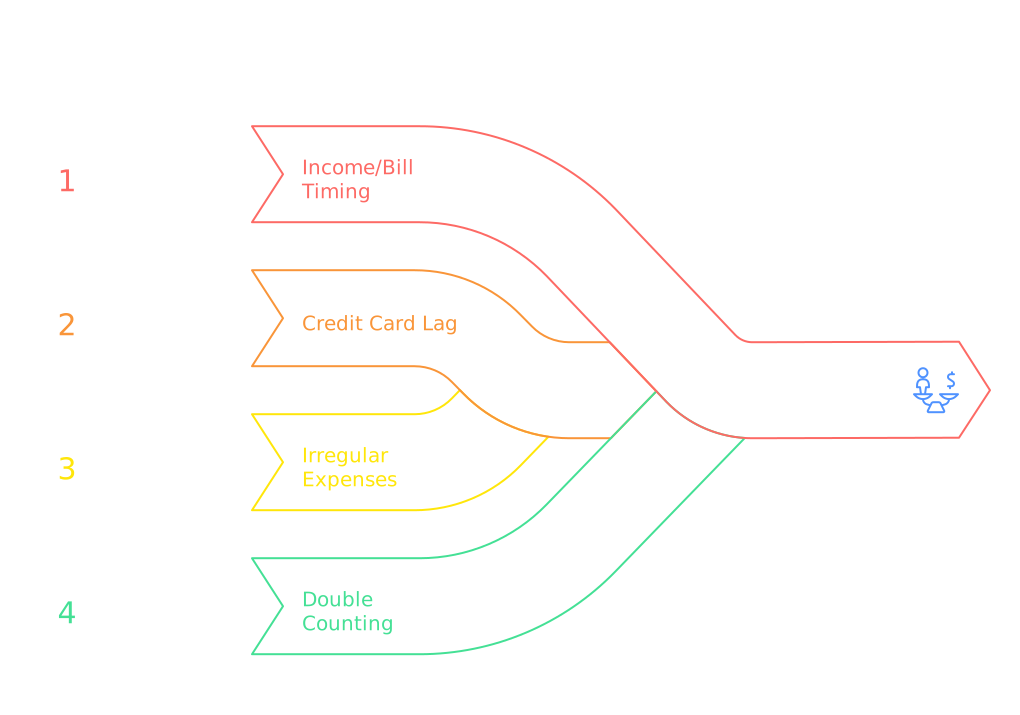
The gap usually comes from one or more of four problems: income and bills settle in the wrong order, credit-card spending reaches checking later, irregular expenses are missing from the monthly plan, or money is counted twice across accounts and transfers.
That does not automatically mean the budget is useless or that the household is overspending. It means the monthly plan must be reconciled with a dated cash-flow forecast before the apparent surplus can be treated as available money.
TL;DR
- A monthly budget answers whether planned income exceeds planned expenses. It does not show whether enough cash will be in checking on each payment date.
- Current balance, available balance, budget surplus, and bill-ready cash are different numbers. Only bill-ready cash subtracts known obligations that have not yet left checking.
- Credit-card purchases create a delay. The spending can be inside the budget while the cash remains visible in checking until the statement payment settles.
- Annual bills, reimbursements, transfers, pending transactions, and bill clusters can make a correct monthly budget disagree with the bank balance.
- Reconcile the gap transaction by transaction, then build a chronological forecast. The Consumer Financial Protection Bureau cash-flow budget carries each week's ending balance into the next week so the timing problem becomes visible.
- The useful operating number is the lowest projected balance before the next reliable deposit, plus a deliberate cushion for ordinary variation and settlement timing.
- Rivo becomes relevant only after recurring unassigned cash remains above that protected floor. It works with an existing checking account, lets the user configure a minimum threshold, and plans around expected bills.
Quick Answer: Why Can a Budget Show a Surplus While Checking Is Low?
A budget can show a surplus while checking is low because the two tools answer different questions.
The monthly budget can be positive even when the sequence is difficult.
Consider an illustrative household with $12,000 of monthly take-home income and $11,000 of monthly spending. The budget reports an illustrative $1,000 surplus. If $6,000 of bills clears before the first $5,500 paycheck, however, the household needs enough opening cash to bridge that early-month gap.
Both statements can be true:
- The household plans to spend $1,000 less than it earns during the illustrative month.
- Checking can still become uncomfortably low before the month's deposits and payments are complete.
The solution is to connect the category budget to a dated cash-flow view.
The distinction also matters because the expected month may not match the completed month.
In the Federal Reserve's Economic Well-Being of U.S. Households in 2025 report, published on May 2026, 30% of adults reported income that varied at least occasionally during 2025, and 11% said income variation had made it difficult to pay bills. At the same time, 35% said monthly spending had increased from a year earlier, compared with 32% who said monthly income had increased.
Those survey results do not diagnose an individual budget. They show why actual deposits and outflows must replace stale assumptions during reconciliation.
.svg)
Budget vs. Cash Flow: The Core Difference
A budget assigns expected income to spending, saving, debt, and other goals over a planning period. Cash flow records when money actually enters and leaves an account.
The distinction is small in wording and large in practice.
A budget is a plan
A monthly budget can tell you:
- expected net income
- planned housing and utility costs
- target grocery and discretionary spending
- planned debt payments
- savings goals
- expected money left over
It is primarily an allocation tool.
Cash flow is a sequence
A cash-flow forecast can tell you:
- the date each deposit should become usable
- the date each bill or transfer should settle
- the running balance after every event
- the lowest expected balance
- which payment creates the low point
- whether the account needs opening cash to bridge the cycle
It is primarily a timing tool.
The CFPB describes a cash-flow budget as a way to track the timing of income and expenses week by week. Each week's ending balance becomes the following week's starting balance. That carry-forward step is what a monthly total does not provide.
A bank ledger is the result so far
The checking ledger contains posted transactions. It may not yet contain:
- a credit-card statement that will draft next week
- a rent or mortgage payment scheduled in another system
- a check that has not been deposited
- an insurance renewal due later in the month
- a reimbursement that has been approved but not received
- card holds or pending transactions
The ledger is essential evidence, but it is not a complete forward plan.
Which Balance to Trust
Trust each balance for the question it is designed to answer. Do not ask one number to do every job.
The CFPB explains that an overdraft can occur when there is not enough money in an account to cover a transaction and the financial institution pays it anyway. It also notes that deposited funds may not always be available for immediate use.
That is why the displayed balance is not a spending recommendation.
Current balance is backward-looking
The current balance reflects posted activity. It helps answer: What has already happened?
If a $3,200 illustrative card payment is scheduled for Friday but has not posted, a $9,000 current balance does not mean the entire $9,000 is unassigned.
Available balance is a bank-operability number
The available balance may incorporate posted items, deposit availability, and some pending activity under the institution's rules. It helps answer: What can the account currently authorize?
It does not know every obligation in your budget, biller's system, email, or household plan.
Bill-ready balance is a household planning number
Use this formula:
Bill-ready balance = posted checking cash - known debits before the next reliable deposit - cash already assigned to dated obligations
All inputs must use the same cutoff date. If the next reliable deposit is in ten illustrative days, include the bills, card payments, transfers, checks, and routine spending expected during those ten days.
Why Do Monthly Totals Hide a Checking-Account Shortage?
Monthly totals ignore order.
An illustrative plan can contain $10,000 of income and $9,000 of outflows and still pass through a negative balance if the outflows arrive first.
All amounts and dates in the following example are illustrative.
The illustrative monthly budget ends $1,000 positive. The lowest cumulative point is negative $7,400.
If the household begins with exactly $7,400, the projected balance touches $0 before the first paycheck. A practical operating floor would usually include additional cash for variable spending, settlement differences, and comfort.
The ending point can be healthy while the path is fragile
A positive end-of-month balance confirms only that the illustrative period ends above zero under the stated assumptions. It does not confirm that every payment can clear safely along the way.
Averages smooth away the difficult day
An average checking balance can hide the same problem. The high balance after payday can offset the low balance after housing and card autopay.
For cash-flow control, the lowest projected balance is more useful than the average because the low point reveals the amount the payment sequence actually consumes.
For a deeper payday-specific calculation, read Why Does Checking Run Low Before Payday?.
Why Does Credit-Card Spending Create a False Surplus?
Credit cards separate the purchase date from the checking withdrawal.
Suppose an illustrative household spends $4,500 on a card during the month. The category budget may correctly record the $4,500 as spending. Checking can still show the same cash because the statement has not been paid.
That creates an apparent contradiction:
- the budget recognizes the expense
- the card recognizes the balance
- checking has not yet recognized the cash outflow
There is no missing money. There is a settlement delay.
Track the three card events
The CFPB advises consumers using automatic payments to monitor both account balances and upcoming debits. If the account lacks enough money, the consumer may face charges from the bank, the biller, or both.
Do not count the same card purchase twice
Choose one consistent budgeting method:
- Record card purchases by category when they occur, then treat the card payment as settlement rather than new spending.
- Or record the card payment as the cash expense, while accepting that category visibility arrives later.
The first method usually provides better spending visibility. The critical rule is not to record both the purchases and the card payment as separate expenses in the same total.
If checking falls specifically after a statement payment, use Why Does My Checking Account Drop After Credit Card Autopay?.
Other Timing and Classification Errors Behind the Gap
The budget-to-checking gap often comes from several small classification errors rather than one large mistake.
Annual and seasonal costs
A budget built from a quiet month can omit insurance renewals, property taxes, tuition deposits, travel, gifts, vehicle registration, and home maintenance.
Those expenses may be irregular without being unexpected. When the category is foreseeable, convert the annual amount into a funding schedule and assign the cash before it is due.
Read Why Does Your Checking Account Look Full Until Annual Bills Arrive? for the full false-surplus test.
Reimbursements and refunds
An approved reimbursement is not settled cash.
Record the amount separately as a receivable. Add it to checking only when it posts, or protect the full timing gap with other cash.
The same rule applies to:
- employer expense reimbursement
- insurance reimbursement
- dependent-care reimbursement
- merchant refunds
- shared expenses another person plans to repay
Transfers between your own accounts
A transfer is not new household spending, but it is a real checking outflow.
If the budget treats a $2,000 illustrative transfer to savings as an expense and then also counts the savings contribution as a separate use of cash, the plan understates the household's position by $2,000. If it ignores the transfer entirely, the checking forecast overstates the account by the same illustrative amount.
Record the movement once. Then classify the destination balance by purpose.
Pending transactions and payment holds
A pending card transaction or temporary hold may differ from the final posted amount. Keep a conservative estimate in the forecast until the transaction settles.
The goal is not to predict every cent. It is to prevent a known but unsettled transaction from masquerading as unassigned cash.
Checks and manual payments
A written check can leave cash visible for days or weeks. The obligation already exists even though the bank ledger has not changed.
Keep a simple outstanding-check register with:
- payee
- amount
- date issued
- expected deposit window
- status
Household handoffs
In a multi-adult household, the budget can be right at the household level while one person's checking account is low.
If one account pays housing and childcare while another receives more of the income, the household needs a dated transfer rule. A combined monthly budget does not guarantee that the payment account is funded.
Is the Budget Wrong, or Is This a Cash-Flow Problem?
Use the symptom to find the dominant diagnosis.
Timing problem
A timing problem exists when income covers normalized expenses over the planning period, but the settlement sequence creates a low point.
The fix may be:
- a larger opening operating floor
- a different transfer date
- a different bill due date, if the biller permits it
- more conservative treatment of variable deposits
- a longer planning window
Missing-expense problem
A missing-expense problem exists when the budget surplus disappears after adding card purchases, cash withdrawals, fees, subscriptions, or irregular obligations.
The budget was incomplete, not merely mistimed.
Affordability problem
An affordability problem exists when reliable recurring income does not cover normalized recurring spending and required obligations.
Moving bills or holding more cash can delay the symptom, but it does not create a recurring surplus.
Classification problem
A classification problem exists when cash is present but already assigned.
Examples include:
- a tax reserve in checking
- cash for an issued card statement
- a sinking fund for insurance
- an emergency reserve
- a home purchase or tuition balance
The visible balance is real. The apparent availability is not.
More than one diagnosis can be true
A household can have a bill cluster, omit annual expenses, and overspend in the same cycle. Fixing one layer does not prove that the other layers are healthy.
How Do You Reconcile Your Budget With Checking?
Reconciliation connects the plan to the account.
Use a defined cutoff date and the same account scope throughout the process.
Step 1: Start from a verified posted balance
Choose the current posted balance from the bank as of a specific illustrative date and time. Record it as the opening point.
Do not begin with the budget's expected balance. The purpose is to explain the difference between expectation and reality.
Step 2: Match posted transactions
Compare the bank ledger with the budget or transaction register.
Mark each item:
- matched
- wrong amount
- wrong category
- duplicate
- missing from budget
- transfer
- refund or reimbursement
- fee or interest
Step 3: Separate unsettled obligations
List transactions known outside the posted ledger:
- pending debits
- issued card statements
- scheduled bills
- outstanding checks
- planned transfers
- routine spending before the next deposit
Do not force these into the posted balance. Keep them in a forward-obligation list.
Step 4: Separate expected inflows
List deposits that have not posted:
- payroll
- benefit payments
- reimbursements
- refunds
- transfers from another account
Classify each as reliable, variable, or uncertain. Use only reliable deposits in the base forecast.
Step 5: Explain the variance
Use this structure:
Expected checking balance from budget
minus expenses missing from the budget
minus transfers and withdrawals not reflected correctly
plus or minus timing differences
plus or minus amount differences
equals reconciled posted balance
The equation should reach the bank's verified balance. If it does not, continue matching transactions rather than inventing an adjustment called miscellaneous.
Illustrative reconciliation
All values in this example are illustrative.
The illustrative $2,400 gap is fully explained. The next step is not to change the numbers until they feel comfortable. It is to correct the budget categories and place unsettled transactions on the cash-flow calendar.
How Do You Calculate Bill-Ready Cash?
Bill-ready cash answers: How much of checking remains after the known claims before the next reliable deposit?
Use this formula:
Bill-ready cash = posted checking balance - pending and scheduled debits - issued card payments - outstanding checks - routine spending before the cutoff - other assigned cash
If a reliable deposit will clear before a specific obligation, add it at the correct date in the forecast. Do not net the entire period in advance.
Worked bill-ready calculation
All values and timing assumptions are illustrative.
The displayed balance is $18,000. The illustrative bill-ready amount is $4,750.
That $4,750 is still not automatically idle. The household must test the projected low point, emergency-reserve policy, known future costs, and whether the amount recurs.
Use one assignment per dollar
Do not subtract the same card obligation both as category spending and as a separate assigned reserve when calculating the final available amount.
The category budget explains what the money purchased. The settlement forecast explains when checking will pay for it. The reconciliation should connect those views without duplicating the cash claim.
How Do You Find the Lowest Projected Balance?
The lowest projected balance is the minimum running balance after placing each expected cash event in date order.
Build the event list
For each event, record:
- expected clearing date
- account
- description
- inflow or outflow
- amount
- confidence
- whether the amount is fixed or variable
Calculate the running balance
Use this formula after each event:
New projected balance = prior projected balance + cleared inflows - cleared outflows
The smallest result is the projected low point.
Add a deliberate cushion
Use:
Safe operating balance = cash needed to keep the projected low point at or above zero + ordinary spending cushion + settlement-timing cushion + chosen comfort amount
The cushion is a household decision, not a universal percentage.
It should reflect:
- variability in utilities, groceries, and other routine costs
- timing uncertainty around deposits and debits
- pending-card differences
- income reliability
- the number of people or payments using the account
- the household's tolerance for intervention
For the complete operating-floor framework, read What Is a Safe Balance?.
Stress-test the low point
Run at least three cases:
The table is a planning framework, not a claim that three cases are sufficient for every household.
What Does the Budget-to-Checking Gap Look Like in Practice?
The following scenarios are illustrative. They demonstrate the mechanics and do not recommend any specific income, spending, account balance, or cash allocation.
Scenario A: The Monthly Budget Is Positive, but the First Week Is Negative
Illustrative setup
- opening checking balance: $8,000
- monthly reliable income: $14,000
- normalized monthly outflows: $12,500
- apparent monthly surplus: $1,500
- early bill cluster before first paycheck: $9,200
What the budget shows
The illustrative household earns $1,500 more than it plans to spend during the month.
What checking shows
Before the first paycheck arrives, the illustrative $9,200 bill cluster exceeds the $8,000 opening balance by $1,200.
All dates and amounts in this running-balance table are illustrative.
Diagnosis
The dominant problem is timing. The budget may be affordable in total, but the checking floor is too low for the current payment sequence.
Better rule
Protect enough opening cash to cover the projected low point plus a deliberate cushion, or change payment timing where practical and permitted.
Scenario B: Credit-Card Settlement Creates the Gap
Illustrative setup
- current checking balance: $20,000
- purchases already recorded in the category budget: $6,500
- issued full-statement card payment: $6,500
- other bills before the next paycheck: $8,000
What the budget shows
The $6,500 of purchases is already classified as spending.
What checking shows
The cash remains visible until the $6,500 statement payment settles.
All dates and amounts in this settlement view are illustrative.
Diagnosis
The gap is classification and settlement timing. The $6,500 should not be counted as new spending twice, but it must remain reserved in checking until payment.
Better rule
Track the purchase for category reporting and the statement debit for cash timing.
Scenario C: An Annual Bill Was Never Monthly
Illustrative setup
- typical monthly surplus: $900
- semiannual insurance payment: $3,600
- amount assigned during the preceding six illustrative months: $0
What the budget shows
Six ordinary months appear to create an illustrative $5,400 surplus.
What checking shows
When the $3,600 insurance payment arrives, checking falls sharply. Only $1,800 of the six-month remainder was truly unassigned before considering any other periodic costs.
All months and amounts in this funding comparison are illustrative.
Diagnosis
The problem is missing normalization. The annual plan should have assigned an illustrative $600 per month to the semiannual obligation.
Better rule
Convert known nonmonthly obligations into dated funding targets before measuring the recurring surplus.
Scenario D: A Reimbursement Is Counted Too Early
Illustrative setup
- work expense paid personally: $2,800
- expected reimbursement: $2,800
- card payment date: day 12
- reimbursement posting date: uncertain
- other near-term bills: $5,500
- checking balance: $7,000
What the budget shows
The work expense and expected reimbursement net to $0 over time.
What checking shows
If the $2,800 card payment settles before reimbursement, the account must cover $8,300 of illustrative near-term claims with $7,000 of cash.
All dates, amounts, and settlement assumptions in this sequence are illustrative.
Diagnosis
The long-run economics may be neutral, but the timing gap is negative $1,300 before any cushion.
Better rule
Treat the reimbursement as a receivable until it posts. Do not use expected repayment to fund another obligation.
Scenario E: A Transfer Is Counted Twice
Illustrative setup
- checking-to-savings transfer: $2,500
- budget line called savings: $2,500
- separate transaction import categorized as another $2,500 expense
What the budget shows
The budget reports $5,000 of cash use.
What the household owns
Only $2,500 left checking, and the same $2,500 remains in savings.
Diagnosis
The household saved $2,500, not $5,000. The budget understates available household cash by an illustrative $2,500 because one movement received two expense labels.
Better rule
Record the transfer once and classify the destination balance by its purpose.
Which Budgeting Method Solves Which Part of the Problem?
No budgeting method automatically replaces cash-flow forecasting. Different methods solve different planning jobs.
Monthly category budget
Use it to answer: Where should our income go?
It is useful for groceries, dining, travel, housing, debt, saving, and other categories. Add a dated cash-flow forecast if the bank balance becomes tight between deposits.
Zero-based budget
Use it to answer: What is every expected dollar assigned to do?
Zero-based budgeting can reduce false surplus, but a dollar assigned to rent is not operationally useful if it is held in the wrong account when rent settles.
Percentage budget
Use it to answer: Are broad priorities aligned with income?
A percentage can guide allocation. It cannot tell you whether card autopay clears before payroll.
Envelope or bucket method
Use it to answer: Which cash belongs to which purpose?
Buckets improve classification. Add account and date fields so the household knows where the cash must be and when.
Dated cash-flow forecast
Use it to answer: Will the operating account remain funded throughout the cycle?
This is the direct companion to any monthly budget when checking runs low despite an apparent surplus.
What Should You Fix First?
Fix the information system before changing the investment or transfer system.
First, reconcile
Match the budget to the posted bank ledger from a known starting point.
Second, normalize
Add annual, semiannual, quarterly, and seasonal obligations to the plan.
Third, schedule
Place reliable deposits and expected debits in clearing-date order.
Fourth, classify
Separate:
- operating cash
- issued card obligations
- sinking funds
- tax reserves
- emergency savings
- near-term goals
- truly unassigned cash
Fifth, protect
Calculate the projected low point and add a deliberate cushion.
Sixth, test recurrence
Review several representative cycles, including a high-spending cycle and a cycle with a periodic bill.
Seventh, choose the operating method
Possible methods include:
- manual transfers
- scheduled transfers after predictable deposits
- separate purpose accounts
- bill-date adjustments where available
- bill-aware cash automation
The best method is the simplest one that protects obligations and remains maintainable.
What Should You Not Do When the Numbers Disagree?
Avoid fixes that make the mismatch less visible.
Do not force the bank balance to match the budget
The bank ledger is evidence. If the numbers differ, explain the variance through transactions, timing, and classification.
Do not call every unmatched amount miscellaneous
A large miscellaneous adjustment can conceal duplicated transfers, unrecorded card spending, fees, or a missing annual obligation.
Do not move the apparent surplus immediately
First subtract issued card statements, pending bills, checks, sinking-fund assignments, and the cash needed through the projected low point.
Do not count uncertain income as settled cash
A reimbursement, bonus, commission, refund, or payment from another person may be expected without being available.
Do not use one quiet month to set a permanent checking floor
Review representative cycles. Include periodic bills, high card statements, variable spending, and income delays that are plausible for the household.
Do not combine operating cash and emergency savings without a rule
The operating floor protects known payment timing. Emergency savings protects larger events that are difficult to predict. One balance can physically contain both, but the assignments should remain distinct.
Where Does Rivo Fit After the Budget and Checking Balance Agree?
Rivo fits after the household can identify a recurring layer of unassigned checking cash above its protected operating floor.
The relevant workflow is:
1. Keep the existing bank and bill-pay setup.
2. Connect the primary checking account used for cash management.
3. Choose the minimum balance that should remain protected.
4. Let Rivo analyze balance and spending patterns above that threshold.
5. Allow eligible idle cash to move into short-duration U.S. Treasury Bills through Jiko Securities.
6. Plan returns of cash before expected bills while retaining the ability to pause or change the automation.
Rivo works on top of an existing bank, lets the user choose how much should remain in checking, and plans around expected bills. Rivo AutoPilot currently supports earnings for one primary checking account, so a household with several operating accounts must first decide which account is the cash-management hub.
Rivo does not make an unaffordable budget affordable. It does not decide how much emergency savings a household needs, whether a future purchase should take priority, or whether expected income is reliable.
Its role is narrower: automate eligible recurring cash above the user-defined checking floor after the household understands what must remain available.
When Is Rivo Not the Right Next Step?
Rivo may not be the right next step when:
- the budget does not reconcile with checking
- recurring normalized spending exceeds reliable recurring income
- the apparent surplus is an expected reimbursement or refund
- the cash is assigned to an issued card statement or near-term bill
- annual and seasonal obligations have not been mapped
- the household cannot yet identify the projected low point
- the entire balance must remain same-day bank cash
- the household wants a bank deposit rather than brokerage-held Treasury securities
- the household prefers to manage transfers or Treasury purchases manually
A bill calendar and a simple transaction register may be the better first tools. Automation is useful only after the household has a sound rule to automate.
A 30-Day Budget-to-Checking Workflow
Use the next completed cycle to rebuild the connection between the budget and the bank.
All day ranges below are an educational workflow, not a financial rule.
Days 1 through 3: Establish the opening position
- record posted checking cash
- list pending transactions
- list issued card statements
- list outstanding checks
- identify the next reliable deposit
Days 4 through 7: Reconcile the prior cycle
- match posted transactions to categories
- correct duplicates and omitted transfers
- identify unbudgeted expenses
- separate reimbursements and refunds that had not posted
Days 8 through 14: Build the dated forecast
- add every reliable deposit by expected clearing date
- add every bill, card payment, transfer, and routine-spending estimate
- calculate the running balance after each event
- mark the projected low point
Days 15 through 21: Normalize irregular obligations
- review the prior twelve months of statements
- list annual, semiannual, quarterly, and seasonal costs
- create funding targets for known obligations
- separate those assignments from emergency cash
Days 22 through 27: Stress-test the floor
- increase variable spending to a plausible recent high
- delay uncertain income
- include a larger card statement or periodic bill
- test whether the chosen cushion prevents intervention
Days 28 through 30: Set the operating rule
- define the protected checking floor
- identify cash that remains unassigned above it
- decide whether the remainder is recurring
- choose manual, scheduled, or bill-aware movement
Repeat the process when pay cadence, housing, childcare, debt payments, account structure, or major goals change.
Final Recommendation
When your budget says you have money but checking is low, do not choose between trusting the budget and trusting the bank.
Use both for their proper jobs.
1. Trust the bank ledger for posted cash.
2. Reconcile the budget to that ledger from a known starting point.
3. Correct missing expenses, duplicate transfers, and premature income.
4. Put unsettled bills and deposits on a dated cash-flow calendar.
5. Calculate bill-ready cash through the next reliable deposit.
6. Find the lowest projected balance across the full cycle.
7. Add a deliberate cushion for routine variation and settlement timing.
8. Normalize annual and seasonal obligations.
9. Separate the emergency reserve and other assigned cash.
10. Treat only the recurring remainder as potentially idle.
The right question is not: Why is my budget wrong?
It is: Which dollars are already assigned, which transactions have not settled, and how low will checking go before the next reliable deposit?
That question turns the apparent contradiction into a reconciliation problem you can solve.
FAQ
Why does my budget say I have money left, but my bank account does not?
The budget may omit transactions, count income before it posts, double-count a transfer, or ignore when bills settle. Reconcile the budget to the posted bank ledger, then add pending and scheduled obligations to a dated cash-flow forecast.
Can my budget be correct even if checking is low?
Yes. A monthly budget can correctly show that total income exceeds total expenses while checking reaches a low point before the next deposit. The monthly surplus measures affordability over the period. The running balance measures payment timing.
Should credit-card payments count as expenses in my budget?
Avoid counting the same spending twice. If card purchases are categorized when they occur, treat the statement payment as the cash settlement of those purchases rather than a new expense. Still place the payment on the checking forecast so the cash is protected until it settles.
What is bill-ready cash?
Bill-ready cash is the posted checking balance after subtracting known debits, issued card payments, outstanding checks, routine spending, and other assigned cash through a defined cutoff such as the next reliable deposit. It is a planning measure, not a bank-provided balance.
How much should I keep in checking when my budget and bank balance differ?
First reconcile the difference. Then keep enough to protect the projected low point, known obligations, routine-spending variation, settlement uncertainty, and your chosen comfort amount. A universal income percentage cannot replace the account's actual payment sequence.
Can Rivo fix the gap between my budget and checking?
Rivo can help automate eligible recurring cash above a user-set minimum and plan around expected bills. It cannot correct missing budget data, eliminate an affordability gap, or decide which cash is assigned. Reconcile the account and establish the operating floor first.
Related Rivo Reading
- To separate the bank's displayed balance from bill-ready cash, read Is Your Available Balance Safe to Spend?.
- To trace how shared bills, app balances, and reimbursements affect the bank ledger, read Why Do Shared Expenses Make Your Checking Balance Hard to Predict?.
- To diagnose a monthly budget that omits a fifth weekly occurrence, read Why Does a Five-Week Month Make Your Checking Account Run Low?.
- To project the actual low point across paychecks, bills, and card autopay, read How to Forecast Your Checking Account Balance.
- To run the weekly control that matches posted cash, pending items, and the forecast, read How to Reconcile Your Checking Account Every Week.

This article is for educational purposes only and is not individualized financial, investment, tax, accounting, or legal advice. Income, expenses, account ownership, liquidity needs, emergency reserves, goals, and risk tolerance differ. Consult qualified professionals about your circumstances.
Rivo is a fintech company, not a bank. Banking services provided by Jiko Bank, a division of Mid-Central National Bank. All U.S. Treasury investments and investment advisory services provided by Jiko Securities, Inc., a registered broker-dealer, member FINRA and SIPC.
Investments in T-bills: Not FDIC Insured. No Bank Guarantee. May Lose Value.
T-bill holdings are securities, not bank deposits. T-bills carry standard fixed-income risks, and selling before maturity can affect market value and realized yield. Review the Jiko Securities U.S. Treasuries Risk Disclosures. SIPC protection does not protect against a decline in the market value of securities.
All calculations labeled illustrative assume only the stated inputs. They exclude changing rates, taxes, money-movement timing, settlement delays, account-specific rules, and household-specific circumstances. They are not forecasts or promises of performance.
Sources
- Consumer Financial Protection Bureau: Cash Flow Budget
- Consumer Financial Protection Bureau: Bill Calendar
- Consumer Financial Protection Bureau: Automatic Payments From a Bank Account
- Consumer Financial Protection Bureau: What Is an Overdraft?
- Federal Reserve: Economic Well-Being of U.S. Households in 2025, Income and Expenses
- Federal Reserve: Economic Well-Being of U.S. Households in 2025, Economic Hardships
- Rivo homepage
- Rivo FAQs
- Jiko Securities U.S. Treasuries Risk Disclosures
- SIPC: What SIPC Protects

Get Rivo Updates
Product news, money insights, and company updates.