Why Is Family Cash Flow So Hard to Predict? Childcare, School Costs, and Bill Timing Explained
Learn why family cash flow feels unpredictable even with stable income, how childcare, school costs, autopay, and annual bills distort checking, and how to find
.png)
Family cash flow is hard to predict because income, childcare, school costs, credit-card payments, reimbursements, and annual bills follow different calendars. A household can earn enough over the year and still see checking swing sharply because the account has to absorb expenses before the income or reimbursement assigned to them arrives.
The first step is not a tighter monthly budget. It is determining whether the household has an affordability problem, a timing problem, or a classification problem in which cash already assigned to future costs appears available today.
TL;DR
- Stable salary does not create stable checking. What matters is the order in which deposits and debits settle.
- Childcare can behave like a second housing payment. In the Federal Reserve's latest household survey, one-fourth of parents with children under age thirteen used paid childcare, and most families paying for both childcare and housing spent at least half as much on childcare as on housing.
- School costs, camps, insurance, travel, activities, and medical expenses may be predictable over a year without being monthly. They create false surplus when their future claims are not visible in the checking balance.
- Credit cards delay the signal between spending and cash settlement. The money may still appear in checking after the purchase, but it is already assigned to the next card payment.
- Reimbursements and benefits create the opposite mismatch: the household pays now and receives cash later. Do not use an expected reimbursement to cover another bill until it posts.
- Diagnose the problem with a chronological cash-flow view. A monthly budget can show that income exceeds expenses while missing the week when checking reaches its lowest point.
- Once the household has protected bills, known irregular costs, emergency needs, and a deliberate comfort cushion, only the recurring unassigned remainder is a candidate for earning elsewhere or automated cash management.
Quick Answer: What Makes Family Cash Flow Unpredictable?
Family cash flow becomes unpredictable when several individually reasonable systems operate on different schedules.
No single category explains every household. The difficulty comes from the interaction.
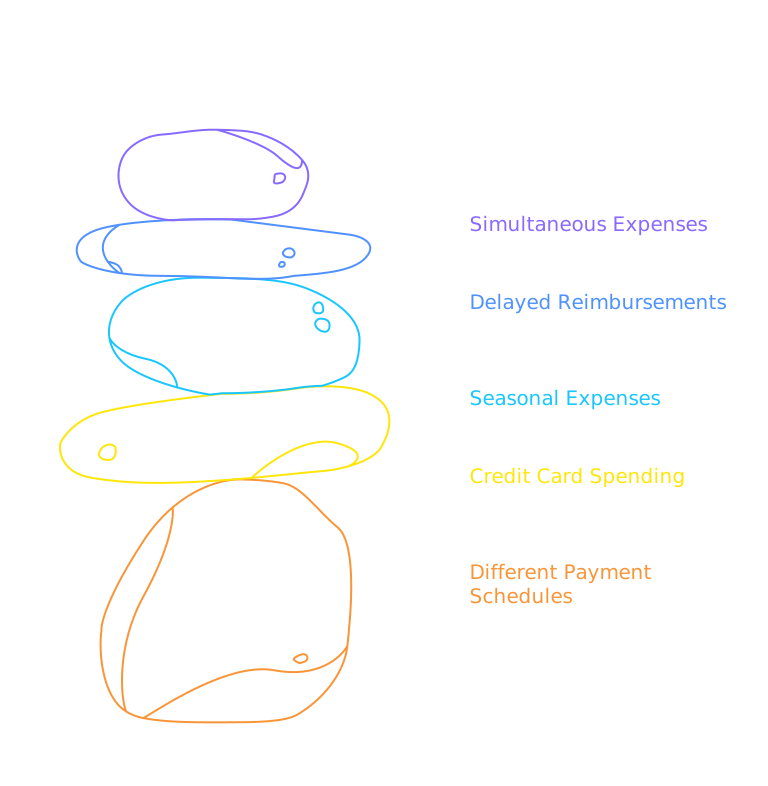
A childcare payment can clear on Monday, a card statement can close on Wednesday, a paycheck can arrive Friday, and a camp deposit can be due the following week. Looking only at the monthly total hides the order.
Why Can a Stable Family Income Still Produce an Unstable Checking Balance?
Annual income measures capacity. Checking measures sequence.
Those are different questions:
- Capacity: Does the household earn enough over a meaningful period to cover its spending?
- Sequence: Is enough cash available in the operating account when each payment settles?
- Classification: Is the displayed cash truly available, or is it already assigned to a card payment, camp, insurance premium, tax bill, or emergency reserve?
The Federal Reserve explains that yearly income can mask monthly variability and that timing mismatches between income and expenses can create financial challenges. In its latest survey, thirty percent of adults reported income that varied at least occasionally during the year, while eleven percent said variable income had made it difficult to pay bills.
Even households with regular salaries can experience cash-flow variation because net deposits change.
Common causes include:
- health-insurance or retirement deductions
- parental leave or unpaid time
- bonuses and commissions
- expense reimbursements
- stock compensation
- payroll corrections
- job changes
- dependent-care deductions
- a paycheck landing after a concentrated bill week
At the same time, spending can change faster than income. In the same Federal Reserve report, thirty-five percent of adults said monthly spending had increased from a year earlier, compared with thirty-two percent who said monthly income had increased.
The practical lesson is not that every family has variable income. It is that a family should plan from actual take-home deposits and settlement dates, not from annual salary or an average month.
The Family Cash-Flow Clocks
For diagnostic purposes, this article groups family cash flow into an editorial framework of seven clocks. Each clock can be predictable on its own while the combined checking balance remains difficult to read.
.svg)
The payroll clock
The payroll clock determines when money becomes available, not when it is earned.
Two adults can both receive regular salaries and still have:
- different pay frequencies
- deposits on the same day, creating a long gap later
- paydays that move around weekends and holidays
- different bonus or commission cycles
- changing net pay after benefit elections
A family paid heavily at the end of one month may appear cash-rich before housing, childcare, and card payments settle at the start of the next.
The childcare clock
The childcare clock can include more than tuition:
- registration fees
- deposits
- weekly or monthly tuition
- late pickup or activity charges
- backup care
- school-closure care
- summer camp
- nanny payroll and taxes
- before-school or after-school care
The cost can also change when a child moves rooms, starts school, changes schedules, or loses an informal care arrangement.
The credit-card clock
The credit-card clock separates purchase date from checking settlement.
When a family buys groceries, school supplies, travel, or medical services on a card, checking does not fall immediately. The checking balance therefore contains cash already committed to the issued or forming statement.
The school and activity clock
The school calendar creates concentrated spending at transitions:
- enrollment
- back-to-school purchases
- fall activities
- holiday programs
- spring sports
- summer camps
- graduation or end-of-year events
Many of these are foreseeable. They feel unexpected when the budget treats them as miscellaneous spending instead of scheduled obligations.
The reimbursement and benefit clock
Some family costs involve a delay between paying and receiving cash back.
Examples include:
- employer travel reimbursement
- dependent-care reimbursement
- health-plan reimbursement
- insurance claims
- tuition or education benefits
- shared expenses repaid by another family member
An approved claim is not the same as settled cash. Processing, documentation, correction, and bank-transfer timing can all delay the inflow.
The annual and seasonal clock
Annual and seasonal bills include costs that are real but absent from most monthly views:
- insurance premiums
- property taxes
- professional dues
- subscriptions and memberships
- holiday travel and gifts
- home maintenance
- vehicle registration and maintenance
- tax preparation
- tuition deposits
If the family has not assigned money to those costs in advance, the current balance overstates the amount available for a transfer or new purchase.
The repair and emergency clock
Unexpected expenses do not wait for a convenient payment week. The Federal Reserve found that fifty-nine percent of adults had at least one major unexpected expense in the prior year.
An emergency reserve exists for events that are difficult to predict in amount or timing. It should not be counted as the same money protecting routine checking operations.
Why Does Childcare Change the Whole Family Cash Map?
Childcare is not simply another line in the budget. It can affect the amount, timing, and reliability of both income and expenses.
The Federal Reserve's latest household survey found:
- one-fourth of parents with children under age thirteen used paid childcare in the week before the survey
- the median monthly childcare payment was $1,083 among families paying for both childcare and housing
- families using at least twenty hours of paid childcare per week reported a median monthly childcare payment of $1,517
- most families paying for both childcare and housing spent at least half as much on childcare as on housing
These are survey medians for the specified groups, not estimates for every family. The numbers show why childcare can shape the operating account as strongly as housing.
Childcare also interacts with income. A closure, sick day, schedule change, or lack of backup care can affect work hours or require an emergency expense. Among dual-earner couples in the same survey, forty-nine percent of working mothers identified themselves as the primary caretaker, compared with eight percent of working fathers.
That finding does not determine how any individual household should divide care. It shows that care work and cash-flow management may be concentrated on one person even when both adults work.
Childcare can create four different cash events
A household that budgets only the recurring tuition misses the other three events.
Ask instead: What will care require from both checking and take-home income over the next school, holiday, and summer transitions?
That question makes the cost visible before it reaches the account.
Why Predictable School Costs Still Surprise You
School costs are often calendar-predictable and amount-variable.
The family may know that back-to-school purchases, field trips, sports registration, camp enrollment, or tuition deposits will happen. It may not know the exact amount until the request arrives.
This creates a common planning error:
1. The household knows the category exists.
2. The cost is absent from the ordinary monthly budget.
3. The current checking balance appears available.
4. The request arrives.
5. The family labels the payment unexpected.
The category was expected. Only the amount or due date was uncertain.
Use a school-year obligation map
The table is a planning framework, not a claim that every school uses the same calendar.
The key distinction is between an irregular obligation and an emergency.
- An irregular obligation is expected in category but not monthly.
- An emergency is difficult to predict in both timing and amount.
Treating school and camp costs as emergencies causes the family to spend its emergency reserve on ordinary calendar transitions.
Why Does Credit-Card Autopay Create a False Family Surplus?
A credit card delays the cash effect of spending.
Suppose a family pays for groceries, activities, a flight, and a medical bill during the same statement cycle. The card balance rises immediately, but checking may not change until autopay settles weeks later.
During that delay, the bank balance can include:
- cash for the mortgage
- cash for childcare
- cash assigned to the next card statement
- cash for an annual bill
- an emergency reserve
- a deliberate comfort cushion
- truly unassigned cash
The display does not separate those jobs.
False surplus is cash that appears available in checking but is already committed to a known obligation.
The three card dates that matter
The due date matters, but settlement can occur on a different day because of weekends, holidays, or bank processing.
For the dedicated card-timing workflow, read Why Does My Checking Account Drop After Credit Card Autopay?.
Do not use a long-run card average after the statement closes
Before the statement closes, an estimate may be necessary.
After the statement closes, the family has a stronger number: the issued statement balance. Continuing to forecast from a long-run average can understate a travel month, medical month, or school transition.
The family should still account for new spending that will appear on the following statement. The issued balance solves the next payment; it does not eliminate the rolling card clock.
Why Do Reimbursements and Benefits Distort the Checking Balance?
Reimbursements create a cash-flow receivable. The household has paid an expense, but the expected cash has not arrived.
Common examples include:
- a work trip charged to a personal card
- a dependent-care expense awaiting claim approval
- a medical claim awaiting reimbursement
- an insurance payment after a repair
- a shared family expense awaiting repayment
The expense can reach the card payment before the reimbursement reaches checking.
Use a reimbursement register
The family should not count the same reimbursement twice: once as an expected deposit and again as a reduction in card spending.
Conservative operating rule: Treat reimbursement as unavailable until it posts, unless the household can absorb a delay without missing another obligation.
This rule may look cautious, but it prevents a claim-processing problem from becoming a checking problem.
Why Can a Monthly Budget Miss the Most Important Week?
A monthly budget compares totals. A cash-flow map orders events.
Both are useful, but they answer different questions.
Consider an illustrative month.
All amounts and dates below are illustrative.
The illustrative totals show positive monthly cash flow because the two paychecks exceed the listed debits. The account still reaches an illustrative low of $4,100 before the deposits.
If the family looked only at the opening balance or end-of-month balance, it could incorrectly move cash before the concentrated payment week.
The Consumer Financial Protection Bureau's bill-calendar method records each bill, amount, and due date, then calls for checking the calendar weekly. For family cash flow, extend that method by adding the payment account, expected settlement date, owner, and confidence level.
Why Do Parents Keep More Money in Checking Than They Can Explain?
An oversized checking balance is often a response to operational uncertainty.
Parents may not know the next exact low point, but they know:
- a large card payment can arrive
- school or camp requests can cluster
- childcare can change
- an annual bill can be forgotten
- a reimbursement can be delayed
- an emergency can occur during an ordinary bill week
The rational response is to leave extra cash where it is visible.
That safety behavior becomes expensive or inefficient only when the extra amount is larger than the household actually needs and remains unassigned across repeated cycles. The immediate goal should not be to push the checking balance as low as possible. It should be to replace vague protection with explicit protection.
A family checking floor has distinct layers
An emergency reserve is usually a separate purpose. A sinking fund for camp or insurance is another separate purpose. Those amounts can be held in the same institution, but they should not be counted as the same cash layer.
When every dollar is assigned once, the family can see whether the checking balance is:
- appropriately protective
- temporarily elevated
- structurally oversized
- too low for the next cycle
Is This a Timing Problem, an Affordability Problem, or a Classification Problem?
Before changing accounts or automating transfers, identify the dominant problem.
Timing problem
A timing problem exists when income is sufficient over the planning period, but deposits and debits arrive in an uncomfortable order.
Signals include:
- the household ends most months with positive cash flow
- checking reaches a low point before payday
- large card payments or childcare cluster early
- a reimbursement regularly arrives after the related card payment
- changing a due date or holding a larger operating floor would reduce stress
Affordability problem
An affordability problem exists when recurring spending and required obligations exceed sustainable recurring income.
Signals include:
- the household uses savings to fund ordinary bills repeatedly
- card balances rise across cycles
- the projected ending balance declines even after timing is corrected
- the family delays bills because there is not enough total cash, not merely because a deposit is late
- removing one unusual expense does not restore a recurring surplus
The latest Federal Reserve survey found that twenty-eight percent of adults either missed a non-credit-card bill or had difficulty paying bills in the prior month. Among adults who struggled, forty-two percent paid at least one bill late.
Those national figures do not diagnose a specific family. They show why cash-flow advice should not assume every low balance can be solved with better timing.
Classification problem
A classification problem exists when enough cash is present, but the household cannot distinguish assigned cash from unassigned cash.
Signals include:
- the current balance looks high before card autopay
- annual bills are remembered only when notices arrive
- emergency savings and operating cash are mentally combined
- reimbursements are counted before posting
- the same cash is described as a cushion, vacation fund, and emergency reserve
More than one problem can exist
Automation can execute a sound rule. It cannot make an unaffordable recurring pattern affordable.
How Do You Run a Family Cash-Flow Stress Test?
A family cash-flow stress test asks whether checking can survive the next sequence of deposits and debits without using money assigned to another purpose.
This is a planning process, not a financial assessment.
Start with the opening operating balance
Use the actual available balance in the account that pays most household obligations.
Then subtract:
- issued credit-card statements
- housing
- childcare
- utilities
- debt payments
- routine variable spending before the next deposit
- known school and activity costs
- annual bills due in the window
- transfers already committed
- checks or payments not yet reflected
Add only deposits with sufficient confidence.
Calculate the projected low point
Use this formula:
projected balance after each event = prior projected balance + expected deposits - expected debits
The lowest result in the sequence is the projected low point.
Then calculate a planning floor:
family checking floor = cash needed to avoid a negative projected low point + timing margin + chosen comfort amount
The formula contains no universal dollar amount. The timing margin and comfort amount depend on the household's actual settlement uncertainty and preferences.
Classify the ending cash
After the sequence, assign the remaining cash to:
- near-term operations
- known irregular obligations
- sinking funds
- emergency savings
- taxes
- deliberate goals
- unassigned remainder
Only the unassigned remainder can be evaluated as potential idle cash.
Repeat the test across different family calendars
One normal month is not enough. Run the test across:
- a normal school month
- a month with a major card statement
- a school-break or camp-payment month
- an annual-bill month
- a month with a delayed reimbursement
- a month with a lower-than-normal deposit
The purpose is to find the household's fragile sequence, not to prove that the average month works.
Worked stress test with a delayed reimbursement
All days, amounts, and planning assumptions in this worksheet are illustrative.
The example compares a baseline sequence with a delayed-reimbursement sequence. The household begins with an illustrative $22,000 and expects an illustrative $3,600 work-expense reimbursement. In the baseline, it arrives before card autopay. In the delayed sequence, it arrives after autopay.
The illustrative monthly totals are identical after the reimbursement posts. The sequence is not. The baseline low point is an illustrative $12,750, while the delayed sequence reaches an illustrative $9,150.
If the household selected an illustrative $11,000 operating floor based only on the baseline, it would break its own rule in the delayed sequence. The stress test reveals that reimbursement timing needs a separate margin or a rule that excludes the receivable until it posts.
Sensitivity check for the same illustrative household
All amounts and timing changes in this table are illustrative.
The table does not imply that a family should use an illustrative $11,000 floor. It demonstrates how a household can test its own floor against combinations that are plausible for its calendar.
What Do Family Cash-Flow Problems Look Like in Practice?
The following scenarios are illustrative. They are designed to show classification and timing, not recommend a specific balance.
Scenario A: Two Salaries, Weekly Childcare, and Concentrated Card Autopay
All amounts and dates in this scenario are illustrative.
Household setup
- opening checking balance: $24,000
- weekly childcare: $750
- housing payment: $4,800
- issued card statement: $7,200
- first net paycheck: $6,500
- second net paycheck: $5,500
- camp deposit due in the same cycle: $2,000
What the family sees
The illustrative $24,000 opening balance looks high relative to ordinary spending.
What the cash map shows
The illustrative $5,000 remainder is not automatically idle. The family still checks annual obligations, emergency savings, and whether that remainder persists after several representative cycles.
Diagnosis
The dominant issue is classification with a timing component. The opening balance is not a single pool of available money. Most of it already has a job.
Scenario B: Stable Salary, Work Travel, and Delayed Reimbursement
All amounts and dates in this scenario are illustrative.
Household setup
- regular opening checking balance: $14,000
- work travel charged to personal card: $4,500
- reimbursement submitted: $4,500
- reimbursement timing: uncertain
- card autopay: before the expected reimbursement window
- normal housing, care, and routine obligations: $9,000
What the family sees
The reimbursement is approved, so the household mentally offsets the card expense.
What the cash map shows
If the family counts the illustrative $4,500 reimbursement before it posts, it may believe that the full $14,000 is available for normal operations. In reality, the card payment and ordinary obligations create an illustrative $13,500 claim on checking.
Diagnosis
The dominant issue is timing. The household may be fully reimbursed later, but the operating account must survive the earlier settlement.
Better operating rule
Treat the reimbursement as a receivable. Add it to available cash only after it posts or after the family has protected the entire delay with separate cash.
Scenario C: Strong Annual Income and Recurring Seasonal Deficits
All amounts in this scenario are illustrative.
Household setup
- recurring monthly net income: $18,000
- recurring monthly obligations and ordinary spending: $16,500
- apparent recurring surplus: $1,500
- annual and seasonal obligations not in the monthly plan: $24,000
What the family sees
The household appears to have an illustrative $18,000 annual surplus because $1,500 remains in a typical month.
What the annual view shows
The illustrative $24,000 of annual and seasonal costs exceeds the illustrative $18,000 typical-month surplus. The family has an illustrative $6,000 annual shortfall before emergencies or new goals.
The household could make the mismatch visible with an illustrative annual funding map.
All months, amounts, and allocations in this table are illustrative.
The illustrative funding need is $2,000 per month, which exceeds the illustrative $1,500 typical-month remainder. The household is not merely experiencing poorly timed payments. It has an illustrative $500 monthly structural gap after annual obligations are normalized.
Diagnosis
The dominant issue is affordability hidden by classification. The annual costs are real recurring obligations even though they are not monthly.
Better operating rule
Convert expected annual and seasonal obligations into a funding schedule before labeling any typical-month remainder idle.
For the full false-surplus workflow, read Why Does Your Checking Account Look Full Until Annual Bills Arrive?.
What Should a Family Fix Before Trying to Earn More on Checking Cash?
Use this order:
1. Visibility: List every material deposit, bill, card payment, care cost, school cost, and reimbursement in one place.
2. Sequence: Order events by expected settlement date.
3. Ownership: Assign one person to monitor each payment or claim and one backup for critical items.
4. Classification: Give each dollar one job.
5. Floor: Protect the projected low point, timing margin, and chosen comfort amount.
6. Exceptions: Add school transitions, camps, travel, annual bills, and known care changes.
7. Recurrence: Confirm that the same unassigned remainder survives representative cycles.
8. Method: Only then choose manual transfers, scheduled transfers, or bill-aware automation.
The order matters.
Moving cash first and reconstructing obligations later turns every irregular payment into an urgent transfer. Holding all cash in checking avoids that operational risk but can leave a recurring idle layer unidentified.
The goal is not maximum movement. It is a maintainable boundary between cash that must stay ready and cash that has no near-term job.
Where Does Rivo Fit After the Family Finds Its Real Floor?
Rivo fits after the family has established that it has recurring idle cash, not while it is still trying to determine whether ordinary spending is affordable.
The narrower use case is:
1. Keep the household's existing bank and bill-pay setup.
2. Choose the primary checking account used for household operations.
3. Set the minimum balance the household wants protected.
4. Let Rivo analyze cash flow above that threshold.
5. Allow eligible idle cash to move into short-duration U.S. Treasury Bills through Jiko Securities.
6. Plan refills before expected bills while retaining the ability to pause or change the automation.
Rivo works with an existing checking account, lets the user configure a minimum threshold, and plans money movement around expected bills. Rivo AutoPilot currently supports earnings for one primary checking account, so a family with several operating accounts must first choose which account is the household hub.
Rivo does not decide the family's values, resolve an affordability gap, establish a sufficient emergency reserve, or determine whether a camp, tuition payment, tax bill, or home project should take priority. Those are household planning decisions.
Its role is operational: manage the recurring eligible cash above a user-defined floor without requiring the family to switch banks or remember each transfer.
For the complete implementation system, read How to Manage Cash Flow in a Dual-Income Household.
When Is Rivo Not the Right Next Step?
Rivo may not be the right next step when:
- recurring spending exceeds recurring income
- the household cannot yet identify its next major bills
- the apparent surplus is a one-time bonus, reimbursement, tax refund, or home-sale balance
- the cash is assigned to a near-term purchase or obligation
- the family needs the entire amount as same-day bank cash
- the household wants a bank deposit product rather than brokerage-held Treasury securities
- the household prefers to manage transfers or Treasury purchases manually
- the family has not chosen a primary checking hub
A manual bill calendar and purpose ledger can be the better first tool. A family should not pay for automation before it has a rule worth automating.
Final Recommendation
Family cash flow feels unpredictable because the household is not operating on one calendar.
Payroll, childcare, cards, school, reimbursements, annual bills, and emergencies all make claims on the same checking balance at different times. A monthly budget can show positive total cash flow while the account still reaches an uncomfortable low point. A high current balance can also be misleading when most of the cash is already assigned.
Use this sequence:
1. Map deposits and debits by expected settlement date.
2. Treat childcare and school transitions as calendar events, not miscellaneous surprises.
3. Reserve cash for issued card statements.
4. Count reimbursements only when the timing is dependable or after they post.
5. Separate known irregular costs from true emergencies.
6. Identify the projected checking low point.
7. Add a timing margin and deliberate comfort amount.
8. Assign sinking funds, emergency savings, taxes, and goals once.
9. Test whether an unassigned remainder survives several representative cycles.
10. Choose the simplest manual or automated system the family will maintain.
The right question is not: Why does our checking balance keep changing when our salaries are stable?
It is: Which family calendar is making a claim on this cash next, and how much remains after every known job is counted once?
That is how a family turns an unpredictable balance into an understandable operating system.
FAQ
Why is my family always short on cash before payday even though we earn enough?
The household may have a timing problem. Housing, childcare, card autopay, and school costs can settle before the next reliable deposit even when total monthly income exceeds total monthly spending. Build a chronological cash map and identify the lowest projected balance before assuming the budget is unaffordable.
How should parents budget for childcare that changes during the year?
Separate core care from transitions, coverage gaps, and seasonal care. Record regular tuition, deposits, registration, school closures, backup care, and camps by expected payment window. Then protect those assignments before treating the current checking balance as surplus.
Are school costs emergencies?
Usually not when the category is foreseeable. A tuition deposit, sports registration, camp, or back-to-school purchase is an irregular obligation if the family expects the category but not the exact amount. Fund it through a sinking schedule. Reserve emergency cash for costs that are difficult to predict in both timing and amount.
Should I count a reimbursement before it arrives?
Use a conservative rule. Treat the reimbursement as unavailable until it posts unless the household can cover the full delay without missing another obligation. An approved claim can still be delayed by processing, corrections, or bank settlement.
How much should a family keep in checking?
Protect the amount needed for bills before reliable deposits, issued card statements, routine spending, known exceptions, timing uncertainty, and the household's chosen comfort amount. The right floor comes from the projected low point, not a universal percentage of income. For the full formula, read How Much Money Should You Keep in Checking?.
Can Rivo solve unpredictable family cash flow?
Rivo can automate eligible cash above a user-set checking minimum and plan refills around expected bills, but it cannot make an unaffordable pattern affordable or decide which family goals should be funded. The household should first identify its operating floor and recurring unassigned cash.
Related Rivo Reading
- To build the complete household operating system, read How to Manage Cash Flow in a Dual-Income Household.
- To plan for a fifth childcare, grocery, or household-service cycle, read Why Does a Five-Week Month Make Your Checking Account Run Low?.
- To prepare for irregular obligations, read Why Does Your Checking Account Look Full Until Annual Bills Arrive?.
- To decide whether hard account separation would make family bills easier to fund and monitor, read Should You Use a Separate Checking Account for Bills?.
- To separate expected repayments, app balances, and settled bank cash, read Why Do Shared Expenses Make Your Checking Balance Hard to Predict?.

This article is for educational purposes only and is not individualized investment, tax, accounting, or legal advice. Income, expenses, childcare, account ownership, liquidity needs, emergency reserves, and risk tolerance differ. Consult qualified professionals about your circumstances.
Rivo is a fintech company, not a bank. Banking services provided by Jiko Bank, a division of Mid-Central National Bank. All U.S. Treasury investments and investment advisory services provided by Jiko Securities, Inc., a registered broker-dealer, member FINRA and SIPC.
Investments in T-bills: Not FDIC Insured. No Bank Guarantee. May Lose Value.
T-bills carry standard fixed-income risks. Selling before maturity can affect value and realized yield. SIPC protection does not protect against market-value changes.
All calculations labeled illustrative assume only the stated inputs. They exclude changing rates, taxes, money-movement timing, settlement delays, account-specific rules, and household-specific circumstances. They are not forecasts or promises of performance.
Sources
- Federal Reserve: Economic Well-Being of U.S. Households in 2025, Executive Summary
- Federal Reserve: Living Arrangements and Care Work
- Federal Reserve: Income and Expenses
- Federal Reserve: Economic Hardships
- Consumer Financial Protection Bureau: Bill Calendar
- Rivo homepage
- Rivo FAQs
- Jiko Securities U.S. Treasuries Risk Disclosures
- SIPC: What SIPC Protects

Shalu Yadav is Rivo's SEO/GEO Expert, bringing over 10 years of experience in making financial content discoverable across both classic search and generative AI platforms.
Follow on LinkedInGet Rivo Updates
Product news, money insights, and company updates.