Why Does Your Checking Account Look High Before Taxes Are Due? Quarterly Payments, Withholding Gaps, and False Idle Cash
Learn why tax reserves make checking look richer than it is, how to separate assigned tax cash, and when the remaining balance may be genuinely idle.
.png)
Your checking account can look unusually high before taxes are due because part of the displayed balance may already be assigned to estimated tax, an expected tax balance, or a withholding gap. That money is visible and liquid, but it is not automatically safe to spend, transfer, or classify as idle cash.
The practical fix is to separate four layers: ordinary bills, routine spending, a safe balance, and the tax reserve supported by your current tax estimate. Only the recurring amount above all four layers is a candidate for other cash-management decisions.
This distinction matters for self-employed workers, commission earners, households with multiple jobs, people receiving bonuses or restricted stock units, investors realizing gains, and anyone whose withholding may not match the final tax liability.
TL;DR
- Tax-reserve cash is assigned cash. It may sit in checking, but it is not idle merely because the bank displays it in the available balance.
- Federal income tax generally operates on a pay-as-you-go basis through withholding, estimated payments, or both, according to IRS Publication 505.
- Individuals generally enter the estimated-tax decision when they expect to owe at least $1,000 after subtracting withholding and refundable credits, subject to the rest of the IRS test and special rules.
- The tax year has four estimated-payment periods, but those periods are not four equal calendar quarters. A normal monthly budget can therefore hide a concentrated checking outflow.
- Income variability makes the problem harder. In the Federal Reserve's 2025 household survey, 30% of adults had income that varied at least occasionally, while the figure was 58% among self-employed adults.
- Do not choose a universal tax-reserve percentage from an article. Use your current return, year-to-date income, withholding, estimated payments, expected deductions and credits, and guidance from a qualified tax professional or the IRS Tax Withholding Estimator.
- Rivo becomes relevant only after known tax cash and the checking floor are protected. You keep your existing bank, choose the minimum checking threshold you want maintained, and eligible cash above that boundary can be managed around bills.
Tax Reserve Quick Reference
.svg)
The visible balance is only the starting number. The classification of each dollar determines whether the account is genuinely overfunded.
Why Does Tax Money Create a False Checking Surplus?
Tax money creates a false surplus when it is counted as available household cash before the related tax obligation is recognized.
The bank shows location, not purpose
A checking balance can contain several different economic jobs:
- cash needed for this week's bills
- cash reserved for an automatic credit-card payment
- cash set aside for estimated tax
- a reserve for an annual insurance bill
- money held for a near-term purchase
- a household comfort amount
- genuinely unassigned cash
The bank can show that the dollars are present. It cannot know every purpose you assigned outside the account.
That is why available balance, safe-to-spend cash, tax-reserve cash, and idle cash are not interchangeable.
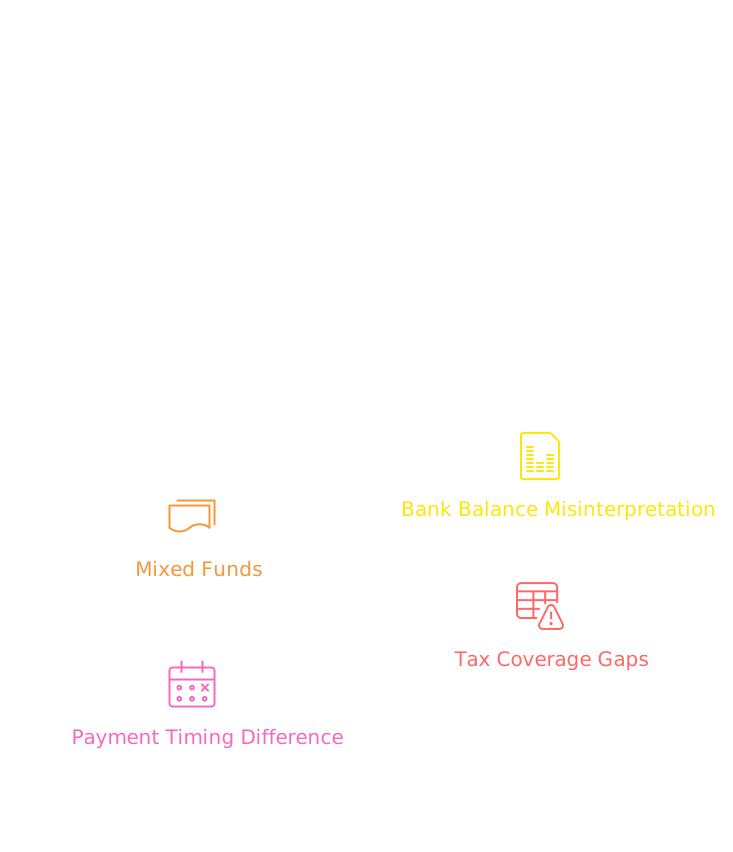
Gross cash is not spendable cash
A self-employed professional may receive an invoice payment into checking with little or no tax withheld. A commission earner may receive a large variable payment. A household may sell an asset and receive proceeds before calculating the related tax effect.
In each case, the deposit increases checking immediately. The tax obligation may appear later.
The problem is not that every event creates additional tax. The problem is that checking receives a cash signal before the household finishes the classification.
Tax payments arrive on a different clock
The IRS describes federal income tax as pay as you go. Employees commonly pay through withholding. People with income that is not fully covered by withholding may need estimated payments.
This creates two clocks:
1. the date cash reaches checking
2. the date tax is withheld, scheduled, or paid
When the clocks are separated, checking can look richer in between.
Cash Events That Commonly Create a Tax Reserve
A tax reserve is most useful when cash arrives before the final tax payment associated with the household's income picture.
Self-employment and contract income
Estimated tax can apply to income that is not subject to withholding, including self-employment income. IRS Publication 505 also lists interest, dividends, capital gains, rents, and royalties as examples of income that may create an estimated-tax requirement.
For a self-employed worker, the operating sequence may be:
1. customer pays invoice
2. cash reaches checking
3. business and household obligations are separated
4. estimated federal, state, and local tax needs are updated
5. the tax reserve is assigned
6. only the remainder enters the household cash-flow decision
Skipping the fourth and fifth steps makes checking look high for the wrong reason.
Bonuses and commissions
A payroll deposit can include withholding without guaranteeing that withholding will equal the household's final tax liability.
For certain separately identified supplemental wages, an employer may use the optional flat 22% federal withholding method. That is a withholding method, not a universal final tax rate. Filing status, total income, deductions, credits, other wages, and state or local rules can change the final result.
The checking lesson is simple: do not treat the full net bonus as idle until the household has reviewed the withholding and expected liability.
Restricted stock units and equity compensation
Restricted stock units can create a confusing sequence because vesting, payroll reporting, shares withheld or sold for taxes, later sale proceeds, and realized gains may occur at different times.
Use:
- the vest confirmation
- payroll statement
- brokerage activity
- cost-basis records
- year-to-date withholding
- tax-professional guidance
Do not infer the tax reserve from the checking deposit alone. A checking entry rarely contains enough information to explain the complete equity-compensation event.
Investment gains, interest, dividends, rent, and royalties
Cash from an asset sale is not the same as taxable gain. The IRS explains that basis is used to determine gain or loss, while a bank transfer from a brokerage may include original principal, gain, loss, dividends, or several transactions.
The calendar should record the cash event. The tax record should determine whether part of it creates a tax reserve.
Keep the cash-flow record and tax record connected, but do not ask either one to do the other's job.
Multiple jobs or a working spouse
Each employer withholds from the information available in its payroll process. A combined household can still have a gap when several income streams interact.
The IRS Tax Withholding Estimator asks for filing status, income, adjustments, deductions, credits, withholding, and estimated payments because the result depends on the combined picture.
For checking, the implication is that several normal-looking net paychecks can still coexist with assigned tax cash.
How Much of a High Checking Balance Is Assigned to Taxes
There is no universal percentage that safely converts a checking balance into a tax reserve.
The reserve should come from a current estimate, not a generic rule.
Use a source-backed tax estimate
Gather:
- prior-year federal and state returns
- year-to-date pay statements
- year-to-date withholding
- estimated payments already made
- self-employment income and expenses
- investment sale and cost-basis records
- bonus, commission, and equity-compensation records
- expected deductions and credits
- known life or income changes
- current guidance from a qualified tax professional
The IRS notes that people should reconsider withholding when life or financial circumstances change, when they prepare the prior return, or when tax law changes in Publication 505.
Convert the estimate into a checking assignment
Use this operating formula:
> Current tax reserve = expected tax payments through the planning horizon - payments already made - withholding specifically included in the estimate
Then separate that reserve from the idle-cash calculation:
> Candidate idle cash = current checking balance - near-term bills - routine spending allowance - safe balance - tax reserve - other assigned cash
Both formulas are cash-management tools. They do not calculate the tax liability itself.
Illustrative reserve calculation
The following example is hypothetical and is not tax advice.
The arithmetic is:
> $46,000 - $13,500 - $3,000 - $5,000 - $12,000 - $2,500 = $10,000
Without the tax reserve, the same account appears to have $22,000 available above bills, spending, the safe balance, and the annual expense. That overstates candidate idle cash by $12,000.
The example is not a recommended checking level. It shows why assigned tax cash must be subtracted before the idle layer is measured.
Why Quarterly Tax Payments Aren't Four Equal Quarters
The phrase "quarterly taxes" is convenient, but the federal estimated-tax calendar does not divide the year into four equal three-month periods.
The year has four payment periods
IRS Publication 505 divides the tax year into four estimated-payment periods, each with a specific due date. The general periods cover:
- income received before April
- income received during April and May
- income received during June, July, and August
- income received during the final four months of the year
Always check the current IRS form and applicable state or local instructions for the actual dates and rules.
Uneven periods distort a monthly budget
A monthly budget may spread tax evenly across twelve months. The payment calendar may pull cash on a different cadence.
The reserve can accumulate monthly even when the payment leaves on an irregular schedule. The calendar must preserve both facts.
Irregular income may need a different method
For people whose income does not arrive evenly, IRS Publication 505 describes an annualized income installment method. That method can change how required payments are calculated by period and may require additional filing steps.
This is a tax-calculation issue for a qualified professional or the applicable IRS worksheet. The checking-account job is to avoid assuming that every payment will equal the previous one.
Why Can Withholding Still Leave a Tax Gap?
Withholding is a prepayment toward tax. It is not a promise that the final return will show zero due.
Payroll sees a limited picture
A payroll system may not fully reflect:
- a spouse's income
- a second job
- self-employment income
- investment gains
- rental income
- a large bonus or commission
- changing deductions or credits
- estimated payments outside payroll
The household must reconcile the combined picture.
Supplemental wage withholding is not final liability
The optional 22% federal withholding method for certain supplemental wages is a useful example. A bonus can arrive with federal withholding and still require a broader household review.
Do not compare the withholding percentage with a headline tax bracket and stop there. Final tax depends on the full return.
A refund last year does not prove this year is covered
The prior return is evidence, not a standing instruction.
Review the estimate after a material event instead of waiting for filing season to explain the checking balance.
Why Tax Cash Is Easy to Mistake for Idle Cash
Tax cash looks like idle cash because it often has the same visible characteristics.
It may:
- sit untouched for weeks
- remain above the normal bill floor
- arrive in a large deposit
- earn little in checking
- lack a scheduled debit in the bank interface
- survive several payroll cycles
But purpose and timing change the classification.
Idle cash is defined by the absence of a better near-term job. Tax-reserve cash already has one.
Where Tax-Reserve Cash Should Sit
The article cannot choose an account for your tax reserve. The right location depends on payment timing, access needs, institution rules, protection type, yield, transfer speed, market risk, and the tax professional's plan.
Evaluate location separately from amount
Use two decisions:
1. How much is assigned to taxes?
2. Where should that assigned cash remain until payment?
Do not let an attractive destination change the amount required.
No row is automatically correct. The tax reserve should not depend on a last-minute transfer that the household has not tested.
Match liquidity to the payment date
Ask:
- Is the payment date known?
- Is the amount final or still estimated?
- How quickly can the money return to checking?
- Does a sale before maturity affect value?
- Is there a daily withdrawal or transfer limit?
- What happens on weekends or bank holidays?
- Can the payment be scheduled from the holding account?
- Does the household need the money for another tax jurisdiction?
Liquidity is a workflow, not a label.
How Tax Reserves Change Your Safe Balance
A safe balance is the minimum checking level you choose to protect for bills, routine spending, timing uncertainty, and comfort.
A tax reserve can interact with that floor in two ways.
Tax cash kept in checking raises the protected balance
If the tax reserve remains in primary checking, add it to the cash that must not be treated as idle.
> Tax-aware checking floor = operating safe balance + tax reserve held in checking + other assigned checking cash
This does not mean the reserve is part of the permanent household floor. It means the floor is temporarily higher while the tax obligation remains.
Tax cash held elsewhere still affects the forecast
If the reserve is outside checking, the bill calendar should still record:
- expected payment date
- payment account
- transfer date, if checking will fund the payment
- expected checking debit date
- confirmation status
- amount confidence
The CFPB bill-calendar method recommends recording what each bill is for, the amount owed, and the due date, then checking the calendar weekly. A tax payment needs at least that level of visibility, plus source-account and funding details.
A Tax-Aware Checking Forecast in Practice
A tax-aware forecast places the tax reserve and payment on dates instead of leaving them as a note.
The following example is hypothetical.
Before the tax payment, checking peaks at an illustrative $41,700. That peak does not prove the household has more than $40,000 of spendable or movable cash. The tax reserve already claims $11,000.
After the payment and other obligations, the account falls to $26,000. The decision should use the projected path, not the peak.
The CFPB cash-flow budget uses a similar operating principle: place income and expenses in the periods when they occur, then carry the ending balance into the next period.
How Can You Tell Whether the Remaining Cash Is Genuinely Idle?
After the tax reserve is protected, the remaining cash still needs to pass an idle-cash test.
Use the six-part test
Candidate idle cash should be:
1. unassigned to tax, bills, purchases, emergencies, or other goals
2. above the operating safe balance
3. visible after pending and expected checking debits
4. supported by dependable income assumptions
5. recurring across more than one normal cash-flow cycle
6. accessible on the timeline the household requires
Separate one-time and recurring surplus
One snapshot can identify cash location. Recurrence identifies whether the surplus is durable.
What Happens If You Move Tax Money Too Soon
Moving assigned tax cash before the payment workflow is proven can create several failures.
The tax payment becomes underfunded
If the reserve is spent or transferred without a return plan, checking may not contain enough cash when the payment is scheduled.
A last-minute sale changes the result
Cash invested in a security may need to be sold before maturity. Treasury Bills carry fixed-income risk, and selling before maturity can affect the realized result.
Transfer timing collides with other bills
A tax payment can share the same week with housing, card autopay, tuition, insurance, or payroll variation. A late return to checking can create an account-level problem even when the household owns enough assets elsewhere.
The household counts the same reserve twice
Double counting occurs when:
- the tax reserve remains inside checking
- a separate tax account also contains cash
- the budget subtracts a monthly tax allocation
- the forecast subtracts the full payment again
The reserve should appear once as a protected amount and once as a future payment event. The forecast must release the assignment when the payment posts.
How Does Rivo Fit After Tax Cash Is Protected?
Rivo fits the recurring idle layer above the household's protected checking needs. It does not determine your tax liability.
The operating sequence is:
1. obtain or update the tax estimate
2. assign the tax reserve
3. add the payment and funding dates to the calendar
4. protect normal bills and routine spending
5. set a conservative checking threshold
6. identify cash that remains unassigned across normal cycles
7. decide whether manual or automated cash management fits
Rivo works with an existing checking account, so direct deposit and bill pay do not need to move. You choose the minimum checking threshold you want protected, and Rivo monitors cash flow around that boundary.
Eligible idle cash is invested in short-duration U.S. Treasury Bills through Jiko Securities. Rivo charges 0.05% per month, calculated on the average daily Rivo balance.
What Rivo can automate
Rivo can support:
- monitoring connected checking cash flow
- identifying eligible cash above the configured threshold
- moving eligible idle cash
- planning refills around detected bills
- adapting when cash-flow patterns change
- pausing or changing automation through user controls
What the household still owns
The household must still communicate or protect:
- a new estimated tax payment
- a changed tax estimate
- a tax deadline not visible in normal transaction history
- a state or local payment
- a large one-time obligation
- cash that should never enter the idle layer
Unusual future payments should not be left to historical pattern recognition alone.
Liquidity and limits still matter
Available funds can be withdrawn through the app up to $15,000 per day. The daily limit is not a timing promise. Movement of funds is not instant and can take up to 3 business days to settle, so plan a tax payment around the settlement window rather than around the withdrawal limit. A tax payment or other obligation above that amount requires advance planning rather than a same-day assumption.
Use Rivo when the fee, product structure, liquidity, controls, and Treasury-bill risk fit the recurring idle layer. Keep the process manual when the reserve is temporary, the amount is uncertain, or immediate deposit-account access is the priority.
Who Is Most Exposed to Tax-Reserve False Surplus
The problem can affect any taxpayer, but several cash-flow patterns make it more visible.
Self-employed households
In the Federal Reserve's 2025 survey, 58% of self-employed adults reported month-to-month income variation, and 22% reported struggling to pay bills because income varied.
Variable receipts, business expenses, self-employment tax, and estimated payments make cash classification especially important.
High earners with bonuses or equity compensation
Large payroll or brokerage events can create a temporary balance peak. The cash may include taxes, planned purchases, diversification proceeds, or other assigned amounts.
Dual-income and multi-job households
Several ordinary payroll streams can create a combined withholding result that differs from what either paycheck suggests alone.
Investors and property owners
Asset sales, dividends, interest, rental income, and royalties can create income that is not fully covered by wage withholding.
Households with state or local obligations
Federal estimated-tax planning does not replace state and local planning. Each jurisdiction can have different forms, dates, calculations, and payment methods.
The Most Common Tax-Reserve Mistakes
Using a generic percentage forever
Fix: update the reserve from current income, withholding, payments, deductions, credits, and professional guidance.
Treating net payroll as proof
Fix: reconcile the full household estimate, especially after bonuses, commissions, job changes, or equity events.
Calling every large deposit idle
Fix: label tax, business, purchase, and other assigned layers before measuring surplus.
Keeping the reserve invisible
Fix: record the reserve amount, payment account, expected date, and confidence level.
Waiting until filing season
Fix: review after material income, withholding, job, equity, or life changes.
Moving tax cash without a return schedule
Fix: match account access, security maturity, settlement, transfer limits, and payment date.
Forgetting state and local taxes
Fix: maintain separate lines for each jurisdiction included in the household's actual plan.
Counting the reserve twice
Fix: reconcile the reserve when each payment posts and remove the completed assignment.
The Weekly Tax-Aware Cash Routine
The tax calculation does not need to happen every week. The cash record should still stay current.
Weekly checking review
- reconcile posted income
- update expected client, payroll, and transfer dates
- mark new bonus, commission, vest, sale, or rental events
- confirm upcoming bills and card autopay
- preserve the current tax reserve
- identify changes that require a refreshed estimate
- recalculate the projected checking low point
Event-triggered tax review
Refresh the tax estimate when a material event changes the plan:
- new job
- spouse job change
- raise
- large bonus or commission
- new self-employment income
- significant asset sale
- equity vest or exercise
- move to another state
- major deduction or credit change
- unexpected balance due or refund
Payment-period review
Before an estimated payment:
1. confirm the amount from the current tax plan
2. confirm the payment account
3. confirm the payment date and method
4. confirm sufficient settled cash
5. pause discretionary cash movement when timing is unclear
6. retain confirmation
7. reconcile the reserve after payment posts
The routine protects both sides of the decision: enough cash for taxes and a defensible definition of what remains idle.
Tax-Reserve and Checking Checklist
Build the tax layer
- Identify every income stream.
- Record year-to-date withholding.
- Record estimated payments already made.
- Gather bonus, commission, equity, investment, rental, and self-employment records.
- Obtain a current tax estimate.
- Separate federal, state, and local obligations.
- Mark the amount and confidence level.
Connect it to checking
- Add each payment to the bill calendar.
- Record the payment account.
- Record the expected debit date.
- Add any transfer or sale lead time.
- Increase the protected checking floor when tax cash remains in checking.
- Reconcile the reserve after payment.
Test for idle cash
- Subtract tax cash.
- Subtract upcoming bills.
- Subtract routine checking spending.
- Protect the safe balance.
- Subtract other assigned cash.
- Test the remainder across more than one normal cycle.
- Compare manual and automated options only after the remainder persists.
FAQ
Is money saved for taxes considered idle cash?
No. Money supported by a current tax estimate and assigned to an expected payment has a defined near-term job. It is tax-reserve cash, even if it sits untouched in checking.
It becomes unassigned only when the tax plan changes, the payment is completed, or a qualified review shows the reserve is no longer needed.
Should estimated tax stay in the same checking account as bills?
It can, but the best location depends on purpose separation, payment timing, transfer speed, institution rules, protection type, yield, and risk. If the reserve remains in checking, include it in the protected balance and do not treat it as safe to spend.
A separate account can improve visibility but adds another funding and reconciliation workflow.
Does payroll withholding mean I do not need a tax reserve?
Not necessarily. Withholding may cover the liability, but the result depends on the household's combined income, withholding, deductions, credits, estimated payments, and other tax facts.
Use the IRS Tax Withholding Estimator or a qualified tax professional when the picture changes.
Why did checking drop so much after an estimated tax payment?
The displayed balance included assigned tax cash before the payment posted. The drop may be operationally normal even though it feels sudden.
Use a dated forecast to compare the pre-payment peak with the post-payment low point. The lower number is more useful for deciding whether cash was genuinely idle.
Can a tax reserve earn yield before the payment?
Possibly, but yield is only one criterion. Evaluate access, settlement, maturity, market risk, custody, transfer limits, payment timing, fees, and applicable tax treatment before choosing a destination.
Do not expose a required payment to a workflow that has not been tested.
Can Rivo calculate how much tax I owe?
No. Rivo manages eligible cash around a user-configured checking threshold and detected bills. It does not replace tax software, IRS worksheets, or a qualified tax professional.
Set or communicate the tax obligation first. Then decide whether recurring cash above the tax reserve and safe balance fits automated cash management.
Final Takeaway: A High Checking Balance Is Not a Tax Plan
A checking balance can be high and still contain very little idle cash.
Before treating the balance as spendable or movable:
- identify the income event
- reconcile withholding
- update the tax estimate
- assign federal, state, and local reserves
- add payment dates to the calendar
- protect ordinary bills and routine spending
- calculate the post-payment low point
- preserve the safe balance
- test the remainder across normal cycles
The tax reserve is not idle because it waits. It is assigned cash waiting for a known job.
Once that job, the checking floor, and every other near-term obligation are protected, the recurring remainder becomes the real cash-management decision. That is the layer Rivo is designed to help manage without requiring a bank switch.
Related Rivo Reading
- To classify a large compensation or refund event before spending it, read What Should You Do When a Bonus, RSU, or Tax Refund Lands in Checking?.
- To build a larger floor around uncertain receipts, read How Much Should You Keep in Checking With Irregular Income?.
- To identify assigned cash that accumulates between infrequent payments, read Why Does Your Checking Account Look Full Until Annual Bills Arrive?.
- To keep tax cash separate from emergency and bill money, read Sinking Fund vs Emergency Fund vs Safe Balance.
- To place estimated payments on the same schedule as paydays and autopay, read How to Build a Bill Calendar for Your Checking Account.

This article is educational and is not financial, investment, tax, accounting, or legal advice.
Yield rate reflects the 4-week T-bill rate when held to maturity. Rate does not include fees. Rates are subject to change. Minimum balance of $100 is required to earn the stated rate.
Rivo is a fintech company, not a bank. Banking services provided by Jiko Bank, a division of Mid-Central National Bank. Jiko Group, Inc. and its affiliates do not provide legal, tax, or accounting advice. You should consult your legal and/or tax advisors before making any financial decisions. This material is not intended as a recommendation, offer or solicitation for the purchase or sale of any security or investment strategy. See FINRA BrokerCheck, Jiko U.S. Treasuries Risk Disclosures and Jiko Securities Inc. Form CRS.
Investments in T-bills: Not FDIC Insured - No Bank Guarantee - May Lose Value. All U.S. treasury investments and investment advisory services provided by Jiko Securities, Inc., a registered broker-dealer, member FINRA and SIPC. Securities in your account are protected up to $500,000. For details, please see www.sipc.org.

Shalu Yadav is Rivo's SEO/GEO Expert, bringing over 10 years of experience in making financial content discoverable across both classic search and generative AI platforms.
Follow on LinkedInGet Rivo Updates
Product news, money insights, and company updates.