Why Does a Five-Week Month Make Your Checking Account Run Low? Weekly Bills, Groceries, Childcare, and Cash Flow
Learn why a five-week month can make checking run low, which weekly expenses create the gap, and how to fund the fifth week without hiding idle cash.
.png)
A five-week month can make your checking account run low because some expenses repeat by weekday or service cycle, while your budget assumes one flat monthly amount. A fifth childcare payment, grocery trip, commute week, therapy session, cleaner visit, allowance, or recurring transfer can reach checking before the next month begins.
The calendar did not necessarily make you spend carelessly. It exposed a cadence mismatch.
A monthly budget can be accurate on average and still underfund the actual month. If you multiply a weekly expense by four, you plan for only part of the annual recurrence. If you use an annualized monthly average but spend the full amount every month, you can still run short unless the unused amount from shorter months rolls forward.
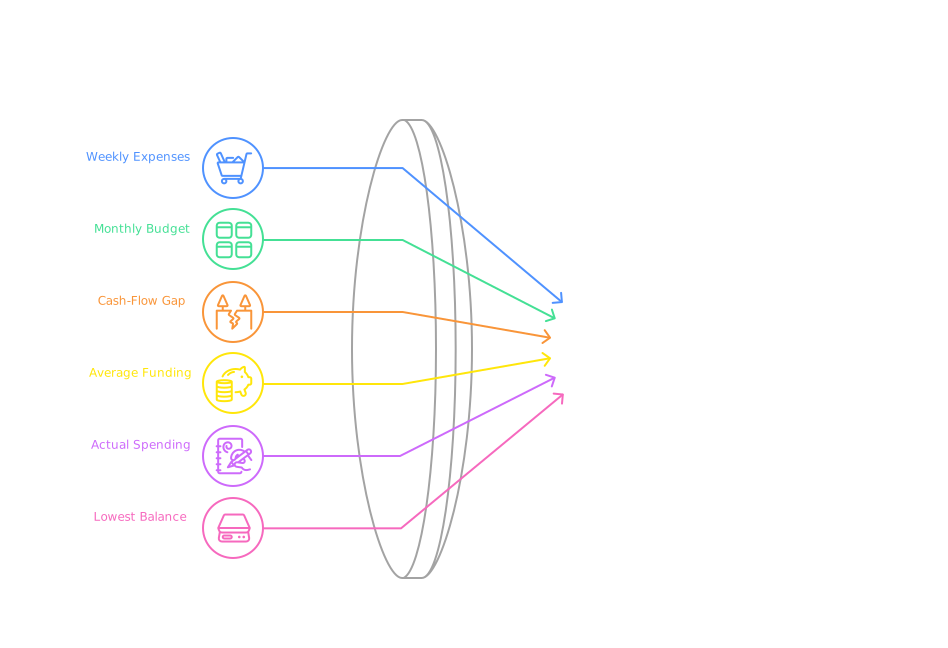
The practical answer is to count actual occurrences, map them to the checking account that must pay, and distinguish three numbers:
- The average monthly funding amount
- The actual cash required in the long month
- The lowest projected checking balance before the next dependable deposit.
Only after the fifth-week requirement, other bills, routine spending, and a conservative floor are protected should any recurring remainder be treated as idle cash.
TL;DR
- A five-week month is an operating label for a month in which a weekly obligation or spending event occurs a fifth time. It does not mean every expense increases.
- The CFPB cash-flow worksheet uses Week 1 through Week 5 because a monthly cash plan can cross parts of five weekly blocks.
- Weekly childcare, groceries, commuting, household services, therapy, allowances, and recurring transfers can create a fifth outflow. Fixed monthly rent or mortgage normally remains one monthly obligation.
- The IRS lists 52 weekly, 26 biweekly, 24 semimonthly, and 12 monthly payroll periods. Income cadence determines whether the long month brings another deposit, only another expense, or both.
- The annualized monthly formula for a weekly cost is weekly amount x 52 / 12. The cash needed in an actual five-occurrence month is weekly amount x 5.
- A long-month shortage is not automatically an affordability problem. It may be a timing, classification, rollover, or account-location problem.
- With Rivo, you set a minimum checking threshold and keep control of automation. The threshold should protect the fifth-week requirement before cash above it is evaluated as idle.
Quick Answer: Why a Five-Week Month Lowers Your Checking Balance
A five-week month lowers checking when the account pays one more weekly or weekday-based expense than the ordinary monthly plan funded.
Suppose childcare is paid every Monday. A month with four relevant Mondays creates four payments. A month with five creates five. If the budget always reserves four payments, the fifth is not a surprise in the calendar, but it is missing from the cash plan.
The same pattern can affect groceries, fuel, commuting, household help, lessons, therapy, pet care, allowances, and scheduled transfers.
The phrase “five-week month” is therefore shorthand. The useful question is not how many boxes appear on a wall calendar. It is how many times each income or expense event reaches the account.
.svg)
What Is a Five-Week Month in Household Cash Flow?
In household cash flow, a five-week month is a month in which a recurring weekly event has a fifth occurrence or the planning window spans parts of five weekly blocks.
It is an occurrence problem
A monthly label hides the recurrence rule.
These instructions produce different cash needs:
- pay once per calendar month;
- pay every Friday;
- pay every other Friday;
- pay after each service visit;
- pay on the first business day after each week ends; and
- transfer money after every paycheck.
Only the first instruction guarantees one event per month. The others follow a cadence that can cross the month boundary differently.
The CFPB worksheet makes the fifth week visible
The CFPB cash-flow budget starts with a weekly balance, adds income, subtracts expenses, and carries the ending balance into the next week. Its worksheet includes columns for Week 1 through Week 5.
That structure matters because checking does not reset when a monthly category reaches its planned total. Cash carries forward until the next deposit or debit changes it.
A long month is not the same as a third-paycheck month
A five-week expense month and a three-paycheck month can happen together, but they are not the same event.
The IRS payroll table distinguishes weekly, biweekly, semimonthly, and monthly frequencies. A weekly employee may receive another paycheck when a fifth payday occurs. A semimonthly employee still generally has the scheduled two pay periods for that month. A biweekly employee may have two or three paydays, depending on the actual calendar.
The dedicated guide explains the income side of the question: Is a Third Paycheck Really Extra Money?. This article owns the expense side.
Why Does a Four-Week Monthly Budget Fail?
A four-week monthly budget fails because the year contains more weekly recurrence than four events multiplied across twelve months.
The IRS table uses 52 annual weekly periods and 12 monthly periods. Dividing those figures gives an average of approximately 4.333 weekly periods per month.
That is arithmetic, not a recommendation:
52 weekly periods / 12 monthly periods = approximately 4.333
Multiplying by four underfunds the year
If a household budgets four weekly payments every month, it funds forty-eight occurrences across twelve months.
4 occurrences x 12 months = 48 funded occurrences
The gap between the 52-period annual weekly cadence and forty-eight funded occurrences must appear somewhere. It often appears as several “expensive months” that feel irregular even though the recurrence rule never changed.
An average is not the amount that leaves checking
Using weekly amount x 52 / 12 creates a stable monthly funding contribution. It does not change the actual debit.
If a weekly expense is illustrative $250:
Illustrative annual cost = $250 x 52 = $13,000
Illustrative monthly average = $13,000 / 12 = $1,083.33
Illustrative four-occurrence month = $250 x 4 = $1,000
Illustrative five-occurrence month = $250 x 5 = $1,250
The dates and amounts are illustrative only. The average works only if the unused illustrative $83.33 from a four-occurrence month remains assigned and rolls forward. If it is spent or called surplus, the long month is still short.
Month-end erases the wrong thing
The budget may close a category at month-end. The cash requirement does not disappear.
A weekly obligation that lands on the final day of one month and again early in the next can create a tight checking sequence even when both monthly budgets look positive. The CFPB describes cash-flow budgeting as tracking income and expenses week by week, with one week’s ending balance carried into the next.
Which Expenses Create Fifth-Week Pressure
The expenses most likely to create fifth-week pressure follow service, usage, or transfer cadence rather than a single monthly due date.
Committed weekly obligations
Committed weekly obligations have a defined amount or service schedule.
Examples include:
- childcare or after-school care billed by week;
- a caregiver or household worker paid weekly;
- therapy, tutoring, lessons, or coaching billed per session;
- cleaning, lawn, pool, or pet-care services billed per visit;
- weekly child or household allowances;
- weekly debt, savings, or family transfers; and
- a recurring contribution tied to payday.
The amount may be predictable. The monthly total still changes with the number of occurrences.
Routine weekly spending
Routine spending is less contractual but still follows daily life.
Examples include:
- groceries;
- fuel, transit, tolls, and parking;
- school lunches;
- laundry;
- work meals;
- prescriptions or supplies used on a regular cycle;
- family activities; and
- cash withdrawals for weekly spending.
These categories may not produce one identical transaction. The fifth weekly block can still add real spending days.
Variable automatic payments
Automatic debits may be fixed or variable. The CFPB explains that automatic payments can use the same amount or vary within an authorized range, including changing utility bills.
A variable monthly bill is not a weekly recurrence, but it can intensify the same long-month low point. Count it by its own authorization and statement, not by multiplying it by five.
Fixed monthly bills
Rent, mortgage, insurance, subscriptions, loan payments, and other fixed monthly obligations do not automatically increase because a month contains a fifth weekly occurrence.
This distinction prevents overfunding.
The table’s implication is simple: label each expense by cadence before you total it.
How Your Pay Schedule Changes the Five-Week Problem
The same fifth-week expense can be easy or difficult depending on when income reaches checking.
The IRS Publication 15-T table for 2026 lists 52 weekly, 26 biweekly, 24 semimonthly, and 12 monthly pay periods. Those annual frequencies create different month-level cash patterns. .
Weekly pay can bring another deposit and another expense cycle
If a household receives a weekly paycheck, a fifth payday may arrive in the same month as the fifth expense occurrence.
That does not guarantee the added deposit is free. It may fund:
- the added weekly costs;
- early-next-month bills;
- annual obligations;
- card autopay; or
- a longer gap before a later deposit.
Use the net deposit date and amount, not the label “extra paycheck.”
Biweekly pay may or may not offset the fifth week
Biweekly income follows a different cadence from weekly expenses. Some long months will contain two paydays, while some contain three.
The mismatch is explained in Why Do Biweekly Paychecks Make Monthly Bills Hard to Time?. For the five-week test, count the actual paydays before assuming income offsets the added cost.
Semimonthly or monthly income may not increase
A household paid semimonthly or monthly can face a fifth childcare, grocery, or service cycle without an additional payroll deposit in that month.
That makes the rollover reserve or opening checking balance more important.
Mixed-income households need one combined map
One partner may be paid biweekly while another is paid semimonthly. A side business, reimbursement, or benefit may use another cadence.
Do not solve the problem by looking at one person’s paycheck count. Map every dependable deposit and every obligation in chronological order.
Converting a Weekly Expense Into a Monthly Budget
Use annualized funding for the budget and actual occurrences for the cash-flow calendar.
Those are two different calculations.
Formula 1: Average monthly funding
The IRS annual frequency table supplies the 52 weekly and 12 monthly periods:
Average monthly funding = weekly amount x 52 / 12
This smooths the annual cost into a consistent monthly contribution.
Formula 2: Actual long-month cash need
Actual long-month cash need = weekly amount x actual occurrences
If the expense occurs five times, multiply by five. If a holiday, closure, skipped service, or prepaid week changes the invoice, use the confirmed amount instead.
Formula 3: Rollover requirement
Rollover requirement =
actual long-month cash need
- average monthly contribution
- any amount already assigned
A positive result is the amount the category or checking floor must carry from prior months.
Illustrative conversion table
All amounts below are illustrative.
The annualized contribution is not supposed to equal every month’s spending. It creates surplus in shorter months that funds the higher cash need in longer months.
Why Dividing the Monthly Amount by Four Also Fails
Dividing a monthly budget by four can create the opposite error.
Suppose a household sets an illustrative monthly grocery budget of $1,000 and interprets it as $250 per week. In a five-occurrence month, spending $250 each week requires an illustrative $1,250.
One of two things must be true:
1. the real weekly target is lower than $250; or
2. the monthly target must be higher or funded with rollover.
Use the direction that matches the commitment
If the contract is weekly, start from the weekly amount and annualize it.
If the decision is a firm monthly cap, divide the monthly amount across the actual number of spending periods in that month.
All symbols and dollar amounts in this table are illustrative. The error is not choosing weekly or monthly planning. The error is mixing the two without reconciling them.
Worked Example: A Five-Week Month That Pushes Checking Below the Floor
The dates and dollar amounts in this section are illustrative only. They do not describe a Rivo customer, expected performance, or a universal household.
Assume an illustrative household starts the planning window with $9,400 in checking and expects:
- two illustrative semimonthly paychecks of $4,100 each;
- an illustrative $2,900 mortgage;
- an illustrative $2,200 credit-card statement;
- illustrative weekly childcare of $500;
- illustrative weekly groceries and transport of $350;
- illustrative utilities and other monthly bills of $900; and
- an illustrative protected checking floor of $2,500.
The four-week budget view
The household already needs opening cash to carry the month. The plan still understates the actual long-month outflow by one childcare payment and one weekly spending block.
The actual five-week view
The illustrative checking balance remains above the illustrative $2,500 floor. The month is affordable in this scenario, but the four-week plan overstated the ending balance by $850.
What the example proves
The fifth week did not create a mysterious expense. It revealed two omitted recurrences:
Illustrative omitted amount =
$500 fifth childcare payment
+ $350 fifth weekly spending block
= $850
If the opening balance had been illustrative $4,000 instead of $9,400, the same omission would have mattered much more. Affordability, timing, and opening liquidity are separate questions.
Calculating the Fifth-Week Checking Requirement
Calculate the fifth-week requirement from the events that actually reach the paying account.
Fifth-week checking requirement =
weekly committed obligations
+ weekly routine spending
+ biweekly events that occur again
+ variable bills in the same window
+ scheduled transfers
- dependable income that settles before the low point
- already assigned rollover cash
Count only the incremental requirement
Do not add the entire month twice.
If four weekly occurrences are already included in the base budget, the fifth-week increment is the added occurrence plus any other events that land in the same window.
Use the paying account, not household net worth
A family can have enough cash overall and still leave the bill-paying checking account short.
Cash in another checking account, savings account, payment app, or brokerage does not fund the debit until the transfer reaches the relevant account. This account-location issue is especially important in dual-income households.
Use dependable income only
Do not subtract a reimbursement, commission, transfer request, or expected side-income payment unless its arrival is dependable for the decision.
The guide to why shared expenses make checking hard to predict explains why expected repayments and settled bank cash need separate treatment.
Is the Problem Timing, Spending, Classification, or Affordability?
A long-month shortage needs a diagnosis before it needs a product.
Timing is not the same as overspending
If checking recovers after a dependable paycheck and the full cycle remains positive, the immediate problem may be timing.
An omitted recurrence is a budget-design error
The household may have spent exactly as intended. The plan simply funded the wrong number of occurrences.
Affordability remains after settlement
If every income source arrives, every transfer settles, and the cycle remains negative, a larger calendar cushion will delay the problem rather than solve it.
Why Can the Monthly Budget Look Fine While Checking Runs Low?
A monthly budget totals income and expenses. Checking experiences the sequence.
The CFPB describes a budget as a plan for using income. Its cash-flow approach adds the timing layer by tracking week-by-week balances.
Both views are useful, but they answer different questions.
The broad reconciliation guide explains why a budget can show money while checking is low. For a five-week month, the distinctive question is whether the expense count itself changed.
Building a Five-Week Cash-Flow Calendar
Build the calendar from recurrence rules, then place actual dates.
The CFPB bill-calendar process recommends recording what each bill is for, the amount owed, and the due date, then checking the calendar weekly.
Step 1: Mark dependable income
Record:
- expected availability date;
- net amount;
- paying institution;
- account receiving the deposit; and
- confidence level.
Do not use the date income is earned if checking cannot use it then.
Step 2: Mark fixed monthly bills
Add rent, mortgage, loan payments, insurance, subscriptions, and issued card statements once, using expected debit dates.
Step 3: Expand weekly and biweekly events
For each event, record:
- recurrence rule;
- actual dates;
- expected amount or range;
- paying account; and
- whether the event is committed or adjustable.
Step 4: Add routine weekly spending
Use recent history to estimate groceries, transport, meals, cash withdrawals, and other routine spending. A range is more honest than false precision.
Step 5: Carry the balance across month-end
Do not reset the running balance on the first day of the next month. Continue until the account passes the fifth-week outflows, early-next-month bills, and the next dependable recovery deposit.
Step 6: Find the actual low point
The lowest projected balance, not the average or ending balance, determines the immediate checking requirement.
The complete implementation guide is How to Build a Bill Calendar for Your Checking Account.
How a Five-Week Month Changes Your Checking Floor
Raise the checking floor when the long-month increment could arrive before dependable income or rollover cash.
Method 1: Permanent long-month margin
Add the largest representative fifth-week requirement to the ordinary checking floor.
This is simple but can leave more cash in checking during ordinary months.
Method 2: Scheduled reserve
Build a separate assigned reserve through shorter months, then move or relabel it before the long month.
This improves classification but adds a transfer or ledger dependency.
Method 3: Dynamic forecast
Recalculate the projected low point from actual dates and amounts.
This can use less permanent cushion, but it requires reliable data and review.
The right floor is the amount that protects the paying account through a representative weak sequence. It is not the largest balance the household has ever seen.
What to Avoid Double Counting
Long-month planning can become too conservative if the same obligation appears twice.
Do not count credit-card purchases and autopay against checking
If a purchase sits on a credit card, the checking outflow usually occurs when the card payment clears. Reserve the issued statement and track open-cycle purchases separately.
Do not subtract a pending debit twice
If the bank’s available balance already reflects a pending authorization, keep the transaction on the calendar for reconciliation but subtract only the unreflected difference.
Do not count a transfer as household spending
Moving cash from one household account to another changes location, not total household resources. Count the final expense once.
Do not count rollover as new income
Cash carried from a shorter month to fund the fifth week is assigned reserve cash, not new earnings.
Do not multiply monthly bills by five
A fifth weekly block does not create five mortgage payments or five monthly subscriptions. Apply each item’s actual recurrence rule.
Where Rivo Fits Once the Fifth Week Is Funded
Rivo fits after the household protects the actual fifth-week requirement and identifies a recurring cash layer that remains above the checking floor.
With Rivo, you connect an existing checking account, set a minimum threshold, and keep control over automation. Rivo is designed to analyze checking patterns, plan around bills and transfers, move eligible idle cash into short-duration U.S. Treasury Bills through Jiko Securities, and return funds before expected obligations.
The threshold should include the long-month exception
If weekly childcare, services, or routine spending create a representative fifth-week requirement, include that amount in the threshold or scheduled reserve before deciding what can move.
Rivo does not create the budget
Rivo is not a budgeting app. It does not decide whether the household intended four or five grocery trips, whether a cleaner will skip a holiday week, or whether childcare charges by attendance or enrollment.
The human responsibility remains:
- identify the recurrence rule;
- confirm unusual service dates;
- classify weekly versus monthly obligations;
- protect manual payments and exceptions;
- keep expected income conservative; and
- update the threshold when the household pattern changes.
One primary checking account should represent the operating hub
Rivo AutoPilot currently supports earnings for one primary checking account, even when multiple accounts can be connected.
The selected primary account should be the one whose balance and bills represent the workflow being managed. If another account pays childcare or weekly services, that obligation must remain protected outside the Rivo-managed calculation unless the cash path is deliberately coordinated.
Product fit starts after the diagnosis
When to Keep More Cash in Checking
Keep more cash in checking when the fifth-week sequence could create a real payment gap.
That includes situations where:
- weekly childcare or household services are material;
- the fifth occurrence lands before the next dependable paycheck;
- a large card statement clears during the same week;
- routine spending is unusually variable;
- the household uses more than one paying account;
- a transfer must cross institutions;
- a holiday changes service or payroll timing;
- expected income is irregular;
- the long-month reserve has not been built; or
- one missed estimate would push checking below the protected floor.
The CFPB recommends knowing the amount and date of regular electronic transfers so the account has enough money when they occur.
Do not optimize the last dollar of a temporary calendar exception. The goal is a reliable checking sequence first.
A 15-Minute Five-Week Checking Audit
Use this audit when checking runs lower than expected near the end of certain months.
Minutes 1 through 3: List weekly commitments
Record every expense whose recurrence is:
- weekly;
- every other week;
- per service;
- per session;
- per payday; or
- tied to a weekday.
Minutes 4 through 6: Count actual occurrences
Use the current and next month together. Mark the expected bank debit or purchase date, not only the service date.
Minutes 7 through 9: Reconcile the monthly budget
For each weekly item, compare:
amount funded
versus
amount required by actual occurrences
Identify whether unused funding from prior months remained assigned.
Minutes 10 through 12: Project the paying account
Start from the current available balance. Add dependable income. Subtract:
- the fifth-week increment;
- issued card statements;
- monthly bills;
- routine spending;
- transfers;
- assigned cash; and
- the protected floor.
Minutes 13 through 15: Classify the result
Use one of four outcomes:
1. Cadence gap: the monthly plan funded the wrong number of occurrences.
2. Timing gap: total resources are sufficient, but cash arrives after the low point.
3. Affordability gap: the cycle remains negative after dependable income settles.
4. Recurring surplus: checking remains above the protected floor after ordinary and long-month cycles.
Only the fourth result creates a strong case for evaluating idle-cash automation.
Final Recommendation
Treat a five-week month as a recurrence test, not a spending mystery.
Start by labeling every expense as weekly, biweekly, monthly, variable monthly, quarterly, annual, or event-driven. Count actual dates. Use weekly amount x 52 / 12 for average monthly funding and weekly amount x actual occurrences for the cash needed in the real month.
Let unused funding roll forward. Do not call it surplus merely because a shorter month used less. Carry the checking forecast across month-end and measure the lowest balance after the fifth-week events, early-next-month bills, and dependable deposits.
Then diagnose the result:
- If the plan funded four events but five occurred, fix the cadence.
- If money arrives after the low point, fix timing or protect more opening cash.
- If cash exists in the wrong account, fix routing.
- If the household remains short after settlement, address affordability.
- If checking remains above a conservative floor through both ordinary and long months, evaluate the recurring remainder as potential idle cash.
Rivo becomes relevant at that last step. The product is designed to manage eligible idle cash above a user-set threshold, not to make an unfunded fifth week disappear.
FAQ
Does every month have four weeks?
No monthly cash plan should assume only four weekly occurrences. The IRS annual payroll table lists 52 weekly periods and 12 monthly periods, which averages approximately 4.333 weekly periods per month. Count the actual dates for each obligation.
How many months have five weekly payments?
There is no universal answer for every expense because it depends on the weekday, service rule, billing calendar, holidays, skipped sessions, and the dates used by the provider. Review the actual contract and calendar instead of relying on a generic list.
Should I multiply every expense by five in a five-week month?
No. Apply the actual recurrence rule. Weekly and per-service expenses may occur again. A fixed monthly mortgage, rent payment, or subscription normally remains one monthly obligation.
What if I get an extra paycheck in the same month?
Include the paycheck only after confirming its date and net amount. Then protect fifth-week expenses, next-month bills, card autopay, annual obligations, and other assigned cash before calling any remainder extra. Read Is a Third Paycheck Really Extra Money? for the full classification process.
Should the fifth-week reserve stay in checking?
Keep it in checking when the payment is near, the transfer path is uncertain, or a delay would threaten the floor. A separate assigned reserve can work when the transfer timing is dependable and the household will not double count the cash.
Can Rivo handle a five-week month?
Rivo is designed to plan around detected bills and transfers while protecting a user-set checking threshold. You still need to identify unusual weekly obligations, routine spending, and service exceptions. Raise or preserve the threshold when the fifth-week requirement is not yet reflected in the normal pattern.
Related Rivo Reading
- To classify the income side of a long month, read Is a Third Paycheck Really Extra Money?.
- To map biweekly paydays against fixed monthly bills, read Why Do Biweekly Paychecks Make Monthly Bills Hard to Time?.
- To reconcile monthly totals with the bank ledger, read Why Does My Budget Say I Have Money but My Checking Account Is Low?.
- To turn the recurrence map into dated reminders, read How to Build a Bill Calendar for Your Checking Account.
- To diagnose childcare, school costs, and household timing more broadly, read Why Is Family Cash Flow So Hard to Predict?.

This article is educational and is not financial, investment, tax, accounting, or legal advice.
Yield rate reflects the 4-week T-bill rate when held to maturity. Rate does not include fees. Rates are subject to change. Minimum balance of $100 is required to earn the stated rate.
Rivo is a fintech company, not a bank. Banking services provided by Jiko Bank, a division of Mid-Central National Bank. Jiko Group, Inc. and its affiliates do not provide legal, tax, or accounting advice. You should consult your legal and/or tax advisors before making any financial decisions. This material is not intended as a recommendation, offer or solicitation for the purchase or sale of any security or investment strategy. See FINRA BrokerCheck, Jiko U.S. Treasuries Risk Disclosures and Jiko Securities Inc. Form CRS.
Investments in T-bills: Not FDIC Insured - No Bank Guarantee - May Lose Value. All U.S. treasury investments and investment advisory services provided by Jiko Securities, Inc., a registered broker-dealer, member FINRA and SIPC. Securities in your account are protected up to $500,000. For details, please see www.sipc.org.
Sources
- Consumer Financial Protection Bureau: Creating a Cash Flow Budget
- Consumer Financial Protection Bureau: Cash Flow Budget for Servicemembers and Veterans
- Consumer Financial Protection Bureau: Bill Calendar
- Consumer Financial Protection Bureau: Budgeting and Timing
- Consumer Financial Protection Bureau: Automatic Payments From a Bank Account
- Consumer Financial Protection Bureau: Avoiding Debit Card Overdrafts
- Internal Revenue Service: Publication 15-T (2026)
- Rivo Homepage
- Rivo Product Details

Shalu Yadav is Rivo's SEO/GEO Expert, bringing over 10 years of experience in making financial content discoverable across both classic search and generative AI platforms.
Follow on LinkedInGet Rivo Updates
Product news, money insights, and company updates.