Why Do Shared Expenses Make Your Checking Balance Hard to Predict? Venmo, Zelle, Reimbursements, and Cash Flow
.png)
Shared expenses make your checking balance hard to predict because the purchase, the repayment request, the person-to-person payment, and the bank settlement can happen on different dates and in different accounts. One person may pay the full bill on a credit card today, receive part of the reimbursement in a payment-app balance tomorrow, and pay the card from checking weeks later.
The household may be even over time, but checking still has to survive the sequence. Money another person owes you is not settled cash. Money received inside a payment app is not necessarily in checking. A transfer between two household members is not new household income. These distinctions determine whether the bank balance is truly available, temporarily low, or falsely high.
Treat every shared expense as a small cash-flow record: who paid, what amount belongs to each person, where repayment will arrive, when it actually settles, and which checking account must fund the original charge. Then protect the checking floor before treating any recurring remainder as idle cash.
TL;DR
- Shared expenses create at least 4 events: the original purchase, the repayment request, the person-to-person payment, and settlement in the account that will fund the bill.
- A reimbursement is a receivable until it arrives. Do not use an expected Venmo or Zelle payment to fund rent, card autopay, or another bill.
- Zelle typically sends money directly to the enrolled recipient's bank account, while money received through Venmo can remain in the Venmo balance until it is transferred or spent. The same repayment can therefore appear on different ledgers.
- A shared purchase can be economically split but operationally concentrated. If one person pays the whole credit-card charge, that person's checking account must be ready for the whole statement debit.
- Incoming reimbursements are not automatically income, and outgoing reimbursements are not automatically new spending. Classify the original expense and the repayment together to avoid double counting.
- Use the actual settled date, not the date someone says "paid," when forecasting checking cash flow. Keep app balances, expected repayments, pending transfers, and posted bank cash in separate columns.
- Rivo becomes relevant only after shared-expense obligations, card payments, other bills, and a user-set checking floor are protected. It is designed to manage recurring idle cash above that floor, not to make unsettled reimbursements available early.
Quick Answer: Why Do Shared Expenses Distort Your Checking Balance?
Shared expenses distort checking because one economic expense can create several cash movements across several ledgers.
Suppose one person pays a group dinner, a utility bill, childcare, travel, or a household purchase. The other participants may owe fixed shares, but the original payer still carries the full cash obligation until every reimbursement settles. If the purchase was made by credit card, the checking impact is delayed again until the card payment clears.
The problem is not that shared expenses are inherently unaffordable. The problem is that an economic split does not automatically create a synchronized cash split.
The practical question is:
After every shared expense is mapped to the person, payment rail, source account, settlement date, and final bill, what cash is actually available in the checking account that must pay the next obligation?
That is the number to use. A request, promise, app notification, or household total is not a substitute.
How Do Venmo and Zelle Affect Checking Differently?
Venmo and Zelle can both move money between people, but the cash does not always land in the same place.
The CFPB defines person-to-person payments as transfers that let a consumer send money without a check, physical card swipe, or cash exchange. Depending on the provider, the payment can begin in a bank portal, prepaid account, or mobile app.
.svg)
Zelle usually credits the enrolled bank account
For enrolled recipients, Zelle states that money is typically available in the linked bank account within minutes, subject to the participating financial institution and eligibility requirements.
That architecture can make the repayment visible in checking quickly. It still does not make a payment request equal to settled cash, and a sender who has not completed the payment has not funded the recipient's account.
Venmo can hold the repayment in an app balance
Venmo states that money received from another person or merchant remains in the Venmo account until the recipient transfers or spends it.
A recipient can therefore see that a roommate paid without seeing the same cash in checking. If the recipient's credit-card autopay will pull from checking, the app balance does not cover that debit until the money reaches the relevant bank account or the recipient uses another funding method.
A standard Venmo bank transfer adds another timing step
Venmo states that its standard bank transfers use the Automated Clearing House and typically complete within 1 business day but can take up to 3 business days. Weekends and U.S. bank holidays are outside that timeframe.
This does not mean every transfer takes the maximum time. It means the recipient should use the estimated arrival date and actual bank posting, not the app receipt date, when a bill depends on the cash.
The takeaway is not that one service is universally better. It is that the household cash map must reflect the payment path actually used.
What Are the Dates Behind One Shared Expense?
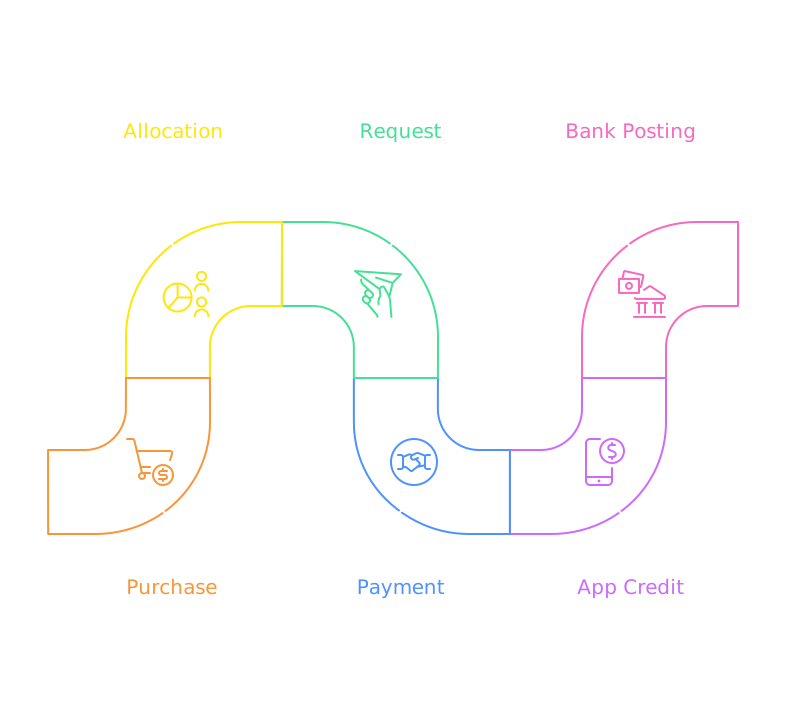
One shared expense can involve more dates than the household remembers.
Purchase date
This is when one person pays the merchant, landlord, utility provider, childcare provider, travel company, or another biller. A debit-card purchase may begin as an authorization. A credit-card purchase may post later and reach checking only through card payment.
Allocation date
This is when the group decides who owes what. The allocation can be immediate, based on a receipt, or delayed until a trip, meal, or billing period ends.
An allocation is accounting information. It does not move cash.
Request date
This is when the payer sends a Venmo request, Zelle request, message, spreadsheet entry, or household reminder. A request can improve visibility, but it is still a receivable.
Payment initiation date
This is when the other person authorizes repayment. Depending on the payment method, the money may move directly between bank accounts, appear in an app balance, or enter a transfer process.
App credit date
For a stored-value payment app, the recipient may see a completed payment inside the app. That can be economically meaningful while remaining operationally separate from checking.
Bank settlement or posting date
This is when the relevant checking account reflects the credit or debit. For cash-flow planning, this is the strongest date for deciding whether the money can fund a bank obligation.
Final bill date
If the original payer used a credit card, the purchase reaches checking when the card payment clears. The guide to why checking drops after credit-card autopay explains that delayed card-to-checking path in detail.
Shared-expense cash flow becomes predictable only when the household tracks the dates that change bank availability, not merely the dates that confirm social agreement.
Why Is an Expected Reimbursement Not the Same as Income?
An expected reimbursement is a receivable: money another person is expected to repay for an expense already incurred on their behalf.
It is not salary, recurring household income, or settled cash. It may make the original expense smaller after everyone pays, but it cannot cover another bill before it arrives.
The economic result and the cash result can disagree temporarily
Consider an illustrative shared trip. All amounts and dates below are assumptions for explaining the sequence, not reported user data or a product projection.
Economically, the payer expects a final cost of an illustrative $1,200. Operationally, the payer's checking account may need to cover the entire illustrative $3,600 if reimbursements have not reached checking before autopay.
Incoming repayment is not a recurring surplus
An incoming reimbursement may make checking rise. That does not mean income increased.
If the original expense was already funded, the repayment restores cash. If the card payment is still pending, the repayment is assigned to that payment. If the payer had to borrow or transfer from savings, the reimbursement may repair that earlier gap.
Only the amount left after the original expense, later bills, and the checking floor are reconciled can be evaluated as unassigned cash.
Household transfers do not create household income
When one spouse or partner sends money to another, one account rises and another falls. The household's total cash is unchanged, excluding any fee.
Treating the receiving account's credit as income and ignoring the sending account's debit overstates household cash flow. Treating both the original purchase and the reimbursement as unrelated expenses can understate it.
The rule is:
Household income excludes transfers between household-owned accounts
Net personal share of a shared expense =
amount personally funded
- repayments actually received for other people's shares
Use those formulas for analysis, but use the actual bank events for timing.
How Do Shared Expenses Create False Surplus and False Shortage?
Shared expenses can make checking look stronger or weaker than the underlying household position.
False surplus for the person who receives repayment early
A repayment may arrive before the related credit-card debit. Checking rises, but the incoming cash is assigned to the card statement.
If the recipient treats the reimbursement as free cash, spends it, or moves it elsewhere, the later card payment can create a surprise drop.
False shortage for the person who pays first
The original payer may show a low bank balance while several reimbursements are still expected. The shortage can be a temporary timing gap rather than a permanent affordability problem.
That distinction matters, but it does not make the gap harmless. Rent, mortgage, utilities, card autopay, and other bills still require settled funds.
False household income when partners repay each other
Household reports can count an internal repayment as income in the receiving account and an expense in the sending account. The transfer changes account location, not household resources.
False idle cash when repayments accumulate
A household may keep a large checking buffer because reimbursements, shared cards, and person-to-person payments are unpredictable. Part of that buffer may be protecting real timing risk. Another part may remain unused across complete cycles.
The answer is not to call the entire buffer idle or necessary. Reconcile the shared-expense layer first, then test the recurring low point.
For a broader reconciliation when the budget and bank disagree, read Why Does My Budget Say I Have Money but My Checking Account Is Low?.
Why Do Credit Cards Make Shared Expenses Harder to Track?
Credit cards add a second delay between the shared purchase and checking.
The merchant charge posts to the card. Other people reimburse the payer. The card statement closes. New purchases continue. Then the statement payment reaches checking. If the household tracks only the card balance or only the reimbursements, the cash forecast can be wrong.
The payer remains responsible for the whole card bill
The card issuer does not divide a restaurant, vacation rental, utility, or family purchase among the people who benefited. The account holder owes the payment under the card agreement.
That means a reimbursement promise does not reduce the checking reserve. A settled repayment can fund the reserve, but the payer should still confirm the amount and source of the scheduled card payment.
New card spending and old reimbursements can overlap
A repayment received today may relate to a purchase in the prior statement, while the current card balance includes a new cycle of personal and shared spending.
Use one line per shared purchase or one summarized line per event. Do not apply one reimbursement to the wrong statement or release the reserve before the relevant payment clears.
Authorized users can create another ownership layer
An authorized user may make a purchase on the primary cardholder's account. The transaction is visible on the card, but the household may still need to decide whether it is shared, personal, reimbursable, or part of a common budget.
The card ledger records who used the card only when the issuer provides that detail. It does not decide the household allocation.
Credit cards do not create the shared-expense problem, but they concentrate it into a later checking withdrawal.
How Can You Track Shared Expenses Without Double Counting?
Use one shared-expense record that connects the purchase, allocation, repayment, and final bank event.
This is a bounded diagnostic tool, not a requirement to build a complicated budget. Its purpose is to answer whether checking is low because money is still owed, high because repayment cash is assigned, or genuinely carrying a recurring surplus.
Record the original payer and final funding account
The person who swiped a card is not always the person whose checking account will ultimately fund the bill. Record both.
For example, one spouse may use a joint card paid from joint checking. A roommate may use a personal card paid from personal checking. The cash-flow risk belongs to the account that will absorb the final debit.
Separate expected, app-held, transferring, and settled amounts
Do not use one "paid" status.
Use:
- Expected: another person owes the amount.
- Sent: the person initiated payment.
- App-held: the payment is complete inside an app balance.
- Transferring: money is moving toward a bank account.
- Settled: the relevant bank account reflects the cash.
- Reconciled: the original bill and repayment have both been matched.
Link the repayment to the original expense
The reimbursement memo, register, or note should identify the original expense or group event. Generic payment descriptions make later reconciliation harder.
Close the record only after the final bill is funded
Receiving every reimbursement does not complete the cash cycle if the card statement or original bill has not cleared. The record closes when the payer has reconciled the original charge, repayments, fees or adjustments, and the final bank debit.
The register is successful when it explains the next checking low point. It is not successful merely because every receipt has a category.
What Is the Correct Way to Reconcile Venmo, Zelle, and Shared Bills?
Reconcile the household view and the checking view separately, then connect them.
Household view: classify the economic expense
Record the full purchase once, then allocate each person's share. Internal household transfers do not become new household income.
For roommates or friends who maintain separate finances, record only the payer's final personal share as their expense after settled reimbursements. Keep unpaid amounts as receivables, not cash.
Checking view: record every bank movement
The checking ledger should show:
- the original bank-funded purchase, if any;
- the credit-card payment, if the purchase was charged;
- each reimbursement that actually reached checking;
- each transfer from a payment-app balance;
- each household transfer between bank accounts; and
- any fee or adjustment.
These cash events should not all become independent spending categories.
Reconcile app balances outside checking
The CFPB notes that payment apps differ in how stored balances are protected and advises consumers to review the specific service before leaving money there. Its consumer guidance explains that money held in a payment app is not always covered by FDIC or NCUA insurance.
Protection is a separate question from cash-flow timing, but the operational implication is the same: an app balance is its own account location. Keep it visible until the balance is transferred, spent, or otherwise assigned.
Use one role for each dollar
Every shared-expense dollar should be one of the following:
- personal expense;
- amount owed to someone else;
- receivable from someone else;
- app-held cash;
- transfer in flight;
- settled reimbursement assigned to a bill;
- settled reimbursement restoring prior cash; or
- unexplained difference requiring review.
Do not let the same dollar appear as both incoming income and a reduction in spending.
What Do Shared-Expense Problems Look Like in Practice?
The examples below are entirely illustrative. They demonstrate timing and classification, not typical household behavior, recommended balances, or expected Rivo outcomes.
Scenario 1: Roommates Share Rent and Utilities
One roommate pays the utility provider and collects the others' shares.
Illustrative setup
- Utility debit from Roommate A's checking: $480
- Roommate B share: $160
- Roommate C share: $160
- Roommate A personal share: $160
- B pays through Zelle on the due date
- C sends a Venmo payment 2 days later
- A leaves C's repayment in the Venmo balance for another day
What checking shows
Roommate A's final illustrative cost is $160. Checking temporarily carried $320 for the other roommates. A monthly budget can show the correct final split while missing that temporary funding requirement.
Scenario 2: One Partner Pays a Shared Credit Card
A couple uses one card for groceries, travel, and household purchases. One partner's checking account funds autopay, while the other partner sends a monthly contribution.
Illustrative setup
- Issued card statement: $5,400
- Partner A personal share: $2,700
- Partner B contribution: $2,700
- Partner B sends money 1 day before autopay
- The card debit and contribution can post in an uncertain order
What matters
Partner A should not transfer away the pre-autopay balance merely because Partner B says the payment was sent. The base forecast should include the full illustrative $5,400 card debit and add the illustrative $2,700 contribution only after its expected bank settlement is reliable.
For the wider household system, How to Manage Cash Flow in a Dual-Income Household explains how to combine pay schedules, shared obligations, ownership, and checking floors.
Scenario 3: A Group Trip Produces App-Balance Cash
One traveler books an illustrative $4,800 rental. Three friends each owe an illustrative $1,200, leaving the payer with the same illustrative personal share.
Two friends pay through Venmo and one pays through Zelle. The payer sees an illustrative $2,400 in the app, an illustrative $1,200 bank credit, and the full illustrative $4,800 card payment approaching.
The payer has collected all reimbursements economically. The checking account has received only the Zelle credit. The Venmo amount must still be transferred or the payer must maintain enough other checking cash for autopay.
Scenario 4: A Reimbursement Makes Checking Look Like Income
A parent pays an illustrative $900 shared activity fee and receives an illustrative $450 from another family member the next week.
If the budget records the original illustrative $900 as spending and the illustrative $450 as income, household income appears higher than it is. If it records the original fee and the incoming transfer as separate spending adjustments without a link, the report becomes hard to audit.
The clean treatment is:
- illustrative personal expense: $450;
- illustrative receivable before payment: $450;
- illustrative settled reimbursement: $450;
- new income created by the reimbursement: $0.
Cash flow still records the actual debit and later credit on their real dates.
Is This a Timing Problem, an Affordability Problem, or a Coordination Problem?
Do not use one diagnosis for every shared-expense issue.
Timing problem
The household or group can afford the expense, but the person who pays first must fund it before reimbursements arrive.
Signals:
- reimbursements consistently settle after the original debit or card payment;
- the account recovers once everyone pays;
- monthly totals are positive, but one week is tight; and
- the same payer repeatedly carries the group.
Affordability problem
The payer or participant cannot cover their own share without delaying another obligation, carrying card debt, or relying on uncertain repayment.
Signals:
- personal shares regularly exceed available cash;
- reimbursements fund current living costs rather than restore the original expense;
- card balances remain after the reimbursement cycle; and
- the checking low worsens across complete cycles.
Rivo does not solve an affordability gap. The cash must first support bills and the household's own obligations.
Coordination problem
The group can afford the expense, but no one owns requests, deadlines, payment methods, or reconciliation.
Signals:
- duplicate requests or duplicate payments;
- vague payment memos;
- disputes over who paid;
- reimbursements sent to the wrong app or account; and
- one person assumes another person funded the shared account.
Account-location problem
The money exists, but it is in the wrong place for the next bill.
Signals:
- funds remain in a payment-app balance;
- one partner's account holds cash while joint checking faces the debit;
- a transfer is in flight; and
- the bank account that funds autopay does not hold the reimbursement.
A large checking buffer may be a rational response to timing, coordination, and account-location uncertainty. It becomes potentially excessive only after those problems are measured.
How Should Shared Expenses Change Your Safe Checking Balance?
Shared expenses should increase the protected checking amount when the account routinely pays first and gets reimbursed later.
The CFPB cash-flow budget method places income and expenses in the weeks when they occur, then carries each ending balance into the next week. Apply the same logic to reimbursements: put them in the forecast when they are dependable enough to settle, not when the request is sent.
Use:
Shared-expense checking need =
normal bills before next reliable deposit
+ full shared charges the account must initially fund
- reimbursements already settled in that account
+ routine spending
+ other assigned cash
+ deliberate cushion
The result is not a permanent recommendation. It is a dated operating requirement.
Use the full funded amount before repayment
If checking or its linked credit card must initially carry the full bill, use the full expected debit in the conservative forecast.
Reduce the requirement only for dependable cash
Do not subtract a reimbursement merely because it is requested, approved, or visible in an app balance. Reduce the checking need when the money is settled in the relevant account or when the household can safely absorb the delay.
Back-test the post-settlement low
Observe what happens after the original bill and reimbursements have all posted. If checking repeatedly remains above the protected floor through representative cycles, a recurring idle layer may exist.
To convert that process into a dated projection, use How to Forecast Your Checking Account Balance. To understand why the displayed bank number may still overstate spendable cash, use Is Your Available Balance Safe to Spend?.
Where Does Rivo Fit After Shared Expenses Are Reconciled?
Rivo fits after the household separates unsettled reimbursements and assigned cash from recurring idle checking cash.
With Rivo, you connect an existing checking account, configure a minimum threshold, and use cash-flow automation to identify eligible cash above that floor. Rivo is designed to plan around bills and transfers, move idle cash into short-duration U.S. Treasury Bills through Jiko Securities, and return funds before expected obligations.
That workflow is relevant when shared-expense uncertainty causes a household to leave more cash in checking than complete cycles actually require.
Rivo does not count a promise as cash
An expected Venmo payment, Zelle request, verbal commitment, or unsettled transfer should not reduce the checking floor. Rivo cannot turn a receivable into bank cash.
One primary checking account should reflect the real payment hub
Rivo currently supports earnings automation for one primary checking account. The primary account should be the account whose balance, bills, transfers, and safe-balance decisions represent the workflow being managed.
If shared expenses are spread across many unrelated accounts, first decide which account is the operating hub and which obligations remain outside it.
The user-set threshold should include irregular shared obligations
Rivo lets you configure a minimum checking threshold. A household that routinely fronts travel, childcare, utilities, group purchases, or card charges should incorporate that pattern before deciding what amount can move.
Bill-aware automation is not reimbursement management
Rivo can analyze checking patterns and plan around expected bills and transfers. It does not decide whether a friend owes you money, enforce a household split, or resolve a disputed shared expense.
The human responsibility remains:
- identify unusual group purchases;
- record unsettled reimbursements;
- verify which account will fund the final bill;
- raise the floor before a large shared event when needed; and
- reconcile the cycle before calling cash idle.
The point is not to optimize every temporary dollar. It is to distinguish temporary reimbursement cash from the recurring idle layer that remains after the household's payment system has finished its work.
When Should You Keep More Cash in Checking?
Keep more cash in checking when shared-expense timing can create a real payment gap.
That includes situations where:
- you regularly pay the full bill for a group;
- reimbursement dates are inconsistent;
- money often remains in a payment-app balance;
- a large card statement will clear before repayments;
- a partner transfer funds joint bills;
- travel, childcare, medical, or household purchases are unusually high;
- the payment account is changing;
- a weekend or bank holiday may shift transfer timing; or
- one delayed repayment would push checking below the protected floor.
Cash should also stay simple when it has a near-term job. An amount can sit motionless and still be assigned.
Do not chase a return on cash that must cover a known card debit, rent, mortgage, tuition, tax payment, contractor payment, or another dated obligation. The goal is reliable cash flow first.
A 15-Minute Shared-Expense Checking Audit
Use this audit when the checking balance looks unexpectedly high or low after a month with many reimbursements.
Minutes 1 through 3: List the original expenses
Record every material shared purchase paid by your checking account, debit card, credit card, or household card.
Capture:
- posted amount;
- original payer;
- final funding account;
- personal share;
- other participants' shares; and
- final bill or card-payment date.
Minutes 4 through 6: List unsettled receivables
Separate:
- not requested;
- requested but unpaid;
- sent but not confirmed;
- app-held;
- transferring; and
- settled in checking.
Do not combine these into one paid amount.
Minutes 7 through 9: Reconcile household transfers
Remove transfers between household-owned accounts from income. Match reimbursements to their original purchases.
Flag duplicate expenses, unexplained incoming payments, and repayments applied to the wrong event.
Minutes 10 through 12: Project the payment account
Start with the current available balance. Add only dependable inflows. Subtract:
- issued card statements;
- scheduled bills;
- unsettled shared charges the account must fund;
- routine spending;
- outstanding transfers;
- other assigned cash; and
- the protected floor.
Minutes 13 through 15: Classify the result
Use one of 4 outcomes:
1. Timing gap: enough money exists, but it arrives after the bill.
2. Coordination gap: cash exists, but requests, ownership, or account location are unclear.
3. Affordability gap: the household remains short after reimbursements settle.
4. Recurring surplus: checking remains above the protected floor after representative cycles.
Only the fourth outcome creates a strong case for evaluating idle-cash automation.
Final Recommendation
Treat shared expenses as cash-flow events, not only as social IOUs or budget categories.
For each material expense, record who paid, what each person owes, where repayment will arrive, when it actually reaches the bank, and which account must fund the final bill. Keep expected repayments, payment-app balances, transfers in flight, and settled checking cash separate.
Then reconcile the economic result with the checking sequence. Incoming reimbursements do not automatically become income. Transfers between household accounts do not create new household cash. A credit-card reimbursement is usually assigned to the card payment until that payment clears.
After shared bills, reimbursements, card autopay, routine spending, and the checking floor are protected, observe the account across complete cycles. If a recurring remainder persists, that is the layer Rivo is designed to manage. If the account remains short, the issue is timing, coordination, or affordability, not idle cash.
FAQ
Does a Venmo reimbursement count as income?
Not for ordinary household cash-flow classification when it merely repays part of a shared expense. Match the reimbursement to the original purchase. Depending on the facts, tax treatment can differ for business payments, sales, or other transactions, so use appropriate records and professional guidance when the payment is not a simple personal reimbursement.
Should I count a Zelle payment before it appears in checking?
No. Zelle states that payments to enrolled recipients are typically available in the linked bank account within minutes, but the bank's actual credit is the stronger cash-flow evidence. A request, message, or sender confirmation is not settled cash.
Why is money in my Venmo balance not showing in checking?
Venmo states that received money can remain in the Venmo account until you transfer or spend it. If a checking bill depends on those funds, use the transfer's estimated arrival date and confirm the bank posting before treating the money as checking cash.
How do I avoid counting a shared expense twice?
Record the original purchase once. Allocate each person's share, treat unpaid shares as receivables, and classify settled repayments as reimbursements tied to that purchase. Do not count the same repayment as new income and a separate reduction in spending.
Should shared expenses increase my checking cushion?
Yes, when your account regularly pays first and gets reimbursed later. Protect the full amount your checking account may need before dependable reimbursements arrive, then back-test the floor after complete cycles.
Can Rivo manage Venmo or Zelle reimbursements?
Rivo is designed to manage eligible idle cash in a connected primary checking account after a user-set minimum is protected. It does not decide who owes a shared expense or make an unsettled repayment available early. Reconcile app balances and receivables before classifying cash as idle.
Related Rivo Reading
- To reconcile a positive monthly plan with the bank cash actually available, read Why Does My Budget Say I Have Money but My Checking Account Is Low?.
- To coordinate shared bills, separate accounts, and 2 pay schedules, read How to Manage Cash Flow in a Dual-Income Household.
- To match shared-expense records with posted cash and unsettled items, read How to Reconcile Your Checking Account Every Week.
- To project the actual bank low point after repayments and bills, read How to Forecast Your Checking Account Balance.
- To separate a displayed bank balance from bill-ready cash, read Is Your Available Balance Safe to Spend?.

This article is educational and is not financial, investment, tax, accounting, or legal advice.
Yield rate reflects the 4-week T-bill rate when held to maturity. Rate does not include fees. Rates are subject to change. Minimum balance of $100 is required to earn the stated rate.
Rivo is a fintech company, not a bank. Banking services provided by Jiko Bank, a division of Mid-Central National Bank. Jiko Group, Inc. and its affiliates do not provide legal, tax, or accounting advice. You should consult your legal and/or tax advisors before making any financial decisions. This material is not intended as a recommendation, offer or solicitation for the purchase or sale of any security or investment strategy. See FINRA BrokerCheck, Jiko U.S. Treasuries Risk Disclosures and Jiko Securities Inc. Form CRS.
Investments in T-bills: Not FDIC Insured - No Bank Guarantee - May Lose Value. All U.S. treasury investments and investment advisory services provided by Jiko Securities, Inc., a registered broker-dealer, member FINRA and SIPC. Securities in your account are protected up to $500,000. For details, please see www.sipc.org.
Venmo and Zelle are not affiliated with Rivo. Product names and trademarks belong to their respective owners.
Sources
- Consumer Financial Protection Bureau: Electronic Fund Transfers FAQs
- Consumer Financial Protection Bureau: Cash Flow Budget
- Consumer Financial Protection Bureau: Is the Money I Keep in My Payment App Safe?
- Venmo: How to Transfer Money to a Bank Account
- Venmo: Standard Bank Transfers FAQ
- Zelle: How to Use Zelle
- Rivo Homepage
- Rivo Product Details

Shalu Yadav is Rivo's SEO/GEO Expert, bringing over 10 years of experience in making financial content discoverable across both classic search and generative AI platforms.
Follow on LinkedInGet Rivo Updates
Product news, money insights, and company updates.