Why Do High Earners Keep So Much Money in Checking? Bills, Bonuses, and Idle Cash Explained
Learn why high earners keep large checking balances, when the cash is justified, when it becomes idle, and how to set a safe balance without disrupting bills.
.png)
High earners often keep large checking balances because higher income can create more cash-flow complexity, not less. Large credit-card autopays, uneven bonuses, RSU proceeds, tax payments, childcare, travel, and several bill dates make an oversized checking cushion feel easier than deciding what can safely move.
That caution can be rational. The problem begins when a recurring layer stays above every bill, planned expense, and realistic comfort cushion for months. That layer is not operating cash anymore. It is potential idle cash.
The right response is not to empty checking or chase the highest rate. It is to separate the money that protects daily life from the money that keeps accumulating because no repeatable cash-management rule exists.
For the broad behavioral explanation, read Why Do People Leave Money in Checking?. To calculate the operating floor first, read How Much Money Should You Keep in Checking?.
TL;DR
- High income does not eliminate cash-flow risk. It often increases the dollar size of mortgage payments, card autopays, childcare, taxes, travel, insurance, and one-time obligations.
- A large checking balance is reasonable when it covers the next bill cycle, known near-term expenses, income timing, same-day access needs, and a deliberate comfort cushion.
- A balance becomes potential idle cash when the same excess survives multiple paydays and bill cycles without a specific job.
- JPMorganChase Institute research found that estimated pre-pandemic median cash buffers were about 26 days of spending for the top income quartile versus 13 days for the bottom quartile. Higher earners often hold more liquidity because their normal outflows are also larger.
- The national average rate for interest-checking rate was 0.07% in July 2026. A persistent $50,000 idle layer would earn about $35 over 1 year at that simple rate.
- The current Rivo rate page lists a 3.65% gross annualized rate as of July 1, 2026, before fees and taxes. Rivo charges a 0.05% monthly management fee, calculated on average daily balance.
- Rivo is relevant when the recurring problem is deciding what can leave checking and when it needs to return. You keep your existing bank, set a minimum checking balance, and let eligible idle cash be managed around expected bills.
High Earners and Checking Cash: The Quick Answer
High earners do not necessarily keep extra cash in checking because they are careless. They often use one large balance as a low-maintenance solution to several uncertain cash-flow questions.
The practical distinction is simple:
Large checking balance = operating cash + assigned cash + comfort cash + potential idle cash
Only the final layer belongs in a yield comparison. The first 3 layers have a liquidity, timing, or behavioral job.
Why Does Higher Income Create More Cash-Flow Complexity?
Higher income increases financial capacity, but it can also increase the number and size of obligations moving through checking.
A household earning $300,000 may have predictable salaries and still face a $7,000 mortgage, $4,000 credit-card statement, $3,000 childcare payment, annual insurance premiums, property taxes, travel, home maintenance, and equity compensation that arrives on a different schedule from ordinary pay.
That household can be financially secure and still have a difficult weekly question: how much of the visible checking balance is actually available?
.svg)
Income is not the same as immediately available liquidity
Annual income is a flow measured across a year. Checking cash is a point-in-time balance used to settle transactions.
The mistake is using annual income as proof that liquidity no longer needs planning. High earners can tolerate more expenses, but they can also create larger transaction swings.
Higher earners often maintain more days of spending in cash
JPMorganChase Institute research based on de-identified account data estimated that, before the pandemic, median cash buffers were approximately 13, 16, 19, and 26 days of spending across the 4 income quartiles. The top income quartile maintained about twice the buffer days of the bottom quartile.
That does not prove every high earner holds too much cash. It shows why a larger dollar balance can be normal when the household's daily outflows are also larger.
Illustrative example:
Illustration assumptions: Each estimate uses monthly outflow x 26 / 30. These are examples, not recommendations or measured household benchmarks.
Stable averages hide large monthly swings
The same JPMorganChase Institute study found that typical month-to-month variation in individual cash buffers was equal to roughly 80% to 100% of a person's usual cash-buffer level. A household can therefore have a stable long-run average while its checking balance moves sharply inside individual months.
That volatility explains why a single screenshot is weak evidence. A $70,000 balance after a bonus may fall to $28,000 after taxes, a card payment, a mortgage, and tuition. The relevant number is the recurring floor after the full cycle, not the temporary peak.
What Are the 8 Main Reasons High Earners Keep Too Much in Checking?
The reasons are operational and behavioral. Most begin as sensible safeguards and become inefficient only when the safeguard is never measured.
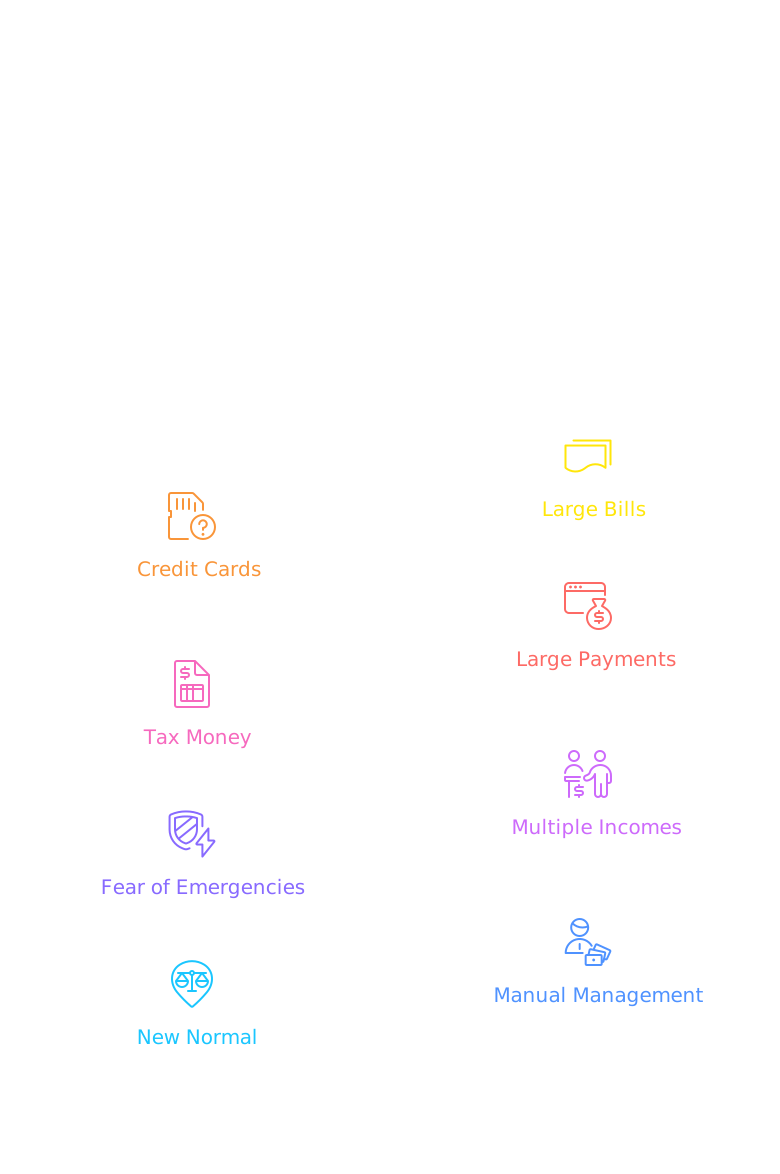
1. Large fixed bills make underfunding feel expensive
A missed $60 subscription is annoying. A failed $7,000 mortgage draft, $5,000 card payment, or $4,000 tuition payment can create a much larger operational problem.
The household responds by keeping several large bills in checking at once. That approach reduces failure risk, but it can also duplicate protection when the account already contains a timing cushion and a separate emergency reserve.
The correct response is not to minimize the checking floor. It is to count each obligation once.
2. Credit cards delay the visibility of real spending
High earners often route most variable spending through rewards cards. Checking therefore looks unusually full during the month because groceries, travel, dining, subscriptions, and household purchases have not yet settled against it.
The card statement acts like a delayed cash claim.
True available checking cash = visible balance - pending card obligation - other assigned payments
If checking shows $45,000 and the next 2 card statements total $12,000, the household does not have $45,000 of unassigned cash. It has at most $33,000 before the mortgage, utilities, taxes, and cushion are counted.
For the detailed timing problem, read Why Does My Checking Account Drop After Credit Card Autopay?.
3. Bonuses and equity compensation create temporary balance spikes
Base salary may pay ordinary bills while a bonus, commission payment, restricted stock unit sale, or tax refund arrives as a large lump sum.
The deposit creates 3 simultaneous decisions:
1. How much is owed for taxes?
2. How much belongs to a near-term goal?
3. How much is genuinely unassigned?
When those decisions are postponed, checking becomes the default holding area. A temporary spike can remain for 3, 6, or 12 months simply because no destination rule exists.
Use What Should You Do When a Bonus, RSU, or Tax Refund Lands in Checking? for the event-specific workflow.
4. Tax obligations are large but hard to see inside one balance
Taxes are not idle cash. They are assigned cash with a future payment date.
The problem is that a tax reserve can sit beside ordinary checking money with no visual boundary. A $40,000 account may contain $18,000 for estimated taxes, $12,000 for the next bill cycle, and only $10,000 of possible excess.
Illustration assumptions: The amounts are hypothetical. Actual tax obligations require individualized tax guidance.
The article's idle-cash math should never treat an unsegregated tax reserve as available money.
5. Two incomes do not create one clean schedule
Dual-income households may receive pay on different dates, use different benefit deductions, and have bonuses or commissions on separate calendars.
More income sources can improve resilience while making cash timing harder to read.
The household may solve this by keeping enough for every plausible mismatch. That is reasonable until the mismatch cushion becomes materially larger than the worst recurring gap.
6. Expensive surprises increase the comfort number
A high-income household may face higher deductibles, more expensive home repairs, travel disruptions, dependent care, or professional obligations. The dollar amount required to feel prepared can therefore exceed a generic checking rule.
This does not mean every possible surprise belongs in checking.
The mistake is funding the same risk in all 4 layers without noticing.
7. Manual optimization has a high attention cost
Moving cash is simple in isolation. Maintaining the system is not.
The household has to inspect balances, forecast bills, decide how much can move, initiate a transfer, monitor settlement, and bring money back before the next payment. A higher earner may reasonably decide that the expected dollar gain is not worth another recurring household task.
*Movement of funds is not instant. Transfers to your linked account can take up to 3 business days to settle, and longer if a Treasury Bill must be sold first. Rivo plans around known bills. It does not guarantee same-day access or a specific arrival date.
That is why an opened savings account does not guarantee that cash will stay optimized. The account can exist while checking continues to accumulate.
For the recurring failure pattern, read Why Manual Transfers Between Checking and Savings Fail.
8. The household normalizes around a high balance
Checking balances are sticky because people learn a personal number that feels safe.
JPMorganChase Institute research found that individuals tended to move back toward a relatively stable personal cash-buffer level after shocks. When balances were abnormally high or low, households adjusted spending or transfers toward their previous norm over time.
That normal level can be useful. It can also become outdated after:
- a child leaves daycare
- a mortgage is refinanced
- a loan is repaid
- compensation becomes more predictable
- an emergency reserve is funded elsewhere
- annual expenses decline
- the household opens another liquid account
A checking floor should be reviewed when the underlying obligations change. Otherwise yesterday's safety number becomes today's idle-cash anchor.
When Is a Large Checking Balance Completely Rational?
A large checking balance is rational when the money has a defined operating or access job.
Keep the next bill cycle simple
Money for payments that will clear before another reliable inflow usually belongs in checking.
That can include:
- mortgage or rent
- credit-card statement balances
- childcare
- insurance
- utilities
- recurring transfers
- debit-card spending
- checks that have not cleared
The amount may be $8,000 for one household and $30,000 for another. The relevant variable is not income alone. It is the bill cycle.
Protect known one-time obligations
A visible balance can be high because the household is waiting for:
- quarterly taxes
- property taxes
- tuition
- a home closing
- a renovation payment
- a vehicle purchase
- a large charitable contribution
- travel already booked
Assigned money is not idle even if it earns little for a short period. Clean execution can be more valuable than maximizing a few weeks of return.
Keep enough for same-day access
Neither a savings transfer nor a security sale should be treated as identical to instantly spendable checking.
Cash needed for an urgent debit, wire, card payment, ATM withdrawal, or unexpected same-day charge should remain in the transaction layer.
Use a comfort cushion you will actually maintain
A mathematically minimal checking floor can fail if it makes the household anxious enough to abandon the system.
The comfort cushion is legitimate when it is:
- a stated dollar amount
- separate from known bills
- large enough to absorb ordinary forecast error
- reviewed periodically
- not allowed to expand automatically after every income increase
The goal is not the smallest possible checking balance. It is the smallest balance that makes the operating system reliable and maintainable.
When Does a High Checking Balance Become Idle Cash?
A high checking balance becomes potential idle cash when the same dollars remain after bills, planned spending, known large expenses, and the chosen comfort cushion are protected.
Use a persistence test, not a payday snapshot
Review the lowest balance across multiple windows:
The 90-day low is a useful starting point, not a universal rule.
Calculate the candidate idle layer conservatively
Candidate idle cash =
90-day low checking balance
- operating safe balance
- known near-term expenses
- any unsegregated tax or sinking-fund money
Illustrative household:
Illustration assumptions: The figures are hypothetical. The formula identifies money to review, not money that must be moved.
The current $78,000 balance overstates the decision by $68,000. The persistent, unassigned layer is closer to $10,000.
Test whether the extra dollars have a sentence
Every large cash layer should complete this sentence:
> This money is here because ________, and I expect to use or review it by ________.
If the first blank is "just in case" and the second has no date, the cash may be idle.
How Much Can Idle Checking Cash Cost a High Earner?
The cost is the gap between what the idle layer earns in checking and what it could earn in an appropriate alternative, after fees, taxes, movement timing, and risk.
The national rate for interest checking was 0.07% in July 2026. The current Rivo rate page lists a 3.65% gross annualized rate as of July 1, 2026, before fees and taxes, with a $100 minimum balance to earn the stated rate.
These are different financial structures. Checking is a bank deposit and an immediate spending rail. Rivo uses short-duration U.S. Treasury Bills through Jiko Securities and charges a 0.05% monthly management fee.
Same-balance illustration
Illustration assumptions: The table applies the dated national checking benchmark and the dated Rivo gross annualized rate to a constant balance for 1 year. These are different structures, not two versions of the same account. Checking cash at an insured bank may be eligible for FDIC insurance within limits. T-bills bought through Jiko Securities are securities, not deposits: Not FDIC Insured, No Bank Guarantee, May Lose Value. Their price can move if they are sold before maturity. The Rivo fee uses a simple 0.60% annual approximation from the 0.05% monthly fee. The table excludes compounding, taxes, rate changes, days held in checking, settlement, withdrawals, and any early sale effect. It is educational, not a forecast.
The table does not mean a household should move its full checking balance. It shows why correctly identifying the persistent idle layer matters.
Aggregate cash shows the problem is not small
U.S. households and nonprofit organizations held approximately $5.949 trillion in checkable deposits and currency at the end of Q1 2026. That series is broad and includes more than household checking accounts, so it should not be interpreted as a direct measure of Rivo-addressable idle cash.
It still establishes the scale of transaction-oriented liquidity in the economy.
The Federal Reserve's 2022 Survey of Consumer Finances found that 98.6% of families held transaction accounts, which include checking, savings, money market, call accounts, and prepaid debit cards. Among holders, the conditional median was $8,000 and the conditional mean was $62,500. The difference between median and mean shows how strongly larger balances affect the aggregate.
Inattention has measurable value to banks
An NBER summary of research on deposit competition estimated that about 58% of the average bank's deposit-related profit stream could be attributed to depositor sleepiness and higher markups. The same research estimated an average bank markup of 68 basis points per year versus 32 basis points in a counterfactual without sleepy depositors.
That does not mean every low-rate checking customer is making a mistake. It means attention and switching behavior have economic value.
For the broader concept, read What Is the Inertia Tax?.
How Should a High Earner Set a Safe Checking Balance?
A safe balance is the minimum checking amount that protects the household's operating needs before any cash is considered idle.
Use a dollar formula, not an income percentage
Safe balance =
next 30 days of fixed bills
+ expected card autopay
+ planned checking spending
+ income and settlement timing cushion
+ known near-term expenses
+ same-day comfort cushion
An income percentage can produce the wrong answer. A household earning $250,000 with a $6,000 monthly outflow may need less in checking than a household earning $180,000 with a $14,000 monthly outflow and uneven commissions.
Example 1: Two salaried earners with children
If checking stays near $55,000 after 3 ordinary bill cycles, the first candidate idle layer is not $55,000. It is the stable amount above $23,000 after known future expenses are deducted.
Example 2: High base salary plus quarterly equity sales
Suppose a $45,000 after-withholding equity deposit arrives. The household should still identify taxes, goals, and known purchases before treating any portion as idle.
Example 3: Commission or self-employment income
This household may rationally keep far more cash available than a salaried household. The tax payment and extended income cushion are assigned money, not idle cash.
For a dedicated formula, read How Much Should You Keep in Checking With Irregular Income?.
Which High-Earner Cash Patterns Create the Most Idle Money?
Three patterns create a strong risk of recurring idle cash: lumpy compensation, oversized bill buffers, and abandoned manual transfers.
The technology professional with equity compensation
The checking account receives salary, reimbursements, and occasional equity-sale proceeds. Ordinary bills are fully covered, but the equity cash remains because taxes and investment decisions feel separate from the workweek.
The key is not the source of the deposit. It is whether the remaining cash has a defined job and date.
The dual-income household with concentrated autopay
The household earns consistently, but a mortgage and several cards clear inside the same 7-day window. The checking floor grows because nobody wants to monitor the peak payment week.
The correct floor should cover that peak week plus timing error. It should not automatically equal several months of full household spending if a separate emergency reserve already exists.
The busy professional who opened a savings account and stopped using it
The household understands yield and already has another account. The failure is maintenance.
Paychecks keep arriving in checking. One or 2 transfers happen after the account opens. Then work, family, and bill timing take priority. The new account remains open, but the checking balance starts growing again.
That is not a knowledge problem. It is a recurring-workflow problem.
The first-generation high earner protecting hard-won security
A large visible balance can carry emotional meaning. It may represent protection from job loss, family obligations, immigration uncertainty, prior scarcity, or the fear of needing help from others.
That context should not be dismissed as irrational.
The better approach is to make the security rule explicit:
1. Define the amount that must remain immediately visible.
2. Separate assigned family or emergency obligations.
3. Review only the recurring excess.
4. Use a structure that can be paused or reversed when circumstances change.
Cash management should preserve the feeling of control, not demand that the household ignore it.
Why Does Opening a High-Yield Savings Account Often Fail to Fix the Problem?
A high-yield savings account can improve the return on a fixed reserve. It does not automatically decide how much can leave checking each week.
The destination and the decision are different
The savings account may be a good destination. The repeated allocation decision can still fail.
Fixed transfers work only when the surplus is stable
A rule such as "move $2,000 every payday" works when income and expenses are predictable.
It breaks when:
- a large card statement follows travel
- a tax payment is due
- a bonus creates a temporary spike
- childcare changes
- one paycheck is delayed
- annual insurance clears
- the household has an unusually expensive month
The result is usually one of 2 behaviors: transfer too little and leave cash idle, or transfer too much and pull it back.
How Does Automation Change the Checking-Cash Problem?
Automation changes the problem from repeated transfer decisions to a maintained boundary.
Automation does not remove judgment. The household still has to set a sensible checking minimum, protect known large payments, and react when life changes.
It does remove the requirement to make the same ordinary decision after every payday.
Where Does Rivo Fit for High Earners With Idle Checking Cash?
Rivo is designed for households whose existing checking setup works but whose recurring surplus is difficult to manage manually.
The operating model is:
1. Keep the current checking account, direct deposit, debit card, and bill-pay setup.
2. Connect one primary checking account through Plaid.
3. Set the minimum checking balance you want protected.
4. Let Rivo evaluate eligible cash above that floor using account activity and expected obligations.
5. Move eligible idle cash into short-duration U.S. Treasury Bills through Jiko Securities.
6. Plan refills before expected bills.
7. Pause, change the floor, request funds, or stop when circumstances change.
The product is a workflow layer, not a replacement bank
The strongest fit is not "a high earner who wants the highest displayed rate."
It is:
- a household with a recurring $10,000, $25,000, or $50,000 idle layer
- a working checking setup it does not want to replace
- meaningful variation in bills or income
- repeated failure to maintain manual transfers
- willingness to use a brokerage-based Treasury structure
- a need for user-controlled thresholds and bill-aware refills
The current cost and access boundaries matter
The fee is not justified merely because someone earns a high income. It is justified only if the automation solves a recurring cash-management task at a value greater than its cost.
Protection labels must remain precise
Rivo is a financial technology company, not a bank. T-bill holdings are securities, not FDIC-insured bank deposits.
Eligible customer securities are held through Jiko Securities, a SIPC member. SIPC protection addresses missing customer cash or securities if a member brokerage fails, subject to limits and rules. It does not protect against a decline in the value of a security.
The Jiko Treasuries risk disclosure describes interest-rate, liquidity, market, and early-sale risks. A short maturity can reduce some exposure, but it does not turn a security into an insured bank deposit.
When Is Rivo Not the Right Place for High-Earner Cash?
Rivo should not be used for every dollar above an ordinary monthly budget.
The right decision can be "keep more in checking." It can also be "use a separate savings reserve" or "manage T-bills directly."
Rivo is the narrower answer when variable idle checking cash and recurring transfer decisions are the actual problem.
What Is a 30-Minute High-Earner Checking Audit?
A useful audit should separate operating cash from idle cash without requiring a complete financial-plan rebuild.
Step 1: Pull 90 days of checking history
Record:
- beginning and ending balance
- lowest daily balance
- all paydays
- mortgage or rent
- card autopays
- taxes
- childcare or tuition
- insurance
- transfers
- unusual expenses
The lowest balance matters more than the highest balance.
Recheck the candidate floor after 30 days, validate it again at 60 and 90 days, compare it with the prior 12-month pattern, and repeat the audit every 6 months or after 1 material income or expense change.
Step 2: Label every large future obligation
Create a list for the next 90 days:
The amounts are hypothetical. Use actual statements and due dates for the household audit.
Step 3: Set the safe balance
Use the formula in this article and add a comfort cushion that is large enough to maintain.
Do not lower the floor simply to create a larger investable number.
Step 4: Calculate the persistent excess
Start with the 90-day low, subtract the floor, and subtract known obligations that are not already included.
If the result is negative or small, stop. The visible balance may be doing real work.
Step 5: Choose a maintainable system
The best system is the one the household will still use after a busy quarter, a vacation, and an unusually large card statement.
Final Recommendation
High earners keep large checking balances because a high balance is a simple response to a complex household cash-flow system. It protects large bills, delayed card spending, uneven compensation, taxes, expensive surprises, and the cost of paying attention.
Do not label the full balance a mistake.
First, calculate the operating safe balance. Second, separate taxes, sinking funds, and known purchases. Third, look for a recurring excess that survives several bill cycles. Only then compare rates, fees, taxes, protection structures, and automation.
If the surplus is fixed and easy to manage, a separate savings account or direct Treasury strategy may be enough.
If the surplus keeps changing and manual transfers repeatedly stop, Rivo can provide the missing workflow: keep the existing bank, protect a user-set checking floor, manage eligible idle cash in short-duration U.S. Treasury Bills through Jiko Securities, and plan around expected bills.
The most useful question is not:
> Is $50,000 too much for a high earner to keep in checking?
It is:
> After every bill, tax reserve, known expense, and deliberate cushion is protected, how much of that $50,000 still has no job?
That remaining number is the real decision.
FAQ
Is $50,000 too much for a high earner to keep in checking?
Not automatically. A $50,000 balance can be reasonable when it covers large card statements, housing, taxes, childcare, a near-term purchase, and a deliberate cushion. It may be excessive when a recurring portion remains above all those needs for 3 or more bill cycles.
Why do high earners need larger checking buffers?
Higher earners often have larger monthly outflows and more uneven cash events, including bonuses, commissions, equity compensation, tax payments, travel, tuition, and concentrated credit-card autopays. The safe balance should be based on actual outflows and timing, not income status.
Should a bonus or RSU deposit stay in checking?
It can stay temporarily while taxes, near-term goals, and investment decisions are clarified. The remaining cash becomes a stronger idle-cash candidate only after those obligations are assigned and the excess persists through a 60-day or 90-day review.
How many months of expenses should a high earner keep in checking?
Checking should usually protect the immediate 30-day operating layer, not necessarily the entire 3-month or 6-month emergency fund. A separate reserve may hold money that can tolerate transfer time. The exact split depends on income stability, dependents, obligations, access needs, and risk tolerance.
Does a high income make Rivo more valuable?
Income alone does not determine fit. Rivo becomes more relevant when the household maintains a meaningful and variable idle layer, wants to keep its bank, and does not reliably maintain manual transfers. The 0.05% monthly fee and product risks still need to be justified by the workflow value.
Can Rivo manage money needed for a large tax payment or home closing?
Known near-term obligations should generally remain outside the idle-cash layer. Rivo permits requests for available funds up to $15,000 per day through the app, and early Treasury sales can affect realized yield. Large deadline-driven payments should be planned separately.
Related Rivo Reading
- To understand the broad behavioral reasons cash stays in checking, read Why Do People Leave Money in Checking?.
- To identify the warning signs of an oversized checking floor, read Are You Keeping Too Much Money in Checking?.
- To coordinate two pay schedules, shared bills, and the checking floor, read How to Manage Cash Flow in a Dual-Income Household.
- To calculate a bill-ready checking floor, read How Much Money Should You Keep in Checking?.
- To trace why a salary increase did not create a stronger recurring balance, read Why Didn't My Checking Balance Improve After a Raise?.

This article is for educational purposes only and is not individualized investment, tax, accounting, or legal advice. Income, expenses, tax obligations, liquidity needs, emergency reserves, and risk tolerance differ. Consult qualified professionals about your circumstances.
Rivo is a financial technology company, not a bank. Banking services are provided by Jiko Bank, a division of Mid-Central National Bank. All U.S. Treasury investments and investment advisory services are provided by Jiko Securities, Inc., a registered broker-dealer and member of FINRA and SIPC.
Investments in T-bills: Not FDIC Insured. No Bank Guarantee. May Lose Value.
The 3.65% rate cited in this article reflects the 4-week T-bill rate as of July 1, 2026 when held to maturity. The rate does not include Rivo fees or taxes, is subject to change, and requires a $100 minimum balance to earn the stated rate.
Investment income on T-bills is taxed federally and generally exempt from state and local income taxes. Jiko Group, Inc. and its affiliates do not provide legal, tax, or accounting advice. Consult legal and tax advisors before making financial decisions. A sale before maturity can create a capital gain or loss and change the realized yield and tax result.
All calculations labeled illustrative assume constant balances and rates for the stated period. They exclude changing rates, compounding differences, taxes, money movement, settlement, early sales, and household-specific circumstances. They are not forecasts or promises of performance.
Sources
- Rivo homepage
- Rivo FAQs
- Rivo rate page
- Federal Reserve Survey of Consumer Finances, 2022
- JPMorganChase Institute: Household Cash Buffer Management
- NBER: Bank Competition and Inattentive Depositors
- FRED: National Rate for Interest Checking
- FRED: Household Checkable Deposits and Currency
- TreasuryDirect: Tax Forms and Tax Withholding
- SIPC: What SIPC Protects
- Jiko Securities U.S. Treasuries Risk Disclosures

Get Rivo Updates
Product news, money insights, and company updates.