Why Didn't My Checking Balance Improve After a Raise? Taxes, Benefits, Spending, and Cash Flow
Got a raise but still don't see more money in checking? Trace gross pay, deductions, lifestyle creep, bill timing, and transfers to find exactly where it went.
.png)
A raise can increase your salary without creating an equally visible increase in your checking balance. The difference may be absorbed before the deposit by taxes, benefits, or retirement contributions. It may be absorbed after the deposit by higher spending, debt payments, savings transfers, or bills that rose at the same time. It may also exist, but remain hidden by paycheck timing and credit-card settlement.
The first question is not, "Why am I still bad with money?" It is:
> Did the expected raise fail to reach checking, or did it reach checking and get assigned somewhere else?
That distinction determines what to inspect next.
This guide provides a pay-stub-to-checking reconciliation, a cash-flow diagnosis, and a framework for deciding what to do if the raise finally creates a recurring surplus. It also explains when cash-management automation may help and when it would solve the wrong problem.
TL;DR
- A gross salary increase is not the same as an equal increase in take-home pay. Net pay is gross pay minus taxes and other deductions, as shown in the CFPB's pay-stub guide.
- First compare one full pre-raise pay period with one full post-raise pay period. Do not diagnose the raise from a partial cycle, bonus check, or reimbursement.
- If gross pay increased but net pay barely moved, inspect withholding, health premiums, retirement contributions, and other payroll deductions.
- If net pay increased but checking did not strengthen, trace the difference into spending, debt payments, savings transfers, shared-account transfers, or larger card payments.
- A higher month-end balance does not prove the raise improved liquidity. Compare the lowest projected checking balance across complete pay cycles.
- In the Federal Reserve's 2025 household survey, 32% of adults reported higher monthly family income while 35% reported higher monthly spending. Income gains and spending gains can occur together.
- Rivo becomes relevant only after the raise creates recurring cash above your protected checking floor. It does not calculate payroll withholding, repair an unaffordable budget, or replace an emergency fund.
Quick Answer: Why Can a Raise Fail to Improve Checking?
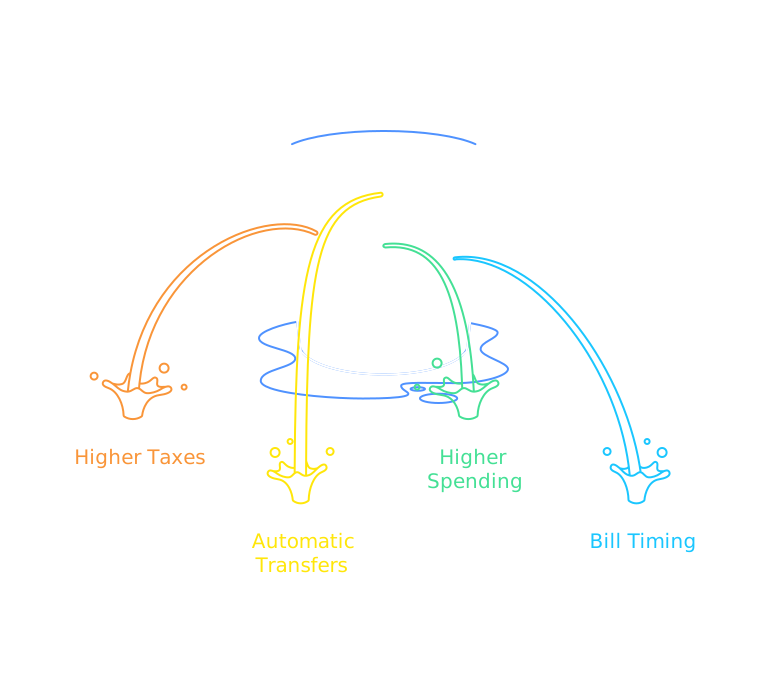
A raise can fail to improve your checking balance for one of four broad reasons:
The raise is not "missing" until you reconcile all four locations.
The bank balance is an outcome, not an explanation
Checking shows deposits and withdrawals after they happen. It does not explain why a deduction changed, whether a card payment represents old spending, or whether a transfer moved money to a better destination.
The diagnosis requires three connected records:
1. the pay stub,
2. the checking ledger, and
3. the accounts receiving transfers or card payments.
A raise can improve finances without increasing checking
If the extra take-home pay now goes to a retirement account, high-interest debt, an emergency fund, or a planned goal, your checking balance may look unchanged while your broader financial position improves.
That is not the same problem as spending the raise without noticing. The destination matters.
Gross Pay, Net Pay, or Both: What Actually Rose
Start with the language on the pay stub.
The CFPB defines gross wages as pay before deductions and net pay as gross pay minus all deductions. Your employer may announce compensation as an annual salary, hourly rate, or percentage increase. Your checking account receives net pay.
.svg)
Use comparable pay periods
Compare:
- the same pay frequency,
- the same number of workdays when relevant,
- the same regular-pay structure,
- no bonus or reimbursement distortion,
- and a full pay period under the new rate.
A biweekly employee should compare a normal biweekly stub with another normal biweekly stub. A semimonthly employee should compare a normal semimonthly stub with another normal semimonthly stub.
Do not divide annual salary by twelve unless you are paid monthly
The IRS estimator describes common pay frequencies and notes that biweekly pay can produce two or three payments in a month, while semimonthly pay produces two payments on set dates. The distinction appears in the IRS Tax Withholding Estimator guidance.
Your expected increase per paycheck should follow your actual pay schedule.
Whether the Raise Has Reached a Full Paycheck Yet
The effective date, pay-period dates, and pay date can differ.
An employer might approve a raise on one date, make it effective on another, and pay it after the payroll period closes. The first deposit after the announcement may include:
- no raise yet,
- only part of the raise,
- a retroactive adjustment,
- or a mix of old-rate and new-rate earnings.
.svg)
Read the pay-period dates
The CFPB pay-stub guide identifies the pay period as the calendar days included in a paycheck. Compare those dates with the raise's effective date.
A one-time catch-up is not recurring surplus
Retroactive pay can create a temporarily high checking balance. Treat it like a one-time deposit until you know the recurring change in net pay.
The recurring amount is what can support a new monthly obligation, savings transfer, or cash-management rule.
When Tax Withholding Absorbs More Than Expected
Federal income-tax withholding depends on earnings and the information supplied on Form W-4. The IRS explains those inputs on its tax-withholding page.
A larger paycheck can produce a larger dollar amount withheld even when your W-4 did not change. Other changes can also affect the result:
- a new W-4,
- an additional withholding election,
- a second job,
- a spouse's job change,
- bonus or supplemental wages,
- or a payroll-system correction.
Compare each tax line in dollars
Use the two-stub comparison:
Do not infer the cause from the total deductions line. Inspect each component.
Use the IRS estimator for withholding, not a rough percentage
The IRS Tax Withholding Estimator uses current pay and household information to help employees evaluate federal income-tax withholding. Its FAQ instructs users to work from the most recent paycheck and distinguishes federal withholding from state taxes, local taxes, Social Security, and Medicare.
Changing a W-4 can affect both current take-home pay and the amount due or refunded at tax filing. This is a tax decision, not a checking-balance trick. Consult a qualified tax professional when your situation is complex.
How Benefits and Retirement Contributions Capture the Increase
Payroll deductions can change near a raise even when the raise did not cause them.
Common examples include:
- health, dental, or vision premiums,
- health savings account contributions,
- flexible spending account contributions,
- retirement-plan contributions,
- life or disability coverage,
- commuter benefits,
- employee stock purchases,
- union dues,
- or wage garnishments.
A percentage-based contribution rises with pay
If a retirement contribution is set as a percentage of eligible pay, the dollar deduction can rise when gross pay rises. That does not mean the raise vanished. Part of it went directly toward the selected benefit.
Use the actual pay-stub difference:
Open enrollment can create a false raise diagnosis
If benefit elections changed near the compensation change, compare the deductions separately. The checking effect may combine:
> raise in net eligible earnings - new benefit cost - changed tax withholding
The solution may be no change at all if the deductions are intentional and affordable. The point is to know where the money went.
Checking Whether Direct-Deposit Instructions Changed
Net pay and checking deposit are not always identical.
Some payroll systems let employees split direct deposit between checking, savings, or multiple accounts. A raise can be automatically allocated away from the account you are watching.
Reconcile net pay to all deposits
Use this equation:
> Net pay = primary checking deposit + secondary account deposits + payroll-card deposits + any paper-check amount
If the equation balances, the raise reached you. It simply did not all reach the primary checking account.
An automatic savings increase is not missing cash
The CFPB describes split direct deposit and recurring transfers as ways to automate savings in its guide to automatic saving.
If the new money is intentionally reaching savings, measure success at the household level rather than only in one checking account.
How Lifestyle Creep Absorbs a Raise
Lifestyle creep means spending rises as income rises, often through many small decisions rather than one dramatic purchase.
The relevant question is not whether you bought a luxury item. It is whether recurring and variable spending increased enough to absorb the recurring net raise.
The Federal Reserve's 2025 household survey found that 32% of adults reported higher monthly family income, while 35% reported higher monthly spending. That result does not prove a raise caused anyone's spending, but it shows why income and spending must be measured together.
Lifestyle creep can begin before the first larger deposit
People may commit anticipated income early:
- signing a lease,
- upgrading a vehicle,
- booking travel,
- increasing childcare,
- adding subscriptions,
- dining out more often,
- or carrying a larger credit-card statement.
The first full raise deposit can arrive after the new spending pattern has already started.
Separate recurring expansion from one-time celebration
The issue is not moral failure. It is an unmeasured change in the operating budget.
When Fixed Costs Rise at the Same Time
A raise often coincides with another life event:
- promotion with more commuting,
- return to office,
- relocation,
- new childcare needs,
- a new benefits year,
- higher insurance premiums,
- or a housing change.
Those costs can absorb the increase without feeling like lifestyle creep.
Build a coincidence table
List every recurring cost that changed within the same period as the raise:
Then compare total fixed-cost growth with the recurring net-pay increase.
Inflation can compete with income growth
In the same Federal Reserve survey, 58% of adults said price changes made their financial situation worse in 2025. A personal raise can occur while rent, food, insurance, and other prices are also rising.
The correct comparison is not new income against old expenses. It is new income against new expenses.
How Debt Payments Capture the Raise
Some households deliberately route a raise toward debt.
Examples include:
- increasing a credit-card payment above the minimum,
- accelerating student-loan payments,
- paying down a personal loan,
- or catching up on overdue obligations.
If checking remains flat while debt declines faster, the raise may be working as intended.
Distinguish payment size from new borrowing
Checking alone cannot show whether the larger withdrawal improved net worth.
Do not automate idle cash while revolving debt is the active priority
Cash above a protected operating reserve may have a higher-priority use when expensive debt is outstanding. The correct order depends on rates, taxes, liquidity, employer matches, and personal risk tolerance.
Rivo does not provide a debt-repayment strategy. It can help keep cash available for scheduled payments, but the debt decision comes first.
When Savings or Investing Captures the Raise
A stronger financial system often makes the raise disappear from checking on purpose.
Look for:
- recurring savings transfers,
- brokerage contributions,
- retirement contributions outside payroll,
- education savings,
- sinking-fund deposits,
- emergency-fund deposits,
- or goal-based subaccounts.
Measure the full household cash position
A flat checking balance with higher savings and lower debt is materially different from a flat checking balance with higher discretionary spending.
Assigned cash is not idle cash
Money transferred for a known purpose remains assigned even if it sits in cash. A down payment, tax payment, tuition bill, or annual insurance premium should not be treated as available merely because the withdrawal has not happened yet.
Use What Is a Safe Balance? to separate operating cash from a genuinely recurring excess.
How Credit Cards Delay the Evidence
Credit cards separate purchase date from checking-withdrawal date.
You may spend more during the first month after a raise, but the checking impact may not appear until the statement is paid. A temporarily higher checking balance can therefore overstate the improvement.
Reconcile purchases and settlement separately
The checking ledger is incomplete without the issued card statements waiting to be paid.
Variable automatic payments require a forward view
The CFPB advises consumers to monitor both account balance and upcoming automatic payments to make sure enough money is available when the payment is scheduled. See its current explanation of automatic payments from a bank account.
A post-raise checking peak is not surplus if a larger card payment is already committed.
How Annual or Irregular Costs Hide the Gain
Monthly spending reports often understate costs that arrive quarterly, semiannually, or annually.
Examples include:
- insurance premiums,
- property taxes,
- professional dues,
- tuition,
- travel,
- gifts,
- home maintenance,
- vehicle registration,
- and medical deductibles.
Convert irregular costs to a planning amount
For diagnosis, use:
> Monthly planning amount = expected annual cost / 12
This is an allocation method, not a claim that the money leaves checking every month.
If the raise now funds obligations that were previously ignored, the checking balance may not climb. The plan may still be more accurate.
When Household Transfers or Shared Bills Change
In a household with two incomes, one person's raise can coincide with a new transfer rule.
For example:
- the higher earner contributes more to the joint account,
- one partner takes over a larger bill,
- shared expenses move to a different card,
- payroll goes to a personal account before transfer,
- or a partner reduces their contribution.
Reconcile the household, not only the employee
A raise can strengthen the joint account while leaving the employee's personal checking unchanged.
Account ownership can hide double counting
Do not count a transfer from personal checking to joint checking as household spending. It is an internal movement until the joint account pays an external expense.
For a broader operating model, read How to Manage Cash Flow in a Dual-Income Household.
Timing Problem or Affordability Problem?
Timing and affordability can produce the same symptom: checking runs low.
They require different responses.
A cash-flow map tests timing
The CFPB describes a cash-flow budget as tracking the timing of income and expenses from week to week. Its cash-flow budget tool carries each week's ending balance into the next week's beginning balance.
If the full cycle is positive but one week goes negative, timing is a central problem.
A recurring deficit tests affordability
If reliable net income does not cover recurring spending, required debt payments, and essential allocations across a complete cycle, the issue is not idle cash.
Do not move money out of checking to chase yield while the operating plan is structurally negative.
Reconciling the Raise From Pay Stub to Checking
Use a three-stage bridge.
Stage 1: Gross pay to net pay
Start with two comparable full-period pay stubs.
Stage 2: Net pay to checking deposit
Stage 3: Checking deposit to recurring surplus
Every difference should have a destination
The reconciliation is complete when the recurring net-pay increase is fully explained by:
- a higher checking floor,
- higher spending,
- higher debt payments,
- higher saving or investing,
- or recurring unassigned surplus.
If a large difference remains, inspect categorization errors, cash withdrawals, peer-to-peer transfers, reimbursements, and duplicated internal transfers.
What a Raise Should Do to Your Lowest Projected Balance
The most useful liquidity test is not the balance immediately after payday. It is the lowest projected balance before the next reliable inflow.
Use:
> Projected low point = starting available balance + reliable inflows - assigned outflows before the next inflow
Illustrative example
The following figures are illustrative only.
The deposit increased by an illustrative $250, but the low point improved by only an illustrative $150 because variable spending also rose.
Compare like-for-like cycles
Do not compare a low-spending vacation week with a normal week, or a three-paycheck month with a two-paycheck month. Use repeated, representative cycles.
To diagnose the recurring trough directly, read Why Does Checking Run Low Before Payday?.
How Long to Observe Before Calling the Raise Missing
Wait long enough to capture:
- one full paycheck at the new rate,
- at least one major card autopay,
- the household's major recurring bills,
- and any automatic savings or debt transfers.
For many salaried households, two complete pay cycles provide a useful first check. This is a practical observation window, not a universal financial rule.
Extend the window when the month is unusual
Use a longer view when the period includes:
- a bonus,
- retroactive pay,
- unpaid leave,
- a large reimbursement,
- a vacation,
- a tax payment,
- an annual premium,
- or a temporary benefit change.
Do not wait to investigate a payroll error
If the pay rate, hours, or deductions appear wrong, contact payroll promptly. The observation window is for cash-flow patterns, not for ignoring an incorrect paycheck.
The 30-Day Raise Audit
Use this audit to locate the difference without rebuilding your entire financial life.
Days 1 to 3: Confirm payroll
- Collect the last normal pay stub before the raise.
- Collect the first full normal pay stub after the raise.
- Compare gross pay, every deduction, net pay, and deposit destinations.
- Confirm the effective date and pay-period dates.
- Ask payroll about unexplained lines.
Days 4 to 10: Trace automatic flows
- List split deposits.
- List transfers to savings, investing, and joint accounts.
- List scheduled debt payments.
- List card autopays and their statement balances.
- Mark internal transfers so they are not counted as spending.
Days 11 to 20: Compare spending
- Compare recurring fixed costs.
- Normalize annual and irregular costs.
- Review card purchases by category.
- Separate one-time purchases from recurring expansion.
- Identify costs that began before the first larger paycheck.
Days 21 to 30: Build the low-point map
- Put reliable deposits on actual dates.
- Put known bills and transfers on expected clearing dates.
- Include issued card statements.
- Add a buffer for uncertain variable spending.
- Compare projected and actual low points.
What to Do With the New Surplus
Once you identify a recurring unassigned surplus, give it a job.
Possible priorities include:
- rebuilding the checking floor,
- restoring an emergency reserve,
- funding known irregular costs,
- paying debt,
- increasing retirement contributions,
- saving for a goal,
- investing for a suitable time horizon,
- or improving the return on near-term cash.
Use an order of operations
This sequence prevents the visible raise from being moved before the household knows what it must cover.
A new surplus should survive more than one payday
Do not classify the entire first larger deposit as recurring excess. Confirm that the surplus remains after the relevant bills, transfers, and card settlements.
When the Raise Becomes Idle Cash
The raise becomes idle cash only when the resulting balance is:
- above the amount needed for day-to-day operations,
- above known upcoming bills and transfers,
- above the chosen uncertainty buffer,
- not part of an emergency reserve,
- not assigned to a near-term goal,
- and recurring across representative cycles.
Today's peak is not the idle-cash amount
Checking commonly peaks after payroll and falls after bills. The difference between the peak and the protected low point may be temporarily assigned.
For the broader balance diagnosis, read Why Does My Checking Account Balance Fluctuate So Much?.
Where Rivo Fits Once a Raise Creates Recurring Idle Cash
Rivo is designed for the part of checking that is repeatedly above the user's protected operating floor.
You connect an existing checking account, choose the minimum amount you want to keep available, and let Rivo analyze income, spending, bills, and transfers. When eligible idle cash exists, Rivo can move it into short-duration U.S. Treasury bills and plan refills before detected obligations. See how the operating model works and review the available controls.
Rivo does not require a bank switch
Rivo works with your existing checking account. There is no need to reroute direct deposit or rebuild bill pay merely because a raise changed your cash flow.
That matters because the diagnostic records remain in the account you already use.
The checking floor remains under your control
You choose the minimum checking threshold. Rivo uses that threshold together with observed cash flow when determining eligible movement. You can modify, pause, or stop automation.
AutoPilot currently supports earnings for one primary checking account, even when multiple accounts are connected. Households with several operating accounts should decide which one represents the primary bill-paying hub.
Eligible cash is invested, not held as an FDIC-insured deposit
Eligible idle cash is invested in short-duration U.S. Treasury bills through Jiko Securities, Inc., a registered broker-dealer and member FINRA and SIPC. The bills are purchased in your name and held in custody by Jiko Securities. The current strategy uses 4-week Treasury bills. Rivo charges a management fee of 0.05% per month based on the average daily Rivo balance.
T-bills carry fixed-income risk, including the possibility that selling before maturity affects realized value or yield. Rates change and returns are not guaranteed.
When Rivo Isn't the Next Step
Rivo is not the next step when:
- the raise has not reached a full pay period,
- payroll appears incorrect,
- withholding needs tax review,
- recurring expenses exceed reliable net income,
- credit-card balances are growing,
- the cash is needed for imminent bills,
- the emergency reserve is incomplete,
- the household has not chosen a safe balance,
- or the apparent excess exists only at the payday peak.
Cash management cannot create affordability
Moving money between checking and an earning destination does not reduce rent, make debt disappear, or turn a recurring deficit into a surplus.
Fix the cash-flow structure first.
Start conservatively after a material income change
A raise, promotion, relocation, or return-to-office schedule can change both income and expenses. Observe the new pattern before reducing the checking floor.
The floor can be revised when actual low points show that the new system is stable.
The Full Diagnosis at a Glance
Use this routing table.
Do not use one explanation for every household
Two people with the same raise can have different results because of filing status, benefit elections, debt, household transfers, bill timing, and spending changes.
The purpose of the framework is to identify the actual route in your records.
Final Recommendation
Do not judge the raise by the checking balance immediately after payday.
First, compare one full pre-raise pay stub with one full post-raise pay stub. Reconcile gross pay to net pay. Then reconcile net pay to every deposit destination. Finally, reconcile the larger checking deposit to recurring spending, debt payments, savings transfers, card settlement, and the lowest projected balance.
The result will usually fall into one of three categories:
1. The raise did not reach checking as expected. Verify payroll, withholding, benefits, and direct-deposit instructions.
2. The raise reached checking but was assigned. Decide whether the new spending, saving, investing, or debt payments match your priorities.
3. The raise created recurring unassigned cash. Protect the checking floor, then choose an appropriate destination for the excess.
Rivo is relevant in the third category. It can help put recurring idle cash to work while planning around the checking balance needed for bills and ordinary spending. It is not a substitute for payroll review, tax advice, debt planning, or an affordable operating budget.
FAQ
Why is my paycheck increase smaller than my salary increase?
The salary increase is generally expressed in gross terms, while your bank receives net pay after taxes and deductions. Compare two full, normal pay periods and inspect each deduction line. Use the IRS Tax Withholding Estimator for federal withholding questions.
Can a raise put me in a higher tax bracket and erase the raise?
U.S. federal income-tax brackets are marginal, so moving into a higher bracket does not apply the higher rate to all taxable income. However, withholding, payroll taxes, benefits, and other deductions can make the deposit increase smaller than the gross increase. Use current IRS tools or a qualified tax professional for your specific situation.
How can I tell whether lifestyle creep absorbed my raise?
Compare recurring fixed costs and normalized variable spending before and after the raise. Separate one-time purchases from persistent changes, and include card purchases that have not yet reached checking through autopay.
Why did my checking stay flat while my finances improved?
The raise may be going to savings, retirement, investing, or debt payoff. Measure account contributions and liability balances, not only the primary checking balance.
How many paychecks should I compare?
Start with one full normal pay period before the raise and one full normal pay period after it. Then observe enough complete cycles to include major bills, card autopay, and automatic transfers. Two representative pay cycles are often a useful first review, but unusual pay or expenses may require longer.
Can Rivo help after I get a raise?
Yes, when the raise creates recurring idle cash above your protected checking floor. Rivo works with your existing checking account, identifies eligible idle cash, and can move it into short-duration U.S. Treasury bills while planning refills around detected obligations. It does not determine tax withholding or fix a recurring budget deficit.
Related Rivo Reading
- To reconcile a positive plan with the cash actually available, read Why Does My Budget Say I Have Money but My Checking Account Is Low?.
- To diagnose the recurring low point between deposits, read Why Does Checking Run Low Before Payday?.
- To separate normal balance movement from a structural shortfall, read Why Does My Checking Account Balance Fluctuate So Much?.
- To understand why a strong salary can still produce a large checking buffer, read Why Do High Earners Keep So Much Money in Checking?.
- To reconcile two pay schedules, shared bills, and account transfers, read How to Manage Cash Flow in a Dual-Income Household.

This article is educational and is not financial, investment, tax, accounting, or legal advice.
Yield rate reflects the 4-week T-bill rate when held to maturity. Rate does not include fees. Rates are subject to change. Minimum balance of $100 required to earn the stated rate.
Rivo is a fintech company, not a bank. Banking services provided by Jiko Bank, a division of Mid-Central National Bank. Jiko Group, Inc. and its affiliates do not provide legal, tax, or accounting advice. You should consult your legal and/or tax advisors before making any financial decisions. This material is not intended as a recommendation, offer or solicitation for the purchase or sale of any security or investment strategy. See FINRA BrokerCheck, Jiko U.S. Treasuries Risk Disclosures and Jiko Securities Inc. Form CRS.
Investments in T-bills: Not FDIC Insured - No Bank Guarantee - May Lose Value. All U.S. treasury investments and investment advisory services provided by Jiko Securities, Inc., a registered broker-dealer, member FINRA and SIPC. Securities in your account are protected up to $500,000. For details, please see www.sipc.org.

Shalu Yadav is Rivo's SEO/GEO Expert, bringing over 10 years of experience in making financial content discoverable across both classic search and generative AI platforms.
Follow on LinkedInGet Rivo Updates
Product news, money insights, and company updates.