Should You Change Your Bill Due Dates to Match Payday? A Cash-Flow Guide for Rent, Credit Cards, and Autopay
Learn when changing bill due dates can improve payday cash flow, which bills to move, what transition risks to verify, and when a larger checking floor works be
.png)
Changing bill due dates to match payday can make checking cash flow easier to manage, but only when the change improves the sequence of deposits and debits without creating a larger bill cluster.
The goal is not to put every bill on the same date. The goal is to reduce the chance that rent, credit-card autopay, utilities, insurance, or loan payments clear before the paycheck intended to fund them.
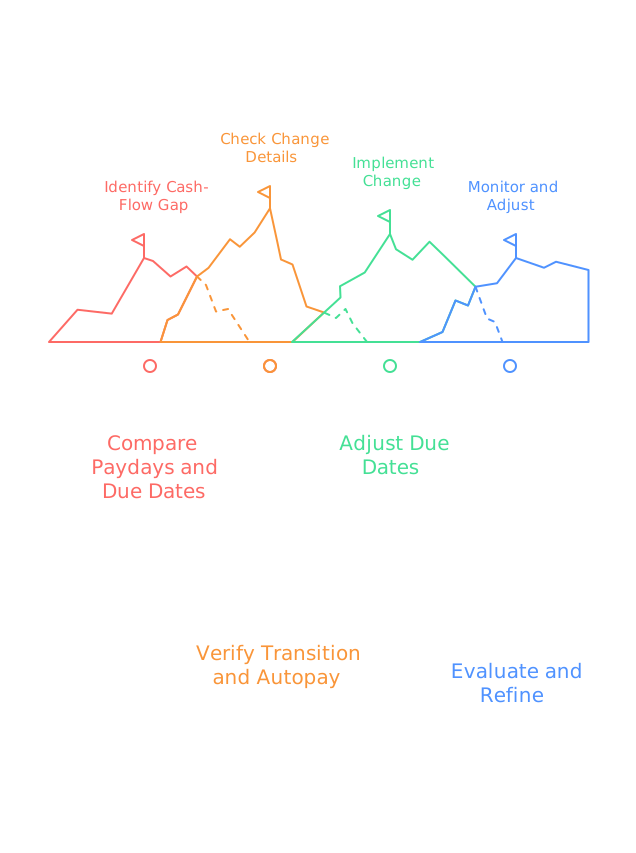
Start by mapping actual pay dates and expected checking debits. Then identify the bill creating the longest or most fragile paycheck-to-bill gap. Ask the provider whether the due date can change, when the new date becomes effective, what the transition payment will be, and whether autopay needs to be updated.
If the provider cannot move the date, or if moving it would make the cluster worse, the better fix may be to pay early, reserve money from an earlier paycheck, keep a larger checking floor, use a separate bills account, or add bill-aware cash management.
TL;DR
- Change a due date only after mapping paydays, bill due dates, scheduled payment dates, and expected checking debit dates.
- A due-date change can improve timing. It does not reduce the bill amount or solve an affordability problem.
- The CFPB recommends identifying a date that better matches income, then confirming the effective date, next payment amount, and any cost before agreeing to a change.
- Not every biller permits a date change, and some changes can produce a longer transition cycle or a larger first payment.
- Start with a bill whose current date creates a recurring low point. Do not move every bill to the day after payday and create one larger cluster.
- Distinguish the contractual due date from the scheduled payment date, expected checking debit date, and actual posted date.
- After the change, verify the next statement, autopay instruction, checking debit, and projected low point before treating the new schedule as permanent. Rivo does not change bill due dates; it helps plan cash movement around the schedule you confirm.
Quick Answer: Should You Change Bill Due Dates to Match Payday?
Consider changing a bill due date when the bill repeatedly falls well before the dependable paycheck intended to fund it and the provider can move it without creating a worse transition.
Do not change the date merely because the new calendar looks cleaner. First compare the projected checking low point under the current schedule and the proposed schedule.
A good change should do at least one of the following:
- shorten the gap between dependable income and the bill,
- reduce the amount checking must carry before the next paycheck,
- separate two or more large payments that currently clear together,
- make the bill easier to assign to a specific paycheck,
- or reduce the operating effort required to avoid a shortfall.
A poor change may move several bills into the same post-payday window, create a larger first payment, leave autopay on the old instruction, or shift the due date without changing when checking actually loses the money.
The decision should be based on the full payment sequence, not the due date alone.
What Problem Does a Due-Date Change Actually Solve?
A due-date change solves a cash-flow timing problem.
It can help when monthly income is sufficient but the order of deposits and debits repeatedly pushes checking below the household's intended minimum. The same rent, card payment, and utility bill may be manageable after payday and difficult several days before payday.
A date change does not solve:
- a bill that is unaffordable relative to income,
- a growing credit-card balance,
- an emergency reserve that is too small,
- uncertain or interrupted income,
- overspending between paychecks,
- or an inaccurate view of upcoming obligations.
If the projected low point remains below zero or below the protected checking floor even after the date moves, the household needs another remedy. That may include reducing spending, changing the payment amount where possible, building more opening cash, contacting the provider about hardship options, or getting qualified financial guidance.
Timing and affordability can exist together. Diagnose them separately.
Why Bill Dates Fall Out of Sync With Payday
Income and bills often use different clocks.
A paycheck may arrive every other week, twice monthly, monthly, or on a variable schedule. Bills may be tied to a calendar date, a statement cycle, a lease, a loan contract, a utility meter cycle, or a provider's processing window.
When those clocks do not align, the checking account has to carry assigned cash across the gap.
This is especially visible with biweekly income. The payday moves through the calendar while fixed monthly bills often remain on the same date. The full explanation is in Why Do Biweekly Paychecks Make Monthly Bills Hard to Time?.
Even fixed twice-monthly income can have a mismatch. Housing, card autopay, insurance, childcare, and utilities may concentrate in one half of the month while the other half carries fewer obligations.
The practical issue is not whether income and expenses balance over the month. It is whether checking remains adequately funded on every important day.
Due Date, Scheduled Payment Date, and Checking Debit Date Are Not the Same
Before requesting any change, separate the dates that govern lateness from the dates that govern checking liquidity.
The difference matters because changing the contractual due date may not automatically change an existing autopay instruction.
It also matters because payment methods behave differently. The CFPB distinguishes a company pulling an automatic debit from a bank account from using a bank's online bill-pay service to send a payment. Those are different payment instructions with different operating paths.
For credit cards, do not schedule a bank bill-pay transfer at the last possible moment. The CFPB notes that online bill payment can take time to process.
Build the plan around the earliest reasonable date checking may lose the money while preserving enough time for the provider to receive the payment.
.svg)
Start With a Bill and Payday Map
Do not call providers first. Build a baseline.
The CFPB's bill-calendar method starts by recording what each bill is for, the amount owed, and the due date. Add the dates required for checking cash-flow planning.
For every important bill, record:
- provider and bill type,
- expected amount or conservative range,
- contractual due date,
- current autopay or scheduled payment date,
- expected checking debit date,
- actual posted date from recent history,
- paycheck currently assigned to fund it,
- ability to request a date change,
- and the projected checking balance after it clears.
For every dependable income event, record:
- expected deposit date,
- amount expected to become available,
- source,
- confidence in the timing,
- and which bills depend on it.
Then place all deposits and debits in chronological order. Carry the running balance forward across month-end.
The complete implementation process is in How to Build a Bill Calendar for Your Checking Account.
Which Bills to Evaluate First
Evaluate bills by cash-flow impact, not by which provider is easiest to call.
Start with the payment that creates the largest recurring drop, the longest gap from dependable income, or the deepest part of a bill cluster.
Credit-card payments
A credit-card due date may be a strong candidate when a large statement payment repeatedly clears before payday.
Before requesting a change, confirm:
- whether the issuer permits the requested date,
- when the new date becomes effective,
- whether the statement closing date also changes,
- whether the grace-period treatment changes,
- whether the current autopay instruction remains active,
- and what amount will be collected during the transition.
Credit-card timing deserves care because the statement cycle, payment due date, grace period, and checking debit are related but not identical. The CFPB explains that a card issuer generally must provide a statement at least 21 days before the payment due date, but the exact account terms and transition treatment still need to be confirmed with the issuer.
Do not assume that changing the due date will reduce the statement balance. It changes timing, not purchases already made.
Utilities and communications bills
Electricity, gas, water, internet, and phone providers may have different policies. Some may allow a date choice. Others may use a billing cycle that cannot be freely moved.
Ask whether the request changes:
- the due date only,
- the meter or service cycle,
- the invoice period,
- the next bill amount,
- any budget-billing arrangement,
- or an existing automatic debit.
Variable utility bills also require an amount range. A better date does not remove seasonal variation.
Insurance premiums
Insurance payments can be large enough to define the checking low point, especially when several policies share a monthly or periodic date.
Confirm whether changing the payment date affects:
- the policy billing plan,
- installment fees,
- coverage status,
- the amount due in the transition period,
- or the authorization used for automatic payment.
Do not move a payment in a way that risks a coverage lapse. Get the new schedule in writing or in the provider account.
Personal, auto, student, and other loans
Loan servicers may limit available dates or apply changes only after specific requirements are met.
Ask about:
- eligibility,
- effective cycle,
- accrued interest,
- the next amount due,
- late-payment treatment,
- principal and interest allocation,
- and autopay status.
The fact that a date can change does not mean the economics are unchanged. Confirm the terms rather than inferring them from the calendar.
Rent and mortgage payments
Housing is often the largest recurring checking debit, but it may be less flexible.
For rent, the lease and landlord determine the contractual date and any grace period. Do not rely on an informal calendar change without written agreement.
For a mortgage, use the current statement and contact the servicer. The CFPB notes that a mortgage statement identifies the amount due, due date, and any late-payment fee information.
If the contractual housing date cannot move, the better remedy may be to reserve cash from the earlier paycheck or use a dedicated bills account.
Subscriptions and memberships
Subscriptions are often easier to restart on a new purchase date than contractual bills are to modify, but policies vary.
Evaluate them last unless the combined cluster is material. Moving a small subscription rarely fixes a checking low point by itself.
The better use of subscription changes is to reduce noise around a critical window, not to create the appearance of solving a larger housing or card-payment mismatch.
How Should You Choose the New Due Date?
Choose the new date from the cash-flow forecast, not from a generic rule such as "the day after payday."
Anchor it to dependable income
Identify the paycheck that should fund the bill. Then choose a date that gives the deposit time to become available and the payment enough time to process.
Do not anchor a fixed bill to commission, reimbursement, freelance income, a bonus, or another deposit whose timing is uncertain.
Protect a processing margin
The scheduled payment should not depend on perfect same-day processing.
Weekends and bank holidays can affect ACH settlement, and billers can have different cutoff rules. Use How Do Bank Holidays Affect Direct Deposit and Autopay? to test the proposed date around non-banking days.
Reduce clusters instead of moving them
If rent, card autopay, insurance, and a loan already clear within a short window, placing another bill in that window can make the projected low point worse.
The guide to What Is a Bill Cluster? explains how nearby payments behave like one checking event.
Consider distributing large debits across dependable deposits when providers permit it. The target is not equal bill counts. The target is a safer running balance.
Use the projected low point as the test
Run the proposed schedule through the same forecast as the current schedule.
Projected balance after event = prior projected balance + reliable inflows - expected outflows
Compare:
- the lowest projected balance,
- the number of days below the intended checking floor,
- the size of the floor gap,
- the amount of opening cash required,
- and the date checking recovers.
Keep the change only when the complete sequence improves.
What to Ask Before Agreeing to a Change
The CFPB's due-date worksheet recommends mapping income and expenses, asking whether the company permits a change, identifying a date that fits income, and confirming when the change takes effect, what the next bill will be, and whether there is a cost.
Use this provider checklist:
1. Can I change the contractual due date?
2. Which dates are available?
3. When will the new date take effect?
4. What is the exact next payment amount?
5. Will the first cycle be longer or shorter?
6. Will interest, installment fees, or other charges change?
7. Does the statement or billing-cycle date also change?
8. Does my current autopay update automatically?
9. Do I need to cancel and recreate any payment instruction?
10. What date should I expect checking to be debited?
11. Will I receive written or in-account confirmation?
12. What should I do if the old date still appears before the change takes effect?
The numbered items are a planning sequence, not claims about any universal provider policy.
Keep the confirmation until the first full cycle under the new schedule has posted correctly.
Why Can the First Payment After a Change Be Different?
Changing a due date can alter the length of the transition period.
If the new date is later, the first revised bill may cover more time. If the new date is earlier, the next payment may arrive sooner than expected. The CFPB specifically warns that moving a due date later can make the first bill after the change higher.
The exact result depends on the provider, product, billing cycle, and account terms.
Do not estimate the transition amount by dividing a normal bill across days unless the provider confirms that method. Ask for the exact amount and effective date.
Then place both the current-cycle obligation and the transition payment in the forecast. A change intended to improve future months can still create short-term pressure.
How Autopay Creates a Transition Risk
An autopay instruction can remain active while the due-date request is pending.
That creates several possible errors:
- the old payment runs before the new schedule begins,
- a new instruction is added without the old one being removed,
- the due date changes but the debit date does not,
- a variable amount is collected under an existing authorization,
- or the household manually pays while autopay is still scheduled.
The CFPB advises consumers to monitor automatic debits and keep enough money in the account because insufficient funds can create overdraft or nonsufficient-funds consequences depending on the account and payment.
For certain preauthorized electronic fund transfers that vary from the previous amount or an agreed range, Regulation E generally requires advance notice at least 10 days before the scheduled transfer, subject to the rule's terms and exceptions.
That notice is useful evidence, but it is not a substitute for checking the provider account and bank activity.
During the transition:
- keep enough cash for the old and confirmed new instructions until one is clearly canceled,
- avoid making a duplicate manual payment,
- save the confirmation,
- review pending transactions,
- and verify the first posted debit.
Illustrative Example: Before and After a Due-Date Change
The dates and dollar amounts in this section are illustrative only. They do not describe a Rivo customer, expected result, or universal household.
Assume an illustrative household:
- receives an illustrative $3,600 paycheck on the fifteenth,
- starts the period with an illustrative $3,300 in checking,
- has an illustrative $2,400 housing debit on the first,
- has an illustrative $1,200 card autopay on the twelfth,
- expects an illustrative $450 of ordinary spending before payday,
- and wants an illustrative $1,500 protected checking floor.
Illustrative current schedule
Under the illustrative current schedule, the projected low point is negative $750, which is $2,250 below the illustrative protected floor.
Assume the card issuer confirms an illustrative date change, provides the transition amount, and moves the card autopay to the eighteenth without changing the illustrative payment amount.
Illustrative proposed schedule
The illustrative revised low point is $450. That is an improvement of $1,200, exactly equal to the card payment moved behind payday.
But the revised low point is still $1,050 below the illustrative protected floor.
The date change improves timing, but it does not fully solve the household's cash-flow requirement. The household still needs more opening cash, a different housing funding method, lower pre-payday spending, another date adjustment, or a lower floor supported by its actual risk tolerance and obligations.
This is why the decision must be tested against the projected low point rather than judged as "fixed" because one bill moved.
Due-Date Change vs. Other Cash-Flow Fixes
Changing the date is one operating option. Compare it with the alternatives.
Change the date when the sequence is the problem
This is the strongest fit when one bill repeatedly falls on the wrong side of a dependable paycheck and the provider offers a clean transition.
Pay early when cash already exists
Paying early can work when the money is available and the provider applies it correctly. Confirm how early payments are treated, especially for loans and recurring services.
The household should still retain evidence that the payment satisfied the correct obligation.
Reserve an earlier paycheck when the bill cannot move
This is often the correct answer for rent, mortgage, or another contractual payment with limited flexibility.
Mark the cash as assigned as soon as the earlier paycheck arrives. Do not count it as idle cash merely because it remains visible in checking.
Use a separate account when visibility is the main problem
A separate bills account can create a strong operating boundary. It is useful when bill money is repeatedly spent because it looks available.
It does not change the amount or timing requirement. The account must still receive enough money before the debits. The decision guide is Should You Use a Separate Checking Account for Bills?.
Keep a larger floor when timing remains uncertain
A larger checking floor may be more practical when bills are variable, several dates cannot move, income timing changes, or the household values more protection than a tightly optimized schedule.
The floor should come from a dated weak-case forecast. It should not be an arbitrary round number copied from another household.
Use automation only after the operating rule is clear
Automation can reduce manual transfers, but it should not guess which cash is assigned to bills.
First define the bills, expected debit dates, uncertain amounts, and minimum checking threshold. Then test whether automation respects the weak part of the cycle.
Should You Move Every Bill to Just After Payday?
Usually not.
Moving every bill to the same window can create a larger bill cluster. The account may look organized because all payments occur together, but the projected low point can become more severe.
Consider the whole sequence:
- If the paycheck reliably covers the cluster and enough cash remains for ordinary spending, concentration may be manageable.
- If the cluster consumes most of the deposit immediately, the household may spend the rest of the pay period close to its minimum.
- If payday can shift around a holiday or payroll exception, a tightly packed post-payday cluster may depend on a deposit arriving exactly as expected.
- If card statements or utilities vary, the cluster can be much larger in some cycles.
The better design may be to place the largest fixed bills behind different dependable paychecks while leaving smaller variable bills where they are.
Optimize the low point and operating effort. Do not optimize for visual symmetry.
When Should You Not Change a Due Date?
Keep the current date when:
- the provider cannot confirm the change in writing or in the account,
- the transition payment would create a near-term shortfall,
- the change affects interest, fees, coverage, or other terms in a way you have not evaluated,
- the current date is already safely funded from an earlier paycheck,
- the proposed date creates a larger cluster,
- the new schedule depends on uncertain income,
- autopay behavior is unclear,
- or the affordability problem remains even under the improved sequence.
Also avoid repeated changes. A bill calendar becomes harder to trust when dates are constantly moving and the household has not observed a full cycle.
If a payment is already late or at risk of being late, contact the provider promptly. A future date change does not erase the current obligation.
Verifying the New Schedule
Treat the request as incomplete until the first revised cycle posts correctly.
Before the change takes effect
- Save the provider confirmation.
- Record the effective date.
- Record the exact transition amount.
- Check whether the statement date changes.
- Confirm the current autopay status.
- Add both old and new possible debits to the conservative forecast until the old instruction is clearly inactive.
When the new bill is issued
- Verify the contractual due date.
- Verify the amount.
- Compare the billing period with the prior statement.
- Check for interest, fees, or term changes.
- Verify the autopay date and bank account.
When the payment processes
- Review the provider's payment status.
- Review pending and posted bank transactions.
- Record the actual checking debit date.
- Confirm that no duplicate payment occurred.
- Recalculate the projected and actual low point.
After a complete cycle
- Decide whether the new date improved the paycheck-to-bill gap.
- Confirm that it did not create a worse cluster elsewhere.
- Update the bill calendar.
- Adjust the checking floor only if the evidence supports it.
One successful debit is useful, but a variable bill or holiday cycle may still behave differently. Keep reviewing until the schedule is stable enough for the household's decision.
Where Does Rivo Fit?
Rivo does not negotiate with billers or change contractual due dates.
Rivo fits after you have mapped the schedule you actually have. You connect an existing checking account and set the minimum amount you want to keep available. Rivo analyzes the balance and spending pattern, plans around detected bills and transfers, and identifies cash above the protected threshold.
When expected payments approach, Rivo can plan money back into checking. You remain in control of the threshold and can pause automation, adjust settings, move money manually, or disconnect.
That can complement a due-date change:
- the date change improves the bill sequence,
- the checking threshold protects the weak part of that sequence,
- and bill-aware automation helps manage cash that is genuinely above the protected need.
It can also help when a provider does not allow a date change. The household can keep the current schedule, reserve enough cash for it, and use a more conservative threshold around the expected debit.
What Rivo does not replace
Rivo does not replace:
- provider confirmation,
- accurate bill amounts,
- a realistic checking threshold,
- emergency savings,
- debt or affordability planning,
- monitoring during a schedule transition,
- or judgment about unusual upcoming expenses.
Cash assigned to a known bill is not idle cash. Keep it protected even if the bank balance temporarily makes it look available.
A Practical Implementation Sequence
Use this order for one bill at a time.
Step 1: Diagnose the low point
Build the current running-balance forecast. Identify the event that creates the deepest recurring drop.
Step 2: Assign the funding paycheck
Choose the dependable deposit that should fund the bill. If it arrives after the bill, the current schedule requires opening cash or an earlier paycheck.
Step 3: Compare available provider dates
Ask which dates are available and how each would affect the transition cycle, statement, payment amount, and autopay.
Step 4: Model the proposed sequence
Move only the confirmed payment in the forecast. Leave every other income and expense assumption unchanged so the comparison is meaningful.
Step 5: Check the transition
Include the old obligation, the new effective date, and the exact transition amount. Maintain enough cash for ambiguity until the old instruction is inactive.
Step 6: Make one bounded change
Avoid changing several major bills at once. A single change is easier to verify and attribute.
Step 7: Observe and update
Record the issued statement, pending debit, actual posted date, and checking low point.
Step 8: Decide whether another change is needed
If the sequence remains below the protected floor, compare another date change with paying early, reserving cash, using a separate bills account, or keeping a larger floor.
Final Recommendation
Change a bill due date only when the forecast shows that the new date improves checking cash flow and the provider confirms the full transition.
Start with the bill that creates the most important recurring mismatch. Verify the contractual due date, scheduled payment date, expected checking debit, new effective cycle, transition amount, and autopay instruction.
Then compare the projected low point before and after the change.
If the new date shortens the fragile gap without creating a larger cluster, it can be a useful fix. If it does not, keep the existing date and use another operating method: pay early, reserve money from an earlier paycheck, use a separate bills account, maintain a larger checking floor, or add bill-aware automation.
The best schedule is not the one with the neatest calendar. It is the one that keeps every obligation funded while leaving enough cash available through the weakest part of the pay cycle.
FAQ
Can I change a credit-card due date to match payday?
Many issuers may offer date options, but the policy and transition rules vary. Ask when the new date becomes effective, whether the statement cycle changes, what the next amount will be, and whether existing autopay updates automatically. Do not rely on the requested date until it appears in the account or written confirmation.
Is it better to pay bills on payday or on the due date?
Paying on payday can improve control when cash is available and the provider applies the payment correctly. Waiting until the due date can preserve cash longer but creates more timing risk. Choose a scheduled date that protects on-time receipt and the checking low point rather than using one rule for every bill.
Should all bills be due on the same day?
Not necessarily. Concentrating every bill can create one large debit cluster. Model the full running balance and distribute major payments across dependable paychecks when provider rules and household operations support it.
What happens to autopay after a due-date change?
It depends on the provider and the payment instruction. Confirm whether the existing autopay will update, remain on the old date, or need to be canceled and recreated. Monitor the provider account and checking until the first revised payment posts.
What if a company will not change my bill due date?
The CFPB worksheet suggests alternatives such as setting aside money from an earlier income event or paying early. A separate bills account or a larger checking floor can also make the existing date easier to manage.
Can Rivo change my bill due dates?
No. Rivo does not change contracts or contact billers for you. Rivo works with your existing checking account, your chosen minimum threshold, and detected bills to help manage cash around the schedule you confirm.
Related Rivo Reading
1. Why Do Biweekly Paychecks Make Monthly Bills Hard to Time?
2. How to Build a Bill Calendar for Your Checking Account
3. What Is a Bill Cluster? Why Rent, Mortgage, Autopay, and Card Payments Hit Checking at Once

This article is educational and is not financial, investment, tax, accounting, or legal advice.
Yield rate reflects the 4-week T-bill rate when held to maturity. Rate does not include fees. Rates are subject to change. Minimum balance of $100 is required to earn the stated rate.
Rivo is a fintech company, not a bank. Banking services provided by Jiko Bank, a division of Mid-Central National Bank. Jiko Group, Inc. and its affiliates do not provide legal, tax, or accounting advice. You should consult your legal and/or tax advisors before making any financial decisions. This material is not intended as a recommendation, offer or solicitation for the purchase or sale of any security or investment strategy. See FINRA BrokerCheck, Jiko U.S. Treasuries Risk Disclosures and Jiko Securities Inc. Form CRS.
Investments in T-bills: Not FDIC Insured - No Bank Guarantee - May Lose Value. All U.S. treasury investments and investment advisory services provided by Jiko Securities, Inc., a registered broker-dealer, member FINRA and SIPC. Securities in your account are protected up to $500,000. For details, please see www.sipc.org.
Sources
- CFPB: Request a change in your bill due date worksheet
- CFPB: Create a bill calendar
- CFPB: How automatic payments from a bank account work
- CFPB: Regulation E, Section 1005.10
- CFPB: When a credit-card payment is considered late
- CFPB: Managing a monthly mortgage payment
- Rivo

Shalu Yadav is Rivo's SEO/GEO Expert, bringing over 10 years of experience in making financial content discoverable across both classic search and generative AI platforms.
Follow on LinkedInGet Rivo Updates
Product news, money insights, and company updates.