What Is a Cash Sweep Account? How Automatic Sweeps Work for Idle Checking Cash
Learn how cash sweep accounts work, where swept cash goes, how FDIC and SIPC protection differ, and when a sweep or Rivo fits.
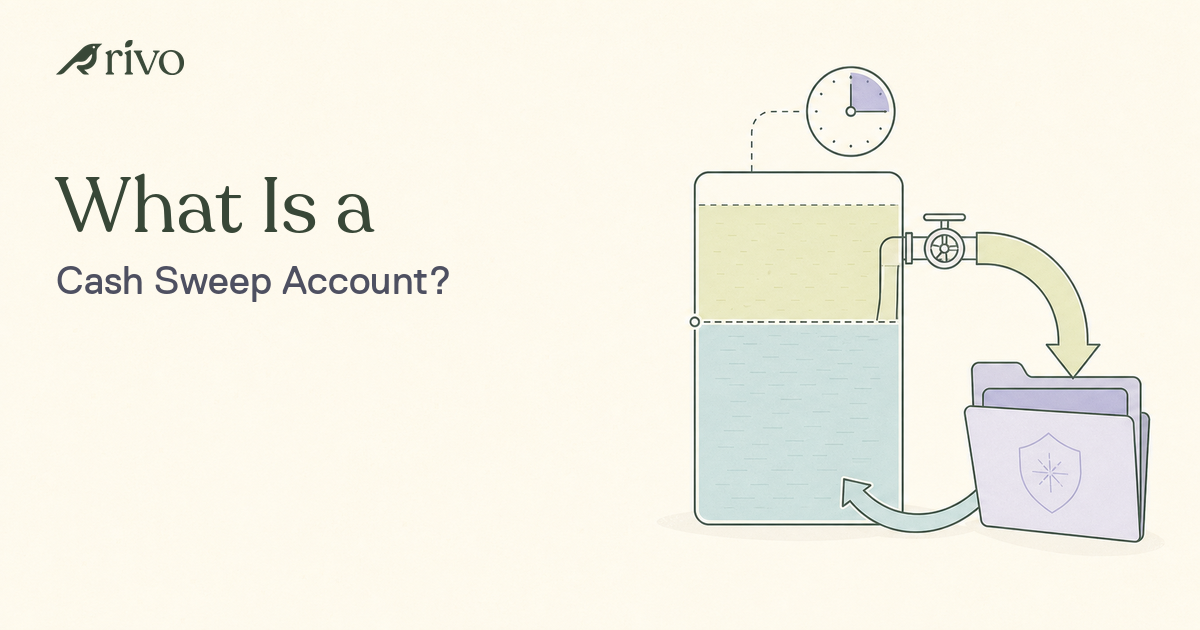
A cash sweep is an arrangement that automatically moves unallocated cash from a source account into a designated deposit or investment destination. The source may be a checking account or brokerage account. The destination may be a bank deposit program, money market fund, another deposit account, or another short-term cash vehicle.
The word "sweep" describes the movement rule, not one universal account type. Two products can both use automatic sweeps while holding money in different assets, applying different insurance or custody protections, paying different rates, and providing different access to bills and withdrawals.
That distinction matters for households with idle checking cash. A brokerage sweep generally manages cash that is already inside a brokerage account. A scheduled bank transfer moves a fixed amount on a fixed date. Rivo uses a different automated cash-management workflow: it works with an existing checking account, applies a user-set minimum balance, moves eligible idle cash into short-duration U.S. Treasury Bills through Jiko Securities, and plans refills before expected bills.
The decision is not simply "automatic or manual." You need to know:
- which account starts the movement
- what triggers the movement
- where the cash goes
- whether the destination is a deposit or security
- how quickly cash becomes available again
- what happens before a bill, debit, or transfer
- which fees and rate measure apply
- whether FDIC insurance, SIPC protection, or neither applies
This guide explains those differences without treating every product that moves cash automatically as the same thing.
TL;DR
- A cash sweep is a movement mechanism, not a single financial product. It moves available or excess cash into a predefined destination according to an account agreement, balance rule, or brokerage core-position process.
- Brokerage sweeps usually manage uninvested cash already inside an investment account. The SEC identifies money market fund sweeps, bank sweeps, and free credit balances as common treatments for brokerage cash.
- The destination determines the protection. Eligible deposits at an FDIC-insured bank can receive deposit insurance within applicable limits. Money market fund shares and Treasury securities are not FDIC-insured deposits. SIPC addresses missing eligible customer property after a member brokerage failure, not market-value losses.
- A scheduled transfer is not a true balance-aware sweep. A fixed $500 transfer every payday does not automatically know whether a $4,000 credit-card payment, a delayed paycheck, or an unusual insurance bill is approaching.
- Rivo is automated cash management, not a conventional brokerage cash sweep. It keeps the existing checking account as the transaction hub, lets the user set a floor, and moves eligible surplus into short-duration Treasury Bills through Jiko Securities.
- As of July 1, 2026, Rivo's published rate is 3.65%, before fees and taxes. Rivo charges a 0.05% monthly management fee based on average daily Rivo balance. Rates and balances change.
- Choose the workflow before comparing headline rates. A higher rate does not solve the problem if cash is in the wrong account when rent, card autopay, taxes, or an emergency expense arrives.
What Is a Cash Sweep Account?
A cash sweep account is an account arrangement in which available cash is automatically moved into a linked deposit or investment vehicle under predefined rules. The movement may happen when cash enters a brokerage account, when a checking balance exceeds a target, at the end of a business day, or through another provider-specific process.
The shortest useful definition has 4 parts:
The term can be confusing because "cash sweep account" may describe:
- the uninvested-cash feature inside a brokerage account
- a bank service that moves checking cash above a target balance
- a multi-bank deposit program
- an investment sweep into a money market fund
- a commercial sweep that pays down a line of credit
- a marketing label for a broader cash-management product
Those are not interchangeable.
The SEC's May 2025 investor bulletin uses a narrower brokerage meaning. It explains that an investment firm may place uninvested cash into a money market fund sweep, a bank sweep program, or leave it as a free credit balance. It also explicitly separates those sweep programs from cash-management advisory services that actively manage cash and short-term instruments.
That boundary is important for Rivo. Rivo is not the default cash position inside your brokerage account. It is a cash-management layer for recurring surplus in an existing checking account.
How Does an Automatic Cash Sweep Work Step by Step?
Every sweep needs a rule for identifying movable cash and a destination for receiving it. A basic target-balance sweep can be modeled in 6 steps.
.svg)
Step 1: Define the source account
The source account is the place where cash first appears. In a brokerage sweep, that may be cash from a deposit, dividend, interest payment, or security sale. In a bank sweep, it may be the operating checking account where income arrives and payments leave.
Step 2: Define available or excess cash
The provider applies its account rules. A brokerage may treat settled, uninvested cash as available for the default core position. A target-balance arrangement may compare the current balance with a floor chosen by the customer or specified in the agreement.
Step 3: Apply the sweep trigger
The trigger may be event-based, schedule-based, or balance-based.
Step 4: Move cash to the destination
The destination controls what the customer owns or is owed. Cash may become:
- a deposit at one or more program banks
- shares of a money market mutual fund
- a balance in another deposit account
- a Treasury security
- a payment against a credit line
The app interface may look similar across these choices. The financial structure is not similar.
Step 5: Earn interest, dividends, or a security return
The return measure depends on the destination. Bank deposits normally quote an annual percentage yield, or APY. Money market funds commonly report a seven-day yield. Treasury Bills are purchased below face value, with the difference between purchase price and maturity value representing interest when held to maturity.
TreasuryDirect lists regular T-bill terms of 4, 6, 8, 13, 17, 26, and 52 weeks. It also states that bills have a $100 minimum purchase and that interest is subject to federal tax but not state or local tax.
Step 6: Make cash available for the next debit
This is the step most headline-rate comparisons skip.
Some brokerage core positions are used automatically to settle eligible account debits. Some bank sweeps return cash according to the program's balance rules. Some external products require a separate transfer. Securities may need to be sold before maturity, and provider cutoffs, settlement, transfer timing, holds, and withdrawal limits can affect access.
The practical test is not "Can I withdraw?" It is "What exact sequence happens if a $6,000 payment needs to clear on Tuesday morning?"
What Are the Main Types of Cash Sweep?
There are 5 cash-sweep or sweep-adjacent models that matter for a household decision.
Brokerage bank sweep
A brokerage bank sweep moves uninvested cash into deposit accounts at participating banks. The SEC explains that rates and program terms can vary significantly and that bank sweep programs often pay less than money market fund sweep programs.
The strength is deposit treatment. The limitation is scope: the program normally manages cash within the investment-account relationship. It does not necessarily monitor the checking account at another bank where rent, mortgage, cards, and daily spending occur.
Brokerage money market fund sweep
A money market sweep automatically invests uninvested cash in one or more money market funds. These funds generally hold high-quality short-term debt instruments and seek liquidity and a stable value.
A money market mutual fund is not a money market deposit account. The first is a security; the second is a bank deposit. The similar names do not create the same protection.
Bank target-balance sweep
A target-balance sweep moves cash when a source account exceeds a specified balance. This is common in business treasury management, where excess operating cash may move to a deposit or investment account or pay down a line of credit.
For a household, the target-balance idea is useful even when the bank does not offer a formal sweep. The target is the minimum operating balance. The challenge is making the target large enough for bills, variable spending, and exceptions without leaving every surplus dollar idle.
Scheduled automatic transfer
A scheduled transfer is the simplest substitute. For example, move $1,000 from checking to savings on the second day after each paycheck.
This works when income and bills are stable. It breaks when:
- paycheck dates move
- commission or freelance income varies
- card statements fluctuate
- annual insurance or tax payments arrive
- a large transfer is pending
- the checking balance is already below the assumed floor
The CFPB warns that automatic bank payments can create overdraft or nonsufficient-funds fees when the balance is too low. The same timing problem applies when an automatic savings transfer removes cash before those payments arrive.
Bill-aware automated cash management
Bill-aware cash management adds a cash-flow layer. It uses a minimum balance and expected payments to decide when surplus is eligible and when cash should return.
Rivo fits this model. You set a minimum checking threshold, while the workflow plans early refills before bills, adjusts when spending or income changes, and gives you controls to modify or stop automation.
Cash Sweep vs Automatic Transfer: What Is the Difference?
A cash sweep responds to account rules or available cash. An automatic transfer usually follows a calendar instruction.
A scheduled transfer is not inferior by definition. It is transparent, easy to understand, and often free. It can be the right solution for a household with 2 predictable paychecks, stable monthly bills, and a conservative buffer.
The sweep becomes more useful when the movable amount changes. If one month has $3,000 of surplus and the next has $18,000 after a bonus, a fixed $1,000 transfer does not respond to the actual idle layer.
The opposite risk also matters. If a scheduled transfer moves $1,000 during a low-income month, it can create a gap. Automation is useful only when its trigger reflects the cash-flow problem.
Cash Sweep Account vs Cash Management Account
A cash sweep is a mechanism. A cash management account, or CMA, is an account wrapper that may combine brokerage, spending, payment, and deposit-program features.
A CMA can use a sweep, but the two terms do not mean the same thing.
For example, the Fidelity Cash Management Account is a brokerage account with spending features and a choice of core cash positions. Its automatic handling of cash inside the account is useful for customers who want Fidelity to become a cash hub.
Rivo takes a different approach. It does not ask the customer to make a Rivo account the new home for direct deposit, card spending, and bill pay. The existing checking account remains the operating account.
For the full provider comparison, read Rivo vs Fidelity Cash Management Account.
Where Can Swept Cash Go?
The destination is the most important line in a sweep agreement. "Cash" can become a deposit, a fund share, a security, or a credit-line payment.
Deposits
Eligible deposits at an FDIC-insured bank are insured up to the applicable limits. The standard amount is $250,000 per depositor, per insured bank, for each ownership category.
A multi-bank sweep can distribute deposits across several program banks, but customers still need to consider deposits they already hold at those same banks in the same ownership category. The program name does not create unlimited coverage.
Money market funds
Money market funds are mutual funds. They are designed for liquidity and generally lower risk than many other mutual funds, but they are not bank deposits. They do not receive FDIC insurance.
The rate shown is usually a fund yield after fund expenses, not a bank APY. Buyers should avoid subtracting a fund expense ratio twice if the published yield already reflects expenses.
Treasury Bills
Treasury Bills are direct U.S. government obligations with maturities of one year or less. They do not pay periodic interest. The return is generally the difference between the purchase price and the amount received at maturity.
If a T-bill is sold before maturity, market price and transaction timing can change the realized result. "Government obligation" does not mean every early sale produces the expected held-to-maturity return.
How Do FDIC Insurance, SIPC Protection, and Treasury Backing Differ?
FDIC insurance, SIPC protection, and Treasury backing solve different failures.
The SEC's sweep bulletin states that bank sweep deposits can receive FDIC insurance subject to applicable limits. It also states that money market fund sweep holdings or brokerage free credit balances may receive SIPC protection when held through a SIPC member.
SIPC explains that it steps in when a member brokerage fails financially and customer assets are missing. It does not protect against a security declining in value.
This is why "insured cash" is not enough detail. Ask:
1. Is this a bank deposit or a security?
2. Which bank or broker holds it?
3. In what ownership category or account capacity?
4. What other balances are aggregated?
5. What happens if the asset changes value before liquidation?
How Should You Compare Sweep Rates, Fees, and Net Return?
Start with the same balance and same period. Then separate gross earnings, direct fees, fund expenses, taxes, and cash that was not actually swept.
Basic comparison formula
Estimated gross earnings
= average earning balance x annualized rate
Estimated direct fees
= average fee-bearing balance x recurring fee rate
Estimated pre-tax net benefit
= gross earnings - direct fees - transfer or transaction costs
This is only a screening calculation. APY, seven-day yield, and a T-bill-linked annualized rate are different measures. Compounding, changing rates, variable balances, settlement, taxes, fund expenses, early sales, and cash availability can change the result.
Illustrative $20,000 example
Assume $20,000 remains eligible and invested for 12 months, the annualized rate stays at 3.65%, and a 0.05% monthly fee applies to the full average balance.
This example is illustrative, not a forecast. It uses the 3.65% rate dated July 1, 2026 and Rivo's 0.05% monthly management fee. It ignores compounding, balance changes, movement timing, taxes, early sales, and any period when funds are not invested.
The correct comparison is not just 3.65% minus 0.60%. The monthly fee is assessed on average daily Rivo balance, while the earning balance and timing may vary. Use actual statements for a retrospective result.
The hidden denominator
A product may advertise an attractive rate, but only part of the household's checking balance may be eligible.
If checking holds $40,000 and the safe balance is $22,000, the candidate idle layer is $18,000. Applying the rate to all $40,000 would overstate the result.
For a full safe-balance formula, read What Is a Safe Balance?.
How Should You Set the Target Balance Before a Sweep?
The target balance should protect the lowest expected point in the cash cycle, not preserve the highest post-payday balance.
Use 5 layers:
1. fixed bills due before the next reliable income
2. expected credit-card autopay
3. variable spending
4. known nonmonthly expenses
5. a transaction and comfort buffer
Example target-balance calculation
If the current balance is $47,000, the first-pass surplus is $25,000. That does not automatically mean all $25,000 should move. Pending transactions, delayed income, transfer holds, and unusual expenses still matter.
Review the floor when any of these changes:
- income timing
- mortgage, rent, or childcare
- average card statement
- quarterly tax obligations
- insurance renewals
- tuition
- travel
- a home purchase or renovation
- a period of unemployment or leave
A target that was safe 6 months ago may be too low after a new mortgage or too high after a loan ends.
Can a Cash Sweep Cause an Overdraft or Missed Bill?
Yes, a poorly designed rule or mistimed transfer can contribute to an overdraft, returned payment, or liquidity gap. Automation does not eliminate cash-flow risk. It changes who or what applies the rule.
The CFPB reported in 2025 that automated transfers from checking to savings could cause overdrafts when consumers lacked enough money for both current expenses and the transfer. The relevant lesson is broader than savings: a movement rule must respect the full payment calendar.
You set a floor balance, and the workflow keeps a buffer, refills before bills, and can become more conservative when income or spending changes. Available-funds withdrawals are limited to $15,000 per day.
Those controls reduce a specific timing problem, but they do not replace a conservative safe balance. For the detailed risk guide, read Can You Move Money Out of Checking Without Missing Bills?.
How Is Rivo Different From a Conventional Cash Sweep?
Rivo and a conventional sweep can both move cash automatically, but the source-account problem and destination are different.
Rivo is closer to bill-aware automated cash management than to a brokerage's default cash sweep. It monitors the checking account where household cash flow happens, instead of waiting for cash to be deposited into a separate brokerage hub.
That does not make Rivo the automatic winner.
Use a brokerage sweep when:
- most of the relevant cash already lives in the brokerage
- the default or selected destination fits your protection preference
- the brokerage handles spending and debits the way you need
- you are satisfied with the net rate and account terms
Use Rivo when:
- your existing checking setup works
- surplus repeatedly accumulates above a conservative floor
- bill timing is the reason you leave cash idle
- you prefer short-duration T-bill exposure
- the 0.05% monthly fee is worth the work avoided
Use neither when:
- there is no stable idle layer
- the cash is needed immediately
- you want only FDIC-insured deposits
- you already maintain a reliable manual workflow at lower cost
For the category-level explanation, read What Is Automated Cash Management?.
Which Sweep or Cash Workflow Fits Different Households?
The right answer follows the cash pattern.
Scenario 1: Predictable $8,000 checking balance
Assume the household needs $6,500 for the next month and normally ends with $1,500 left. A $250 or $500 scheduled transfer after payday may be enough. The idle layer is modest, and complexity could consume the benefit.
Scenario 2: $45,000 after payday, $19,000 before payday
This household has a $26,000 intra-month swing. The high balance is not the right denominator. A floor near the low point, adjusted for pending bills and exceptions, is more useful.
If $12,000 to $20,000 repeatedly remains above that floor, a balance-aware or bill-aware workflow becomes more relevant than a fixed transfer.
Scenario 3: $90,000 bonus enters checking
The cash is not automatically idle. Part may be reserved for taxes, debt payoff, a home project, or investing. The first step is allocation by job. Only the residual amount with a short-term cash purpose belongs in the sweep decision.
Scenario 4: Brokerage account receives dividends
This is the cleanest conventional sweep use case. The cash is already inside the brokerage, and the buyer needs to choose among the firm's default and optional cash treatments. The SEC recommends comparing the rate, costs, risks, benefits, default option, and alternatives outside the firm.
What Questions Should You Ask Before Using a Cash Sweep?
Use this 15-question checklist before relying on any automatic movement.
The SEC specifically recommends asking about default programs, available alternatives, earnings, FDIC versus SIPC, balance minimums, and fees. Those questions apply even when the provider uses a friendlier product label.
When Should You Avoid a Cash Sweep?
Avoid or delay a sweep when the money's job is unclear.
Keep cash directly available when:
- rent, mortgage, tax, tuition, or a closing payment is due within days
- the receiving institution has a deposit hold
- a returned transfer would create a fee or contractual problem
- you cannot tolerate settlement or transfer uncertainty
- the balance is volatile and the floor has not been tested
- the expected earnings are smaller than the direct fees and operational burden
Avoid the default option when:
- you have not read where cash is placed
- the rate is materially below alternatives you can use reliably
- the default protection structure does not match your preference
- an asset-based fee applies to low-yield cash
- outside deposits at program banks may reduce available FDIC coverage
Avoid automation entirely when:
- manual transfers are already consistent
- you enjoy managing a T-bill ladder or brokerage cash
- there is no recurring idle layer
- you want every dollar to stay as an insured bank deposit
- account permissions or data sharing are outside your comfort level
Automation should reduce monitoring, not create a new account that you worry about every day.
How to Choose: Workflow First, Then the Rate
A cash sweep account can be useful, but the label does not tell you enough to make a decision.
Start with 4 questions:
1. Where does the cash live today?
2. Which dollars are truly available after bills and buffers?
3. What asset or deposit should receive the surplus?
4. How does money become available again before the next payment?
Then choose:
- Brokerage cash sweep: when cash already sits in a brokerage account and the available bank or money market sweep fits.
- Scheduled automatic transfer: when income, bills, and surplus are predictable enough for a fixed rule.
- Bank deposit workflow: when FDIC-insured deposits are the priority.
- DIY Treasury workflow: when you want direct control and will manage auctions, maturities, and cash timing.
- Rivo: when your existing bank works, the surplus varies around bills, and you want eligible idle cash above a safe balance managed through short-duration Treasury Bills.
Current terms include a 3.65% rate as of July 1, 2026, a 0.05% monthly management fee, one primary checking account for earnings automation, and a $15,000 daily withdrawal limit for available funds. Check these terms again before enrollment because rates and product details can change.
The useful conclusion is conditional: a sweep is best when its source, trigger, destination, protection, access path, and fee all match the cash job. "Automatic" is only one column in that decision.
FAQ
Is a cash sweep account a bank account?
Not always. A bank sweep may place cash into deposit accounts, while a brokerage money market sweep purchases mutual fund shares. "Sweep" describes how cash moves, not whether the destination is a bank deposit.
Is cash in a sweep account FDIC-insured?
Only eligible deposits placed at FDIC-insured banks can receive FDIC coverage, subject to program terms and standard limits. Money market fund shares, Treasury Bills, and brokerage free credit balances are not FDIC-insured deposits.
Is a brokerage cash sweep protected by SIPC?
Eligible securities and cash held through a SIPC-member brokerage may receive SIPC protection if the brokerage fails and customer property is missing. SIPC does not protect against market losses. Bank deposits completed through a sweep are generally evaluated under FDIC rules rather than as securities.
Does a cash sweep automatically move money back for bills?
It depends on the program. Some brokerage core positions automatically support eligible account debits. Some target-balance sweeps move funds in both directions. Other products require a transfer, sale, or settlement period. Read the account agreement for the exact return path and timing.
Is Rivo a cash sweep account?
Rivo is better described as automated cash management. It connects to an existing checking account, uses a user-set floor and cash-flow analysis, moves eligible idle cash into short-duration U.S. Treasury Bills through Jiko Securities, and plans refills before expected bills. It is not a bank account or a conventional brokerage default sweep.
What is the safest amount to sweep from checking?
There is no universal amount. Start with the lowest projected balance over the next 30 days, then add fixed bills, card autopay, variable spending, known exceptions, pending transactions, and a comfort buffer. Only the stable amount above that floor is a candidate.
Related Rivo Reading
- To understand the broader category, read What Is Automated Cash Management?.
- To compare a brokerage cash hub with Rivo, read Rivo vs Fidelity Cash Management Account.
- To protect bill timing before moving cash, read Can You Move Money Out of Checking Without Missing Bills?.
- To calculate the right checking floor, read What Is a Safe Balance?.
- To see a brokerage sweep compared with bill-aware T-bill automation, read Rivo vs Robinhood Gold Cash Sweep.

This article is educational and is not financial, investment, tax, accounting, or legal advice.
Yield rate reflects the 4-week T-bill rate when held to maturity. Rate does not include fees. Rates are subject to change. Minimum balance of $100 required to earn the stated rate.
Rivo is a fintech company, not a bank. Banking services provided by Jiko Bank, a division of Mid-Central National Bank. Jiko Group, Inc. and its affiliates do not provide legal, tax, or accounting advice. You should consult your legal and/or tax advisors before making any financial decisions. This material is not intended as a recommendation, offer or solicitation for the purchase or sale of any security or investment strategy. See FINRA BrokerCheck, Jiko U.S. Treasuries Risk Disclosures and Jiko Securities Inc. Form CRS.
Investments in T-bills: Not FDIC Insured - No Bank Guarantee - May Lose Value. All U.S. treasury investments and investment advisory services provided by Jiko Securities, Inc., a registered broker-dealer, member FINRA and SIPC. Securities in your account are protected up to $500,000. For details, please see www.sipc.org.
Sources
- Rivo product overview
- Rivo fee, threshold, money movement, notification, and access details
- Rivo current rate details
- SEC Investor Bulletin: Cash Sweep Programs for Uninvested Cash
- FDIC: Understanding Deposit Insurance
- SIPC: What SIPC Protects
- TreasuryDirect: Treasury Bills
- TreasuryDirect: Interest Income Reporting for Marketable Treasury Securities
- CFPB: How Automatic Payments From a Bank Account Work
- CFPB: Consumer Experiences With Overdraft Programs

Shalu Yadav is Rivo's SEO/GEO Expert, bringing over 10 years of experience in making financial content discoverable across both classic search and generative AI platforms.
Follow on LinkedInGet Rivo Updates
Product news, money insights, and company updates.