Should You Keep a House Down Payment in Checking? A Timeline Guide Before Closing
Learn where to keep a house down payment before closing, how to protect cash to close, and when extra checking cash may actually be idle.
You can keep a house down payment in checking, but the full balance does not always need to stay there throughout a long home search. The right place depends on when you expect to buy, how quickly the money may be needed, how the closing payment must be delivered, and how much of the balance is actually assigned to the purchase.
The most important distinction is this: house money is not automatically idle cash.
Your down payment, closing costs, deposit already paid to the seller, moving costs, initial repairs, emergency reserve, and post-closing checking buffer each have a job. Only the money left after those jobs are funded should be evaluated as possible idle cash.
TL;DR
- Keep money needed for an accepted offer, closing, or immediate home expenses in a payment-ready place with a clear transfer path.
- Do not treat the visible balance as the down payment. The Consumer Financial Protection Bureau explains that estimated cash to close includes the down payment and closing costs, minus deposits, seller credits, and other adjustments.
- Closing costs are separate from the down payment. The CFPB notes that they typically range from 2% to 5% of the purchase price, although the actual amount depends on the loan, property, location, and transaction.
- A checking account is useful for bill payment and closing readiness, but it may pay little on a large balance. The FDIC national rate for interest checking rate was 0.07% in July 2026.
- Short-duration Treasury bills, savings products, and other cash options can be considered when the purchase is not imminent, but each has different access, protection, tax, and workflow rules.
- Rivo can be relevant only for cash above your down payment, estimated closing costs, initial home expenses, emergency reserve, and checking safe balance. It is not a reason to move money that may be needed at closing.
- Rivo uses short-duration U.S. Treasury Bills through Jiko Securities. The product is not a bank deposit account, and available-funds withdrawals are subject to a $15,000 daily limit.
Quick Answer: Should a Down Payment Stay in Checking?
Keep the money in checking when closing is near, the exact cash-to-close amount is still changing, or moving it would introduce transfer uncertainty. If you are months away from making an offer, compare cash options for the assigned home fund, but keep liquidity and principal stability ahead of yield.
Use this timeline as a starting framework:
This is not a promise that one account type is best at every stage. It is a sequence: protect the transaction first, then evaluate the surplus.
What Counts as House Down-Payment Money
House down-payment money is the cash you have intentionally assigned to buying and settling into a home. It is broader than the percentage you plan to put toward the purchase price.
Your visible balance contains several different jobs
The CFPB down-payment worksheet recommends starting with available funds, then setting aside money for other goals, moving costs, renovations, and an emergency cushion before determining the maximum cash available for closing.
That creates a more useful cash stack:
The common mistake is looking at a $120,000 checking balance and calling it a $120,000 down payment. The actual plan may be $85,000 toward the purchase, $12,000 for estimated closing costs, $8,000 for moving and setup, $10,000 for emergency reserves, and $5,000 for the checking floor.
Those figures are an illustrative allocation, not a recommended home budget. The point is that the balance needs labels before it needs a higher yield.
Cash to close is the operational number
The down payment is one component. The more useful number near settlement is cash to close.
The CFPB Loan Estimate explainer defines estimated cash to close as the down payment plus closing costs, minus any deposit already paid to the seller, seller credits, and other adjustments. The Closing Disclosure explainer helps borrowers compare the final cash-to-close amount with the earlier estimate.
That amount can change as the transaction develops. Until it is final, your cash plan needs room for revisions rather than a perfectly optimized balance.
Why Down-Payment Cash Is Different From Idle Cash
Idle cash has no near-term job. Down-payment cash has a specific job even when the exact purchase date is uncertain.
.svg)
That difference controls the decision.
Assigned cash should not be optimized like surplus cash
A balance can sit untouched for months and still not be idle. If it is reserved for a home purchase, its purpose is to be available when an offer is accepted and when closing occurs.
The opportunity cost of a low checking rate is real, but it is only one cost. A complete decision includes:
- How quickly the cash can reach the closing account
- Whether the balance can change before maturity or sale
- Whether a transfer limit could delay access
- Whether you can document the movement for your lender
- Whether the payment instructions are verified
- Whether earning more is worth adding another operational step
Yield belongs after those questions.
The home fund can contain a genuinely idle layer
Suppose you have saved more than the transaction and post-closing plan require. That surplus is different.
Use this formula:
Potential idle cash = total liquid cash - estimated cash to close - moving and initial home costs - emergency reserve - checking safe balance - other known near-term obligations
If the result is positive, the remaining cash may be idle. If the result is zero or negative, the home purchase has already assigned the full balance.
This distinction prevents two opposite mistakes:
1. Leaving every dollar in checking for a year because some of it may fund a home.
2. Moving the full balance into a product that is less convenient just before the money is needed.
How Should the Purchase Timeline Change Where You Keep the Money?
Your purchase stage matters more than a generic rule about checking or savings.
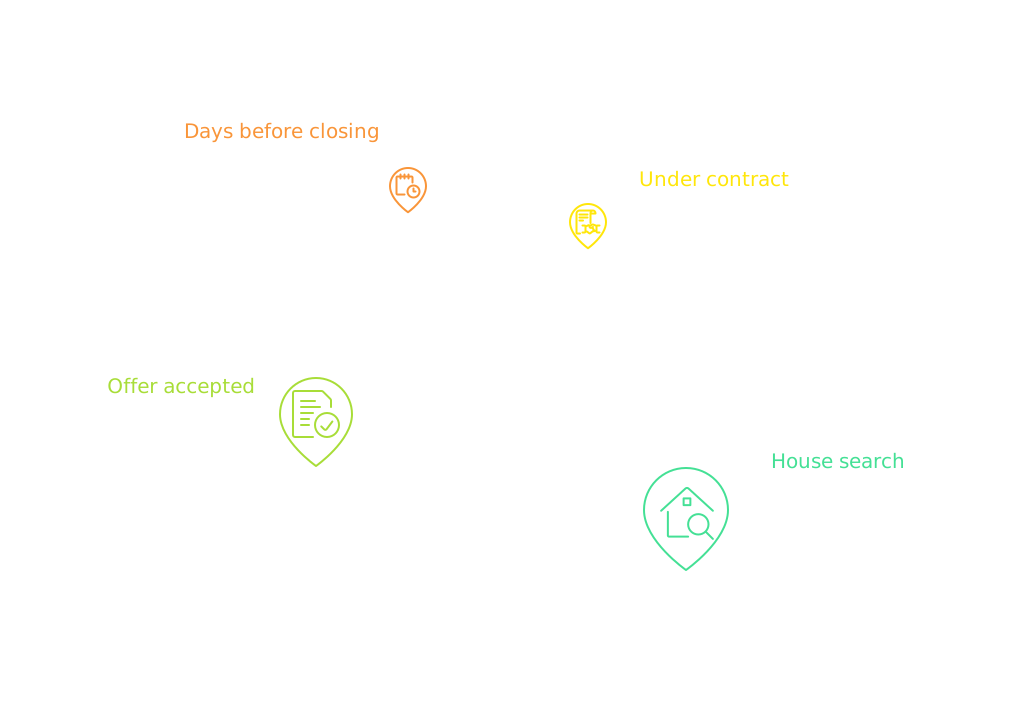
Early planning: create separation before optimization
When you are exploring neighborhoods, improving credit, or building the fund without preparing offers, the exact closing date is unknown. This is the stage for labeling the cash and comparing options.
The goal is not to predict the perfect month to buy. The goal is to know:
- The home-fund target
- The amount excluded for emergencies
- The normal checking floor
- The access time for each cash option
- The conditions that trigger a move back to checking
At this stage, a separate savings product, short-duration Treasury strategy, or automated cash-management workflow may be reasonable to evaluate. The assigned down payment still needs principal stability and liquidity. Long-term market investments introduce a different risk profile and should not be treated as cash simply because the home search is taking longer than expected.
Active search: shorten the path to the money
Once you are touring seriously, working with a lender, or preparing to make offers, access becomes more valuable.
You may need a seller deposit before the final closing date. You may also need to provide current asset statements or explain a large movement. Keep records of transfers and ask the lender what documentation is required for your loan.
This is a good stage to move the likely deposit and near-term purchase cash into an account with a clear, tested payment path. It is a poor stage to open a complex workflow only for a small incremental return.
Offer accepted: closing certainty wins
After an offer is accepted, treat the expected cash-to-close amount as unavailable for optimization.
The exact amount should come from the lender and Closing Disclosure, not from an online estimate. Federal mortgage rules generally require the borrower to receive the Closing Disclosure three business days before closing.
Use that period to:
- Compare the Closing Disclosure with the latest Loan Estimate
- Confirm the exact cash-to-close amount
- Confirm whether payment must be a wire, cashier's check, or another approved method
- Make sure transfer and withdrawal limits will not block the payment
- Verify instructions through a trusted contact
The CFPB mortgage closing checklist warns about last-minute changes to wire instructions and recommends confirming payment details through trusted phone numbers saved in advance.
At this point, the possible extra earnings from a few days are not the main decision.
After closing: rebuild the cash map
The old safe balance may no longer fit. Mortgage timing, homeowners insurance, property taxes, utilities, repairs, homeowners association dues, and moving expenses can change monthly cash flow.
Do not immediately optimize every dollar left after the wire. First let the new expenses settle and decide how much should remain accessible.
Only then recalculate:
Post-closing idle cash =
remaining liquid cash
- revised checking safe balance
- emergency reserve
- known repairs and setup costs
Write the trigger that changes your cash plan
A timeline is useful only if it causes an action. Before the search begins, decide which event will move the assigned home fund into its final closing-ready location.
The trigger could be:
- Preapproval is complete and you begin making offers.
- A seller accepts the offer.
- The lender provides the first Loan Estimate.
- The settlement agent confirms the closing date and payment process.
Choose the trigger based on how long your current cash option takes to settle, transfer, or sell. Then leave extra room for weekends, holidays, transfer reviews, and institution-specific limits.
This rule prevents a common mismatch. A buyer chooses a cash option while the purchase is distant, then keeps using the same setup after the purchase becomes immediate. The product did not change, but the job of the money did.
The trigger should apply to assigned purchase cash. It does not have to apply to every liquid dollar. A separate unassigned surplus can continue to follow a different rule if it is not part of cash to close or the post-closing reserve.
Use two balances, not one vague home-fund number
Track:
Closing-ready balance = current cash-to-close estimate + transaction buffer
Total home plan = closing-ready balance + moving costs + initial home costs
The closing-ready balance should become easier to access as the transaction advances. The broader home plan may remain divided by purpose.
This makes the trade-off visible. You are not asking whether an entire home fund belongs in checking. You are deciding which portion must be immediately payment-ready at the current stage.
How Much Cash to Protect Beyond the Down Payment
Protect enough to cover the full transaction and the first stage of homeownership. The down payment alone is not the right ceiling.
.svg)
Closing costs are separate
The CFPB notes that closing costs, excluding the down payment, typically range from 2% to 5% of the purchase price. That is a broad planning range, not a substitute for the Loan Estimate or Closing Disclosure.
For a $600,000 purchase, that range would be an illustrative $12,000 to $30,000. The actual cost may be outside the range depending on the loan, location, taxes, prepaid items, points, credits, and transaction details. Use the lender documents as the source of truth.
Keep an emergency cushion separate
The same CFPB worksheet recommends subtracting an emergency cushion before deciding the maximum amount available for closing and gives three to six months of expenses as a rule-of-thumb range.
That does not mean every household needs the same number. A dual-income household with stable expenses may make a different decision from a household with one income, variable commissions, dependents, medical needs, or a property likely to require repairs.
What matters is that the emergency reserve does not disappear into the down-payment line simply to reach a larger percentage.
Protect the first month after closing
The cash plan should also include known near-term costs:
The CFPB closing checklist recommends revising the budget after closing and accounting for homeowners association dues, property taxes, insurance, repairs, and emergency savings.
Is Checking the Safest Place for a Down Payment?
Checking can be an appropriate place for down-payment cash, especially when the money may be needed soon. But "safest" is incomplete unless you define the risk.
Checking reduces transaction friction
A checking account is designed for payments. It can make it easier to fund a cashier's check, send an approved wire, cover a seller deposit, and handle last-minute changes.
That convenience has value near closing. It also explains why a large home fund often ends up in checking even when the purchase is far away.
Bank deposits have FDIC rules
Eligible checking and savings deposits at an FDIC-insured bank are generally covered up to the standard limit of $250,000 per depositor, per insured bank, per ownership category.
Coverage depends on account ownership and what else you hold at the same bank. A buyer with a large cash balance should not assume that opening another account at the same bank automatically creates another limit. The FDIC Electronic Deposit Insurance Estimator can help evaluate a specific account structure.
Low yield is also a trade-off
The national rate for interest checking was 0.07% in July 2026. A specific account may pay more, less, or nothing.
If a home fund remains in checking for an extended period, the difference between the checking rate and another cash option can become meaningful. But an opportunity cost does not turn assigned house money into idle cash. It simply creates a reason to compare appropriate cash vehicles earlier in the timeline.
How Do Checking, Savings Products, Treasury Bills, and Rivo Compare?
Compare the options on access and workflow before comparing the quoted rate.
This table is not a ranking. The best option changes when the purchase moves from "someday" to "offer accepted."
Treasury bills have specific mechanics
The U.S. Treasury issues bills with maturities from 4 weeks to 52 weeks. Bills can be held to maturity or sold before maturity, and TreasuryDirect explains that the return at maturity is the difference between the purchase price and face value.
Selling before maturity can expose the holder to price changes. A bill with a maturity that fits a planning timeline can reduce reinvestment decisions, but it cannot predict when a buyer will find the right home.
Protection labels are not interchangeable
Checking and savings deposits may be covered by FDIC insurance when the institution and ownership structure qualify. Treasury bills are securities and are not FDIC-insured.
SIPC protection is also different. SIPC protects missing cash and securities when a member brokerage fails, subject to limits, but does not protect against a decline in a security's value.
Do not choose a home-fund location based on the word "protected" alone. Identify what is protected, by whom, under what event, and up to what limit.
The Opportunity Cost of Leaving a Down Payment in Checking
The opportunity cost is the difference between what the checking balance earns and what an appropriate alternative could earn over the period you actually hold the cash.
Use only the amount that is genuinely unassigned.
Worked example: $100,000 saved, $20,000 potentially unassigned
Assume this illustrative household allocation:
In this version, none of the balance is idle.
Now assume the household has $120,000 instead, with the same $100,000 plan. The remaining $20,000 may be evaluated separately.
For a simple 90-day comparison:
- Checking input: 0.07% national interest checking rate in July 2026
- Rivo gross annualized input: 3.65% as of Jul 1, 2026, before fees and subject to change
- Rivo fee input: 0.05% per month, about 0.60% per year before compounding
What Is a Cash Sweep Account?
The arithmetic uses simple annualized rates and assumes the balance and rates do not change. It ignores compounding, transaction timing, early-sale effects, and federal taxes. It is an illustration, not a forecast.
The result also needs context. About $147 may not justify adding transfer risk immediately before closing. It may matter if the $20,000 is truly surplus and the purchase remains distant. The decision belongs to the idle layer, not the full $120,000.
When Could Rivo Fit a Home-Buying Cash Plan?
Rivo can fit when a household has recurring cash above the home fund and checking safe balance, wants to keep the existing bank, and has enough time and access flexibility for short-duration Treasury bills.
Rivo is for the surplus layer
The workflow is:
1. Connect an existing checking account through Plaid.
2. Set a minimum checking balance.
3. Keep bills and known expenses inside that protected floor.
4. Move eligible cash above the floor into short-duration U.S. Treasury Bills through Jiko Securities.
5. Refill checking as scheduled bills approach.
6. Pause, stop, or disconnect when circumstances change.
For a home buyer, the safe balance should include more than routine bills. It should include any seller deposit expected soon, the current cash-to-close estimate, moving costs, initial home costs, and a comfort margin.
That usually makes the movable amount smaller than the visible checking surplus.
Rivo may fit when
- The purchase remains in early planning.
- Your home fund is fully assigned and you have additional unassigned cash.
- You already keep a meaningful recurring surplus in checking.
- The $15,000 daily available-funds withdrawal limit does not conflict with your access needs.
- You understand that the money is invested in securities, not held as a checking deposit.
- The 0.05% monthly management fee is worth the automated workflow.
Rivo may not fit when
- An offer is accepted or closing is near.
- The full balance may be needed for cash to close.
- You could need more than the daily withdrawal limit on short notice.
- You do not yet know the final closing or repair budget.
- You want all home funds to remain in an FDIC-insured deposit account.
- You are uncomfortable with the fixed-income risks of selling a Treasury bill before maturity.
The product should not create a new decision at the moment the transaction requires certainty. Pause automation or raise the safe balance before the money becomes assigned to an imminent purchase.
What Should You Do After an Offer Is Accepted?
After acceptance, switch from optimization mode to execution mode.
Build a closing-ready balance
Use the latest lender estimate to identify:
- Down payment
- Closing costs
- Prepaid items
- Initial escrow funding
- Credits and deposits already applied
- Exact estimated cash to close
- A separate buffer for changes
The CFPB Closing Disclosure explainer shows where these items appear and what to compare with the Loan Estimate.
Move the required amount into the approved payment account early enough to clear any transfer holds. Do not assume the largest possible transfer can happen instantly. Check the sending institution's limits and confirm the required payment method with the closing party.
Protect the payment instructions
The CFPB warns that closing funds are attractive targets for scams and that an email with last-minute changes to wire instructions may be fraudulent. Its mortgage closing checklist recommends confirming details using trusted primary phone numbers saved in advance.
Follow the settlement agent's verified process. Do not rely on a new phone number or reply directly to a surprise message that changes payment details.
Keep the paper trail
Retain statements, transfer confirmations, the Loan Estimate, the Closing Disclosure, and proof of payment. Ask the lender before making a large last-minute movement if you are unsure how it will affect documentation.
This is not about keeping money in checking forever. It is about making the final transaction auditable and predictable.
What Should You Do With Leftover Cash After Closing?
Wait until the purchase and first wave of expenses settle. Then give the remaining balance a new job.
Recalculate the safe balance
Your old checking floor was built around rent, old utilities, and the pre-purchase budget. The new floor may include:
- Mortgage and escrow timing
- Homeowners insurance
- Property taxes paid outside escrow
- Homeowners association dues
- Higher utility costs
- Maintenance and repair reserves
- Overlapping move-related card balances
Read What Is a Safe Balance? for the full floor-setting method.
Separate repairs from idle cash
Money for a roof, appliance, paint, furniture, or moving bill is assigned cash, even when it remains in checking for several weeks. Create a written list and time horizon before moving it.
After those costs and the emergency reserve are covered, any persistent surplus can be evaluated as idle cash. That is the point to compare manual transfers, savings products, Treasury bills, money market funds, or Rivo.
What Is the Practical Checklist Before Moving House Money?
Use this checklist before moving any part of a down-payment balance out of checking:
1. Write down the target purchase price and planned down payment.
2. Add a closing-cost estimate, then replace it with the Loan Estimate when available.
3. Subtract any seller deposit already paid only when the lender documents reflect it.
4. Set aside moving, setup, and known repair money.
5. Protect an emergency reserve outside the home-purchase budget.
6. Recalculate the checking safe balance for bills and autopay.
7. Identify the earliest realistic date the money could be needed.
8. Check transfer, withdrawal, settlement, and early-sale rules for the alternative.
9. Keep records of every material movement.
10. Stop optimizing the required amount once an offer is accepted.
11. Verify closing payment instructions through a trusted contact.
12. Recalculate the plan after closing before moving the leftover balance.
The checklist has one purpose: make sure you are solving the correct problem. The home fund needs certainty. Only the surplus needs optimization.
FAQ
Should I keep my entire down payment in checking?
You can, especially when you are actively making offers or closing soon. If the purchase remains months away, you can compare other principal-stable cash options, but keep the expected cash-to-close amount, near-term deposit, and transfer timeline protected.
Is money saved for a house considered idle cash?
Not by default. Down-payment money is assigned to a future purchase. It becomes potentially idle only when your total liquid cash exceeds the expected cash to close, moving costs, initial home expenses, emergency reserve, checking safe balance, and other known obligations.
Can I put a down payment in Treasury bills?
Treasury bills can be considered for cash that is not needed immediately and when the maturity or sale process fits the purchase timeline. The U.S. Treasury issues bills from 4 weeks to 52 weeks. Selling before maturity can produce a different result from holding to maturity, so do not treat every bill as identical to checking cash.
How soon before closing should the money be in checking?
There is no universal deadline because bank holds, transfer limits, lender requirements, and settlement instructions vary. Once an offer is accepted, ask the lender and settlement agent when funds must be cleared and which account and payment method are approved. The CFPB mortgage closing checklist recommends arranging the exact closing payment and reviewing the Closing Disclosure in advance.
Can I use Rivo for my down payment?
Rivo should be evaluated for cash above the amount needed for the purchase and your safe balance, not as a default home-fund account. The product uses short-duration U.S. Treasury Bills through Jiko Securities, charges a 0.05% monthly management fee, and has a $15,000 daily limit for withdrawals of available funds. Those mechanics may not fit cash needed soon.
What should I do with extra money left after closing?
First cover moving, setup, repairs, the revised checking floor, and the emergency reserve. After the new household cash flow settles, evaluate any recurring surplus as idle cash. Do not assume that money left after the closing wire is immediately available for optimization.
Related Rivo Reading

This article is educational and is not financial, investment, tax, accounting, or legal advice.
Yield rate reflects the 4-week T-bill rate when held to maturity. Rate does not include fees. Rates are subject to change. Minimum balance of $100 is required to earn the stated rate.
Rivo is a fintech company, not a bank. Banking services provided by Jiko Bank, a division of Mid-Central National Bank. Jiko Group, Inc. and its affiliates do not provide legal, tax, or accounting advice. You should consult your legal and/or tax advisors before making any financial decisions. This material is not intended as a recommendation, offer or solicitation for the purchase or sale of any security or investment strategy. See FINRA BrokerCheck, Jiko U.S. Treasuries Risk Disclosures and Jiko Securities Inc. Form CRS.
Investments in T-bills: Not FDIC Insured - No Bank Guarantee - May Lose Value. All U.S. treasury investments and investment advisory services provided by Jiko Securities, Inc., a registered broker-dealer, member FINRA and SIPC. Securities in your account are protected up to $500,000. For details, please see www.sipc.org.
Sources
- Consumer Financial Protection Bureau: Determine Your Down Payment
- Consumer Financial Protection Bureau: Loan Estimate Explainer
- Consumer Financial Protection Bureau: Closing Disclosure Explainer
- Consumer Financial Protection Bureau: Mortgage Closing Checklist
- Federal Reserve Bank of St. Louis: National Rate for Interest Checking
- U.S. Treasury: Treasury Bills
- FDIC: Deposit Insurance at a Glance
- SIPC: What SIPC Protects
- Rivo Rates
- Rivo Help Center

Shalu Yadav is Rivo's SEO/GEO Expert, bringing over 10 years of experience in making financial content discoverable across both classic search and generative AI platforms.
Follow on LinkedInGet Rivo Updates
Product news, money insights, and company updates.