Why Does Your Checking Account Look High After Payday? Assigned Cash, Autopay, and False Surplus Explained
Learn why checking looks high after payday, which dollars are already assigned to bills, and how to calculate the amount that is actually free or idle.
.png)
Your checking account looks high after payday because income arrives before many of the expenses it must cover. The full deposit becomes visible at once, while mortgage or rent, credit-card autopay, childcare, utilities, insurance, transfers, and everyday spending may leave over the rest of the pay cycle.
That creates a post-payday peak. The number is real, but the apparent surplus can be misleading. Some of the cash is available under the bank's rules while already assigned under your household plan.
The practical question is not, "How much is in checking today?" It is:
How much will still be unassigned after every obligation through the next protected point has cleared?
Answer that by starting with the bank balance, subtracting known bills and assigned reserves, projecting routine spending, and protecting a checking floor. Only the positive amount left after that sequence is a candidate for discretionary spending, saving, investing, or automated idle-cash management.
TL;DR
- Checking often looks unusually high after payday because one large deposit appears before a series of later withdrawals.
- The Consumer Financial Protection Bureau defines cash flow as the timing of money coming in and going out. A balance peak can therefore coexist with a tight week later in the same cycle.
- Available cash is not automatically unassigned cash. Rent or mortgage, issued card statements, scheduled automatic payments, outstanding checks, taxes, annual bills, transfers, and routine spending may still have to leave.
- Calculate a post-payday free-cash amount by subtracting unreflected obligations, spending through the cutoff, assigned reserves, and the protected checking floor.
- Use the next reliable deposit or the end of a complete bill cycle as the cutoff. Looking only at the next few days can hide later card autopay or bill clusters.
- A high balance is a genuine surplus only when the remainder survives the account's projected low point, known exceptions, and a reasonable stress case.
- Rivo becomes relevant after that recurring surplus is established. You keep your existing bank, choose the minimum checking threshold you want protected, and eligible idle cash can be managed around detected bills.
Quick Answer: Why Does Checking Look High Right After Payday?
Checking looks high right after payday because deposits and withdrawals are asynchronous. Payroll may become available in one transaction, while the expenses funded by that payroll clear on different dates.
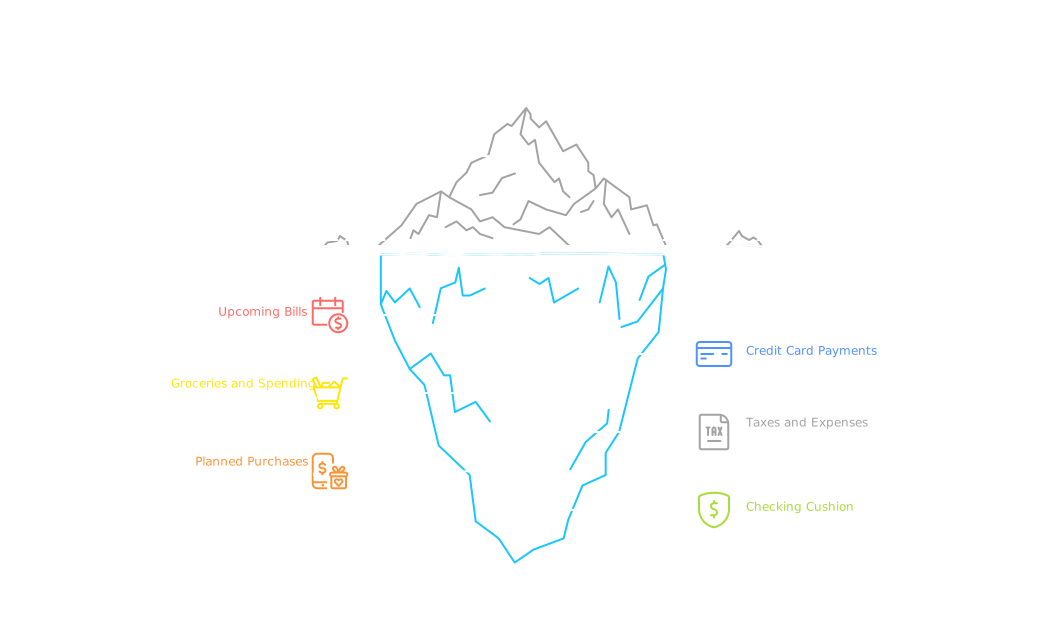
The high balance can contain several kinds of money:
Use this planning formula:
Post-payday free cash equals:
- bank-displayed balance
- minus obligations not already reflected
- minus routine spending through the cutoff
- minus assigned reserves
- minus the protected checking floor
If the result is negative, the account only appears full. If it is close to zero, the peak is mostly operating cash. If it is positive and repeats through representative cycles, the remainder may be a genuine surplus.
What Is the Post-Payday Balance Illusion?
The post-payday balance illusion is the tendency to treat the account's temporary high point as money with no future job.
It is an editorial name for a timing problem, not a bank term or diagnosis. The balance is not fake. The mistaken conclusion is that every visible dollar is newly available for an unrelated decision.
Income posts before its full purpose is visible
A paycheck can fund:
- housing,
- credit-card autopay,
- utilities,
- childcare,
- insurance,
- transportation,
- groceries,
- debt payments,
- transfers,
- taxes,
- and the next period's checking cushion.
Those uses may not appear next to the deposit. They become visible only as bills are issued, automatic debits are initiated, purchases settle, or transfers occur.
The bank sees account activity, not every household commitment
The banking app can show posted transactions, pending activity, holds, and funds availability according to the institution's rules. It does not automatically know that part of the balance is reserved for:
- a card statement due later,
- an annual insurance premium,
- an estimated tax payment,
- a contractor invoice,
- a tuition payment,
- an outstanding check,
- or a planned family transfer.
The displayed balance answers an account-processing question. The household still has to answer the assignment question.
The peak can feel like progress even when nothing changed
Suppose the same salary arrives on the same schedule and funds the same obligations. Checking rises after payday and falls as bills clear. The peak does not necessarily mean net worth increased or spending capacity expanded. It may simply mark the beginning of another operating cycle.
The better sign of progress is not a higher temporary peak. It is a stronger recurring remainder after the full cycle and assigned cash are accounted for.
Why Income Creates a Peak, Not a Smooth Balance
Household cash flow is lumpy. Income often arrives in a few deposits, while expenses follow several payment systems and calendars.
.svg)
The CFPB describes cash flow as the timing of income and expenses. When the timing is uneven, the checking balance naturally forms peaks and declines.
Pay schedules and bill schedules use different calendars
A bill may be due on a fixed calendar date. A paycheck may arrive weekly, every other week, twice monthly, monthly, or on an irregular schedule.
Those cadences do not automatically align. A paycheck can arrive just before a light bill window in one cycle and just before a heavy card payment in another. The same visible peak can therefore support different amounts of free cash.
Credit cards delay the checking impact
When a household uses credit cards for routine purchases, checking does not fall at the moment of each purchase. The card balance grows first. Checking falls later when a card payment clears.
That delay is one of the main reasons the account can look unusually full after payday. The money funding prior card purchases is still visible in checking, even though the household has already consumed the goods or services.
Automatic payments remove the payment action, not the cash requirement
Automatic payments make bills easier to administer, but checking still needs enough cash on the payment date. The CFPB advises consumers to monitor both account balances and upcoming automatic payments because insufficient funds can lead to bank or biller fees.
The correct interpretation is not that autopay is risky by itself. It is that autopay cash becomes assigned before the debit reaches checking.
Which Dollars Are Already Assigned After Payday
Assigned cash is money with a known purpose, amount, timing window, or protection role. It can remain in checking while being unavailable for an unrelated decision.
Bills that have not reached the bank
Start with every bill that must be paid before the next protected point:
- rent or mortgage,
- credit-card autopay,
- utilities,
- childcare or tuition,
- insurance,
- loan payments,
- subscriptions,
- taxes,
- and scheduled transfers.
The CFPB bill-calendar method records what each bill is for, the amount owed, and the due date. For checking management, also record the expected date the money should leave the account.
Purchases already made on a credit card
Card purchases are assigned spending even while the checking balance remains unchanged.
Once a statement is issued, the planned payment amount is a concrete obligation. Before the statement closes, current card activity and known purchases can provide a planning estimate. Keep the issued statement and the developing statement cycle separate so the same purchase is not counted twice.
Routine spending before the cutoff
The balance must also fund ordinary life between payday and the next reliable deposit or bill-cycle endpoint.
Include a realistic allowance for:
- groceries,
- transportation,
- pharmacy and healthcare,
- debit-card purchases,
- cash withdrawals,
- peer-to-peer payments,
- and other expected checking outflows.
A household that puts most daily spending on credit cards should avoid subtracting those purchases immediately and then subtracting the same card payment again. Forecast the actual checking debit while separately monitoring the developing card obligation.
Outstanding checks and scheduled transfers
A check becomes assigned when it is issued, not when the recipient finally deposits it.
A transfer becomes assigned when the household commits to it, even if checking has not yet lost the funds. This includes transfers to savings, brokerage accounts, another bank, a family member, or a shared household account.
Taxes, annual expenses, and planned purchases
Cash for taxes, insurance renewals, tuition, travel, repairs, a home project, or another dated purchase may sit in checking for convenience. Its location does not change its purpose.
Label these amounts separately. Otherwise, a large paycheck landing before the expense can make the same dollars look like a new surplus.
The protected checking floor
The protected floor is the minimum amount the household wants to preserve after modeled obligations. It absorbs ordinary forecast error, variable spending, transaction timing, and personal comfort needs.
The floor is not the same as the bill total. It is the balance that should remain after the bills and spending in the planning window are accounted for.
Worked Example: How a Full-Looking Account Becomes a Small Surplus
The following scenario is illustrative. Every dollar amount, bill, date, and reserve is a hypothetical planning assumption, not a recommendation or claim about a typical household.
Assume an account shows an illustrative $28,400 after payroll becomes available.
The account looked like it held an illustrative $28,400 of capacity. Under the stated assumptions, only $2,500 remains unassigned.
That $2,500 is still provisional. The household should test whether:
- every major bill was included,
- the card payment is current,
- routine spending is realistic,
- the annual reserve is complete,
- income timing is dependable,
- and the result survives an unfavorable but plausible cycle.
What happens if the card payment is larger?
Assume the illustrative card statement is $1,300 higher because of travel. The provisional remainder falls from $2,500 to $1,200.
What happens if payroll is delayed?
If the next deposit becomes available later than expected, the planning window must extend through the additional days. Add the bills and routine spending that occur before the delayed deposit.
What happens if the annual bill is forgotten?
Removing the illustrative $2,200 insurance reserve would make the free-cash result appear to be $4,700. That does not create more money. It only hides an assigned use.
The calculation is useful because it makes the interpretation auditable. Each layer can be confirmed, updated, or challenged.
Current Balance, Available Balance, and Post-Payday Free Cash
These numbers are related but not interchangeable.
A bank balance is a snapshot
The displayed number is essential for reconciliation. It is not a full cash-flow forecast.
A future card debit may be absent. An outstanding check may still be unpresented. A tax payment may exist only in the household's calendar. A recent deposit may also be subject to institution-specific availability rules.
Available does not mean unassigned
An available balance can be sufficient to authorize a purchase today while leaving too little for a scheduled debit later.
Use the separate guide on whether an available balance is safe to spend for posting, authorization, pending-transaction, and overdraft mechanics. For the payday question, the important boundary is simpler: subtract all known jobs from the visible cash before interpreting the peak.
Post-payday free cash is a household planning measure
The bank does not calculate this number for you. It depends on the cutoff, bill calendar, spending assumptions, assigned reserves, and protected floor.
That makes it more subjective than a bank balance, but more useful for the decision at hand.
How Should You Choose the Cutoff?
The cutoff is the point through which the post-payday balance must fund the account before you classify any amount as free.
Use the next reliable deposit for a pay-cycle decision
If the question is, "What can I safely spend before my next paycheck?", project through the date when the next dependable deposit becomes available.
Include every payment and normal spending event before that point.
Use a complete bill cycle for an idle-cash decision
If the question is, "Is some of this cash repeatedly idle?", the next paycheck may be too short a window. A later mortgage, card payment, tax debit, or annual bill can still consume the apparent surplus.
Use a complete representative pay-and-bill cycle, then add known exceptions outside the cycle.
Use the later date when timing is uncertain
When a deposit or payment can occur within a window, use the conservative availability or debit date in the base case. Keep the more favorable timing as a separate scenario.
Do not rely on the earliest date observed once if the account needs the money to arrive before a large debit.
Extend the window after a change
Rebuild the cutoff after:
- a job or payroll change,
- a new card,
- a mortgage or rent change,
- a childcare or tuition change,
- a move,
- a partner joining or leaving the household cash flow,
- a new automatic transfer,
- or a material change in routine spending.
The old post-payday rule may no longer match the new sequence.
How Different Pay Schedules Change the Illusion
The payday peak appears differently across pay patterns, but the same assignment rule applies.
Weekly and frequent pay
Frequent deposits can reduce long gaps, but they can also blur which paycheck funds which obligation. A large monthly debit may require cash accumulated across several paydays.
Do not classify the latest deposit in isolation. Check whether prior deposits were already reserved for the same large bill.
Every-other-week pay
Fixed bill dates and moving pay dates can create different-looking cycles. One payday may land just before housing. Another may land during a lighter window.
The lighter cycle is not automatically surplus if the account needs to bridge the next heavy window.
Twice-monthly pay
Stable pay dates simplify the calendar, but the two halves of the month can carry very different obligations. One may include housing and card autopay; the other may include fewer fixed bills but more routine spending.
Calculate the low point for each half rather than applying the same free-cash assumption to both deposits.
Monthly and irregular pay
A large monthly or irregular deposit can produce the strongest illusion because the balance rises sharply. That deposit may need to fund a longer period, uncertain income timing, taxes, or business-related transfers.
For variable income, separate confirmed cash from expected cash. Do not use a possible future deposit to justify spending from today's peak.
Why Does Credit-Card Autopay Make Payday Cash Look Free?
Credit cards move the economic purchase and the checking withdrawal onto different timelines.
The money was spent before checking moved
If groceries, travel, medical costs, or household purchases went on a card, the checking balance can remain high while the obligation grows elsewhere.
Payday then adds cash to an account that has not yet absorbed the prior card cycle. Treating the full peak as new money ignores that delay.
Use the issued statement when available
Confirm the selected autopay setting and reserve the amount expected to leave checking.
The CFPB explains that automatic payments can be fixed or variable. A card or utility payment can therefore have a predictable date but a changing amount.
Do not double count the same spending
Choose a consistent checking model:
- If card purchases are represented through the future card payment, do not also subtract each purchase as an immediate checking outflow.
- If a payment has already reduced the available balance, do not subtract it again as unreflected.
- If part of a card balance belongs to a later statement, separate it from the issued payment due in the current window.
The objective is one complete subtraction for each obligation.
Why Do Annual Bills and Sinking Funds Distort the Peak?
An ordinary pay cycle can look stronger when an irregular obligation is not included.
Examples include:
- property tax,
- insurance renewals,
- tuition,
- professional fees,
- memberships,
- vehicle registration,
- planned travel,
- home repairs,
- medical payments,
- and estimated taxes.
Infrequent does not mean unexpected
An annual bill can be predictable even though it does not appear in the current month's transaction history.
If the household has been accumulating cash for it, that reserve is assigned. If the household has not been accumulating cash, the upcoming bill still belongs in the forecast.
A sinking fund can sit inside checking
A sinking fund is a purpose, not necessarily a separate account. The money may be physically mixed with operating cash while remaining logically reserved.
Maintain an assigned-cash ledger with:
All amounts in this table are illustrative assumptions.
Quiet months should not reset the rule
If the account looks high only because the next annual charge sits outside the current view, the surplus is temporary.
Use a representative cycle plus an exception calendar. That keeps a quiet month from becoming the basis for an aggressive spending or transfer decision.
Mistakes That Follow a High Post-Payday Balance
The risk is not the high balance itself. It is the action taken from an incomplete interpretation.
Overspending from a temporary peak
A large deposit can loosen spending decisions because the account appears comfortably funded. The effect is strongest when card purchases delay the checking impact further.
The control is not a general ban on discretionary spending. It is a defined free-cash amount that already protects upcoming obligations.
Moving cash before the cycle low
Moving money out of checking can be reasonable. The error is basing the move on the peak instead of the lowest projected balance.
If the household repeatedly transfers money back from savings to cover bills, the original transfer rule likely ignored timing, variable card payments, or assigned cash.
Keeping too much forever
The opposite mistake is treating every dollar as potentially needed. This protects against uncertainty but can leave a stable recurring surplus unclassified.
The answer is not to guess lower. Track complete cycles, improve the bill calendar, measure forecast error, and identify the amount that repeatedly survives.
Calculating the Amount That's Actually Free
Use a reconciliation, assignment, forecast, and protection sequence.
Start with the current bank display
Record:
- current or ledger balance,
- available balance,
- pending debits,
- pending deposits,
- holds,
- and recently posted activity.
Confirm which pending items the available balance already reflects.
Subtract obligations not already reflected
Add every known bill and transfer through the cutoff. Use current statements or biller records instead of an old average when available.
Add routine spending
Estimate only the spending that should affect checking before the cutoff. Keep credit-card purchases and their checking payment on a consistent timeline.
Subtract assigned reserves
Remove taxes, annual bills, planned purchases, emergency cash intentionally kept in checking, and other earmarked amounts not already included.
Protect the checking floor
Preserve the minimum amount chosen for ordinary variability, timing uncertainty, and comfort.
Test the result through the low point
The result is not validated because it is positive today. Build a dated running balance and confirm that the floor survives every event through the cutoff.
Candidate free cash equals:
- minimum projected balance
- minus the protected checking floor
- minus assigned reserves outside the forecast
If that calculation is positive, run a stress case before acting.
Stress-Testing the Post-Payday Surplus
A stress test asks whether the result survives a plausible unfavorable change without pretending to predict every emergency.
Stress the inputs that actually vary
Do not add random pessimism to every line. Use account history and known upcoming changes.
If card spending is stable but payroll timing varies, stress payroll. If income is stable but utilities and travel vary, stress those outflows.
Keep emergencies separate
A routine cash-flow stress case is not a replacement for an emergency reserve. A job loss, major medical event, or large repair belongs in a broader liquidity plan.
This article is about interpreting the payday peak, not determining the correct emergency-fund size.
Review forecast error
After the cycle closes, compare the projected low point with the actual low point. Identify whether the difference came from:
- a missing bill,
- a timing shift,
- a higher amount,
- an income delay,
- an untracked transfer,
- or routine spending error.
Use that evidence to improve the next calculation.
When a High Post-Payday Balance Is a Genuine Surplus
A high balance becomes decision-ready when the cash is not merely visible but durable.
Look for all of these conditions:
- The complete pay-and-bill cycle is mapped.
- Issued card statements and developing card obligations are recognized.
- Routine spending through the cutoff is included.
- Taxes, annual bills, and planned purchases are assigned.
- The protected checking floor survives the projected low point.
- A realistic stress case does not create a shortfall.
- The positive remainder appears across representative cycles.
Temporary surplus
A temporary surplus may come from:
- payroll arriving before housing,
- a card payment clearing later than usual,
- a bonus or reimbursement,
- a quiet spending cycle,
- a delayed annual bill,
- or two deposits landing close together.
Temporary does not mean useless. It means the money needs a specific short-term plan instead of being treated as a recurring baseline.
Recurring surplus
A recurring surplus remains after normal obligations and known exceptions across representative cycles.
That amount can support a separate decision:
- leave it in checking,
- move it to a deposit account,
- use it for a planned goal,
- invest it according to an appropriate plan,
- or use automated cash management.
The destination decision comes after the surplus is established.
What to Do on Payday
Use a short operating review before making a large discretionary purchase or transfer.
Reconcile
- Confirm the deposit is available.
- Review pending transactions.
- Check whether any large debit just posted.
- Identify outstanding checks.
Assign
- Reserve mortgage or rent.
- Reserve issued card payments.
- Reserve fixed and variable automatic payments.
- Add routine spending through the cutoff.
- Label taxes and annual obligations.
- Preserve the checking floor.
Forecast
- Put remaining events in date order.
- Calculate the running balance.
- Mark the projected low point.
- Test a relevant unfavorable case.
Decide
The process can be manual, spreadsheet-based, or automated. The important part is that the high balance is interpreted through its future jobs.
How a Bill Calendar Prevents the Payday Illusion
A bill calendar makes assigned cash visible before it leaves checking.
At minimum, record:
- bill or income event,
- expected amount,
- due date,
- scheduled payment date,
- expected checking impact date,
- payment method,
- source account,
- amount confidence,
- and status.
The CFPB's bill-calendar guidance recommends collecting bills, recording the amount and due date, and reviewing the calendar weekly. A checking-focused version adds the expected account date so the household can see when the peak should decline.
Add income to the same calendar
A bill-only calendar shows obligations but not whether checking can fund their sequence. Include paycheck availability dates and dependable transfers into checking.
Connect the calendar to a running balance
The calendar identifies events. A forecast turns them into a projected balance path.
Use How to Build a Bill Calendar for Your Checking Account for the source schedule and How to Forecast Your Checking Account Balance for the running-balance method.
Reconcile expected and posted activity
Mark each event as expected, scheduled, pending, or posted. Update variable amounts when bills or statements are issued.
The calendar becomes more reliable when it records what actually happened, not only what was planned.
Where Rivo Fits Once the Surplus Is Established
Rivo is relevant when the problem is no longer identifying a shortfall. It is managing a recurring idle layer without repeatedly calculating transfers and return dates by hand.
Rivo works with an existing checking account. The user chooses a minimum checking threshold, Rivo analyzes connected cash flow, and eligible idle cash can move into short-duration U.S. Treasury Bills through Jiko Securities. As detected bills and transfers approach, Rivo plans to move cash back into checking.
The Rivo product details support the existing-bank connection, minimum threshold, bill-aware money movement, notifications, and user controls.
Rivo does not make assigned cash idle
Money needed for bills, routine spending, taxes, annual obligations, or the checking floor should not become part of the idle layer merely because automation is available.
The threshold should start from a conservative understanding of the account's low point.
Rivo does not replace household knowledge
The system can analyze connected activity, but a household may know about a future obligation that has not appeared in transaction history.
Before a large unusual payment, review the threshold and use the available pause or control settings when appropriate.
The product solves an operating problem
A disciplined household can maintain a bill calendar, forecast checking, move surplus cash, and schedule refills manually.
Rivo is designed for people who have a recurring surplus but do not want the ongoing monitoring and transfer workflow. It is not a fix for an unfunded bill cycle or uncertain spending plan.
When to Leave the Post-Payday Balance Alone
Do not move or spend the apparent surplus when:
- the next card payment is unknown,
- a major bill has not been added,
- income timing is uncertain,
- an annual obligation is approaching,
- the account's low point has not been measured,
- a transfer back would not be available when needed,
- or the household is relying on a possible future deposit.
Also keep more cash immediately accessible when your personal needs, account rules, or risk tolerance require it.
A negative budget is not an idle-cash problem
If recurring expenses exceed reliable income, the payday peak will eventually decline without leaving a durable remainder.
The priority is affordability and cash-flow stability, not yield optimization.
An unknown floor is not a product-selection problem
If you do not know how much checking needs to protect, choosing a destination for the apparent surplus is premature.
First build the calendar, forecast the low point, and define the floor.
A one-time deposit needs a one-time plan
A bonus, refund, reimbursement, asset sale, or family transfer may create a large peak. Determine whether the money is assigned to taxes, a goal, debt, spending, or investment before treating it as recurring idle cash.
Final Recommendation
When checking looks high after payday, do not treat the peak as a spending limit or an idle-cash estimate.
Start with the bank-displayed balance. Reconcile pending activity. Subtract mortgage or rent, credit-card autopay, other bills, routine spending, outstanding checks, scheduled transfers, taxes, annual obligations, and planned purchases. Protect the checking floor. Then project the account through the next reliable deposit or complete bill cycle.
The decision sequence is:
- Reconcile the snapshot. Confirm what the bank balance includes.
- Assign the cash. Give every known bill, reserve, and routine expense a place.
- Forecast the sequence. Find the lowest projected balance, not the highest visible balance.
- Protect the floor. Preserve ordinary variability and timing uncertainty.
- Stress the result. Test the inputs that actually change.
- Classify the remainder. Distinguish temporary cash from recurring surplus.
- Choose the destination. Spend, save, invest, keep, or automate only after the amount is established.
Rivo can be useful when a recurring unassigned amount remains and the household wants that cash managed around bills without switching banks or maintaining manual transfers. It should operate above a conservative floor, not turn the full payday peak into an investment decision.
FAQ
Why does my checking account look rich on payday and low later?
Income may arrive in one large deposit while housing, card autopay, utilities, childcare, transfers, and routine spending leave over the rest of the cycle. The high point and low point describe different moments in the same cash-flow sequence.
Is my whole paycheck available to spend when it lands?
Not if part of it must fund bills, card payments, routine spending, assigned reserves, or the checking floor. Calculate the amount left after those jobs through a defined cutoff.
Should I move money to savings immediately after payday?
Only after checking can fund the projected low point and known exceptions. A fixed payday transfer can be too large when card payments, annual bills, income timing, or routine spending change.
Why does credit-card autopay make checking fall after payday?
Card purchases occur before the checking withdrawal. The checking balance can remain high while the card obligation grows, then fall when the statement payment clears. Reserve the expected payment before calling the post-payday balance surplus.
How do I know whether the extra balance is really idle?
Map a complete pay-and-bill cycle, subtract assigned cash, protect the checking floor, and run a relevant stress case. The amount is a stronger idle-cash candidate when a positive remainder survives representative cycles.
Can Rivo manage cash that is temporarily high after payday?
Rivo is designed to identify eligible idle cash above a user-set minimum threshold and plan movement around detected bills. A temporary peak is not automatically idle, so keep the threshold conservative and account for unusual future obligations the connected history may not yet show.
Related Rivo Reading
- To understand the low point at the other end of the cycle, read Why Does Checking Run Low Before Payday?.
- To diagnose the full rise-and-fall pattern, read Why Does My Checking Account Balance Fluctuate So Much?.
- To separate bank availability from household spendability, read Is Your Available Balance Safe to Spend?.
- To calculate the dated low point, read How to Forecast Your Checking Account Balance.
- To map paydays, bills, and expected debits, read How to Build a Bill Calendar for Your Checking Account.

This article is educational and is not financial, investment, tax, accounting, or legal advice.
Yield rate reflects the 4-week T-bill rate when held to maturity. Rate does not include fees. Rates are subject to change. Minimum balance of $100 is required to earn the stated rate.
Rivo is a fintech company, not a bank. Banking services provided by Jiko Bank, a division of Mid-Central National Bank. Jiko Group, Inc. and its affiliates do not provide legal, tax, or accounting advice. You should consult your legal and/or tax advisors before making any financial decisions. This material is not intended as a recommendation, offer or solicitation for the purchase or sale of any security or investment strategy. See FINRA BrokerCheck, Jiko U.S. Treasuries Risk Disclosures and Jiko Securities Inc. Form CRS.
Investments in T-bills: Not FDIC Insured - No Bank Guarantee - May Lose Value. All U.S. treasury investments and investment advisory services provided by Jiko Securities, Inc., a registered broker-dealer, member FINRA and SIPC. Securities in your account are protected up to $500,000. For details, please see www.sipc.org.
Treasury Bills are securities and carry fixed-income risks. Selling Treasury Bills before maturity may affect the realized result. Review the Jiko U.S. Treasuries Risk Disclosure.
Sources
- Consumer Financial Protection Bureau: An Essential Guide to Building an Emergency Fund
- Consumer Financial Protection Bureau: How Automatic Payments From a Bank Account Work
- Consumer Financial Protection Bureau: Bill Calendar
- Rivo Homepage
- Rivo Product Details and Controls
- Jiko Securities: U.S. Treasuries Risk Disclosure

Get Rivo Updates
Product news, money insights, and company updates.